Quotulatiousness

March 7, 2019

JWR should have reconsidered as many times as necessary to come to the “correct” decision, apparently

Filed under: Cancon, Law, Politics — Tags: , , , — Nicholas @ 05:00

Colby Cosh asks who is the one with memory issues — former Trudeau puppet-master Gerald Butts who resigned unexpectedly (but not at all for reasons related to the SNC-Lavalin affair, we’re told) or the minister who was relegated to the least important portfolio (in the view of the Trudeau government) in a totally unrelated cabinet shuffle after failing to fold under pressure?

On Wednesday, in testifying about the SNC-Lavalin scandal that has punched a hole in Justin Trudeau’s cabinet, Gerald Butts left an impression of sincerity, or at least earnestness, and professed the best of intentions as Trudeau’s exiled principal secretary. Do you suppose it will help? The Liberal government’s SNC situation clearly has a traplike nature. Until the criminal charges against SNC-Lavalin are heard in a trial and resolved, or until they are abandoned, the thing will remain news, and Liberals will suffer.

The government’s line is that it was inappropriate for former attorney general Jody Wilson-Raybould to make a final commitment to leaving her Director of Public Prosecutions alone and to living with the decision not to enter a plea-bargaining process with SNC-Lavalin. Her successor in the office, David Lametti, will not make such a commitment now. We will never get the reassurance of hearing that the matter is closed. The professed view of cabinet, what’s left of it, is that it would be wrong to close it.

The government has tried to explain its belabouring of Wilson-Raybould as being perfectly appropriate. She was supposed to verrrry carefully consider the fate of 9,000 SNC-Lavalin jobs and a head office in Quebec, and then consider it again, and then consider it again. Butts tells us that they weren’t looking for a particular politically convenient answer, mind you.

They just stayed after her to keep reconsidering the answer she kept giving, explicitly or implicitly. They reassured her at every turn that the decision was hers. And then they got rid of her and made it someone else’s.

[…]

In theory, if you wanted to get rid of a truculent justice minister who won’t put a thumb on the scales of justice, offering her a job you know she will never, ever take seems like a good way to set about doing that. But this is just an unhappy coincidence, and we are not to draw inferences from it. I would conclude that “The Liberal government undoubtedly meant well,” but saying this sarcastically has, I am afraid, already become a Canadian cliché.

March 5, 2019

It’s almost as if we elected the actor, but really wanted the character he’d played on TV instead

Filed under: Cancon, Media, Politics — Tags: , , , , — Nicholas @ 03:00

In Maclean’s, Paul Wells calls Justin Trudeau an imposter:

… the problem for Trudeau — who came to power promising a new era of transparency — is that this phoniness is a trait he shows all too often.

In 2016, when the Globe and Mail reported that the Prime Minister had attended a Vancouver fundraiser attended by Chinese billionaires — one of whom promptly donated money to the private Montreal foundation named for Trudeau’s father — the Liberal Party of Canada said no government business is discussed at such events. Trudeau later admitted they asked about policy and he talked about jobs.

Legalizing cannabis is one of the signature achievements of this government. But Trudeau has never been able to say he did it so affluent consumers could more readily get high. Instead, he had everyone in his government swear the goal was to drain the black market and keep the stuff out of the hands of teenagers. Neither goal has come anywhere close to being reached. Judged by the standards of a bake-off for the children of privilege, legalization has been a great success. Judged by the standards the Prime Minister claims, it’s a mess. The operating assumption seems to be that we’re simply supposed to read between the lines — that we’ll understand that when Trudeau speaks he is not to be taken seriously.

[…]

I could keep picking examples of Trudeau acting one way and talking another (climate change, Indigenous reconciliation) until the cows come home. But at some point you’d say, with reason, that this is not exactly innovative behaviour for an elected politician. But what’s so damaging about the SNC-Lavalin affair is that, in private, there’s no evidence Trudeau governs as the future-looking sophisticate he plays on TV.

[…]

There’s a stack of assumptions behind that strategy as long as your arm: that SNC does work so good it could never be replaced, that a trial would wreck it, that a mere judge couldn’t possibly weigh the company’s social contribution in determining its legal liability. And the biggest assumption of them all is that all of this is so obvious, none of it needed explaining in two years of feverish PMO activity. Not to the attorney general — she got earfuls of explanation, delivered in shifts working overtime, for months after she made what Trudeau felt was the wrong decision. And not to you and me. Trudeau never thought you and I deserved to know why he was trying to keep SNC out of a trial court. This makes a mockery of a simple idea: the consent of the governed.

It turns out that behind the curtain, the wizard from the woke future of politics was indulging the oldest of old-fashioned industrial policy. Navdeep Bains, the so-called innovation minister, might as well legally change his name to C.D. Howe for all the innovation going on here.

As for Wilson-Raybould’s diversity of background and perspective, it turned out to be inconvenient. She didn’t buy into a cozy meeting of minds along the Toronto-to-Montreal corridor. And the meeting of minds was what really mattered. Because it’s 2019.

The day got worse for Trudeau, as another cabinet minister resigned rather than stick around for the deck chairs to start floating away:

March 3, 2019

We need more data on the SNC-Lavalin affair

Filed under: Cancon, Government, Media, Politics — Tags: , , , — Nicholas @ 03:00

Andrew Coyne insists the whole story must come out before we call in the RCMP:

Where do we go from here? It is important not to get ahead of ourselves. Opposition calls for the prime minister to resign over the SNC-Lavalin affair, or for the RCMP to investigate, are premature at this point. However compelling Wednesday’s testimony before the Commons justice committee by the former minister of justice and attorney general, Jody Wilson-Raybould, may have been, all of the facts are not in.

It is still open to the government to provide those missing facts, and still possible to hope they may prove exculpatory. That they have done their level best so far to provide none, alas, strongly suggests the contrary. Even in response to Wilson-Raybould’s detailed, documented account of the many and sustained ways in which he and officials in his government attempted to interfere with a criminal prosecution, to the point not only of threatening her job but, it would seem, of carrying out the threat, the best that Justin Trudeau could offer was that he “disagreed” with it.

The prime minister prevented Wilson-Raybould from speaking for as long as he dared, and is still insisting she may not discuss potentially significant conversations with him and his cabinet after she was shuffled out of Justice. The prime minister’s former principal secretary, Gerry Butts, has agreed to testify before the committee, but no current employee of the prime minister’s office has yet been called, nor have any of the others Wilson-Raybould identified as having pressured her to go easy on SNC-Lavalin, save the clerk of the privy council, Michael Wernick.

Demands for a public inquiry, then, or at least for all of the relevant witnesses to be called before the committee, are closer to the mark. Whatever the prime minister and his people may or may not be guilty of, they cannot be allowed to get away with this blatant stonewalling. So, too, the Conservative and NDP leaders were justified in calling for Parliament to continue to sit next week, rather than take the next two weeks off. Indeed, they would be within their rights to hold up all parliamentary business, including the budget, until they get satisfaction. It is that important.

March 2, 2019

Mark Steyn – Trudeaupia on the Waterfront

Filed under: Business, Cancon, Government, Law, Politics — Tags: , , , — Nicholas @ 03:00

Mark Steyn on the “nothing to see here, let’s just move on” SNC-Lavalin affair:

Speaking as someone who gets sued a lot, I account Jody Wilson-Raybould as a killer exemplar of what every litigant dreads the other side coming up with – a credible witness. In a riveting performance, the former Attorney General of Canada laid out calmly and without overheated rhetorical flourish a campaign by the most powerful figures in the government to get their cronies at SNC-Lavalin off the hook of a criminal prosecution for bribing (Libyan) government officials. Ms Wilson-Raybould identified just shy of a dozen Liberal Party bruisers who leaned on her, including the most senior chaps in the Prime Minister’s Office, the Privy Council Office and the Ministry of Finance – and ultimately the PM himself.

But, in a competitive field, perhaps the behavior of Michael Wernick, Clerk of the Privy Council, a career civil servant and the highest-ranking in Canada, is the most outrageous. In a three-man meeting – the Clerk, the Attorney General and the PM – Mr Wernick acted not as an impartial public servant but as a gung-ho party hack demanding political interference in a criminal prosecution in order to help Justin’s pals beat the rap:

    The PM again cited potential loss of jobs and SNC moving. Then to my surprise – the Clerk started to make the case for the need to have a DPA – he said “there is a board meeting on Thursday (Sept 20) with stock holders” … “they will likely be moving to London if this happens”… “and there is an election in Quebec soon”…

    At that point the PM jumped in stressing that there is an election in Quebec and that “and I am an MP in Quebec – the member for Papineau”.

    I was quite taken aback. My response – and I remember this vividly – was to ask the PM a direct question while looking him in the eye – I asked: “Are you politically interfering with my role / my decision as the AG? I would strongly advise against it.” The Prime Minister said “No, No, No – we just need to find a solution.”

When Ms Wilson-Raybould held firm against Justin’s pressure to lean on the Crown’s prosecution of a serious criminal case, he arranged a Cabinet reshuffle to remove her as Attorney General.

This is a protection racket: Underneath the LGBTQWERTY Ramadan socks and the Bollywood bridesmaid outfits for his passage through India, Justin Trudeau turns out to be Lee J Cobb in On the Waterfront. My old friend Paul Wells calls this a “moral catastrophe” for Justin. Not quite: He is who he is. It’s a moral catastrophe for Canada if those who dote on the Dauphin make the rest of us go along with it.

February 28, 2019

The federal Liberals did get one important thing right … no, not marijuana legalization

Filed under: Cancon, Economics, Government — Tags: , , , — Nicholas @ 03:00

Justin Trudeau’s Liberals haven’t had a lot of successes in their term in office, but there is one achievement they can legitimately take some credit for:

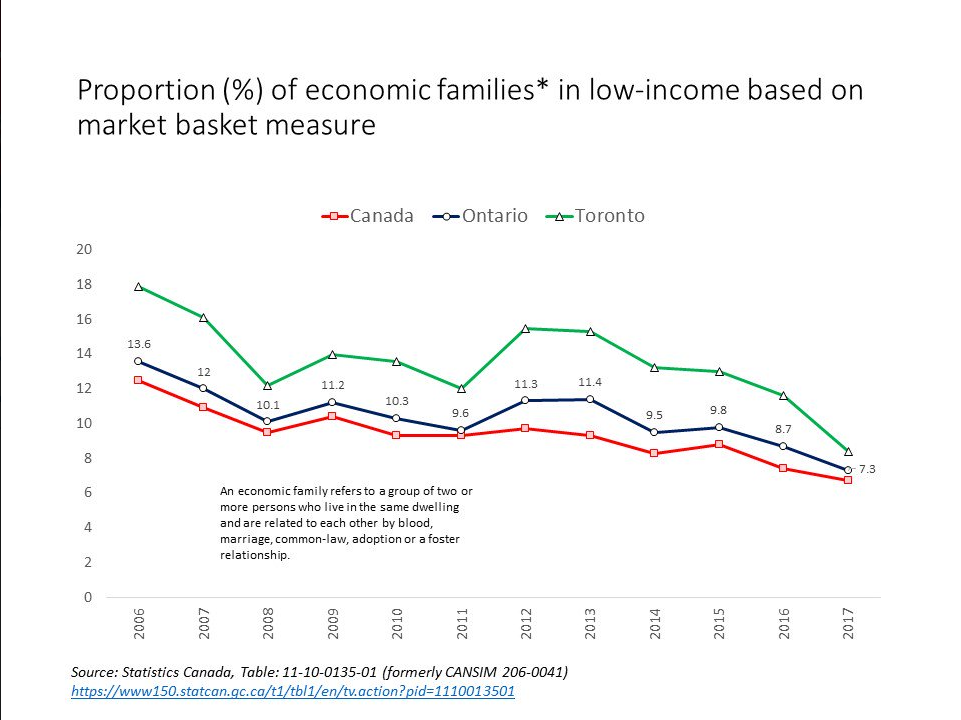
Pssst. Can I let you in on a little secret? Keep it under your hat, but — the poverty rate has fallen again. In fact, it’s at a new all-time low. Statistics Canada reports that the percentage of Canadians falling below the official poverty line in 2017 fell to 9.5 per cent, down from 15.6 per cent in 2006. That still leaves much room for improvement. But this is remarkable progress.

Of course, the official measure of poverty, known as the Market Basket Measure, has only been around for a few years. But an earlier, unofficial measure, known as the Low Income Cut Off, goes back much further. It, too, is at an all-time low, after a steady, two decades-long decline. Indeed, at 7.8 per cent, it’s barely half what it was in 1996.

Andrew Coyne continues:

The sources of this amazing success story are not hard to find — and no, it is not quite as simple a matter as replacing the Conservatives with the Liberals. The trendlines on both low and median incomes, I repeat, go back to the mid-1990s: when the economy, after the long recession, began to grow again.

It turns out — who knew — that poverty tends to fall, and incomes to rise, in periods of economic growth, such as we have enjoyed, almost without interruption, since then. Even the 2009 recession, a relatively mild one in Canada, barely made a dent in either trend.

Still, the Liberals deserve some credit for the continuing decline in poverty since they were elected. If the overall rate has dropped appreciably, it has fallen even more among children — especially welcome, given the lasting effects poverty can have on life chances. At nine per cent, it is down a third from just two years ago.

That’s almost certainly due, at least in part, to the Liberals’ first and most significant policy reform: the rationalization of several existing child benefits and credits into a single income-tested Canada Child Benefit, with increased amounts going to low-income families. It turns out — who knew — that if you give people more money, they are less likely to be in poverty.

February 26, 2019

“The SNC-Lavalin affair is the quintessential Canadian controversy”

Filed under: Business, Cancon, Government, Law, Politics — Tags: , , , , — Nicholas @ 03:00

Conrad Black on the ongoing SNC-Lavalin scandal:

The SNC-Lavalin affair is the quintessential Canadian controversy. It is alleged by unnamed sources that the former justice minister and attorney general, Jody Wilson-Raybould, was pressured to order her officials to assess fines rather than prosecute executives for financial crimes in the matter of SNC-Lavalin’s methods in seeking certain construction contracts in Libya, not a country where the Better Business Bureau rules commerce with an iron fist. At a later date, Ms. Wilson-Raybould consented to be moved to the position of associate minister of national defence and minister of veterans’ affairs, generally considered a demotion. When rumours circulated in the media about the propriety of allowing the company to pay fines rather than prosecute some of its executives, the prime minister defended the government, denied the rumours, and stated that the minister’s continued presence in the government was proof that the rumours were unfounded. The minister then resigned, but has since attended a full caucus meeting and had a calming effect on the Liberal MPs. She has said nothing publicly because of the delicacy of lawyer/client privilege opposite the prime minister, who has declined to waive the privilege. This is, in fact, bunk. The prime minister was not the client of the minister of justice in the SNC-Lavalin affair, and the prime minister doesn’t have any standing to waive anything on this subject, and his invocation of cabinet secrecy is twaddle, especially after the subject was aired before the entire Liberal caucus.

All government spokespeople deny any official misconduct or impropriety but the principal secretary and chief strategist of the regime, Gerald Butts, resigned, with the novel explanation that although nothing inappropriate had occurred, he thought the air should be cleared, so he walked the plank. This is the point at which this supposed scandal becomes uniquely Canadian. A minister belatedly resigns but informally continues to attend cabinet and expatiate on this issue and the government reinforces its protestations of absolute innocence of wrongdoing by the prime minister accepting the abrupt resignation of the most influential non-elected person in the government (and he also had a great deal more influence than almost all the elected ministers and MP’s).

I invite any reader to cite another country where a minister would consent to be shuffled down, maintain a complete silence while her father, an indigenous leader, has conducted an entertaining non-stop press conference denouncing the “white man’s justice,” although he has clearly gamed the system pretty well for himself, and the head of the prime minister’s office and closest collaborator of the prime minister resigns while proclaiming that nothing improper has been done and that he is only sacrificing himself to satiate the false accusers. This is too innocuous for the Americans and major European countries, too wholesome for Latin America, too complicated for the Swiss and Scandinavians, too discrete for Australia, and small potatoes for the Japanese. This is Canada, the land of Dudley Do-Right, and before him, of Nelson Eddy and Jeanette MacDonald singing Rose-Marie in the Rockies. The story line of this scandal is absurd, but in its way, magnificently Canadian.

February 22, 2019

The odd dual role of the Minister of Justice and Attorney General of Canada

Filed under: Cancon, Government, Law — Tags: , , , — Nicholas @ 03:00

Colby Cosh provides an interesting tidbit of Canadian constitutional detail in the SNC-Lavalin affair:

As a minister she can be expected, and will have expected, to sometimes be given advice and orders from the PM. It would not be an unusual feature of her job to have one of the PM’s close advisers visit her with delegated instructions. Maybe sometimes those instructions would be delivered somewhat abruptly. It happens.

But. The minister of justice also bears an associated title: she is also the attorney general of Canada. You may have gotten the idea that this is just a matter of tradition, a romantic holdover from olden times. It is in fact a matter of explicit statute, the Department of Justice Act, as well as an important constitutional concept. The minister of justice is a politician who writes legislation and oversees the operation of law and courts. The attorney general, although always and necessarily the same human as the minister of justice, is a distinct person charged with the royal authority to commence, manage and cancel criminal prosecutions. When someone sues the Crown it is normally the attorney general who answers, and when the Crown sues it is done through her.

What does this mean? It means that if you are the prime minister’s trusted old chum who does his dirty work, it is all right for you to visit a mere minister of justice, operating in that capacity, and to tell her what the boss wants done for crude partisan reasons. But it is quite strictly forbidden to do that to an attorney general.

In matters of hiring or statute-writing, you can go ahead, kick down her door, and tell her “Orillia needs more red-headed Hungarian judges!” or “There really oughta be a law against candy.” When it comes to prosecutions — when madame has her attorney general hat on — it is very different. You, as a sunny-ways enforcer, are not even supposed to provide unsolicited advice or hints from the prime minister. The PM may be the minister of justice’s boss, but he is not in the chain of command between the attorney general and the sovereign at all.

An attorney general is supposed to make prosecution decisions with the good of the country in mind, and she can ask ministers for their opinions about what would be good, just as she could consult any other schmuck. But for a PM or his dogsbody to venture such an opinion spontaneously, whatever the motive, is not cool. If someone tried to give an attorney general such advice, and she told that person to shove off back to Cape Breton in a leaky dory, and she woke up one morning not long after and turned on the radio and heard that she was no longer attorney general, that would certainly be a mighty big deal.

February 16, 2019

The state of play in the SNC-Lavalin affair

Filed under: Business, Cancon, Law, Media, Politics — Tags: , , , , — Nicholas @ 05:00

If you happen to have misplaced your Libranos scorecard, Daniel Bordman has a quick summary to bring you up to date:

So here is how the accusation stands: The PMO put pressure on the AG to the benefit of SNC-Lavalin, she refused and was shuffled out of the AG position.

This led to a massive public outcry from the Conservatives, NDP and the 10 or so Journalists left in the mainstream media. The original plan was for the new AG, David Lametti, to explain to the public why this story is overblown and there was no need to look any further into the allegations.

His plan: he went on TV and explained to the public that he had spoken to Justin Trudeau and he had denied the allegations, so no investigation was needed. Brilliant! If only Bruce MacArthur and Alexander Bissonnette had known of this expert legal strategy of denying what you were caught doing, they could have escaped justice.

It is also important to note that the Prime Minister admits to having “rigorous conversations” with Jody Wilson Raybould over the SNC-Lavalian case.

After the Shaggy “it wasn’t me” defence failed to convince anyone outside of the CBC editorial board of Justin Trudeau’s innocence, a new plan was formed.

Plan B seemed to be, have everyone smear Jody Wilson-Raybould and act like it was her scandal not the PMO’s.

While she was remaining silent due to attorney-client privilege (which is a debatable position), Trudeau continued to speak for her. Again, it should be pointed out that Trudeau could have waived this at anytime to let her tell her side of the story, he didn’t.

This all came to a head when Trudeau claimed that “her presence in the cabinet speaks for itself”. The next day she resigned.

Off to Plan C, which seems to have been concocted by new Liberal strategist, Kim Jong Un.

A committee will be constructed to investigate these accusations, which of course will have a majority of Liberals and be headed by Liberal MP, Anthony Housefather, who has already added his flare to the investigation suggesting the reason that Jody Wilson Raybould was shuffled out of the AG position was because she didn’t speak French.

Remember, he is the impartial leader of Liberals investigating an allegation of Liberal corruption. It is also important to point out that both of the ministers in charge of immigration matters, Ahmed Hussain and Bill Blair, can’t speak a word of French between them.

February 14, 2019

We’re all shocked, shocked to hear allegations of Liberal Party corruption (again)

Filed under: Cancon, Government, Law, Politics — Tags: , , , , — Nicholas @ 03:00

At Blazing Cat Fur, surprise is expressed that anyone is surprised that corruption in the federal Liberal Party is again in the news. As I commented on Gab last week, “But this has been ‘business as usual’ for the Natural Governing Party for generations. Why is it suddenly not okay now?” It’s no wonder that veteran Liberal politicos are shocked that anyone even cares at this late stage.

Paul Wells of MacLean’s has written Canada, the show in which he professes surprise and disappointment at the back-room dealings exposed in the SNC-Lavalin affair, why he’s almost in shock! Shock I tell you! – “You thought this government was about family benefits and boil-water advisories? The Lavalin affair offers a glimpse of the real scene — maybe the real Canada.”

Seriously? Is anyone over age 8 shocked to learn that Canada is run for the benefit of the Liberal Party and its crony capitalist backers?

I mean besides the media cheerleaders who helped elect the cardboard cutout known as Justin Trudeau.

You shouldn’t be surprised at the antics of a Liberal party whose moral universe dictates no strings attached abortion on demand and the demonization of its opponents. Or whose “leader” experiences sexual assault differently than his victim.

A brokerage party that has weaponized “diversity and multiculturalism” to implement a divisive mass immigration policy that benefits – Surprise! Our corporate welfare class.

The antics of a party that labels citizens who object to their mass-immigration Ponzi-scheme as intolerant, racists, islamophobes & Nazis has surprised you with its shady dealings? Really?

January 25, 2019

Putting the federal cabinet on a radical diet

Filed under: Bureaucracy, Cancon, Government — Tags: , , , — Nicholas @ 03:00

Earlier this week, Ted Campbell suggested that one (of many) problems Justin Trudeau faces is the sheer size of his cabinet: there are limits to the number of people who can be successfully managed to achieve an organization’s goals by a single person. This is the reason most armies limit the size of their smallest tactical units to at most ten soldiers … much more than that, and the average leader is unable to maintain direct control without delegating sub-groups to subordinates. Running a federal government is a much more complicated task than running an infantry section. He begins by praising what he feels was the best cabinet in federal history:

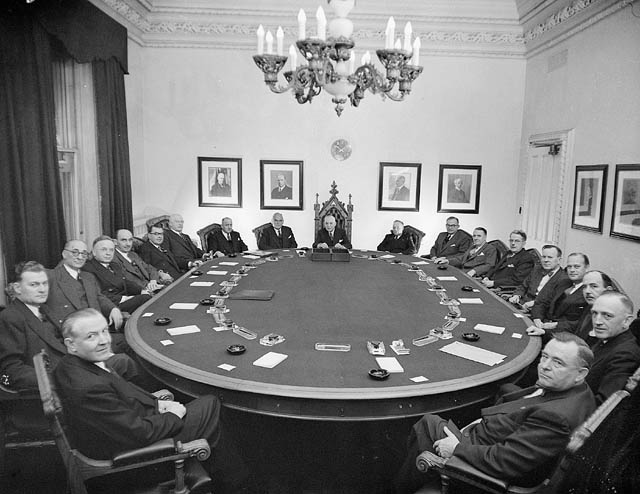
A friend and regular interlocutor, reacting to a comment I made about a week ago, suggesting that the Trudeau cabinet is still too large, challenged me to look at the “ideal” cabinet. Now, it is certainly no secret that I think the “best” government Canada ever had, in modern times, say during the past century, was a Liberal one, led by Louis St Laurent. It was firmly grounded in liberal political philosophy that was shared, and broadly accepted, by most Canadians; the St Laurent cabinet was determined to govern for the people, for each person, not just to govern the people; it was economically bold but, at the same time, fiscally prudent; it believed, firmly, in a principled foreign policy and a strong enough military to give it the muscle it would need, from time to time; it advanced increasingly progressive social policies, step-by-step, but always in moderation; it was about as competent and as honest as almost any government was ever going to be … bearing in mind that governments are composed of men and women much like us.

This was the St Laurent cabinet:

There is some doubt about the date of this picture; one Government of Canada source says 1948 and another says 1953; the few familiar faces around the table, Douglas Abbott, Brooke Claxton, Brigadier Milton Gregg VC, C.D. Howe and Lester B. Pearson all served throughout that entire period. What is not in doubt is that the cabinet was much smaller than what we see today: fewer than 20 members. Today’s cabinet has over 35 members.

The problems of large cabinets are grounded in two realities: more and more complex issues, especially social issues, and more choices. Louis St. Laurent had between 245 and 265 MPs in the whole House of Commons and he governed with between 118 and 191 Liberal MPs on the government side. Justin Trudeau has a bigger problem: any modern majority government has 170+ members and Canadians are much better informed (or at least aware) of what government might do for (and to) them. He, like every prime minister before him, responds to the challenge by giving every group a voice. The outcome is a larger and larger cabinet. It’s not Justin Trudeau’s fault, it wasn’t Pierre Trudeau’s fault, either.

The correct answer, in my opinion, is a two tier cabinet: senior and junior ministers or an “inner” and “full” cabinet.

January 16, 2019

Justin Trudeau is against using refugees as political props … at least when others do it

Filed under: Cancon, Liberty, Middle East, Politics — Tags: , , , — Nicholas @ 03:00

Politicians traffic in hypocrisy, example seven million and three:

There were no good reasons to make a big show of [Rahaf Mohammed] Alqunun’s arrival, in other words, and plenty of good reasons not to. Furthermore, Justin Trudeau has been very clear about what he thinks of using refugees as political props. He was at his most thespian back in 2015 when it was alleged Stephen Harper’s office had been sifting through applications from Syrian asylum-seekers in search of potential photo ops.

“That’s DIS-GUST-ING,” Trudeau hissed at a campaign stop in Richmond, B.C. “That’s not the Canada we want; that’s not the Canada we need to build.”

In the end, though, there was Foreign Affairs Minister Chrystia Freeland with her arm draped around Alqunun, announcing that this “brave new Canadian” would not be taking questions. Luckily, Freeland herself had arrived equipped with some crimson talking points.

“I believe in lighting a single candle,” she said. “Where we can save a single person, where we can save a single woman, that is a good thing to do. … And I’d like to also emphasize, this is part of a broader Canadian policy of supporting women and girls in Canada and around the world.”

“Canada is a country that understands how important it is to stand up for human rights, to stand up for women’s rights around the world,” Trudeau chimed in.

It would be well-nigh impossible to argue against hearing, at the very least, Alqunun’s claim for asylum. But at this point, she is certainly also a political prop — a living symbol of the Liberal view of Canada’s place in the world, and an always-welcome opportunity for self-congratulation.

January 2, 2019

In violation of Betteridge’s law of headlines, this question can clearly be answered “yes!”

Filed under: Cancon, Media, Politics — Tags: , , , , , , — Nicholas @ 03:00

A few days back, Ted Campbell posted under the title “Is it time to get rid of the CBC? Should we?” Betteridge’s law says the answer should be “no”, but in this case the answer is more like “Why haven’t we sold that thing off already?”:

OK, the source of this cringeworthy video clip, Rebel Media, may be suspect to many ~ I do not follow them ~ but it does bring up a question: is this what we expect for the $1 Billion plus we pay for the CBC?

The complete interview, which I watched. looks, as someone else said, more like an advertisement for one of those online dating sites than news. It certainly caused a small storm about the CBC’s bias … which, in this case, especially when compared to CBC journalists’ question and comments directed to e.g. Andrew Scheer and Maxime Bernier, seems over the top, even by the CBC’s standards. And that begs the question: is the CBC living up to its mandate? The Broadcasting Act says (§3(1)(d)(i), inter alia, that “The Canadian broadcasting system should serve to safeguard, enrich and strengthen the cultural, political, social and economic fabric of Canada.” I suspect that someone will want to make a case that the CBC, as a network, at least in it’s English language ‘news’ services, has crossed a line and looks too much like a 24 hour a day informercial for the Laurentian Consensus as represented by the Liberal Party of Canada.

[…]

What does the CBC do? Basically it provides, in both English and French, three services:

  • Radio Canada International ~ this is Canada’s voice to the world, it is, today, entirely on the internet. In 2012 the Harper government imposed a 10% cut on CBC/Radio Canada ~ then CBC/Radio Canada decide that RCI, which is little known, would have its budget cut by 80% from $12+ Million to just over $2 Million. That ended the era of RCI‘s shortwave, world wide service. It was a criminally stupid decision that, in my considered, professional opinion, should have caused the government of the day to summarily dismiss the entire CBC/Radio Canada Board and all of the most senior managers for cause. Every country needs a “voice,” RCI was ours … the gold standard for international broadcasting is found in the BBC World Service and Deutsche Welle, both still provides near global coverage using nearly jam-proof shortwave and satellite radio stations. Both, of course, make extensive and intensive use of the internet;
  • CBC Radio ~ CBC Radio has a big, integrated network of stations covering most of Canada. You can see a list of transmitters on their web site. If you live in Arctic Bay, in Nunavut, population 850±, you are served by radio station CKAB-FM which is a community-owned CBC North rebroadcaster that gets its programming from CFFB in Iqaluit; if you live in Prince Rupert, BC, your are served by CBC Radio 1 (a national network which has a mix of local, regonal and national programmes) broadcasting on 860 KHz and if you live in Shilo, MB you are also served by CBC Radio 1 on FM from Brandon, the people in Twillingate, NL are served, again by Radio 1 from Grand Falls which is rebroadcast on 90.7 MHz from a transmitter in Botswood. In short, CBC Radio is doing a first rate job of serving most Canadians, even if you find some of the content banal and biased. I think it is, by and large, money well spent because in many, many, many communities the CBC provides the only news and weather; but
  • CBC Television is, in my opinion, a near total waste of taxpayer’s money. As you can see from this list (you have to select the province you want) the CBC has only 14 English language TV broadcast stations which serve about 25 urban ‘markets’ and serves less than 10% of the Canadian market in prime time. (Rex Murphy, in a talk to the Manning Centre, quipped about the low audience levels of the CBC at about the 2’50” mark.) It used to have hundreds of transmitters providing near national coverage but in 2012, when Canada converted to digital TV, it closed all but 14 because only a tiny number (certainly less than 5%, likely less than 2%) of Canadians want to watch CBC and do not have cable or internet access. Electing to not serve Canadians with many, many local TV stations was a smart business decision because, as you can see from this listing, Canadians from Kamloops, through Kenora and on to Halifax and St. John’s are served by other networks.

I think that Radio Canada International should be upgraded; CBC Radio should remain about the same, government funded and commercial free, and CBC TV should be closed, completely and the money saved should be used to directly subsidize TV, film and radio production in Canada based on Canadian content rules: n% for the production company being Canadians and using Canadian studios, x% for using Canadian talent ~ on screen and in in the studio, y% for using Canadian locations and so on.

Some, at least half, I suspect, of the CBC’s 14 television licences will sell, at auction, for a tidy sum, making room for new, innovative, probably ethnic, services in larger cities ~ Vancouver, Calgary, Toronto and Montreal and a couple of others. The CBC”s excellent production facilities will also sell for a good sum to private entrepreneurs who will then host dozens of independent radio and TV programme producers. There’s nothing wrong with Canadian production values and in a more open market I suspect that Canadian drama, public affairs, education and political commentary programmes can survive and even thrive, each on its own merits.

November 25, 2018

“They said Trudeau was going to be a uniter, but what an accomplishment”

Filed under: Cancon, Economics, Politics — Tags: , , , , — Nicholas @ 03:00

Prime Minister Justin Trudeau visited Calgary this week, just as the city council officially buried its Olympic bid (but somehow decided to try to keep the subsidies from other levels of government for that event). His visit was the target of protests from both organized labour and Albertans angry about the federal government’s part in keeping Alberta oil from getting to market:

The prime minister flew into Calgary on Thursday to meet with Mayor Nenshi, chat with the Chamber of Commerce, and have photos taken at the site of new social housing being built partly on Ottawa’s dime. The PM left no word on what he thought of the whole “let’s buy Calgary an Olympics without going to the trouble of having one” concept. There were unexpected distractions at every turn in Calgary, the main one being a fierce protest outside his temporary headquarters at the downtown Hyatt.

The Herald’s agreed-upon estimate of the size of the anti-Trudeau protest was two thousand people. I am not sure I trust their math, but at any rate the crowd was large enough to snarl traffic and intimidate the police. I say “crowd,” but perhaps the word should be “crowds,” because the protest was actually twofold.

The striking Canadian Union of Postal Workers was there to discourage Trudeau from passing the back-to-work legislation his cabinet is cooking up. And there was also a coinciding protest over the landlocking of Alberta’s oil, which has widened the spread between world oil prices and local spot prices to surreal, unimagined heights. The sluggishness of pipeline construction has left Alberta hydrocarbons all but worthless. And now the world price is tottering from medium-high levels, ending a sunshiny global oil season from which the province got no advantage.

The posties’ chants of “Negotiate!” alternated with the militant oilpatch’s cries of “Build that pipe!” In a way the spectacle was touching. Here, in the streets of Calgary, you had one of the most internationalist and red-dyed corners of Canadian organized labour literally joining forces with its mostly non-union, mostly right-wing working-class brethren. They said Trudeau was going to be a uniter, but what an accomplishment.

This solidarity will, of course, be fleeting. CUPW, having played the Grinch successfully, will either cut a deal or take its medicine when the back-to-work law passes. But Calgary’s resentment of Trudeau will not be so quick to evaporate — nor, perhaps, will the images of our young prime minister facing a display of active mass public hostility for the first time.

November 23, 2018

“These are deficits of choice, not necessity”

Filed under: Cancon, Economics, Government — Tags: , , — Nicholas @ 03:00

The federal government released its fall economic statement the other day. The contents would not really have been a surprise to anyone who’s been paying attention since the last election, as Andrew Coyne explains:

The 2018 fall economic statement begins with a puzzle. Economic growth, it trumpets, is strong — the strongest in the G7 in, er, 2017. Unemployment is at a 40-year low; capacity utilization is back to pre-recession levels; profits are up; wages are growing faster than they have in eight years.

All this good news has produced a bumper crop of revenues to the federal treasury: an average of roughly $5.5-billion more annually over the next couple of years than was projected in the spring budget. Yet deficits are now projected to be … higher than expected — at $19.6 billion and $18.1 billion, respectively, about 10 per cent over forecast.

What explains this surprising result? Simple: as it has done throughout its tenure, the Trudeau government took the revenue windfall, and spent it — every last dollar and then some.

This is what the government calls “carefully managing deficits over the medium term.” It used to talk about reducing or even eliminating deficits. Now it seems devoted to doing whatever it takes to keep them in the $20 billion range, in perpetuity.

To be sure, the current set of projections, like its predecessors, shows deficits declining majestically in later years. But somehow in the here and now they never do. Once upon a time, this was supposed to be owing to a shortfall in revenues, the fruit of the Harper government’s supposed obsession with austerity.

By now this is not even pretended. The last Harper budget projected revenues for the current fiscal year at $326.9 billion, enough for a small surplus. The latest estimate has them at $328.9 billion — yet the deficit stands at $18.1 billion. Even allowing for a couple of billion dollars in accounting adjustments, it’s clear what is going on. These are deficits of choice, not necessity.

November 16, 2018

The political wrangles ahead over the federal carbon tax

Andrew Coyne — for once not beating the drum for electoral reform — discusses the challenge facing the federal government in the wake of provincial resistance to their carbon tax plans:

But the real test, of course, is yet to come. The provinces cannot stop the tax on their own. The court challenges are likely to fail. Provinces that refuse to implement carbon pricing will simply find the federal “backstop” tax imposed in its place. It is the election that will decide the issue, not duelling governments. Or so Conservatives hope.

Certainly there are abundant grounds to doubt the political wisdom of the Liberal plan. A tax, or anything that resembles it, would be a hard enough sell on its own. But a tax in aid of a vast international plan to save the earth from a scourge that remains imperceptible to most voters, to which Canada has contributed little and against which Canada can have little impact, while countries whose actions would be decisive remain inert? Good luck.

What seems clear is that voters’ support for carbon pricing is shallow and tentative. The Conservative strategist who chortled to the National Post that the Liberals are asking Canadians “to vote with their hearts, not their wallets” — an impossibility, he meant — was correctly cynical. Just because people want to save the planet doesn’t mean they want to pay for it.

The best way to read the public’s mood is in the positions of the political parties, who are in their various ways each trying to assure them that it won’t cost them a dime. The Liberal version of this is to promise to rebate the extra cost of the federal tax to consumers — indeed, they pledge, 70 per cent of households will make a profit on the exchange.

The Conservatives have been less forthcoming, but it would appear their plan is to hide the cost, substituting regulations, whose effects are largely invisible to consumers, for the all-too-visible tax at the pump. Here, too, I suspect they may have a better (i.e. more cynical) read on popular opinion. The public often prefer to have the costs of government hidden from them, even if they know they are paying them — even if they know they are paying more this way, as indeed they are in this case. Do what you want to us, they seem to say, just don’t rub our faces in it.

So I would be skeptical about polls showing majority support for the federal plan: 54 per cent, according to Angus Reid, while Abacus finds 75 per cent would either support or at least accept it (versus 24 per cent opposed). These were taken shortly after the announcement of the federal rebates. Yet it is far from evident the rebates will still register with people a year from now. Indeed, the Conservatives barely paused to acknowledge them as inadequate before going on to pretend they had never been mentioned.

« Newer PostsOlder Posts »

Powered by WordPress