Quotulatiousness

October 26, 2018

Economist Jack Mintz dis-claims credit for the Liberals’ carbon tax scheme

Filed under: Economics, Environment, Government — Tags: , , , , — Nicholas @ 05:00

Everybody likes to be recognized for their work, but Jack Mintz wants to delineate where his original plan and the actual carbon tax scheme implemented by the federal government diverge:

I continue to maintain, as I have all these years, that the best way to implement carbon taxes is to use the revenues to reduce harmful corporate and personal taxes (I’ve since added land-transfer taxes to the original list). This includes removing anti-competitive levies while also providing support for low-income households to cope with higher electricity, heating and transportation costs.

However, what was unveiled Tuesday by the federal Liberal government in its carbon-pricing plan fails to achieve what I would have argued to be an ideal carbon policy. What is being advertised as a climate plan for provinces that fail to follow Ottawa’s carbon-tax directives — currently New Brunswick, Ontario, Manitoba and Saskatchewan, but they’ll likely be joined by others — instead comes across as a grand redistribution scheme administered by an expanding government bureaucracy.

While the federal carbon tax is almost uniform (electricity is not yet included), it provides special exemptions for certain sectors such as farmers, fishers, aviation, power producers in the North and greenhouse operators, although not the ones growing recreational cannabis.

But the departure from uniformity is marginal and not nearly as concerning as the Trudeau government’s continuing commitment to existing and even new regulations and subsidies to promote “clean energy,” each with their implicit carbon price. While economists repeatedly argue for a carbon tax precisely because it means we can forgo these high-cost interventions, somehow that has all been lost. While plenty of the economists behind the carbon-tax lobby were cheering Prime Minister Justin Trudeau’s new plan yesterday, I somehow missed their demands that we now must eliminate clean fuel and renewable electricity standards, subsidies for electric vehicles and ethanol — all of which have carbon costs well in excess of the $50-a-tonne carbon tax planned for 2022.

Another failure of the federal plan is to pass on carbon taxes in the form of Justin Bucks — or, to use the more laborious official name for these tax rebates: Climate Action Incentive Payments. So, rather than include carbon taxation as part of a comprehensive tax reform to make the tax system simpler, less distorting and fair, these Justin Bucks will be paid to households, small businesses, municipalities, universities, colleges, hospitals, non-profit and Indigenous populations.

A fatal flaw in federal pricing plan is a major shift in taxes from individuals to businesses. The average per household rebate — $1,161 in Saskatchewan in 2022 for example — is more than the cost per household of $946 (not including GST or HST on any energy bills). Even though the document states that business taxes are fully shifted forward to households, something is amiss here. How can household rebates average more than costs?

October 25, 2018

It’s not a “bribe” … it’s an “incentive”!

Terence Corcoran explains why the federal government’s promised “incentive” isn’t in any way, shape, or form any kind of bribe:

Step right up, ladies and gentlemen. Welcome aboard the all-new Canadian Cynical Circular Carbon Circus, the amazing Liberal climate control spectacle that will send you on a great environmental ride into the future.

Come on in! We will pay you to not consume fossil fuels — as individuals and as industries. It’s an economic revolution that takes us beyond blockchain and cryptocurrencies and cannabis into a brave new universe in which money goes round and round and everybody wins. We will pay Canadians with their own money — more than $20 billion over five years in carbon taxes that will raise the price of gasoline by 11 cents a litre by 2022, and ever higher thereafter if not sooner. Everybody pays and everybody wins, except for those who don’t. And some people win more than they pay. It’s better than a lottery!

For the people of Ontario, Saskatchewan, Manitoba and New Brunswick, the federal carbon circus cash comes via a new “Climate Action Incentive Payment.” An Ontario family of four will receive $307 for this year, the amount to be claimed on 2018 income tax returns. A Saskatchewan family will get a Climate Action Incentive Payment of $609.

What’s the Climate Action Incentive Payment for? The Liberal plan unveiled by Prime Minister Justin Trudeau and Environment Minister Catherine McKenna Tuesday doesn’t specify. What are taxpayers in the four provinces being incented to do, exactly, with this new wad of free cash? There is only one explanation: Vote Liberal in 2019!

The payments are based on a 2019 carbon price of $20 a tonne, rising to $50 by 2022. As the carbon tax goes up, Ontario families will receive $718 in 2022 and Saskatchewan families $1,459. And there will be more to come, presumably, since the latest doomsday scenario from the UN Intergovernmental Panel on Climate Change — the font of all speculation and data manipulation on climate issues — warned that by 2030 (only 12 years from now) a carbon price of somewhere between $135 to $5,500 per tonne would be needed to keep global warming below 1.5 degrees Celsius.

October 3, 2018

USMCA (aka son-of-NAFTA) – what’s the damage after all?

Filed under: Business, Cancon, Economics, USA — Tags: , , , , , — Nicholas @ 03:00

The most common sentiment from Canadian comments appears to be “meh, it could have been much worse”. That doesn’t mean it’s particularly good, either:

All that cross-border yelling, a solid year of bluster and petulance, dire rhetoric about “stabs in the back” and “special places in hell,” fake deadlines and all-night negotiations, and we end up with pretty much the agreement we started with? All that was required to fix NAFTA, that destroyer of American jobs and pox on its prosperity, the deal Donald Trump memorably complained was “the worst agreement in history,” was to change its name — from North American Free Trade Agreement to US-Mexico-Canada Agreement? Seriously?

Not quite. The result is certainly a far heave from some of the more apocalyptic scenarios we had been entertaining ourselves with. But neither is it the largely unaltered “NAFTA 2.0” of much initial comment. There are substantive changes in there, most of them bad, and not all of them imposed by an overbearing U.S. on an unwilling Canada.

Still, it’s not quite the conflagration we’d been banking on, is it? Trump is the bully in middle school who threatens to take your lunch money, only to settle for a half a slice of your pizza. Or, in this case, 3.6 per cent of it.

That’s the share of the Canadian dairy market to which the U.S. will now have tariff-free access, a slight advance on the 3.25 per cent market share the U.S. had negotiated under the Trans Pacific Partnership — before Trump withdrew from it. (Oh, and “milk price classes 6 and 7” are eliminated, for fans of that dispute. It involves skim milk solids.) There are also some minor increases in tariff-free imports in the other supply-managed sectors: eggs, chicken, cheese and so on. Everything else will face the same triple-digit tariffs, as before.

That’s unfortunate. Supply management is a blight on the Canadian political and economic landscape we could well do without. The NAFTA re-negotiations were an ideal opportunity to bargain it away, as it should have been in the original NAFTA. That it remains more or less intact — even the dairy lobby could manage only a half-hearted jeremiad of imminent lacto-doom in response — is one of the chief disappointments in this agreement.

Still, what did you expect? There was never any chance of these negotiations resulting in a deepening and broadening of NAFTA — not with protectionists on both sides of the table. The only question was whether the status quo protectionists on this side — who wished to preserve all of NAFTA’s existing exemptions — could hold out against the expansionist protectionists on the other, who wished to cut NAFTA into little mercantilist pieces. As it turns out the answer is: surprisingly well.

A quick summary of the winners and losers in this agreement:

Is this a free trade agreement?

No. Unlike NAFTA, this latest agreement makes no pretense to be about free trade (or even freer trade). It’s a protectionist agreement imposed by the U.S. on the other two countries.

Who benefits from the agreement?

The primary beneficiaries of the agreement are labor unions, U.S. dairy farmers, U.S. drug manufacturers, and companies that provide automation for manufacturers (e.g., robot makers).

The agreement will require at least 30 percent of cars (rising to 40 percent by 2023) to be made by workers earning $16 an hour. This will force more cars to be produced in the U.S. and Canada since the typical manufacturing wage in Mexico is only about $5 per hour. The agreement also requires Mexico to make it easier for workers to form unions, which will make them less competitive against more productive unionized workers in the U.S. and Canada.

U.S. dairy farmers will also gain greater access to the Canadian market. Because of new restrictions on how much dairy Canada can export, there is the potential for U.S. dairy to gain a greater market share in foreign countries.

U.S. drug companies will also be able to sell pharmaceuticals in Canada for 10 years (rather than eight) before facing generic competition.

Because the agreement makes human labor in the three countries somewhat more costly, companies that create robots and other automation will likely be the long-term beneficiaries.

Who are the biggest losers in this agreement?

As with almost all protectionist trade agreements, consumers are the ones who will be hurt the most.

As the Washington Post notes, economists and auto experts think USMCA is going to cause car prices in the U.S. to “rise and the selection to go down, especially on small cars that used to be produced in Mexico but may not be able to be brought across the border duty-free anymore.”

Because the restrictions on Canadian steel and aluminum also remain in place, businesses that use those materials in manufacturing will pay inflated prices, and their products will be less competitive on the global market.

September 27, 2018

“Oops” indeed!

Filed under: Asia, Cancon, Politics, Religion — Tags: , , , , — Nicholas @ 06:00

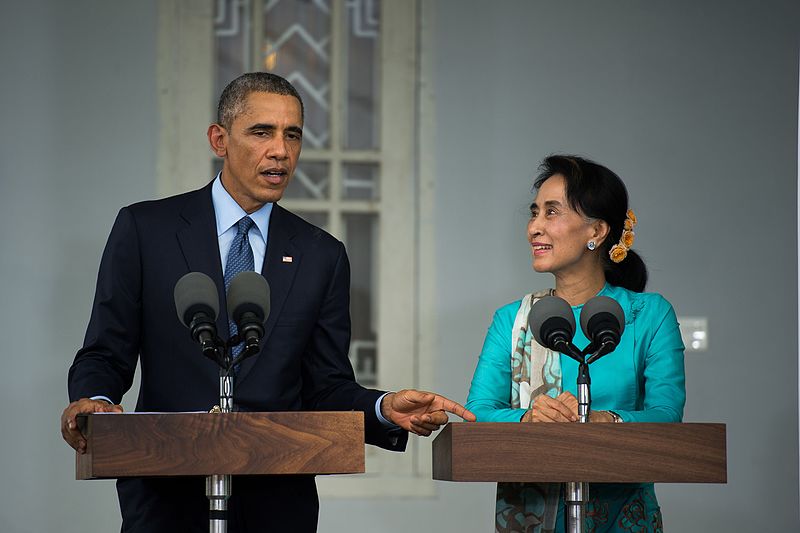
Colby Cosh has a bit of good-natured fun-poking at the great and the good of the Canadian Establishment as an honorary Canadian turns out to be presiding over something that might be described as genocide:

President Barack Obama and Aung San Suu Kyi in 2014
Photo via Wikimedia Commons

Sometimes I am convinced that Canada is a name that will endure through the ages and travel with mankind throughout the galaxy. Sometimes I am convinced that we should be considered exclusively as a subject for absurdist fairy tales, a real-life Ruritania or Grand Fenwick. I guess it goes about 50-50. But I am afraid the emerging controversy over Aung San Suu Kyi’s honorary Canadian citizenship puts us firmly in kooky Zembla territory.

The present State Counsellor of Burma was the fourth person ever to receive this distinction. Now we are talking about withdrawing her honorary citizenship because, as first minister of Burma, she has been heavily implicated in massacres and ethnic cleansing of the Muslim Rohingya people of the country’s Rakhine state.

One in four: not such a great batting average, is it? Our political class devised the highest and most permanent form of honour that could be envisioned for a foreign do-gooder, and literally the fourth person on the entire surface of the planet who was deemed to have met the criteria went and became CEO of a genocide. What does this suggest about the collective judgment of Canada’s elite? You don’t suppose anyone is going to lose a job over this, do you?

[…]

Our prime minister is now spitballing the idea of having Aung San Suu Kyi’s honorary citizenship withdrawn, and one supposes that if this might help save innocent lives, it ought to be considered, even at the price of turning this concocted showpiece institution of “honorary citizenship” into garbage. One of the essential meanings of citizenship is that it cannot be withdrawn, even with due process, even when a citizen has perpetrated unspeakable crimes. “Honorary citizenship” does not confer the legal rights of the real thing, but surely it is at least supposed to resemble the real thing — to represent a commitment of analogous significance and irreversibility as that which we enter into with immigrants taking the oath and joining the club over at the courthouse.

Since honorary citizenship is not conferred by Parliament, it is not clear that it could be revoked by Parliament. Probably an Order-in-Council would do (because, again, no enforceable rights are at stake). If this is done in the case of Aung San Suu Kyi, it seems obvious that we should just put the institution in abeyance for a century or so. Let later generations see if they can manage not to screw up this honorary citizenship thing so thoroughly.

September 10, 2018

Speculation on an early federal election

Filed under: Cancon, Politics — Tags: , , , — Nicholas @ 03:00

Ted Campbell on the recent musings in the official party organ Toronto Star on the pros and cons of the Prime Minister going to the polls this fall rather than next year:

The Star, a pretty Liberal friendly journal, says, in an article by Robin Sears, a former NDP insider (in fact he was national director of the NDP for seven years), that “Liberal hawks, like those of a generation earlier, are heatedly debating a snap election call. Not entirely surprising, since [we] have not seen a decade since the ’50s when a government has not been forced by events, or decided to seize a strategic advantage, and called an early election … [and] … The Liberal hawks’ arguments are getting stronger. Neither of their opponents is ready, and each will likely be stronger a year from now. The Federal Court and Donald Trump have both just stuck a finger in the Prime Minister’s eye. This is an opportunity to return the favour with a much harder counterpunch, a strong new political mandate.“

[…]

I agree with Robin Sears … going [to] the polls sooner, in the fall of 2017, and running against Donald Trump (and the ghost of Stephen Harper) makes good political sense because it seems, to me, highly unlikely that Justin Trudeau and his gang that cannot shoot straight are going to get any better in the next year or so. In fact the Trudeau regime’s record, to date, suggests that a year from now the country might be in ruins.

Right now the NDP appears to be in shambles; Jagmeet Singh’s leadership is being questioned at pretty high levels, and the Conservatives are still reeling from Maxime’s Bernier’s defection. Waiting until October 2018 risks giving both the Conservatives and the NDP time to reorganize and present new, attractive programmes and, perhaps even new, more attractive leaders, too.

Will he go to the polls in 2017? Who knows? Parliament is due to reconvene, after the long summer recess, in a week ~ on 17 September. Many people were expecting a new Throne Speech outlining a pre-election platform filled with promises that will, most likely, never be kept, but Robin Sears makes a good case for Prime Minister Trudeau to go to the Governor General, next week, and to tell her that the situation is such that Canada’s government needs a new mandate.

August 15, 2018

Maxime Bernier on sensible limits to “unlimited” diversity

Filed under: Cancon, Politics — Tags: , , , , — Nicholas @ 03:00

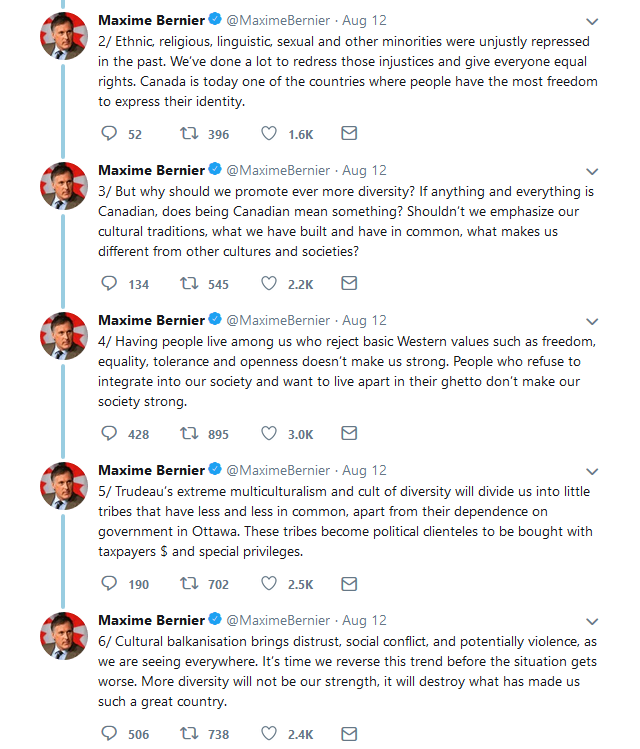
Maxime Bernier responds to Prime Minister Trudeau’s apparently unlimited desire for more and more diversity in Canada:

The following tweets as a screencap, to avoid slowing down the whole page loading (as often happens with multiple tweet embeds):

August 7, 2018

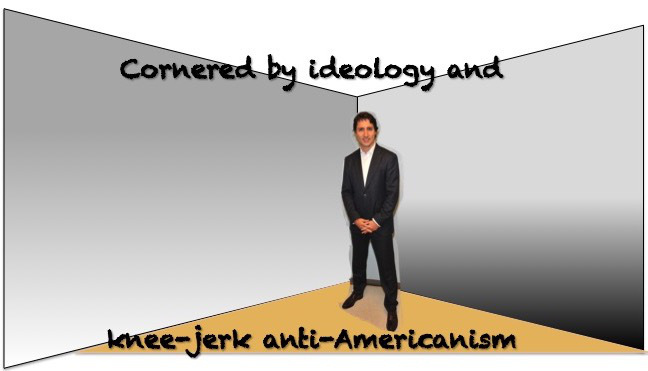
“[Trudeau’s] ideology is jeopardizing 20% of the Canadian economy”

Brandon Kirby on Prime Minister Justin Trudeau’s failing efforts to negotiate with the United States on trade:

Trade with Canada constitutes 2% of America’s GDP and trade with America constitutes a whopping 20% of Canada’s GDP. My home province of New Brunswick finds 50% of its private sector exporting to the U.S. – NAFTA is of vital importance to our economy.

The dwindling efforts of Trudeau’s cabinet to negotiate a deal with the Americans could become his government’s greatest failure. With tariffs already being imposed on steel and aluminum, NAFTA is potentially unraveling before our eyes and along with it, the Canadian economy.

Trudeau’s American counterpart isn’t known for his vocal support of trade and yet he handed Canada everything on a silver platter at the recent G7 summit. He offered to remove all tariffs and subsidies on imports and exports, provided Canada did the same. This is about as fair an offer as one could expect. Trudeau retaliated by insisting Canada had been insulted.

The trouble with Trudeau is precisely that. He was given a talking point. He developed rhetoric rather than substance. Akin to Marco Rubio’s disaster of a debate performance, who refused to go off script even when he was being called out for scripted answers, Trudeau had a talking point. It was a good one, Canadians and Americans died together in the mountains of Afghanistan to bring justice for Americans who died on September 11th. Trump alluded to our tariffs on their dairy farmers as a national security threat. But when Trump acquiesced, Trudeau kept to his talking points and refused to go off script, even when his talking points no longer made sense.

The initial renegotiation began with Trudeau’s government attempting to include a chapter on gender. The Americans weren’t enthusiastic about devoting a significant portion of their time at the negotiations to discussing an unenforceable chapter of the deal, but Trudeau pressed on.

The liberal rationale in the briefing notes was leaked, “Think back 20 years and remember the early discussions of labour and environment in the context of trade agreements.”

Environmental and labour standards were included in the negotiations of decades past because a country that has humane labour standards is at a trade disadvantage to countries that neglect their workers and their environment. Gender doesn’t have any bearing on trade. His ideology is jeopardizing 20% of the Canadian economy.

July 20, 2018

“Trudeau becomes the first prime minister I’ve ever covered who has demoted himself”

Filed under: Cancon, Politics — Tags: , , — Nicholas @ 05:00

In Maclean’s, Paul Wells analyzes Prime Minister Justin Trudeau’s recent federal cabinet shuffle:

So much has changed, culminating — for now — with the burial of Ontario provincial Liberalism at the hands of Doug Ford. Alberta and Quebec could next fall to Jason Kenney and François Legault. Certainly that’s the way to bet it. Even normally sunshiny New Brunswick, Newfoundland and PEI are refusing to file carbon reduction plans in line with what Catherine McKenna expects.

So the cabinet Trudeau shuffled on Wednesday isn’t a pre-election cabinet, in the sense of one that’s sweet and shiny to attract distracted voters, so much as it’s a survive-until-the-election cabinet. If this cabinet were a movie, it’d be Walter Hill’s 1979 classic The Warriors. A bunch of street fighters, just trying to make it from the Bronx to Brooklyn in one piece. Doug Ford calling to them from an abandoned car, clinking empty bottles together. Or to use another, perhaps less obscure, movie analogy, it’s farewell to Hope and Hard Work, hello to Horse’s Head/ In Your Bed.

The stars of this partially-refurbished cabinet are two bad cops, in one case quite literally: Bill Blair and Dominic LeBlanc. Blair’s job on the border-crossing file isn’t only to get up Doug Ford’s nose, though that’s a handy bonus. It’s to do more or less what he did as the Liberals’ back-bench pilot of cannabis legalization: to steward a controversial file as humourlessly as humanly possible, to convey with every flinty word and steely grimace that the government is not even remotely interested in messing around.

It’s interesting that Ahmed Hussen, a personable and diligent minister who was also obviously appointed so he could incarnate Liberal branding of openness and diversity, keeps every part of the immigration file except those elements that scare some voters: the people walking across the border. Those parts have been assigned to Sgt. Rock over here.

LeBlanc, an irrepressible rogue whose dad was Pierre Trudeau’s fisheries minister and who has known Justin Trudeau all his life, is not by nature a political bone-crusher, although that’s certainly within his vocabulary. He doesn’t even like when people like me emphasize that part of his personality. He will prefer to get along. But he has the job Trudeau had because Trudeau noticed that, even though his intergovernmental minister was Justin Trudeau, the intergovernmental mood out there was getting noticeably chippy. So Trudeau stripped Trudeau of that portfolio and handed it to someone who could concentrate on it. It’s traditional to view a smaller ministerial portfolio as evidence of a demotion. Trudeau becomes the first prime minister I’ve ever covered who has demoted himself.

June 29, 2018

Justin Trudeau’s emotional thinking style resonates with female voters

Filed under: Cancon, Economics, Politics — Tags: , , — Nicholas @ 05:00

Brandon Kirby on, among other things, why Justin Trudeau polls consistently higher with women than with men:

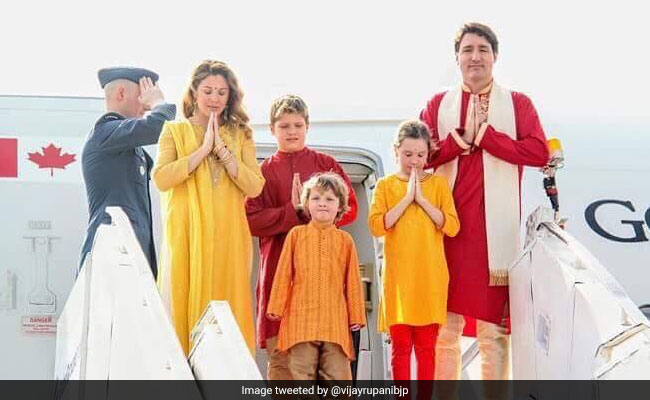
Justin Trudeau and family during India visit
Image via NDTV, originally tweeted by @vijayrupanibjp

Justin Trudeau gave one of his worst interviews during the campaign with a Maritime reporter, Steve Murphy.

Murphy continually asked him for the numbers on his spending promises, to which Trudeau had none to give. Eventually he went on the offensive against Murphy and suggested that Murphy approached politics with a calculator while Trudeau can speak to Canadians. People who think in terms of STEM find this remarkably absurd.

It’s problematic that if the numbers don’t add up in Trudeau’s budgets, he won’t be helping Canadians at all. Wages will remain stagnant while power bills go up, grocery bills go up, and our tax bills will go up.

Trudeau is on the record claiming that he will grow the economy from the heart outward, but as the calculator dictates, his plans have serious economic consequences and the rhetoric that appears caring is actually destructive.

Rational thinkers find the empty rhetoric of growing the economy from the heart outward, while simultaneously making life harder on the poor and middle class, highly offensive.

Feminists have supplied us with the premise that on average, women don’t think in terms of STEM. Economics as a science requires an appraisal that is thoroughly calloused at times, which people who don’t appreciate STEM will find highly offensive.

The end result is that if women don’t think in terms of calloused rationalism, they won’t find libertarianism at all appealing.

If it were the case that only Canadian women were permitted to vote, Trudeau would win a majority government easily. If only Canadian men were to vote, Trudeau would be swiftly defeated.

George W. Bush was the most unpopular president in the U.S. during my lifetime, and yet his approval ratings are polled higher for Americans than Trudeau’s are among Canadian men.

There’s a discrepancy between men and women but that doesn’t imply individualism is wrong.

[…]

We do need to encourage women to adopt the calloused STEM approach. $99 per case of water isn’t how most women think, but unlike the opposing view it has the virtue of actually being getting water to people; going beyond stage-one-thinking – it’s actually compassionate.

June 17, 2018

Conrad Black – Trump’s not bluffing

In the National Post (but linked from his personal website), Conrad Black warns of the danger of assuming that Trump is just blustering on his trade threats:

Justin Trudeau struck just the right Canadian note of our gentle nature but refusal “to be pushed around,” and he predictably will reap the short-term reward for standing up for the country opposite the ideal American bogeyman, the blustering billionaire president who has been a Garry Trudeau caricature of the Ugly American for 25 years. (It is a very incomplete picture, like most caricatures, but it works for Trump and he often cultivates it.) The boycotts of American goods and holidays will be a bonus to Canada economically and the anti-Trump American media will be along within two weeks to lionize doughty Canada like “Gallant little Belgium” in 1914 and “Plucky Israel” in 1947, and it will strengthen Canada’s always fragile self-regard opposite the United States.

On the other hand, Trump isn’t just a blowhard; all his career he has known how to go for the jugular and his reference to 270-per-cent Canadian tariffs on butter is a valid complaint that threatens to tear the scab off this egregious payoff to the comparatively small number of Quebec dairy farmers who mainly profit from it. The same issue was hammered hard by Martha Hall Findlay when she ran for the federal Liberal leadership in 2013 and by Maxime Bernier when he ran narrowly behind Andrew Scheer for the Conservative federal leadership last year. The issue died down after their unsuccessful campaigns, but if Donald Trump is incited to hammer that theme, he will roil the domestic Canadian political waters and English-French relations in the country generally.

Presumably our trade negotiators will not become so intoxicated by the prime minister’s peppy talk and spontaneous popular boycotts of the U.S. that they forget the correlation of forces. An aroused American administration could do serious damage to Canada’s standard of living, and it could be a tempting tactic to expedite more important negotiations with Mexico and the principal Asian and European powers. The United States is now enjoying three times as great a rate of economic growth as Canada (4.8 to 1.5 per cent), has lower tax rates, 11 times as great an economy, and more unfilled jobs than unemployed people.

Behind the peeling façades of Norman Rockwell and Walt Disney, the United States is a monster, and not always an amiable monster. If Canadians are blinded by their visceral dislike of Donald Trump, as the antithesis of Canadian criteria for likeable public figures, they will be exposed to the ruthless pursuit of the national interest that in his own career propelled him from technical insolvency to immense wealth and celebrity and then, against all odds, to control of a great political party and to the headship of the most powerful country in the world. If these talks blow up, the U.S. doesn’t have to settle for WTO rules; it can impose outright protectionist measures. Justin Trudeau has been agile, and the country has responded admirably. But Canadian policy-makers must understand that they are playing for almost mortal stakes with potentially dangerous protagonists who have no sense of fair play and no interest in what Canada thinks of them.

June 12, 2018

G7 minus one

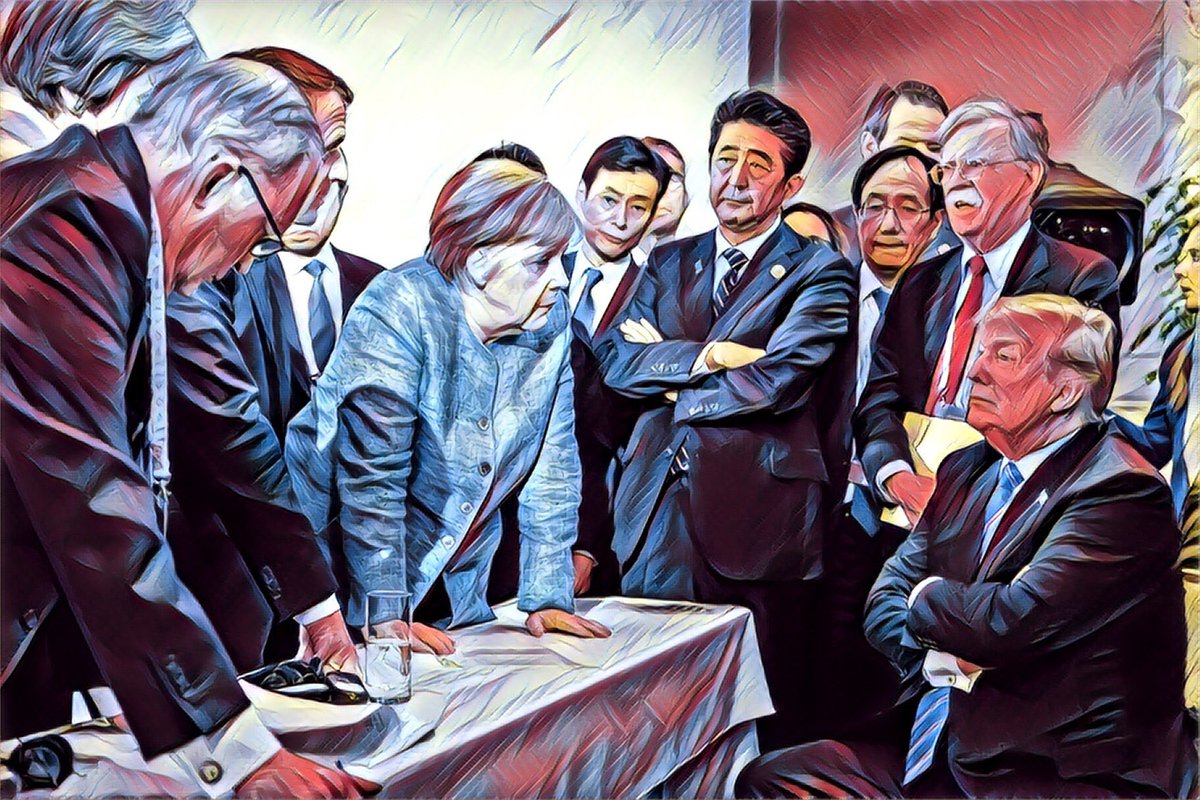
Justin Raimondo on the well-shared image of Angela Merkel and her associates apparently trying to browbeat Donald Trump at the G-7 meeting (this version from Raimondo’s article):
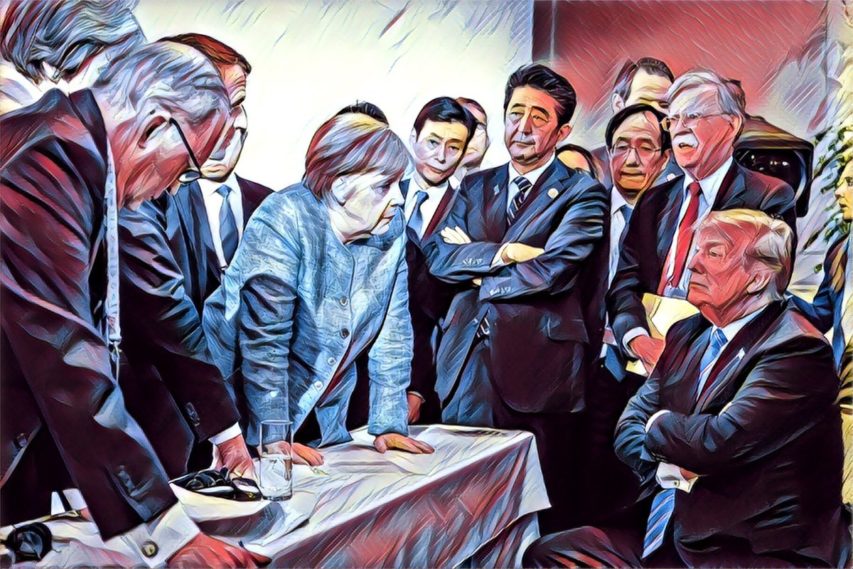
All the Very Serious People are tweeting and retweeting this “iconic” photo of Trump surrounded by the Euro-weenies, with Angela Merkel seeming to lecture the President while the rest of our faithless “allies” look on. It’s “America Alone” – the visual representation of the internationalist worldview: Trump’s policy of “America First” is “isolating” us, and, according to clueless leftists like Michael Moore, Merkel is now the “leader” of the “free world.”

This last is good news indeed, for if Merkel is the new leader of the “free world” then the stationing of 35,000 US troops in Germany – at a cost of billions annually – is no longer required and we can bring them home. This also means Germany, rather than the US, will be sending troops all over the world to fight “terrorism” – a move that is sure to cause consternation in certain regions with a history of German intervention, but hey, somebody has to do it!

The political class is screaming bloody murder over Trump’s performance at the G-7 meeting in Canada, where he reportedly spent most of the time detailing how much the US was paying for the defense of our vaunted “allies,” not to mention the high tariffs imposed on American goods. He then proposed a “free trade zone” in which member countries would drop all tariffs, subsidies, and other barriers to trade: the “allies” didn’t like that much, either. Nor did the alleged advocates of free trade here in the US give him any credit for ostensibly coming around to their point of view. Which reminds me of something Murray Rothbard said about this issue: “If authentic free trade ever looms on the policy horizon, there’ll be one sure way to tell. The government/media/big-business complex will oppose it tooth and nail.”

Of course the Euro-weenies don’t want real free trade: after all, they practically invented protectionism. What they want is a free ride, at Uncle Sam’s expense, and the reason they hate Trump is because they know the freebies are over. However, what really got the Usual Suspects frothing at the mouth was Trump’s insistence that Russia be readmitted to the G-8:

    “I think it would be good for the world, I think it would be good for Russia, I think it would be good for the United States, I think it would be good for all of the countries in the G-7. I think having Russia back in would be a positive thing. We’re looking to have peace in the world. We’re not looking to play games.”

The “experts” went crazy when he said this: our “allies” are being insulted, they wailed, while our “enemies” are being “appeased.” It’s sedition! Russia! Russia! Russia!

Eric Boehm says that the White House’s justification for imposing tariffs on national security grounds may have been undermined through Trump’s tweets hitting back after what he clearly felt was Justin Trudeau’s hissy fit (although Trudeau didn’t exactly break new ground or say anything radically different in his comments):

The Trump administration has spent months trying to construct a rather flimsy argument that steel and aluminum imports from Canada and other close American allies constitute a national security threat. More than a handy way to drum up public support for trade barriers, the “national security” claim is a crucial bit of the legal rationale for letting the president impose tariffs on those goods without congressional approval.

Then, as he was departing this past weekend’s G7 summit, Trump took to Twitter to air some grievences with Canadian Prime Minister Justin Trudeau. In doing so, the president may have significantly kneecapped that legal argument.

The last sentence of Trump’s tweet is the one that really matters.

The White House slapped a 25 percent tariff on imported steel and a 10 percent tariff on imported aluminum by invoking Section 232 of the Trade Expansion Act of 1962, which gives the president legal authority to impose tariffs without congressional approval when it’s for the sake of national security. That line of argument, outlined by Commerce Secretary Wilbur Ross in a February report, says that America needs aluminum and steel to make weapons of war, and that protecting the domestic steel and aluminum industries is the only way to ensure the country will be able to defend itself if attacked.

That is pretty weak, as I (and others) have written before. But as long as Trump makes that claim — no matter how strained the logic might be — the law seems to be on his side. Invoke “national security” and the president can do what he wants with trade.

Except now Trump seems to have admitted that it’s not about national security at all. His tweet plainly states that “our Tariffs [sic] are in response to his of 270% on dairy!”

Chris Selley points out that up until this eruption, Canadian politicians were still carrying on as if nothing was really at stake (especially Conservative leader Andrew Scheer, who re-swore his allegiance to ultra-protectionist supply management at all costs, and damn actual free trade):

So utterly obsessed are Canadian politicians by the small differences between them that federal Conservative leader Andrew Scheer recently demanded Prime Minister Justin Trudeau explain what he meant when he suggested Canada might be “flexible” on the issue of supply management in the dairy industry, in the face of new demands from Washington. It’s preposterous: you can’t fit a processed cheese slice between the three major party’s total devotion to the dairy cartel.

Because, as we all know, what unites Canadians from coast-to-coast is our universally shared determination to pay significantly higher prices for dairy products, to ensure that Quebec farmers are not overly bothered by pesky competition from uppity foreigners who don’t even speak Joual

June 11, 2018

Jay Currie says it’s time to light the Bat Signal for … Brian Mulroney?

Filed under: Business, Cancon, Economics, Government, USA — Tags: , , , , , , — Nicholas @ 05:00

I find it hard to believe that things have gotten to the point that anyone, let alone Jay Currie, is looking to former PM Brian Mulroney to pull Justin’s chestnuts out of the Trumpian fire:

In Canada, more specifically Ontario, the destruction of the auto industry would be a full scale, all hands on deck, disaster. Realistically, the auto sector is Ontario’s largest private sector employer and the largest manufacturing sector. Being priced out of the US market would kill tens of thousands of well-paid jobs.

Trump has taken the measure of Trudeau and his tiny, annoying, Minister of External Affairs, Chrystia Freeland and concluded they are featherweights. Which means that Canada is potentially screwed because Trump has no faith in our leadership. You don’t call people dishonest publicly if you plan to do business with them.

It is unlikely that Trudeau will be aware of just how badly he has failed for a few days. The Canadian media are heavily invested in a narrative which has Justin standing up to the big, bad, Trump. Trudeau’s tone-deaf advisors are, no doubt, revelling in the fact they got lots of “gender” language into the communique.

It will take a few days for the more sober side of the media to realize what peril Trudeau has put us in. And a few more for the geniuses in the PMO to figure out that Trump is not playing the same game as they are.

When they do figure it out the question will arise, “What the fuck do we do now?”

As I am quite sure Butz and his posse read this blog I have a simple suggestion.

Normally, I would have suggested they get in touch with Simon Reisman who negotiated both the Auto-Pact and NAFTA. Alas, Reisman is dead.

Second best by a long shot? Brian Mulroney. A man I have next to no time for but who a) managed to get Canadians onboard for NAFTA, b) was a quite successful Canadian Prime Minister, c) is wired into both Trump World and broad swaths of corporate America.

If Trudeau could get Mulroney to do it Mulroney would be going into the US with a serious, well thought out, everything on the table, pitch. Likely starting with first principles – no tariffs, no subsidies, no non-tariff barriers. Be prepared to dump dairy and end transhipment of Chinese steel. And pitch it to the Trump people as the template for the deals which could be made with the EU, Japan, India and so on. (China is a whole other thing.)

The key point here is that Canada has to move, and move quickly, away from the finger-wagging politics of gender inclusion and climate change to a hard-nosed business approach to getting the best deal we can with an America which is now willing to put its own interests first.

June 7, 2018

Trade war with Canada justified because the White House was torched in the War of 1812

Filed under: Cancon, Economics, History, USA — Tags: , , , — Nicholas @ 05:00

Maybe it was intended as a joke, but what else was Trump supposed to say when Trudeau actually asked what actual security threat Canada poses to the United States?

During a phone call with Canadian Prime Minister Justin Trudeau last weekend, President Donald Trump reportedly justified his decision to impose tariffs on Canadian steel and aluminum by invoking … the burning of the White House by British troops during the War of 1812.

At least, that’s what CNN is reporting this afternoon. Here’s how they put it, citing information from “sources familiar with the call: “Trudeau pressed Trump on how he could justify the tariffs as a ‘national security’ issue. In response, Trump quipped to Trudeau, ‘Didn’t you guys burn down the White House?'”

That is, presumably, a reference to the War of 1812, during which British troops invaded Washington, D.C., and set fire to the White House. Despite the war’s name, the burning of the White House actually occurred in 1814. And it wasn’t carried out by Canadians because, well, Canada did not become an independent nation until 1867 — or 53 years after the White House burned.

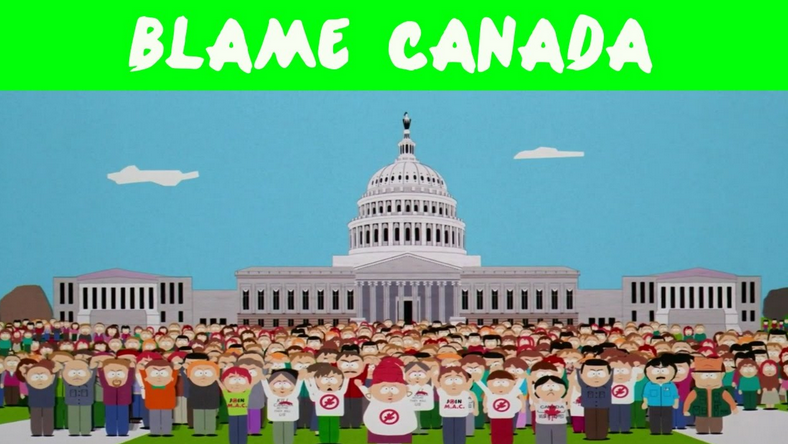
But, sure, whatever. The War of 1812 makes Canada a national security threat in the year 2018, despite our having been allies for the last century, sharing the world’s longest unpatrolled border, and exchanging more than $620 billion in goods last year. The rationales for war with Canada in Canadian Bacon and South Park: Bigger, Longer & Uncut are more grounded in reality.

May 6, 2018

Justin Trudeau may (or may not) delay the legalization date for marijuana

Filed under: Cancon, Government, Politics — Tags: , , — Nicholas @ 05:00

It’s just another day in Liberal Ottawa, as the Prime Minister briefly appears to wobble on the one election promise he’s close to fulfilling before the next election cycle begins. Colby Cosh manfully avoids a few drug-related jokes while recounting the latest “goffe” (as Gary Johnson actually said):

The legislative scenes preceding the three-quarters-legalization of marijuana in Canada continue to have an unreal, hallucinatory quality for which I am determined not to use the obvious metaphor. On Tuesday the Senate Aboriginal Peoples Committee presented the government with a demand that its vague summer legalization deadline be delayed by “up to one year” because Indigenous groups were not consulted closely enough on the effects of making it lawful to have a plant.

The prime minister, after some hemming and hawing, reiterated that legalization will happen on time, whatever the particular date happens to end up being. This will certainly come as a relief to the people who have poured zillions of dollars into a new horticultural and retail industry on the premise that it would, y’know, exist. Seeing how many of them are former Conservative politicians, perhaps they can be persuaded to buy a novena or two for a Liberal government that has — despite the unique moral pressure that Indigenous Canadians are capable of exercising, and in arguable defiance of its own history — decided to stick to an electoral promise.

Even as it is, the promise is taking most of the life of a Parliament to fulfill. Perhaps the conscience of Justin Trudeau, the little cartoon angel that perches on his shoulder and whispers progressive maxims in his ear, would have preferred to relent and toe the legalization deadline forward a year. Unfortunately, on the list of Trudeau’s political problems, “not being able to get stuff done in Canada” ranks alarmingly high at the moment.

In an ideal world, going along with the Senate committee and inflicting a wrestler’s piledriver on the economy for the sake of a principle might have been tempting. May 2018 is, alas, not really the time to be asking for that. It is precisely because so many interest groups and subnational governments have had to be negotiated with and appeased that pot legalization has taken so long — long enough that another election is in sight, with other elements of the Liberal program already in smithereens by the wayside.

April 17, 2018

The trap Trudeau carefully laid for himself

Filed under: Business, Cancon, Environment, Government, Politics — Tags: , , , , — Nicholas @ 05:00

Andrew Coyne on the interminable “negotiations” for the Kinder Morgan pipeline:

Whatever anyone’s concerns — economic, environmental, Aboriginal or other — that is the process by which those concerns are adjudicated. And that is the process that approved the pipeline: the NEB, the cabinet and the courts, all ruling in its favour (though not every legal appeal has been exhausted: a case is still before the Federal Court of Appeal on behalf of seven First Nations arguing they were not adequately consulted).

Why, then, do so many feel entitled, not merely to disagree, or to protest, as is their democratic right, but to substitute their own authority for that prescribed by law: to defy the courts, to threaten disorder, and to deny federal jurisdiction?

Much of the blame should be attached to the current custodians of lawful authority, the governments of Canada and British Columbia. It was Justin Trudeau who, campaigning for office, gave his imprimatur to the extralegal, anti-democratic doctrine of “social licence,” telling pipeline opponents that “governments might grant permits, but only communities can grant permission.”

It was Trudeau, too, who lent support to the notion that Aboriginal communities have, not merely a constitutional right to be consulted on projects affecting lands to which they have title, as the courts have found they have, but an absolute veto. And it was Trudeau who legitimized those who, because they did not like the NEB’s decision, had dismissed it as biased or negligent, with his promise of a special panel to review the project.

Likewise it was John Horgan who, campaigning for office, famously promised to “use every tool in the toolbox” to stop the pipeline from being built. We know now that his government has known since at least the time it took office that it had no constitutional authority to do so. But if Horgan had hoped to walk back the promise, in the grand tradition of Canadian politics, after he was elected, he finds his way blocked by his partners in power, the Green Party.

So he has instead opted to stall for time, delaying permits, threatening legislation, and — someday, maybe — referring the whole business to the courts, hoping the project’s sponsor, Kinder Morgan, will give up in frustration. As, at length, it has declared it will do if Horgan’s government is not brought to heel, with spectacular effect: it has spurred the Trudeau government to state, in terms that allow no retreat, that “the pipeline will be built.”

But reasserting lawful authority, after so many years of disuse, will not be as easy as all that. It is not only the Trudeau or Horgan governments, after all, that have played this game: before Horgan, there was Christy Clark and her constitutionally odious “five conditions” for “approving” the Northern Gateway pipeline, and before Trudeau there were decades of federal governments that allowed the provinces to run the jurisdictional table against them, in the name of “co-operative federalism.”

« Newer PostsOlder Posts »

Powered by WordPress