Quotulatiousness

April 10, 2018

There’s a reason most people don’t take Canada seriously on energy issues

Filed under: Business, Cancon, Politics — Tags: , , , — Nicholas @ 03:00

Paul Wells reports on the most recent twist in the pipeline debate:

Jim Carr stood next to the Centennial Flame in front of Parliament’s Peace Tower and addressed a chilled knot of reporters and news cameras. An hour earlier Kinder Morgan had announced it was halting all non-essential spending on its Trans Mountain pipeline expansion project. If the company can’t find a way to proceed with the project, it will abandon it at the end of May.

Crunch time. Carr is the natural resources minister, generally reckoned as a heavyweight in the Trudeau cabinet. This project is basically the sum and totality of his political credibility packed into one long, narrow and increasingly hypothetical tube. And now it hung by a thread. The tube, I mean. Or his credibility. Or my metaphor. Anyway, he seemed to be taking it well.

“Thank you for coming to chat about pipelines,” Carr said, just as cool as you please. “We seem to spend a fair bit of time on that subject.”

The ennui. It burns. Carr summarized the state of play, more or less as I just did, and then read from prepared notes in French: “We expect the government of British Columbia to cease immediately all attempts to delay this project.” He did not repeat that sentence in English.

Instead he delivered a kind of analysis. “What we’re witnessing is the consequence of uncertainty. And in this case it’s uncertainty that’s generated by the government of British Columbia by threatening court action. Even if it doesn’t frame a question. Even if it doesn’t choose a court in front of which a question would be reviewed. And there are consequences in the threat of delay. Investor confidence is very important. It’s not only important for all of Canada, it’s also important for the province of British Columbia. And for a province that is as rich and has the abundance of natural resources that British Columbia has, the people of B.C. should know that this kind of uncertainty has consequences.”

This long succession of sentences could perhaps best be summarized as “C’mon, guys.”

[…]

This precinct is full of historical parallels, whether you want them or not. About 80 feet from where Carr was standing, on an October morning in 1970, Pierre Elliott Trudeau had run into another CBC reporter, Tim Raife, who wanted to know what he would do about the kidnapping of Quebec’s transport minister and the British trade commissioner. “Just watch me,” the prime minister said, and three days later he invoked the War Measures Act, which we all still argue about sometimes.

But Pierre Trudeau’s “Just watch me” established a precedent, not just for artful vagueness, but for follow-through. It’s a precedent honoured most often in the breach: generations of politicians have used “Just watch me” or its assorted variants, including “All options are on the table,” when what they really meant was “I have no clue” or “I’m crossing my fingers” or “Baby needs a new pair of shoes.”

So the temptation among other actors in a political drama, when a central figure pulls the just-watch-me, is to wait them out and not do their work for them by folding their cards prematurely. And sure enough, the rest of Sunday night played out according to a series of familiar scripts. Jason Kenney was apocalyptic. Rachel Notley was firm, including in her insistence that what she had seen so far from Ottawa wasn’t nearly satisfactory. And John Horgan, B.C.’s premier, was unapologetic. As some of my friends like to say, if nothing changes, nothing changes.

April 3, 2018

Governments are like diapers – they need to be changed regularly and for the same reason

Paraphrasing an old joke in the headline, but as Andrew Coyne points out, it’s close enough to observed federal reality to qualify:

Is it inevitable that every government becomes what it once despised — a matter of the realities of power overtaking the dreams of opposition? Or do their broken promises, ethical lapses and abuses of power remain, in the end, choices, for which they can be held to account? Do governments turn to seed, or were they that way before they took office? Or is the problem not of any particular party at any particular time, but of a larger culture of cynicism and deceit, in which all parties share?

I do not know the answers to these questions. I only see the same pattern repeated in every government over the last several decades. The Mulroney government came to power promising to clean up the sodden mess left by the Trudeau Liberals (“you had an option, sir — you could have said no!”), only to indulge in its own orgy of patronage appointments and dubious ethics.

The Chretien Liberals were elected to clean up the mess left by the Mulroney Conservatives. Instead they ramped up a massive kickback scheme overseen by a parallel government of party officials and Liberal-friendly advertising executives — to say nothing of their shameless pork-barreling, habitual disdain for Parliament or the prime minister’s personal portfolio of shame.

The Harper government ran and won on a promise to break this pattern, even including the passage of a Federal Accountability Act among their “five priorities.” In power, they invented whole new ways to evade accountability and step on Parliament, while going back on nearly every principle they had ever held or promise they had ever made. Unsurprisingly, compromises on principle ended up begetting compromises on ethics, if only because, in the blur, people forgot which was which.

And now the Trudeau Liberals, again, dynastic succession being the surest sign of the democratic health of a polity. But then, Trudeau fils went to unusual lengths to stress how different he was, not only from his father but from pretty much every leader who went before.

March 11, 2018

Polls begin to reflect public disillusionment with Trudeau after gaffe-filled India trip

Filed under: Cancon, India, Politics — Tags: , , — Nicholas @ 03:00

After all the PR blunders, it’s amazing that the Liberals are still riding as high in public opinion polls as they are:

By now it is clear the federal Liberals are in some difficulty with the public. Much excitement attended that Ipsos poll earlier this week showing them trailing the Conservatives for the first time, and by a not inconsequential margin: 38 to 33. But it’s not just Ipsos.

Forum Research, which gives the Tories a 12-point lead, may be an outlier, but Nanos’s latest four-week rolling poll shows the Liberal lead has shrunk to less than four points from eight points in December; Abacus Data, similarly, now has them just three points ahead, the narrowest margin they have found since the election.

Overall, the CBC’s Poll Tracker website now puts the two parties more or less level, based on a weighted average of the polls, at 36 per cent. Contrast that with the Liberals’ first year in office, when they maintained a lead of as much as 20 points, or even their second, when they led by eight to 10. Something is clearly up.

The reason is not hard to find, nor is it unusual: the prime minister’s personal approval rating has declined markedly. To be sure, he remains the Liberals’ chief asset: Nanos still shows 40 per cent of Canadians put Justin Trudeau as their preferred prime minister. Sixty per cent say he “has the qualities of a good political leader.”

[…]

The immediate explanation for the prime minister’s cratering appeal is the recent official visit to India, conceded on all sides to have been a disaster. There’s no doubt this has taken its toll — Ipsos finds more than twice as many Canadians of the view that the visit was “negative for Canada-India relations” than the contrary.

But if the India visit accelerated the decline, it is also true that the prime minister’s appeal has been fading for some time. The India trip may have crystallized certain perceptions of him, but the ingredients have been evident for a while. People do not form impressions of a leader’s character and abilities instantaneously, but only as the result of an accumulation of incidents and impressions.

The Tories’ pre-election attempts to discredit Trudeau as “just not ready” failed in the light of a long campaign in which he persuaded increasing numbers of Canadians that he was. I don’t imagine many would have said he was much of a deep thinker — his worst moments are almost always when he tries to pretend he is — but people gave him credit for sincerity, personal decency, idealism, and a native political ability that seemed to grow throughout the campaign.

But now? Asked to name the first quality that came to mind, I suspect increasing numbers might be more inclined to mention his cynicism.

March 2, 2018

Canada’s foreign policies, in the wake of recent Prime Ministerial mis-steps

Filed under: Cancon, China, Government, India — Tags: , — Nicholas @ 03:00

Ted Campbell suggests that our current foreign policy goals have been seriously undermined by the — shall we say “disappointing” — outcomes of Prime Minister Trudeau’s Chinese and Indian trips:

[Former senior Canadian diplomat David] Mulroney begins by saying that: “The best that can be said about Prime Minister Justin Trudeau’s visit to India is that it may prompt a review, if not a complete rethinking of a Canadian foreign policy that appears to be seriously off the rails. We have some hard lessons to learn … [and] … At the very least, the Prime Minister’s debacle in India should encourage smart people in Ottawa to zero in on what isn’t working.” That’s good thinking. At the end of every major campaign, an especially after campaigns in which things go awry, good military commanders convene a board of senior officers to consider “lessons learned,” in the hope that they will not make the same mistakes next time. sadly, especially today, the lessons learned are all too quickly forgotten even if the analysis was rigorous enough in the first place.

“Most worrying,” David Mulroney says, “is a fundamental and puzzling failure at the level of policy implementation, something that appears to be compounded by the Prime Minister’s own impetuosity. Flying to India before the big meeting with Prime Minister Narendra Modi was in the bag, much like heading off to Beijing on a free-trade themed visit without any reasonable expectation that a deal was doable, exposes Mr. Trudeau to a degree of prolonged public skepticism that comes to define the visit itself.” In other words: Justin Trudeau goes off “half cocked” as we soldier say … not ready for action. That is, I suspect, in part because his team in the Prime Minister’s Office (PMO), was brilliant on the campaign trail in 2015 but is really unqualified to advice the leader of the government of the G7 nation; that poor quality of policy advice matters because Justin Trudeau was, and still is, to be sure, “just not ready” for the job he was handed. But his office campaign team wants to get and keep him in the public eye because that’s part of the 2019 campaign strategy … this time it failed because they really didn’t understand the business at hand.

[…]

But India is not just any country, as Mr Mulroney explains: “India isn’t our friend. It is a rising regional power beset with a range of domestic problems, including serious human rights issues. It takes a prickly approach to global issues that is often at odds with traditional Canadian policies in areas ranging from trade policy to nuclear disarmament … [and, he says] … The Indian diplomats I worked with could be wonderfully pleasant after the official day was done. But, for the most part, they brought a formidably ruthless precision to their pursuit of India’s interests in the world. While they might ultimately agree to grant Canada a concession, this was always a product of hard and often heated negotiations. They never conceded a point because they liked us or because we are home to a large Indo-Canadian community.” Further, he adds that “My experience with Chinese diplomats was entirely similar.” Although never at the same level as Mr Mulroney, I worked in the international arena as a senior officer, especially in one sector (global radio-communications which included arranging for the expansion of mobile communications in the 1990s. My Chinese and Indian colleagues were, indeed, fine men and women but they, just like me, were there ~ Geneva, a lot, but everywhere from Washington, London, Canberra and Tokyo to Beijing ~ defending their interests. “friendship,” even long standing alliances didn’t count for anything. Billions of dollars were at stake, profits and losses would hinge on how we ~ engineers and lawyers and businessmen and soldiers from dozens of countries ~ managed to slice up the radio spectrum to allow these new services to thrive. The Chinese and Indian delegates were just as professional, just as technically qualified, just as hard nosed as the Americans, Brits and Canadians.

“Long before the election of U.S. President Donald Trump,” David Mulroney says, “it should have been clear to us that the world is changing in ways that do not align with traditional Canadian views, interests and values. If we’re smart, the rise of countries like China and India can certainly contribute to our prosperity, and with hard work, we should be able to find common cause on important issues such as global warming … [but, he adds] … the rise of these assertive and ambitious Asian powers will almost certainly challenge global and regional security. Both will also continue to reject traditional Canadian notions about global governance and human rights, and neither will be particularly squeamish about interfering in Canadian affairs.” Sunny ways, feminism and being green don’t count for much; they are very certainly not a sound foundation upon which to build a foreign policy. We have to start thinking about our vital interests in the world ~ about what they are and about how we can and will protect and promote them: that’s the basis of a grand strategy. It was also the kind of thinking that Stephen Harper hated: he wanted to deal with issues incrementally, linking them together, sometimes, into a coherent web but never allowing them to become too important in and of themselves. That was bad enough but I’m persuaded that Justin Trudeau doesn’t think about those “big ideas” at all … because, I fear, they are, simply, quite beyond his comprehension.

February 26, 2018

India’s largest newspaper on Justin Trudeau’s “disaster visit”

Filed under: Cancon, India, Media, Politics — Tags: , , , , — Nicholas @ 03:00

Paul Wells linked to this story in the world’s largest circulation English language newspaper, The Times of India:

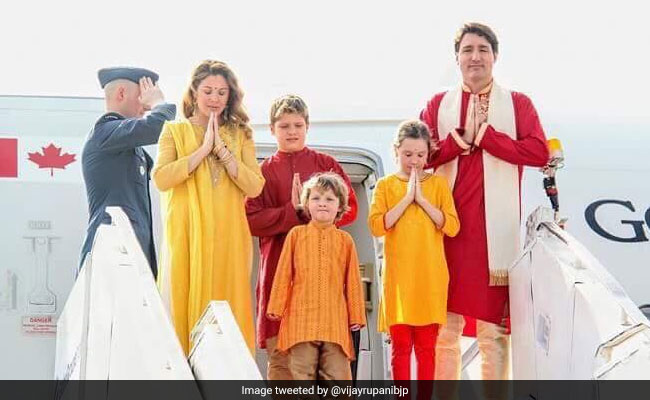
Justin Trudeau and family during India visit
Image via NDTV, originally tweeted by @vijayrupanibjp

Canadian prime minister Justin Trudeau’s visit was a disaster that has little parallel in India’s recent diplomatic history. But as the Canadian prime minister returned home on Saturday after almost a week of recurrent diplomatic missteps, ironically, it may have provided the opportunity to reset relations between Canada and India.

On Saturday, Indian government officials were angry at suggestions by Canadian officials that India was responsible for Khalistani terrorist Jaspal Atwal getting a visa to India and used his presence to embarrass Trudeau.

Trudeau, in his meeting with prime minister Narendra Modi, also complained that his visit had been shadowed by a single issue. Atwal got a visa because he was taken off the blacklist some years ago. But he was part of a number of Trudeau’s own events that did not involve the Indian government at all.

A prime ministerial visit to a foreign country for a week with a thin official component is always fraught with danger. In addition, moving the official meetings to the very end of the trip indicated that the government meetings were an after-thought. Most foreign leaders who throw in other events almost always front-load the official meetings, and then go on to business or tourism events.

Here, it was clear from the start that Trudeau came to India to score with his Sikh constituency back home — four out of the six cabinet ministers who travelled with him were Sikh, as were an overwhelming number of MPs who also travelled with him. Until the media barrage in India forced the Canadian side to change tack, Trudeau was not even ready to meet Amarinder Singh, chief minister of Punjab. Even the Canadian high commissioner’s official reception was a celebration of Punjab with the prime minister himself waltzing in on bhangra beats.

February 23, 2018

“…the Trudeaus playing ‘Mr Dressup and Family’ in exotic locations on the taxpayers’ dime isn’t the problem”

Filed under: Cancon, India, Politics — Tags: , , , , , — Nicholas @ 03:00

The press is having a hard time presenting Justin Trudeau’s India trip in a positive light, which clearly pains the teeny-bopper Trudeau fan club that composes a large part of the Canadian media. Ted Campbell sees the trip as a series of wasted opportunities to begin healing the breach between India and Canada:

I’ve taken my time in commenting on the prime minister’s trip to India. To say that I’m very disappointed is to put it mildly … I’m disappointed and a little embarrassed to be a Canadian. But the Trudeaus playing “Mr Dressup and Family” in exotic locations on the taxpayers’ dime isn’t the problem. We have, in fact, a serious problem as far as India is concerned and we, Canada, one of India’s oldest and firmest friends is in danger of being seen as an adversary. That’s a problem and it is, in my mind, a HUGE problem for Canada.

As Vishnu Prakash, former Indian envoy to Canada, told Indian news site The Print on Monday, ““Over the years, the Canadian political establishment, across the spectrum (whether it is the NDP, Conservatives or Liberals) has been mollycoddling Khalistani elements. Under the Trudeau government, this has increased. He had himself appeared on a Khalistani platform in Toronto in April last year.” It, the “mollycoddling Khalistani elements,” has been going on since at least the 1980s, back when Indira Ghandi’s government cracked down (1984) and nearly provoked a civil war and even in 1985 when Air India flight 182 was bombed, almost certainly an attack organized by Canadians, in Canada, as retaliation. Then the governments of the day spent 20 years and over $100 million on an investigation that retired Supreme Court Justice John Major described as a “cascading series of errors” by the government, writ large, including, especially, the RCMP and CSIS. India was not impressed.

India was less impressed when Canadian political parties began to actively court the Canadian the entire Indo-Canadian community but failed to condemn Sikh separatism. Canadians, including Brian Mulroney, Jean Chrétien, Stephen Harper and Justin Trudeau have “explained,” correctly, that people are allowed to support unpopular causes here in Canada, so long as they don’t break our laws, but India, not unreasonably, given Canada’s own history of separatist violence, would like something more. But the Sikh vote is active and “efficient” and all parties want it and that seems, to India, anyway, to mean turning a blind eye to the (disputed) fact assertion that the Khalistan independence movement is centred in and funded from Canada … Prime Minister Trudeau made thing worse, according to The Hindu, when “On April 30, [2017] Mr. Trudeau addressed a parade for ‘Khalsa Day’, which included floats glorifying Sikh militant leaders Jarnail Singh Bhindranwale, Amreek Singh and former General Shahbeg Singh who were killed in the siege of the Golden Temple and Operation Bluestar in June 1984.” That act appears to have crossed a line, leading to what the whole world is now interpreting as a major diplomatic snub […]

The big issue is not the rather gentlemanly snub of Justin Trudeau by India’s highest officials; our prime minister appears more interested in having an all expenses paid vacation with his family than in doing the nation’s business in any event; the real issue is the Canadian political actions that made it politically necessary for Prime Minister Modi to administer that snub at all.

What Canada needs to do now is repair relations with India, and that may require Prime Minister Trudeau to look very, very closely at any ties any of his ministers may have with the Khalistan independence movement, he says there are none, and either making them sever all ties with separatists or severing them from the Liberal cabinet, caucus and even the Party. Andrew Scheer needs to do the same with the Conservatives and Jagmeet Singh needs to speak out for national unity ~ if it’s good for Canada then it’s good for India, too. On this issue, at least, politics should indeed, stop at the water’s edge.

Of course, when you allow things like this to happen, diplomacy becomes a much trickier profession than normal:

In Britain, the Daily Mail published the comments from a lot of Indians who have been offended by Trudeau’s choices of clothing on the visit so far:

Justin Trudeau has been ridiculed on social media by Indians for his ‘tacky’ and over the top outfit choices while on his first visit to their nation as Prime Minister.

While many praised his clothing during the first two days of his trip, patience was wearing thin by the time he attended a Bollywood gala on Tuesday night, before the tide turned against him on Wednesday.

Ministers, authors, journalists and ordinary Indians lined up to mock him on Wednesday, saying his wardrobe was ‘fake and annoying’.

Perhaps taking note of the criticism, the Canadian leader donned a suit on Thursday as he visited Jama Masjid, one of India’s largest mosques.

Leading the criticism was Omar Abdullah, former chief minister of Jammu and Kashmir, who tweeted on Wednesday saying Trudeau’s preening was ‘all just a bit much.’

‘We Indians do not dress like this every day sir, not even in Bollywood.’

Bhaavna Arora, a bestselling Indian author, also chimed in, accusing Trudeau of wearing ‘fancy dress’ and saying she found it ‘fake and annoying’.

Shekhar Gupta, founder of Indian newspaper The Print also mocked the Canadian Prime Minister, accusing him of ‘running a week-long “election campaign” in India in fancy dress.’

January 5, 2018

Justin Trudeau’s PR team fumbles badly with Boyle photo-op

Filed under: Cancon, Media, Politics — Tags: , , , , , — Nicholas @ 03:00

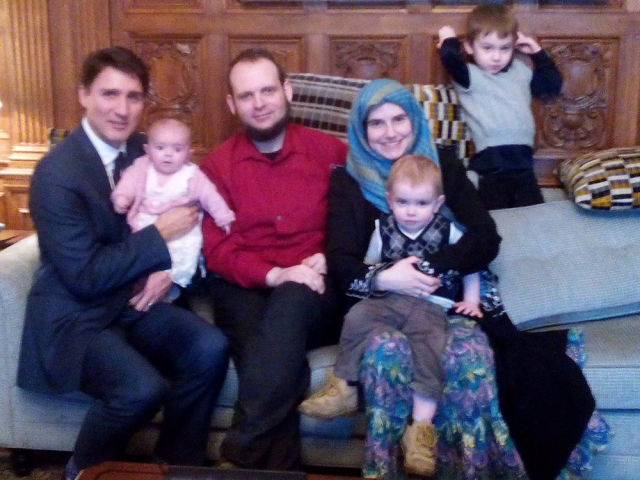
Late last year, the Boyle family were “rescued” from the Taliban and the Prime Minister not only met with them, but allowed some photos to be taken that quickly made their way out onto social media. Now that Joshua Boyle has been arrested for a long list of offenses, the PM is looking very bad indeed, as Chris Selley points out:

Prime Minister Justin Trudeau and the Boyle family in Ottawa, 18 December.

The supposed geniuses surrounding Prime Minister Justin Trudeau are capable of some very strange decisions. Arranging a meeting with Joshua Boyle and his family after their release from Taliban captivity, and agreeing to the Boyles photographing the smiling encounter — Joshua later tweeted out some snaps — is certainly one of them.

Boyle was arrested Tuesday and charged with a raft of offences including sexual assault and unlawful confinement, concerning events beginning immediately after the family’s return to Canada in early October. Trudeau met the Boyles on Dec. 18. Now photos of Trudeau beaming with the accused are all over the news. If PMO procedures somehow didn’t flag the investigation, that’s a serious concern. If they did and the meeting happened anyway, it’s horrendous political risk management at the very least.

Indeed, these were hardly the first red flags. The PMO argues it would agree to such a meeting with any released hostages — a very stupid policy if it exists, because the Boyles aren’t quite any released hostages. When the Taliban nabbed Joshua and five-months-pregnant Caitlin Coleman in 2012, they were ostensibly “backpacking in Afghanistan.” The phrase dances off the tongue a bit like “scuba diving in Yemen” or “gastronomic tour of Somalia”: not inconceivable, but the Boyles will not have been surprised to learn that some in the U.S. intelligence community were suspicious. They reportedly refused an American military flight home over fears — perfectly reasonable ones, surely — that they might wind up stuck at Bagram Airfield.

But what the heck, let’s think the best of the Boyles. Sunny ways, etc. The best still involves the unpleasant matter of Joshua’s short-lived marriage to none other than Zaynab Khadr — daughter of the late Ahmed Khadr, the Egyptian-Canadian al-Qaida financier for whom Jean Chrétien famously went to bat when he was detained in Pakistan.

[…]

Unseriousness is a serious charge against Trudeau: big hat, staff photographer, few cattle. Another non-official photo released this week shows Trudeau and his Castro-worshiping brother Sacha in matching sweaters depicting the Last Supper attended by emojis, with the words Happy Birthday strung over top. In a rather over-the-top tweet, Conservative MP Candice Bergen accused the PM of “intolerance” and of “mocking Christianity” — and no question, many Canadians might expect the prime minister to eschew such a garment lest it cause offence. (It was in private, of course, but it’s public now.) But many Canadians also might expect the prime minister to eschew such a garment because he’s the leader of a G7 country, a serious person with a serious job that he’s taking seriously.

This touchy-feely cool-dad happy-go-lucky shtick has taken Trudeau a long, long way. I very much doubt it can take him any further. And I think the backlash, when it comes, could be legendary.

December 9, 2017

The Trudeau sideshow in China

Filed under: Cancon, China, Economics, Politics — Tags: , , , — Nicholas @ 05:00

Colby Cosh on figuring out why Justin Trudeau’s trip to China didn’t end in the glory he and his handlers were clearly anticipating:

My favourite part of the fair has always been the sideshow. And when it comes to Justin Trudeau’s official visit to China, the sideshow definitely turned out to be the most interesting part of the proceedings. Interpreting the outcome of the visit involves a certain amount of old-fashioned Kremlinology, applied to both sides, but it seems fairly clear that Trudeau was gulled into providing Chinese leadership with some celebrity glamour in exchange for a big pile of nothing on Chinese-Canadian trade.

He came to China with hopes for progress on a future trade deal that would involve China accepting new labour, gender, and environment standards. But he collided with the newly aggressive Xi Jinping doctrine — a change in the official Chinese mood that insists on the country’s superpower status. China-watchers know that over the past year, in a process that culminated at the 19th Chinese Communist Party Congress in October, China has become more explicit, and more chauvinist, in claiming to pursue an independent, indigenous alternative model of economic and social progress.

[…]

Western commentators on China have, for a long time, had an implicit vision of a re-emerging bipolar world, with China in the old place of Russia as an ideological challenger to Western democracies. Xi is taking them at their word. China’s aspirations are no longer to follow or imitate the West, but to out-compete it on its own terms, without any of the untidy, politically dis-unifying elements of Western life — independent universities, newspapers that aren’t trash, multiple political parties, and the like.

Given this background, Trudeau arguably arrived in China at exactly the wrong moment. Formal talks on a China-Canada free trade agreement would have been the first ever between China and a G7 country. It turned out that there was more value for Xi in slapping the hand of friendship. The Global Times, an organ of the party’s People’s Daily newspaper network, published a cranky English-language editorial in the midst of Trudeau’s visit.

The editorial attacked the “superiority and narcissism” of Canadian newspapers, as an alternative to jabbing the prime ministerial guest in the eye personally. But it is easy enough to read between the lines. “Trade between China and Canada is mutually beneficial, more significant than the ideology upon which the latter’s media has been focusing,” wrote the tabloid’s editor, Hu Xijin. “When Canada imports a pair of shoes from China, will Canada ask how much democracy and human rights are reflected in those shoes?”

If Trudeau had been hoping to wipe away memories of his embarrassing stunt at the TPP negotiations by a Pierre-Trudeau-like Chinese breakthrough, the Chinese government clearly saw him coming a few thousand miles away and ensured that no such PR coup would be allowed.

November 17, 2017

Canada is back in peacekeeping … sorta

Filed under: Africa, Cancon, Military — Tags: , , , — Nicholas @ 03:00

Ted Campbell is not happy with the government’s “decision” on peacekeeping:

It appears that today, Prime Minister Justin Trudeau announced just about the “best thing” for him and his Liberals in the long, long, long run up to the 2019 election campaign; but it’s pretty much the worst thing he could do for Canada and the Canadian Forces and the UN. In fact: it appears to involve a handful of “penny packet” commitments ~ a “grab bag” one journalist said, none of which will do much good ~ being too small to even been noticed amongst the 75,000+ UN soldiers in Africa ~ and none of which will contribute materially to the Trudeau Liberal’s quest for a second class, temporary, powerless seat on the worthless UN Security Council.

Let’s be very clear: Canada is not “back” ~ this is a far cry from the sort of traditional UN peacekeeping that Canada did in the 1950s, ’60s and ’70s and that Justin Trudeau and many, many Canadians imagined in 2015, and it is a far cry from what Canada could do if the government really wanted to help.

[…] I suspect that too many non-military voices in too many special interest groups argued for the “penny packet” and “let the UN help decide” approach. My suspicion is that the UN simply doesn’t know how to organize or manage a complex, logistical and/or air transport mission, and the “civil society” special interests that want Canada “back” in UN peacekeeping have no idea at all about military matters or how to get the most bang for the buck.

The good news for the Liberals is that it will the autumn of 2018, at the earliest, when “negotiations” with the UN come to some sort of conclusion and, probably, early 2019 before Canada actually sends anyone into anything like harm’s way … just in time for a campaign photo-op with the PM waving good-by to some female RCAF members in baby blue berets as they board a plane bound for somewhere. And, so long as the UN doesn’t send any home in caskets the Trudeau government campaign team will be happy. But it will give Team Trudeau another chance to smugly proclaim that “Canada’s back,” and that’s all that really matters in official Ottawa late in this decade.

October 26, 2017

Bonus quote-of-the-day

Filed under: Africa, Cancon, Media, Military, Politics, Quotations — Tags: , , — Nicholas @ 05:00

In an article in the Globe and Mail, Lee Berthiaume (Canadian Press) reports that “The Trudeau Liberals may have promised to ramp up Canada’s role in peacekeeping, but new UN figures show there were fewer Canadian peacekeepers in the field last month than at any point in recent memory … [and] … The revelation comes as Canada prepares to host a major peacekeeping summit in Vancouver next month, raising fears the country will be badly embarrassed unless the numbers start rising – and fast … [because] … The intervening year [since the Liberals promised 600+ blue beret wearing peacekeepers] has instead seen a steady decrease in the number of Canadian blue helmets and blue berets deployed around the world, from 112 peacekeepers in August 2016 to 68 last month.

This is risky for Canadian soldiers because the Trudeau regime is not exactly famous for making sound, well though out, carefully crafted plans ~ witness the small business tax fiasco and democratic reform, just for examples. It is possible, even probable, that rather than be embarrassed in public the Liberals will react, as cornered rats often do, and commit troops to a dangerous, hopeless, worthless mission just to avoid yet another political humiliation. Canadian soldiers may soon find themselves in some rotten hellhole with orders to not, under any circumstances, shoot at a child soldier, not even in self defence, or do any harm to a person of colour … because the Liberals know that the media will be watching ~ platoons of journalists will be deployed, each more anxious than the next to win some prize by being the first to report on a Canadian killing a black child.

Ted Campbell, “Cornered?”, Ted Campbell’s Point of View, 2017-10-25.

October 20, 2017

Justin Trudeau’s government at the two-year mark

Filed under: Bureaucracy, Cancon, Government, Politics — Tags: , , , , , — Nicholas @ 05:00

Paul Wells nicely lists all the good things the Trudeau government has managed to do during the first two years of its mandate, then gets down to the other side of the balance sheet:

The worse continues to pile up. I see no way the rushed and timid legalization of cannabis will drain the black market and, in hardening more penalties than it relaxes, it seems certain to provide busywork for police who have been asking only to be freed up to tackle more serious problems. (An internal Ontario government memo reaches the same conclusions.)

Since it’s impossible to find anyone in the government who’s conspicuous for saying no to any proposed spending spree, it’s a near dead-lock certainty that Canada will become a nursery for white elephants — and, unless this generation of public administrators is luckier than any previous generation, for corruption, somewhere in the system.

The government’s appointments system is, as one former staffer told me this week, “just a little f–ked,” with backlogs as far as the eye can see. There’s a serious bottleneck for important decisions, with the choke point in the Prime Minister’s Office. Rookie ministers, which is most of them, are held close. Those who don’t perform are sent new staffers from the PMO: career growth comes from the centre, not the bottom.

A cabinet full of political neophytes — and there is nothing Trudeau could have done to avoid that, given how few seats he had before 2015 — has been trained to cling for dear life to talking points. The result is unsettling: most of the cabinet simply ignores any specific question and charges ahead with the day’s message, conveying the unmistakable impression they are not as bright as — given their achievements before politics — they must surely be. Or that they think their audience isn’t. I doubt this is what anyone intends, but by now it’s deeply baked into the learned reflexes of this government.

Then there is this tax mess. I’m agnostic on the policy question: in my own life I’ve been spectacularly unimaginative in organizing my finances for minimal taxation. I put all the book money into RRSPs, called my condo an office for the two years I used it as one, and that was the end of that. But the summer tax adventure has left the Liberals with their hair on fire, for two broad reasons. One is that Bill Morneau’s personal financial arrangements are becoming surreal. The other is the way the project — and especially the life stories of its stewards, Trudeau and Morneau — undermined the Liberals’ claim to be champions of the middle class.

Wells very kindly doesn’t mention the ongoing flustercluck that is our military procurement “system” (which to be fair, the Liberals did inherit from the Harper Conservatives), which has gotten worse rather than better — and only part of that is due to Trudeau’s trumpeted “No F-35s” election pledge. The Royal Canadian Navy seem no closer to getting the new ships they so desperately need (aside from the Project Resolve supply ship, which the government had to be arm-twisted into accepting), and the government hasn’t yet narrowed down the surface combatant requirements enough to select a design.

October 14, 2017

It’s not the actual dollar amount wasted, it’s what it reveals about the federal government

Filed under: Cancon, Government — Tags: , , — Nicholas @ 05:00

Colby Cosh, giving full credit for the scoop to Tom Korski, on the minor-but-revealing way the federal government treats taxpayer money:

Even as I summarize this news, I can see the potential for various kinds of carping from ad men or illustrators who don’t want their oxen gored. “Sigh, this is just business as usual.” Like hell it is: under the Conservatives the finance department used plain covers or inexpensive stock photos for the budget. This is exclusively Liberal tomfoolery.

“Okay, but the cost is perfectly reasonable for what we got!” Two hundred thou for one document, huh? Try that one out on a newspaper art director. Try it out on anyone who ever worked for a magazine, particularly one with newsstand sales that actually depended on a fancy cover.

Maybe you’re thinking, “Even if it’s a bit ridiculous, it’s ONLY $200,000 against a background of billions.” But is it? To me this is the most intriguing part of all. Blacklock’s quotes an e-mail (“It’s fresh. I love where this is going”) from someone who has the title “senior marketing advisor for the finance department”.

Am I the only one left asking, “Why the hell does the federal finance department need a marketing advisor?” The “senior” part denotes a six-figure salary, none of which is included in the cheque that was written to the nice creatives at McCann. Is the finance department a business whose revenues depend on effective advertising? Does Canada’s federal government have several finance departments contending with each other for market share?

[…]

This is the sort of use of public funds for essentially partisan purposes that we can’t throw anybody in jail for, except in my daydreams. Blacklock’s uncovered e-mails make this positively explicit: in arguing over the 2016 budget cover someone observed that, “Justin Trudeau’s election mantra was all about positivity, change, and optimism for the future. We want this budget cover to illustrate that feeling.” I would say this utterance is not quite in the tradition of our public service, except for my fear that it is a perfect expression of the real tradition.

October 9, 2017

QotD: The fall and rise of the “liberal” label in Canada

Filed under: Cancon, Politics, Quotations — Tags: , , — Nicholas @ 01:00

The word “liberal” began to encounter a well-known crisis starting in about 1980. Liberalism had become equated with feeble criminal justice, Cold War slackness, large public deficits, high taxes, squirrelly currency … the mix of outrages varied from place to place and from time to time, but the common theme was weakness. To be a liberal was to be spongy and soft-headed about Darwinian imperatives of life, foreign policy and economics.

Our federal Liberal party has, given time, addressed some of these perceptions head-on and simply outlasted others. The capital-L Liberal brand has benefited from a whole range of phenomena, from Paul Martin’s curtailment of the federal public service to Justin Trudeau beating the crap out of a Conservative senator on television and looking good doing it. Trudeau took pains to stress the presence of “liberty” in the name “Liberal,” which had become almost a forgotten secret, a coincidence of etymology. That deprived the Conservatives of some of the energy that socially liberal and libertarian fellow-travellers might have brought to the contest.

Perhaps the secret of recent history in the provinces is that conservatives are not addressing psycho-semantic problems with the term “conservative.” How many times have you heard someone say, “I’m a social liberal but a conservative on economics”? This is the default political position of most adults now, is it not? Liberalism, which is to say pluralism, has won the argument in the “social” realm of government. What once was liberalism in economics, the dirigisme that my generation was taught to think of as the “mixed economy,” has largely lost; but the people who call themselves Liberals have succeeded at extricating themselves from the reputational burden.

Colby Cosh, “Is conservatism on the way out?”, National Post, 2015-11-10.

October 6, 2017

New NDP leader Jagmeet Singh even gets the thumbs up from crusty old conservative fogey

Filed under: Cancon, Media, Politics — Tags: , , , , — Nicholas @ 06:00

That is, Singh is seen as a much bigger threat to Justin Trudeau than to “stodgy” Andrew Scheer … which, in electoral terms, might leave the Liberals and NDP fighting it out for second place in the polls and the Conservatives up near majority territory. He’s certainly teh new hotness as far as the newspapers are concerned:

The media is buzzing about Jagmeet Singh being a game changer. Campbell Clark, writing in the Globe and Mail, says that “The NDP once picked stalwarts to fight the good fight as leader. Now, they have chosen someone who might disrupt Canadian politics. Don’t underestimate the potential for Jagmeet Singh to shake things up.” Chantal Hébert, writing in the Toronto Star, says “[Andrew] Scheer has to be hoping that Singh will give Trudeau more of a run for his money, for it usually takes a divided progressive vote for the Conservatives to win power.” And Lorne Gunter, writing in the Edmonton Sun, says that “Trudeau is a paper “progressive” – a poser – compared to Singh … [and] … unlike Thomas Mulcair, Singh’s predecessor as NDP leader, Singh won’t lose core social democrat voters by running to the right of the Liberals in the next federal election the way Mulcair did in 2015 … [thus, and] … In short, Singh is a headache the Liberals never imagined having. Compared to Trudeau, he is younger (38 rather than 45), smarter, at least as well-dressed and even more of a trendy, politically correct symbol.“

“But,” Mr Gunter says, while Jagmeet’s Singh’s selection is bad news for the Liberals, it “should be good for the Tories … [because] … It should revive vote-splitting on the left. And it should allow Tory Leader Andrew Scheer, while dull, to appear as the only clear alternative to the two Big Government leaders.”

Singh isn’t likely to draw a lot of votes from the Tories, but he’s a major threat to Trudeau in exactly those mediagenic qualities that Trudeau used to such great effect in the last federal election. Justin is in danger of being out-cooled by the new guy. A lot will depend on how long the media allows Singh’s political honeymoon to last, as they will be the primary channel for the “cool duel” to play out.

August 1, 2017

Justin Trudeau and “the uncritical puffery that is passing for political journalism”

Filed under: Cancon, Media, Politics, USA — Tags: , , — Nicholas @ 03:00

In the Washington Post, Jen Gerson says that the hero worship from the US media is making it harder to hold the Prime Minister to account for his actions:

As a Canadian, I’m not surprised that the American news media and the Internet are saturated by swooning profiles. The Rolling Stone cover story “Why Can’t He Be Our President” was only the most recent example. Shortly after Trudeau was elected, Vogue fawned: “The New Young Face of Canadian Politics” — despite the fact that he was neither new nor particularly young. Business Insider noted that he looked like a “Disney prince.” Vanity Fair seems to have a Trudeau vertical. US Weekly: “Canada’s New Prime Minister is Super Hot.” He even inspired the quintessential BuzzFeed piece: “Literally Just 27 Really Hot Photos of Justin Trudeau.” CNN’s headline sums up the trend: “Justin Trudeau, ‘the anti-Trump,’ shows U.S. Canada’s progressive, diverse face,” which was a particularly impressive take, considering Trudeau is a white man and the son of a previous Canadian prime minister — making him pretty close to the embodiment of a nascent hereditary political establishment in Canada.

Please stop.

Although Trudeau has proved to be a powerful public relations coup for my country, the political erotica now streaming from the southern border is embarrassing, shallow and largely misses the mark. Trudeau is not the blue-eyed lefty Jesus, and the global affection for him — and for the progressive politics that he and this country seem to represent — presents a puerile and distorted vision of Canada and its political culture. Worse, the uncritical puffery that is passing for political journalism only makes it harder to hold the man to account.

[…]

The most stinging truth about Trudeau is that he hasn’t done much at all. He came into power an avatar of youthful Canadian optimism and has squandered one of the most extraordinary honeymoon periods any politician has had in recent memory. The best that can be said of his accomplishments is that he has tripled his promised deficits, promised deferred tax increases on the wealthy and almost legalized marijuana — although it will be up to the provinces to sort out that mess.

Trudeau promised Camelot and delivered, well, Ottawa.

Ottawa is okay. It’s better than some places and worse than others. Next to the swamp of Washington, the Rideau Canal is idyllic. But let’s not valorize the man who happens to preside over it during a time of national embarrassment for the United States. Canadians have rewarded Trudeau with mediocre poll numbers, typically hovering at between a 50 percent and 60 percent approval rating.

Yes, he’s the poster boy for Brand Canada, and a good one. Perhaps someone who is charming and affable is precisely what Canada needs as key alliances and treaties such as NATO and NAFTA come under threat. But his real talent lies not in government but in showmanship. At least on that front, that Trump and Trudeau have something in common.

« Newer PostsOlder Posts »

Powered by WordPress