Snipped from a longer post by Paul Sellers, discussing how he developed his woodworking beyond just sharing skills in person:
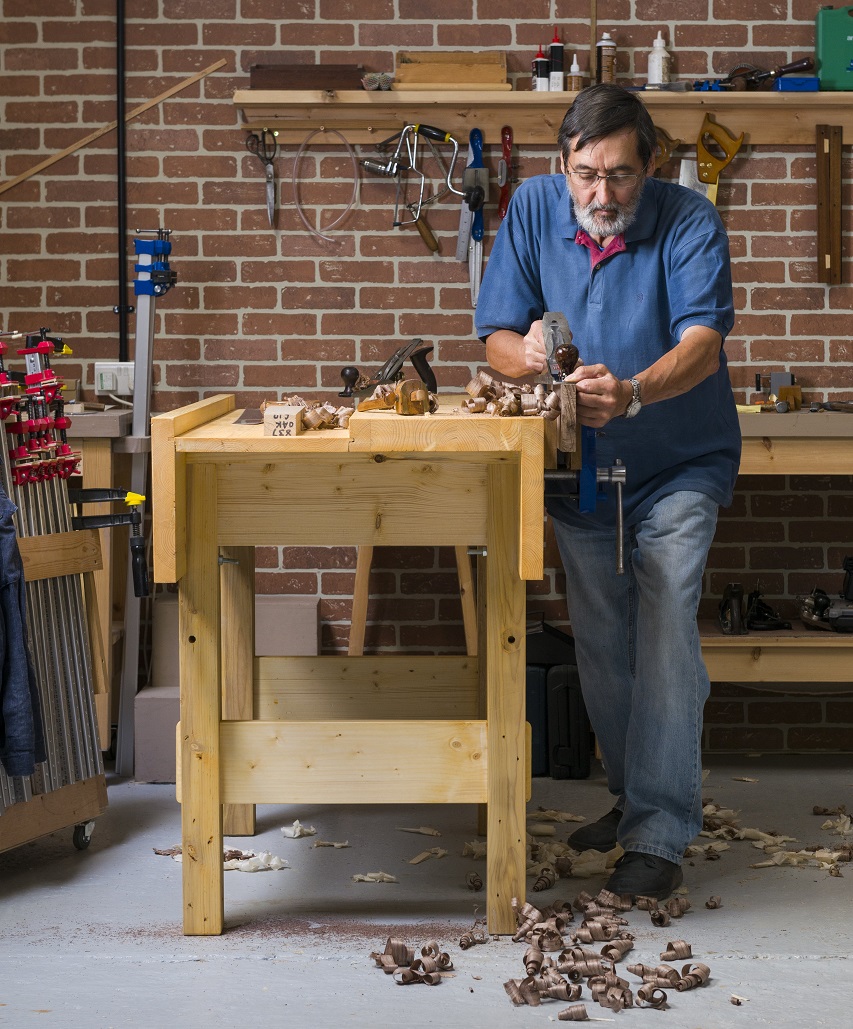
When I’m working in my shop, picking up tools, flipping wood and twisting a plane to a more effective cut, the response to my working with my hands has been something I mostly took for granted. But I became gradually aware of others watching me. I mean sometimes you just catch someone innocently watching somewhere, perhaps in a cafe or something. You glance up and catch them and they, embarrassed, look away. I became ever more conscious that people watched me working with a sort of silent fascination you to me my work was just ordinary work that I did all the time. Suddenly I realised that, ah! they’ve never seen such as this before. I saw then that people in the past three decades would be most unlikely to see such things. Even carpenters may never see or have seem a man like me recess hinges or plane the edge of a door, let alone dovetail a box corner or shape a mould to the edge of a mantle shelf with a block of wood holding a blade. Whereas it is till hard for me to imagine such a thing, it’s become a reality that 99.9% of people living in the world have never in their life seen a man like me working with his hands and working with hand tools instead of machines. To them such a thing has become as if they were watching something, well, magic. A shaving rises from the throat of a plane as if from some secretive place and by some special device and it twists away as a ribbon might flutter in a gentle breeze. It’s a spell plucked from a sorcerer’s hand book causing ribbons of pine to rise skyward before their very eyes. I might take such things for granted because I do see hundreds if not thousands of these things happen in a given day or week. They on the other hand never saw such as this before. If you’ve watched an experienced chef dice up onions with a knife live you’ll know what I mean. So it is with a chisel cut and a smoothing plane, a plough plane and a router plane.
The birth of new-genre woodworkers
When I first began my work training others, my own apprentices, young students and such, children too, it wasn’t at all that I needed more staff but that I couldn’t help myself. It’s always been the same. I never taught to make income because I always earned my income and then taught from my abilities as a producing craftsman. That’s the truth. Because I responded to the yearning of others to become crafting artisans, the outcome led to a new life. Of course they were always adult men who approached me. They wanted me to help them become one kind of woodworker or another. They would stay working with or alongside me for a year or two until they gained a level of proficiency they needed to function well and then they’d move on. Mostly there was some reciprocal gain, mostly it was always tipped in their favour not mine. In fact I would always lose money on the deal because money and making personal gain was never the reason I did it. But it was when I began teaching smaller children through to teenagers that I began seeing the deeper issues. Remember, I wasn’t a teacher being paid for the many evenings I invested in holding classes year in year out. Hundreds of children came to my classes several nights a week for two decades. I never charged a penny and let them use my own tools and supplied the wood until they acquired their own. It was a lot of work but it was such fun too. Dads and lads stood at benches from 7 till 9.30 each night and it was here that I began to see more deeply into the future possibilities of the yet unborn woodworkers be that the kids or their parents. This was an unexpected trip up. A sort of punctuation mark in my history if you will.
Mostly it was dads who came with their boys and it was here that I began to see a latent penchant in dads as they helped their sons to sharpen up chisels or reset a bumped plane. Somehow it was the need of their sons that pulled something out of the dads. You know what it’s like: something goes wrong with your child and you just can’t help yourself but pull out all of the stops to make it right. I would see the dads struggle to find an answer knowing that they might not have the answer at all, but try they might! I had to find the solution and find it I did. I started holding classes for adults so that they could reach the children that I couldn’t. People came to classes from all over the US and then they started flying in from other countries too. On the one hand it was ideal to have face to face contact this way, but on the other I knew the audience was much wider but that I could never reach them without some exponential changes being made.
So anyway, in my own small way I became something of a solution. By the end of two decades I had personally trained 5,000 woodworkers from 5 year olds to ancients through hands-on classes in beginning woodworking. It was and always has been hand tool woodworking and no one else had done such a thing on so wide a scale at that time. I knew I could steer dads to guide their sons and be a bridge for them to continue growing closer through the work in hand. Something that in my view had become increasingly lacking and today is getting far worse. Ultimately, my teaching the children meant also that the dads were gaining the same insights the kids were. Their maturer years combined with experience and strength meant that they could stay ahead of their children to help them. The outcome is more evident today than ever.