Quotulatiousness

October 25, 2014

Sharpening woodworking tools

Filed under: Technology, Tools, Woodworking — Tags: , , — Nicholas @ 09:39

Paul Sellers talks about the practical limits to sharpening woodworking tools like planes and chisels:

As I have said, we have become something of an obsessive bunch when it comes to the different elements of working wood; sharpness has become more and more obsessive. Now we are not talking about the violin maker seeking sharp levels for clear tone from the wood and who uses wood so soft, unsharp gouges and planes would bruise rather than cut the fine surfaces he strives to achieve. His standards parallel the levels needed for severing tissue by the surgeon’s hand, not the bench joiner chopping mortises and cutting a few dovetails.

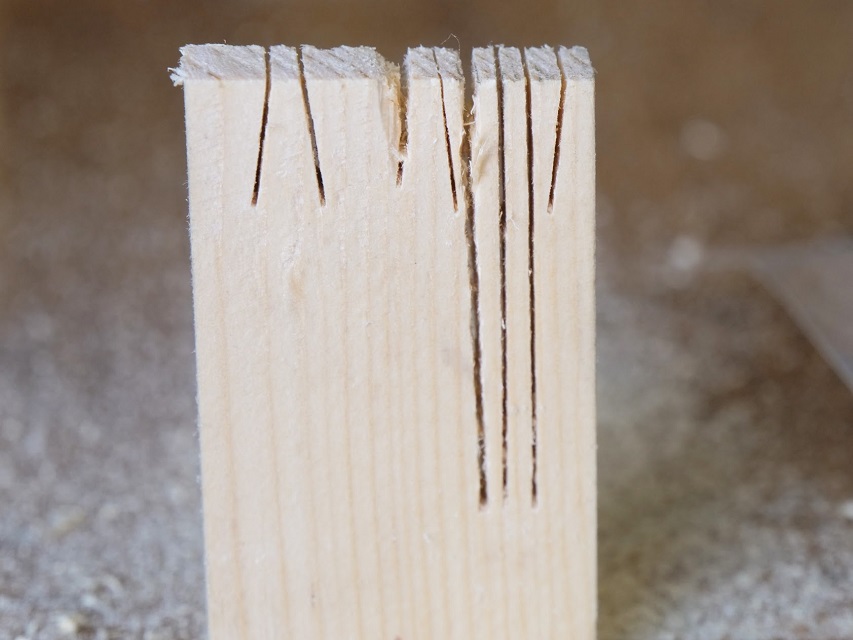
Chisel edge degradation by Paul Sellers

It’s unfortunate that since the demise of ordinary craftsmanship we now turn to guru wood writers and not wood-wrights. Woodwrights are no longer there to give us our information of course. It’s true too that the sources of information become more and more questionable. Three recent sources of information teaching on sharpening techniques I tracked back to tool catalog and online sales people selling products for sharpening. Most of the information they have is not new but regurgitated. Each phase of sharpening change marks another saleable product and so we see Japanese water stones added to carborundum stones, Arkansas stones and Washita stones and then came diamonds and abrasive films, diamond paste and flattening stones. The list goes on.

We have survived the different gospels of scary sharp and micro-bevel methodology and are emerging to this very simple reality. As long as you start the cutting edge somewhere around 30-degrees and polish it out it will cut well. If you you sharpen to around 1200-grit it will cut most anything you need in woodworking. If you sharpen to a polished edge of around 15,000-grit you can slice the most delicate of materials effortlessly, but 98% of the time that’s far from necessary. What am I saying? I’m saying that we generally sharpen to task but often sharpen to a higher level because it’s not much extra effort. We all know after a few efforts at sharpening that the greatest effort comes at the start of the process when we have to regain ground to get through a fractured and dulled edge and back to a productive cutting edge. That said, it’s not a big deal, just a few extra strokes on the coarse diamonds gets you there. So, if that is the case, why do we sharpen to higher levels than are usually needed. Well, it is a fact that the more polished the two plains forming the arête for a cutting edge are, the sharper the edge is but the stronger the edge is too. As I said, the extra effort is worth the work because it’s so quick and effective. It’s not so much what we do to the edge to establish it but what we do to the edge after we have prepared it for work. Taking the chisel to the surface of the wood to work the wood begins an immediate process of edge reduction we now know is edge fracture but was once called wear. No matter the steel, edge fracture occurs at some level but some steels fracture more readily than others. What we often do not realise is that it is impossible to find a steel that both takes and retains an edge and at the same time has a level of durability we can rely on forever. All edges wear away by fracture and constantly need restoring.

September 2, 2014

Sharpening woodworking tools

Filed under: Technology, Tools, Woodworking — Tags: , , — Nicholas @ 16:23

I’m an occasional woodworker, but I’m always aware I don’t sharpen my tools as often as I should. One of the reasons I don’t is that it’s such a hassle to sharpen them properly: it’s not as simple as sharpening a kitchen knife, and you need to spend time to work through from a coarse grit (250 or so), through medium grit (1000) and into fine (4000) or even superfine (15000 and higher). This video by Paul Sellers has persuaded me that it doesn’t have to be that way for most of the woodworking hand tools I’m likely to use:

Published on 8 Nov 2013

In this video Paul Sellers shows that you don’t need to sharpen to 15,000+ grit on you planes, chisels and other woodworking tools. 250-grit works just fine for most of our woodwork. Paul addresses the myths and misinformation put forward, and challenges what we think about sharpening.

To find out more about Paul Sellers and the work he is involved with visit http://paulsellers.com

August 26, 2013

A small note from the hand tool trade

Filed under: Business, Tools, USA — Tags: , , — Nicholas @ 08:02

In a discussion of the plight of Sears in the major appliance market, Coyote Blog mentions an earlier Sears mis-step in a different market:

Oddly, I witnessed a similar Sears private label fracas when I worked for Emerson Electric over a decade ago. For years and years, Emerson (not the folks who make the cheap radios and TVs) manufactured many of the Sears Craftsman hand tools and power tools. Sears got tough one year, and negotiated a better deal of some sort with someone else, and an entire division of Emerson saw its sales basically going to zero. So Emerson bought a bunch of orange paint and plastic, went to Home Depot, and cut a deal for a private label tool line at Home Depot (Emerson separately owns the Rigid tool company, so a lot of the items were branded Rigid). Emerson ended up in potentially better shape (I did not stay long enough to see how it turned out), partnered with a growing rather than a declining franchise.

October 20, 2010

Some combination tools work well … and then there’s this one

Filed under: Humour, Randomness, Tools, Woodworking — Tags: , — Nicholas @ 13:05

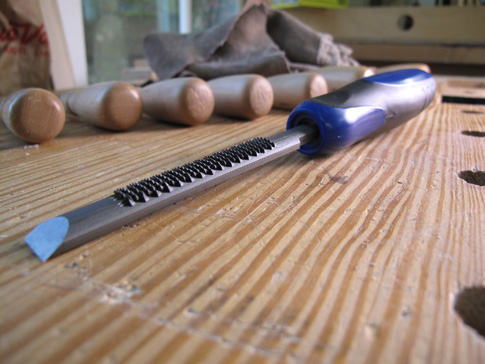
Christopher Schwarz gives in to the urge to try out a new tool that combines the rasp and the chisel in one not-so-easy-to-handle package:

Now usually when I see a tool like this I just ignore it. Boneheaded ideas like this usually end up in a mass grave with the bones of dodo birds, passenger pigeons and AMC Pacer automobiles. But a couple weeks ago I stumbled on a set of these tools for sale — new — on Amazon.

These tools must be stopped. So I bought a set of three to take a look. They are as bad as I feared.

The tools are incredibly heavy. The rasp teeth are coarse and not very aggressive. They manage to make more of a farting sound than any scratches in the wood. Of course, it doesn’t help things that you have to use the rasp one-handed — grabbing the chisel tip is ill-advised.

Or is it? The chisel edge is as sharp as Lennie from “Of Mice and Men.” And when you do pound the chisel into a piece of wood (thank you Mongo the Mallet) the tool stops dead after 1″ because the rasp teeth dig into your work.

And the worst thing of all? They are branded as Nicholson — the once-great rasp maker.

But if this tool can succeed in the marketplace for 10 years, what other opportunities are toolmakers missing out on?

September 10, 2010

More on that list of tools you don’t need

Filed under: Randomness, Tools — Tags: , — Nicholas @ 12:27

Jon, my former virtual landlord, wanted to respond to this post:

Your post — here — is amusing. I am guessing, though, that you and Sippican Cottage just don’t do certain things around the house. Taking SC’s easy ones . . .

Sledgehammer — I use mine to set stakes around trees and shrubs.

Center Punch — You don’t need the one shown in the Pop Crap article (which has a shank similar to that of a cold chisel, which makes me think the one they show there is for masonry work), but a centre punch is helpful for drilling. I punch the centres of all my drilled holes, even those that I’m doing on the drill press. I also use a centre punch when mounting hardware, such as hinges, to wood.

Combination wrench — I guess you guys don’t do any plumbing, or anything with bolts that go completely through an object. You can’t reach everything with a socket — a socket will not undo the nut on a toilet’s feed pipe (unless, of couse, you break away the toilet’s tank so that you can get to the nut from the top). And you sometimes need to hold the bolt head in place while you crank on the nut with a socket. I have a good set of combination wrenches and use them a lot on our bikes and playground equipment. I also have a cheap set that came with my socket set that’s convenient to have with the sockets, but I don’t think they will stand up to prolonged use. The socket set itself is an interesting item that would make Sippican Cottage laugh out loud: it’s a 300-some-odd-piece set with 1/4″, 3/8″, and 1/2″ drives and sockets. I see the need for 1/4″ and 3/8″ and use both frequently. If I ever need to install industrial-grade light standards or build a highway overpass, I guess the 1/2″ set will come in handy.

But hey — it was on sale!

Jigsaw — Depends on what you are doing. I use mine to rough out stuff that I am going to finish with a template on the router table. If I had a bandsaw, I’d use that instead. I did not have $700 to drop on a bandsaw, so I bought this $50 item instead.

Tin Snips — you need these if you do home repairs involving metal. I’ve used mine to repair or replace exhaust vents, install anti-bird mesh in said vents, replace the clothes dryer exhaust tubing, and to do repairs to aluminum downspouts. I’ve also used them to open those freakin’ polycarbonate clamshell packages that all electronics and toys seem to come in. They are the only way I can get into those things without slicing up my hands on the packaging.

Machinist Vise — this is the only vise I have at the moment. A real woodworker may not need one of these, but I have found mine to be handy.

I wonder how many bench planes Sippican Cottage has . . .

Humph.

As Gerard Vanderleun points out in the comments to the original Sippican Cottage post, “I love this fisking more than I love the dream of an Obama recall. It gets worse since Yahoo evidently chopped this down from the original 50 by Logan. That’s a schmo at the beginning and a know-nothing Yahoo intern chopping at the end. De-licious.

September 7, 2010

A “terrific, haphazard mess of twenty arbitrary thingamabobs”

Filed under: Humour, Randomness, Tools — Tags: , — Nicholas @ 12:57

I’m not much of a woodworker, so I don’t quite have the necessary gravitas to manage a proper takedown like SippicanCottage:

It’s a shameful pleasure of mine, I admit it. I love to read lists of tools randomly drawn from a Home Depot flyer, written by people that can’t write, aimed at people that don’t make anything but reservations. Popular Mechanics doesn’t disappoint with their: Tools Everyone Should Own. It’s a terrific, haphazard mess of twenty arbitrary thingamabobs, written in the breathless prose usually reserved for paperbacks with pictures of Fabio on their cover and the tears of countless overweight data entry clerks dappling the pages.

OK, first, let’s take care of the easy stuff:

  • Sledgehammer – You don’t need that
  • Center Punch – You don’t need that
  • Combination wrench – Singular? Never mind. The item just before it is a socket wrench set. You don’t need both. And they put an adjustable wrench on the list, too. How many nuts you got, Willis? Are they all loose?
  • Jigsaw – You don’t need that. And Jig Saw is two words.
  • Tin Snips -You don’t need those
  • Machinist Vise – You don’t need one of those

Down to fourteen.

Hmmm. What about a slightly more serious look at the PM list? Here’s my barely informed views on the suggestions:

  1. Sledgehammer. I’ve got one. I bought it for one specific job. I’ve only ever used it for that one job. Should have borrowed one from the neighbours.
  2. Center Punch. I’ve got one. Inherited it from my late father-in-law’s toolkit. Never used it.
  3. Putty Knife. I’ve got a few. Used occasionally for filling voids in plywood.
  4. Safety Glasses. SC is right: this isn’t a tool, but you should definitely use them whenever you’re waving powertools around.
  5. Adjustable Wrench. Got a few, mostly inherited. Occasionally used, but I could get by with fewer.
  6. Pipe Wrench. Got one, also inherited. Never used it.
  7. Socket Wrench Set. I have both metric and Imperial flavours. Used fairly frequently (far more than I thought when I first bought a cheap set at Canadian Tire). SC is right that if you’ve got a socket set, you should have few uses for adjustable wrenches.
  8. Combination Wrench. I have several, unmatched, in various states of rust/paint/corrosion. All inherited, and rarely used.
  9. Jigsaw. One of the first power tools I bought. Rarely used once I bought a table saw.
  10. Crosscut Saw. Once I used a Japanese saw, I scrapped all my “traditional” western saws. Cutting on the pull stroke allows a much thinner blade, and better control in use.
  11. Snips. I have some general purpose snips. They’re just oversized scissors, and not used very often in my shop. Probably more useful if you do metalwork.
  12. Needle-Nose Pliers. Yeah, okay, you probably need these.
  13. Power Drill. Yes, you need this one too. Don’t go for the biggest and best: at heart, these are simple tools and you don’t need too many “features”. Variable speed and a “pilot light” are probably all 98% ever use in the way of extras. More battery power also means more weight: unless you want the exercise, don’t go bigger than you can comfortably lift and hold without wobble or shake.
  14. Drill Bits. I don’t know why they listed this separately: what good is your power drill without drill bits?
  15. Circular Saw. I’ve got one, and use it for breaking down plywood panels pretty much exclusively (I can’t get full 4’x8′ panels down the basement stairs). If you have a table saw, you won’t use your circular saw as often.
  16. Measuring Tape. Yes, you need one. Get a good one. A metal case is probably better for general use, because it’s one tool that everyone seems to drop off the workbench every now and again.
  17. Hammer. Yes, you need one, but you won’t use it as often as you expect.
  18. Machinist Vise. No, you don’t need one, unless you’re doing metal work. I have one — bought on sale several years ago — it’s still in its original packaging.
  19. Multibit Screwdriver. Yes. Get a good one, if you can: you’ll use it a lot.
  20. Extension Cord. Once again, not really a tool, but do get a heavy duty cord for running your power tool away from the outlet: don’t use cheap household extension cords for this.

H/T to American Digest for the link.

August 12, 2009

Woodworking tools from Altoids tins

Filed under: Technology, Tools, Woodworking — Tags: , — Nicholas @ 12:09

Over at the Woodworking Magazine blog, they challenged their readers to come up with tools using Altoids tins as raw materials. The readers rose to the challenge, and then some:

Altoids router

I was worried this would happen. Some of the entrants to our contest to build a tool from an Altoids tin built tools that actually worked. Sigh. Woodworkers are so practical.

We’re also practical. And so the winner of our contest is Tom Bier, who built a working router plane from an Altoids tin. The tool is impossibly clever – you open the lid to store the iron and thumbscrew. Heck I’d buy one.

« Newer Posts

Powered by WordPress