
Stumpy Nubs
Published on 17 Jan 2016
June 14, 2018
The 3 Hand Planes Power Tool Woodworkers Should Own (How to buy handplanes)
Comments Off on The 3 Hand Planes Power Tool Woodworkers Should Own (How to buy handplanes)
June 12, 2018
How to Make a Strop | Paul Sellers
Paul Sellers
Published on 22 May 2018A strop enables you to sharpen your bladed tools to another level. Made from a simple block of ply, this quick and easy tutorial shows you how to make your own with minimal materials.
For more information on these topics, see https://paulsellers.com or https://woodworkingmasterclasses.com
Comments Off on How to Make a Strop | Paul Sellers
June 4, 2018
How to turn a No.78 into a Scrub Plane | Paul Sellers
Paul Sellers
Published on 14 May 2018Preparing rough stock can be time-consuming. A scrub plane can really help ease this process. Old ones are hard to get hold, and new ones are expensive. Paul shows how you can easily convert a No. 78 rebate plane into an excellent scrub plane.
For more information on these topics, see https://paulsellers.com or https://woodworkingmasterclasses.com
Comments Off on How to turn a No.78 into a Scrub Plane | Paul Sellers
May 5, 2018
Cabinet Scraper Honing Guide | Paul Sellers
Paul Sellers
Published on 13 Apr 2018Getting a crisp 45° bevel on your cabinet scraper can be tricky. Paul shows how to make and use a honing guide that gives you a guaranteed angle every time.
For more information on these topics, see https://paulsellers.com or https://woodworkingmasterclasses.com
Comments Off on Cabinet Scraper Honing Guide | Paul Sellers
April 21, 2018
How to Make Sawhorses Introduction | Paul Sellers
Paul Sellers
Published on 20 Apr 2018Episode 1 will be released on Monday 23rd of April 2018
Paul shows how to make a pair of sawhorses using the method he first learnt when he was 16. They are very useful around the shop for resawing stock and a many others uses. The sawhorses make use of a compound housing joint that ensures a solid construction.
THE TOOLS YOU WILL NEED ARE:
Knife
Square
Combination gauge (or marking gauge)
Tape/Ruler (or both)
Sliding bevel
Chisel hammer
Chisels (at least 1″)
Smoothing plane (No 4)
Tenon saw
*Handsaw
Hand drill and screwdriver or drill driver* = optional
JOINTS LIST:
Compound housing jointFor more information on these topics, see https://paulsellers.com or https://woodworkingmasterclasses.com
Comments Off on How to Make Sawhorses Introduction | Paul Sellers
April 15, 2018
How to Use a Hand Plane
This Old House
Published on 5 Dec 2015This Old House general contractor Tom Silva demonstrates the proper way to use hand planes. (See below for a shopping list, tools, and steps.)
Shopping List for How to Use a Hand Plane:
– Machine oil, used to lubricate sharpening stone
– Wood block, used to prevent tear-out in end grainTools List for How to Use a Hand Plane:
– Bench planes
– Specialty planes
– Block planes
– Sharpening stone, for sharpening plane irons
– Clamp, used to secure wood block to workpieceSteps for How to Use a Hand Plane:
1. Bench planes are used to flatten and smooth broad wood surfaces and narrow edges.
2. Long bench planes are best suited for smoothing very long surfaces and edges.
3. Specialty planes, such as a shoulder plane or rabbet plane, have plane irons (blades) that come flush with the edges of the tool.
4. Block planes are compact, versatile, and ideally suited for smoothing edges, small surfaces, and end grain.
5. Rotate the adjusting nut to control the depth of cut.
6. Pivot the lateral adjustment lever to square up the iron to the plane body.
7. Release the iron cap and extract the plane iron from the plane.
8. Test the sharpness of an iron by standing it on your thumbnail. If the iron slides off, it needs sharpening.
9. To sharpen a plane iron, start by applying machine oil to the coarse side of a sharpening stone.
10. Set the iron against the oiled stone with its beveled end facing down.
11. Tilt up the iron until its bevel is flush with the stone. Maintain that exact angle as you slowly rub the iron across the stone in a circular motion.
12. After a minute or two, flip over the iron and place it flat against the stone. Rub the iron back and forth to remove any burr from the back surface.
13. Next, flip the stone over to reveal its smooth surface. Apply oil and repeat the sharpening process.
14. Then raise the iron just a fraction of an inch, and make two or three passes across the stone.
15. Repeat the thumbnail test of Step 8 to check the iron’s sharpness.
16. When planing the narrow edge of a board, inspect the direction of the wood grain on the side of the board.
17. Always plane in the direction of the up-angling wood grain. Don’t plane against it.
18. Adjust the throat (mouth) of the plane to increase or decrease the gap between the plane iron and the bed of the plane. The proper adjustment will help prevent tearing out the grain.
19. Decrease the gap when planing end grain, and increase it when planing edge grain or making deep cuts.
20. When planing end grain, prevent tear-out by planing in from both ends toward the middle.
21. Another technique is to clamp a sacrificial wood block to the end of the board prior to planing. Then, any tear-out will occur in the block, not the board.
Comments Off on How to Use a Hand Plane
April 2, 2018
The amateur woodworker’s six stages of tool addiction
Christopher Schwarz explains the painful path most amateur woodworkers follow as they begin gathering tools:
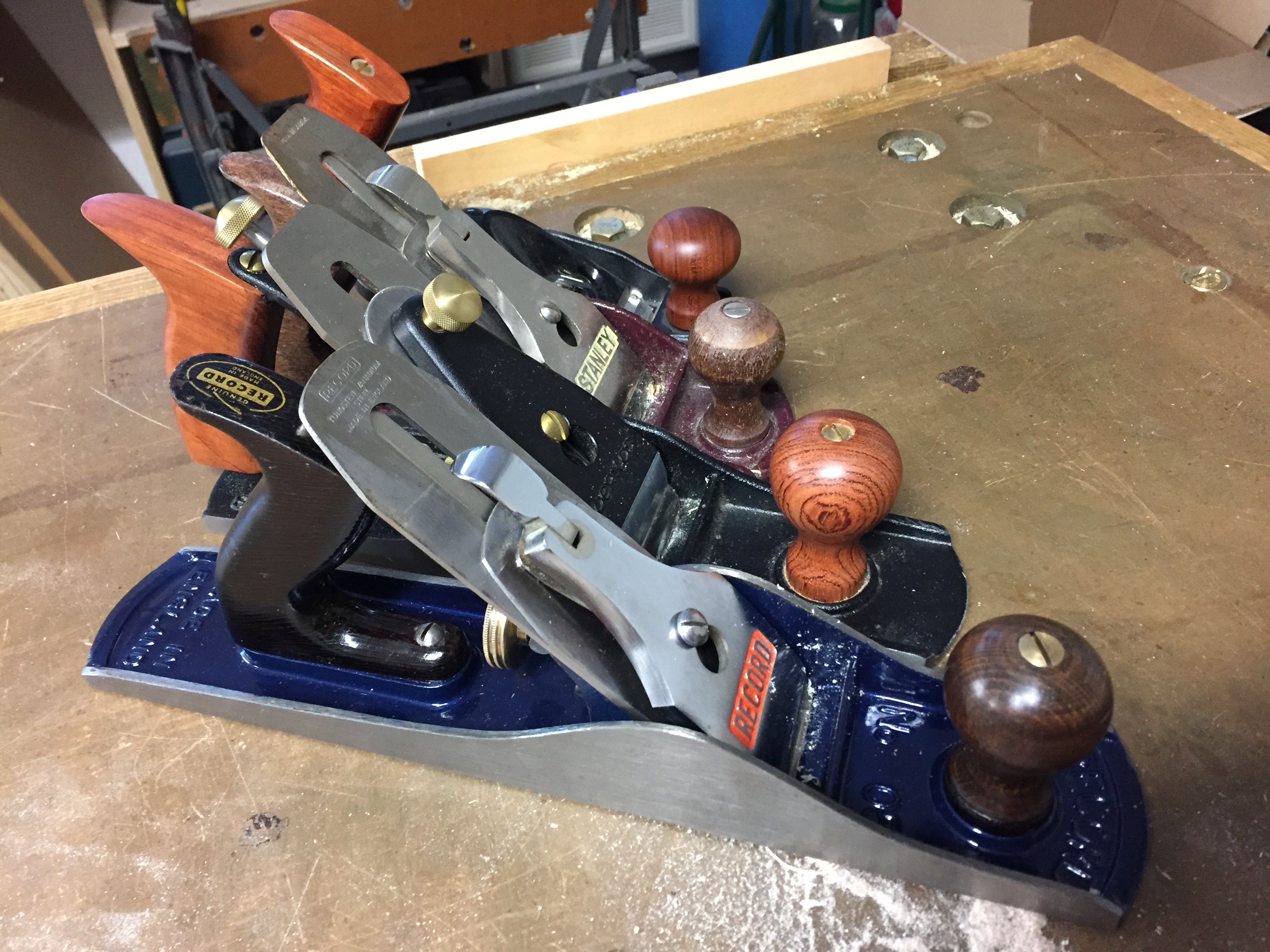
Get Tools, Any Tools
When I first decided to make furniture, I knew I needed tools. So I went to a 24-hour Walmart in the middle of the night and bought a set of tools that looked useful, including a chisel, a block plane, a level, a coping saw and a miter box saw. I had no idea how to use them, but they looked like things a furniture-maker would own (as opposed to a plumber).The next day I started to make some shutters for our house, and realized I needed other tools. So I went to the hardware store and picked up another pile of junk. This cycle continued for a long time until I decided to start reading about woodworking instead of making things up as I went along.
Obsess Over Statistics
You get every catalog out there. You find every website that sells tools and machinery. You discover tool reviews – wait there’s something better than a Walmart block plane? And you discover statistics. Table flatness, arbor runout, Rockwell hardness, the different grades of carbide.The idea is that if you can process all of these statistics, you will be able to pick the best tools to replace your dimestore tools.
[…]
Buy Jigs to Replace Skills
The next two stages are dangerous because if you get stuck in one of them, you can go bankrupt. During the “jig” phase, you start using your statistically perfect tools and realize there is something missing because your results suck.It can’t be the tool. You did all the reading, and it is the best one out there. What’s missing is skill, but you conclude that what is missing are the jigs and accessories.
Example: Your first hand-cut dovetails look terrible, so you buy a router and an entry-level commercial jig. After weeks of messing with the jig, your dovetails look better but they are so uniform that they look boring.
So you dip back into your statistics phase and read all about dovetail jigs and buy a commercial jig that allows you to variably space your tails. But this jig only has an 18” capacity, so….
[…]
Upgrade & Stockpile
As you become more skilled, you enter the most dangerous phase of all. This is the phase where you find you have some success with a tool, such as a shoulder plane, and so you buy seven examples of it to find the one you like the best. Different sizes, different grips, different makers.You upgrade your benchtop table saw because you can finally understand the benefits of a contractor or cabinet saw. You end up with four smoothing planes, six routers and a huge credit card bill. You start comparing scratch awls and screwdrivers. You divert your online tool purchases to your workplace so your spouse doesn’t notice.
On the bright side, there is hope, or as he calls it the “Great Psychic Break”, followed (for the fortunate) by the “Please, No More Tools” phase of spiritual enlightenment.
Comments Off on The amateur woodworker’s six stages of tool addiction
March 24, 2018
How to Use a Scrub Plane | Paul Sellers
Paul Sellers
Published on 23 Mar 2018Scrub planes can be used for a variety of tasks, from stock preparation and hogging off stock in preparation for the smoothing plane to refining chamfers and texturing the surface.
For more information on these topics, see https://paulsellers.com or https://woodworkingmasterclasses.com
Comments Off on How to Use a Scrub Plane | Paul Sellers
March 20, 2018
How to buy used hand planes- How much should you pay? What to look for…
Stumpy Nubs
Published on 5 Feb 2016
Comments Off on How to buy used hand planes- How much should you pay? What to look for…
March 19, 2018
What SAWS do you NEED?
Matt Estlea – Furniture
Published on 16 Oct 2017Woodworking is not a cheap hobby to get into, especially when starting off. This video will guide you through the options available in regards to saws and hopefully help you make a more suitable and informed choice.
My name is Matt Estlea, I’m a 22 year old Woodworker from Basingstoke in England and my aim is to make your woodworking less s***. I come from 5 years tuition at Rycotewood Furniture Centre and 4 years experience working at Axminster Tools and Machinery where I still currently work on weekends. During the week, I film woodworking projects, tutorials, reviews and a viewer favourite ‘Tool Duel’ where I compare two competitive manufacturers tools against one another to find out which is best. I like to have a laugh and my videos are quite fast paced BUT you will learn a lot, I assure you.
Lets go make a mess.
Comments Off on What SAWS do you NEED?
March 15, 2018
Vintage Stanley Planes: Is older really better?
Rex Krueger
Published on 25 Jan 2018Most hand tool collectors and users go way back when they get Stanley bench planes. Older ones are usually more valuable and are often considered to work better, especially when compared to later-model, post-war planes. But this wisdom is almost totally wrong. Stanley planes did start to suck in the 1960s, but the planes they made in the 1950s and before may be the best they ever made. These late-model planes have improved features, thicker castings, easier adjustment and more precise machining. And, these planes are typically ignored by collectors, so you can get them cheap.
Are you thinking about shelling out big bucks for a premium plane? Maybe first, you should check out a late-model Stanley.
Comments Off on Vintage Stanley Planes: Is older really better?
February 22, 2018
How to Read Wood Grain | Paul Sellers
Paul Sellers
Published on 2 Feb 2018What does it mean to ‘read the grain’ in woodworking? In this video Paul explains what this means, how to do it, and how it helps you achieve better, quicker results. Paul shows how some pieces of wood can simply be planed using a shallow set and a sharp plane while others need to be planed in the right direction. Sometimes wood can be planed in either direction but occasionally there are pieces of wood that are too difficult to tackle with a plane at all.
For more information on these topics, see https://paulsellers.com or https://woodworkingmasterclasses.com
Comments Off on How to Read Wood Grain | Paul Sellers
February 21, 2018
10 AMAZING things you can do with a combination square!
Stumpy Nubs
Published on 16 Feb 2018LINKS TO TOOLS SEEN IN VIDEO (clicking on these links helps support us, at no cost to you)►
iGaging combination squares (high quality, moderate price): http://www.chipsfly.com/category/RS.html
Starrett combination squares (highest quality, high price): http://amzn.to/2sC1DLU
Comments Off on 10 AMAZING things you can do with a combination square!
February 17, 2018
How to Correct New Saws | Paul Sellers
Paul Sellers
Published on 16 Feb 2018What do you have to do to a saw you’ve just bought to get it ready for work? Paul takes a few minutes to show what it takes to get as saw cutting beautifully.
For more information on these topics, see https://paulsellers.com or https://woodworkingmasterclasses.com
February 8, 2018
Stock Prep by Hand – Christopher Schwarz
Popular Woodworking
Published on 2 Feb 2017Learn how to process rough stock by hand and make it project ready – it’s not as difficult as you might think. (Excerpted from “Build a Hand-Crafted Bookcase,” by Christopher Schwarz – available at ShopWoodworking.com as a video download or DVD.)
Comments Off on Stock Prep by Hand – Christopher Schwarz


