Forgotten Weapons
Published 25 May 2017William Whiting and the Webley company had high hopes for their self-loading pistols being adopted by the British military — but they never got the success they were hoping for.
After the poor performance of the Webley 1904 (https://www.youtube.com/watch?v=-hT38…) at trials, William Whiting decided to make sure his next attempt would be fully developed before he put it in the hands of the military. He did very well at that too, as the gun which would become the Model 1913 Webley did very well from its very first military tests. The Royal Navy was, in fact, quite enthusiastic about it, although the Army was not. The Navy would ultimately adopt the gun and purchase about 8,000 of them during World War One, while the Army acquired just a couple hundred and preferred to stick to its revolvers.
Thanks to Mike Carrick of Arms Heritage magazine for loaning me these pistols to bring to you!
Cool Forgotten Weapons merchandise! http://shop.bbtv.com/collections/forg…
http://www.patreon.com/ForgottenWeapons
If you enjoy Forgotten Weapons, check out its sister channel, InRangeTV! http://www.youtube.com/InRangeTVShow
September 25, 2021
Webley 1913 Semiauto Pistol: History and Disassembly
September 19, 2021
Chassepot: Best of the Needle Rifles
Forgotten Weapons
Published 3 May 2019The Model 1866 Chassepot was France’s first military cartridge-firing rifle. It used a self-contained paper cartridge on the same basic principle as the Prussian 1841 Dreyse rifle, but was a substantial improvement on that system. The Chassepot fired an 11mm bullet at about 1350 fps (410 m/s), which was substantially higher velocity than the Dreyse. It was more accurate and had a substantially longer effective range. The French would produce about 1.5 million Chassepot rifles, most of them before the Franco-Prussian War.
Despite the quality of the Chassepot rifle, that war would go tremendously badly for the French, with hundreds of thousands of men and arms captured by the Prussians and the new German state being declared in the palace of Versailles. In the aftermath, many German cavalry units would adopt Chassepots for their own use, until the Gewehr 71 was available in carbine form. The French would resume Chassepot production briefly after the war, but would soon transition to a new rifle, the metallic cartridge firing Gras.
http://www.patreon.com/ForgottenWeapons
Cool Forgotten Weapons merch! http://shop.bbtv.com/collections/forg…
Contact:
Forgotten Weapons
PO Box 87647
Tucson, AZ 85754
September 16, 2021
Tanks Chat #124 | FV4005 Tank Destroyer | The Tank Museum
The Tank Museum
Published 23 Apr 2021David Fletcher MBE explores the experimental FV4005, with original turret and 183mm gun fitted on a Centurion Mark 12 hull.
(more…)
QotD: The youthful Utopian
More than half a century ago, I had a friend in junior high school I could never figure out or drum much common sense into. He was quite the dreamer. He loved science fiction. His nickname was “Angus” — derived from the fact that he was rather rotund, and our school was surrounded by farm fields. When we grazed at the same lunch table, he would speculate endlessly about what life on other planets might be like. He was very earnest, and very entertaining.
One day I suggested facetiously that Angus stop speculating and go find out for himself. “Build a spaceship someday and fly to the planet of your choice,” I recommended. To my surprise, he took me seriously.
Some days later, Angus excitedly told me he had it all worked out. He had designed the spaceship and even brought the plans to show me. Then he unfolded a large sheet of brown wrapping paper. There it was — the entire cockpit control panel of the craft that would take Angus to the cosmos. There was a button for everything.
“This is not a plan!” I declared with a laugh. “It’s just a bunch of buttons with labels on them.”
“But it’s all here,” Angus insisted. “I’ve thought of everything — Start, Stop, Land, Take-off, Dodge Asteroids, you name it, everything you need to know.” He even had an all-purpose button to take care of anything unexpected, which he thought was a genius innovation.
What I remember most vividly about this experience was not the fine detail of my friend’s sketch. It was my frustrating inability to convince him he was delusional, that his plan was no plan at all, that as a 14-year-old he wasn’t yet ready for a senior position at NASA. He was what philosopher Eric Hoffer might call a “true believer” — convinced beyond any hope of convincing otherwise that his plan was thorough, perfect, and sure to work.
I lost track of Angus after graduation, but I am quite certain his spaceship never left the ground.
Lawrence W. Reed, “The Dark Side of Paradise: A Brief History of America’s Utopian Experiments in Communal Living”, Foundation for Economic Education, 2021-06-13.
September 14, 2021
Sturmgewehr MP-44 Part II: History & Implementation
Forgotten Weapons
Published 27 Sep 2016Cool Forgotten Weapons Merch! http://shop.bbtv.com/collections/forg…
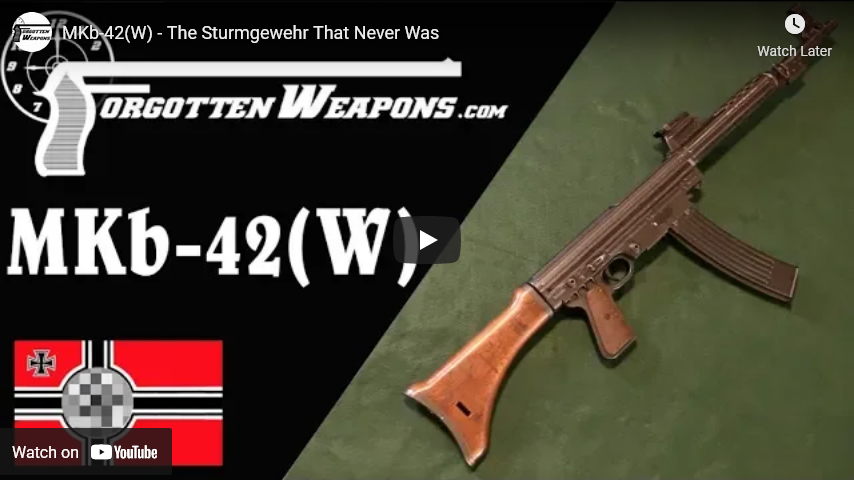
The Sturmgewehr was the result of a German intermediate cartridge development program that began in the mid-1930s. It was sidelined for a period as the focus of German Ordnance shifted to full-power rifles in 8x57mm with telescopic sights, but as the German fighting in Russia became more desperate, many Ordnance officers realized that the greater firepower offered by the Sturmgewehr concept was one of the few options that might be able to allow depleted German units to effectively hold ground against Russian attacks.
To this end, the guns were issued primarily in the East, with whole companies being equipped in order to focus a maximum amount of firepower, rather than spreading the new rifles piecemeal across all units. Ultimately, of course, this was insufficient to prevent the growing Soviet advance — but for the individual German soldier, an MP-43/44/StG-44 would have been a much more comforting weapon than a Kar98k Mauser!
September 11, 2021
Sturmgewehr MP-44 Part I: Mechanics
Forgotten Weapons
Published 27 Sep 2016The MP-43 (which is mechanically identical to the MP-44 and StG-44; the differences are the subject for another video later) is a tilting bolt rifle with a long stroke gas piston. It was manufactured primarily from complex sheet steel stampings, as a way to minimize the amount of high-quality and thus difficult to acquire steels needed for its construction. The rifle is heavy by today’s standards, but remarkably ergonomic (except for the metal handguard, when heats up quickly). Its sights come right up to the eye when shouldering the rifle, and it disassembles quickly and easily.
It really is one of the best small arms developed during World War II.
September 9, 2021
Furniture Forensics with a Country Chair
Rex Krueger
Published 8 Sep 2021This post-and-rung chair looks like trash, but it’s actually a master-class in green woodwork.
More video and exclusive content: http://www.patreon.com/rexkrueger
See More About Traditional Furniture!: (Scroll Down)
(more…)
August 26, 2021
Winchester WWII 50 AT rifle
Forgotten Weapons
Published 3 Aug 2016http://www.patreon.com/ForgottenWeapons
David Marshall Williams was hired by the Winchester company in 1939, and would have a hand in a number of major projects during his 10-year stint with the company, although best known for the M1 Carbine. The Carbine was an offshoot of the Winchester G30 and G30M rifles, which would also evolve into the G30R and Winchester Automatic Rifle. Another offshoot using this same basic mechanism was this undesignated .50 BMG semiautomatic antitank rifle developed by Winchester during World War II.
This rifle, like its developmental precursors, uses a two-lug, Garand type rotating bolt and a Williams gas tappet short stroke action. It has a 10-round detachable box magazine.
Although I have not found a testing report, the gun was apparently tested by the Canadian military and performed quite well. It was never purchased or put into serial production, however, most likely because as an antitank rifle the .50 BMG cartridge was not effective by the end of World War II.
August 25, 2021
Tanks Chats #121 | The Cascavel | The Tank Museum
The Tank Museum
Published 2 Apr 2021The Tank Museum’s Curator David Willey presents a Tank Chat on the EE-9 Cascavel, a Brazilian Armoured Car developed during the 1970s, primarily for reconnaissance. David also touches upon the EE-11 Urutu, which shares many of the Cascavel’s components. Join him to find out more.
(more…)
August 22, 2021
Mounties’ First Revolver: the NWMP Adams MkIII
Forgotten Weapons
Published 3 May 2021http://www.patreon.com/ForgottenWeapons
https://www.floatplane.com/channel/Fo…
Cool Forgotten Weapons merch! http://shop.forgottenweapons.com
The first handguns issued by the North West Mounted Police (which would later become the modern RCMP) were 330 Adams revolvers, requisitioned by the new police service in March 1874, and shipped over from England. Upon their receipt in July of that year, the Mounties were dismayed to find thoroughly worn out Adams Mk I 5-shot conversions from old percussion revolvers. These were found totally unfit for frontier service, and an appeal was sent back to England for something better.
A replacement shipment arrived in October 1875, and this time they received 326 much better Adams MkIII revolvers (330 were shipped, but 4 were stolen in transit). The MkIII pattern was a purpose-made .450 Adams cartridge revolver, holding six shots with a double action trigger and solid frame. These served very well, and the NWMP ordered more in 1880 — for which they instead received Enfield revolvers, which had replaced the Adams in British military service by that time.
The 326 Adams MkIII revolvers issued by the NWMP were marked by a local gunsmith upon their arrival. The right side of the frames are marked “C M.P.” (presumably Canada Mounted Police) and given a police inventory number just below the barrel (in addition to the serial number above the trigger). These issue numbers were defaced when the guns were sold out of service.
Contact:
Forgotten Weapons
6281 N. Oracle Box 36270
Tucson, AZ 85740
August 19, 2021
Hill SMG/Pistol: Inspiration for the FN P90
Forgotten Weapons
Published 28 Apr 2021http://www.patreon.com/ForgottenWeapons
https://www.floatplane.com/channel/Fo…
Cool Forgotten Weapons merch! http://shop.forgottenweapons.com
John L. Hill was a World War One fighter pilot [in the short-lived Canadian Air Force] who went into the oil and gas industry, and enjoyed tinkering with guns in his free time. In 1949 he got an idea for a new style of magazine and feed system, which he developed and patented in the early 1950s. Hill’s intention was to create a submachine gun for the military or police that held its magazine flat atop the action, instead of sticking out of the gun where it would get in the way. To do this, Hill designed the system that would be later used in the FN P90, with ammunition held perpendicular to the barrel, and a turret mechanism in the action to turn the cartridges 90 degrees for feeding in the chamber.
Hill built seven or eight fully automatic prototypes, which were examined by the US Army and the FBI. One was tested at Aberdeen Proving Grounds in 1953, and we still have some of the photos from that examination (that particular gun was built using an MP40 barrel, interestingly). Hill’s guns varied in pretty much all details, including different barrel lengths, stock configurations, and magazines. Some used single-stack and some double-stack magazines, but all were a simple blowback action.
At some point in the late 50s or early 60s, Hill sold his patent rights to a pair of Texas businessmen who built 90 or 100 more examples (mostly semiautomatic) under the name H&B Enterprises. They took one to FN in Belgium, who found it interesting but did not opt to license or produce it. Ultimately, nobody was interested enough to put the gun into production, and only a small number of the H&B guns survive today. The original Hill prototypes were donated to the Lone Star Flight Museum in Texas in 1993, although it is not clear where they are today.
When FN began to design the P90 in the early 1980s, Hill’s concept made a return. It is not known exactly how much direct link there was between the Hill prototype and the P90 concept, but the eventual patents filed on the P90 do reference Hill’s patents (among others). The P90 remains the only production firearm to use this clever rotary feeding system.
Hill’s patents:
https://patents.google.com/patent/US2…
https://patents.google.com/patent/US2…For more documents, see the Forgotten Weapons page on this design:
https://www.forgottenweapons.com/hill…Contact:
Forgotten Weapons
6281 N. Oracle 36270
Tucson, AZ 85740
August 18, 2021
Tank Chats #120 | Sd.Kfz. 234 Panzerspähwagen | The Tank Museum
The Tank Museum
Published 26 Mar 2021The Tank Museum’s Curator David Willey presents a Tank Chat on the Sd.Kfz. 234 Panzerspähwagen, a heavy German reconnaissance vehicle from the Second World War, and the only wheeled German armour in The Tank Museum collection. Join David as he tells you more.
(more…)
August 16, 2021
French and German Armies in 1870 – Dreyse and Chassepot Rifle Overview I GLORY & DEFEAT Week 3
realtimehistory
Published 29 Jul 2021Sign up for Curiosity Stream and get Nebula bundled in and SAVE 26%: https://curiositystream.com/realtimeh…
While the French and different German Armies are gathering we are taking the time this week to take a look at military organization and warfare in 1870. As a special guest we also have Cap And Ball on the show who introduces the famous Chassepot and Dreyse rifles which will be important in this conflict.
» THANK YOU TO OUR CO-PRODUCERS
John Ozment
James Darcangelo
Jacob Carter Landt
Thomas Brendan» OUR PODCAST
https://realtimehistory.net/podcast – interviews with historians and background info for the show.» LITERATURE
Arand, Tobias: 1870/71. Die Geschichte des Deutsch-Französischen Krieges erzählt in Einzelschicksalen. Hamburg 2018
Delpérier, Louis; Mirouze, Laurent: Der Deutsch-Französische Krieg 1870/71. Bd. 2. Uniformierung und Ausrüstung der französischen Armeen. Wien 2020
Herre, Franz: Kaiser Wilhelm I. Der letzte Preuße. Köln 1980
Milza, Pierre: L’année terrible. La guerre franco-prussienne. Septembre 1870 – mars 1871. Paris 2009
Stein, Markus; Bauer, Gerhard: Der Deutsch-Französische Krieg 1870/71. Bd. 1. Uniformierung und Ausrüstung der deutschen Armeen. Wien 2020» SOURCES
Fontane, Theodor: Der Krieg gegen Frankreich. Bd. 1. Berlin 1873
Kriegsgeschichtliche Abtheilung des Großen Generalstabs (Hg.): Der deutsch-französische Krieg 1870/71. Erster Theil. Erster Band. Berlin 1874
Pflugk-Harttung, Julius: Krieg und Sieg 1870-1871. Bd. 2 Berlin 1896» OUR STORE
Website: https://realtimehistory.net»CREDITS
Presented by: Jesse Alexander
Written by: Cathérine Pfauth, Prof. Dr. Tobias Arand, Jesse Alexander
Director: Toni Steller & Florian Wittig
Director of Photography: Toni Steller
Sound: Above Zero
Editing: Toni Steller
Motion Design: Philipp Appelt
Mixing, Mastering & Sound Design: http://above-zero.com
Maps: Battlefield Design
Research by: Cathérine Pfauth, Prof. Dr. Tobias Arand
Fact checking: Cathérine Pfauth, Prof. Dr. Tobias ArandChannel Design: Battlefield Design
Contains licensed material by getty images
All rights reserved – Real Time History GmbH 2021
August 15, 2021
Denel NTW 20: A Multi-Caliber Anti-Materiel Rifle
Forgotten Weapons
Published 7 Sep 2018http://www.patreon.com/ForgottenWeapons
Cool Forgotten Weapons merch! http://shop.bbtv.com/collections/forg…
Created by noted South African gun designer Tony Neophytou, the NTW-20 is a bolt action anti-materiel rifle made in 20x82mm, 20x110mm, and 14.5x115mm. The weapon began as idea to use the large quantities of surplus 14.5mm ammunition available at the time, and a recognition that the 14.5mm Soviet cartridge was an excellent anti-armor round, with a really remarkably high muzzle velocity. To widen the rifle’s capabilities, it was decided to incorporate an easily interchangeable barrel, and also chamber it for the 20x82mm round used in the Inkunzi PAW individual weapon and Inkunzi Strike machine gun. The 20x82mm is low velocity compared to traditional 20mm cartridges, carrying the same explosive or incendiary payload but without the punishing recoil of what was originally an aircraft cannon cartridge.
Both of these cartridges are fed from a 3-round box magazine on the left side of the action. A single-shot version in the longer 20x110mm cartridge was also developed by request of a military client, but this cartridge is too long to fit the magazine. A version in .50 BMG was considered, but decided against on the basis of the 14.5mm being just as available and substantially more effective.
The gun is liberally sprinkled with clever engineering and design features — things like using the recoil-absorbing travel of the action to recock the hammer, and the use of both 20mm and 14.5mm cartridge cases as levers for unlocking the barrel. The optic was custom made for the rifle, an 8x56mm long eye relief scope to prevent any chance of the scope bell injuring the shooter during recoil. The trigger mechanism uses only a single spring, and is easily removed from the action. The bolt handle itself is on a pivot pin, and provides the primary extraction leverage to ensure easy cycling with the high-pressure 14.5mm cartridge.
From a military perspective, the NTW-20 is easily broken apart into barrel and action loads, and can be transported more easily than any comparable weapon by a two-man team. The use of a recoil buffer in the action and an effective muzzle brake makes it a remarkably pleasant 20mm rifle to fire. Of all the anti-material rifles I have fired (Lahti L39, Solothurn S18-1000, Mauser T-Gewehr), the NTW-20 was by far the most comfortable to shoot. It was also the only one in which I jumped at the chance to fire more rounds once the filming needs were met. It certainly has a kick, but not at all a painful one.
Many thanks to Denel Land Systems for allowing me to try out this very cool rifle!
If you enjoy Forgotten Weapons, check out its sister channel, InRangeTV! http://www.youtube.com/InRangeTVShow
August 12, 2021
FN CAL: Short-Lived Predecessor to the FNC
Forgotten Weapons
Published 4 Jan 2019http://www.patreon.com/ForgottenWeapons
Cool Forgotten Weapons merch! http://shop.bbtv.com/collections/forg…
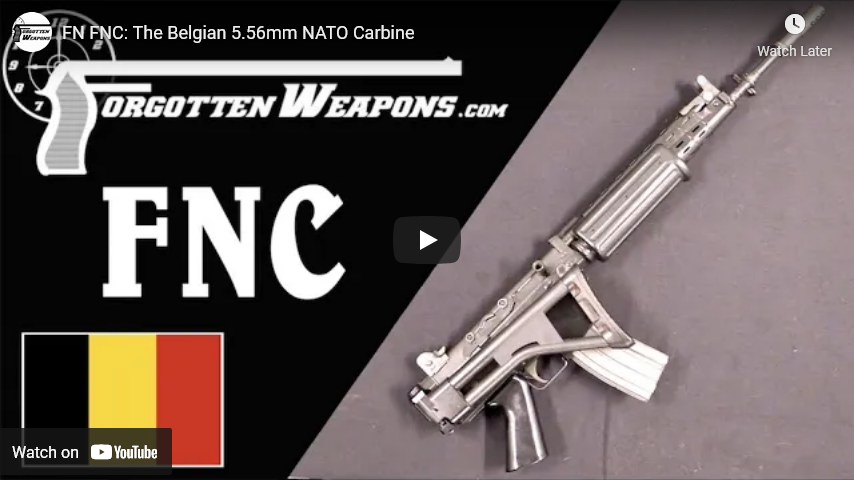
The CAL (Carabine Automatique Leger; Light Automatic Carbine) was FN’s first attempt to produce a 5.56mm rifle as a counterpart to the 7.62mm FAL. While light and handy, the CAL was a relatively complex and expensive design, and failed to garner many sales. About 12,000 were made in total before FN pulled the gun in favor of the FN FNC, which would prove to be much more successful.
Contact:
Forgotten Weapons
PO Box 87647
Tucson, AZ 85754