
I begin rather skeptical of most gun-control proposals. The ones that are pitched in the aftermath of mass shootings are particularly cynical, as they often attempt to regulate circumstances unrelated to the shooting. I still grind my teeth at Mayors Against Illegal Guns running ads in my state citing the Virginia Tech shooting, and talking about the need to shut the “gun show loophole” — even though the shooter didn’t obtain his weapons at a gun show. These sorts of arguments strike me as one part craven opportunism, one part feel-good placebo. (I wanted to say “panacea,” but panacea actually means a genuine cure-all.)
If someone wants to propose a new restriction on gun ownership after a tragedy, and cites that tragedy as a reason to pass it, it’s necessary to show how that new restriction would have prevented, mitigated, or impacted that tragedy. For example, almost none of the gun laws proposed after Newtown would have changed much of anything in that awful shooting, as that disturbed young man stole his mother’s legally purchased guns.
I suppose there are two potential changes to the law that would have significantly altered events in Newtown. First, a total ban on private ownership of firearms, which our friends in the gun-control movement keep insisting isn’t their goal.
Second, a restriction on gun ownership by people who live under the same roof as a person who’s deemed mentally incompetent or a threat to himself or others. Of course, then you get into the questions of what constitutes, “mentally incompetent or a threat to himself or others,” what constitutes “under the same roof”, etc.
Then there are the proposals to limit how many rounds each gun can fire before reloading. Almost every spree shooter — we need a better term for this — has had more than one firearm when they’ve launched their attacks. Instituting 10-round limits would mean that future shooters would get off 20 shots before pausing to reload, presuming they only brought two guns. It’s reasonable to conclude future mass killers will just bring three or four guns when they begin their rampage. This strikes me as a quite modest mitigation in the danger of these shooters, too modest to seriously consider.
Jim Geraghty, “Why Post-Shooting Gun-Control Debates Are So Insufferable”, National Review Online, 2013-09-18
November 28, 2013
QotD: The gun-control debate
November 23, 2013
Houston – sex trafficking capital of the world (says Dallas newspaper)
According to a Dallas newspaper, Houston is the focal point of a vast sex trafficking operation:
Check out this obvious crap — unbelievable to any thinking person — in the November 22 Dallas Morning News.
The Texas Senator and Representative that the paper apparently very credulously and obediently took notes from contend that there are 300,000 sex trafficking cases prosecuted every year — “in Houston alone.”
Here’s the quote from the Dallas Morning News editorial:
Editorial: Cracking down on sex traffickers
Two Texas Republicans, Sen. John Cornyn and Rep. Ted Poe of the Houston area, are co-sponsoring a bill that would impose stiff penalties on these adult victimizers of up to life in prison. The Justice for Victims of Trafficking Act, which has bipartisan support in both houses, would supplement an existing law that focuses primarily on punishing sex-trafficking organizations abroad.
Poe and Cornyn estimate that one-quarter of U.S. sex-trafficking victims have Texas roots. Poe says our state’s proximity to Mexico and high immigrant population give the state a particularly high profile. In Houston alone, about 300,000 sex trafficking cases are prosecuted each year.
Do they work butt-drunk at this paper?
300,000? Do you realize how many people that is?
[…]
Of course, Houston’s population is only 2.161 million. So, throw in my fantasy guestimate of at least 200,000 uncaught and unpunished people guilty of sex trafficking on top of the 300,000 supposedly documented. This suggests that a vast segment of Houston’s population — at least 15 percent and maybe 25 percent — is engaged in the business of sex trafficking.
Math is hard.
November 13, 2013
The end of the ASBO … and the start of something worse
In sp!ked, Patrick Hayes talks about the new social control mechanism being introduced to replace the notorious ASBO, the Injunction to Prevent Nuisance and Annoyance:
It sounds like a joke, but IPNAs — introduced in Clause 1 of the Anti-Social Behaviour, Crime and Policing Bill, which received its second reading in the House of Lords last week — really do seem quite easy to enforce. Indeed, they make their predecessors, New Labour’s notorious Anti-Social Behaviour Orders (ASBOs), seem like a level-headed intervention into community life in comparison.
The bill says that in order for an IPNA to be granted, a court needs to be satisfied ‘on the balance of probabilities that the respondent has engaged or threatens to engage in conduct capable of causing nuisance or annoyance to any person’. Once satisfied, the court can issue an IPNA in order ‘to grant the injunction for the purpose of preventing the respondent from engaging in anti-social behaviour’.
It seems that for the Lib-Con coalition government, the problem with ASBOs was not that they circumvented the normal exercise of law by dishing out behaviour-controlling orders to people who hadn’t actually committed any crime, but rather that they only covered behaviour that might cause ‘harassment, alarm or distress’. So it has introduced IPNAs, which cover everyday nuisance and annoying behaviour, too. In fact, you don’t actually have to be annoying to get an IPNA — even the threat of behaving annoyingly can earn you one of these orders that do not require criminal-law standards of proof and can instead be handed out, to anyone over 10, at a court’s convenience. If you flout an IPNA, you face up to three months in prison.
November 12, 2013
Corruption watch: US government edition
In his weekly NFL column, Gregg Easterbrook frequently has extended discussions of non-football items like this week’s quick tour of recent US federal, state, and local government agencies’ corruption news:
This column contends that corruption in government is a larger problem than commonly understood — that a reason expenditures at the federal, state and local levels keep smashing records, yet schools and bridges don’t get built, is that a significant fraction of what government spends is not just wasted, it is stolen.
Last week’s news that two senior admirals have been placed on leave on suspicion of corruption, while two Navy commanders and a senior official of the actual NCIS, not the TV show, have been arrested and charged with corruption, might be just the tip of an iceberg, to employ a nautical metaphor. Here’s a quick tour of recent corruption charges:
In federal government, a top EPA official stole nearly $900,000 from the agency, including through his expense account and by not reporting to work for months at a time yet receiving full pay. Absurdly, he was believed at the EPA when he claimed to be on assignment for the CIA. If the CIA needed an environmental specialist, there is a system by which one would be “detailed,” and the EPA would know.
Recently, an Army contractor was sentenced to 20 years in prison for stealing about $30 million using false invoices. Former congressman Jesse Jackson Jr. recently was sentenced to prison for embezzling from campaign funds; his wife was sentenced for income-tax evasion. (The campaign embezzlement did not cost taxpayers anything, the tax evasion did.)
In state government, the Securities Exchange Commission has accused the state of Illinois of pension bond fraud. The S.E.C. has charged the former head of the California state pension fund with fraud. Members of the New York Senate have been arrested on bribery charges. The lieutenant governor of Florida resigned over involvement with a fake charity.
In local government, the former mayor of Detroit just went to prison for corruption. Several members of the Washington, D.C., city council have been jailed or indicted for corruption, including one in jail for stealing from a youth-sports fund. A former California mayor just pleaded no contest to corruption charges. A former Chicago alderman just pleaded guilty in a corruption case. Chicago might be “the most corrupt city in the country,” with kickbacks and embezzlement costing Chicago taxpayers $500 million per year, a rate that works to $185 annually stolen from each resident.
[…]
In a big, complicated world, there will always be some who steal. Most public officials are honest and work hard to administer public funds properly. But we tend to think of theft in government as a problem of bygone days of bosses in smoke-filled rooms. With evermore money flowing into government, evermore corruption might be one result.
The cult of the victim
In sp!ked, Barbara Hewson explains why the “believe the victim” mantra is a “recipe for injustice”:
First, it creates an ideal climate in which those who have not been abused can claim that they have been. Second, it ignores the ease with which false memories of abuse can be created, whether by self-persuasion, interaction with victim/survivor groups, or influence by third parties with axes to grind. Those third parties may include therapists, policemen, injury lawyers, campaign groups, and journalists avid for scandal. All these players espouse the ideology of victimisation.
In 1997, the US sociologist Joel Best identified seven widely accepted propositions which, taken together, create this powerful ideology:
1) Victimisation is widespread;
2) Its consequences are fundamentally psychological, and long-lasting;
3) Victims are innocent, victimisers are exploitative, and there is no room for moral ambiguity;
4) Both society and victims themselves fail to appreciate the extent of victimisation;
5) People must be taught to recognise their own, and others’ victimisation;
6) Claims of victimisation must not be challenged, as this is ‘victim-blaming’;
7) The word ‘victim’ connotes powerlessness: the term ‘survivor’ is preferable. (1)Victims/survivors are praised for their courage, and enjoined to recover. The language of recovery is permeated by the doctrinaire religiosity of the 12-step movement, pioneered by the founders of AA in the US. This may explain why some victim-advocacy groups can sound cult-like, with their own jargon (‘grooming’, ‘trafficking’, ‘mind control’) and their disdain for non-believers.
But, like any religion, the victim/survivor movement needs new recruits and new spheres of influence. Not satisfied with sensitising society to victims’ needs, they then demand integration within institutional structures, and then wholesale institutional change. The contemporary victim industry, according to Best, mass-produces victims.
Even those who deny prior experience of victimisation are seen as candidates for conversion. Best quotes the comedienne Roseanne Barr from the early Nineties: ‘When someone asks you, “Were you sexually abused as a child?”, there’s only two answers. One of them is, “Yes”, and one of them is “I don’t know”. You can’t say no.’
What Barr alludes to is the concept of ‘gradual disclosure’. Hugely influential with therapists and social workers, this posits that people who have been abused will initially deny it, and need help to overcome their denial. This is a deeply flawed approach, because it assumes that there is always something to disclose. It refuses to countenance the possibility that a denial means there is nothing to disclose. According to researchers, there is no clinical evidence to support the theory of gradual disclosure (2).
November 7, 2013
Some guidelines on not getting arrested
In The Atlantic, Mike Riggs pulls some potentially useful advice from a book by a former FBI and police officer:
Dale Carson is a defense attorney in Jacksonville, Florida, as well as an alumnus of the Miami-Dade Police Department and the FBI. So he knows a thing or two about how cops determine who to hassle, and what all of us can do to not be one of those people. Carson has distilled his tips into a book titled Arrest-Proof Yourself, now in its second edition. It is a legitimately scary book — 369 pages of insight on the many ways police officers profile and harass the people on their beat in an effort to rack up as many arrests as possible.
“Law enforcement officers now are part of the revenue gathering system,” Carson tells me in a phone interview. “The ranks of cops are young and competitive, they’re in competition with one another and intra-departmentally. It becomes a game. Policing isn’t about keeping streets safe, it’s about statistical success. The question for them is, Who can put the most people in jail?”
Which would make the question for you and me, how can we stay out of jail? Carson’s book does a pretty good job of explaining — in frank language — how to beat a system that’s increasingly predatory.
[…]
If police want to hassle you, they’re going to, even if you’re following the above tips as closely as possible. What then? Every interaction with a police officer entails to contests: One for “psychological dominance” and one for “custody of your body.” Carson advises giving in on the first contest in order to win the second. Is that belittling? Of course. “Being questioned by police is insulting,” Carson writes. “It is, however, less insulting than being arrested. What I’m advising you to do when questioned by police is pocket the insult. This is difficult and emotionally painful.”
Winning the psychological battle requires you to be honest with cops, polite, respectful, and resistant to incitement. “If cops lean into your space and blast you with coffee-and-stale-donut breath, ignore it,” Carson writes. Same goes for if they poke you in the chest or use racial slurs. “If you react, you’ll get busted.” Make eye contact, but don’t smile. “Cops don’t like smiles.” Always tell the truth. “Lying is complicated, telling the truth is simple.”
October 24, 2013
Balancing the scales of justice
Do you remember the name Annie Dookhan? She shows up in a post called “If you’re not getting enough convictions on drug charges, tamper with the evidence at the lab“. Her case came to court recently and she was sentenced to a three-year prison term. At Popehat, Clark does a bit of math to determine whether the scales of justice are in balance here:
Before she was caught Dookhan lied about 34,000 samples.
Over 4,000 cases were tainted with her corrupt evidence.
Over 1,100 people were jailed in cases where Dookhan was the primary or secondary chemist finding them “guilty” of drug crimes.
Without knowing the exact durations of their sentences, we can’t know how many person-years of confinement Dookhan was responsible for, but taking two years as a conservative guess per person, she was responsible for 2,200 person years of confinement.
Without knowing the exact torture and abuse these 1,100 men and women underwent, we can’t know exactly how much rape and degredation Dookhan was responsible for, but given that we do know that most rape victims in the US are men, specifically men in the custody and “protection” of the State, and looking at the multiple studies that show that 9-20% of inmates are raped, we can guess that Dookhan was responsible for over 100 men and women being raped. To hand-wave further, we can guess than because “once a punk, always a punk” in the prisoner’s code, she is responsible for thousands of actual rapes.
To recap:
Ariel Castro:
- crime: 3 prisoners, 30 person years, hundreds of rapes.
- sentence: life plus 1,000 years.
Annie Dookhan:
- crime: 1,100+ prisoners, 2,200+ person years, thousands of rapes.
- sentence: three years,
October 3, 2013
The Bystander Effect in Philadelphia
Techdirt‘s Tim Cushing talks about an incident in Philadelphia where a transit police officer was losing a fight with a suspect, yet none of the people came to the assistance of the cop or even called 911:
The fact is that a certain number of citizens aren’t going to come to a cop’s defense simply because they’ve seen too much abuse occur at the hands of cops. When law enforcement struggles with an arrestee, they’re not too shy about bringing in several more officers to help out, or just sending an attack dog after them. They’re also in possession of several more weapons than most citizens carry — including pepper spray, batons, tasers and guns.
The odds are stacked in favor of police officers. When one is suddenly unable to avail himself of all the weapons at his disposal, police leadership seems to think the public should jump in and save their “heroes,” or at least call 911.
Over at PINAC’s writeup of the event, the oft-arrested/hassled photographer Carlos Miller points out why that’s a bad idea.
I admit I would be the one video recording, not necessarily because I wouldn’t want to help the cop, but because pulling out my camera and recording is very instinctive for me, while dialing 911 is anything but.
In fact, my instinct is to avoid calling 911 at all costs because I don’t trust police enough not to turn me into a suspect when they arrive, which we have seen happen numerous times in the past.
Beyond the chilly relationship between citizens and cops are further factors, legal and otherwise, that Chief Nestle isn’t considering when he expresses his shock at the public’s inaction.
First, there’s the Bystander Effect. Very basically, the more people present in a situation, the less likely that someone will offer aid. Two factors that came into play during this beatdown are empathy and the “diffusion of responsibility.” Many people simply don’t empathize with cops, even when a citizen has gained the upper hand. This disconnect leads directly to less altruistic behavior. The more someone empathizes with the victim, the more likely they are to respond. Judging from the majority of the comments under the news report, it’s very unlikely that any crowd would be filled with empathetic individuals.
October 2, 2013
September 26, 2013
Crony Capitalism and prison privatization
I’m generally in favour of moving economic activities out of the government sphere and into the competitive marketplace, but the privatization of prisons is a great example not of free enterprise but of crony capitalism run amok:
Private prisons are antithetical to a free people. Of all the functions a civilized society should relegate to the public sector, it’s abundantly clear incarceration should be at the very top of the list. Jailing individuals is a public cost that a society takes on in order to ensure there are consequences to breaking certain rules that have been deemed dangerous to the happiness and quality of life within a given population. However, the end goal of any civilized culture must be to try to keep these cost as low possible. This should be achieved by having as few people as possible incarcerated, which is most optimally achieved by reducing incidents of criminality within the population. Given incarceration is an undesirable (albeit necessary) part of any society, the idea is certainly not to incentivize increased incarceration by making it extremely profitable. This is a perverse incentive, and one that is strongly encouraged by the private prison industry to the detriment of society.
[…]
In the Public Interest describes itself as:
A comprehensive resource center on privatization and responsible contracting. It is committed to equipping citizens, public officials, advocacy groups, and researchers with the information, ideas, and other resources they need to ensure that public contracts with private entities are transparent, fair, well-managed, and effectively monitored, and that those contracts meet the long-term needs of communities.
Their report explains how private prison companies insist that states embed “occupancy guarantees” into their contracts with the public sector. They estimate that at least 65% of all private prison contracts have such guarantees, and in some states, like Arizona, the guarantee is a shockingly high 100%. This leads to overcrowding in many instances, and sometimes violent offenders are placed in prisons set up for nonviolent offenses just to fill the quotas. In the event that the beds can’t be filled, the taxpayer makes up the difference to the private prison company. They win no matter what. It’s just more crony capitalism. Below are some highlights from this excellent report.
Major Findings
- 65 percent of the private prison contracts ITPI received and analyzed included occupancy guarantees in the form of quotas or required payments for empty prison cells (a “low-crime tax”). These quotas and low-crime taxes put taxpayers on the hook for guaranteeing profits for private prison corporations.
- Occupancy guarantee clauses in private prison contracts range between 80% and 100%, with 90% as the most frequent occupancy guarantee requirement.
- Arizona, Louisiana, Oklahoma and Virginia are locked in contracts with the highest occupancy guarantee requirements, with all quotas requiring between 95% and 100% occupancy.
Update: On the topic of prison abuse, there’s an interesting post at Reason talking about the hidden-yet-pervasive practice of locking up children in solitary confinement “for their own protection”:
Solitary confinement was once a punishment reserved for the most-hardened, incorrigible criminals. Today, it is standard practice for tens of thousands of juveniles in prisons and jails across America. Far from being limited to the most violent offenders, solitary confinement is now used against perpetrators of minor crimes and children who are forced to await their trials in total isolation. Often, these stays are prolonged, lasting months or even years at a time.
Widely condemned as cruel and unusual punishment, long-term isolation for juveniles continues because it’s effectively hidden from the public. Research efforts by the American Civil Liberties Union and the Texas Criminal Justice Coalition have struggled to uncover even the most basic facts about how the United States punishes its most vulnerable inmates.
How can a practice be both widespread and hidden? State and federal governments have two effective ways to prevent the public from knowing how deep the problem goes.
The first has to do with the way prisons operate. Sealed off from most public scrutiny, and steeped in an insular culture of unaccountability, prisons are, by their very nature, excellent places to keep secrets. Even more concealed are the solitary-confinement cells, described by inmates as “prisons within prisons.” With loose record-keeping and different standards used by different states, it’s almost impossible to gather reliable nation-wide statistics.
The second method is to give the old, horrific punishment a new, unobjectionable name. Make the torture sound friendly, with fewer syllables and pleasant language. This way, even when abuse is discovered, it appears well-intentioned and humane.
So American prisons rarely punish children with prolonged solitary confinement. Instead, they administer seclusion and protective custody. Prison authorities don’t have to admit that “administrative segregation” is used to discipline children. Just the opposite, actually. It’s all being done “for their own protection.”
September 15, 2013
Why “Breaking Bad: Canada” is a ludicrous meme
Megan McArdle is a fan of the TV show Breaking Bad, but she also is fairly well informed about the US healthcare system. This means that the idea that the TV show’s Canadian counterpart would look like this…
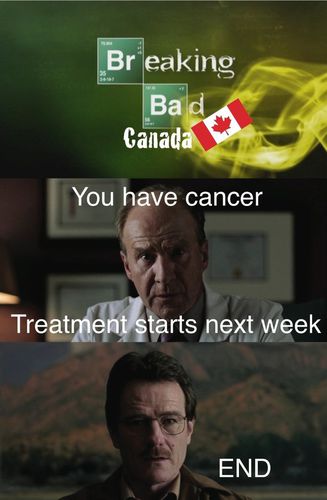
…depends on the audience for the real TV show not actually knowing much about the US system.
The series starts with Walter White, a high school chemistry teacher in Albuquerque, New Mexico, who is diagnosed with lung cancer. His lousy health maintenance organization won’t cover a decent doctor, or treatment. So Walter is forced to turn to crime just to pay his medical bills and … whoa, wait a minute. You know who has excellent benefits, compared with basically everyone else in the country? Teachers, firefighters and cops. Maybe they’re overworked and underpaid, but the one thing that you cannot say about them is that they’re forced to endure shoestring health-care plans. According to the Internet, Albuquerque school district employees are eligible for
Medical, Dental, Vision, Basic and Additional Life Insurance, Long Term Disability, Pre-tax Insurance Premium Plan (PIPP), Flexible Spending Accounts, Long Term Care Insurance, 403(b) and the 457(b) Deferred Compensation Plans.
That’s a generous package. Moreover, the Albuquerque school district self-insures, so any complaints about benefit levels should be directed at the city government, not your “lousy HMO.”
Later, after Walt’s actions accidentally result in the shooting of his brother-in-law, a Drug Enforcement Agency agent, Walt’s wife takes a bunch of the meth money to pay for Hank’s treatment. On his government salary, Hank can’t possibly afford the treatment he needs, because, of course, his lousy insurance policy won’t cover more than a few visits to the physical therapist … and whoa, we just went from “unrealistic” to “ludicrous.” You know who has even better benefits than employees enjoying a compensation package collectively bargained with a local government? Federal employees in a low-cost state such as New Mexico. Moreover, extra benefits are available to people injured in the line of duty.
In short, a number of key plot points hinge on the improbable assertion that people who actually enjoy some of the best health insurance in the country actually suffer some of the worst — so bad that we are expected to believe that Walt had no choice but to cook meth to cover the gaps. For an otherwise great show, this is incredibly silly.
September 8, 2013
Prince Andrew’s brief career as a burglar
Red faces again for the security team at Buckingham Palace:
The incident came two days after a break-in at the Palace, which is said to have left Royal protection officers “jittery”.
Prince Andrew, 53, was walking in the garden when sources claim he was ordered to the ground and asked to identify himself. Scotland Yard say that no weapons were drawn during the incident.
A Palace source told the Sunday Express: “There is a high turnover of the police on duty at the Palace but you’d think anyone would know what Prince Andrew looks like.
“It’s fair to say that to describe the Duke as unhappy and the two officers as highly embarrassed is the biggest understatement of the century.”
Police are on high alert after the biggest security breach at the Palace in 30 years, in which a man managed to scale a 12ft fence, evade dozens of armed officers, and make his way into the state rooms last Monday.
September 1, 2013
America’s hidden (true) crime rate
In a post from last year at n+1, Christopher Glazek explains why the official crime rate is failing to show the true level of violent crime in the United States:
According to government statistics, Americans are safer today than at any time in the last forty years. In 1990, there were 2,245 homicides in New York City. In 2010, there were 536, only 123 of which involved people who didn’t already know each other. The fear, once common, that walking around city parks late at night could get you mugged or murdered has been relegated to grandmothers; random murders, with few exceptions, simply don’t happen anymore.
When it comes to rape, the numbers look even better: from 1980 to 2005, the estimated number of sexual assaults in the US fell by 85 percent. Scholars attribute this stunning collapse to various factors, including advances in gender equality, the abortion of unwanted children, and the spread of internet pornography.
[…]
Statistics are notoriously slippery, but the figures that suggest that violence has been disappearing in the United States contain a blind spot so large that to cite them uncritically, as the major papers do, is to collude in an epic con. Uncounted in the official tallies are the hundreds of thousands of crimes that take place in the country’s prison system, a vast and growing residential network whose forsaken tenants increasingly bear the brunt of America’s propensity for anger and violence.
Crime has not fallen in the United States — it’s been shifted. Just as Wall Street connived with regulators to transfer financial risk from spendthrift banks to careless home buyers, so have federal, state, and local legislatures succeeded in rerouting criminal risk away from urban centers and concentrating it in a proliferating web of hyperhells. The statistics touting the country’s crime-reduction miracle, when juxtaposed with those documenting the quantity of rape and assault that takes place each year within the correctional system, are exposed as not merely a lie, or even a damn lie — but as the single most shameful lie in American life.
From 1980 to 2007, the number of prisoners held in the United States quadrupled to 2.3 million, with an additional 5 million on probation or parole. What Ayn Rand once called the “freest, noblest country in the history of the world” is now the most incarcerated, and the second-most incarcerated country in history, just barely edged out by Stalin’s Soviet Union. We’re used to hearing about the widening chasm between the haves and have-nots; we’re less accustomed to contemplating a more fundamental gap: the abyss that separates the fortunate majority, who control their own bodies, from the luckless minority, whose bodies are controlled, and defiled, by the state.
An amazing bit of information from the article is that the US government didn’t even bother collecting statistics about prison violence until 2011. They used the formal complaint rate as a proxy for the actual rate of crime committed behind bars. That was around 800 per year. When they actually started taking note, the more realistic number was produced:
In January, prodded in part by outrage over a series of articles in the New York Review of Books, the Justice Department finally released an estimate of the prevalence of sexual abuse in penitentiaries. The reliance on filed complaints appeared to understate the problem. For 2008, for example, the government had previously tallied 935 confirmed instances of sexual abuse. After asking around, and performing some calculations, the Justice Department came up with a new number: 216,000. That’s 216,000 victims, not instances. These victims are often assaulted multiple times over the course of the year. The Justice Department now seems to be saying that prison rape accounted for the majority of all rapes committed in the US in 2008, likely making the United States the first country in the history of the world to count more rapes for men than for women.
To some — especially on the right — prison rape is considered part of the expected punishment for crimes. Comedians have used the notion for jokes for decades. Perhaps now it’s time to consider that this is actually a state crime against humanity?
H/T to Marginal Revolution for the link.
August 24, 2013
Bradley Manning or Chelsea Manning
In this week’s Goldberg File, Jonah Goldberg talks about Bradley Manning’s stated desire to transition to be Chelsea Manning:
What is the best time to announce that you want to be treated like a woman? Not wanting to be a woman myself, I can only speculate. But a few possibilities come to mind. First of all, if you are, in fact, a woman. Then there might be a whole panoply of times and situations when making such a request makes sense. Like when a bunch of steak-head dudes try to include you in their fart humor. Or when they challenge you to a chicken-wing-eating contest.
So I’m talking to you dudes right now. When would it make the most sense for a guy to ask to be treated like a woman? When you’re redeeming your coupon at a day spa, maybe? Certainly, if you’re the cowardly sort, when hostage-takers on your flight announce they will release the women and children. Maybe when you’re the only “man” in your Fifty Shades of Grey book club? Or perhaps when the testosterone in the air at BronyCon stings your nostrils. Again these are only guesses. And I’m just going out on a limb here — but my gut feeling is that one circumstance you can cross off your list, one moment when you don’t want to announce you want to be treated like a dame, is when you’re about to spend 35 years in a men’s prison.
Don’t get me wrong. Some dudes can pull it off. For example, this guy (Click it! It’s funny!). But Bradley Manning just doesn’t seem like the kind of fellah that could discriminate successfully among potential suitors and sundry other gentleman callers.
Let me be clear up front, if Bradley Manning wasn’t a treasonous buffoon who materially damaged the United States of America, I’d take it a little easier on him. In fact, I’m a little squishier on this stuff than Kevin Williamson is — and he’s a libertarian.
[…]
That said, I do think that such beliefs can be very, very strongly held. I also think that as we learn more about how humans develop in utero, gender-identity confusion can have a very hard-wired component. A man thinking he’s a woman — or thinking he was supposed to be born as a woman (or vice versa) — isn’t the same thing as dabbling in Marxism in college or thinking that Van Halen was better with Sammy Hagar. It is not purely a conscious choice or matter of taste. As such it deserves some sympathy, respect, and even a little social space.
But you know who else deserves space, sympathy, and respect? The majority of Americans who don’t think the factory installed their parts wrong. For instance, the push to make unisex bathrooms or let gender-confused girls use boy’s rooms and vice versa is quite simply madness.
The vast majority of Americans — straight, gay, black, white, young, old, Christian, Muslim, Jew, Jedi, and atheist — believe that the humans with the dangly bits should use the boys’ bathroom. And yet out in California, the DOJ just settled a suit saying that this very old arrangement must now be revised to accommodate a minority of one person.
Of course I believe in individual rights and liberties. I’ve always believed democracy without guaranteed individual rights is just a clever way to organize a mob (as I like to say, in a pure democracy, 51 percent of the people get to pee in the cornflakes of 49 percent of the people). But we’re talking about a civilization here, and in a civilization you don’t hold the entire culture hostage to the ever-changing whims and desires of a handful of people.


