World War Two
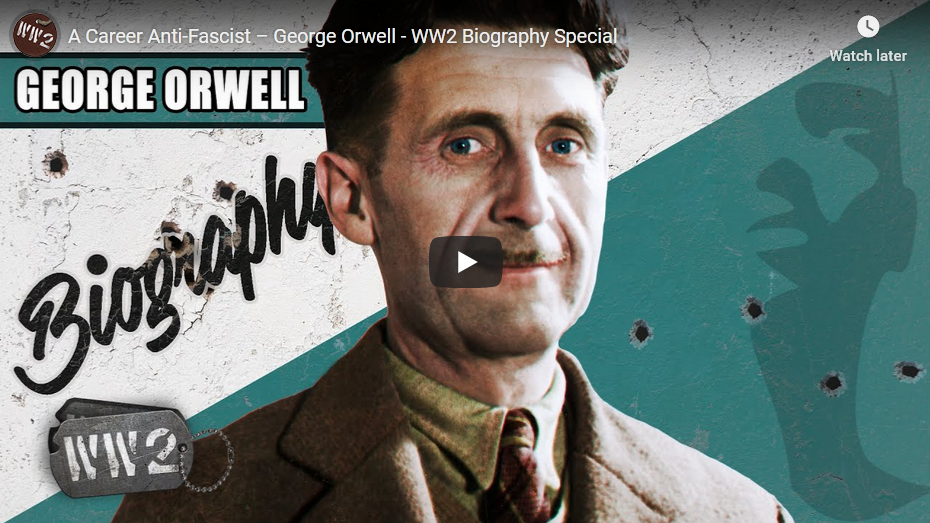
Published 6 Aug 2020George Orwell is one of the most famous English writers in the modern age. But how did he become the man who would coin so many of the words we still use in our political debates?
Join us on Patreon: https://www.patreon.com/TimeGhostHistory
Or join The TimeGhost Army directly at: https://timeghost.tvFollow WW2 day by day on Instagram @World_war_two_realtime https://www.instagram.com/world_war_two_realtime
Between 2 Wars: https://www.youtube.com/playlist?list…
Source list: http://bit.ly/WW2sourcesHosted by: Indy Neidell
Written by: Rune Væver Hartvig
Director: Astrid Deinhard
Producers: Astrid Deinhard and Spartacus Olsson
Executive Producers: Astrid Deinhard, Indy Neidell, Spartacus Olsson, Bodo Rittenauer
Creative Producer: Joram Appel
Post-Production Director: Wieke Kapteijns
Research by: Rune Væver Hartvig
Edited by: Mikołaj Cackowski
Sound design: Marek Kamiński
Map animations: Eastory (https://www.youtube.com/c/eastory)Colorizations by:
Cassowary https://www.flickr.com/photos/cassowa…
Klimbim https://www.flickr.com/photos/2215569…Sources:
Wellcome Images V0014461
Bundesarchiv
Narodowe Archiwum Cyfrowe
From the Noun Project: Pig by supalerk laipawat, Horse by supalerk laipawat, Goat by Laymik, Sheep by Laymik, Cow by supalerk laipawat, Chicken by supalerk laipawat, Farmer by Symbolon, Podium by Focus LabSoundtracks from the Epidemic Sound:
Howard Harper-Barnes – “London”
Johannes Bornlof – “Deviation In Time”
Johannes Bornlof – “The Inspector 4”
Skrya – “First Responders”
Jo Wandrini – “Puzzle Of Complexity”Archive by Screenocean/Reuters https://www.screenocean.com.
A TimeGhost chronological documentary produced by OnLion Entertainment GmbH.
August 7, 2020
From Medieval Letters Patent to our modern patents, by way of Venice
In the latest Age of Invention newsletter, Anton Howes traces the lines of descent from the Letters patent of the Middle Ages, through Venetian legal innovations, to what began to resemble our modern patent system:

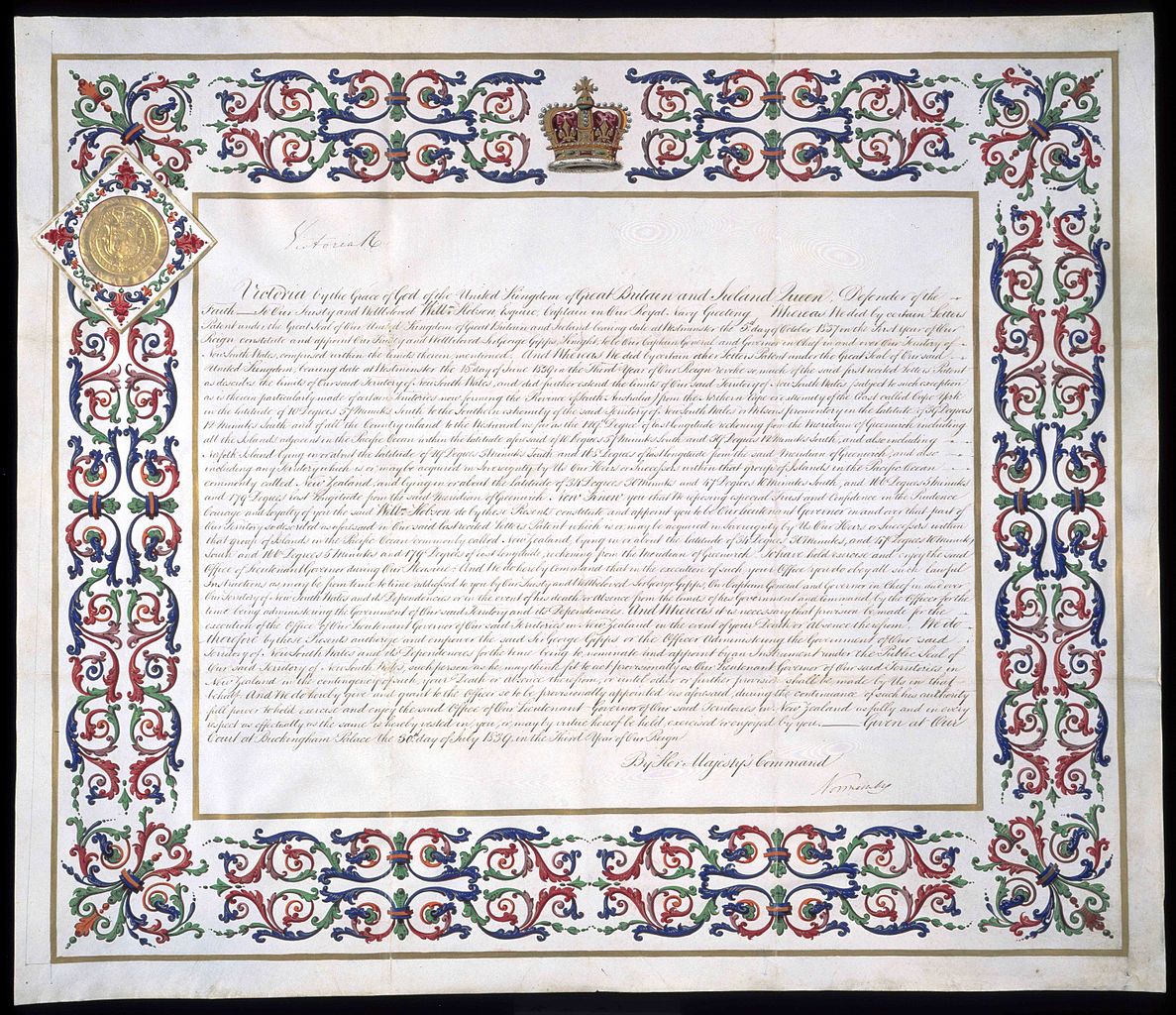
Letters Patent Issued by Queen Victoria, 1839
On 15 June 1839 Captain William Hobson was officially appointed by Queen Victoria to be Lieutenant Governor General of New Zealand. Hobson (1792 – 1842) was thus the first Governor of New Zealand. This position was renamed in 1907 as “Governor General”. Hobson arrived in New Zealand in late January 1840, and oversaw the signing of te Tiriti o Waitangi only a few days later. By the end of 1840, New Zealand became a colony in its own right and Hobson moved the capital of the colony from the Bay of Islands to Auckland. He served as Governor until his death in 1842 after he suffered a stroke at the age of 49.
Constitutional Records group of Archives NZ via Wikimedia Commons.
Patents for invention — temporary monopolies on the use of new technologies — are frequently cited as a key contributor to the British Industrial Revolution. But where did they come from? We typically talk about them as formal institutions, imposed from above by supposedly wise rulers. But their origins, or at least their introduction to England, tell a very different story.
England’s monarchs had long used their prerogative powers to grant special dispensations by letters patent — that is, orders from the monarch that were open for all the public to see (think of the word patently, from the same root, which means openly or clearly). For the most part, such public proclamations had been used to grant titles of nobility, or to appoint people to positions in various official hierarchies — legal, religious, and governmental. And, of course, letters patent could be used to promote the introduction of new technologies.
[…]
Monopolies in general, of course, over particular trades or industries had been granted for centuries, by rulers all across Europe. They granted such privileges to groups of merchants, artisans, and city-dwellers, giving them rights to organise and regulate their own activities as guilds or as city corporations. Inherent to all such charters was the ability of the in-group to restrict competition from outsiders, at least within the confines of their city. And the ruler, in exchange for granting such privileges, typically received a share of the guild’s or corporation’s revenues. But such monopolies were very rarely given to individuals. When they were, it was often so unpopular as to be almost immediately overturned. And they were rarely used to encourage innovation.
With one exception: Italy. Throughout the fifteenth century, some Italian city guilds had begun to forbid their members from copying newly-invented patterns for silk and woollen cloth, effectively granting a monopoly over those patterns to the individual inventors. In Venice, a 50-year monopoly was granted in 1416 to one Franciscus Petri, of Rhodes, to introduce superior fulling mills. In Florence, the famous architect and engineer Filippo Brunelleschi was granted a monopoly in 1421 for a vessel he designed for transporting heavy loads of marble, in exchange for revealing the secrets of his design. The printing press was also introduced to Venice using such a privilege, with a 5-year monopoly granted in 1469 to Johannes of Speyer, though he died only a few months after receiving it. And these ad hoc grants were made with increasing frequency, such that in 1474 Venice legislated to make them more systematic, declaring that 10-year monopolies could be obtained for all new technologies, either invented or imported (though it continued to also grant ad hoc patents, with the terms and durations decided on a case-by-case basis as before). Under the 1474 law, Venice was soon granting patent monopolies to the introducers of various mills, pumps, dredges, textile machines, printing techniques, and even special kinds of lasagna. It granted over a hundred patents in the first half of the sixteenth century, with many more thereafter.
From Venice, the use of patent monopolies as an instrument of policy spread abroad, with the initiative coming from the would-be introducers of novelties themselves. In the mid-fifteenth century, for example, a French inventor who had acquired patents in Venice was also successfully lobbying for similar privileges from the archbishop of Salzburg, the duke of Ferrara, and the Hapsburg Holy Roman Emperor. The use of patent monopolies thus soon diffused to the rest of Italy, to Germany, and to the various dominions of the Spanish emperor — including Spain itself, its American colonies, and the Low Countries.
And, eventually, to England. But not in the way we might expect. In 1496, the Venetian explorer Zuan Chabotto (aka John Cabot) acquired a patent monopoly from Henry VII over the trade and products of any lands he was to discover — a legal procedure unlike anything that earlier English explorers had attempted (they had merely been granted licenses). Cabot’s grant even differed from the agreements made by Christopher Columbus with the Spanish crown, or by earlier explorers for the Portuguese. Columbus, for example, was effectively granted a patent of nobility — the hereditary titles of viceroy, admiral, and governor. He and the Portuguese explorers were direct agents of the crown, with military and justice-dispensing responsibilities over any newly conquered lands — a model derived from the Christian conquests of Muslim Iberia. Columbus effectively became a marcher lord, a custodian and defender of Spain’s new borderlands.
August 6, 2020
Post WWII United Kingdom – Cold War Documentary
The Cold War
Published 11 Apr 2020Our historical documentary series on the history of the Cold War continues with a video on the post-World War II situation in the United Kingdom
Support us on Patreon: https://www.patreon.com/thecoldwar or Paypal: http://paypal.me/TheColdWar
✔ Merch store ► https://teespring.com/stores/thecoldwar
✔ Instagram ► http://www.instagram.com/thecoldwartv#ColdWar #UK #WorldWar
July 26, 2020
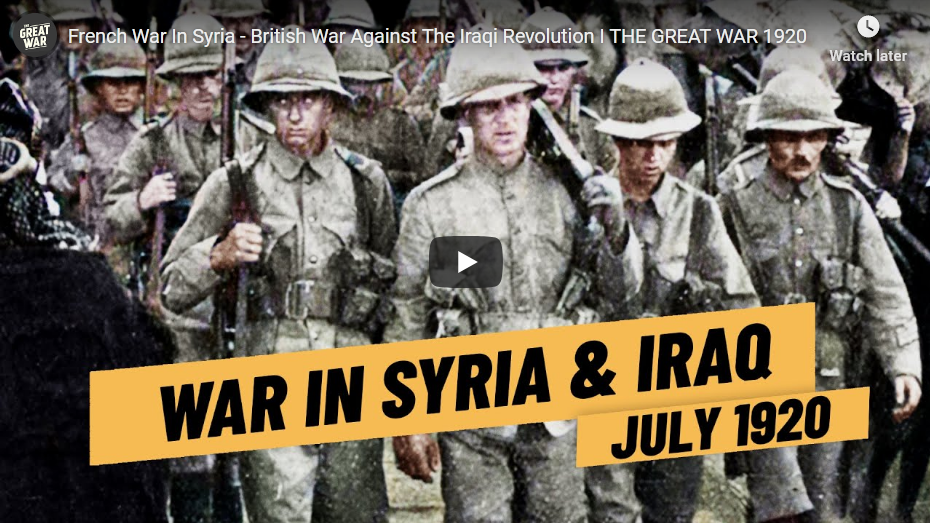
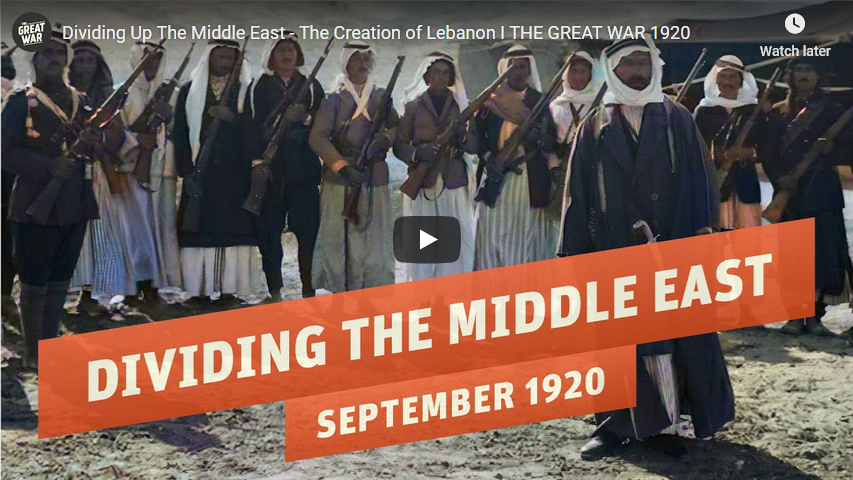
French War In Syria – British War Against The Iraqi Revolution I THE GREAT WAR 1920
The Great War
Published 25 Jul 2020Sign up for Curiosity Stream and get Nebula bundled in: https://curiositystream.com/thegreatwar
The French and British colonial powers had their own plans on how to rule the Middle East after the costly campaigns of World War 1. National self-determination for the different groups in Syria, Iraq, Palestine and Arabia were not part of these plans. And so in the summer of 1920 the situation in Iraq and Syria escalated and the French-Syrian War and the Iraqi Revolt broke out.
» SUPPORT THE CHANNEL
Patreon: https://www.patreon.com/thegreatwar» OUR PODCAST
https://realtimehistory.net/podcast – interviews with World War 1 historians and background info for the show.» BUY OUR SOURCES IN OUR AMAZON STORES
https://realtimehistory.net/amazon *
*Buying via this link supports The Great War (Affiliate-Link)» SOURCES
Kadhim, Abbas. Reclaiming Iraq: the 1920 revolution and the founding of the modern state (U of Texas Press, 2012).
Allawi, Ali. Faisal I of Iraq (Yale University Press, 2014).
Fromkin, David. A Peace to End All Peace (Macmillan, 2009 [1989]).
Naaman, Abdullah. Le Liban: histoire d’une nation inachevée.
Karsh, Efraim & Karsh, Inari. Empires of the Sand: The Struggle for Mastery in the Middle East 1789-1923, (Cambridge, MA : Harvard University Press, 1999)» MORE THE GREAT WAR
Website: https://realtimehistory.net
Instagram: https://instagram.com/the_great_war
Twitter: https://twitter.com/WW1_Series
Reddit: https://reddit.com/r/TheGreatWarChannel»CREDITS
Presented by: Jesse Alexander
Written by: Jesse Alexander
Director: Toni Steller & Florian Wittig
Director of Photography: Toni Steller
Sound: Toni Steller
Editing: Toni Steller
Motion Design: Philipp Appelt
Mixing, Mastering & Sound Design: http://above-zero.com
Maps: Daniel Kogosov (https://www.patreon.com/Zalezsky)
Research by: Jesse Alexander
Fact checking: Florian WittigChannel Design: Alexander Clark
Original Logo: David van StepholdContains licensed material by getty images
All rights reserved – Real Time History GmbH 2020
July 21, 2020
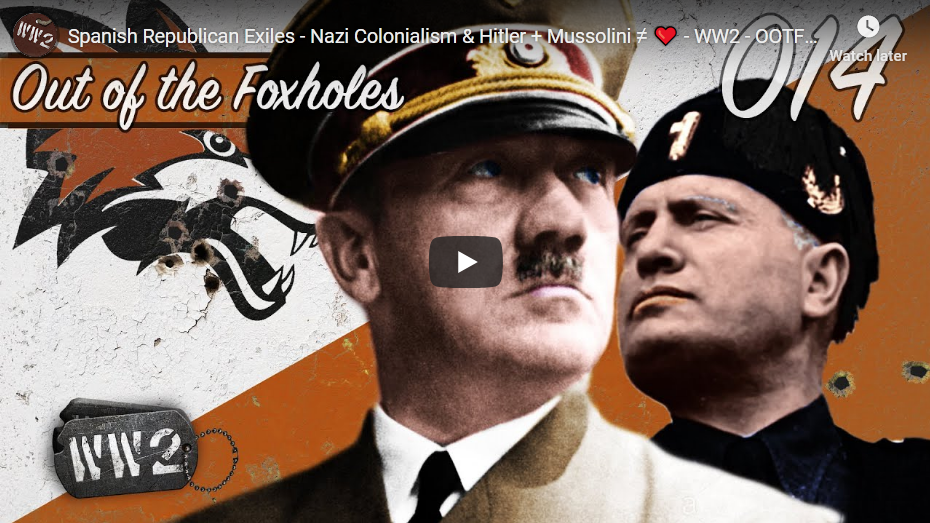
Spanish Republican Exiles – Nazi Colonialism & Hitler + Mussolini ≠ ❤️ – WW2 – OOTF 014
World War Two
Published 16 Jul 2020What did Spanish Republicans do during the Second World War? How would the Axis have divided Africa? And did Hitler plan to keep Mussolini around after the war? Find out as Indy and the Chair of Infinite Knowledge answer three more intriguing questions in this episode of Out of the Foxholes!
Join us on Patreon: https://www.patreon.com/TimeGhostHistory
Or join The TimeGhost Army directly at: https://timeghost.tvSubmit your own question for Out of the Foxholes here: https://community.timeghost.tv/c/Out-…
Follow WW2 day by day on Instagram @World_war_two_realtime https://www.instagram.com/world_war_two_realtime
Between 2 Wars: https://www.youtube.com/playlist?list…
Source list: http://bit.ly/WW2sourcesHosted by: Indy Neidell
Written by: Rune Væver Hartvig
Director: Astrid Deinhard
Producers: Astrid Deinhard and Spartacus Olsson
Executive Producers: Astrid Deinhard, Indy Neidell, Spartacus Olsson, Bodo Rittenauer
Creative Producer: Joram Appel
Post-Production Director: Wieke Kapteijns
Research by: Rune Væver Hartvig
Edited by: Karolina Dołęga
Sound design: Marek Kamiński
Map animations: Karolina DołęgaVisual Sources:
Bundesarchiv
US Holocaust Memorial Museums
Library of Congress Geography and Map Division
Nasjonalbiblioteket from Norway
Icons from The Noun Project by: Milinda Courey, Eucalyp, Luis Prado, Gan Khoon Lay, DonBLC, Pavel N and Rigo PeterMusic:
“Deviation In Time” – Johannes Bornlof
“Superior” – Silver Maple
“Underlying Truth” – Howard Harper-BarnesArchive by Screenocean/Reuters https://www.screenocean.com.
A TimeGhost chronological documentary produced by OnLion Entertainment GmbH.
July 5, 2020
History Summarized: Colonial India
Overly Sarcastic Productions
Published 4 Jul 2020Start your free trial at http://squarespace.com/overlysarcastic and use code
OVERLYSARCASTICto get 10% off your first purchase.Indian History has always been a story of peoples coming and going, but the subcontinent’s modern history takes that up to 11, with the arrival of Central Asian Mughals and boatloads of Europeans. See how India transforms from Medieval to Modern in this final act of our History of India.
SOURCES & Further Reading: The Discovery of India by Jawaharlal Nehru, A History of India by Michael H. Fisher (a lecture series by The Great Courses).
This video was edited by Sophia Ricciardi AKA “Indigo”. https://www.sophiakricci.com/
Our content is intended for teenage audiences and up.Special thanks to Varda Alighieri for coaching me through my (hopefully serviceable) pronunciations!
PATREON: https://www.Patreon.com/OSP
MERCH LINKS: https://www.redbubble.com/people/OSPY…
OUR WEBSITE: https://www.OverlySarcasticProductions.com
Find us on Twitter https://www.Twitter.com/OSPYouTube
Find us on Reddit https://www.Reddit.com/r/OSP/
June 19, 2020
Anglo-Dutch Wars | 3 Minute History
Jabzy
Published 25 Apr 2015First, Second and Third Anglo-Dutch Wars. I left out the Fourth War because it really wasn’t connected to the previous 3.
Also – I hope you don’t mind I used ‘Netherlands’ throughout the video despite the fact the term didn’t come until much later.
June 15, 2020
African History Disproves Guns Germs and Steel by Jared Diamond
The Cynical Historian
Published 26 Oct 2019There’s a question in the history profession that if sufficiently answered could not only reshape how we conceive ourselves, but reveal the best course of action for politics around the world. What makes the West strong? While there are many answers, the most popular of these has been Jared Diamond’s Guns Germs and Steel. You’ll see his argument all over the place, including a NatGeo documentary. But of course it has its detractors, to the point that some historians consider it pseudo-history. Now I think that’s going too far, but there are enough problems with his thesis that we can’t take it as the final answer to these questions. So let’s talk about that.
————————————————————
errata
10:32 – not “Blaut’s theory” but “Diamond’s theory” (thx PunkSci)
————————————————————references:
James M. Blaut, Eight Eurocentric Historians: The Colonizer’s Model of the World, Volume Two (New York: The Guilford Press, 2000), 149-172. https://amzn.to/2YFt0iQMichael C. Campbell and Sarah A. Tishkoff, “African Genetic Diversity: Implications for Human Demographic History, Modern Human Origins, and Complex Disease Mapping,” Annual Review of Genomics and Human Genetics 9 (22 September 2008): 403-433.
Jared Diamond, Guns Germs and Steel: The Fates of Human Societies (New York: WW Norton, 1997). https://amzn.to/2GK6AqI
Martin W. Lewis and Karen E. Wigen, The Myth of Continents: A Critique of Metageography (Berkeley: University of California Press, 1997). https://amzn.to/2H0ylv7
Richard York and Philip Mancus, “Diamond in the Rough: Reflections on Guns, Germs, and Steel,” Human Ecology Review 14, no. 2 (2007): 157-162.
https://thetruesize.com
————————————————————
Support the channel through PATREON: https://www.patreon.com/CynicalHistorianLET’S CONNECT:
Subreddit: https://www.reddit.com/r/CynicalHistory/
Discord: https://discord.gg/Ukthk4U
Twitter: https://twitter.com/Cynical_History
May 21, 2020
1949: Death and Sovereignty | The Indonesian War of Independence Part 5
TimeGhost History
Published 20 May 2020The Dutch reconquered most of the Indonesian cities on Java and Sumatra, but the Indonesian War of Independence continues as the international community grows tired of the Dutch attitude.
Join us on Patreon: https://www.patreon.com/TimeGhostHistory
Hosted by: Indy Neidell
Written by: Isabel Wilson and Joram Appel
Director: Astrid Deinhard
Producers: Astrid Deinhard and Spartacus Olsson
Executive Producers: Astrid Deinhard, Indy Neidell, Spartacus Olsson, Bodo Rittenauer
Creative Producer: Joram Appel
Post-Production Director: Wieke Kapteijns
Research by: Isabel Wilson and Joram Appel
Edited by: Karolina Dołęga
Maps: Ryan Weatherby
Sound design: Marek KamińskiColorizations:
Carlos Ortega Pereira (BlauColorizations) – https://www.instagram.com/blaucoloriz…Bibliography: https://bit.ly/IndoSources
Image Sources:
Nationaal Archief
Tropenmuseum, part of the National Museum of World Cultures
Journal of the Humanities and Social Sciences of Southeast Asia
Tukangpulas – https://www.instagram.com/tukangpulas…The icons from The Noun Project by Adrien Coquet
Archive by Screenocean/Reuters https://www.screenocean.com.
A TimeGhost chronological documentary produced by OnLion Entertainment GmbH.
From the comments:
TimeGhost History
1 day ago
We have seen two colonial offensives, two peace agreements, civil wars and multiple foreign interventions. And yet, 1949 is the most deadly year of the entire Indonesian War of Independence. And, without spoiling the episode, stuff doesn’t end in 1949. Indonesia will stay the stage of revolts, colonialism, civil war and ideological purges for decades to come. We won’t get to cover that in these series, as these are exclusively about the Indonesian War of Independence from 1945 to 1949. We might revisit the area in the future though. If you want to support that, and share in the decision of what series to make next, you can support us on www.patreon.com/timeghosthistory or https://timeghost.tv.
Cheers, Joram and Izzy
May 14, 2020
1948: The Dutch vs. the USA – 2nd Police Actions | The Indonesian War of Independence Part 4
TimeGhost History
Published 13 May 2020The international community forces the Dutch to end their first colonial offensive with the Renville Agreement. However, as the Dutch, the Indonesian Republicans and the multiple other groups continue fighting, an impasse devolops.
Join us on Patreon: https://www.patreon.com/TimeGhostHistory
Hosted by: Indy Neidell
Written by: Joram Appel
Director: Astrid Deinhard
Producers: Astrid Deinhard and Spartacus Olsson
Executive Producers: Astrid Deinhard, Indy Neidell, Spartacus Olsson, Bodo Rittenauer
Creative Producer: Joram Appel
Post-Production Director: Wieke Kapteijns
Research by: Joram Appel and Isabel Wilson
Edited by: Karolina Dołęga
Sound design: Marek KamińskiColorizations:
Dememorabilia – https://www.instagram.com/dememorabilia/
Carlos Ortega Pereira (BlauColorizations – https://www.instagram.com/blaucoloriz…
Jaris Almazani (Artistic Man) – https://instagram.com/artistic.man?Research Sources: https://bit.ly/IndoSources
Visual Sources:
Nationaal Archief
National Archives NARA
Tropenmuseum, part of the National Museum of World CulturesIcons from the Noun Project by Wonmo Kang, Creative Mania & Claudia Revalina
Archive by Screenocean/Reuters https://www.screenocean.com.
Music:
“Other Sides of Glory” – Fabien Tell
“Remembrance” – Fabien Tell
“Sailing for Gold” – Howard Harper-Barnes
“Last Point of Safe Return” – Fabien Tell
“It’s Not a Game” – Philip Ayers
“Moving to Disturbia” – Experia
“March Of The Brave 10” – Rannar Sillard
“March Of The Brave 9” – Rannar SillardA TimeGhost chronological documentary produced by OnLion Entertainment GmbH.
May 9, 2020
History Summarized: The Meiji Restoration
Overly Sarcastic Productions
Published 8 May 2020Japan may well have the record for World’s Speediest Industrialization, but how did they accomplish so much so fast without falling victim to Europe’s favorite 19th century pastime of “Colonization”? And how did Japan build up a Pan-Asian empire so darn quickly? All that and more in this deep-dive into the Meiji Restoration!
SOURCES & Further Reading:
Modern Japan: A Very Short Introduction by Goto-Jones.
The Japanese Empire: Grand Strategy from the Meiji Restoration to the Pacific War by Paine.
Bushido: The Soul of Japan by Nitobe.THAT WACKY POLITICAL CARTOON: “Japan Makes Her Debut Under Columbia’s Auspicies” https://tile.loc.gov/storage-services…
This video was edited by Sophia Ricciardi AKA “Indigo”. https://www.sophiakricci.com/
Our content is intended for teenage audiences and up.
PATREON: https://www.Patreon.com/OSP
DISCORD: https://discord.gg/h3AqJPe
MERCH LINKS: https://www.redbubble.com/people/OSPY…
OUR WEBSITE: https://www.OverlySarcasticProductions.com
Find us on Twitter https://www.Twitter.com/OSPYouTube
Find us on Reddit https://www.Reddit.com/r/OSP/
May 7, 2020
1947: From Dutch Boy to Murderer – 1st “Police Actions” | The Indonesian War of Independence Part 3
TimeGhost History
Published 6 May 2020The Dutch are desperate to regain control over their colony as the Lingadjatti Treaty failed to deliver. They launch a brutal military offensive which they mask as “police actions” in an attempt to satisfy the international community.
Join us on Patreon: https://www.patreon.com/TimeGhostHistory
Hosted by: Indy Neidell
Written by: Joram Appel
Director: Astrid Deinhard
Producers: Astrid Deinhard and Spartacus Olsson
Executive Producers: Astrid Deinhard, Indy Neidell, Spartacus Olsson, Bodo Rittenauer
Creative Producer: Joram Appel
Post-Production Director: Wieke Kapteijns
Research by: Joram Appel and Isabel Wilson
Edited by: Karolina Dołęga
Sound design: Marek KamińskiColorizations:
Carlos Ortega Pereira (BlauColorizations) – https://www.instagram.com/blaucoloriz…
Dememorabilia – https://www.instagram.com/dememorabilia/
Jaris Almazani (Artistic Man) – https://instagram.com/artistic.man?ig…
KlimbimResearch Sources: https://bit.ly/IndoSources
Visual Sources:
Nationaal Archief
Tropenmuseum, part of the National Museum of World Cultures
Archive by Screenocean/Reuters https://www.screenocean.com.Music:
“Last Point of Safe Return” – Fabien Tell
“Guilty Shadows 4” – Andreas Jamsheree
“Epic Adventure Theme 4” – Håkan Eriksson
“Symphony of the Cold-Blooded” – Christian Andersen
“Disciples of Sun Tzu” – Christian Andersen
“March Of The Brave 10” – Rannar Sillard – Test
“Remembrance” – Fabien Tell
“Moving to Disturbia” – Experia
“Deflection” – Reynard Seidel
“Heroes On Horses” – Gunnar Johnsén
“Not Safe Yet” – Gunnar Johnsen
“Ominous” – Philip Ayers
“Last Point of Safe Return” – Fabien Tell
“Epic Adventure Theme 4” – Håkan Eriksson
“Walk With Legends” – Bonnie Grace
“Epic Adventure Theme 4” – Håkan ErikssonA TimeGhost chronological documentary produced by OnLion Entertainment GmbH.
May 4, 2020
History Summarized: The Maya, Aztec, and Inca
Overly Sarcastic Productions
Published 29 Jul 2017Human sacrifice, smallpox, and the Spanish empire … that’s the whole story, right? Haha, eheh, hehe, HA, not even close! The civilizations of Mesoamerica are fascinating in their own right, and very distinct from each other too! Step on in and I’ll learn you a thing or two.
Also no spoilers, but next time, I’m covering the Iroquois Confederation! Ok, maybe that was exactly a spoiler. [Reposted here.]
This video was produced with assistance from the Boston University Undergraduate Research Opportunities Program.
PATREON: www.patreon.com/user?u=4664797
MERCH LINKS:
Shirts – https://overlysarcasticproducts.threa…
All the other stuff – http://www.cafepress.com/OverlySarcas…Find us on Twitter @OSPYouTube!
April 30, 2020
1946: Kill and Only Kill – Death to Colonialism | The Indonesian War of Independence Part 2
TimeGhost History
Published 29 Apr 2020The Indonesian War of Independence is heavily fuelled by the gangs of youngsters who go by the name of Pemuda. They engage in clandestine guerrilla fighting as their revolution takes a violent turn.
Join us on Patreon: https://www.patreon.com/TimeGhostHistory
Hosted by: Indy Neidell
Written by: Isabel Wilson and Joram Appel
Director: Astrid Deinhard
Producers: Astrid Deinhard and Spartacus Olsson
Executive Producers: Astrid Deinhard, Indy Neidell, Spartacus Olsson, Bodo Rittenauer
Creative Producer: Joram Appel
Post-Production Director: Wieke Kapteijns
Research by: Isabel Wilson and Joram Appel
Edited by: Karolina Dołęga
Sound design: Marek KamińskiColorizations:
Dememorabilia – https://www.instagram.com/dememorabilia/
Jaris Almazani (Artistic Man) – https://instagram.com/artistic.man?ig…
Carlos Ortega Pereira (BlauColorizations) – https://www.instagram.com/blaucoloriz…Research Sources: https://bit.ly/IndoSources
Sources:
Tropenmuseum part of the National Museum of World Cultures
Nationaal Archief
Imperial Wars Museum: SE7034; SE5663Music:
“Deviation In Time” – Johannes Bornlof
“Disciples of Sun Tzu” – Christian Andersen
“Epic Adventure Theme 4” – Håkan Eriksson
“Guilty Shadows 4” – Andreas Jamsheree
“Last Point of Safe Return” – Fabien Tell
“Magnificent March 3” – Johannes Bornlöf
“March Of The Brave 10” – Rannar Sillard
“The End Of The World 2” – Håkan Eriksson
“The Inspector 4” – Johannes Bornlöf
“The Unexplored” – Philip Ayers.
“Try and Catch Us Now” – David CelesteArchive by Screenocean/Reuters https://www.screenocean.com.
A TimeGhost chronological documentary produced by OnLion Entertainment GmbH.
From the comments:
TimeGhost History
1 day ago (edited)
For the research of this episode about Indonesian revolutionary culture in 1946, I mostly turned to the diaries and writings of those who were there. Reading the untouched experiences was so absorbing and allowed for writing a bottom-up narrative. Something that didn’t make it into the video was the work of Chairil Anwar, a poet who died young a few years after the War of Independence. Dwelling about the life and death of the individual during the revolution, his poetry defied Indonesia’s antagonists. In his poem “Notes for 1946”, he writes of how it felt to be among the young generation of Indonesia: “We – running dogs, hunting hounds – we get to see only a moment of this drama we play in.” I’d definitely recommend reading his work if you’re interested!
Cheers, Izzy.
April 23, 2020
1945: Japan Joins the Allies | The Indonesian War of Independence Part 1
TimeGhost History
Published 22 Apr 2020In Indonesia, following the end of the Second World War catalyses the end of brutal Japanese rule. Their exit prompts the Dutch to begin restoring their prewar colonial status over the archipelago. But nationalist spirits are brewing, their opportunity to proclaim Indonesian independence is transpiring.
Join us on Patreon: https://www.patreon.com/TimeGhostHistory
Watch the Prologue to the Indonesian War of Independence series right here: https://youtu.be/IkKJSRaeOik
Hosted by: Indy Neidell
Written by: Isabel Wilson and Joram Appel
Director: Astrid Deinhard
Producers: Astrid Deinhard and Spartacus Olsson
Executive Producers: Astrid Deinhard, Indy Neidell, Spartacus Olsson, Bodo Rittenauer
Creative Producer: Joram Appel
Post-Production Director: Wieke Kapteijns
Research by: Isabel Wilson and Joram Appel
Edited by: Karolina Dołęga
Sound design: Marek KaminskiColorizations:
Dememorabilia – https://www.instagram.com/dememorabilia/
Jaris Almazani (Artistic Man) – https://instagram.com/artistic.man?ig…Sources:
Archive by Screenocean/Reuters https://www.screenocean.com.
Tropenmuseum, part of the National Museum of World Cultures
Imperial War Museum Arts: Ronald Searle, SE5895 , SE-5865, SE5663, SE5724
RijksmuseumMusic:
“Deviation In Time” – Johannes Bornlof
“Last Point of Safe Return” – Fabien Tell
“Deflection” – Reynard Seidel
“Disciples of Sun Tzu” – Christian Andersen
“Split Decision” – Rannar Sillard
“Other Sides of Glory” – Fabien Tell
“Last Man Standing 3” – Johannes Bornlöf
“Magnificent March 3” – Johannes Bornlöf
“Deviation In Time” – Johannes BornlofA TimeGhost chronological documentary produced by OnLion Entertainment GmbH.
From the comments:
TimeGhost History
1 day ago (edited)
For the last decades, writing colonial histories on events such as the Indonesian War of Independence has been a difficult task. Due to the incriminating nature of the events, records were either never made or have been regularly “lost” since. Political interest in the events was minimal in both The Netherlands and Indonesia, but times are changing. In recent years, a lot more research power has been allocated to this topic by Dutch and Indonesian Universities and Research collectives. Finding colonial truths is a huge focus of academia right now and their work has allowed us to get real with colonialism in this series. We’re sure that even more sources and stories will surface in the coming years, allowing for more books and documentary such as ours to be made. We’re interested to hear what you think about this episode! Make sure to let us know in the comments!Cheers,
Izzy