Quotulatiousness

July 9, 2014

Britain’s latest moral panic enters the “proposing bad law” stage

Filed under: Britain, Law, Media — Tags: , , , , — Nicholas @ 08:40

Iain Martin says it’s now gotten to the point “where it is permissible to mention George Orwell and his novel Nineteen Eighty-Four“:

Peter Wanless, the chief executive of the NSPCC, said earlier: “If someone consciously knows that there is a crime committed against a child, and does nothing about it because they put the reputation of the organisation above the safety of that child, that should be a criminal offence.”

“Consciously knows.” There’s an interesting phrase. It seems that the NSPCC sees this sanction applying only to people in positions of responsibility. But how can that be defined fairly in law? Will the new law only apply to the chief executive of a health trust, but not to the finance director or to the head of communications? It would be impossible to define such a law so narrowly. In time it would have to apply to anyone working in any organisation. And, surely it must also apply to anyone who comes into contact with said organisation and who might have heard that a crime has been committed? People often think they “consciously know” something when they have actually only heard it third-hand. If the idea is established that failure to pass on a wild rumour to the police is somehow illegal, it is not difficult to imagine what could go wrong.

[…]

If it is to become a crime to fail to report suspicions that child abuse is taking place, why should the new law not to be extended in time to all other areas of criminal activity? It could become illegal to fail to report to the police if you suspected that a fellow citizen had committed a crime, or might be about to. As someone wise on Twitter put it earlier: the historical precedents of states making it compulsory for citizens to report on their fellow citizens are not encouraging.

July 8, 2014

Understatement of the day – “Britain in the Seventies was a very weird place”

Filed under: Britain, Law, Media — Tags: , , , , , , — Nicholas @ 08:42

In the Telegraph, Iain Martin tries to put this summer’s British media hysteria/witch hunt into a bit of perspective:

Anyone who expresses astonishment about the wave of recent revelations and allegations centred on the conduct of assorted entertainers and celebrities from the Seventies must have been lacking access to a television set, if they are genuinely shocked. In that decade, and on into the Eighties, even the most successful and least funny comedy programme rested mainly on one joke, which involved a man in a raincoat chasing around bikini-clad young women. Back then the work of Benny Hill was regarded as family entertainment, and groping, sexual incontinence and jokes about the corruption of innocence were the staples of countless other comedians. It would be surprising – really, wouldn’t it? – if a minority of twisted, power-crazed people working in “entertainment” intent on sexual abuse hadn’t exploited the opportunity to do terrible harm.

Britain in the Seventies was a very weird place. The sexual revolution (largely an elite project of the Sixties, which did not go mainstream until later) had produced a bizarre popular culture hybrid. In the Seventies, the British saucy postcard tradition, always darker than it looked, featuring cheeky innuendo, collided with a crazed mood of supposed sexual liberation. The message pushed out in some sitcoms and other forms of popular entertainment was that everyone was permanently at “it” and that any woman resisting “it” was a prude or a relic of a bygone era. Questions of license, consent and desirability became hopelessly confused. This was the dark flip side of the numerous benefits which came with the abandonment of the old, stifling constraints imposed on both sexes.

To make matters even more hazardous, Britain in the Seventies was a country wobbling on the verge of a transition. The population’s over-reliance on deference and a blind faith in the virtues of authority had already been tested in the Suez disaster and in the Profumo scandal of 1963, although it had not collapsed entirely. Parents still operated on the assumption that fellow adults in positions of power were likely to be trustworthy, and the majority were. But thanks to scandals revealed since involving schools, churches, children’s homes, the BBC, the Scouts and so on, we know that some individuals and networks of paedophiles exploited that trust, again to do terrible harm.

The hound pack of the media is in full cry, and that urge to convict before trial is overwhelming common sense and propriety.

But increasingly we seem less interested in due process – as a protection against miscarriage of justice or to prevent a bad precedent being established – than we do in the excitement of the moment and urgent demands for a government “inquiry” which must usually be “over-arching”. These inquiries are now an industry in themselves, although curiously the one area that probably deserved it (the banking collapse presided over by the political class which triggered the worst downturn in 80 years) was not given a proper inquiry. Funny that.

On Westminster child abuse, the risk was identified by Claire Fox speaking on BBC Radio 4’s Today Programme earlier. She said that rumour is already becoming confused with evidence. All manner of claims are now being aired and reported as though they are fact. “Twenty members of the Establishment,” “ministers” and unnamed “leading figures” are accused of dark and sinister deeds. Alongside those making genuine allegations, anyone with a claim will get on air at the moment, any crank or fantasist who wants to attract attention or settle scores will cry that they are being ignored or suppressed if the broadcasters will not give them a platform immediately. It would be a brave BBC producer who would decline right now.

July 5, 2014

Did Rolf Harris face a kangaroo court?

Filed under: Britain, Law, Media — Tags: , , , , — Nicholas @ 09:59

I didn’t follow this particular case (or any of the recent British witch-hunting expeditions against former celebrities), but this post makes it seem as if at least some of the charges Harris was convicted of were remarkably flimsy:

Rolf Harris has been convicted and for many that is conclusive proof of his guilt. However, we should not forget that the British justice system is not perfect, it can make errors, as these high profile miscarriages of justice show.

I do not know if Rolf Harris committed the crimes he was accused of. However, I find the fact that he was convicted, based on the evidence reported by the BBC, alarming.

Let me explain why:

    COUNT ONE – VERDICT: GUILTY

    “The woman said she was aged seven or eight when she queued to get an autograph from Harris at a community centre in Hampshire in 1968 or 1969. When she reached the front of the queue, Harris had touched her inappropriately with his “big hairy hands”, she told the jury.

    The court heard that no evidence could be found that Mr Harris had been at the community centre. He also showed his hands to the jury and denied they were hairy.”

When they say that no evidence could be found that Mr Harris had been at the community centre, they don’t mean a cursory glance turned nothing up. They searched local newspaper archives between January 1967 and May 1974, council records and even conducted letter drops appealing for witnesses. Nothing, not a single piece of independent evidence that he was ever there!

It is hard to see how the uncorroborated recollection of an event alleged to have happened 45 years ago, when the witness was eight, can constitute proof beyond reasonable doubt.

On another count of which Harris has been found guilty by the court:

So the accuser couldn’t remember when it happened (or how old she was), she couldn’t remember where it happened and yet the jury found her 36 year old memory of the indecent assault to be evidence beyond a reasonable doubt!

When we talk about the indecent assault we are not talking about something so traumatic, like rape, that it would understandably be burned into her memory. We are talking about a 17 year old having her bottom touched in the 1970′s, a time where bottom pinching was considered mainstream enough for popular TV shows such as Are You Being Served and on billboards for respectable brands such as Fiat.

Again, nobody who wasn’t there can be sure what Rolf Harris did or didn’t do in this case, but I know that there is an £11m incentive for people to make up accusations and without any corroborating evidence there has to be a reasonable doubt in favour of the accused.

I have no idea whether Harris is actually guilty of the accusations, but I’m astonished a court could convict based on such flimsy evidence. Clearly, at least in high profile media-related cases, the presumption of innocence has been replaced by a presumption of guilt.

July 3, 2014

QotD: The death of nuance

Filed under: Media, Quotations, USA — Tags: , , , — Nicholas @ 00:01

… American liberalism culture is now synonymous with a juvenile Manicheanism that imagines some perfect world we could achieve if people just weren’t so selfish and evil; that getting showily, publicly angry about problems is more popular than actually attempting to solve them; that there is no issue of such emotional and moral complexity that many people can’t reduce it to a black-and-white caricature; and that we have created a media which has made its financial best interest inextricable from destroying depth, nuance, and complexity. I genuinely don’t know if people believe in difficult choices and intractable problems anymore; they’ve been bludgeoned by the loud noises and shouting we mistake for discussion into thinking that all problems have clear villains and easy answers. I do know that this is no way to run a democracy. And I also know that, years from now, when people like Vogell are no longer wasting a second of their time thinking about physical restraint of children who are a danger to themselves and others, the women in my program will be working, quietly and selflessly and for awful compensation, trying to help the children they are now accused of abusing.

Fredrik deBoer, “difficult problems after the death of nuance”, Fredrik deBoer, 2014-07-01.

June 29, 2014

QotD: Feminism should not be just reflexive blaming of men

Filed under: Politics, Quotations — Tags: , , , , — Nicholas @ 00:01

I find myself increasingly shocked at the unthinking and automatic rubbishing of men which is now so part of our culture that it is hardly even noticed.

Great things have been achieved through feminism. We now have pretty much equality at least on the pay and opportunities front, though almost nothing has been done on child care, the real liberation.

We have many wonderful, clever, powerful women everywhere, but what is happening to men? Why did this have to be at the cost of men?

I was in a class of nine- and 10-year-olds, girls and boys, and this young woman was telling these kids that the reason for wars was the innately violent nature of men.

You could see the little girls, fat with complacency and conceit while the little boys sat there crumpled, apologising for their existence, thinking this was going to be the pattern of their lives.

Doris Lessing, quoted by Fiachra Gibbons in “Lay off men, Lessing tells feminists: Novelist condemns female culture that revels in humiliating other sex”, Guardian, 2001-08-14

June 28, 2014

Autism and vaccines infographic

Filed under: Health, Media, Science — Tags: , , — Nicholas @ 10:44

Click to see full infographic

Click to see full infographic

H/T to Nils Werner for the link.

May 27, 2014

Internet privacy advice for kids (who are not “Digital Natives”)

Filed under: Business, Media, Technology — Tags: , , , , , — Nicholas @ 13:15

Cory Doctorow sympathizes with young people who have literally grown up with the internet:

The problem with being a “digital native” is that it transforms all of your screw-ups into revealed deep truths about how humans are supposed to use the Internet. So if you make mistakes with your Internet privacy, not only do the companies who set the stage for those mistakes (and profited from them) get off Scot-free, but everyone else who raises privacy concerns is dismissed out of hand. After all, if the “digital natives” supposedly don’t care about their privacy, then anyone who does is a laughable, dinosauric idiot, who isn’t Down With the Kids.

“Privacy” doesn’t mean that no one in the world knows about your business. It means that you get to choose who knows about your business.

It’s difficult to explain to people just how open their online “secrets” really are … and that’s not even covering the folks who are specifically targets of active surveillance … just being on Facebook or other social media sites hands over a lot of your personal details without your direct knowledge or (informed) consent. But you can start to take back some of your own privacy online:

If you start using computers when you’re a little kid, you’ll have a certain fluency with them that older people have to work harder to attain. As Douglas Adams wrote:

  1. Anything that is in the world when you’re born is normal and ordinary and is just a natural part of the way the world works.
  2. Anything that’s invented between when you’re fifteen and thirty-five is new and exciting and revolutionary and you can probably get a career in it.
  3. Anything invented after you’re thirty-five is against the natural order of things.

If I was a kid today, I’d be all about the opsec — the operational security. I’d learn how to use tools that kept my business between me and the people I explicitly shared it with. I’d make it my habit, and get my friends into the habit too (after all, it doesn’t matter if all your email is encrypted if you send it to some dorkface who keeps it all on Google’s servers in unscrambled form where the NSA can snaffle it up).

Here’s some opsec links to get you started:

  • First of all, get a copy of Tails, AKA “The Amnesic Incognito Live System.” This is an operating system that you can use to boot up your computer so that you don’t have to trust the OS it came with to be free from viruses and keyloggers and spyware. It comes with a ton of secure communications tools, as well as everything you need to make the media you want to send out into the world.
  • Next, get a copy of The Tor Browser Bundle, a special version of Firefox that automatically sends your traffic through something called TOR (The Onion Router, not to be confused with Tor Books, who publish my novels). This lets you browse the Web with a much greater degree of privacy and anonymity than you would otherwise get.
  • Learn to use GPG, which is a great way to encrypt (scramble) your emails. There’s a Chrome plugin for using GPG with Gmail, and another version for Firefox
  • If you like chatting, get OTR, AKA “Off the Record,” a very secure private chat tool that has exciting features like “perfect forward secrecy” (this being a cool way of saying, even if someone breaks this tomorrow, they won’t be able to read the chats they captured today).

Once you’ve mastered that stuff, start to think about your phone. Android phones are much, much easier to secure than Apple’s iPhones (Apple tries to lock their phones so you can’t install software except through their store, and because of a 1998 law called the DMCA, it’s illegal to make a tool to unlock them). There are lots of alternative operating systems for Android, of varying degrees of security. The best place to start is Cyanogenmod, which makes it much easier to use privacy tools with your mobile device.

May 20, 2014

Scotland ratchets up the Nanny State

Filed under: Britain, Government, Law — Tags: , , , , — Nicholas @ 10:27

Last year, the Scottish government introduced legislative proposals to nominate state guardians for all Scottish children, to be called “named persons” and to exercise rather Orwellian powers over the child and the child’s parents. The legislation is now in force, and Stuart Waiton explains why it’s such an intrusive step:

The children’s minister, Aileen Campbell, has been dismissive of those people who have criticised the act as state snooping, or, as many Christian groups have put it, an ‘attack on the family’. For Campbell, the new powers and duties being given to the state guardians are simply another service to help families in trouble and further ensure that children are protected in society. Indeed, Aileen Campbell at times appears to be nonplussed by her critics, incapable of seeing why her caring approach is not instantly celebrated. The claims of state snoops undermining the family, she argues, are simply ‘misunderstandings’ and ‘misrepresentations’ of the new law. When someone raised the point that this act undermined the role of parents in child-rearing, Campbell, somewhat comically, replied, ‘we recognise that parents also have a role’.

However, given the increasing ways in which all children are being categorised as ‘vulnerable’, the way in which all professionals are being educated to put child safety at the top of their agenda, and at time in which ‘early intervention’ is promoted as the only rational approach to solving social problems, there is a serious risk that the relationship between the ‘named person’ and parents will become one predicated on suspicion. Given that the red line for when it is appropriate to intervene in a child’s life is also being downgraded, from the child being seen as at serious risk of harm to mere concerns about their ‘wellbeing’, the potential for unnecessary and potentially destructive state intrusion into family life with this law is significant.

[…] There is also a great danger here that by incorporating every single child in the child-safety rubric, the few children who need state intervention in their lives will get lost in this vast system and not get the support they need. As one concerned parent has noted, when you are looking for a needle in a haystack, why make the haystack bigger?

May 8, 2014

Reason‘s Video Game Nation page

Filed under: Business, Gaming, Liberty, Media — Tags: , , , — Nicholas @ 09:02

Reason's Video Game Nation page

April 29, 2014

International pedophile rings – “a Bilderberg of diaper snipers”

For some reason, every decade or so a new moral panic sweeps the land (in this case, it’s showing up in multiple Western countries). Everyone gets their collective knickers in a twist over some horrible outrage which requires, nay, demands that something must be done. The panic de jour is organized gangs of pedophiles (it’s been the panic de jour several times in the last forty years). Kathy Shaidle looks at the most recent eruption of out-of-control morality:

One particularly distasteful breed of conspiracy theory that stubbornly refuses to die, however, is that which posits the existence of local, national, or even international pedophile rings.

Does pedophilia exist? Sure. However, it doesn’t follow that perverts have semiorganized themselves into some kind of parody of Freemasonry, a Bilderberg of diaper snipers.

For whatever reason — a quirk of the collective unconscious; individual shame and guilt; profound resentment of the ruling elite — the modern mind wants to believe in these vast pederast conspiracies, even though, again and again, investigations into their existence come up embarrassingly empty.

Yes, we can argue that this is because “the authorities” are members of the ring, too, but lots of “authorities” were in on Mafia and KKK malfeasance; this made prosecution difficult, but certainly not impossible. There are museums packed with primary source evidence of the Klan’s existence, and the Mob’s; contrast that with this utterly bizarre example of what can only be described as anti-journalism that appeared in the UK’s Islington Tribune earlier this month:

    Despite recognition that a huge paedophile ring preyed on Islington children’s homes in the 1970s and 1980s no one has ever been prosecuted and all the records of the homes and the names of the children who went to them have been “lost.”

Behold: After the longest and most expensive trial in American history, all charges were dropped in the McMartin Preschool child abuse case, during which an archeologist testified to the existence of “secret tunnels” on the school’s grounds, and children claimed they’d been raped at orgies at car washes.

Here in Canada, a $53 million inquiry failed to uncover a widely rumored pedophile ring in Cornwall, Ontario. (The Ontario Provincial Police had already reached the same conclusion eight years earlier.) At the end of the day — or, rather, the decade and counting — only one individual was ever convicted of any crime.

Theodore Dalrymple observed a decade ago that the people most likely to express outrage about pedophiles are actually those whose own kids tend to be neglected:

On no subject is the British public more fickle and more prone to attacks of intense but shallow emotion than childhood. Not long ago, for example, a pediatrician’s house in South Wales was attacked by a mob unable to distinguish a pediatrician from a pedophile. The attackers, of course, came from precisely the social milieu in which every kind of child abuse and neglect flourishes, in which the age of consent has been de facto abolished, and in which adults are afraid of their own offspring once they reach the age of violence. The upbringing of children in much of Britain is a witches’ brew of sentimentality, brutality, and neglect, in which overindulgence in the latest fashions, toys, or clothes, and a television in the bedroom are regarded as the highest — indeed only — manifestations of tender concern for a child’s welfare.

An earlier example happened in my home town in the late 1980s, although fortunately for Middlesbrough’s reputation the name of the county was the usual label for the moral panic: the Cleveland child abuse scandal.

The Cleveland child abuse scandal occurred in Cleveland, England in 1987, where 121 cases of suspected child sexual abuse were diagnosed by Dr Marietta Higgs and Dr Geoffrey Wyatt, paediatricians at a Middlesbrough hospital (in the now abolished county of Cleveland). The children were subject to place of safety orders, and some were removed from their parents’ care permanently. While in foster care, the children continued to be regularly examined by Dr. Higgs who subsequently accused foster parents of further abuse leading to them too being arrested.

After a number of court trials, cases involving 96 of the 121 children alleged to be victims of sexual abuse were dismissed by the courts, and 26 cases, involving children from twelve families, were found by judges to have been incorrectly diagnosed.

Despite the judicial results, the bureaucrats believed (and apparently still do believe) that the sexual abuse of all those children really did occur and that even that large number was less than a tenth of the actual problem.

April 23, 2014

Happy Meal toys as human rights violations

Filed under: Business, Food, Law, USA — Tags: , , , , , — Nicholas @ 09:16

Amy Otto on the attempt to sue McDonald’s because they were handing out “gendered” toys with their Happy Meals:

A recent article in Slate by Antonia Ayres-Brown, a junior in high school, details the valiant feminist struggle she ultimately brought to the Connecticut Commission on Human Rights and Opportunities against McDonald’s for … discriminating on the basis of sex in the distribution of Happy Meal toys. “Despite our evidence showing that, in our test, McDonald’s employees described the toys in gendered terms more than 79 percent of the time, the commission dismissed our allegations as ‘absurd’ and solely for the purposes of ‘titilation [sic] and sociological experimentation,’” she wrote.

Let’s leave aside the fact that Connecticut has a Commission on Human Rights and note that this girl sincerely believes McDonald’s offering toys described, at times, as being for a girl or for a boy is a human rights violation.

While I admire the girl’s plucky disposition and effort, I do hope one day she learns to channel her energy into productive uses that will advance her cause in positive ways. This could have all been solved by her parents simply encouraging her to ask for the toy she wants. If girls are continually taught that they as individuals have no power to negotiate a situation as simple as “I’d like that toy” without the Connecticut Commission on Human Rights getting involved, I submit that these women are proving the case that they should not be put in positions of leadership or power.

By the author’s own admission,“McDonald’s is estimated to sell more than 1 billion Happy Meals each year.” Yet it does not occur to her that the fast food worker giving a “girl’s” toy to a girl is simply trying to give the customer what she wants in the most expeditious manner possible. This is a company that sells a billion of these things a year and gets them in the hands of their customers as fast as possible.

People do not eat at McDonald’s to get into a gender studies discussion with the teenage kid at the register; they go there to get food fast, hence the term “fast food.” If the author had worked in fast food for any nominal period of time, she might realize that the employee’s main motivation is not to spend any time persecuting women but to make it through his or her shift as painlessly as possible.

April 9, 2014

QotD: “Perhaps being a boy is a learning disorder”

Filed under: Bureaucracy, Education, Health, Quotations — Tags: , , — Nicholas @ 00:01

… more children are being diagnosed with “autism spectrum disorders” than ever, specifically that diagnoses have gone from one in about a hundred and fifty to about one in sixty eight. A lot of these diagnoses are for children with extremely mild Aspergers, right at the borderline between normal (whatever that is) and Aspergers. Now this may be a result of more people suffering from ASD’s, especially extremely mild Aspergers, as a result of cumulative mutations and pregnant women being exposed to environmental risks. Or it could be that ever since the Fed’s started throwing money at diagnosing and providing educational services for kids with ASD’s they have become the diagnoses de jour. In fact, it is worth noting that since the Feds started throwing more money at ASD’s and less at ADD and ADHD the number of children diagnosed with the former has increased and the latter two decreased. Apparently getting more Federal funding causes learning/psychological disorders and getting funding cut cures them.

That or educators are blowing off the needs of kids with disorders that are not “getting the love.” My own personal opinion is that favored problems get over-diagnosed and those not blessed with Fed money get under-diagnosed. Shame on the education establishment either way.

It should also be noted that whichever disorder is getting attention it seems to hit males about four times as often as females. In fact, it seems that a lot of the descriptors of symptoms for various ASD’s and ADD read like pretty normal behavior for boys.

Perhaps being a boy is a learning disorder (there’s a large number of females who would nod their head in agreement with this thesis).

A.X. Perez, “Old News Interpreted”, Libertarian Enterprise, 2014-04-06

February 19, 2014

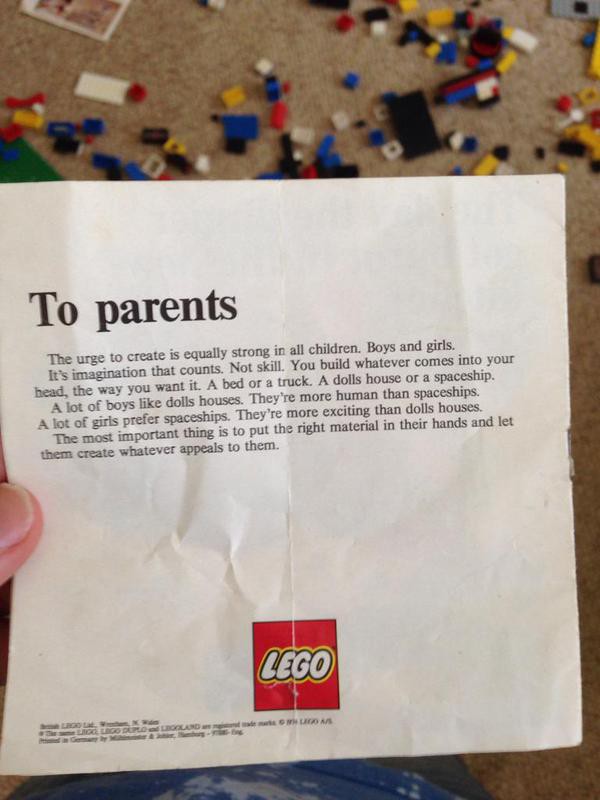
QotD: Down with LEGOification!

Filed under: Media, Quotations — Tags: , , — Nicholas @ 12:17

Even as a child, I was vaguely annoyed by the LEGO kits that allowed you to recreate something you’d seen on TV or in the movies. The greatest thing about LEGOs is that you can use them to build anything your imagination can create. Castles, cars, airplanes, you name it: If you had the blocks and a mild spark of ingenuity, you could do just about any damn thing you pleased.

But the LEGOification of every aspect of popular culture is, in many ways, the exact opposite of the triumph of imagination. This ideal asks you to take something endlessly changeable and shove it into a tiny mental space already dominated by every other facet of popular culture. It’s a perversion of the LEGO ideal, a slap in the face of everyone who grew up tinkering with their building blocks in the hope of creating something new and exciting, something just for themselves or their friends.

Also, if you could get off my lawn, that would be great.

Sonny Bunch, “Knock It Off with the LEGOs, Jerks”, Washington Free Beacon, 2014-02-19

February 13, 2014

Disproportional punishment

Filed under: Law, USA — Tags: , , , , — Nicholas @ 10:16

In the Washington Post, Jacob Sullum illustrates the weird disproportionality of the sentences handed out to child porn offenders versus the sentences received by actual child abusers:

The legal treatment of people caught with child pornography is so harsh that they can end up serving longer sentences than people who actually abuse children. In a 2009 analysis, federal public defender Troy Stabenow shows that a defendant with no prior criminal record and no history of abusing children would qualify for a sentence of 15 to 20 years based on a small collection of child pornography and one photo swap, while a 50-year-old man who encountered a 13-year-old girl online and lured her into a sexual relationship would get no more than four years.

Under federal law, receiving child pornography, which could mean downloading a single image, triggers a mandatory minimum sentence of five years — the same as the penalty for distributing it. Merely looking at a picture can qualify someone for the same charge, assuming he does so deliberately and is aware that Web browsers automatically make copies of visited sites. In practice, since the Internet nowadays is almost always the source of child pornography, this means that viewing and possession can be treated the same as trafficking.

The maximum penalty for receiving or distributing child porn is 20 years, and federal sentencing guidelines recommend stiff enhancements based on factors that are extremely common in these cases, such as using a computer, possessing more than 600 images (with each video clip counted as 75 images), and exchanging photos for something of value, including other photos. Federal agents reportedly found 200 child porn videos on Loskarn’s hard drive when they arrested him on December 11.

Ninety percent of federal child-porn prosecutions involve “non-production offenses” like Loskarn’s: downloading or passing along images of sexual abuse, as opposed to perpetrating or recording it. As a result of congressional edicts, the average sentence in such cases rose from 54 months in 2004 to 95 months in 2010, according to a 2012 report from the U.S. Sentencing Commission (USSC). The penalties have become so severe, the commission noted, that judges frequently find ways to dodge them, resulting in wildly inconsistent sentences for people guilty of essentially the same conduct.

When did “Child Find” morph into “Missing Persons”?

Filed under: Cancon, Randomness — Tags: — Nicholas @ 08:29

Some of my utility bills come with return envelopes (yes, even in this day of internet banking, lots of bill payments still go through the old-fashioned mail system). At least one of them uses the back of the return envelope to print Child Find alerts, with a photo and information about the missing child. This seems like a good idea, although the most recent example seems to be a bit of a stretch:

Child Find envelope

First, the information says that the missing child was twenty years old when last seen … have we officially decided that childhood lasts into the twenties? Second, the missing person has been missing for a pretty long time — since 1988 — and it seems unlikely that this photo will have much more than a casual resemblance to her current appearance (assuming that she’s still alive, of course).

« Newer PostsOlder Posts »

Powered by WordPress