The Shah that emerges from these pages would be almost a tragic figure, if they gave us a better feel for him as a person, that is to say as a living being rather than a mere policy-maker. He was by nature a vacillator, thrust by inheritance and a destiny beyond his control into a position in which vacillation would eventually prove fatal. In addition to self-doubt, however, he was also inclined to vainglory, oscillating between the two, retreating from crises and ostentatiously parading himself, and boasting, when things seemed to be going well. He thought that he had both the right and the duty, genuinely for the sake of his country, to rule rather than reign, but while he had the ideas of an autocrat, he also had those of an ordinary decent person who baulked at the shedding of much blood, the only way, in the end, that he could have preserved his throne (and possibly not even then).
He was intelligent and wily, and his achievements were not negligible. He managed to wrest control of Iran’s oil first from the British and then from the international oil consortium that succeeded them. He played the oil market with great skill. He instituted an important land reform that genuinely benefitted the peasantry, expanded education, and had a full understanding of the importance of technology in the modernization of Iran necessary if it were to be anything other than a dependent state. His foreign policy was flexible, pragmatic, and shrewd. He needed the Americans but did not trust them (or anybody else, for that matter), realising that in politics there were no friendships, only common interests. This was to be borne out in the most terrible and tragic way during his last few years of exile, with which this book does not deal. Where there is no friendship, there is no gratitude for services rendered.
His failures were at least as great as his successes, and in the end more important from the point of view of his personal destiny. He so hollowed out political life in Iran, in order to exercise power as a true autocrat, that it came to have two poles: sycophancy and plotting against him. Sycophancy is a terribly addictive drug, no doubt a permanent temptation of the powerful (and therefore a good reason to restrict political terms of office); you can never have enough of it, nor can it ever be outrageous enough.
Unfortunately for the Shah, no one is sycophantic from principle, indeed sycophants tend (rightly) to despise themselves, fully aware that they are acting from the most naked of self-interest. There is no rat that leaves a sinking ship faster than a sycophant deserting a lost cause. A sycophant will take a risk to preserve his skin, but not to preserve his master.
Theodore Dalrymple, “Downfall of the House of Pahlavi”, The Iconoclast, 2021-03-03.
June 16, 2021
QotD: The Shah of Iran
June 3, 2021
John McWhorter on Affirmative Action
In the latest post at It Bears Mentioning, John McWhorter outlines the history of Affirmative Action in American schooling and explains why it’s no longer doing anything useful and should be re-oriented to actually help disadvantaged students of all races:

John McWhorter’s Twitter thumbnail image
I do not oppose Affirmative Action. I simply think it should be based on disadvantage, not melanin. It made sense – logical as well as moral – to adjust standards in the wake of the implacable oppression of black people until the mid-1960s.
When Affirmative Action began in the 1960s, largely with black people in mind, the overlap between blackness and disadvantage was so large that the racialized intent of the policy made sense. Most black people lived at or below the poverty line. Being black and middle class was, as one used to term it, “fortunate”. Plus, black people suffered open discrimination regardless of socioeconomic status, in ways for more concrete than microaggressions and things only identifiable via Implicit Association Testing and the like. In a sense, black people were all in the same boat.
Luckily, Affirmative Action worked. By the 1980s, it was no longer unusual or “fortunate” to be black and middle class. I would argue that by that time, it was time to reevaluate the idea that anyone black should be admitted to schools with lowered standards. I think Affirmative Action today should be robustly practiced — but on the basis of socioeconomics.
A common objection is that this would help too many poor whites (as if that’s a bad thing?). But actually, brilliant and non-partisan persons have argued that basing preferences on socioeconomics would actually bring numbers of black people into the net that almost anyone would be satisfied with.
I’m no odd duck on my sense that Affirmative Action being about race had passed its sell-by date after about a generation. At this very time, it had become clear, to anyone really looking, that the black people benefitting from Affirmative Action were no longer mostly poor – as well as that simply plopping truly poor black people into college who had gone to awful schools had tended not to work out anyway. It was no accident that in 1978 came the Bakke decision, where Justice Lewis Powell inaugurated the new idea that Affirmative Action would serve to foster “diversity”, the idea being that diversity in the classroom made for better learning.
I highly suspect that most people have always had to make a slight mental adjustment to get comfortable with this idea, as standard as it now is in enlightened discussion. Do students in classes with a certain mixture of races learn better? Really? Not that there might not be benefits to students of different races being together for other reasons. But does diversity make for better learning? Has that been proven?
As you might expect, it has not – and in fact the idea has been disproven, again and again. No one will tell you this when the next round of opining on racial preferences comes about. But this doesn’t mean it isn’t true.
June 1, 2021
Undoing Dr. Beeching’s cuts
In The Critic, Brice Stratford looks at the British government’s “nationalization if necessary, but not necessarily nationalization” scheme to once again reform Britain’s passenger railway network:
Astonishing scenes this week, whereby the Tory government announces a White Paper to re-nationalise the railways. The union bosses and Guardianistas who have called for such policy for decades immediately decided that actually it’s a terrible idea, or that this doesn’t count as re-nationalising because it’s the Conservatives doing it, or that calling the new entity “Great British Railways” just because it will run Great Britain’s railways is so offensive that the entire project should be called off. It’s all very tribal, and very silly, and very 2021, alas.
Of course, the Department for Transport (DfT) is still afraid of admitting that this is in fact renationalisation, as to do so would be to rile up certain elements of the Right, and to admit what we all know: that their generations-long experiment in railway privatisation has been a failure. Today we have a service which is overpriced, unreliable, and generally an unpleasant and ineffective experience from start to finish.
The postwar Labour government included railway nationalization in its many, many reforms to the economic life of Britain and in 1948 the remaining railway systems were unified as British Railways. By the 1960s, the system was losing money at a high rate of speed, so Dr. Beeching was called upon to recommend how to put the railway if not into profit then at least into a much more acceptable rate of loss:
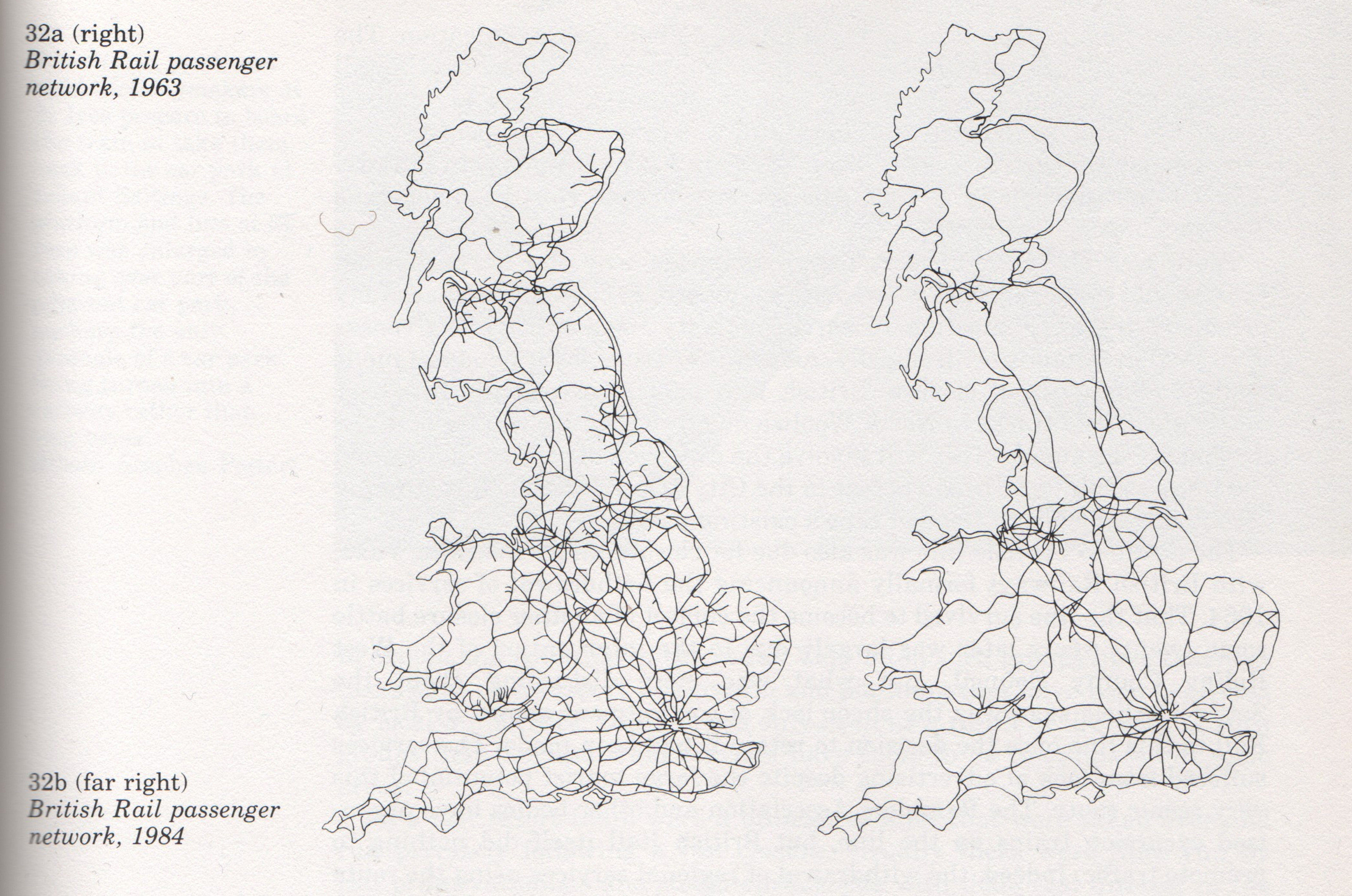
Maps originally from Losing Track by Kerry Hamilton and Stephen Potter (1985), by way of Is Your Journey Really Necessary?, 2012-12-31.
https://isyourjourneyreallynecessary.wordpress.com/2012/12/31/nice-work-if-you-can-get-there/
Click map to enlarge.
The aim of the Beeching cuts, which followed on from a pair of reports written by Dr Richard Beeching in 1963 and 1965 for the British Railway Board (of which he was Chair), was to turn the loss-making British railways network into a profitable enterprise. Prioritising this profitability over all else, he proposed axing about a third of Britain’s then 7000 railway stations, removing passenger service from around 5000 route miles, and cutting 70,000 jobs over three years. The moves were highly controversial, and though they certainly saved money, the social consequences were extensive and the scars remain visible today.
As a consequence of the cuts, Britain became over-reliant on car travel, and over the 1970s and 80s town planners gutted the experientially human-scale city centres in service of this newly favoured road transport. We still very much feel the consequences of the Beeching axe today, whereby a rail journey between neighbouring cities is often only possible by zigzagging up to London and back down again, and public transport between rural communities is limited to one bus service every hour or two in the morning and mid-afternoon, which crawls along at a testudinian pace, further isolating and atrophying the scattered settlements that once were happy, thriving homes.
The Avengers – Must See TV
Billy Rees
Published 19 Aug 2015ITV programme from 2005 presented by Joan Collins.

May 19, 2021
Why Did We Stop Wearing Hats?
Karolina Żebrowska
Published 28 Apr 2020should we bring hats back? what do you think?
_____________
My Instagram: https://bit.ly/2Qo9rrI
My nudes: https://bit.ly/2UHHY6N
My merch: bit.ly/2CCq5jE
May 1, 2021
When the libraries failed
In another of a series of book reviews by Astral Codex Ten readers, Scott Alexander posted this review of Double Fold by Nicholson Baker, which helps to indicate just when libraries — and librarians — lost their mojo:

“Nottingham central library” by JuliaC2006 is licensed under CC BY 2.0

If you enter a major research library in the US today and request to see a century-old issue of a major American newspaper, such as Chicago Tribune, The Wall Street Journal, or major-but-defunct newspapers such as the New York “World”, odds are that you will be directed to a computer or a microfilm reader. There, you’ll get to see black-and-white images of the desired issue, with individual numbers of the newspaper often missing and much of the text, let alone pictures, barely decipherable.
The libraries in question mostly once had bound issues of these newspapers, but between the 1950s and the 1990s, one after another, they ditched the originals in favor of expensive microfilmed copies of inferior quality. They continued doing this even while the originals became perilously rare; the newspapers themselves were mostly trashed, or occasionally sold to dealers who cut them up and dispersed them. As a consequence, many of these publications are now rarer than the Gutenberg Bible, and some 19th and 20th century newspapers have ceased to exist in a physical copy anywhere in the world.
When Double Fold by Nicholson Baker came out in 2001, it was described as The Jungle of the American library system. After 20 years, the book remains universally known, sometimes admired but often despised, among librarians. The reason for their belligerence is that Baker publicly revealed a decades-long policy of destruction of primary materials from the 19th and 20th centuries, based on a pseudoscientific notion that books on wood-pulp paper are quickly turning to dust, coupled with a misguided futuristic desire to do away with outdated paper-based media. As a consequence, perfectly well preserved books with centuries of life still ahead of them were hastily replaced with an inferior medium which has, at the moment that I am writing this review, already mostly gone the way of the dodo. Despite its notoriety among librarians, however, Double Fold is little-known among the general public, even compared to Baker’s other non-fiction and his novels.
This is a shame, since the mass destruction of books and newspapers by libraries in the post-war era deserves to be better known as one of the most egregious failures of High Modernism, comparable with the wackiest plans of Le Corbusier. The story combines an excessive reliance on simplistic mathematical models, wilful ignorance to the desires of actual library-users and scholars, embracement of miniaturization and modernization as terminal values, and an almost complete disregard of 19th century books as historical artefacts. Unlike industrial farms, which can be broken up, and Brasília-style skyscrapers, which can be torn down and replaced with something else, the losses caused by the mass deaccessioning of books and newspapers from libraries were often irreplaceable.
As part of the uproar that followed the book’s publication, the Association of Research Libraries published an online anti-Baker FAQ, and in 2002, the book Vandals in the Stacks? by Richard J. Cox came out, presenting an attempted refutation of Baker’s theses. I have read both of these and discuss Cox’s arguments later on, but I must admit in advance that I was mostly convinced by Baker’s argumentation much more than by that of his opponents. Nonetheless, it is uncommon to have a polemical book receive a book-length response, and anyone interested in Baker’s thesis is advised to check out Cox as well.
March 5, 2021
The Way We Live – A Railwayman’s Film Darlington 1960
Anthony Alexandrovic
Published 24 Jul 2015[Originally from] Tyne Tees TV

February 23, 2021
The Corgi Toys Story
Little Car
Published 4 Feb 2020Corgi Toys is the name of a range of die-cast toy vehicles produced by Mettoy Playcraft Ltd. in the United Kingdom.
The script for this video comes from Wikipedia: https://en.wikipedia.org/wiki/Corgi_Toys
If you find issues with the content, I encourage you to update the Wikipedia article, so everyone can benefit from your knowledge.
To get early ad-free access to new videos, or your name at the end of my videos, please consider supporting me from just $1 or 80p a month at https://www.patreon.com/bigcar
Link to my other channel – Big Car: https://www.youtube.com/bigcar2

February 15, 2021
QotD: Tail-end boomers aren’t really Baby Boomers at all
The boomers were the baby boom after WWII. By the time I hit school, the classrooms were half empty, the trailers that they’d added the decade before were being used for craft classes or gym or something that required tons of space.
It would take a long time to come home if you were still being born in ’62. (And I’d been due in ’63.)
This is important simply because I want to make it clear when I came of age it wasn’t with the boomer ethos of “each generation is going to be bigger than the last and we’re going to remake the world in our image.” That expectation is still obvious in books of the fifties and sixties, as well as the attached Malthusian panic.
The boomers, like now the millenials, are a much maligned generation. The public image is almost not at all that of the people in the generation I actually know, with a very few exceptions.
The people the media chose to highlight were the ones they wanted the boomers to be, not who they were.
But something about the boomers is true — ironically the reason that caused them to hate my generation before they decided to aggregate us, because it gave them more power to still be considered young and marketable-to — and that is that they were raised in the expectation they would make the world a better place, and that they could because of sheer numbers, and because they’d been brought up to be better than their parents.
Sarah Hoyt, “Business From The Wrong End”, According to Hoyt, 2018-09-27.
February 10, 2021
“Did you know that seventy years ago, our grandparents were having an underpolarization crisis?”
Scott Alexander reviews Why We’re Polarized by Ezra Klein, beginning with the underpolarization crisis of the mid-20th century:

In 1950, the American Political Science Association “released a call to arms … pleading for a more polarized political system”. The report argued that “the parties contain too much diversity of opinion and work together too easily, leaving voters confused about who to vote for and why”. Everyone agreed with each other so much, and compromised so readily, that supporting one party over the other seemed almost pointless.
In 1976, three years after Roe v. Wade, Democrats and Republicans were about equally likely to support abortion restrictions. That same year, a poll found that “only 54% of the electorate believed that the Republican Party was more conservative than the Democratic Party”; 30% thought there was no difference. As late as 2004, about equal numbers (within 5 pp) of Democrats and Republicans agreed with statements like “government is almost always wasteful and inefficient” and “immigrants are a burden on our country”. Between the late 60s and early 90s, Democratic presidents deregulated the airlines and passed welfare reform; Republican presidents pushed immigration amnesties and founded the EPA.
What happened between then and now? Klein has two answers: a historical answer, and a structural answer.
The historical answer is: the Dixiecrats switched from Democrat to Republican.
When the North won the Civil War, it had grand plans to remake the South into a paradise of racial equality and universal love. After Lincoln’s death, his successor Andrew Johnson decided this sounded hard and gave up. Within a few decades, the South was back to being a racist, paramilitary-violence-prone one-party dictatorship. That one party called itself “Democrat”, but had few similiarites to the Democrats in the North. The Southern Democrats (“Dixiecrats”) and northern Democrats disagreed on lots of issues, but the South hated the Republicans so much after their experience with Lincoln that they caucused with the northern Democrats anyway. This turned into a stable coalition, with northern Democrats agreeing to support the South against civil rights for blacks, and the Dixiecrats supporting the northern Democrats whenever they needed something.
But since the Democratic party contained both northern Democrats (relatively liberal) and Dixiecrats (relatively conservative), it didn’t want to take a coherent party-wide stance on liberalism vs. conservatism. And by the median voter theorem, that meant the Republicans also didn’t want to take a coherent stance on liberalism vs. conservatism. So both parties ended out centrist and identical.
In 1964, the Civil Rights Act threatened the Dixiecrats’ key issue. It wasn’t quite as simple as “Democrats were for it, Republicans were against it” – in fact, 80% of Republicans and 60% of Democrats supported it. But that year’s presidential election pitted heavily pro-CRA Democrat Lyndon Johnson against anti-CRA Republican Barry Goldwater, beginning Southerners’ defection to the Republican Party.
Klein says this successfully got all the conservatives on one side of the aisle and all the liberals on the other, allowing polarization to begin. Essentially, he believes polarization is a natural process, which the odd coalitions of the early 20th century temporarily prevented. Once the coalitions were broken, it could begin to do its work. He spends the rest of the book talking about why exactly polarization is so natural, what aspects of modernization have made it worse, and what sort of feedback loops make it keep going
Victor Davis Hanson on Animal Farm, America’s nightmare 2021 version
Victor Davis Hanson outlines the original George Orwell novel and then contrasts today’s situation with what progressives demanded back in the 1960s and 70s:
Yes, the downtrodden pigs, the exploited horses, and the victimized sheep finally did expel Farmer Jones from America’s Animal Farm.
But in his place, as Orwell predicted, revolutionary pigs began walking on two feet and absorbed all the levers of American cultural influence and power: the media, the bureaucracies, Wall Street, Silicon Valley, publishing, the academy, K-12 education, professional sports, and entertainment. And to them all, the revolutionaries added their past coarseness and 1960s-era by-any-means-necessary absolutism.
We are now finally witnessing the logical fruition of their radical utopia: Censorship, electronic surveillance, internal spying, monopolies, cartels, conspiracy theories, weaponization of the intelligence agencies, pouring billions of dollars into campaigns, changing voting laws by fiat, a woke revolutionary military, book banning, bleeding the First Amendment, canceling careers, blacklisting, separate-but-equal racial segregation and separatism.
Conspiracies? Now they brag of them in Time. Read their hubristic confessionals in “The Secret History of the Shadow Campaign That Saved the 2020 Election.” Once upon a Time, radicals used to talk of a “secret history” in terms of the Pentagon Papers, or a “shadow campaign” in detailing Hollywood blacklisting. They are exactly what they once despised, with one key qualifier: Sixties crudity and venom are central to their metamorphosis.
Our left-wing American revolutionary cycle from the barricades to the boardroom was pretty quick — in the manner that the ideology of the Battleship Potemkin soon led to Stalin’s show trials, or Mao’s “long march” logically resulted in the Cultural Revolution. The credo, again, is that the noble ends of forced “equity” require any means necessary to achieve them.
The Left censors books in our schools, whether To Kill a Mockingbird or Tom Sawyer. It is the Left who organizes efforts to shout down campus speakers or even allows them to be roughed up.
The Left demands not free-speech areas anymore, but no-speech “safe spaces” and “theme houses” — euphemisms for racially segregated, “separate-but-equal” zones. “Microaggressions” are tantamount to thought crimes. The mere way we look, smile, or blink can indict us as counterrevolutionaries. Stalin’s Trotskyization of all incorrect names, statues, and commemoratives is the Left’s ideal, as they seek to relabel Old America in one fell swoop. No one is spared from the new racists, not Honest Abe, not Tom Jefferson, not you, not me.
For “teach-ins,” we now have indoctrination sessions. But the handlers are no longer long-haired 1960’s dreamy, sloppy, and incoherent mentors. They are disciplined, no-nonsense brain-washers.
The Left’s Russia is our new old bogeyman. Putin is the new “We will bury you” Khrushchev.
February 9, 2021
QotD: Nothing sounds like the Beatles
It’s a pertinent question because the Beatles were so acclaimed as musical innovators in their time and still so hugely popular. And yet, nobody sounds like them. Since not long after the chords of the “Let It Be” died away in 1969, every attempt to revive the Beatlesy sound of bright vocal-centered ensemble pop has lacked any staying power among rock fans. It gets tried every once in a while by a succession of bands running from Badfinger to the Smithereens, and goes nowhere. Why is this?
Another, related question is: Why does so very little in today’s rock music sound like Chuck Berry?
Inventor of rock and roll, they still call him. And yet outside of occasional tributes and moments of self-conscious museumizing, nobody writes rock music that sounds anything like “Johnny B. Goode” anymore. Modern tropes and timbre are vastly different. Only the rock beat – only the drum part – survives pretty much intact.
It’s odd, when you think about it. The sound that electrified the late Fifties and Sixties is still revered, but it’s gone. The basic rock beat remains, but everything above it has been flooded out, replaced by something harder and darker.
We all sort of know, even as casual listeners, that rock has evolved a lot. There’s even a tendency for the term “rock and roll” to nowadays be specifically confined to the older sound, with “rock” standing alone to refer to the more modern stuff.
[…]
The sea-change happened between 1969 and 1971. The moving figures were: Jimi Hendrix. British Invasion bands like the Rolling Stones and Led Zeppelin and the Who. American West Coast bluesmen like Mike Bloomfield and Al Cooper. The San Franciso acid-rock scene. And many lesser imitators.
What they did was raze old-school rock-and-roll to the ground, replacing it with a bastard child of LSD and Chicago-style hard electric blues. That angry, haunting, minor-key idiom is what buried the Beatles and put a stamp on rock music so final that today the sound of any modern arena rocker – like, say, Guns’n’Roses – is recognizably the same thing musicians began to record around 1970.
(Which it should be pointed out, is a very long run for a mass-market pop genre. It’s as though in 1970 our radios had still been full of pop in forms dating from 1925 …)
Eric S. Raymond, “The blues ate rock and roll!”, Armed and Dangerous, 2017-12-28.
January 31, 2021
QotD: Sixties music wasn’t what you think it was
Tom Jones is great, I love his stuff, but he’s not going to melt your face with his guitar riffs, and he’s there at #8, right in front of “Build Me Up, Buttercup.” Which is one hell of a catchy tune, and compared to “Love Theme from Romeo and Juliet” (#15) it’s practically Slayer, but rock it ain’t. Ray Stevens is at #61, for pete’s sake, with “Guitarzan.” If that hasn’t convinced you that The Sixties were nothing like they show in the movies (and that maybe the Viet Cong deserved to win), I don’t know what would.
Severian, “Entertainers (III): Hair Metal Attains Nirvana”, Rotten Chestnuts, 2020-10-08.
January 26, 2021
The brief and inglorious life of Penn Central
In City Journal, Nicole Gelinas recounts the tale of the fateful merger of two great American railroad systems that lasted just long enough to support massive financial chicanery before descending into inevitable bankruptcy:

More than 50 years on now, the spectacular collapse of the Penn Central railroad in 1970 is little remembered today, but its legacy is still with us — not so much as a warning, but as a prelude: to New York City’s own near-bankruptcy in the 1970s; to four decades of financial engineering, beginning in the 1980s; to the 2001 Enron downfall; to the 2008 financial crisis and its “too big to fail” bailouts — and yes, even to the public discontent that elected President Donald Trump.
As America emerged from World War II, most people would have laughed at the idea of the nation’s two premier freight and passenger railroads, the Pennsylvania and the New York Central, going broke in a quarter-century’s time. By design, the Pennsy and the Central were not fierce competitors but complementary “frenemies” that had long agreed not to undercut one another’s monopoly profits. From Massachusetts to Missouri, the two railroads dominated freight and passenger travel in the northeast quarter of the United States, with nearly 21,000 miles of track between them.
Yet even as America built its powerhouse postwar economy, the railroads struggled. As Joseph R. Daughen and Peter Binzen write in The Wreck of the Penn Central, their cult-classic chronicle of the Penn Central’s demise, during the war the then-separate railroads had been running their equipment 24 hours a day to transport troops and supplies, leaving them with “worn-out” equipment.
In the fifties and sixties, moreover, new competitive pressures prevented them from catching their breath. Trucks competed with the railroads for freight hauling via the new, free highways the nation was building. Commuter-rail passengers moved to the highways as well, while long-haul rail passengers took to the skies. The railroads’ decline accelerated in the sixties, partly because of the collapse of northeast manufacturing.
In 1962, the two companies decided to merge. But railroading was one of the most heavily regulated industries in the United States, so the merger took six years, as it wound its way through multiple levels of public approval for the creation of the 100,000-worker, 100,000-shareholder, 100,000-creditor behemoth. Meantime, government-set rates already fell short of the railroads’ long-term costs.
The combined entity that would become the Penn Central made significant concessions to win political support for the merger, including no-layoff pledges that would hamper its ability to cut spending and a promise to take on the independent (and chronically insolvent) New York, New Haven, and Hartford passenger railroad.
After the merger, the railroads discovered that they had incompatible computer systems, which threw railyards into chaos and angered customers. The Penn Central’s three top officials, too, were incompatible. They “scarcely spoke to one another,” write Daughen and Binzen. Stuart Saunders, the board chairman, was a political guy. Alfred Perlman, the president, was a trains guy. These different outlooks could have complemented each other, but personalities got in the way. Rounding out this dysfunctional triumvirate was Penn vet David Bevan, the top financial official, perpetually “angry and humiliated” at not being picked for the top job.
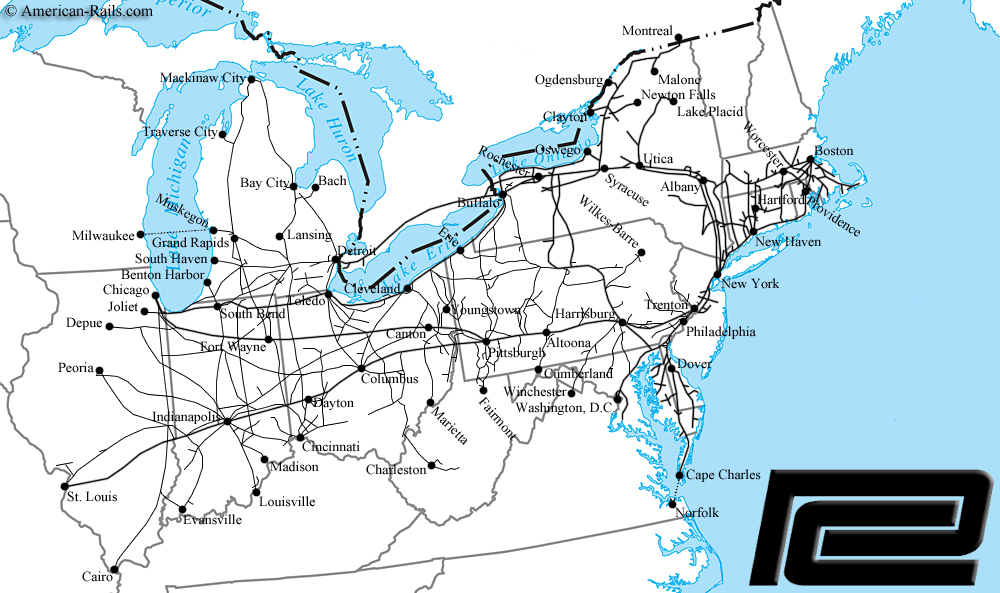
Penn Central route map from us.leforum.eu
http://us.leforum.eu/t1355-Photos-du-Penn-Central-PC.htm
H/T to Ed Driscoll at Instapundit, who also posted this video the combined entity put together to celebrate the merger:
December 22, 2020
Repost – The Monkees – “Riu Chiu”
Uploaded on 15 Dec 2015
The Monkees perform “Riu Chiu” from Episode 47, “The Monkees’ Christmas Show”.
H/T to Kathy Shaidle for the link.