Quotulatiousness

April 4, 2020

Eighteenth century health improvements through “ventilators”

Filed under: Britain, Health, History, Technology — Tags: , , , , — Nicholas @ 03:00

In the latest Age of Invention newsletter, Anton Howes relates how a mistaken belief still led to a significant improvement in health:
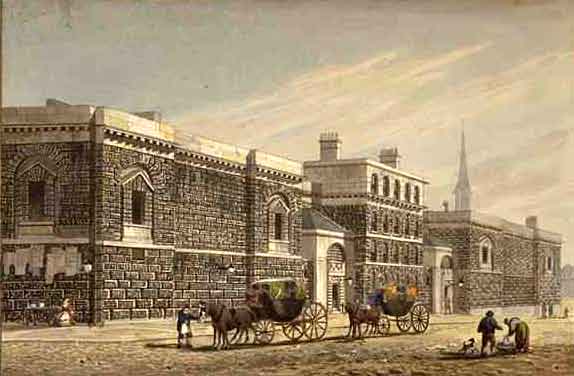
The west view of Newgate Prison, circa 1810, by George Shepherd (1784-1862).
Wikimedia Commons.

One of the most worrying diseases of the mid-eighteenth century was typhus. We now know that it is spread by lice or fleas, but at the time, like so many other diseases, it was thought to be caused by noxious air — “malaria”, for example, literally means “bad air”. This was not a silly theory. It was based on empirical observation, which perhaps explains why the belief in such noxious miasmas persisted for so long — well into the late nineteenth century, if not the early twentieth, before finally being ousted by germ theory. Our ancestors were not stupid, no matter how strange their beliefs might appear in hindsight. (Also take alchemy, or the belief that some animals spontaneously generated.)

The Central Tower of the Palace of Westminster is actually a disguised ventilator.
Photo by Cary Bass via Wikimedia Commons.

Typhus fit the miasma theory especially well because it frequently appeared in confined spaces, like ships’ holds, prisons, mines, workhouses, and hospitals. The disease was thus often called “gaol fever”, or “hospital fever”. And there was the fact that at least one of the solutions designed to combat miasmas, the ventilator, actually seemed to work. This ventilator was not the kind that is in such high demand right now, used to help feed oxygen into patients’ lungs, but instead a machine used to get the air flowing in and out of confined spaces — like a 1740s air-conditioning unit.

At first glance, removing the stale air from a space shouldn’t do anything against typhus. But mortality declined drastically in the prisons and ships to which the ventilator was introduced. It halved the number of deaths per year in Newgate prison, where the bellows-like machinery was powered by a windmill, and the inmates of the Savoy prison fared even better. On ships, too, mortality declined among mariners, passengers, soldiers, and especially among the group that suffered most from long voyages across the eighteenth-century Atlantic: slaves.

But it’s not clear exactly why. After all, the ventilator did not kill the typhus-ridden lice or fleas. I have a few theories as to what must have been going on. Perhaps, by improving the supply of oxygen to confined spaces, people’s bodies were simply better served to deal with all manner of diseases. Surgeons aboard slave ships sometimes noted that, without proper ventilation, many slaves would simply die in the night of suffocation. Or perhaps the ventilator’s effectiveness had something to do with its drying effect. The machine was used to prevent grain stores from becoming humid, thus staving off damp-loving weevils. The ventilators might thus have staved off typhus through a similar means: although I’m not so certain about body lice, humid conditions are preferred by fleas. Regardless of the real reasons, the ventilators worked, and even when they did not reduce mortality, they made confined spaces more bearable for those who had to endure them. Ship captains reported that they did not even have to force their sailors to pump the ventilator’s bellows, because they liked the cool air so much. Ventilators were soon installed in the House of Commons, and in many of London’s theatres.

From the Wikipedia entry on architectural ventilation:

The development of forced ventilation was spurred by the common belief in the late 18th and early 19th century in the miasma theory of disease, where stagnant ‘airs’ were thought to spread illness. An early method of ventilation was the use of a ventilating fire near an air vent which would forcibly cause the air in the building to circulate. English engineer John Theophilus Desaguliers provided an early example of this, when he installed ventilating fires in the air tubes on the roof of the House of Commons. Starting with the Covent Garden Theatre, gas burning chandeliers on the ceiling were often specially designed to perform a ventilating role.

Mechanical systems
A more sophisticated system involving the use of mechanical equipment to circulate the air was developed in the mid 19th century. A basic system of bellows was put in place to ventilate Newgate Prison and outlying buildings, by the engineer Stephen Hales in the mid-1700s. The problem with these early devices was that they required constant human labour to operate. David Boswell Reid was called to testify before a Parliamentary committee on proposed architectural designs for the new House of Commons, after the old one burned down in a fire in 1834. In January 1840 Reid was appointed by the committee for the House of Lords dealing with the construction of the replacement for the Houses of Parliament. The post was in the capacity of ventilation engineer, in effect; and with its creation there began a long series of quarrels between Reid and Charles Barry, the architect.

Reid advocated the installation of a very advanced ventilation system in the new House. His design had air being drawn into an underground chamber, where it would undergo either heating or cooling. It would then ascend into the chamber through thousands of small holes drilled into the floor, and would be extracted through the ceiling by a special ventilation fire within a great stack.

Reid’s reputation was made by his work in Westminster.

Monetary Policy: The Negative Real Shock Dilemma

Filed under: Economics, Government — Tags: , , , , — Nicholas @ 02:00

Marginal Revolution University
Published 15 Aug 2017

Imagine a negative real shock, like an oil crisis, just hit the economy. How should the Fed respond?

Decreasing the money supply will help with inflation, but make growth worse. Increasing the money supply will improve growth, but inflation will climb higher. What’s the Fed to do?!

QotD: The danger of studying philosophy

Filed under: Education, Humour, Quotations — Tags: , , , — Nicholas @ 01:00

I quickly learned that […] many of my professors valued paradoxical and obscure arguments. And I got pretty good at making them. In an essay on Wallace Stevens, I concluded by asserting, “If everything is nothing, then that nothingness is everything. For poetry to encompass one, it encompasses the other. When Stevens’s mind of winter descends into the inescapable nothingness of his subjectivity, he has claimed for himself the totality of everything.” I don’t know what this means. But I wrote it and I was rewarded for it.

I knew my analysis of Wallace Stevens would please my professor, but I was bothered by a nagging thought that I really didn’t understand Wallace Stevens. I wondered if my graduate school training just amounted to a parlor trick. Last year, at my high school, the students enjoyed arguing if a hotdog is a sandwich, the millennial equivalent of asking how many angels can dance on the head of a pin. The hotdog question made its way to the whiteboard in our staff lounge. By the time I arrived, my colleagues had written their responses. Some argued that a hot dog is not a sandwich because a sandwich requires two pieces of bread and a hotdog bun isn’t supposed to separate. Others averred that it most definitely is a sandwich: Meat between bread is a sandwich, end of story. I saw these responses and thought, “Simpletons!” before putting my graduate education to work: “In order to determine if a ‘hotdog is a sandwich,’ we must first determine the proper understanding of ‘is’ for if we do not grasp the ontological necessity of being itself, we fall into an abyss wherein ‘being’ is and is not itself and thus a hotdog is and is not a sandwich for it is and is not its very self.” I was quite amused by the whole situation until a colleague told me that a student had seen the whiteboard and said he wanted to study philosophy so that he could write like me.

S. A. Dance, “Incomprehension 501: Intro to Graduate School”, Quillette, 2018-03-06.

April 3, 2020

Barbarossa, African Jews, and the fate of PoWs in Germany – WW2 – Out of the Foxholes 009

Filed under: Africa, France, Germany, History, Military, Russia, WW2 — Tags: , , , , , — Nicholas @ 06:00

World War Two
Published 2 Apr 2020

Did the British government know of the German plans for Operation Barbarossa? What happened to Jewish communities in Ethiopia? And to Prisoners of War in occupied countries?

Submit your own question for OOTF: https://community.timeghost.tv/c/Out-…

Join us on Patreon: https://www.patreon.com/TimeGhostHistory
Or join The TimeGhost Army directly at: https://timeghost.tv

Follow WW2 day by day on Instagram @World_war_two_realtime https://www.instagram.com/world_war_t…
Between 2 Wars: https://www.youtube.com/playlist?list…
Source list: http://bit.ly/WW2sources

Written and Hosted by: Indy Neidell
Produced and Directed by: Spartacus Olsson and Astrid Deinhard
Executive Producers: Bodo Rittenauer, Astrid Deinhard, Indy Neidell, Spartacus Olsson
Creative Producer: Joram Appel
Post-Production Director: Wieke Kapteijns
Research by: Indy Neidell
Edited by: Mikołaj Cackowski
Map animations: Eastory (https://www.youtube.com/c/eastory)

Colorizations by:
Adrien Fillon – https://www.instagram.com/adrien.colo…

Sources:
IWM MH 26392, BU 5939, HU 58537
Religion by Berkah Icon from the Noun Project
Letter by Mochammad Kafi from the Noun Project
quiet by priyanka from the Noun Project
Doctor by Wilson Joseph from the Noun Project
jail by Luis Prado from the Noun Project

Soundtracks from the Epidemic Sound:
Johannes Bornlof – “The Inspector 4”
Johannes Bornlof – “Deviation In Time”
Andreas Jamsheree – “Guilty Shadows 4”

Archive by Screenocean/Reuters https://www.screenocean.com.

A TimeGhost chronological documentary produced by OnLion Entertainment GmbH.

Taffy Holden, the Accidental Lightning Pilot

Filed under: Britain, History, Military — Tags: , , — Nicholas @ 05:00

The History Guy: History Deserves to Be Remembered
Published 24 Sep 2018

In the United Kingdom in 1966, an RAF ground crewman conducting an electrical test suddenly finds himself airborne. Taffy Holden, the accidental Lightning pilot, deserves to be remembered.

The History Guy uses media that are in the public domain. As photographs of actual events are sometimes not available, photographs of similar objects and events are used for illustration.

Patreon: https://www.patreon.com/TheHistoryGuy

The History Guy: History Deserves to Be Remembered is the place to find short snippets of forgotten history from five to fifteen minutes long. If you like history too, this is the channel for you.

Awesome The History Guy merchandise is available at:
teespring.com/stores/the-history-guy

The episode is intended for educational purposes. All events are portrayed in historical context.

#history #aviation #thehistoryguy

The English Electric Ligthning F1 had another, rather more dramatic appearance on the front page of the Daily Mirror in October 1962:

English Electric F1 Lightning interceptor XG332 about to crash on 13 September 1962.
Photo by Jim Mead via Reddit.com.

Whilst carrying out a demonstration flight, there was a fire in the aircraft’s reheat zone. Un-burnt fuel in the rear fuselage had been ignited by a small crack in the jet pipe and had weakened the tailplane actuator anchorage. This weakened the tailplane control system which failed with the aircraft at 100 feet on final approach. The aircraft pitched up violently just as Aird was coming up to land. Aird lost control of the aircraft and ejected.

Luckily, because the nose pitched up he had just enough time to eject.

The tractor in the photograph was a Fordson Super Major. If you look closely at the grill, you’ll see it reads D H Goblin, as in the de Havilland Goblin jet engine.

The tractor driver was 15-year-old Mick Sutterby, who spent that summer working on the airfield. He wasn’t posing for the camera. In fact, he was telling the photographer, Jim Mead, to move on, because he shouldn’t be there.

Mead saw the plane coming in and the nose pitch up. Then Aird ejected and Mead says he had just enough time to line up the shot as the Lightning came down nose first.

Meanwhile, George Aird landed on a greenhouse and fell through the roof, breaking both legs as he landed unconscious on the ground. The water from the sprinkler system for the tomatoes woke him. He’s reported to have said that his first thought was that he must be in heaven.

The photographs taken that day first went to the Ministry of Aviation. Once they were released, Mead sold them to the Daily Mirror.

How To Prepare the Cabinet for Gluing Up | The Cabinet Project #8 | Free Online Woodworking School

Filed under: Tools, Woodworking — Tags: , , — Nicholas @ 04:00

Matt Estlea
Published 30 Mar 2020

In this part of the cabinet project, I will be showing you how to prepare the cabinet for gluing up. We will focus on flushing joinery, pre-sanding inside faces, and will prepare the drawer cavity for a smooth, obstruction free fit.

See the full lesson here:
https://mattestlea.com/free-online-wo…

Plans for this project:
https://mattestlea.com/product/cabine…

Buy Pre-Planed Material Packs for this Project Here:
www.mattestlea.com/projectpacks
_________________________________________________________________

Support what I do by becoming a Patron! This will help fund new tools, equipment and cover my overheads. Meaning I can continue to bring you regular, high quality, free content. Thank you so much for your support! https://www.patreon.com/mattestlea

Don’t want to commit to a monthly direct debit but still want to help out? That’s fine!
You can make a one time donation here: www.mattestlea.com/donate
You can donate us biscuits here: www.mattestlea.com/wishlist
_________________________________________________________________
BUY THE WOODWORKING BIBLE HERE:
www.mattestlea.com/the-woodworkers-manual
_________________________________________________________________

SOCIAL MEDIA
Instagram: www.instagram.com/mattestlea
Twitter: www.twitter.com/mattestlea
Patreon: www.patreon.com/mattestlea
Pinterest: www.pinterest.com/mattestlea
LinkedIn: www.linkedin.com/in/matt-estlea-b6414b11a/
_________________________________________________________________
See what tools I use here: www.mattestlea.com/equipment
My Website: www.mattestlea.com
_________________________________________________________________

My name is Matt Estlea, I’m a 24 year old Woodworker from Basingstoke in England and my aim is to make your woodworking less s***.

I come from 5 years tuition at Rycotewood Furniture Centre with a further 1 year working as an Artist in Residence at the Sylva Foundation. I now teach City and Guilds Furniture Making at Rycotewood as of September 2018.

If you’re interested in studying at Rycotewood, view their courses here:
www.mattestlea.com/rycotewood

I also had 5 years of experience working at Axminster Tools and Machinery where I helped customers with purchasing tools, demonstrated in stores and events, and gained extensive knowledge about a variety of tools and brands. I discontinued this at the start of 2019 to focus solely on video creation and teaching.

During the week, I film woodworking projects, tutorials, reviews and a viewer favourite ‘Tool Duel’ where I compare two competitive manufacturers tools against one another to find out which is best. I also have a Free Online Woodworking School which you should definitely check out!

www.mattestlea.com/school

I like to have a laugh and my videos are quite fast paced BUT you will learn a lot, I assure you.

Lets go make a mess.

“And what are your personal pronouns?”

Filed under: Politics, USA — Tags: , , , , , — Nicholas @ 03:00

Last week, Amy Alkon considered the demands of “pronoun authoritarians”:

Personally, I’m disturbed by the whole notion that we “include” people through calling them the right pronoun, which requires all this “homework” about a person before you say one word to them.

This new requirement for doing this seems to be a sort of religion that allows people to have power over others — to push them around and deem them thought and speech criminals, even if they simply forget to use somebody’s requested “pronoun.”

This also seems to be a way for people to feel special without earning it — to require people to find out all sorts of information about them, on penalty of being accused of a thought or speech crime and then cancelled.

It seems outrageous to me that some stranger would be required to prep for conversation by investigating my history — that my family are Eastern European Jews, that old friends call me “Flamey” or “Flame-o,” that I eat keto, that I blah, blah, blah, blah, blah — and that they would be seen as disrespectful and even bigoted for failing to find out all the ways I’m (heh) unique and special.

But that’s what we’re requiring people to do with this notion that we have to ask “what is your preferred pronoun?”

And again, this is done now with threats embedded — with the threat that you will lose your job and be deemed a bigot if you don’t make this “What’s your pronoun?” business a priority.

Oh, and I will be very clear on this again: If you want me to call you “zhe” or “they” or “lemon pie with a slight dusting of confectioner’s sugar on top,” I will do my best to remember that and do it, because it’s kind.

But I think the considerations above are important, and I think it’s too easy to just accept the demand to ask people for their “pronouns” as a requirement for being considered decent — with the possible penalty of losing everything as the penalty for failing in some way, even by forgetting.

Tank Chats #66 Leopard 2 | The Tank Museum

Filed under: Germany, History, Military, Weapons — Tags: , , , , , — Nicholas @ 02:00

The Tank Museum
Published 8 Feb 2019

Curator David Willey gives chapter and verse on the German Main Battle Tank, Leopard 2, which first entered service with West Germany during the Cold War.

The Leopard 2 Main Battle Tank was kindly temporarily loaned to The Tank Museum by the Historic Collection of the Royal Netherlands Army.

Some stills and footage: © All rights reserved. (AR2011-0034-009, PA01-2016-0139-076, IS2010-3030-24, IS2011-1021-15, IS14-2017-0003-049, B11-ATHENA-020) reproduced with the permission of DND/CAF (2019)

At 8:55 Leopard 2 from The Arsenalen Museum, Sweden.

Support the work of The Tank Museum on Patreon: ► https://www.patreon.com/tankmuseum

Visit The Tank Museum SHOP: ► https://tankmuseumshop.org/
Twitter: ► https://twitter.com/TankMuseum
Tiger Tank Blog: ► http://blog.tiger-tank.com/
Tank 100 First World War Centenary Blog: ► http://tank100.com/ #tankmuseum #tanks #tankchats

QotD: Canadian senators

Filed under: Cancon, Politics, Quotations — Tags: , , , , — Nicholas @ 01:00

When I heard that Sen. Tommy Banks had died of leukemia at age 81, I thought maybe the newspaper notices ought to be left to the people who knew him better — and in Edmonton that number comes to thousands upon thousands of people. I interviewed Banks a few times as a young political reporter. I think every such person has learned the procrastinator’s trade secret that if you’re doing an issues story, senators are easier to get hold of on a short deadline than elected MPs, and a lot easier than cabinet ministers, especially if you’re an unknown lightweight.

This, at least, used to be the case. I am not sure whether it applies to the Brave New Senate that now exists after the somewhat cynical appointments of Stephen Harper and the experimental renovations of Justin Trudeau. But if you have ever wondered why political beat writers and old codger columnists often have surprisingly positive sentiments about the Senate, which nine-tenths of the people reading these words despise, this is probably one reason: a senator might call you back soon enough to be of some use.

And there’s another, related reason. In phoning a senator to chat about issues because you can’t get a “real” politician to return your inquiry, you would (or, anyway, I would) sometimes find surprisingly strong evidence that the Senate quietly lives up to its original constitutional promise. Spared the effort of endless electioneering and toilsome constituent service, senators do have time for deep study of projects and problems, and some freedom to develop independent opinions. I do not say that most of them use the time and the freedom, but it was, and I’m sure it still is, fairly easy to avoid the duds.

Colby Cosh, “R.I.P. Senator Tommy Banks, a figure from Edmonton’s pantheon”, National Post, 2018-01-26.

April 2, 2020

Testing the English Joiner’s Bench

Filed under: Tools, Woodworking — Tags: , , — Nicholas @ 06:00

Rex Krueger
Published 1 Apr 2020

Can my fast and easy Joiner’s Bench survive the toughest tests in the shop?
More Video and Exclusive Content: http://www.patreon.com/rexkrueger

Complete Joiner’s Bench Bundle (40 pages, full color, only $10): https://bit.ly/2QZls9T
(more…)

What exactly is one second? | James May’s Q&A (Ep 2) | Head Squeeze

Filed under: Greece, History, Science — Tags: , , — Nicholas @ 05:00

BBC Earth Lab
Published 10 Jan 2013

James May discusses what exactly a seconds is. He also delves into how time as we know it could have been totally different. This is because the second had many “rivals” over the years that never got their way.

Outtakes from this video: http://www.youtube.com/watch?v=kLpGHt…

James May’s Q&A:
With his own unique spin, James May asks and answers the oddball questions that we’ve all wondered about from “What exactly is one second?” to “Is invisibility possible?”

A Soviet-Nazi Alliance – The Molotov-Ribbentrop Pact | BETWEEN 2 WARS I 1939 Part 2 of 3

Filed under: Europe, Germany, History, Military, Russia — Tags: , , , , , , — Nicholas @ 04:00

TimeGhost History
Published 1 Apr 2020

In 1939, two bitter rivals sign a non-aggression pact. But the treaty is something more than just a simple pledge of neutrality. Nazi Germany and the Soviet Union have also secretly agreed on how they will carve up Eastern Europe between them.

Join us on Patreon: https://www.patreon.com/TimeGhostHistory

Hosted by: Indy Neidell
Written by: Francis van Berkel
Directed by: Spartacus Olsson and Astrid Deinhard
Executive Producers: Bodo Rittenauer, Astrid Deinhard, Indy Neidell, Spartacus Olsson
Creative Producer: Joram Appel
Post-Production Director: Wieke Kapteijns
Research by: Francis van Berkel
Edited by: Daniel Weiss
Sound design: Marek Kamiński

Sources:
Bundesarchiv_Bild:
102-14436, 146-1977-159-11, 146-1982-159-22A,
146-1997-060-33A, 183-2006-1010-502, 183-H27337,
183-H28422, 183-R09876, 183-R14433, 183-S52480, RH 2/2292,
Novosti archive, image #409024 / Vladimir Grebnev

From the Noun Project:
killer with a gun By Arthur Shlain
guns by By Cards Against Humanity,
Shield By Laili Hidayati,

Photos from color by klimbim.

Colorizations by:
– Owen Robinson – https://www.instagram.com/owen.colori…
– Dememorabilia – https://www.instagram.com/dememorabilia/

Soundtracks from Epidemic Sound:
– “Last Point of Safe Return” – Fabien Tell
– “The Inspector 4” – Johannes Bornlöf
– “Easy Target” – Rannar Sillard
– “Split Decision” – Rannar Sillard
– “Death And Glory 1” – Johannes Bornlöf
– “First Responders” – Skrya
– “Disciples of Sun Tzu” – Christian Andersen
– “Mystery Minutes” – Farrell Wooten
– “Split Decision” – Rannar Sillard
– “Death And Glory 3” – Johannes Bornlöf
– “The Charleston 3” – Håkan Eriksson

A TimeGhost chronological documentary produced by OnLion Entertainment GmbH.

From the comments:

TimeGhost History
1 day ago (edited)
If you didn’t think this topic is controversial enough already, we have an even more contentious question for you: Is the Soviet Union basically an Axis Power between 1939 and 1941?

Technically the answer is a definite “no” because the USSR will never sign the Tripartite Pact, but it’s still worth thinking about. The USSR and Nazi Germany will cultivate a pretty productive relationship after they sign the Non-Aggression Treaty, not only prompting a joint occupation of Poland but also allowing Hitler to invade Western Europe without having to worry about his eastern borders. So when you look at it like that, the USSR directly supported the Nazi war machine. On the other hand, it is probably a bit of a leap to blame the USSR for Nazi expansionism, and Stalin is forced by circumstances to enter into the Pact. The USSR is not ready to fight a war at this point, and the treaty buys not only time but also space, creating a virtual buffer zone between Germany and the Motherland in the form of Poland. Cynical and calculated, yes, but that’s diplomacy for you. Stalin will obviously offer a very extreme interpretation of this second argument after the war, casting Soviet actions as a necessary defensive measure against the imperialism of the Western Powers and their supposed encouragement of Nazi Germany. Stalinist myth-making aside, the argument that defensive considerations is a significant factor in the Soviets signing of the Pact does have some merit.

This question is more than just an academic exercise. The USSR rightfully gets credit for bearing the brunt of the Nazi onslaught, but would we think differently about it as an Allied power if we also understood as a former Axis power? Let us know what you think below. Stay safe out there.

Cheers, Francis.

Fallen flag — the Pere Marquette Railway

Filed under: History, Railways, USA — Tags: , , , , , , — Nicholas @ 03:00

This month’s fallen flag article for Classic Trains is the story of the Pere Marquette Railway by Kevin P. Keefe:

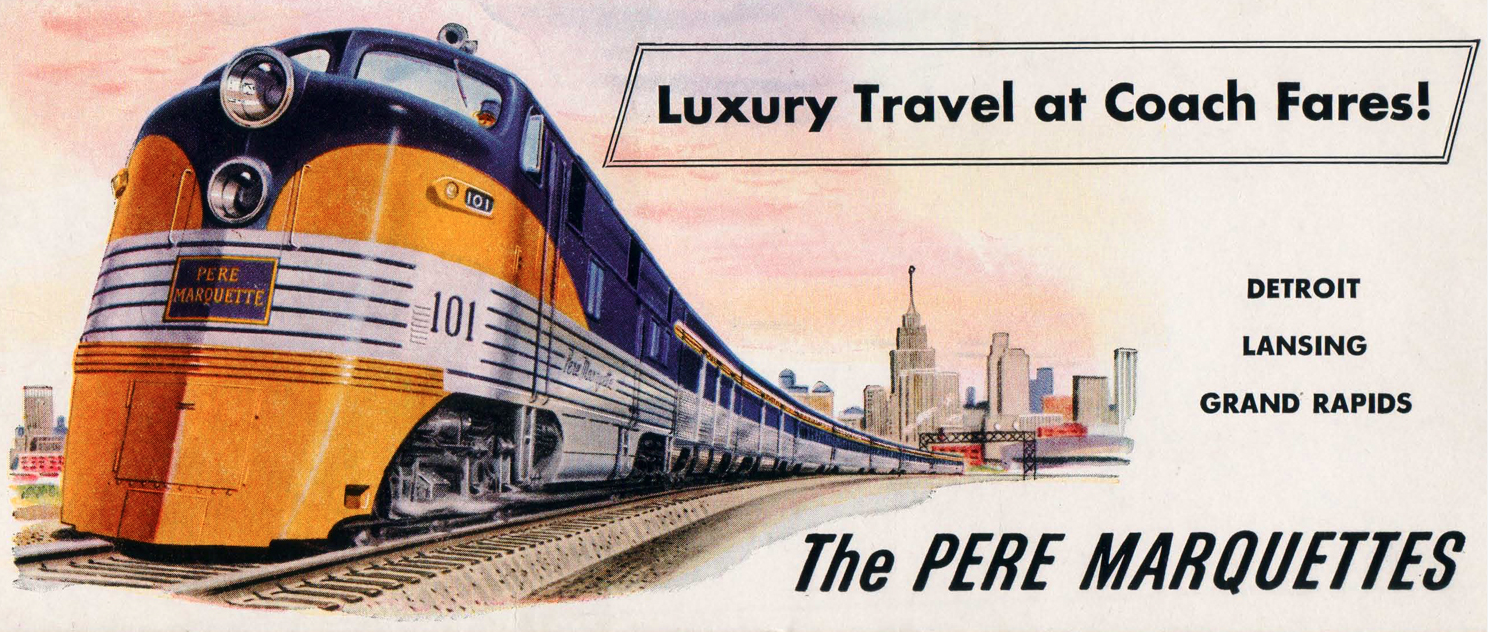
C&O’s formal acquisition of the Pere Marquette in 1947 did more than help usher in the postwar merger era; it also closed the book on a railroad with a colorful and quirky history. PM was created in 1900 by the consolidation of three roads: Flint & Pere Marquette; Detroit, Grand Rapids & Western; and Chicago & West Michigan. (The town of Pere Marquette; today we know the place as Ludington. Jacques Marquette, the French missionary and explorer, died and was buried here in 1675, and the name Pere Marquette had been given to the inlet lake off Lake Michigan, the river that feeds into it, and an 1847 community there.)

All three carriers had roots in the lumber industry, so the new Pere Marquette Railroad not only connected important Michigan cities, it also operated a branchline network covering much of the state’s Lower Peninsula. PM’s early corporate history was chaotic, marked by receivership and ownership changes. The Cincinnati, Hamilton & Dayton acquired PM in 1904 and for a time leased it to various parties, including the Erie Railroad. Thus did Baltimore & Ohio briefly control the PM through its ownership of the CH&D. When Pere Marquette came out of a receivership in 1907, it would be for only five years.

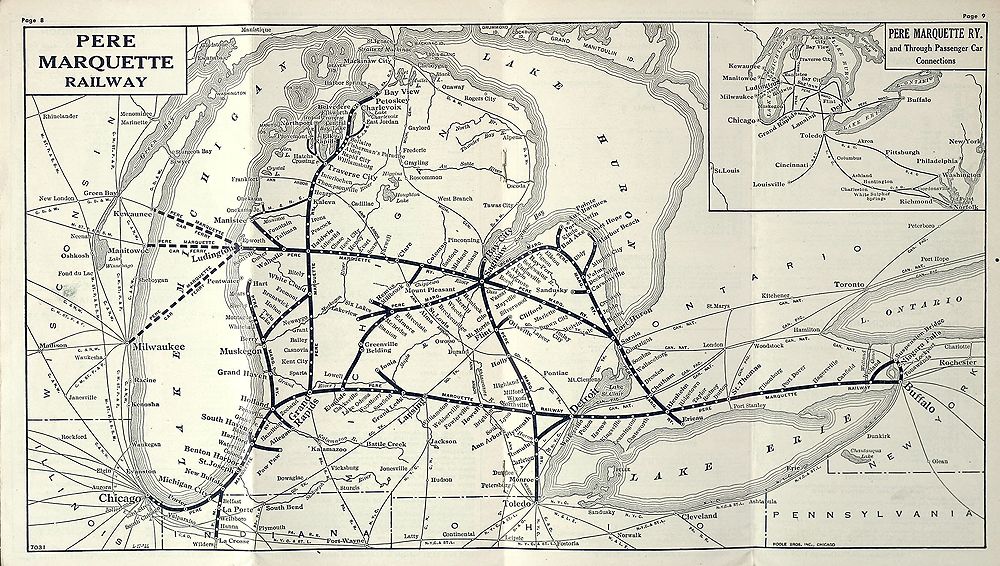
Those early, troublesome times, however, were marked by two strategic steps forward. One was the chartering of the Pere Marquette of Indiana, which built from New Buffalo, Michigan, southwest to Porter, Indiana, allowing PM to reach Chicago, via trackage rights on the Lake Shore & Michigan Southern (NYC). The second was the lease of the Lake Erie & Detroit River Railway, pushing PM eastward from Walkerville (Windsor), Ontario, to St. Thomas, thence to Suspension Bridge (Niagara Falls), New York, via rights on Michigan Central affiliate Canada Southern, and on to Buffalo on the NYC. Patched together as they were, these additions allowed PM to position itself as a Buffalo–Chicago bridge carrier.

Pere Marquette route map from a 1944 timetable.
Via Classic Trains.

In the ensuing years, the rectangular PM logo would largely disappear from view, although the road’s eventual 12 E7’s wore the script Pere Marquette train name, along with C&O identification, into the mid-1950s, thanks to equipment trust restrictions. PM’s three GE 70-tonners of 1947 were sold, but a few of its 16 EMD switchers (2 SW1’s of 1939 and ’42, 14 NW2’s of 1943–46) carried PM lettering into the 1960s, and C&O kept PM’s color pattern of yellow front-end bands with red pinstriping on a blue body on 11 more EMDs of 1948 that came fully lettered C&O: NW2’s 1850–1856 and E7’s 95–98.

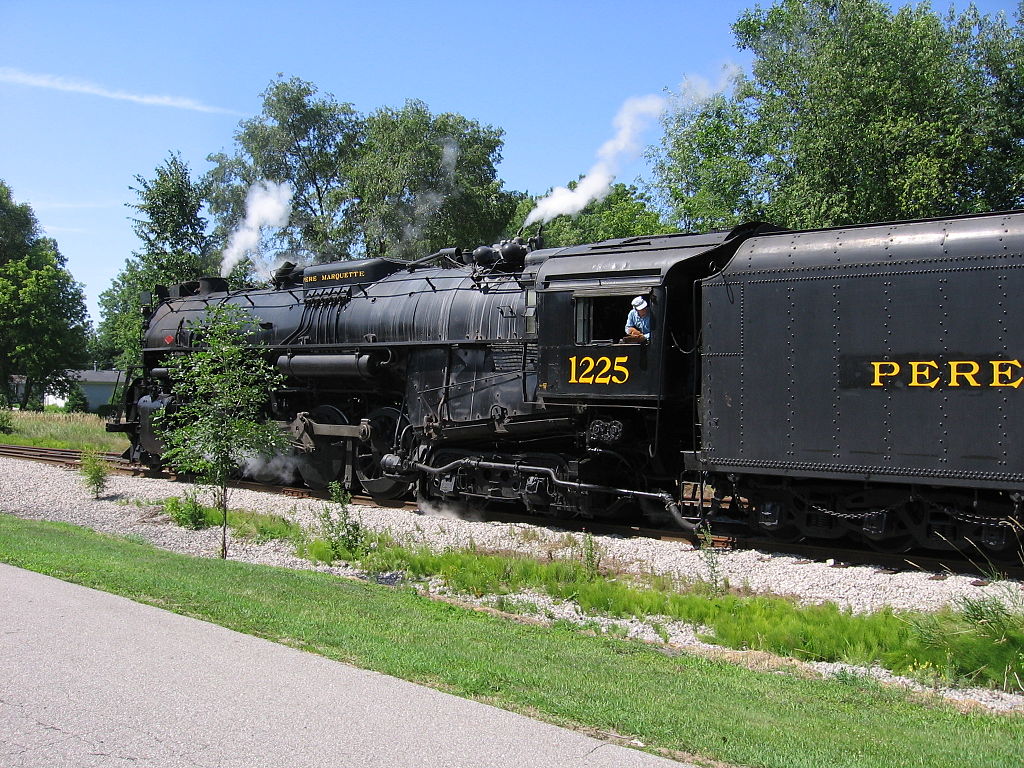
As for the famous Berkshires, they, along with all of Pere Marquette’s steam locomotives, were retired by 1951. Eleven found a temporary reprieve on C&O’s Chesapeake District in Kentucky and West Virginia, but only for a few months. Two, 1223 and 1225, survived as display items in Michigan, and as a student at Michigan State University, I became involved with the restoration of the 1225, which today occasionally operates on excursions.

Perhaps it’s fitting that the Pere Marquette’s last equipment order as an independent railroad was in 1947 for six of EMD’s 1,500 h.p. BL2 “branchline” diesels, Nos. 80–85. Chosen to negotiate PM’s web of secondary lines — most of them rooted in the road’s origins as a logger — the homely diesels were as quirky and as singular as the PM itself. Pointedly, even though they sported the “speed striping” as found on the E7’s, the BL2’s were delivered in full “Chesapeake & Ohio” lettering.

Pere Marquette 1225, a Berkshire 2-8-4 steam locomotive, passes through Alma in March 2009.
Photo by Chelseyafoster via Wikimedia Commons.

The Pere Marquette also had a maritime division and one of their ships had a disastrous voyage (via Wikipedia) 110 years ago:

The Pere Marquette operated a number of rail car ferries on the Detroit and St. Clair Rivers and on Lake Erie and Lake Michigan. The PM’s fleet of car ferries, which operated on Lake Michigan from Ludington, Michigan to Milwaukee, Kewaunee, and Manitowoc, Wisconsin, were an important transportation link avoiding the terminal and interchange delays around the southern tip of Lake Michigan and through Chicago. Their superintendent for over 30 years was William L. Mercereau.

Pere Marquette 18

On September 10, 1910, Pere Marquette 18 was bound for Milwaukee, Wisconsin, from Ludington, Michigan, with a load of 29 railroad freight cars and 62 persons. Near midnight, the vessel began to take on massive amounts of water. The captain dumped nine railroad cars into Lake Michigan, but this was no use — the ship was going down. The Pere Marquette 17, traveling nearby, picked up the distress call and sped to assist the foundering vessel. Soon after she arrived and she could come alongside, the Pere Marquette 18 sank with the loss of 28 lives; there were 33 survivors. Her wreck has yet to be located and is the largest unlocated wreck of the Great Lakes.

1884 Tacticool: Silver & Fletcher’s “Expert” Auto-Ejector

Filed under: Britain, History, Weapons — Tags: , , , — Nicholas @ 02:00

Forgotten Weapons
Published 1 Dec 2019

In 1884, Hugh Silver and Walther Fletcher patented a system to rapidly unload a gate-style revolver. They negotiated an agreement to have their system integrated into Webley revolvers (specifically the New Model RIC) as an option, and sold about 350 of them, including some to both the Royal Irish Constabulary and the Metropolitan London Police, under the name “The Expert”. Not so different from today’s tactical widget market, eh? The practical use of the system was to bypass the glacially-slow manual ejector rod and instead unload a cylinder full of empty cases simply by pulling the trigger six times in rapid succession. To avoid the obvious potential safety hazard this entailed, they also added a safety to retract the firing pin. It’s this firing pin safety that people usually notice when seeing the guns, as it is much more visible than the ejection mechanism.

The system could also be used to eject empty cases one by one as the gun was fired, although doing so required leaving the loading gate open while firing. The Webley revolvers made with the system are devoid of Webley company markings, although they do have both a Webley serial number (most being in the 33,000 – 36,000 range) and a Silver & Fletcher number (between 1 and about 350).

http://www.patreon.com/ForgottenWeapons

Cool Forgotten Weapons merch! http://shop.bbtv.com/collections/forg…

Contact:
Forgotten Weapons
6281 N. Oracle #36270
Tucson, AZ 85704

QotD: “To translate is to betray a little”

Filed under: Quotations, Randomness — Tags: , , — Nicholas @ 01:00

The discussion […] reminded me of when I was sixteen and embarked on a class called “Techniques of Translation.”

Although I had studied French and English and German, the translations I’d done so far were of the “I took the pen of my neighbor” variety. I thought the class would teach me to smooth out the sentence to “I took my neighbor’s pen” and that would be that.

I was wrong. Oh, it taught that also, but that was a minor portion of it. The class mostly hinged on the moral, ethical and — most of all — professional dilemmas of being a translator. I know any number of you are translators, formal or informal, but any number of you are also not. So, for the ones who are not, let me break the news with my usual gentleness:

There is no such thing as translation.

The French have a proverb “to translate is to betray a little” — or at least that’s the closest meaning in English. It’s fairly close to the true meaning, but slightly askew, of course. Every language is slightly askew to other languages.

The idea that there exists in every language a word that is exactly the equivalent of other languages is sort of like assuming that aliens will — of course — live in houses, go to school, ride buses, understand Rebecca Black’s “Friday”.

Language is how we organize our thoughts, and each word, no matter how simple, carries with it the cultural freight and experience of the specific language. Oh, “mother” will generally mean “the one who gave birth to” — except for some tribal, insular cultures where it might mean “the one who calls me by her name” or “my father’s principal wife” — but the “feel” behind it will be different, depending on the images associated with “mother” in the culture.

So, when you translate, you’re actually performing a function as a bridge. Translation is not the straightforward affair it seems to be but a dialogue between the original language and the language you translate into. If you’re lucky, you meet halfway. Sometimes that’s not possible, and you feel really guilty about “lying” to the people receiving the translation. When on top of language you need to integrate different cultures and living systems (which you do when translating anything even an ad) you feel even more guilty, because you’re going to betray, no matter how much you try. At one point, a while back, I had my dad on one phone, my husband on the other, and I was doing rapid-fire translation about a relatively straight forward matter. And even that caused me pangs in conscience, because my dad simply doesn’t understand how things are done here. I had to approach his experience and explain our experience in a way he wouldn’t think I was insane or explaining badly. That meant a thousand minor lies.

Sarah Hoyt, “Betraying A Little – A Blast From The Past From June 2011”, According to Hoyt, 2018-01-09.

« Newer PostsOlder Posts »

Powered by WordPress