Quotulatiousness

May 8, 2021

Special Presentation: Semiauto Pistols of the 1800s

Filed under: Europe, Germany, History, Military, Weapons — Tags: , , , , , — Nicholas @ 02:00

Forgotten Weapons
Published 19 Sep 2018

http://www.patreon.com/ForgottenWeapons

Cool Forgotten Weapons merch! http://shop.bbtv.com/collections/forg…

Today’s Special Presentation is an overview of all the semiautomatic pistols that were actually put into serial production before the year 1900. We have looked at these individually before, but I think it is worthwhile to examine them together in context, to gain a better understanding of what the automatic pistol scene was really like in the last years of the 19th century.

If you enjoy Forgotten Weapons, check out its sister channel, InRangeTV! http://www.youtube.com/InRangeTVShow

Contact:
Forgotten Weapons
6281 N Oracle #36270
Tucson, AZ 85704

From the comments:

Joseph Heschmeyer
2 years ago (edited)
“Hi guys, thanks for tuning in for another video on ForgottenWeapons.com. Today we’ll be looking at the science fair project that got me kicked out of middle school.”

QotD: That time the global elites were against diversity

There was simply no debate back then [in the aftermath of the Great War] that a mass influx of European refugees to Africa would have been a conquest, not a “humanitarian crisis” that Africans, with their ample space and nutrient-rich soil, had some kind of responsibility to sit back and accept. And to be clear, many of the European refugees who would have trekked across Sörgel’s newly reclaimed land were genuinely in need. They were impoverished, homeless, destitute. And a lot of them were fleeing political violence. Those folks were as poor, wretched, and persecuted as any Honduran is today. But in fully rejecting Atlantropa as a goal to be pursued, the international community took the position that “it sucks that you’re impoverished and mistreated in your home country, but it ain’t Africa’s problem. Stay where you are.”

See, in those days, the elites believed in keeping people in their own damn land. Hard as that might be to fathom now, that used to be a mantra of the progressive internationalists. There was a die-hard belief that the key to world peace was the separation of people, the segregation of populations by race, religion, and ethnicity. That was the entire point of the Greek/Turkish population exchange of 1923, overseen by the League in the name of keeping Greek Christians and Turkish Muslims separated for the sake of peace. As UNC Chapel Hill history professor Sarah Shields wrote in her 2016 essay in the Journal of the History of International Law, the prevailing belief at that time was that “Muslims and non-Muslims could not live together peacefully, and modernity required rejecting a diverse past in favor of a nation-state along European (unmixed) lines.”

Separation was the future, diversity was the past. Damn near 1.6 million Greeks and Turks were sent from the land of their birth to the land where they could live with those of a similar faith. Many of the other population transfers and redrawn boundaries that followed World War I were based on that same concept of giving people their “own” homeland based on characteristics like religion or ethnicity. It was simply taken as fact back then that nations function better with some level of homogeneity. That was canon back then. By the time the U.N. came around, that notion was still very much a guiding principle, as the internationalists realized that a vision of a multireligious, multiethnic Palestine was unrealistic and unattainable. And the Jews and the Arabs realized that too, which is why they started slaughtering each other, because they couldn’t bear to live in a partitioned state. Being separate but equal was not enough. They wanted to be separate and separated.

David Cole, “When Refugees Were Conquerors”, Taki’s Magazine, 2018-10-29.

May 7, 2021

The Nazi Invasion of Canada?! – WW2 – On the Homefront 009

Filed under: Britain, Cancon, Economics, History, Military, USA, WW2 — Tags: , , , , , — Nicholas @ 04:00

World War Two
Published 6 May 2021

What would happen if Nazi Germany invaded Canada? You don’t need to imagine. In 1942, the government of Mackenzie King launched a propaganda effort that simulates Canada falling under Hitler’s yoke. Why? For the war economy of course!

Join us on Patreon: https://www.patreon.com/TimeGhostHistory
Or join The TimeGhost Army directly at: https://timeghost.tv

Follow WW2 day by day on Instagram @ww2_day_by_day – https://www.instagram.com/ww2_day_by_day
Between 2 Wars: https://www.youtube.com/playlist?list…
Source list: http://bit.ly/WW2sources

Hosted by: Anna Deinhard
Written by: Fiona Rachel Fischer and Spartacus Olsson
Director: Astrid Deinhard
Producers: Astrid Deinhard and Spartacus Olsson
Executive Producers: Astrid Deinhard, Indy Neidell, Spartacus Olsson, Bodo Rittenauer
Creative Producer: Maria Kyhle
Post-Production Director: Wieke Kapteijns
Research by: Fiona Rachel Fischer
Edited by: Miki Cackowski
Sound design: Marek Kamiński
Map animations: Miki Cackowski and Eastory (https://www.youtube.com/c/eastory​)

Colorizations by:
Adrien Fillon – https://www.instagram.com/adrien.colo…​
Daniel Weiss

Sources:
IWM Art.IWM PST 18495, CH 27, CH 3231, CH 6831, HU 88386, HU 104482
nationaal archief
Photo Album of F.V. Light (1923-2000)

Soundtracks from the Epidemic Sound:
Howard Harper-Barnes – “London”
Johannes Bornlof – “The Inspector 4”
Howard Harper-Barnes – “Prescient”
Max Anson – “Ancient Saga”
Howard Harper-Barnes – “Sailing for Gold”
Philip Ayers – “Please Hear Me Out”
Jo Wandrini – “Puzzle Of Complexity”
Reynard Seidel – “Deflection”
Rannar Sillard – “March Of The Brave 4”
Phoenix Tail – “At the Front”

Archive by Screenocean/Reuters https://www.screenocean.com​.

A TimeGhost chronological documentary produced by OnLion Entertainment GmbH.

From the comments:

World War Two
1 day ago
As you can see in the video, the efforts to raise money to pay for the war were extremely high. But when we read about the stuff that was going on in Winnipeg on “If-Day”, we were really surprised — talk about “playing” war! Of course, this top-notch high-effort propaganda had quite the impact on the citizens of Winnipeg, because — let´s be honest — who wouldn´t be frightened by any kind of Nazi invasion? And they did not spare any effort to get the details right, too. What is your impression of If-Day? Have you heard of it before? Please let us know in the comments!

Cheers, Fiona

P.S. If you want to watch the short film starring Donald Duck which Anna mentions in the video, click right here: https://www.youtube.com/watch?v=XNMrMFuk-bo&ab_channel=8thManDVD.com%E2%84%A2CartoonChannel

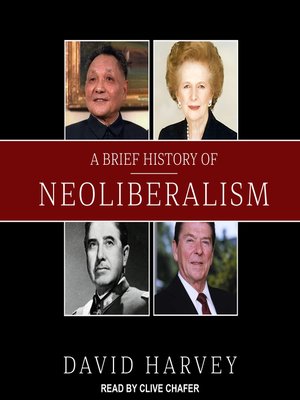
Scott Alexander reviews David Harvey’s A Brief History Of Neoliberalism

Filed under: Books, Economics, History, USA — Tags: , , , , , , — Nicholas @ 03:00

[Update: In the comments, “gunker” explains that this is another of Scott’s reader-contributed book reviews, not one of his own work. My apologies for the mistake.] After a quick rundown of the conventional explanation for the decline and fall of the comfortable post-WW2 US economy in the 1970s, Scott gives an overall appreciation of Harvey’s arguments:

… This treatment is almost the opposite of the way ABHoN describes events. Telling the story this way makes me feel like Jacques Derrida deconstructing some text to undermine the author and prove that they were arguing against themselves all along.

Harvey is an extreme conflict theorist. The story he wants to tell is the story of bad people destroying the paradise of embedded liberalism in order to line their own pockets and crush their opponents. At his best, he treats this as a thesis to be defended: embedded liberalism switched to neoliberalism not primarily because of sound economic policy, but because rich people forced the switch to “reassert class power”. At his worst, he forgets to argue the point, feeling it so deeply in his bones that it’s hard for him to believe anyone could really disagree. When he’s like this, he doesn’t analyze any of the economics too deeply; sure, rich people said something something economics, to justify their plot to immiserate the working classes, but we don’t believe them and we’re under no obligation to tease apart exactly what economic stuff they were talking about.

In these parts, ABHoN‘s modus operandi is to give a vague summary of what happened, then overload it with emotional language. Nobody in ABHoN ever cuts a budget, they savagely slash the budget, or cruelly decimate the budget, or otherwise [dramatic adverb] [dramatic verb] it. Nobody is ever against neoliberal reform — they bravely stand up to neoliberal reform, or valiantly resist neoliberal reform, or whatever. Nobody ever “makes” money, they “extract” it. So you read a superficial narrative of some historical event, with all the adverbs changed to more dramatic adverbs, and then a not-very-convincing discussion of why this was all about re-establishing plutocratic power at the end of it. This is basically an entire literary genre by now, and ABHoN fits squarely within it.

Harvey’s theses, framed uncharitably, are:

1. Embedded liberalism was great and completely sustainable. The global economic system collapsing in 1971 was probably just coincidence or something, and has no relevance to any debate about the relative merit of different economic paradigms.

2. Sure, some people say that the endless recession/stagflation/unemployment/bankruptcy/strikes of the 1970s were bad, but those people are would-be plutocrats trying to seize power and destroy the working class.

3. When cities, countries, etc, ran huge deficits and then couldn’t pay any of the money back, sometimes the banks that loaned them that money were against this. Sometimes they even asked those places to stop running huge deficits as a precondition for getting bailed out. This proves that bankers were plotting against the public and trying to form a dystopian plutocracy.

4. Since we have proven that neoliberalism is a sham with no advantages, we should switch back to embedded liberalism.

Let’s go through these one by one and see whether I’m being unfair.

Tank Chats #106 | Panzer IV | The Tank Museum

Filed under: Germany, History, Military, Weapons, WW2 — Tags: , , , , , , — Nicholas @ 02:00

The Tank Museum
Published 11 Sep 2020

Join The Tank Museum’s Curator David Willey as he discusses the Sd.Kfz 161, better known as Panzer IV: the most numerously produced tank by Germany during the Second World War.

Support the work of The Tank Museum on Patreon: ► https://www.patreon.com/tankmuseum
Visit The Tank Museum SHOP & become a Friend: ► tankmuseumshop.org

Twitter: ► https://twitter.com/TankMuseum
Instagram: ► https://www.instagram.com/tankmuseum/
#tankmuseum #tanks

QotD: Battleship gunnery in WW2

Filed under: Britain, Germany, History, Military, USA, Weapons, WW2 — Tags: , , — Nicholas @ 01:00

Capital ships could also only defeat their opponents’ armour IF they could find them and hit them accurately. Which was hardly a given, as only the British – with the eight WWI 15″ guns on Warspite — and Germans — with the nine modern 11″[!] guns on Scharnhorst — actually hit any moving target at 26,000 yards or more. (Both in relatively clear conditions in daylight, and both well inside the theoretical 35,000-45,000 yard full range of most battleship guns.)

[Three years later, in foul weather at night during the Battle of North Cape, the Germans had their fears that British radar had advanced far beyond theirs in gunfire direction completely confirmed, when Scharnhorst was pounded to scrap by Duke of York and a few cruisers in a battle where even the British cruisers could engage and score hits at ranges that didn’t allow Scharnhorst to reply accurately.]

No other navy came even close to hitting anything actually moving at any speed at 26,000 yards (though West Virginia managed within about 15% of it with 22,800 yards using the latest radar at Surigao Strait in late ’44). Certainly not the radar-deficient Italians and Japanese.

At night, or in bad weather, that meant radar-efficient nations had an unsurpassable advantage, particularly for fast moving targets at sea like those hit by Warspite and Scharnhorst.

[Although one USN 16″ battleship peppered stationary French targets in a port at even longer ranges, some USN engagements — like Guadalcanal — were at Jutland distances, if not closer. (5,000-8,000 yards, even though the US ships had radar … Which would have been fine if the USN had been consciously doing a Matapan-style 3,500 yard ambush, but South Dakota‘s radar and other power went down to “electrical fault”, and she accidentally wandered within 5,000 yards and was battered at close range, “leaving the ship in Lee’s words ‘deaf, dumb, blind, and impotent'”. Fortunately Washington‘s working radar allowed her to sneak up on the Japanese and win the battle.) ]

At Surigao Straits those USN battleships with more modern radar — the late war rebuilds West Virginia, California and Tennessee — spotted the enemy at over 30,000 yards, and opened fire at 22,000 yards, actually getting some hits with the opening salvos! But some ships with less effective radar — Maryland (eight 16″) — had to wait for visual sightings of shell splashes before joining in, and Pennsylvania (twelve 14″) with her older Mark III radar, failed to spot the enemy at all.

How many and how big your guns are, or what their range is, doesn’t matter a damn if you never see your opponent!

[Though please note, in every battle of the war, the navy which has the choice — either through speed in daylight, or radar superiority at night or in heavy weather — always closed the range to their maximum advantage (if not to point-blank where possible) before engaging.]

So instead of endlessly debating the value of ten or twelve 14″ versus eight 15″ or 16″ or even nine 11″ or 16″; or of 20 degree versus 30 degree or 40 degree elevation; or of heavier slower shells versus lighter faster ones: I tend to accept that most heavy guns could penetrate most armour, and just wonder whether they could only hit anything in good light and good weather, or if they were completely blind in the wrong conditions?

Nigel Davies, “Real Battleships for WWII – Part I – defining a battleship”, rethinking history, 2021-01-23.

May 6, 2021

Three Mid-Priced Handplanes Tested for a Year

Filed under: Tools, Woodworking — Tags: , , — Nicholas @ 06:00

Rex Krueger
Published 5 May 2021

I tested three planes for year. Is one of them right for your shop and budget?

More video and exclusive content: http://www.patreon.com/rexkrueger
Tools and Links Below! (Scroll down)
(more…)

Cold War 2: Electric Dumbaloo

Filed under: China, USA — Tags: , , , — Nicholas @ 05:00

Seva Gunisky at Hegemon has some thoughts on the undeclared-but-real new Cold War between the Peoples’ Republic Of China and what remains of the “west”:

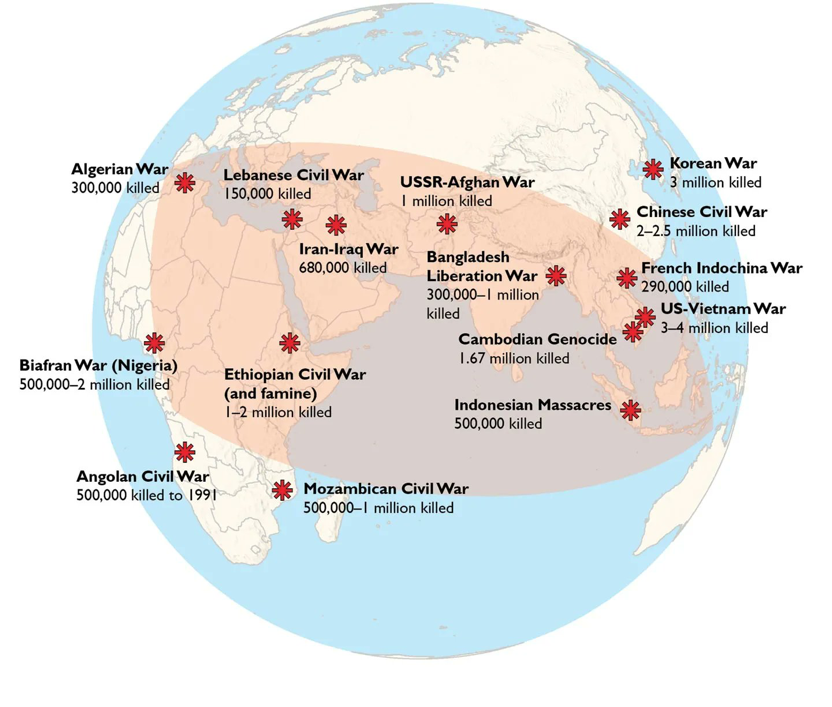
Approximate casualties of the many separate “hot” conflicts of the first Cold War.

Last week I discussed some reasons for and against the label of “Cold War” to describe US-Chinese relations, but mostly ignored the ethical implications of this debate. Since then I’ve encountered some genuinely terrible takes on the subject, so I wanted to expand on the idea just a bit.

One thing I failed to mention is how the presence of Chinese-Americans in the US — something largely missing during the first Cold War — complicates the debate. If you’re a China dove, one argument might be that any criticism of China’s regime amounts to racism against Chinese-Americans …

I’ve worked with many people with Chinese ancestry and people who came to Canada quite recently (in the software business it’d be hard to avoid working with folks from former and current communist countries), so I’ve always tried to be as careful as possible to couch my criticism of China — the PRC — to ensure that even a casual reader is clear that I’m against the government and their system, not individual people from China. It doesn’t always work, because for too many people these days, everything has to be viewed through a racist lens and anything that might possibly look or sound like racism must therefore absolutely be racism.

I think this argument can be taken too far, and used as a cheap way to shield China’s regime from legitimate criticism. As Alex Hazanov points out, it’s the same patronizing conflation people make when arguing that any criticism of Israel must be an attack on American Jews.

The doves are right, however, that the presence of nearly four million Chinese-Americans makes cold war discourse more fraught than the first time around, when the Soviets were “white” and safely far away. Official statements and attitudes will have to take special care, but in general the US does not have a great history in this regard. I fully expect reactionary cranks to demand that Chinese-Americans publicly and ritualistically denounce the Chinese government. Still, I hope it should be obvious that characterizing any critique of China’s government as “imperialist” or “sinophobic” is silly.

But brace yourselves for the shitstorm of dumb that will accompany this (hopefully cold) geostrategic conflict:

Take first Cold War discourse, add a dash of racism, filter it through social media, and you are beginning to get a sense of how dumb the debates are going to be.

[…]

And if we are going to pick a cold war “doctrine”, we should consider that neither Russia or China is looking great in the medium run. It seems that despite its supposed efficiency the Chinese regime is unable to resolve the information problem common in closed regimes, that regime personalization under Xi has worsened the problem, and that this, combined with structural/demographic problems, means the Chinese regime has a rough road ahead in the next 10-30 years.

If so, the best policy for US is certainly to avoid head-on confrontation in favor of something like neo-containment. But that’s another conversation.

H/T to Colby Cosh for the link.

Il Duce and the Fascist Abuse of History | B2W: ZEITGEIST! I E.17 – Harvest 1922

TimeGhost History
Published 5 May 2021

The modern age is an age of modern things. But it is also an age when people yearn for times past. One of the main men to weaponize this yearning is Benito Mussolini, and this season, he moves to recreate the Roman Empire in his fascist image.

Get your own Indy Neidell Tie here: https://www.youtube.com/channel/UC4Mi…

Join us on Patreon: https://www.patreon.com/TimeGhostHistory​

Hosted by: Indy Neidell
Written by: Francis van Berkel
Director: Astrid Deinhard
Producers: Astrid Deinhard and Spartacus Olsson
Executive Producers: Astrid Deinhard, Indy Neidell, Spartacus Olsson, Bodo Rittenauer
Creative Producer: Maria Kyhle
Post-Production Director: Wieke Kapteijns
Research by: Francis van Berkel and Timothy Smith
Image Research by: Lucas Aimo
Edited by: Lucas Aimo
Sound design: Marek Kamiński

Colorizations:
– Daniel Weiss
– Mikołaj Uchman

Archive by Screenocean/Reuters https://www.screenocean.com​.

A TimeGhost chronological documentary produced by OnLion Entertainment GmbH.

From the comments:

TimeGhost History
2 days ago (edited)
The only thing more interesting than learning about history is learning about how people in history learned about history.

For starters, it is just interesting in itself. Anyone with a passion for history will want to hear about the circumstances of how a new discovery was made or how certain historical narratives were preserved over time. But more analytically, looking at how a society understood its history can tell you a lot about that society understood itself and the contemporary world around it. That second point is particularly true of the modern age. Ironically, it is a very modern “thing” to be so aware of history. Indeed, the modern age saw the birth of the museum, of nationalist histories, and even the concept of what “History” itself was (note the capital H).

It’s such a massive topic and one that perhaps isn’t suited to a single pinned comment. Interested in learning more? Maybe we’ll do another video on it someday. In the meantime, you can read up the works of Reinhart Koselleck … that should keep you occupied.

Fallen Flag — the Northern Pacific Railway

Filed under: Business, History, Railways, USA — Tags: , , , , , , , — Nicholas @ 03:00

This month’s Classic Trains fallen flag feature is the Northern Pacific Railway by George Drury. The NP was a government-authorized transcontinental line planned to run from a Great Lakes port to the Pacific Northwest. Its founding legislation was passed during the American Civil War but construction of the right of way didn’t begin until 1870 and the line was completed in September, 1883. The railway was granted up to 60 million acres in land grants, but eventually only claimed about 40 million acres (much of this land was already occupied or claimed by various First Nations tribal groups who — of course — were given no choice about having a railway built through their lands and many actively fought against the railway eventually requiring formal US Army protection for the surveying and building crews).

Despite the vast land grants, the costs of building the railway eventually drove Jay Cooke, the original financial backer, into bankruptcy which was one of the major triggers of the financial disaster known as the Panic of 1873. The economic impact was widespread and was known — until the 1930s — as the “Great Depression”, and the US economy took several years to resume growth while other industrialized countries suffered the effects for longer.

NP reorganized by converting the bonds to stock, and the Lake Superior & Mississippi was reorganized as the St. Paul & Duluth. In 1881 control of the NP was purchased by Henry Villard, who also controlled the Oregon Railway & Navigation Co. and the Oregon & California Railroad. On Sept. 8, 1883, NP drove a last spike at Gold Creek, Mont., near Garrison, completing a line from Duluth to Wallula Junction, Wash. Northern Pacific trains continued on the rails of the OR&N to Portland, where NP’s own line to Tacoma resumed (it crossed the Columbia River by ferry from Goble, Ore., to Kalama, Wash.).

Even before completing the line at Gold Creek, NP began constructing a direct line from Pasco, Wash., over the Cascade Range to Tacoma. The Puget Sound area was beginning to grow, and NP wanted to reach it with its own line rather than rely on OR&N. Indeed, soon after the last-spike ceremonies, Villard’s empire collapsed and OR&N became part of Union Pacific (Southern Pacific got the Oregon & California). The Pasco–Tacoma line opened in 1887, with temporary switchbacks carrying trains over Stampede Pass until the opening of Stampede Tunnel in May 1888.

To help populate the railway’s claimed lands, colonization offices were established in northern Europe in the mid-1880s to attract immigrants to settle and farm along the right of way. Many Americans of German or Scandinavian ancestry can trace their roots back to these programs, which generally offered very cheap package deals for transportation to the United States along with parcels of land and other inducements.
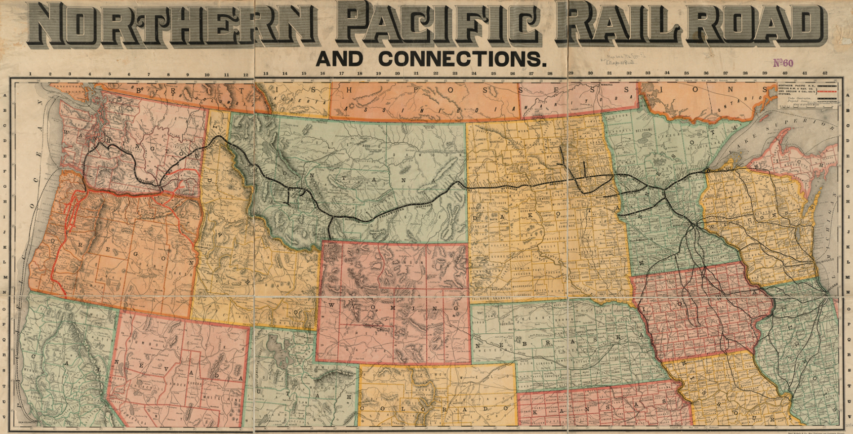
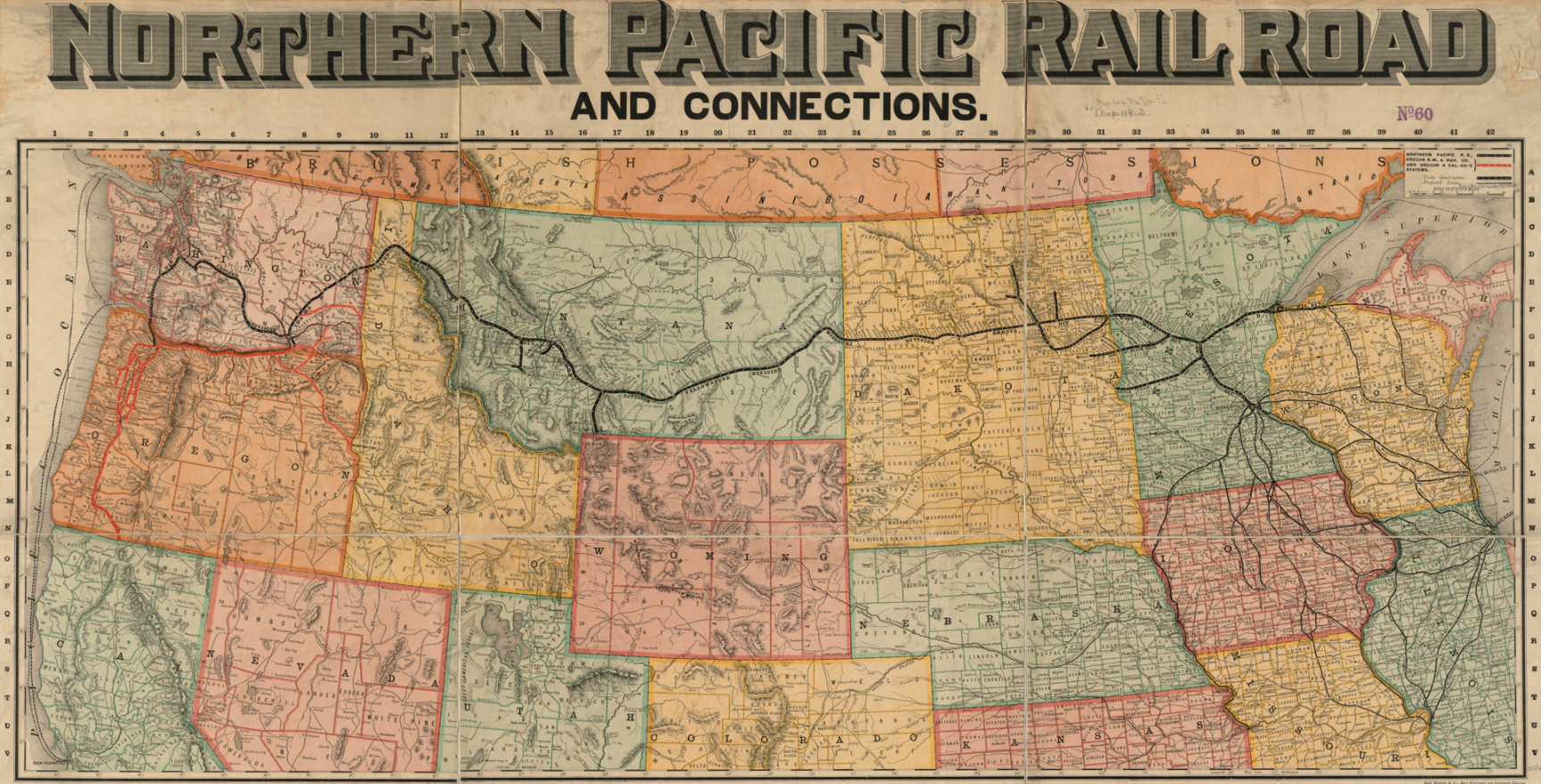
Detail from an 1885 Rand McNally publication showing a “Shipper’s Guide To All Points On And Connections To the Northern Pacific Railroad, Its Branches And Connecting Lines”
Original scan from the Norman B. Leventhal Map Center at the BPL via Wikimedia Commons.

In 1901 Northern Pacific and Great Northern gained control of the Chicago, Burlington & Quincy by jointly purchasing approximately 98 percent of its capital stock. That same year James J. Hill and J. P. Morgan formed the Northern Securities Co. as a holding company for NP and Great Northern. The U.S. Supreme Court dissolved Northern Securities in 1904. In 1905 the two roads organized the Spokane, Portland & Seattle, which was completed from Spokane through Pasco to Portland in 1908. GN and NP attempted consolidation in 1927, but the Interstate Commerce Commission made giving up control of the Burlington a requisite for approval, a condition the roads found unacceptable.

In October 1941 NP purchased the property of the Minnesota & International Railway (Brainerd to International Falls, Minn.), which it had controlled for a number of years.

In image, Northern Pacific was the most conservative of the three northern transcontinentals. (Great Northern was a prosperous, well-thought-out railroad; the Milwaukee Road was a brash newcomer.) Bulking large in NP’s freight traffic were wheat and lumber. In the 1920s and 1930s NP suffered from smaller than usual wheat crops and competition from ships for lumber moving to the East Coast. Ship competition decreased during World War II, and postwar prosperity brought an increase in building activity and population growth to the area NP served. NP was the oldest of the northern transcontinentals and had been instrumental in settling the northern plains. It served the populous areas of North Dakota, Montana, and Washington. Its slogan was “Main Street of the Northwest,” and its secondary passenger train of the 1950s and ’60s was the Mainstreeter. Its flagship was the North Coast Limited, launched in 1900.

In 1956 NP and Great Northern again studied merger of the two roads, the Burlington, and the Spokane, Portland & Seattle. In 1960 the directors of both roads approved the merger terms. On March 2, 1970, NP was merged into Burlington Northern along with Great Northern; Chicago, Burlington & Quincy; and Spokane, Portland & Seattle.


The Royal Canadian Navy – Sinking you, but politely

Filed under: Britain, Cancon, History, Military, WW1, WW2 — Tags: , , , , , — Nicholas @ 02:00

Drachinifel
Published 27 Jan 2021

A brief history of the Royal Canadian Navy from its origins to the end of WW2.

Sources:
https://archive.org/details/seaisatourgatesh00germ
https://www.canada.ca/en/navy/services/history/naval-service-1910-2010.html
Legion Magazine – “Over The Side: The Courageous Boarding Of U-94”
www.amazon.co.uk/No-Higher-Purpose-Operational-1939-1943/dp/1551250616
www.amazon.co.uk/Canadas-Navy-Century-General-Interest/dp/0802042813/

Free naval photos and more – www.drachinifel.co.uk

Want to support the channel? – https://www.patreon.com/Drachinifel

Want a shirt/mug/hoodie – https://shop.spreadshirt.com/drachini…

Want a poster? – https://www.etsy.com/uk/shop/Drachinifel

Want to talk about ships? https://discord.gg/TYu88mt

Want to get some books? www.amazon.co.uk/shop/drachinifelDrydock

Episodes in podcast format – https://soundcloud.com/user-21912004

Music – https://www.youtube.com/c/NCMEpicMusic

QotD: Bureaucracy and “Dunbar’s Number”

Filed under: Bureaucracy, Government, Quotations — Tags: , , , , — Nicholas @ 01:00

    Dunbar’s number is a suggested cognitive limit to the number of people with whom one can maintain stable social relationships — relationships in which an individual knows who each person is and how each person relates to every other person … By using the average human brain size and extrapolating from the results of primates, [Dunbar] proposed that humans can comfortably maintain 150 stable relationships.

    Wikipedia

Let’s stipulate that the “leader” of a “Dunbar Group” can effectively manage ALL of the group’s affairs. In our hypothetical community, “Dunbarville” (note that we’re doing a very Hobbesian “thought experiment” here), our leader – let’s call him Steve – can grasp the essentials of every issue facing the town. He doesn’t need to be an expert without portfolio. He doesn’t have to know all the ins-and-outs of, say, farming to be the effective leader of Dunbarville. However, he has to know that farming is a thing, the basics of how it’s done, understand the importance of well-maintained farms to the community, etc. Steve can delegate the management of Dunbarville’s kolkhoz to an experienced expert farmer, but Steve knows enough to be able to intervene effectively if the farm expert gets too big for his overalls.

Now consider what happens if Steve is any good at his job. Because Dunbarville’s kolkhoz is so well-managed, it can support a much larger population than 150. What does Steve do? Well, he knows that a population greater than 150 will be beyond his capacity to handle 100% effectively … but he also knows that forcing population restrictions on Dunbarville is the fastest way to get himself exiled, after which they’re going to have a baby boom anyway, so Steve does the best he can. In a few years he’s operating at 90% efficiency, then 70%, then 55%, because the community is simply growing too large for any one man to handle.

Now he has to delegate, and the delegation has to be permanent. Steve simply can’t keep up with everything that’s going on in the kolkhoz. So he delegates “kolkhoz management” to Gary. Gary’s not a bad guy – in fact, he’s the dude who managed the kolkhoz so well in the first place. But that task is, itself, now too big for even Gary to handle, so Gary hires some assistants. Worse, Gary knows he’s getting on in years, so to make sure the kolkhoz will keep working at peak, baby-boom-causing efficiency even after he’s gone, he sets up the Gary School of Farm Management …

And so forth, you get the point, we don’t have to run through the whole thing. That’s what I mean by “irreducible complexity” (IC). Once you clear the Dunbar Number, certain tasks have to be independently managed by cadres of experts who are only nominally answerable to the central authority. That’s where bureaucrats come in, and that’s where bureaucrats are good. Steve can’t manage ALL of Dunbarville’s affairs anymore, since it’s now a bustling community of 1,500, but he can manage the 150 bureaucrats who report to him. And since those bureaucrats are supervising only 150 people themselves …

Bureaucrats are, in effect, the re-imposition of a Dunbar Number on an increasingly complex society. When I say that the Roman Empire, for example, was under-bureaucratized, that’s what I mean. Maybe the Emperor had the good sense to limit his high officials to 150, but they had to manage 400 lower officials each, and each of those 400 were responsible for 20,000 peasants, or whatever the numbers actually were. That’s “irreducible complexity,” org-charts version. Unless you’ve got a perfectly balanced ratio of managers to managed, things are going to get very fuzzy at the edges, very fast … and that’s of course assuming complete competence on everyone’s part.

Severian, “Anticipations and Objections (I)”, Founding Questions, 2020-12-16.

May 5, 2021

The Greatest Spy Story Almost Never Told – WW2 – Spies & Ties 02

Filed under: Europe, Germany, History, Military, USA, WW2 — Tags: , , , , , — Nicholas @ 04:00

World War Two
Published 4 May 2021

A spy story almost forgotten to history that is key to understanding the espionage campaign that was waged as Hitler, Stalin, Roosevelt, and Churchill publicly directed the frontlines. Coming together here are the histories of cryptography, Nazi double-agents, and nuclear weapons.
(more…)

Michael Geist’s overview of the federal government’s steady retreat from their 2015 election promises on protecting Canadians’ online privacy and free speech rights

Reposting his most recent Maclean’s article on his website, Michael Geist explains why the federal government’s blatant hypocrisy over Canadians’ rights online has finally gotten many people paying closer attention:

The government had maintained that it had no interest in regulating user generated content, but the policy reversal meant that millions of video, podcasts, and the other audiovisual content on those popular services would be treated as “programs” under Canadian law and subject to some of the same rules as those previously reserved for programming on conventional broadcast services.

The backlash undoubtedly caught the government by surprise, particularly since the policy change garnered little discussion at committee. As the public concern mounted, Guilbeault retreated to his standard talking points about how the opposition parties were unwilling to stand up to the web giants. The arguments fell flat, however, since the new rules were directly targeting users’ content, not the Internet companies. Further, the public reaction pointed to a government increasingly out-of-step with the public, which may support increased Internet regulation, but not at any cost.

The fact that the Liberal government was open to regulating millions of TikTok and Youtube videos was a reminder of how unrecognizable its digital policy approach has become in recent years. The party was elected in 2015 on a platform that promised to entrench net neutrality, prioritize innovation, focus on privacy rather than surveillance, and support freedom of expression. Most of those positions now seemingly reflect a by-gone era.

It is still anxious to demonstrate its tech bona fides, but now progressive policies appear to mean confronting the “web giants” with threats of regulation, penalties, and taxes. Cultural sovereignty has replaced innovation as the guiding principle, which has meant the Minister of Innovation, Science and Industry has been replaced by the Minister of Canadian Heritage as the digital policy lead.

And so for the past 18 months, Guilbeault has been handed Canada’s digital policy keys. In Guilbeault’s eyes, seemingly everything is under threat – Canadian film and television production, a safe space for speech, the future of news – and the big technology companies are invariably to blame.

Few would dispute that an updated tech regulatory model is needed, but evidence-based policies are in short supply in the current approach. For example, the use or misuse of data lies at the heart of the power of big tech, yet privacy reforms have been curiously absent as a government priority. Indeed, Bill C-11 was promoted by Prime Minister Justin Trudeau last November as legislation to give Canadians greater control over their personal information, but under newly named ISI Minister François-Philippe Champagne, it has scarcely been heard from again.

The government has similarly done little to address concerns about abuse of competition, the risks associated with algorithmic decision-making, or the development of a modernized framework for artificial intelligence. Years of emphasis on the benefits of multi-lateral policy development and consensus-building were unceremoniously discarded the recent budget in order to commit to a digital services tax in 2022 that could spark billions in tariff retaliation. In fact, the US-Canada-Mexico Trade Agreement that the government trumpeted as a major success story restricts Canada’s ability to even establish a new liability regime for technology companies.

New Rifles for Old Ammo: The Royal Navy’s Unique SMLE MkI**

Filed under: Britain, History, Military, Weapons, WW1 — Tags: , , , — Nicholas @ 02:00

Forgotten Weapons
Published 27 Jan 2021

http://www.patreon.com/ForgottenWeapons

https://www.floatplane.com/channel/Fo…

Cool Forgotten Weapons merch! http://shop.bbtv.com/collections/forg…

When the SMLE was adopted by the British, it was to be the new universal rifle for all branches of service, including the Royal Navy. This suited the Navy just fine; they like the features of the new design. However, the Army quickly moved to update their rifles for the new MkVII Spitzer ammunition, and this was an issue. The Navy still had substantial stockpiles of the older round-nose MkVI cartridge, and did not go through it nearly as quickly as the Army. The Navy did not want to simply throw out their ammunition, but the differences in trajectory between the two types of ammunition was substantial. So the Navy opted to adopt its own unique rifle variation, the MkI**. This in effect was the new Army pattern rifle, but with the rear sight still calibrated for the trajectory of MkVI ammunition.

This pattern was first adopted in 1908, using rifles with the then-standard split charger guide. When the fixed charger bridge was adopted, the Navy (which still had plenty of MkVI ammunition) chose to update its MkI** rifles to fixed charger bridges, without making any change to their designation. Once they finally ran out of the older ammunition during World War One, the rifles were updated once again to what was then the standard MkI*** pattern. As a result, intact MkI** rifles — especially ones with the split charger guide — are extremely rare to find today. Many thanks to the owner of these two specimens for giving me access to share them with you!

Contact:
Forgotten Weapons
6281 N. Oracle #36270
Tucson, AZ 85740

« Newer PostsOlder Posts »

Powered by WordPress