
Governments thrive on infectious diseases, because only governments, or institutions that are very hard to distinguish from governments, can contain them. Which is why I always suspect that such “pandemics” (pandemic seems now to be the regular word for an “epidemic”) tend to be somewhat exaggerated. But if I were a politician, I would never dare to say such a thing.
Brian Micklethwait, “Not a good time to be a chicken”, Samizdata, 2006-02-21.
January 19, 2022
QotD: Pandemics
Comments Off on QotD: Pandemics
January 18, 2022
Decadence
In the latest Libertarian Enterprise, Sarah Hoyt considers the old Soviet put-down of all of western culture (especially the American one) … that it was decadent:
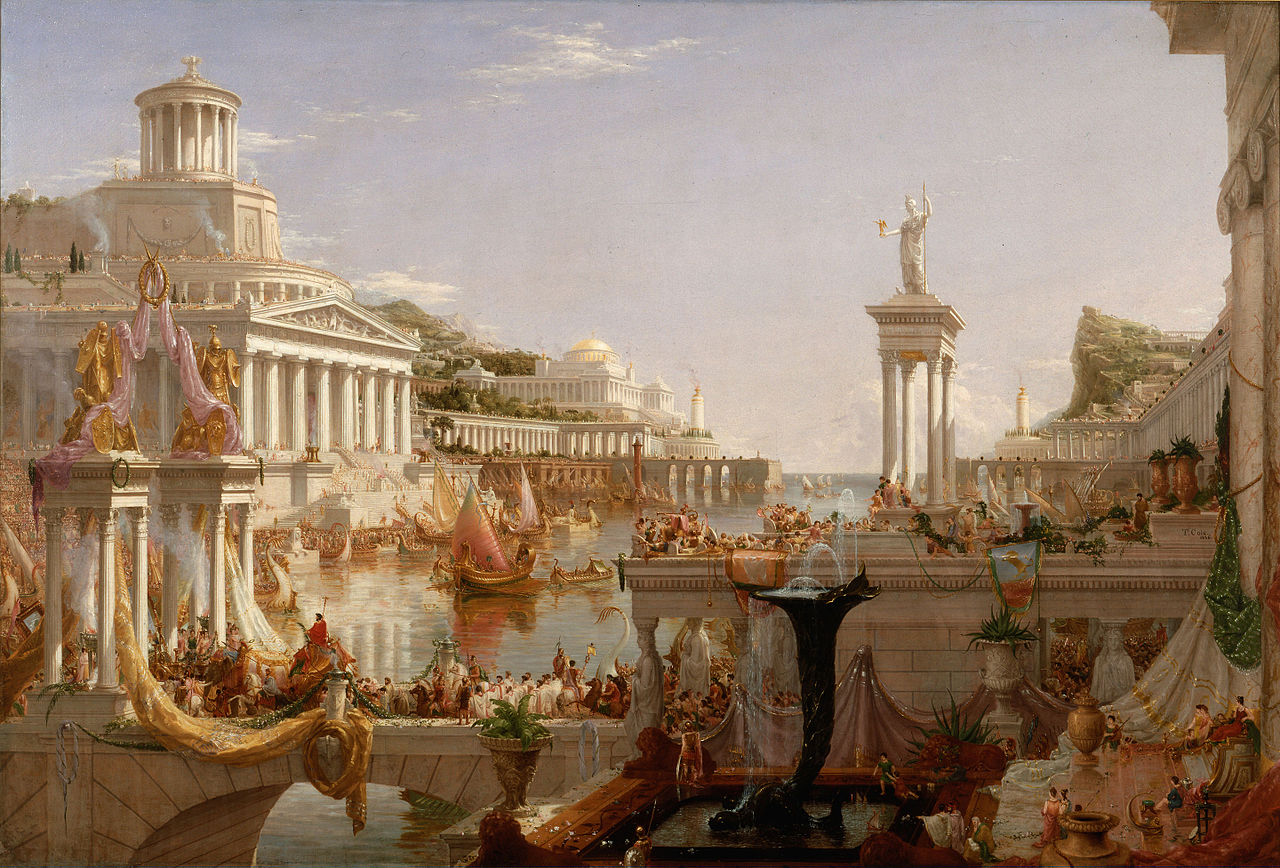
“The Consummation of Empire” from the painting series “The Course of Empire” by Thomas Cole (1801-1848).
New York HIstorical Society collection via Wikimedia Commons.
Yes, sure. I hear any number of you gnashing your teeth on that side of the screen: the soft living, the snowflakery in — mostly — our universities, the demands that everyone cater to them, people being completely terrified of a bad cold. Oh, yeah, rampant crime and bad sexual morals. We’re OBVIOUSLY decadent. How can I make fun of it?
Very easily.
For one your gnashing of teeth rhymes eerily with Romans gnashing of teeth for millennia, long before Rome was anywhere near ripe to fall, and in fact while Rome was the bad ass of the world. Second, it echoes even more eerily all of the Christian explanations of why Rome fell, which curiously also echoed the Christian beliefs in the loss of paradise.
“Decadence is sinfulness, and then comes the end and only G-d can save you” is the narrative there. Which is fine, in a spiritual sense, and completely bonkers insane when it applies to cultures and history. But it served the nascent theocracy that replaced Rome quite well. One of the things it served was to explain why life was now much, much harder. Because you know, abundance is what leads to decadence. Life is too soft, you don’t work hard enough and … bam! suddenly you’re in the middle of an orgy or worshiping a goat or something. Never you mind that the Romans pretty much did that all along, even when they were the badasses of the world. It’s really easy to shape the history of a fallen civilization so it suits the purposes of its successor.
Which brings us to the fact that Communism is a Christian heresy, complete with paradise — the supposed egalitarian and property-free pre-history (it’s also really easy to shape a period that left no account of itself that we can find) — until greed — and in one version PATRIARCHY and in another “whiteness” WTF that means — kicked us out of it. Now we must force the perfect human (Homo Sovieticus!) to emerge, so we can go back to living in caves in (sing it) perfect harmony. (Yeah.)
The complaints of decadence I heard as a young woman were mostly Soviet Agit Prop. Yes, yours were too. They ranged from incoherent to frigging insane. Some of it was a very old rhyming chorus: Americans were decadent because they were too rich. They had too many choices. They were too immoral. They never had enough, and would commit crimes to be richer. They ate too much, drove too much, slept in too comfortable a bed, and in general were DECADENT. Just like Rome before it fell. (If you realize the actual structure of Imperial Rome was closer to the Soviet Union’s, a plunder culture that could only survive by stealing, the whole thing will take your breath away with its chutzpah.
The fact that our (even though at the time it was your, as I was a foreigner at least in some ways) entertainment and art echoed these crazy accusations only made the whole thing stick, so even the right, American loving side (which anyway always has a vast side of puritanism in America. And speaking of puritans, let’s talk about what some of them did to … turkeys? If weird sexual kinks are a sign of decadence, we’ve never been non-decadent) bought into it. I mean Spartacus (the novel) portrait of the decadence of Rome was meant to echo how bad America was. What’s that I hear? The author was a communist? You. Don’t. Say. I think I sent my shocked face out to be mended, but I won’t be a sec while I retrieve it.
In a more personal sense, my own family told me Portugal too was decadent. Why, unlike mom, I didn’t have to walk beside the train line to pick up enough coal for the family to cook. We had butane bottles delivered, even if they were super expensive, so we often cooked on a petrol lamp in the patio, if the weather was fine.
Decadent and soft living, I tell you. Sure, the bathroom was outside, but it was a bathroom, with running water included. JUST like Rome before the fall. How much longer till we started screwing Nightingales’ Tongues, eating Bear Sausages and electing horses to congress (I think in America we’ve been doing that all along, too. Though I’d prefer if every now and then we elected the front half of the horse.)
Comments Off on Decadence
David Starkey – The Churchills episode 1
Whitehall Moll History Clips
Published 7 Jan 2019David Starkey weaves the stories of two great British war leaders: John and Winston Churchill. Hear how John Churchill rose from obscurity to be King James II’s right-hand man.

Comments Off on David Starkey – The Churchills episode 1
A Labour Party attempt to count coup against Boris Johnson may have backfired by showing the NHS in a terrible light
Brendan O’Neill explains why he found the Labour social media post to be a very bad idea:
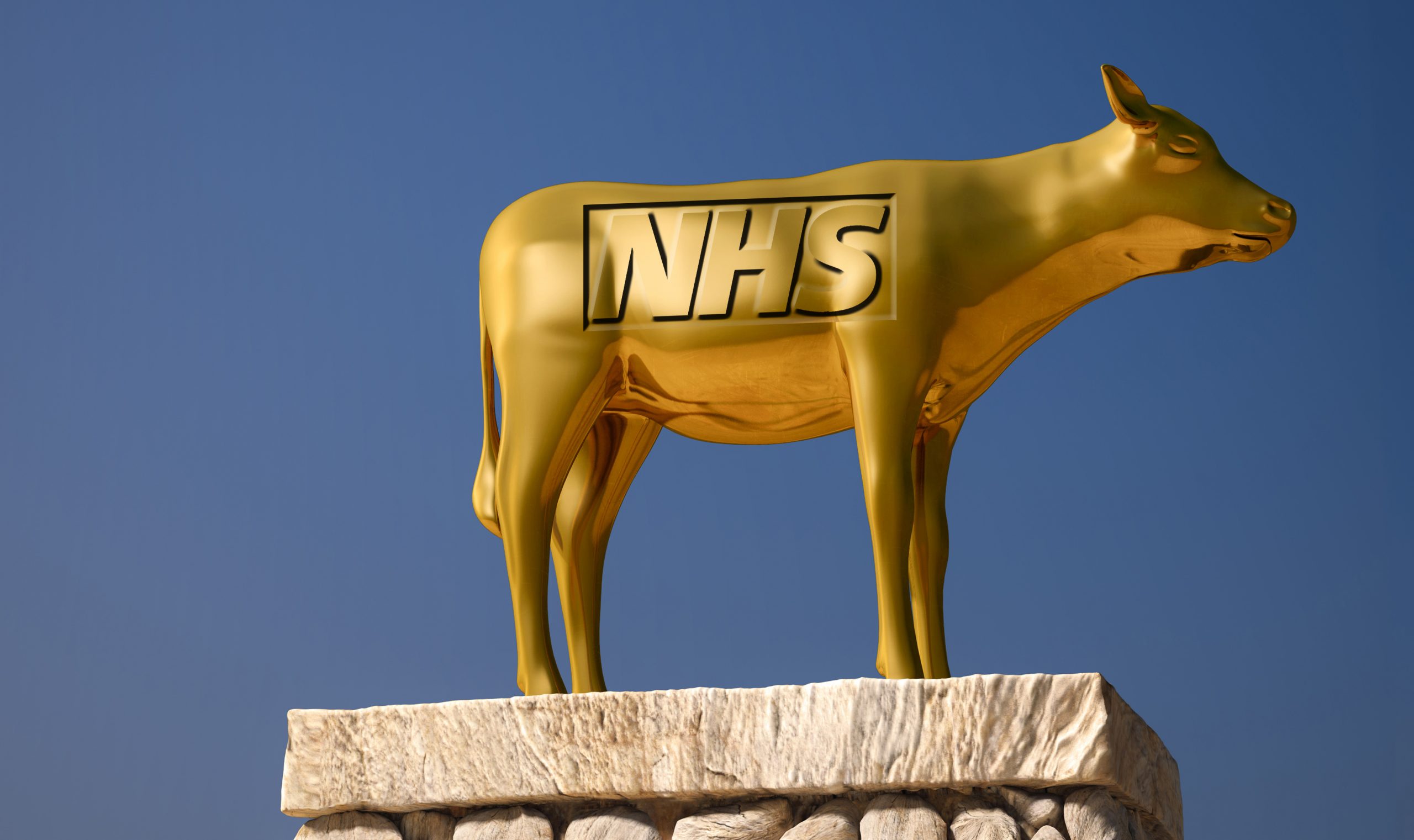
Not actually the official symbol of Britain’s National Health Services … probably.
This week, in response to the latest drinks-during-lockdown scandal engulfing Downing Street, the Labour Party tweeted something so extraordinary, so tone deaf, so inhumane, that it managed to make Boris and his coterie of rule-breaking hypocrites look almost principled in comparison.
It was a comment from an NHS nurse named only as Jenny (thank God for the absence of Jenny’s surname, for I shudder to think of the abuse she would receive if her full identity were revealed). This is what Jenny, according to Labour, had to say about the government’s boozy get-togethers on 20 May 2020 and other occasions when the rest of us were locked down:
I remember 20 May 2020 vividly, I spent hours on the phone to a man who was in the hospital car park, utterly desperate to see his wife. He begged, wept, shouted to be let in, but we said no – for the greater good of everyone else. She died unexpectedly and alone, as the government had a party.
This is a genuinely extraordinary statement. It is astonishing that no one in the Labour social-media team thought twice about posting it. The aim of this tweet is clearly to make us shake our heads and say “I can’t believe the government had a party while the NHS was making such tough decisions”, but in truth it has the exact opposite effect. It made me, at least, think to myself: “I can’t believe we let people die alone. I can’t believe the howling grief of a desperate man was ignored. I can’t believe there was such a complete and catastrophic collapse in everyday humanity during the lockdown.”
Labour clearly wants us to sympathise with “Jenny” against the government. But I find myself far more disgusted, far more outraged, by Jenny’s behaviour than by Boris Johnson’s. To have a sneaky party during lockdown is one thing. To ignore the pleas of a begging, weeping man and to watch as his wife subsequently died alone is something else entirely. It is in an utterly different moral ballpark. It is an unconscionable act. It is an obscenity against the human family that makes Boris and Carrie’s 25-minute visit to a garden party look saintly in comparison.
Comments Off on A Labour Party attempt to count coup against Boris Johnson may have backfired by showing the NHS in a terrible light
Ishapore No6 Jungle Carbine SMLE Prototype
Forgotten Weapons
Published 21 Nov 2018https://www.forgottenweapons.com/isha…
http://www.patreon.com/ForgottenWeapons
Cool Forgotten Weapons merch! http://shop.bbtv.com/collections/forg…
In 1943, the British government began a program to develop a shortened and lightened version of the No1 SMLE rifle, for production in India and Australia — where the national ordnance factories had not converted to production of the No4 rifle. This prototype is the first pattern produced by the Ishapore Arsenal for testing. Its barrel is cut down to 16.5 inches (plus a 2.8 inch long conical flash hider), it has a unique 3-position flag style of rear aperture sight, and has had its sling swivels repositioned. This rifle was tested in the UK, and some modifications were recommended. A second pattern from Ishapore was then provisionally approved as the No6 MkI on September 1st, 1944, but cancelled before production could begin. The Australian pattern of No6 was approved a year late in September 1945, but then declared obsolete before it could be put into production. With the end of World War Two and Indian independence in 1947, the funding and impetus for a new short rifle were lost, and instead Ishapore would end up converting its production to No1 pattern rifles in 7.62mm NATO a few years later.
Contact:
Forgotten Weapons
PO Box 87647
Tucson, AZ 85754

Comments Off on Ishapore No6 Jungle Carbine SMLE Prototype
QotD: The role of fate in man’s affairs
P.G. Wodehouse, “Jeeves and the Unbidden Guest”, My Man Jeeves, 1919.
Comments Off on QotD: The role of fate in man’s affairs
January 17, 2022
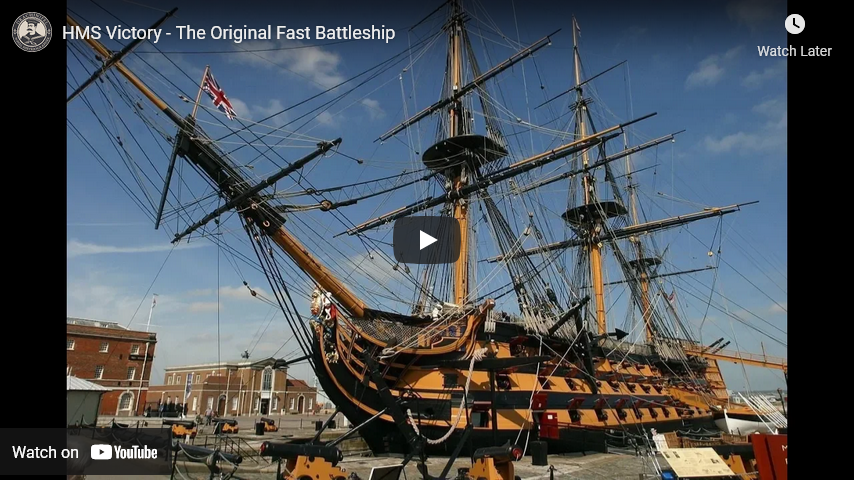
HMS Victory – The Original Fast Battleship
Drachinifel
Published 3 Jul 2019Today we look at the world’s oldest commissioned warship, the first rate ship of the line HMS Victory.
Want to support the channel? – https://www.patreon.com/Drachinifel
Want to talk about ships? https://discord.gg/TYu88mt
Music – https://www.youtube.com/c/NCMEpicMusic
Comments Off on HMS Victory – The Original Fast Battleship
“We need to address the corrosive influence of behavioural science on public life”
Frank Furedi on the British government’s use (and over-use) of “nudge” polices to influence the behaviour of the British public:
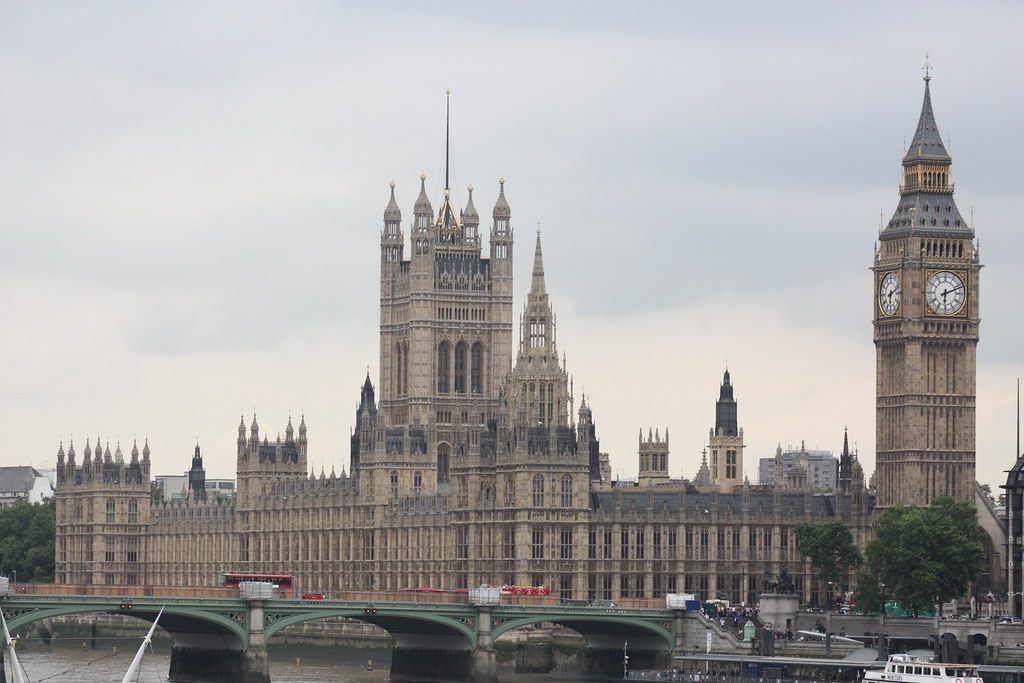
“Palace of Westminster”by michaelhenley is licensed under CC BY-NC-SA 2.0


Behavioural science, aka “nudging”, has been used by the government during the pandemic to scare people into doing the “right” thing. This insidious development has even been acknowledged by Simon Ruda, one of the co-founders of the Behavioural Insights Team, aka the Nudge Unit, which is part-owned by the UK government. He wrote that the “most egregious and far-reaching mistake made in responding to the pandemic has been the level of fear willingly conveyed [to] the public”.
Though he said that the propagation of fear had more to do “with government communicators and the incentives of news broadcasters” than with behavioural scientists themselves, Ruda’s admission is still striking. He even expressed concern about the state’s willingness “to use its heft to influence our lives without the accountability of legislative and parliamentary scrutiny”.
Ruda is not the only behavioural scientist concerned about officialdom’s systematic scaremongering. On 22 March 2020, a paper written by the Scientific Pandemic Influenza Behaviour Advisory Committee (SPI-B) for the government’s Scientific Advisory Group for Emergencies (SAGE) complained that the public was too relaxed about the pandemic. “A substantial number of people still do not feel sufficiently personally threatened”, it stated, adding that too many “are reassured by the low death rate in their demographic group”. It then urged the government to increase “the perceived level of personal threat… among those who are complacent, using hard-hitting emotional messaging”.
Some members of SAGE have since reported feeling “embarrassed” by the nature of SPI-B’s advice. As one regular SAGE attendee put it last year: “The British people have been subjected to an unevaluated psychological experiment without being told that is what’s happening.”
It is to be welcomed that at least some behavioural scientists are now questioning the political use of their discipline. But the problem goes deeper than fear-mongering during the pandemic. We need to address the corrosive influence of behavioural science on public life in general.
Comments Off on “We need to address the corrosive influence of behavioural science on public life”
The shooting range where you fire over a busy road
Tom Scott
Published 18 Oct 2021The Brünnlisau shooting range in Switzerland has its targets on the other side of a major road. And it’s safe. Here’s how and why. Thanks to everyone at the Schiessanlage Brünnlisau!
Camera: Alicja Pahl
Producer: Sebastian Capeda at Viven https://viven.ch
Editor: Michelle Martin https://twitter.com/mrsmmartinI’m at https://tomscott.com
on Twitter at https://twitter.com/tomscott
and on Instagram as tomscottgo

Comments Off on The shooting range where you fire over a busy road
QotD: The British ruling class reaction to fascism and communism
The British ruling class were not altogether wrong in thinking that Fascism was on their side. It is a fact that any rich man, unless he is a Jew, has less to fear from Fascism than from either Communism or democratic Socialism. One ought never to forget this, for nearly the whole of German and Italian propaganda is designed to cover it up. The natural instinct of men like Simon, Hoare, Chamberlain, etc. was to come to an agreement with Hitler. But – and here the peculiar feature of English life that I have spoken of, the deep sense of national solidarity, comes in – they could only do so by breaking up the Empire and selling their own people into semi-slavery. A truly corrupt class would have done this without hesitation, as in France. But things had not gone that distance in England. Politicians who would make cringing speeches about “the duty of loyalty to our conquerors” are hardly to be found in English public life. Tossed to and fro between their incomes and their principles, it was impossible that men like Chamberlain should do anything but make the worst of both worlds.
One thing that has always shown that the English ruling class are morally fairly sound, is that in time of war they are ready enough to get themselves killed. Several dukes, earls and what-not were killed in the recent campaign in Flanders. That could not happen if these people were the cynical scoundrels that they are sometimes declared to be. It is important not to misunderstand their motives, or one cannot predict their actions. What is to be expected of them is not treachery or physical cowardice, but stupidity, unconscious sabotage, an infallible instinct for doing the wrong thing. They are not wicked, or not altogether wicked; they are merely unteachable. Only when their money and power are gone will the younger among them begin to grasp what century they are living in.
George Orwell, “The Lion And The Unicorn: Socialism and the English Genius”, 1941-02-19.
Comments Off on QotD: The British ruling class reaction to fascism and communism
January 16, 2022
Library borrowing versus book store sales
I used to be a regular library user, but tapered off substantially after a few unhappy visits to the Toronto Reference Library on Yonge Street in the late ’80s (I’m now fully a believer in some of the wilder tales of disruptive and even criminal behaviour within libraries). I had my doubts about the direction most western library systems chose to concentrate on “popular” books and to get rid of “old” or infrequently borrowed books. It seemed to me that this was an attempt to set up libraries in direct competition with bookstores, and a deliberate act of neglect toward the function of libraries as repositories of valuable but less popular media. In the latest SHuSH newsletter, Kenneth Whyte details a fascinating natural experiment we’ve all be involved in over the last two years that seems to prove that library systems have been, in effect, taking money away from book sellers:

“Toronto Public Library” by Jim of JimOnLight is licensed under CC BY-NC-ND 2.0

Those of you who have been reading SHuSH for a while know that I suspect public libraries are doing harm to the publishing industry and author incomes.
Before the shooting starts, my standard qualifiers: I love libraries; they do a lot of fine work and are crucial civic institutions, running many outstanding programs and providing many necessary services, including the lending of books to children and people who genuinely can’t afford to buy them; I am always in libraries for research and to borrow and read hard-to-find books; I don’t want libraries to go away; I don’t want them harmed; I want their lending practices adjusted before they swallow what’s left of commercial publishing, book retailing, and, along with it, what’s left of author incomes.
By way of background, I’ve written at length in previous newsletters about how public libraries in the last decades of the last century abandoned their traditional role as gatekeepers of the culture, responsible for the moral, intellectual, and aesthetic growth of the public, choosing instead to pander to their patrons. They began pimping the likes of Mickey Spillane and Jacqueline Susann to goose the foot traffic and circulation stats they habitually use to demand of their political masters more funding and better buildings.
Over time, librarians have trained people who can afford to buy books for their own entertainment — the vast majority of library reading is for entertainment — to borrow them instead. Today, three out of four books read in the US and four out of five read in Canada are borrowed, not bought. That is bad for publishing, bookselling, and author incomes.
And then the Winged Hussars Wuhan Coronavirus arrived:
I believe it is self-evident that spending loads of taxpayer money to make the most popular books available at no charge at dozens of points around a city (as well as online) undermines retail sales of books, as it would if the same were done for coffee, running shoes, or Leafs’ tickets.
I have to admit, at the same time, that I’ve lacked hard evidence showing a portion of book borrowing represents lost sales. Nobody has thoroughly researched the question (it certainly isn’t in the interests of libraries to do so). The absence of a smoking gun has made it easy for library defenders to throw up their hands: maybe there’s a relationship, maybe not. People love free shit and will cheerfully strangle good faith to retain access to it.
I’ve tried to devise ways to prove conclusively that libraries are seriously undermining book sales. Maybe some huge experiment where we closed the public libraries in a large jurisdiction and studied what happened to retail book sales. But who was going to organize that? It seemed impossible until COVID-19 stepped up.
Libraries across North America and, indeed, around the world, have been closed, semi-closed, or otherwise limited in their borrowing activities throughout the two-year course of the pandemic. According to Library Journal, total circulation of library materials collapsed by 25.7% in 2020 (notwithstanding a huge spike in e-book borrowing). It looks like physical borrowing fell by roughly half. The 2021 numbers aren’t out yet but individual library reports suggest they will look a lot like 2020.
Meanwhile, over in publishing land, the champagne corks are flying. US book sales, which grew healthily in the first pandemic year 2020, grew again in 2021 and are now 19% ahead of the pre-pandemic year, 2019. All the major publishers have reported smashing sales (attributing the increase to their own genius). All categories are up, including adult fiction (31% over 2019) and adult non-fiction (10% over 2019).
Going by these numbers, it appears that a roughly 25% reduction in library borrowing leads over a two-year period to an increase of 19% in bookselling. I wouldn’t bank on those numbers, or even on the rough proportions, but I think the data demonstrates that when you make books more difficult to borrow for free, people turn more frequently to booksellers.
Comments Off on Library borrowing versus book store sales
Food for Leningrad, Breaking the Siege! – WW2 – 177- January 15th, 1943
World War Two
Published 15 Jan 2022Soviet attacks are launched this week to destroy the Hungarians, all while the German desperation at Stalingrad and Velikie Luki continues, but in the far north the Soviets have broken through the siege of Leningrad after 16 months. And the Casablanca Conference begins, a meeting to guide the war’s future progress.
(more…)
Comments Off on Food for Leningrad, Breaking the Siege! – WW2 – 177- January 15th, 1943
Is the narrative about the Trans Movement about to change?
In the latest Weekly Dish, Andrew Sullivan marks a perhaps significant change in how mainstream media outlets are discussing the Trans Movement:

An unusual thing happened in the conversation about transgender identity in America this week. The New York Times conceded that there is, indeed, a debate among medical professionals, transgender people, gays and lesbians and others about medical intervention for pre-pubescent minors who have gender dysphoria. The story pulled some factual punches, but any mildly-fair airing of this debate in the US MSM is a breakthrough of a kind.
Here’s the truth that the NYT was finally forced to acknowledge: “Clinicians are divided” over the role of mental health counseling before making irreversible changes to a child’s body. Among those who are urging more counseling and caution for kids are ground-breaking transgender surgeons. This very public divide was first aired by Abigail Shrier a few months ago on Bari’s Substack, of course, where a trans pioneer in sex-change surgery opined: “It is my considered opinion that due to some of the … I’ll call it just ‘sloppy’, sloppy healthcare work, that we’re going to have more young adults who will regret having gone through this process.” Oof.
The NYT piece also concedes another key fact: that puberty blockers are neither harmless nor totally reversible. Money quote:
Some of the drug regimens bring long-term risks, such as irreversible fertility loss. And in some cases, thought to be quite rare, transgender people later “detransition” to the gender they were assigned at birth. Given these risks, as well as the increasing number of adolescents seeking these treatments, some clinicians say that teens need more psychological assessment than adults do.
I would think that, just as a general rule, minors making permanent, life-changing decisions should receive more psychological treatment than adults. How on earth is this not the default? In what other field of medicine do patients diagnose themselves, and that alone is justification for dramatic, irreversible medication?
The NYT doesn’t give you the data for the “increasing number” of transitions because it’s hard to find in the US. In the UK, however, the data show a 3,200 percent rise in adolescents seeking transition over a decade — 70 percent of whom are girls seeking to become boys, a break from historical norms where boys/men were much more likely to seek transition. Nor does the NYT give any data for “detransitioners”. But any brief look online suggests they are not exactly “quite rare”. They are, in fact, becoming a small but recognizable and tenacious part of the trans landscape. And among the risks of puberty blockers that the NYT does not mention are neurological damage, bone-density loss, and a permanent inability to experience sexual pleasure. And in almost every case (98 percent in one report), puberty blockers are never reversed.
Comments Off on Is the narrative about the Trans Movement about to change?
The world’s most useful model railway
Tom Scott
Published 27 Sep 2021In Darmstadt, Germany, there’s the Eisenbahnbetriebsfeld: a model railway connected to actual railway signalling equipment, so that controllers can learn without putting any real trains in danger. I got to learn the very basics.
■ More about the railway (in German): https://www.eisenbahnbetriebsfeld.de/Camera: Moritz Janisch
Producer: Marcel Fenchel https://www.fenchel-janisch.de
Editor: Isla McTearWith thanks to Deutsche Bahn and DB Training, AKA Bahn, the Institut für Bahnsysteme und Bahntechnik at TU Darmstadt, and all the team at the Eisenbahnbetriebsfeld!
I’m at https://tomscott.com
on Twitter at https://twitter.com/tomscott
and on Instagram as tomscottgo

Comments Off on The world’s most useful model railway
QotD: Once “discovered”, colonization of the Americas was inevitable
This is not a joke. Political reality has a way of crashing in on the pipe dreams of liberal academics. The reality is, if the English had not colonised, then the French or the Dutch would have. If the Spanish had not colonised, the Portuguese would have. This would have shifted the balance of power at home, and any European country which had not colonised, would have been relegated to secondary status. And it is easy to overestimate the amount of control that European governments actually had. As soon as the New World was discovered, many fisherman and traders sailed across the Atlantic on their own, in hopes of circumventing tax authorities and scoring a fortune. Long before colonies were established in most regions, the New World was crawling with Europeans whose superior technology gave them an edge in combat. Nonetheless, it was extremely dangerous for Europeans to provoke fights with Native Americans, and most of them tried to avoid this when possible. In retrospect, one could in theory be impressed that so many European governments showed a genuine concern to rein in the worst excesses of their subjects, with an express eye to protecting the Indians from depredation. The logic was simple: they attempted to protect their subjects at home, in order to secure good order and a better tax base. So they would do the same to their subjects in the New World. For a long time, few Europeans harboured any master plan of pushing the Native Americans out of their own lands. In more densely populated regions such as Mexico, such an idea must have seemed an absurdity. Reality tends to occur ad hoc. Boundaries often took generations to move, and would have seemed fixed at the time. For several centuries, many Europeans assumed that they would long be a minority on the North American continent. In Mexico and Peru, they always have been.
Population density mattered, a lot, when it came to pre-modern global migrations. China and India were “safe” from excessive European colonisation because they had the densest populations in the world, and they were likewise largely immune to any diseases brought by Europeans. SubSaharan Africa had a lower population density depleted by slave raiding, but they still outnumbered European colonists by a large margin throughout the colonial era — again because European contact did not decimate their numbers through disease the way it did in the Americas. It is worth noting that no one claims that Europeans committed genocide in India, Asia or even Africa, although their technological advantages gave them every opportunity had they actually been of a genocidal mindset (as were for example the Mongols). In fact, the European track record shows them to be almost shockingly un-genocidal, given their clear technological advantages over the rest of the world for a period of several centuries. Few other civilisations, given similar power over so much of the world’s people, would have behaved in a less reprehensible manner. This is not to give Europeans a pat on the back. Rather it is to point out that Europeans are regularly painted as the very worst society on Earth, when in fact they had the power to do far, far more evil than they actually did. Let us at least acknowledge this fact.
Jeff Fynn-Paul, “The myth of the ‘stolen century'”, Spectator Magazine, 2020-09-26.
Comments Off on QotD: Once “discovered”, colonization of the Americas was inevitable


