Quotulatiousness

March 29, 2023

The Grauniad something something glass houses something something throwing stones

Filed under: Britain, Business, History, Media, USA — Tags: , , , , , , — Nicholas @ 05:00

In UnHerd, Ashley Rindsberg recounts the details we know so far about the Guardian‘s embarassing historical project to find out about the newspaper’s links to the slave trade:
The Guardian prides itself on being one of the most Left-leaning and anti-racist news outlets in the English-speaking world. So imagine its embarrassment when, last month, a number of black podcast producers researching the paper’s historic ties to slavery abruptly resigned, alleging they had been victims of “institutional racism”, “editorial whiteness”, “microaggressions, colourism, bullying, passive-aggressive and obstructive management styles”. All of this might smack of progressive excess, but, in reality, it merely reflects an institution incuriously at odds with itself.

Questions about The Guardian‘s ties to slavery have been circulating since 2020, when, amid the media’s collective spasm of racial conscience following the murder of George Floyd, the Scott Trust announced it would launch an investigation into its history. “We in the UK need to begin a national debate on reparations for slavery, a crime which heralded the age of capitalism and provided the basis for racism that continues to endanger black life globally,” journalist Amandla Thomas-Johnson wrote in a June 2020 Guardian opinion piece about the toppling of a statue of 17th-century British slaver Edward Colston. A month later, the Scott Trust committed to determining whether the founder of the paper, John Edward Taylor, had profited from slavery. “We have seen no evidence that Taylor was a slave owner, nor involved in any direct way in the slave trade,” the chairman of the Scott Trust, Alex Graham, told Guardian staff by email at the time. “But were such evidence to exist, we would want to be open about it.” (Notably, Graham, in using the terms “slave owner” and “direct way”, set a very specific and very high bar for what would be considered information worthy of disclosure.)

The problem is that the results of the investigation, conducted by historian Sheryllynne Haggerty, an “expert in the history of the transatlantic slave trade”, have never been made public. When contacted with questions about what happened to the promised report, Haggerty referred all inquiries to The Guardian‘s PR, which has remained silent on the matter. (The Guardian was asked for comment and we were given the stock PR response The Guardian gave following the podcaster’s letter.) But what we do know is this: according to Guardian lore, a business tycoon named John Edward Taylor was inspired to agitate for change after witnessing the 1819 Peterloo Massacre, when over a dozen people were killed in Manchester by government forces as they protested for parliamentary representation. Two years later, Taylor, a young cotton merchant, with the backing of a group of local reformers known as the Little Circle, founded the paper.

“Since 1821 the mission of The Guardian has been to use clarity and imagination to build hope,” The Guardian‘s current editor, Katharine Viner, proudly proclaims on the “About us” page of the paper’s website. Part of this founding myth concerns one of the defining social and political issues of the day, slavery, which the Little Circle members, including Taylor, vigorously opposed as a moral affront. “The Guardian had always hated slavery,” Martin Kettle, an associate editor, wrote in a 2011 apologia on why during the Civil War the paper had vociferously condemned the North while equivocating on the South.

That may be true, but it also presents an incomplete picture. The Manchester Guardian, as the paper was then known, was founded by cotton merchants, including Taylor, who were able to pool the money needed to launch the paper by drawing on their respective fortunes. While none of these men, many of whom were Unitarian Christians, is likely to have engaged in slavery, they didn’t just benefit from but depended upon the global slave trade that provided virtually all of the cotton that filled their mills. As Sarah Parker Remond, an African American abolitionist, said upon visiting Manchester in 1859: “When I walk through the streets of Manchester and meet load after load of cotton, I think of those 80,000 cotton plantations on which was grown the $125 million worth of cotton which supply your market, and I remember that not one cent of that money ever reached the hands of the labourers.”

Will Finland Leave the War? – WW2 Special

World War Two
Published 28 Mar 2023

The Finns have been fighting the Soviet Union since the Winter War. But now, Marshal Mannerheim and Prime Minister Risto Ryti look like they might pull out of the Eastern Front commitments they agreed upon with their Axis allies. German-Finnish relations seem to be at breaking point, and Red Army troops are threatening the borders. How long will Finland stay in this war?
(more…)

The obscure Polish banker who foresaw the carnage and deadlock of the First World War

Filed under: Books, Europe, History, Military, WW1 — Tags: , , , — Nicholas @ 03:00

Jon Miltimore on one of the few people to realize the increased deadliness and growing size of modern armies foreclosed any possibility of a quick, glorious war that would have the troops “home for Christmas”:

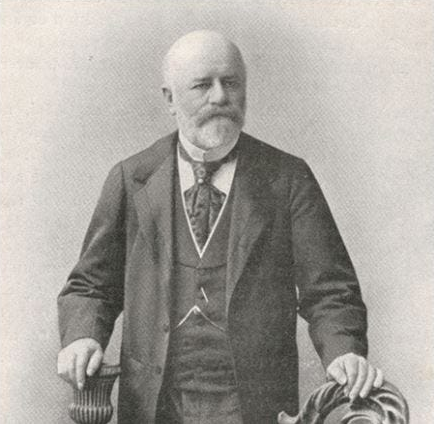
Jan Bloch, author of The War of the Future in its Technical, Economic and Political Relations (1898).

One man who did portend the carnage was Jan Bloch, a Polish banker and railroad baron who moonlighted as a military theorist. In 1898, Bloch published a little-noticed six-volume work titled The War of the Future in its Technical, Economic and Political Relations. The following year, the work was re-published in a single volume under a new title: Is War Now Impossible?

In the work, Bloch, who had closely studied Britain’s campaign in Africa during the Boer War, explained that modern weaponry had become so deadly that it had fundamentally changed warfare. Bayonet charges and cavalry flanking maneuvers were obsolete in an era defined by sophisticated earthworks and precision projectiles, he suggested.

    Everybody will be entrenched in the next war. It will be a great war of entrenchments. The spade will be as indispensable to a soldier as his rifle. The first thing every man will have to do, if he cares for his life at all, will be to dig a hole in the ground. War, instead of being a hand-to-hand contest in which the combatants measure their physical and moral superiority, will become a kind of stalemate, in which neither army is able to get at the other, threatening each other, but never being able to deliver a final and decisive attack.

War would be “impossible” in the sense that it would be suicidal. Neither side would be able to gain a decisive advantage, battles along massive contiguous fronts would continue indefinitely.

Was Bloch suggesting that modern man had vanquished war by making it so deadly and terrible? Hardly. He argued that humans would be slow to realize the changes, and the results would be catastrophic.

    At first there will be increased slaughter — increased slaughter on so terrible a scale as to render it impossible to get troops to push the battle to a decisive issue. They will try to, thinking that they are fighting under the old conditions, and they will learn such a lesson that they will abandon the attempt forever. Then, instead of war fought out to the bitter end in a series of decisive battles, we shall have as a substitute a long period of continually increasing strain upon the resources of the combatants. The war, instead of being a hand-to-hand contest, in which the combatants measure their physical and moral superiority, will become a kind of stalemate, in which neither army being willing to get at the other, both armies will be maintained in opposition to each other, threatening the other, but never being able to deliver a final and decisive attack …

    That is the future of war — not fighting, but famine, not the slaying of men, but the bankruptcy of nations and the breakup of the whole social organization …

First World War generals don’t get much credit for their varied efforts to break the trench warfare deadlock, and later historians certainly piled on for the leaders’ collective failure to resolve the problem, but as Bret Devereaux pointed out, there was no easy solution. Artillery wasn’t the answer, nor were the famed German Stoßtruppen, nor the technical innovation of tanks, nor air power (either tactical or strategic). The technology of the day provide no one answer, but the leaders tried everything they could and the bleeding went on.

Anti-Tank Chats #7 | Panzerschreck | The Tank Museum

Filed under: Europe, Germany, History, Military, Weapons, WW2 — Tags: , , , — Nicholas @ 02:00

The Tank Museum
Published 2 Dec 2022

Join Historian Stuart Wheeler as he details another anti-tank weapon, the Panzerschreck.
(more…)

QotD: Sacrifice

As a terminology note: we typically call a living thing killed and given to the gods a sacrificial victim, while objects are votive offerings. All of these terms have useful Latin roots: the word “victim” – which now means anyone who suffers something – originally meant only the animal used in a sacrifice as the Latin victima; the assistant in a sacrifice who handled the animal was the victimarius. Sacrifice comes from the Latin sacrificium, with the literal meaning of “the thing made sacred”, since the sacrificed thing becomes sacer (sacred) as it now belongs to a god, a concept we’ll link back to later. A votivus in Latin is an object promised as part of a vow, often deposited in a temple or sanctuary; such an item, once handed over, belonged to the god and was also sacer.

There is some concern for the place and directionality of the gods in question. Sacrifices for gods that live above are often burnt so that the smoke wafts up to where the gods are (you see this in Greek and Roman practice, as well in Mesopotamian religion, e.g. in Atrahasis, where the gods “gather like flies” about a sacrifice; it seems worth noting that in Temple Judaism, YHWH (generally thought to dwell “up”) gets burnt offerings too), while sacrifices to gods in the earth (often gods of death) often go down, through things like libations (a sacrifice of liquid poured out).

There is also concern for the right animals and the time of day. Most gods receive ritual during the day, but there are variations – Roman underworld and childbirth deities (oddly connected) seem to have received sacrifices by night. Different animals might be offered, in accordance with what the god preferred, the scale of the request, and the scale of the god. Big gods, like Jupiter, tend to demand prestige, high value animals (Jupiter’s normal sacrifice in Rome was a white ox). The color of the animal would also matter – in Roman practice, while the gods above typically received white colored victims, the gods below (the di inferi but also the di Manes) darkly colored animals. That knowledge we talked about was important in knowing what to sacrifice and how.

Now, why do the gods want these things? That differs, religion to religion. In some polytheistic systems, it is made clear that the gods require sacrifice and might be diminished, or even perish, without it. That seems to have been true of Aztec religion, particularly sacrifices to Quetzalcoatl; it is also suggested for Mesopotamian religion in the Atrahasis where the gods become hungry and diminished when they wipe out most of humans and thus most of the sacrifices taking place. Unlike Mesopotamian gods, who can be killed, Greek and Roman gods are truly immortal – no more capable of dying than I am able to spontaneously become a potted plant – but the implication instead is that they enjoy sacrifices, possibly the taste or even simply the honor it brings them (e.g. Homeric Hymn to Demeter 310-315).

We’ll come back to this idea later, but I want to note it here: the thing being sacrificed becomes sacred. That means it doesn’t belong to people anymore, but to the god themselves. That can impose special rules for handling, depositing and storing, since the item in question doesn’t belong to you anymore – you have to be extra-special-careful with things that belong to a god. But I do want to note the basic idea here: gods can own property, including things and even land – the temple belongs not to the city but to the god, for instance. Interestingly, living things, including people can also belong to a god, but that is a topic for a later post. We’re still working on the basics here.

Bret Devereaux, “Collections: Practical Polytheism, Part II: Practice”, A Collection of Unmitigated Pedantry, 2019-11-01.

March 28, 2023

WEIRD World – basing all our “assumptions about human nature on psych lab experiments starring American undergraduates”

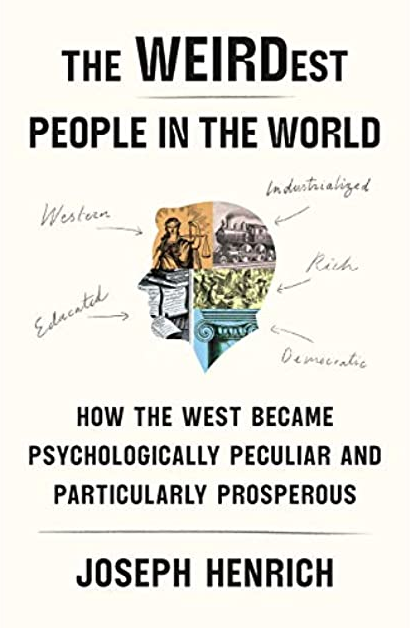
Jane Psmith reviews The WEIRDest People in the World: How the West Became Psychologically Peculiar and Particularly Prosperous by Joseph Henrich:

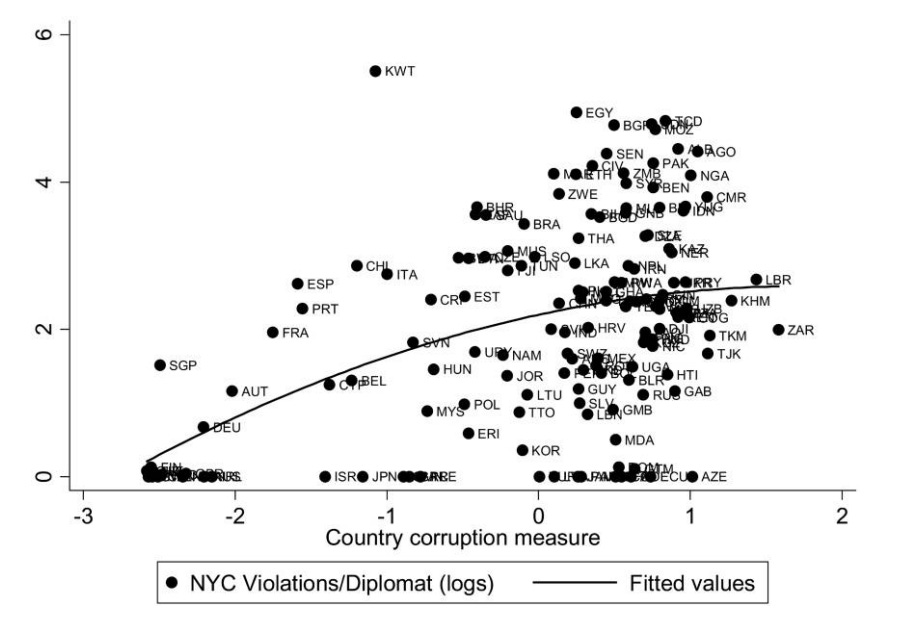
Until 2002, diplomats at the United Nations didn’t have to pay their parking tickets. Double-parking, blocking a fire hydrant, blocking a driveway, blocking an entire midtown Manhattan street — it didn’t matter; when you have diplomatic plates, they let you do it. In the five years before State Department policy changed in November 2002, UN diplomats racked up a whopping 150,000 unpaid parking tickets worth $18 million in fines. (Among other things, the new policy allowed the city to have 110% of the amount due deducted from the US foreign aid budget to the offending diplomats’ country. Can you believe they never actually did it? Lame.) Anyway, I hope you’re not going to be surprised when I say that the tickets weren’t distributed evenly: the nine members of Kuwait’s UN mission averaged almost 250 unpaid tickets apiece per year (followed by Egypt, Chad, Sudan, Bulgaria, and Mozambique, each between 100 and 150; the rest of the top ten were Albania, Angola, Senegal, and Pakistan). The UK, Canada, Australia, Denmark, the Netherlands, Sweden, and Norway had none at all. The rest of the rankings are more or less what you’d expect: for example, Italy averaged three times as many unpaid tickets per diplomat as France and fifteen times as many as Germany.

What did the countries with the fewest unpaid parking tickets have in common? Well, they generally scored low on various country corruption indexes, but that’s just another way of saying something about their culture. And the important thing about their culture is that these countries are WEIRD: western, educated, industrialized, rich, and democratic. But they’re also, in the grand scheme of human history, weird: their inhabitants think differently, behave differently, and value different things than most humans. Among other things, WEIRD people are individualistic, nonconformist, and analytical. They — okay, fine, we — are particularly hard-working, exhibit low time preference, prefer impersonal rules we apply universally, and elevate abstract principles over contextual and relationship-based standards of behavior. In other words, WEIRD people (as Joseph Henrich and his colleagues pointed out in the influential 2010 paper where they coined the phrase) are outliers on almost every measure of human behavior. Wouldn’t it be silly for an entire academic discipline (and therefore an entire society ideologically committed to Trusting The Experts) to base all its assumptions about human nature on psych lab experiments starring American undergraduates? That would give us a wildly distorted picture of what humans are generally like! We might even do something really dumb like assume that the social and political structures that work in WEIRD countries — impersonal markets, constitutional government, democratic politics — can be transplanted wholesale somewhere else to produce the same peace and prosperity we enjoy.

Ever since he pointed out the weirdness of the WEIRD, Henrich has been trying to explain how we got this way. His argument really begins in his 2015 The Secret of Our Success, which I reviewed here and won’t rehash. If you find yourself skeptical that material circumstances can drive the development of culture and psychology (unfortunately the term “cultural Marxism” is already taken), you should start there. Here I’m going to summarize the rest of Henrich’s argument fairly briefly: first, because I don’t find it entirely convincing (more on that below), and second, because I’m less interested in how we got WEIRD than in whether we’re staying WEIRD. The forces that Henrich cites as critical to the forging of WEIRD psychology are no longer present, and many of the core presuppositions of WEIRD culture are no longer taken for granted, which raises some thought-provoking questions. But first, the summary.

Henrich argues that the critical event setting the West on the path to Educated, Industrialized, Rich, and Democratic was the early medieval western Church’s ban on cousin marriage. That might seem a little odd, but bear in mind that most of the humans who’ve ever lived have been enmeshed in incredibly dense kin networks that dictate obligations, responsibilities, and privileges: your identity is given from birth, based simply on your role as a node in an interdependent network. When societies grow beyond the scale of a family, it’s by metaphorically extending and intensifying these kinship bonds (go read our review of The Ancient City for more on this). These kinship networks perpetuate themselves through marriage, and particularly through marriage to relatives, whether blood or in-laws, to strengthen existing connections. Familial or tribal identities come first, before even the claims of universal religions, as when Wali Khan, a Pakistani politician, phrased his personal allegiances as “I have been a Pashtun for six thousand years, a Muslim for thirteen hundred years, and a Pakistani for twenty-five.” You could imagine Edwin of Northumbria or Childeric saying something pretty similar.

Then, beginning in the 4th century, the western Church began to forbid marriages to relatives or in-laws, the kinship networks began to wither away, and alternative social technologies evolved to take their place. In place of the cousin-marriers’ strong tight bonds, conformity, deference to traditional authority, and orientation toward the collective, you get unmoored individuals who have to (or get to, depending on your vantage point) create their own mutually beneficial relationships with strangers. This promotes a psychological emphasis on personal attributes and achievements, greater personal independence, and the development of universalist social norms. Intensive kinship creates a strong in-group/out-group distinction (there’s kin and there’s not-kin): people from societies with strong kinship bonds, for instance, are dramatically more willing to lie for a friend on the witness stand. WEIRD people are almost never willing to do that, and would be horrified to even be asked. Similarly, in societies with intensive kinship norms, you’d be considered immoral and irresponsible if you didn’t use a position of power and influence to benefit your family or tribe; WEIRD people call that nepotism or corruption and think it’s wrong.

The Rise of the US Army Air Forces

Filed under: Britain, Europe, Germany, History, Military, USA, WW2 — Tags: , , , , — Nicholas @ 04:00

World War Two
Published 27 Mar 2023

The United States Army Air Force, USAAF, is the most powerful air force in the world. Alongside the Royal Air Force, it is winning the air war against the Luftwaffe. But things weren’t always like this. At the outbreak of war, the USAAF could not hold a candle to its allies or enemies. How have the Americans managed to turn things around?
(more…)

Computers and music, from 1961 to 2001

Filed under: History, Media, Technology — Tags: , , , — Nicholas @ 03:00

Ted Gioia explains the deep history behind the scene in the movie 2001: A Space Odyssey where H.A.L. sings a song:

Not many people could afford an IBM 7094 computer back in the early 1960s — a typical installation cost $3 million. That’s the equivalent of around $20 million in purchasing power today. Over the course of the decade, fewer than 300 were built.

You didn’t get much computing power for that hefty price tag, at least by current-day standards. But if you wanted a machine that did complex or rapid math, you had few other options. The 7094 could handle 250,000 additions or subtractions in just one second. A whole room of accountants couldn’t keep up with it.

But addition and subtraction aren’t very sexy. So someone got the bright idea of teaching the IBM 7094 to sing. That’s why John L. Kelly Jr., Carol Lockbaum, and Lou Gerstman of Bell Labs, in Murray Hill, New Jersey, began working in 1961 on this pioneering computer music project.

Digital music wasn’t an entirely new development, even in those distant days, but singing presented completely different challenges, requiring breakthroughs in speech synthesis. But Bell Labs — then the in-house research arm of AT&T (it’s now part of Nokia) — had more expertise in that area than any other organization in the world.

The Bell Labs team needed a song for their experiment. They decided on “Daisy Bell” — also known as “Bicycle Built for Two” — composed by British tunesmith Harry Dacre in 1892.

The idea for the song came to Dacre when he visited the US and found, to his surprise, that the customs officials had imposed a tariff on his bicycle. A friend quipped that he was lucky it wasn’t a bicycle with two seats, or the duty might have been double. The end result was Dacre’s most successful song ever.

[…]

Even back in the early 1960s, this tune didn’t have much hipness potential. But at least the melody was simple, well-known, and no longer protected by copyright. (That said, I would love to watch a jury in 1961 debate computer music rights.)

For the instrumental parts of the song, the Bell Labs team relied on contributions from Max Matthews, who had created a breakthrough sound-generating program called MUSIC back in 1957. In those ancient analog days, he had hooked up his violin to an IBM 704, and was thus the first performer in history to transfer live music to a computer for synthesis and playback.

Miles Davis – “Concierto de Aranjuez: Adagio”

Filed under: Europe, Media, USA — Tags: , , — Nicholas @ 02:00

Miles Davis
Published 23 Mar 2021

“Concierto de Aranjuez: Adagio” by Miles Davis
(more…)

QotD: In praise of aristocracy and monarchy

Filed under: Britain, Government, History, Quotations — Tags: , , , , — Nicholas @ 01:00

Mr. McDonnell, deputy leader of the British Labour Party, which for the time being is in opposition, recently objected to the presence of hereditary peers in the “upper” house of Britain’s Parliament, using the crude and vulgar language typical of populist politicians anxious to demonstrate their identity with the people or the masses. (It is strange, by the way, how rarely leftists who are in favor of confiscatory economic policies are condemned as populist, when they appeal mainly to envy, spite, and resentment, those most delightful of all human emotions.)

Speaking for myself — the only person for whom I am fully entitled to speak — I would rather be ruled (at least in the modern world) by the Duke of Northumberland than by Mr. McDonnell; and this is for perfectly rational reasons and not, as might be supposed, from any feeling of nostalgia for a world we have lost.

Unlike Mr. McDonnell, the Duke of Northumberland does not feel that he has to make the world anew, all within his lifetime — or rather within his political lifetime, a period that is even shorter. He knows that the world did not begin with him and will not end with him. As the latest scion of an ancient dynasty going back centuries, he is but the temporary guardian of what he has inherited, which he has a duty to pass on. Moreover, as someone whose privileges are inherited, he knows that his power (such as it is) is fragile in the modern world. He must exercise it with care, discretion, and consideration.

Theodore Dalrymple, “The Appeal of Inherited Power”, Taki’s Magazine, 2017-07-29.

March 27, 2023

The vicious – not virtuous – circle of green

Filed under: Economics, Environment, Government, Media, Politics — Tags: , , , — Nicholas @ 05:00

Elizabeth Nickson thinks that our societal pursuit of green technology will be the undoing of everything we have built:

Some of us have been saying this for a very long time: green will bring down the world. Green creates a vicious circle, a term you may remember from Economics 101. It is when the serpent eats itself, no wealth is created and collapse results. That is what we are doing with ESG, with carbon taxes, with the forced adoption of unreliable vertiginously expensive green energy. It has skewed every single market. No one is investing in sound enterprise, and anything once sound is a Jenga tower, unstable, rotting from within. This. This is what threatens to bring down the world.

Green is built on subsidies. And not just government subsidy. Every mutual fund, every hedge fund, every multinational and every local or national corporation has a green monster within preventing innovative investments, sucking profits and growth. Every local, regional and state government leaks millions to green morons promising to “bring sustainable prosperity”. The only prosperity is theirs. They fiddle around in lakes and watercourses, producing “studies”, all of which are hysterical and exaggerated. They muck around in forests, buying as much as possible, shut them down, never visit again, leaving them to desertify. They buy farms and ranches, leaving them to rot. They are termites, eating us alive.

These outfits have burrowed into every level of government and every ministry. They are purely extractive. They do not produce anything of value. They leech. They move in and out of government. When in government, they identify sources of funds to plunder once out of government. In 2015, I did a cross-ministry analysis of just how much money these folks take from the government annually. It is in the hundreds of billions in the US alone. From private foundations they take more billions. All this money is used to shut down economic activity.

[…]

Here is the nasty little secret that lies at the heart of environmentalism. It has been long captured by plutocrats and WEFers, who use it to take resources once thought to belong to the people, to everyone, to use in order to innovate and develop. This freedom and access, and only this was the source of prosperity in the United States. It powered the entire world. It made America the beacon, the lighthouse of the world. It produced strong healthy brilliant young people who performed one feat of innovation, athleticism, and creation after another. All those kids today are working on ever more vicious ways to surveil, control and supress via AI.

And the interior is being cleared of people, businesses, farms, ranches, working forests, mines, and oil and gas installations.

In pursuit of 2030 goals, Biden’s agents are busily acquiring hundreds of millions of acres from private owners, from state and regional land banks, which they will then lock down. Many ranchers, including the heroic Wayne Hage, believe that government is taking that land to use as collateral for its massive debt to the Bank for International Settlements. The only people who will be able to use those resources are multinationals who pay a fee to government and to the BIS to pay down the loans. No citizens will be able to access those resources to make money for themselves, to build families and businesses and towns and cities. The environmental movement has, within 40 years, returned us to serfdom, where we eat what we are told to eat, go where we are told to go, take whatever medicine they want to give us, and eventually, fight when we are told to fight.

The environmental movement is so evil, it has twisted ethical standards to the point where we are able to kill each other with impunity. Their PR is so strong, so invasive, that every school child now believes there are too many people (this is nonsense), and population must be drastically drawn down (a genocide unrivalled in history). Every adult secretly fears this is true. This appalling lie has created a culture of death. What are the effects of this thinking, that life is no longer sacred, but a threat?

Why Russia Lost the Polish-Soviet War

Filed under: Europe, History, Military, Russia — Tags: , , , , , , , — Nicholas @ 04:00

The Great War
Published 24 Mar 2023
The Polish-Soviet War was one of the most important conflicts in the aftermath of the First World War when Eastern Europe was in flux. Both the Polish and the Bolshevik Army had the advantage numerous times and at the Battle of Warsaw is looked like the Bolsheviks would carry the revolution into Western Europe.
(more…)

The war against fertility

Filed under: Britain, Cancon, Media, Politics, USA — Tags: , , , , , , , — Nicholas @ 03:00

Chris Bray:

The effacement of women’s bodies is changing from a cultural signal to a battlefield maneuver. The acceleration of the presence of men as dominant participants in women’s sports, the growing intensity of casually monstrous blue zone attacks on families and parenting, the emergence of drag queens — men playacting as women, burlesque cartoons about sexual identity — as The Most Important Symbol Ever (and something children should definitely see) …

… and now this:

That’s footage from a Let Women Speak event in Auckland, New Zealand, where women arguing that “women” are “adult human females” were physically attacked by a mob of “transwomen” — by men — and their allies. It’s very progressive when men dressed as women silence women and hurt them. More here, also linked above.

In the opening paragraph of this post, you may have thought that one of the things I mentioned was different than the other things — that the blue state assault on families and parenting isn’t specifically gendered, and is equally an assault on the role of mothers and fathers. And it is. But.

It seems to me that the very very strange thing breaking out all over the world — or all over the Anglosphere, because I don’t see Nigeria and Peru and Singapore going all-in on transgendered everything — is loaded with subtext about a febrile loathing for fertility. In policy, we’re incentivizing childlessness, and disincentivizing childbearing. Birthrates are declining sharply, and were declining even before the mRNA injections, while blue state governments work on laws that tell would-be parents their children can vanish from their custody on political pretexts. Who has the future children while the state says that hey, nice family you have there, be a shame if something were to happen to it?

I suspect the reason so much hate and rage is being directed at women is that their bodies can produce babies, which means that the hate and rage is being directed at the future. Peachy Keenan, who’s all over this stuff in multiple forums, wrote recently about Hicklibs on Parade, describing “how deeply the postmodern, anti-human gender ideology has penetrated into what we used to call ‘middle America'”:

    In Plano, Texas last fall, an “all-ages” drag brunch attracted some unwanted attention from people who thought they lived in a conservative state. At the brunch — which was held at Ebb & Flow, an eatery in an upscale strip mall — a buffoonish man in a dress wearing cat ears sings, “My p*ssy good, p*ssy sweet, p*ssy good enough to eat”, while flashing his underwear.

    In the video from the event, a four-year old girl stares in shock as the “drag” performer twerks and grinds for the ladies in attendance.

    The people in the crowd watching this man systematically strip away a little girl’s innocence look like nice friendly Texans; plump grandmas and families and the types you’d run into at the local Costco. They are not hipsters; they are not edgy. They look normal!

    This is what makes all of this so striking. These slightly downmarket Texan and Midwestern prairie home companion women have, historically, been the only thing holding this rickety old country together.

Frommer Pistolen-MG Model 1917: A Crazy Villar Perosa Copy

Filed under: Europe, History, Military, Weapons, WW1 — Tags: , , , , , — Nicholas @ 02:00

Forgotten Weapons
Published 23 Nov 2022

After encountering Italian Villar Perosa machine pistols in the field, Austro-Hungarian troops requested a similar weapon. The project was given to FÉG to work on, and the result was the Pistolen-MG Model 1917: a pair of Frommer Stop pistols with long barrels and 25-round magazines, redesigned to fire from the open bolt, mounted to an adorably tiny tripod and spade grips.

Only a few dozen of these were made for testing, and they were not accepted for military service. Many thanks to Joschi Schuy for giving me access to film that fantastic surviving example for you!
(more…)

QotD: Homo electronicus and the problem of instant communications

Filed under: Media, Politics, Quotations, USA — Tags: , , , , , — Nicholas @ 01:00

There are lots of problems with instant communications, and they really need a whole post (or series, or book) to themselves, but one is particularly relevant here. As discussed above, it’s not the technology itself, it’s the application. The internet, like TV, is one of those gadgets that are almost impossible not to use. If it’s there, you’re going to log on – it takes serious, frustrating effort not to. Try it!

One obvious consequence of this is that it turns the whole world into a giant hen party. Karen has always been with us, probably with equal prevalence. But as late as the mid-1990s, she’d have to confine her scolding to PTA meetings and places like that. But now everyone has the Internet, and social media’s a thing, and it’s just sitting there, compelling you to use it. Woman’s natural role as the guardian of the tribe’s mores becomes Karen-ism on crack.

Severian, “Recent Evolution”, Rotten Chestnuts, 2020-09-28.

« Newer PostsOlder Posts »

Powered by WordPress