
… it is far easier to protect against chemical munitions than against an equivalent amount of high explosives, a point made by Matthew Meselson. Let’s unpack that, because I think folks generally have an unrealistic assessment of the power of a chemical weapon attack, imagining tiny amounts to be capable of producing mass casualties. Now chemical munition agents have a wide range of lethalities and concentrations, but let’s use Sarin – one of the more lethal common agents, as an example. Sarin gas is an extremely lethal agent, evaporating rapidly into the air from a liquid form. It has an LD50 (the dose at which half of humans in contact will be killed) of less than 40mg per cubic meter (over 2 minutes of exposure) for a human. Dangerous stuff – as a nerve agent, one of the more lethal chemical munitions; for comparison it is something like 30 times more lethal than mustard gas.
But let’s put that in a real-world context. Five Japanese doomsday cultists used about five liters of sarin in a terror attack on a Tokyo Subway in 1995, deployed, in this case, in a contained area, packed full to the brim with people – a potential worst-case (from our point of view; “best” case from the attackers point of view) situation. But the attack killed only 12 people and injured about a thousand. Those are tragic, horrible numbers to be sure – but statistically insignificant in a battlefield situation. And no army could count on ever being given the kind of high-vulnerability environment like a subway station in an actual war.
In order to produce mass casualties in battlefield conditions, a chemical attacker has to deploy tons – and I mean that word literally – of this stuff. Chemical weapons barrages in the First World War involved thousands and tens of thousands of shells – and still didn’t produce a high fatality rate (though the deaths that did occur were terrible). But once you are talking about producing tens of thousands of tons of this stuff and distributing it to front-line combat units in the event of a war, you have introduced all sorts of other problems. One of the biggest is shelf-life: most nerve gasses (which tend to have very high lethality) are not only very expensive to produce in quantity, they have very short shelf-lives. The other option is mustard gas – cheaper, with a long shelf-life, but required in vast quantities (during WWII, when just about every power stockpiled the stuff, the stockpiles were typically in the many tens of thousands of tons range, to give a sense of how much it was thought would be required – and then think about delivering those munitions).
[…]
But that’s not the only problem – the other problem is doctrine. Remember that the modern system is all about fast movement. I don’t want to get too deep into maneuver-warfare doctrine (one of these days!) but in most of its modern forms (e.g. AirLand Battle, Deep Battle, etc) it aims to avoid the stalemate of static warfare by accelerating the tempo of the battle beyond the defender’s ability to cope with, eventually (it is hoped) leading the front to decompose as command and control breaks down.
And chemical weapons are just not great for this. Active use of chemical weapons – even by your own side – poses all sorts of issues to an army that is trying to move fast and break things. This problem actually emerged back in WWI: even if your chemical attack breaks the enemy front lines, the residue of the attack is now an obstruction for you. […] A modern system army, even if it is on the defensive operationally, is going to want to make a lot of tactical offensives (counterattacks, spoiling attacks). Turning the battle into a slow-moving mush of long-lasting chemical munitions (like mustard gas!) is counterproductive.
But that leaves the fast-dispersing nerve agents, like sarin. Which are very expensive, hard to store, hard to provision in quantity and – oh yes – still less effective than high explosives when facing another expensive, modern system army, which is likely to be very well protected against such munitions (for instance, most modern armored vehicles are designed to be functionally immune to chemical munitions assuming they are buttoned up).
This impression is borne out by the history of chemical weapons; for top-tier armies, just over a century of being a solution in search of a problem. The stalemate of WWI produced a frantic search for solutions – far from being stupidly complacent (as is often the pop-history version of WWI), many commanders were desperately searching for something, anything to break the bloody stalemate and restore mobility. We tend to remember the successful innovations – armor, infiltration tactics, airpower – because they shape subsequent warfare. But at the time, there were a host of efforts: highly planned bite-and-hold assaults, drawn out brutal et continu efforts, dirigibles, mining and sapping, ultra-massive artillery barrages (trying a wide variety of shell-types and weights). And, of course, gas. Gas sits in the second category: one more innovation which failed to break the trench stalemate. In the end, even in WWI, it wasn’t any more effective than an equivalent amount of high explosives (as the relative casualty figures attest). Tanks and infiltration tactics – that is to say, the modern system – succeeded where gas failed, in breaking the trench stalemate, with its superiority at the role demonstrated vividly in WWII.
Bret Devereaux, “Collections: Why Don’t We Use Chemical Weapons Anymore?”, A Collection of Unmitigated Pedantry, 2020-03-20.
April 2, 2023
QotD: The (in-)effectiveness of chemical weapons against “Modern System” armies
April 1, 2023
The fastest growing demographic in Canada might be the “Pretendians”
In Quillette, George Case outlines the fraught topic of claimed First Nations heritage among Canadians:

“The Pretendians”, a CBC documentary – https://www.cbc.ca/passionateeye/episodes/the-pretendians
Many North Americans have cited such extraction as a conversation piece, an exotic mark of character, or just an intriguing bit of genealogy: among them are singers Cher and Beyoncé, actor Johnny Depp, rockers Jimi Hendrix and Robbie Robertson, baseball great Johnny Bench, and numerous others.
That such backgrounds are both perfectly plausible and difficult to verify tells us something about the history of the human species since 1492. Consensual or coerced relations between Europeans, Africans, and Indigenous people throughout the Americas — even when socially deplored or officially prohibited—must have happened countless times to generate the populace we are today. Most of us, by some measure, are mini-melting pots. And consider, too, today’s routine unions of partners whose great-grandparents might have been horrified at the prospect of “marrying out”: Protestants with Catholics, Jews with Gentiles, Asians with Anglos, and a rainbow of other combinations. Indeed, to oppose such relationships, and the products thereof, is now usually seen as a small-minded prejudice of the ignorant and intolerant.
Unless the opponent happens to be a Native person. In Canada, over the last few years, a rash of scandals have erupted over prominent figures whose claims of Aboriginal heritage have been heatedly disproved, like novelist Joseph Boyden, actress and filmmaker Michelle Latimer, academic Carrie Bourassa, and former judge Mary Ellen Turpel-Lafond. The uproar around “Pretendians” has raised uncomfortable questions around race and politics that the angriest Aboriginals may not have intended in their denunciations. Métis lawyer Jean Teillet has called the phenomenon “the ultimate step in colonialism”, while on The Indigenous Foundation website, Neegahnii Madeline Chakasim has asserted, “To claim Indigenous ancestry and/or claim to be a member of a Nation without any evidence, or claiming Indigeneity for the fun of it, is a complete slap to the face of any existing Indigenous person.” And Ojibwe writer Drew Hayden Taylor explained the message of his 2022 documentary, The Pretendians, by remarking, “In past centuries, the dominant culture has tried to take so many things from us, leaving behind the one thing most important to us: who we are.”
Yet just who are “we”? As with so much else in conventional Canadian wisdom around Native issues, the jealous guarding of authentic Native identity has its logical terminus in a separate-but-equal regime that contradicts the universal impartiality promised to all citizens: sanctioned racial essentialism for Aboriginals, mandatory multiculturalism for everyone else. Never discriminate against, but always discriminate in favor. In principle, all people are to be treated interchangeably, but in practice, one subset of people must be impermeably sealed off from others. At its creepiest, the Pretendian problem has echoes of the one-drop standards that obtained in Nazi Germany and the Jim Crow American South, insofar as sorting the real Natives from the fake ones is determined in part by a biological purity that few other cultures attempt to preserve, much less openly endorse.
It’s also ironic that in many episodes of exposed Pretendians, the purported disadvantage of a Native background — statistically, Canadian Natives are poorer than non-Natives, suffer higher rates of addiction and suicide, and have long been overrepresented in prisons and as victims of crime — is used as a bonus credential in academia or the arts. Schools and other institutions eager to boast of their ameliorative “Indigenization” programs have hired, commissioned works by, or otherwise granted special recognition to applicants based on unchecked claims of Aboriginal ancestry.
Eventually — and inevitably — some of those claims turn out to be flimsy: a vague personal biography here, a tenuous adoption record there, suspicious gaps in government documentation (Canadian Natives are entitled to hold a “Status Indian” card issued by federal or provincial agencies) somewhere else. This has happened across Canada, from Vancouver’s Emily Carr University of Art and Design, where faculty member Gina Adams’s Native lineage was called into question in 2021, to Kingston Ontario’s Queen’s University, where no less than six instructors and staff had their Native self-identification doubted in an anonymous report that came out the same year.
Complicating these situations, however, is that few of these cases seem to have been deliberate frauds. Even the famous imposter Archie Belaney (1888–1938), an Englishman whose Scottish-Apache persona of “Grey Owl” was wholly invented, parlayed his imaginary Native status into genuinely progressive campaigns for wilderness conservation in the early 20th century.
Athenian or Visigoth? Western civilization or barbarism?
Jon Miltimore recalls Neil Postman’s 1988 essay titled “My Graduation Speech”, which seems even more relevant today than when he wrote it:
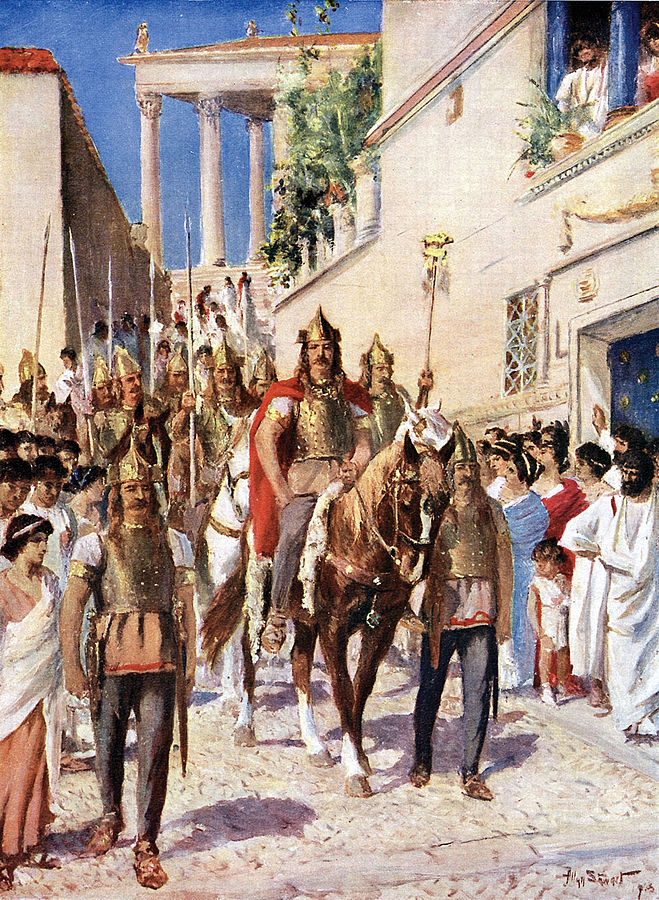
Alaric, King of the Visigoths, entering Athens in 395 AD.
Public domain illustration originally published in the Encyclopedia Britannica, 1920 via Wikimedia Commons.
What seemed to bother Postman was a nagging suspicion that modern humans were taking civilization for granted. This sentiment was more clearly expressed in one of Postman’s less-known literary works, his 1988 essay titled “My Graduation Speech“.
In his speech, Postman discusses two historic civilizations familiar to most people today — Athenians and Visigoths. One group, the Athenians, thrived about 2,300 years ago. The other, the Visigoths, made their mark about 1,700 years ago. But these civilizations were separated by much more than time, Postman explained.
The Athenians gave birth to a cultural enlightenment whose fruits are still visible today — in our art, education, language, literary works, and architecture. The Visigoths, on the other hand, are notable mostly for the destruction of civilization.
Postman mentions these peoples because, he argued, they still survive today. Here is what he wrote:
I do not mean, of course, that our modern-day Athenians roam abstractedly through the streets reciting poetry and philosophy, or that the modern-day Visigoths are killers. I mean that to be an Athenian or a Visigoth is to organize your life around a set of values. An Athenian is an idea. And a Visigoth is an idea.
But what ideas? What values? Postman explains:
To be an Athenian is to hold knowledge and, especially the quest for knowledge in high esteem. To contemplate, to reason, to experiment, to question — these are, to an Athenian, the most exalted activities a person can perform. To a Visigoth, the quest for knowledge is useless unless it can help you to earn money or to gain power over other people.
To be an Athenian is to cherish language because you believe it to be humankind’s most precious gift. In their use of language, Athenians strive for grace, precision, and variety. And they admire those who can achieve such skill. To a Visigoth, one word is as good as another, one sentence in distinguishable from another. A Visigoth’s language aspires to nothing higher than the cliché.
To be an Athenian is to understand that the thread which holds civilized society together is thin and vulnerable; therefore, Athenians place great value on tradition, social restraint, and continuity. To an Athenian, bad manners are acts of violence against the social order. The modern Visigoth cares very little about any of this. The Visigoths think of themselves as the center of the universe. Tradition exists for their own convenience, good manners are an affectation and a burden, and history is merely what is in yesterday’s newspaper.
To be an Athenian is to take an interest in public affairs and the improvement of public behavior. Indeed, the ancient Athenians had a word for people who did not. The word was idiotes, from which we get our word “idiot”. A modern Visigoth is interested only in his own affairs and has no sense of the meaning of community.
Postman said all people must choose whether to be an Athenian or a Visigoth. But how does one tell one from the other? One might be tempted to think that education is the proper path to becoming an Athenian. Alas, Postman argued that this was not the case.
I must tell you that you do not become an Athenian merely by attending school or accumulating academic degrees. My father-in-law was one of the most committed Athenians I have ever known, and he spent his entire adult life working as a dress cutter on Seventh Avenue in New York City. On the other hand, I know physicians, lawyers, and engineers who are Visigoths of unmistakable persuasion. And I must also tell you, as much in sorrow as in shame, that at some of our great universities, perhaps even this one, there are professors of whom we may fairly say they are closet Visigoths.
Postman concluded his speech by expressing his wish that the student body to which he was speaking would graduate more Athenians than Visigoths.
The production of educated barbarians was relatively low in 1988, despite Postman’s pessimism. The production of such modern-day Visigoths is unimaginably higher now than the tail end of the Cold War when he was writing. I fear we have already made our decision … and may God have mercy upon our souls.
“The Spaghetti Harvest” (1957) | Panorama | Classic BBC clips | BBC Archive
BBC Archive
Published 31 Mar 2022Panorama reports from Switzerland, where the combination of a mild winter and the virtual disappearance of pests like the spaghetti weevil, has resulted in a bumper spaghetti crop.
This clip is believed to be one of the first televised April Fools pranks – the original fake news, if you will. The narrator of the film is the highly respected journalist Richard Dimbleby. Back in 1957, some viewers failed to see the funny side and criticised the BBC for airing the spoof news item on what is supposed to be a serious factual programme. Others, however, were so intrigued that they wrote in to the BBC asking where they could purchase their very own spaghetti bush.
Originally broadcast 1 April, 1957.
(more…)
QotD: P.G. Wodehouse and Sir Oswald Mosley
There was one exception. The object of Wodehousian scorn was the moustachioed leader of Britain’s black-shirted Fascists, Sir Oswald Mosley, 6th Baronet. A fencing champion at school, dashing war record in the Flying Corps, and a Member of Parliament, he was the recipient of an inherited title, with a family tree that stretched back to the 12th century, a country house and a Mayfair residence. In Wodehouseland, Mosley is transformed into the equally aristocratic Roderick Spode, 7th Earl of Sidcup.
Plum was intolerant of even the vaguest of threats to the established order of things. He voiced his dislike of Spode through Bertie Wooster, likening the fascist leader to one of “those pictures in the papers of dictators, with tilted chins and blazing eyes, inflaming the populace with fiery words on the occasion of the opening of a new skittle alley”. Plum focussed his gaze on the Spode/Mosley moustache, which was “like the faint discoloured smear left by a squashed black beetle on the side of a kitchen sink”, describing its owner as “one who caught the eye and arrested it”.
The proto-dictator appeared, thought Wodehouse, “as if Nature had intended to make a gorilla but had changed its mind at the last moment”. Every reader would have known it was Mosley in the crosshairs, because Spode was the leader of a fascist group called the “Saviours of Britain, also known as the Black Shorts”. The transition of attire is because, as another of Wodehouse’s masterful creations, Gussie Fink-Nottle, observed, “by the time Spode formed his Association, there were no black shirts left in the shops”.
A different Wodehouse character warned, “Never put anything on paper … and never trust a man with a small black moustache.” Indeed, anyone “whose moustache rose and fell like seaweed on an ebb-tide” was best avoided. Plum could have been referring to Mosley or Hitler. The former, as leader of Britain’s real-life black shirts, was an unashamed admirer of the latter, and he interned in Holloway prison during the war. Afterwards, as an advocate of what we today would call Holocaust denial, he moved to Paris where he died in 1980. His political journey was interesting. Mosley started as a Conservative, drifted leftwards into the Labour Party, then further left into his own independent party, which evolved into the right-wing British Union of Fascists.
Modelled on the Italian and German fascist movements, Mosley and his supporters came to believe that “Jewish interests commanded commerce, the Press, the cinema, dominated the City of London, and killed British industry with their sweatshops”. Fascism lurking in the upper classes troubled Plum Wodehouse so greatly that Spode and his Black Shorts appeared in five of his works between 1938–74.
Peter Caddick-Adams, “Coups and coronets”, The Critic, 2022-12-13.
March 31, 2023
Bill C-11 should properly be called the “Justin Trudeau Internet Censorship Bill”
In The Free Press, Rupa Subramanya explains why the federal government’s Bill C-11 is a terrible idea:

Canada’s Liberals insist the point of Bill C-11 is simply to update the 1991 Broadcasting Act, which regulates broadcasting of telecommunications in the country. The goal of the bill, according to a Ministry of Canadian Heritage statement, is to bring “online broadcasters under similar rules and regulations as our traditional broadcasters”.
In other words, streaming services and social media, like traditional television and radio stations, would have to ensure that at least 35 percent of the content they publish is Canadian content — or, in Canadian government speak, “Cancon”.
The bill is inching toward a final vote in the Canadian Senate as soon as next month. It’s expected to pass. If it does, YouTube CEO Neal Mohan said in an October blog post, the same creators the government says it wants to help will, in fact, be hurt.
[…]
If you’re confused by all this — if you’re wondering why the Liberal Party and its allies in these quasi-governmental organizations are suddenly so worried about Canada’s national identity — that’s understandable.
In a 2015 interview with The New York Times, Trudeau proudly declared, “There is no core identity, no mainstream in Canada.” Canada, he explained, is “the first postnational state”. The authorized, two-volume biography of Trudeau’s father, former prime minister Pierre Trudeau, is called Citizen of the World. Pablo Rodriguez maintains dual citizenship — in Canada and in Argentina, where he was born.
So why is Trudeau, of all people, championing this legislation? There’s an easy explanation — and it has nothing to do with borders or culture.
“Bill C-11 is a government censorship bill masquerading as a Canadian culture bill,” Jay Goldberg, a director at the conservative Canadian Taxpayers Federation, told me. Referring to the Canadian Radio-television and Telecommunications Commission, Goldberg said, “The government is intending to give the power to the CRTC to be able to filter what we see in our news feeds, what we see in our streaming feeds, what we see on social media.”
Supporters of Bill C-11 emphasize it would affect only YouTube, Netflix, Amazon, TikTok, and other Big Tech platforms; the Heritage Ministry statement notes “the bill does not apply to individual Canadians”. But the language is so vague that it’s unclear how it would actually be implemented.
For example, it would be up to CRTC regulators to decide what constitutes “Canadian” content. The singer The Weeknd was born in Toronto but now mostly lives in Los Angeles. Does he still count as Canadian? What about rock n’ roller Bryan Adams, who was born in Kingston, Ontario, and spends a great deal of time in Europe?
“We have absolutely no idea how AI will go, it’s radically uncertain”… “Therefore, it’ll be fine” (?)
Scott Alexander on the Safe Uncertainty Fallacy, which is particularly apt in artificial intelligence research these days:
The Safe Uncertainty Fallacy goes:
- The situation is completely uncertain. We can’t predict anything about it. We have literally no idea how it could go.
- Therefore, it’ll be fine.
You’re not missing anything. It’s not supposed to make sense; that’s why it’s a fallacy.
For years, people used the Safe Uncertainty Fallacy on AI timelines:
Eliezer didn’t realize that at our level, you can just name fallacies.
Since 2017, AI has moved faster than most people expected; GPT-4 sort of qualifies as an AGI, the kind of AI most people were saying was decades away. When you have ABSOLUTELY NO IDEA when something will happen, sometimes the answer turns out to be “soon”.
Now Tyler Cowen of Marginal Revolution tries his hand at this argument. We have absolutely no idea how AI will go, it’s radically uncertain:
No matter how positive or negative the overall calculus of cost and benefit, AI is very likely to overturn most of our apple carts, most of all for the so-called chattering classes.
The reality is that no one at the beginning of the printing press had any real idea of the changes it would bring. No one at the beginning of the fossil fuel era had much of an idea of the changes it would bring. No one is good at predicting the longer-term or even medium-term outcomes of these radical technological changes (we can do the short term, albeit imperfectly). No one. Not you, not Eliezer, not Sam Altman, and not your next door neighbor.
How well did people predict the final impacts of the printing press? How well did people predict the final impacts of fire? We even have an expression “playing with fire.” Yet it is, on net, a good thing we proceeded with the deployment of fire (“Fire? You can’t do that! Everything will burn! You can kill people with fire! All of them! What if someone yells “fire” in a crowded theater!?”).
Therefore, it’ll be fine:
I am a bit distressed each time I read an account of a person “arguing himself” or “arguing herself” into existential risk from AI being a major concern. No one can foresee those futures! Once you keep up the arguing, you also are talking yourself into an illusion of predictability. Since it is easier to destroy than create, once you start considering the future in a tabula rasa way, the longer you talk about it, the more pessimistic you will become. It will be harder and harder to see how everything hangs together, whereas the argument that destruction is imminent is easy by comparison. The case for destruction is so much more readily articulable — “boom!” Yet at some point your inner Hayekian (Popperian?) has to take over and pull you away from those concerns. (Especially when you hear a nine-part argument based upon eight new conceptual categories that were first discussed on LessWrong eleven years ago.) Existential risk from AI is indeed a distant possibility, just like every other future you might be trying to imagine. All the possibilities are distant, I cannot stress that enough. The mere fact that AGI risk can be put on a par with those other also distant possibilities simply should not impress you very much.
So we should take the plunge. If someone is obsessively arguing about the details of AI technology today, and the arguments on LessWrong from eleven years ago, they won’t see this. Don’t be suckered into taking their bait.
Look. It may well be fine. I said before my chance of existential risk from AI is 33%; that means I think there’s a 66% chance it won’t happen. In most futures, we get through okay, and Tyler gently ribs me for being silly.
Don’t let him. Even if AI is the best thing that ever happens and never does anything wrong and from this point forward never even shows racial bias or hallucinates another citation ever again, I will stick to my position that the Safe Uncertainty Fallacy is a bad argument.
Canada’s not-so-secret ruling class – the Laurentian elite
Yuan Yu Zhu explains why Canada, despite its huge geographical spread, is ruled almost exclusively by people drawn from a very small, very incestuous ruling class:

University College, University of Toronto, 31 July, 2008.
Photo by “SurlyDuff” via Wikimedia Commons.
Unlike many countries’ socio-political elites, the Laurentians are not readily identifiable on sight. They have long abandoned their differentiated mid-Atlantic drawl; their houses do not have moats.
What distinguishes them above all else is the uniformity in their outlook. Britain is often said to be run by a consensus blob; but its Canadian equivalent make the Westminster blob seem positively anarchical.
As John Ibbitson, the great chronicler of the Laurentian elite, has written:
Although they often disagree among themselves, they share a common set of assumptions about Canada: that it’s a fragile nation; that the federal government’s job is to bind together a country that would otherwise fall apart; that the biggest challenge is keeping Quebec inside Confederation; that the poorer regions must forever stay poor, propped up by the richer parts of the country; that the national identity — whatever it is — must be protected from the American juggernaut; that Canada is a helpful fixer in the world, a peacekeeper, a joiner of all the best clubs.
Latterly they have added to this list the belief that Canada is a genocidal state built on stolen land, which should atone for its past through part-performative truth and reconciliation – without, however, actually giving any of the stolen land back. It is perhaps unnecessary to add that they are almost all small-l and/or big-L liberals.
This is not to say that their class background (in a country whose official ideology denies the existence of such a thing) is not highly homogenous. They are generally to be found in the two or three large cities of Ontario and Quebec. They tend to be from the upper-middle class families and be secularized.
Many will have been educated in the same private secondary schools; most will have attended a smattering of universities in Ontario and Quebec: the University of Toronto, Queen’s, and McGill (which Johnston headed when Trudeau was a student there).
A large number of them are bilingual, in a country where real bilingualism remains the exception.
Many have post-graduate degrees, often from abroad; something like a quarter of Mr Trudeau’s cabinet ministers have degrees from Oxbridge alone, a shocking figure given how uncommon they are among the population at large.
They then tend to gravitate into the same professional occupations, and they even live in the same few neighbourhoods in the same few cities. Sometimes, like the prime minister and his special rapporteur, they even end up sharing adjoining vacation cottages literally in the Laurentians region.
How to make a Shaker Candle Box | Episode 1
Paul Sellers
Published 11 Nov 2022Many new to woodworking find the concept of hand-cutting dovetails intimidating, and yet it is one of the most fundamental joints used in woodworking. Dovetails are the joints we use for making all kinds of boxes, large and small. They are designed to take certain pressures throughout their lives as drawers, cabinets, and boxes of every shape and size.
The methods of squaring and preparing stock are the critical preface to laying out the joints, so in this episode we show you the steps we take to that end. Following the stock-prep, we focus on a method of layout and making that makes the process fast, efficient, and accurate, after which we cut all four dovetail corners.
(more…)
QotD: The education racket
Indeed, it’s not going too far to say that these types of institutions are designed to chase off anyone brighter, more honest, or more hardworking than the average member. If you haven’t had any experience with teachers or school boards lately (you lucky bastards), think back to your last encounter with Human Resources, or your neighborhood’s Homeowners’ Association. The only person who can stand to work for HR or be part of the HOA is … well, is the kind of person who works in HR or is part of the HOA — dull, vapid, lazily malicious busybodies. They’re as lazy as they are dumb, as dumb as they are malicious. The key to dealing with them, like the Sovietologist’s key to predicting the Politburo, is figuring out which of their lovely personality traits is likely to come to the fore in a given situation.
Severian, “How Dumb Are Liberals?”, Rotten Chestnuts, 2020-07-31.
March 30, 2023
The use and mis-use of wargames
Cheating in wargames must be approximately five minutes younger than wargames themselves … famously, the Imperial Japanese Navy didn’t like the outcome of wargaming what became the Battle of Midway and “cheated” by refloating the aircraft carriers shown as sunk in the simulation and Wehrmacht General Paulus ran a wargame that showed Operation Barbarossa would fail and he was also told to ignore the results and ended up in Stalingrad. Lessons can be learned from formal wargames, but as CDR Salamander points out, a wargame outcome can be custom-tailored as the leaders require:
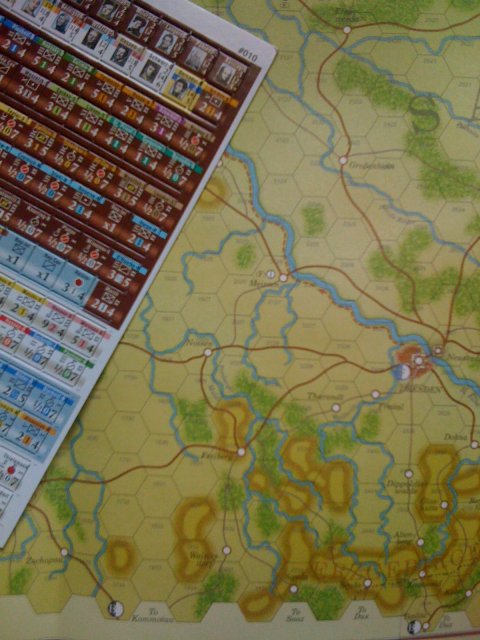
Not this kind of civilian wargame … a real wargame run by professional military staff!
One of the things that will get my eye twitching faster than about anything else is when someone responds to a question or concern with a, “Well, in our wargames …”
Bullshit.
That may work for civilians or under-briefed lawmakers who lack the depth in military matters, but anyone who has run or been part of a wargame knows that you can design one to give you the outcomes you want.
Planning assumptions etc … it is all flexible.
Wargames, done right, don’t tell you the future, but they do help inform gaps in your OPLAN, thinking, or expectations of the enemy … and shortfalls you might have.
At the POLMIL level — where our most senior uniformed and civilian leaders live — you have distinctly different concerns than Tactical, Operational, or — if your Planning Confession separates Strategic from the POLMIL level — Strategic level.
For the senior uniformed leader to make this statement, as if it were a bolt out of the blue, is simply gobsmacking;
A “big lesson learned comes out of Ukraine, which is the incredible consumption rates of conventional munitions in what really is a limited regional war,” General Mark Milley, the chairman of the Joint Chiefs of Staff, told the House Armed Services Committee.
“If there was a war on the Korean peninsula or a great power war between United States and Russia, United States and China, those consumption rates would be off the charts,” he said.
Whose charts? Who made them and using what metrics and dataset?
Yes … that is a lesson for most out there … but it should not be for the CJCS. Hell, I remember certain aspects of updating the OPLAN for Korea a quarter century ago when we beat the drum that, “We don’t have enough ____ and only a few days of ____ before we are combat ineffective.”
This. Is. Not. New.
As we mentioned last July, magazine depth has been a chronic shortfall for a long time.
I have trouble believing that the CJCS is shocked, SHOCKED, that this is an issue.
It isn’t a “lesson learned” — it is a lesson ignored.
One of the easiest, most obvious-to-the-accountants economy any military can make is to scrimp on the inventory of live ammunition … if there’s no war, much of the stored munitions must be disposed of at a cost, and what’re the chances they’ll throw a war before the next election? Plus, if there’s only so much in storage, it’s not economical to have the training allowance of ammunition go up, so you can reduce the resupply levels and free up money in the budget for sexier, more mediagenic toys.
“Food insecurity” – one of the neat new benefits of our over-regulated economy
Elizabeth Nickson on how western governments (in her case, the provincial government of British Columbia) are working hand-in-glove with environmental non-governmental organizations to create “food insecurity”:

Original image from www.marpat.co.uk
In Canada, the British Columbia government in order to increase “food security” is handing out $200,000,000 to farmers in the province. Food insecurity, which means crazy high food prices, comes to us courtesy of the sequestration of the vast amounts of oil and gas in the province and the ever increasing carbon tax, which (like a VAT in Europe), as you probably know, is levied at every single step in food production. Add the hand-over-fist borrowing in which the government has indulged for the last 20 years, and you have created your own mini-disaster.
Ever since multinational environmental non-governmental organizations (ENGOs) took over public opinion in the province, our economy has been wrenched from resource extraction to tourism. Tourism is, supposedly, low-impact. The fact that it pays $15 an hour instead of $50 an hour and contributes very much less to the public purse than forestry, mining, farming, ranching, oil and gas, means we have had borrow to pay for health care and schooling. This madness spiked during Covid, and, as in every “post-industrial” state, has contributed to making food very, very much more expensive, despite the fact that British Columbia where I live, is anything but a food desert. We could feed all of Canada and throw in Washington State.
Inflation comes from a real place, it has a source, it is not mysterious and arcane. Regionally, it comes from “green” government decisions. I pay almost 70 percent more for food now than I did five years ago. Of course one cannot know with any confidence how much the real increase is. The Canadian government was caught last week hiding food price statistics and well they might. The Liberal government leads with its “compassion”, blandishing the weak and foolish, hiding the fact that in this vast freezing country they are trying to make it even colder by starving and freezing the lower 50 percent of the population.
Even the Wasp hegemony that ran this country pre-Pierre Elliot Trudeau knew not to try that. But not this crew! It doesn’t touch them. They don’t see and wouldn’t care if they did, about the single mother working in a truck stop on the Trans-Canada Highway, who steals food for her kids because all her money is going towards keeping them warm.
[…]
The region in which I live used to grow all the fruit for the province, now, well good luck with that buddy. Last year under the U.N. 2050 Plan, local government tried to ban farming and even horticulture. That was defeated so hard that the planner who introduced it was fired and the plan scrubbed from the website. Inevitably it will come again in the hopes that citizens or subjects, as we in Canada properly are, have gone back to sleep. U.N. 2050, an advance on 2030, locks down every living organism, and all the other elements that make up life, assigns those elements to multinationals, advised by ENGOs, which can “best decide” how to use them.
If the only tool you have is a hammer, it’s tempting to treat everything as if it were a nail. It is only the most arcane and numerate think tanks who bang on and on about over-regulation and how destructive it is. Regulation is so complex that most people would rather do anything than think about it, much less deconstruct it.
“Nothing is as permanent as a temporary government program” … except those few that make your life easier
At Astral Codex Ten, Scott Alexander reacts to the US government’s new moves to make telehealth less useful for as many people as possible:



Telemedicine is when you see a doctor (or nurse, PA, etc) over a video call. Medical regulators hate new things, so for its first decade they ensured telemedicine was hard and inconvenient.
Then came COVID-19. Suddenly important politicians were paying attention to questions about whether people could get medical care without leaving their homes. They yelled at the regulators, and the regulators grudgingly agreed to temporarily make telemedicine easy and convenient.
They say “nothing is as permanent as a temporary government program”, but this only applies to government programs that make your life worse. Government programs that make your life better are ephemeral and can disappear at any moment. So a few months ago, the medical regulators woke up, realized the pandemic was over, and started plotting ways to make telemedicine hard and inconvenient again.
The first fruit of their labor is DEA-407, which makes it hard for telemedicine doctors to prescribe controlled substances. Controlled substances are drugs like Adderall, Ritalin, Xanax, or Ambien that the government has declared to be potentially addictive. The new rules say that telemedicine doctors can no longer prescribe these (or, in some cases, can prescribe them one time in an emergency).
Why don’t I like this decision? I am a telepsychiatrist. I work with about a hundred psychiatric patients who, for one reason or another, prefer online to physical appointments:
- Some live in small towns that don’t have psychiatrists of their own
- Some have agoraphobia, chronic pain, or some other condition that makes it hard for them to go to an office.
- Some move around a lot and like to be able to see their psychiatrist whether they’re in LA or SF.
- Some live hundreds of miles away from me, but know and trust me for some reason, and would rather see me than someone closer to them.
- Some appreciate the fact that I charge lower rates than psychiatrists who have offices, because I don’t have to pay for Bay Area commercial real estate and pass those costs on to my patients.
- Some work during work hours, and like being able to see me from their office instead of taking half the day off to travel to my location.
- Some like convenience and dislike inconvenience
As a psychiatrist, a big part of my job is prescribing controlled substances. For example, most guidelines agrees that the first-line treatment for severe ADHD is stimulant medications (eg Adderall or Ritalin). And although psychiatrists hate to admit it, the first-line treatment for temporary crisis anxiety, especially when it’s so bad that the patient isn’t able to listen to your clever plans to solve it with therapy, is benzodiazepines (eg Valium or Klonopin). You can’t be a good well-rounded psychiatrist without the option to sometimes prescribe these drugs.
“Well, your patients will have to find a different psychiatrist, or transition off of them”. Nobody ever finds different psychiatrists. Some of my patients are a bad match for my style or areas of expertise, and I’ve tried very hard to find them different psychiatrists, and it never works. Maybe there are no other psychiatrists in their area. Maybe the psychiatrists in their area don’t take the right insurance, or are too far away from mass transit. Maybe the psychiatrists have six month long wait lists. Sometimes it’s just that my ADHD patients get distracted and forget they were supposed to find new psychiatrists, and I can’t hold their hand literally all the time. As for transitioning off the medications, some patients absolutely cannot function at all without them. Did I mention that if you come off of some of them too quickly, you can literally die?
FN’s Millionth Pistol: Presented to John Browning; Saved by a Belgian Cop
Forgotten Weapons
Published 28 Nov 2022Fabrique Nationale was formed as a consortium of small gunmakers to produce Mauser rifles for the Belgian Army, and when that work was complete the company basically had nothing else to do … until they met John Browning. Browning had a new pistol design and needed a manufacturer — and FN happened to be a manufacturer in need of a new design. The resulting partnership would last until Browning’s death decades later, and essentially created the modern FN that we know today.
FN produced its one millionth Browning pistol on July 15th, 1912 and decided to throw a huge party in recognition of the achievement. It would take 18 months to get everything arranged, and the gala was held on January 31st, 1914. John Browning attended, along with his son Val, several Belgian government ministers, and FN’s international sales agents. As part of the festivities, a number of Baby Browning pistols marked “Un Million” were presented to VIPs, and Browning himself was given this Model 1900 with a gold engraved serial number “1,000,000”. It’s worth noting that FN did not actually make a million Model 1899/1900 pistols — those only reached about 725,000. The one million number included production of later models, like the Baby Browning and FN 1910.
Browning was not particularly interested in commemorative guns, and gave the pistol to his notary in Bruges when he left to return to the US. It remained with that man until his death, when it because his widow’s property. When the Belgian government passed a gun registration law in 1945, she duly registered it — and that record remains. It was registered again in 1985 in the new computerized Belgian system (listed as a revolver; gun registries are always notoriously full of errors). In 2006 Belgian gun laws changed again, and many guns had to be surrendered to the police. This pistol was one of them; handed in for destruction to a local police office. Fortunately, the officer who received it recognized that it was a historically significant piece, and was able to arrange its preservation.
(more…)
QotD: Revealed preference in the teenage hellscape of high school
Robert Stacy McCain, “Conflicting Signals”, The Other McCain, 2019-05-23.


