
NFB
Published 15 Jun 2015In this film Keaton rides across Canada on a railway scooter and, between times, rests in a specially appointed passenger coach where he and Mrs. Keaton lived during their Canadian film assignment. This film is about how Buster Keaton made a Canadian travel film, The Railrodder. In this informal study the comedian regales the film crew with anecdotes of a lifetime in show business. Excerpts from his silent slapstick films are shown
Directed by John Spotton – 1965.
July 4, 2023
Buster Keaton Rides Again (1965)
Comments Off on Buster Keaton Rides Again (1965)
It’s not “bullying” for corporations to act in their own (and their shareholders’) best interests
The weekly round-up from The Line editors wasn’t happy reading for fans of the Canadian mainstream media:
The Canadian government approached this as if it was “Big Tech” who were reaping all the rewards … when in fact it was the Canadian media companies getting most of the benefit from the arrangement. No wonder “Big Tech” chose to take their bat and ball and go home.
There are two major items up for consideration, and we’ll deal with each in turn. The first is a proposed merger between Postmedia and the Torstar/Metroland newspapers. The second, and most significant, news item, is that following on Meta/Facebook’s decision to stop featuring news on its feeds, Google is promising to drop the Google News Showcase feature, and to stop surfacing Canadian news links on its search feeds. All of this is in response to C-18, the Online News Act.
This law is trying to force Facebook and Google to compensate news organizations for the links that appear on their platforms; so the companies reacted in an entirely predictable way after the bill received Royal Assent last week — they announced they are going to absent themselves from the scope of the bill by no longer providing those links.
The government, its supporters, and many in the media itself reacted to this announcement with the same inane bluster that has come to dominate the conversation around this byzantine and poorly conceived bill. The Liberals promised to stand up to “Big Tech”; and the media organizations that pinned their survival on milking this new revenue stream are now accusing Google et al. of “bullying”. We at The Line don’t consider this rhetoric to be rational or in good faith. We are annoyed — we are horrified — by these companies’ decisions, but we understand them.
Both Facebook and Google made it clear that C-18 was untenable from a business point of view; they both warned that they would consider pulling news links in response. From Big Tech’s perspective, the decision-making tree is real simple here: does the revenue generated by news outweigh the potential uncapped financial liability that C-18 would present? Further, would complying with C-18 in Canada present a greater risk to the company globally if the bill were replicated in larger media markets? Or are the companies better off to withdraw from a low-priority market pour encourager les autres. We can scream about the evils of Big Tech all we want, but ultimately, these are just math conversations.
No one ought to be surprised that the math didn’t go our way. But almost everyone was. Because — and there’s no nice way to say this — this country’s media industry is both painfully parochial and embarrassingly self-important. For people whose job it is to understand and explain the world to Canadians, it often astonishes us at how incompetent we are at understanding and explaining that world to ourselves. Canadian journalists have an unshakeable faith in our vocation; we genuinely believe that our work is a vital service to democracy. Therefore the fruits of that labour — the news content — must be valuable to the digital platforms that we now depend upon to distribute it. This is why many in the industry were so unshakeably convinced that Facebook and Google were bluffing during the course of C-18. Incredibly, many seem to remain convinced that Big Tech will capitulate to their demands for capital, even now. To quote this old gem: “It is difficult to get a man to understand something, when his salary depends on his not understanding it”.
The flaw in this reasoning ought to be apparent, yet the industry lacks the digital savvy to understand the risk it is courting. “What about Bing, amiright?” Denial and self-importance are now sucking Canadian journalism straight into the maw of an existential crisis. To lose Facebook is a major set back; to lose Google is death.
The thing our colleagues and peers need to come to terms with is that Canadian journalism just isn’t that important in the global scheme of things. Facebook and Google aren’t out to get us — they are indifferent to us. Canadian news comprises a small and un-lucrative segment of even Canadian traffic flows. And Canada is a mid-tier market, at best. Optics aside, global tech oligopolies simply don’t lose very much by cutting us off. Facebook and Google are in the business of advertising, not journalism. They share neither our self regard, nor our democratic mandate; as a result, there is no internally coherent reason for them to take losses in order to save our industry. We just don’t matter to them.
On her Substack, Tasha Kheiriddin doesn’t blame Google for the impending destruction of what’s left of mainstream Canadian media:
The funeral has begun. The pyres are lit; the mourners are weeping. RIP, Canadian media industry, we hardly knew ye. Between mergers, acquisitions, closures, and layoffs, you didn’t stand a chance. And then came Bill C-18.
The legislation, passed last week, compels internet behemoths Meta and Google to compensate Canadian news outlets in exchange for featuring links to their content. Bill C-18 is modeled on an Australian law that saw the two tech giants enter into financial arrangements with media outlets in that country. Here in Canada, the Parliamentary Budget Office estimates similar deals could produce annual revenues of $329 million, a juicy sum for the cash-strapped news business.
Instead, Meta and Google announced that they would no longer include Canadian news links. Rather than reap a profit, Canadian media companies now face the prospect of far fewer eyeballs on screens – and the decimation of their ad revenue. Meta also cut its funding to CN2i, the Coopérative nationale de l’information indépendante, which supports six print publications, including La Presse, further damaging media companies’ bottom line.
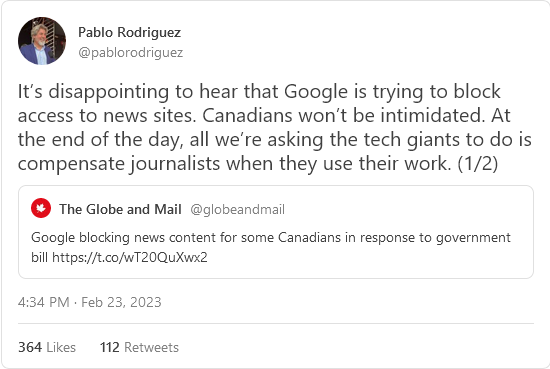
Cue the sound of “Taps” and political outrage. Heritage Minister Pablo Rodriguez had this to say:
Big tech would rather spend money to change their platforms to block Canadians from accessing good quality and local news instead of paying their fair share to news organizations … This shows how deeply irresponsible and out of touch they are, especially when they make billions of dollars off of Canadian users.
No, this shows how deeply out of touch the government is with the business model of these companies – and with internet technology in general.
Comments Off on It’s not “bullying” for corporations to act in their own (and their shareholders’) best interests
From the American Revolution: Short Land Pattern Brown Bess
Forgotten Weapons
Published 22 Mar 2023The standard weapon of the British Army in the American War of Independence was the “Brown Bess”, and today we are looking at a 1769 Short Land Pattern example of the Brown Bess. This was a smoothbore .75 caliber, 10.2 pound flintlock with a whopping 42 inch barrel (the Long Land Pattern it superseded had a 46” barrel). Adopted in 1769, it would serve as the British standard infantry arm until 1797.
This particular example was issued to the 53rd Infantry Regiment, otherwise known as the King’s Shropshire Light Infantry. This regiment arrived in Quebec City in May 1776 and participated in the fighting at Ticonderoga and Saratoga, where several of its companies were captured and interned until the end of the war.
(more…)
Comments Off on From the American Revolution: Short Land Pattern Brown Bess
QotD: The (arguments over the) founding of America
You could of course say that the ideals of universal equality and individual liberty in the Declaration of Independence were belied and contradicted in 1776 by the unconscionable fact of widespread slavery, but that’s very different than saying that the ideals themselves were false. (They were, in fact, the most revolutionary leap forward for human freedom in history.) You could say the ideals, though admirable and true, were not realized fully in fact at the time, and that it took centuries and an insanely bloody civil war to bring about their fruition. But that would be conventional wisdom — or simply the central theme of President Barack Obama’s vision of the arc of justice in the unfolding of the United States.
No, in its ambitious and often excellent 1619 Project, the New York Times wants to do more than that. So it insists that the very ideals were false from the get-go — and tells us this before anything else. Even though those ideals eventually led to the emancipation of slaves and the slow, uneven and incomplete attempt to realize racial equality over the succeeding centuries, they were still “false when they were written”. America was not founded in defense of liberty and equality against monarchy, while hypocritically ignoring the massive question of slavery. It was founded in defense of slavery and white supremacy, which was masked by highfalutin’ rhetoric about universal freedom. That’s the subtext of the entire project, and often, also, the actual text.
Hence the replacing of 1776 (or even 1620 when the pilgrims first showed up) with 1619 as the “true” founding. “True” is a strong word. 1776, the authors imply, is a smoke-screen to distract you from the overwhelming reality of white supremacy as America’s “true” identity. “We may never have revolted against Britain if the founders had not understood that slavery empowered them to do so; nor if they had not believed that independence was required in order to ensure that slavery would continue. It is not incidental that 10 of this nation’s first 12 presidents were enslavers, and some might argue that this nation was founded not as a democracy but as a slavocracy,” Hannah-Jones writes. That’s a nice little displacement there: “some might argue”. In fact, Nikole Hannah-Jones is arguing it, almost every essay in the project assumes it — and the New York Times is emphatically and institutionally endorsing it.
Hence the insistence that everything about America today is related to that same slavocracy — biased medicine, brutal economics, confounding traffic, destructive financial crises, the 2016 election, and even our expanding waistlines! Am I exaggerating? The NYT editorializes: “No aspect of the country that would be formed here has been untouched by the years of slavery that followed … it is finally time to tell our story truthfully”. Finally! All previous accounts of American history have essentially been white lies, the NYT tells us, literally and figuratively. All that rhetoric about liberty, progress, prosperity, toleration was a distraction in order to perpetrate those lies, and make white people feel better about themselves.
Andrew Sullivan, “The New York Times Has Abandoned Liberalism for Activism”, New York, 2019-09-13.
Comments Off on QotD: The (arguments over the) founding of America
July 3, 2023
Nuclear power
One of the readers of Scott Alexander’s Astral Codex Ten has contributed a review of Safe Enough? A History of Nuclear Power and Accident Risk, by Thomas Wellock. This is one of perhaps a dozen or so anonymous reviews that Scott publishes every year with the readers voting for the best review and the names of the contributors withheld until after the voting is finished:
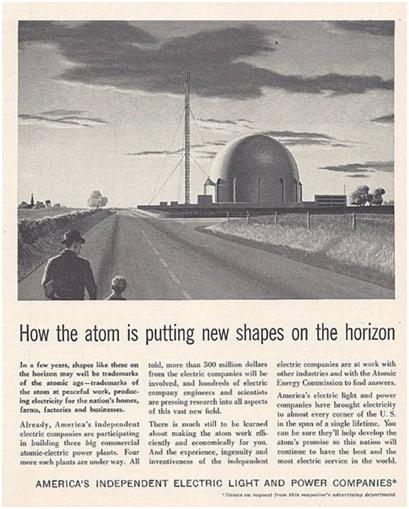
Let me put Wellock and Rasmussen aside for a moment, and try out a metaphor. The process of Probabilistic Risk Assessment is akin to asking a retailer to answer the question “What would happen if we let a flaming cat loose into your furniture store?”
If the retailer took the notion seriously, she might systematically examine each piece of furniture and engineer placement to minimize possible damage. She might search everyone entering the building for cats, and train the staff in emergency cat herding protocols. Perhaps every once in a while she would hold a drill, where a non-flaming cat was covered with ink and let loose in the store, so the furniture store staff could see what path it took, and how many minutes were required to fish it out from under the beds.
“This seems silly — I mean, what are the odds that someone would ignite a cat?”, you ask. Well, here is the story of the Brown’s Ferry Nuclear Plant fire, in March 1975, which occurred slightly more than a year after the Rasmussen Report was released, as later conveyed by the anti-nuclear group Friends of the Earth.
Just below the plant’s control room, two electricians were trying to seal air leaks in the cable spreading room, where the electrical cables that control the two reactors are separated and routed through different tunnels to the reactor buildings. They were using strips of spongy foam rubber to seal the leaks. They were also using candles to determine whether or not the leaks had been successfully plugged — by observing how the flame was affected by escaping air.
The electrical engineer put the candle too close to the foam rubber, and it burst into flame.
The fire, of course, began to spread out of control. Among the problems encountered during the thirty minutes between ignition and plant shutdown:
- The engineers spent 15 minutes trying to put the fire out themselves, rather than sound the alarm per protocol;
- When the engineers decided to call in the alarm, no one could remember the correct telephone number;
- Electricians had covered the CO2 fire suppression triggers with metal plates, blocking access; and
- Despite the fact that “control board indicating lights were randomly glowing brightly, dimming, and going out; numerous alarms occurring; and smoke coming from beneath panel 9-3, which is the control panel for the emergency core cooling system (ECCS)”, operators tried the equivalent of unplugging the control panel and rebooting it to see if that fixed things. For ten minutes.
This was exactly the sort of Rube Goldberg cascade predicted by Rasmussen’s team. Applied to nuclear power plants, the mathematics of Probabilistic Risk Assessment ultimately showed that “nuclear events” were much more likely to occur than previously believed. But accidents also started small, and with proper planning there were ample opportunities to interrupt the cascade. The computer model of the MIT engineers seemed, in principle, to be an excellent fit to reality.
As a reminder, there are over 20,000 parts in a utility-scale plant. The path to nuclear safety was, to the early nuclear bureaucracy, quite simple: Analyze, inspect, and model the relationship of every single one of them.
Comments Off on Nuclear power
The Battle That Prevented A Nuclear World War Three | Kapyong: The Forgotten War | Timeline
Timeline – World History Documentaries
Published 2 Jul 2023On April 24, 1951, following a rout of the South Korean army, the Chinese People Volunteer Army pursued their enemy to the lines of Australian and Canadian troops still digging fall-back defences, 39 kilometres to the rear. Here, sometimes at the length of a bayonet, often in total darkness, individual was pitted against individual in a struggle between a superpower and a cluster of other nations from across the world. They fought for a valley, the ancient and traditional invasion route to Seoul. If it fell the southern capital and the war, was lost. The United Nations troops had the military advantage of the high ground and artillery support: the Chinese relied entirely on vastly superior numbers. As a result, young men from both sides found a battle which was very close and very personal.
The Battle of Kapyong became the turning point of China’s Fifth Offensive in that Korea spring. The aim of the offensive was to finally drive the foreign troops out of South Korea and into the sea. What happened instead, changed the history of the Korean War. The Chinese were denied victory and forced back into negotiations. Had they succeeded, another crushing defeat for the US could have triggered events that led to a nuclear holocaust in Asia — and World War Three.
(more…)
Schools fail their students when they try to teach things the students have no interest in learning
David Friedman has several examples of success in learning when the learner suddenly wants to learn the material:
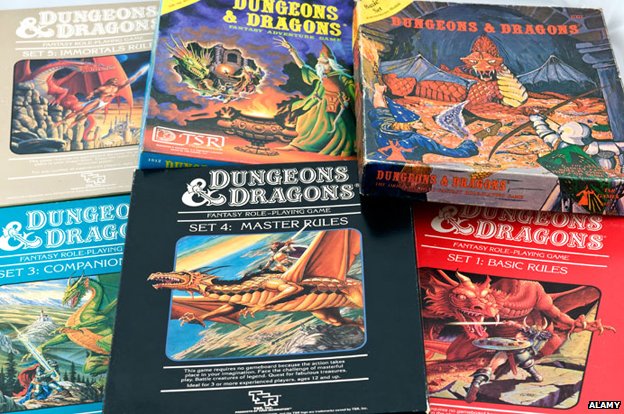
One of the problems with our educational system is that it tries to teach people things that they have no interest in learning. There is a better way.
What started me thinking about the issue and persuaded me to write this post was an online essay, by a woman I know, describing how she used D&D to cure her math phobia.
How to Cure Mathphobia
I was failed by the education system, fell behind, never caught up, and was left with a panic response to the thought of interacting with any expression that has numbers and letters where I couldn’t immediately see what all of the numbers and letters were doing. The first time I took algebra one, I developed such a strong panic response that it wrapped around to the immediate need to go to sleep, like my brain had come up with a brilliant defense mechanism that left me with something akin to situational narcolepsy. (I did, actually, fall asleep in class several times, which had never happened to me before.) I retook the class the next year. I spent a lot of that year in tears, with a teacher who specifically refused to answer questions that weren’t more specific than “I don’t get it” or “I have no idea what any of those symbols mean or what we’re doing with them”.
Until she had a use for it:
The first time I played D&D, I was a high school student. My party was, incidentally, all female, apart from one girl’s boyfriend and the GM, who was the father of three of the players. We actually started out playing first edition AD&D, which I am almost tempted to recommend to beginners, just on the grounds that if you start there you will appreciate virtually every other edition of D&D you end up playing by comparison. I might have given up myself before I started, except that one of the players in the first game I ever spectated was a seven-year-old girl, and I was not about to claim that I couldn’t do something that a seven-year-old was handling just fine.
One of my most vivid memories of this group is the time we were on a massive zigzagging staircase — like one of those paths they have at the Grand Canyon, that zigzag back and forth down the cliff face so that anyone can reach the bottom without advanced rock-climbing. We saw a bunch of monsters coming for us from the ground below, and we weren’t sure whether they had climb speeds, but we didn’t super want to wait to find out. The ranger pulled out her bow to attack them before they could get to us.
“Now, wait a moment,” says the GM. “Can your arrows actually reach that far?”
“Well, they’re only, like, sixty feet away.”
“No, it’s more than that, because you have to think about height in addition to horizontal distance.”
“Yeah, but that’s, like, complicated?”
“Is it? Most of you are taking geometry right now, don’t you know how to find the hypotenuse of a right triangle?”
There were some groans. Math was hard. But we did know how to find the hypotenuse of a right triangle. We got out some scrap paper and puzzled over it for a couple minutes, volunteering the height of the cliff and the distance of the monsters and deciding that we could ignore the slight slope caused by the zigzagging stairways. We got a number back and compared it to the bow’s range per the rules. We determined that we could hit the monsters without a range penalty.
We killed the monsters. This wasn’t the real victory that day.
Comments Off on Schools fail their students when they try to teach things the students have no interest in learning
Three Forgotten Roman Megaprojects
toldinstone
Published 31 Mar 2023The longest tunnel in ancient history. A highway suspended over a raging river. A secret harbor for the Roman navy. These are three of the most impressive Roman engineering projects that you’ve probably never heard of.
(more…)
Comments Off on Three Forgotten Roman Megaprojects
QotD: The key weakness of the royal cause in the English Civil War
[T]he power of the mighty hath no foundation, but in the opinion and belief of the people.
A king whose knights won’t ride out to battle on his behalf is just a weirdo in funny clothes. Charles I lost for a lot of reasons, but far from the least of them was that his “foundation” was badly cracked. However attached one might be to the notion of monarchy in the abstract, it – monarchy – is always intimately connected to the personality of the monarch … and Charles I was a real piece of work, even by the world-class standards of Renaissance princes. Parliament was outgunned, often outmanned, and suffered from what should’ve been a critical shortage of experienced leadership. But all those massive advantages were offset by the fact that the Royalist forces were fighting for Charles I, personally.
(This is not the place for a long discussion of the course of the English Civil Wars – and I’m not qualified to give you one in any case – but a quick look at the top commanders of the opposing sides will illustrate the point. Prince Rupert was arguably the equal, mano-a-mano, of any Parliamentary general, up to and including Cromwell. But he was still a Prince, and carried on like one (like a young one, to boot) … and even if he weren’t, he was still running the show on behalf of his uncle. Cromwell, on the other hand, inspired fanatic loyalty, not least because he embodied a cause that was much higher than himself).
Severian, “Hobbes (III)”, Founding Questions, 2020-12-12.
Comments Off on QotD: The key weakness of the royal cause in the English Civil War
July 2, 2023
Of course they’re lying – the interesting thing is how they sell the lies
In his Friday Mailbag, Severian answers a reader question about the reports coming out of Ukraine about casualties in the recent fighting:
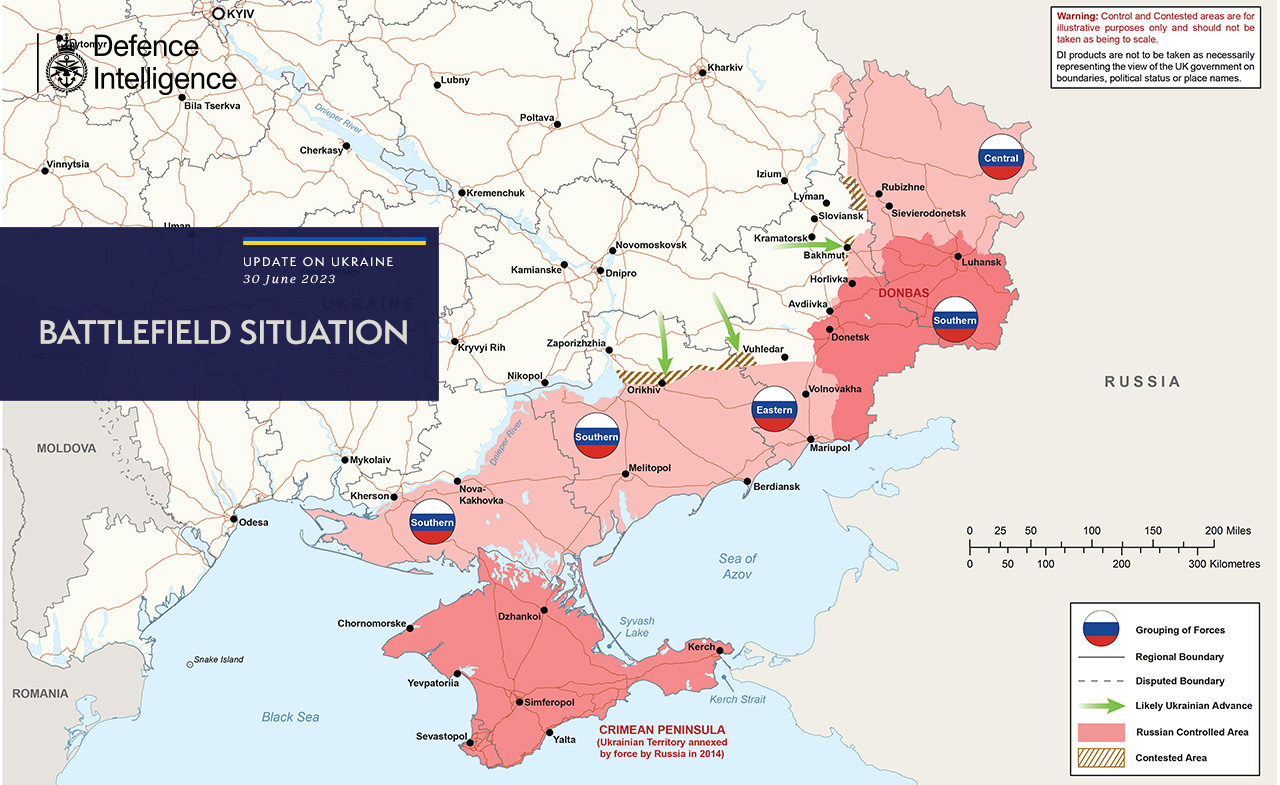
Back in the worst of the covid days (so far), I often said that we’re stewing in so many obvious lies, I’m starting to question the very existence of a country called “China”. Not to mention the germ theory of disease. Is there actually a war at all in Ukraine? How do we sift and weight sources?
My rules of thumb (two thumbs, two rules) for judging the underlying truthiness of a Media story are what I’ll call “the Goebbels factor” and “admission against interest”.
The “Goebbels factor” is that fellow’s well-known dictum that the best propaganda is mostly true. Outright lies — straight up, 100% false-to-facts whoppers — are actually extremely rare, even in the AINO Media. This is because out-and-out lies take a tremendous amount of effort to maintain. Not only that, their opportunity cost is off the charts, because once you’ve peddled the lie, you’re stuck with that specific lie forever. You have to keep investing in the lie, and you must also keep investing in what I guess we’ll call the “information infrastructure” surrounding that lie. It’s just not cost-effective.
The second factor — “admission against interest” — is, of course, just the second step in everyone’s favorite dance, the Media Shuffle. The first step is “That’s not happening!” The second step is “… and here’s why it’s good that it is.” Think of it as the retooling of the previous “information infrastructure.” Lies have to be supported, one way or the other. If the lie is “there’s no inflation!”, then the “information infrastructure” consists of semi-plausible (for Juggalo values of “plausible”) “explanations” of all the very obvious inflation that’s very obviously happening. You know the drill: Putin’s price hikes! Global Warming!! Systemic Racism!!!
It’s much easier to flip those around, to “explain” why all those are actually good for you, than it is to keep investing in the original lie. It’s important to note — as if y’all need the reminder! — that the “admission against interest” is ALSO chock full of lies; you have to cross check the new lies against the old lies to reach an approximation of the truth (the discipline known as FNG-ology; the practitioners of which are stoyakniks).
Given all that: Yeah, the war in Ukraine is real, and the Ukrainians really are getting keestered. My heart goes out to the Ukrainian people, who did nothing to deserve it, and I only ask that you remember who did this to you: Brandon and the Juggalos. It’s ALL on them. Putin really had no choice.
Comments Off on Of course they’re lying – the interesting thing is how they sell the lies
Allies Liberate Cherbourg – WW2 – Week 253 – July 1, 1944
World War Two
Published 1 Jul 2023Several weeks after the invasion of Normandy began, the Allies finally take a port city there, though the actual harbor has been destroyed. On Saipan the Americans have the advantage, in Finland, the Soviets do, but the big news is the Soviet destruction of huge chunks of German Army Group Center, demolishing entire Army Corps, and surrounding tens of thousands of the enemy.
(more…)
Comments Off on Allies Liberate Cherbourg – WW2 – Week 253 – July 1, 1944
If you were trying to destroy trust online, you’d use the playbook currently in use by all the major players
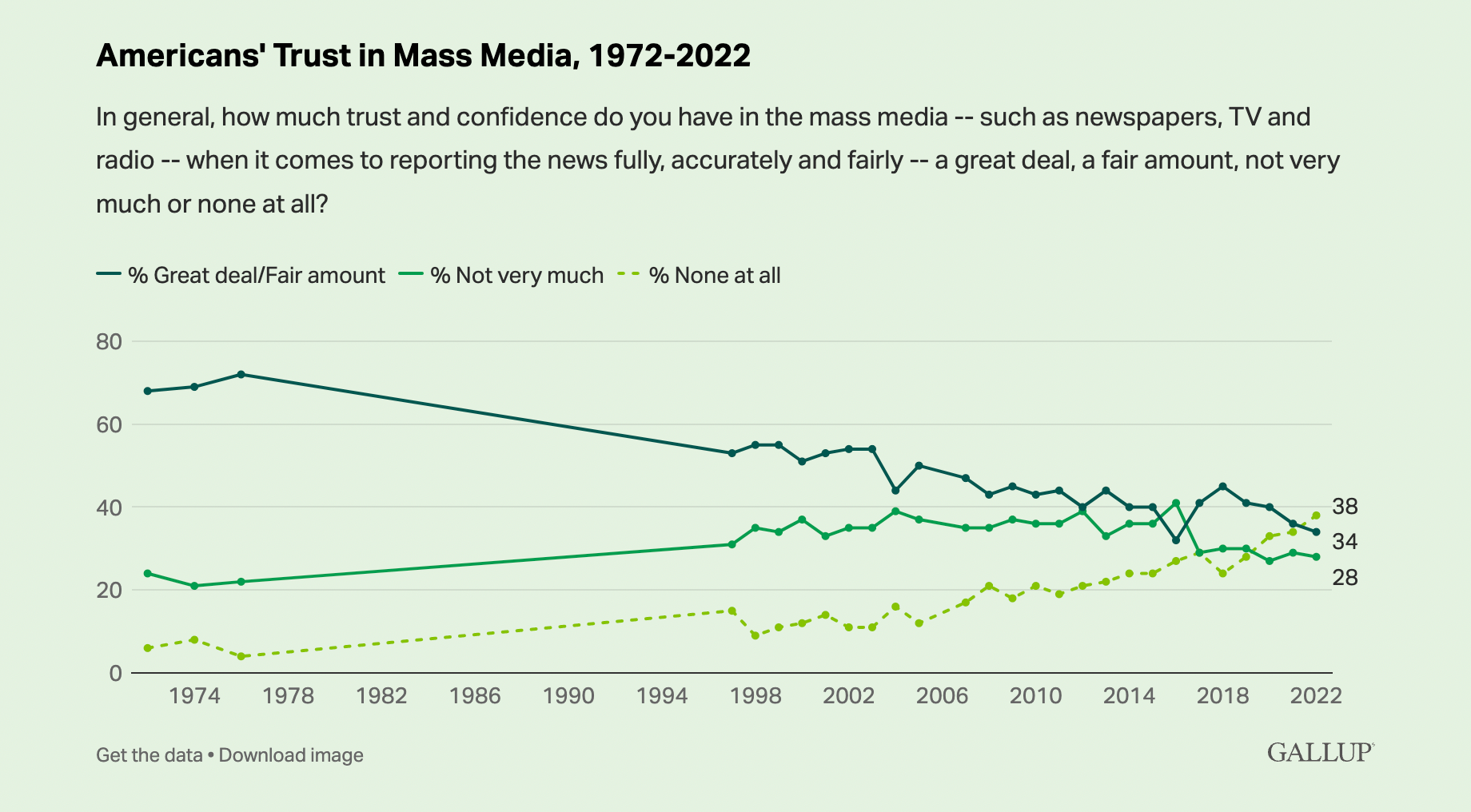
Ted Gioia calls it the “Information Crap-pocalypse”:
People keep telling me that we’re living on an Information Superhighway. But that’s not true.
The flow of information today is more like a river. A very polluted river.
Folks have been dumping their crap into our information flows for a long, long time. Big corporations and institutions are the worst offenders — they actually get rich by polluting our data streams. But individuals are adding to the raw sewage too.
Some of them do it just for kicks.
It’s gotten worse lately. A whole lot worse. Just look at the polluted streams of information in your own life, and try to find a single safe space where the data stream is fresh and clean.
Some of us have stopped even trying.
This is how the Information Age ends, and it’s happening right now.
In the last 12 months, the garbage infows into our culture have increased exponentially. As a result, nothing is harder to find now than actual information — which I define as “knowledge based on demonstrable or reliable facts”.
The result is a crisis of trust unlike anything seen before in modern history.
We are bypassing the Web 3.0 we were promised — which was supposed to deliver trust-based systems and validation tools. Instead we’ve gone straight to Web 4.0, which is like the worst kind of Wild West Web. Outlaws and desperados contol all the data highways and byways. Trust and reliability are scarcer than gold nuggets.
Do you think I’m exaggerating?
Let me ask you a question. If your job was to destroy access to reliable information in our society, how would you do it?
You would start with the 30 steps outlined below.
Comments Off on If you were trying to destroy trust online, you’d use the playbook currently in use by all the major players
Tank Chats #170 | Sd. Kfz. 251 | The Tank Museum
The Tank Museum
Published 31 Mar 2023Curator David Willey is back with another Tank Chat. This time, he will be discussing the Sonderkraftfahrzeug 251, which is more commonly referred to as the Sd.Kfz. 251.
(more…)
Comments Off on Tank Chats #170 | Sd. Kfz. 251 | The Tank Museum
QotD: Processes for fighting the last war
The same applies to “cyber” or “information warfare”; there is no doubt that technology has changed the so-called “battlespace”, making it bigger and more complex by, in effect, adding an invisible dimension. We have been conducting “information operations” for decades, even millennia — I would argue that at the end of the Third Servile War (73-72 BCE) when Marcus Licinius Crassus crucified 6,000 of Spartacus’ followers on the Appian Way (it is not clear if Spartacus, himself was among them) that it was psychological warfare which is either a subset of or a near relation to information warfare. But the tools have changed and with them, tactics need to change, too, but some principles will remain as they were 2,000 years ago, or 100 years ago (the Zimmerman Telegram) or 75 years ago (Turing, the Enigma machine and Bletchley Manor).
Ted Campbell, “Following the blind leader (3)”, Ted Campbell’s Point of View, 2019-05-21.
Comments Off on QotD: Processes for fighting the last war
July 1, 2023
The Trudeau plan to eliminate Canada from the internet is going great!
Wait, you mean that wasn’t the plan? It must have been, if you judge the plan by the amazing results:

The damage caused by the government’s Bill C-18 continues to grow as Meta has started to cancel its existing agreements with Canadian publishers. The move should not as a surprise since any deals that involve facilitating access to news content would bring the company into the legislative framework and mandate payments for links. Indeed, Meta said earlier this week that its 18 existing deals “did not have much of a future“. When this is coupled with a reported “impasse” between the government and Google over its approach to Bill C-18, the risks to the Canadian media sector look increasingly dire.
This was entirely foreseeable, yet Canadian Heritage Minister Pablo Rodriguez never seemed to take the risks seriously. It raises the question of whether the government developed estimates of the cost of its legislation if Meta and Google chose to comply by stopping news sharing or linking. While there were estimates for the benefits of new deals that ran into the hundreds of millions of dollars, did it conduct a risk assessment of the economic costs that would come from Internet companies exiting the news market in Canada?
There are obviously costs that extend far beyond the economics that include reduced access to news, increased prominence of low quality news sources, harm to the Canadian Internet, and the reputational damage to a government that handled this about as incompetently as possible. But from a pure economic perspective, the risks were always understated as they extended beyond just the value of increased traffic to publishers from the links they were themselves posting. Both Google and Meta have deals with Canadian publishers reportedly worth millions of dollars. As Meta’s step to begin cancelling deals suggests, those agreements are unlikely to survive the decision to exit news in Canada.
And of course, Google doesn’t want to set any kind of precedent by accepting a shakedown from any two-bit hoodlum country like Canada:
The worst case scenario for Canadian Heritage Minister Pablo Rodriguez, the Canadian news sector, and the Canadian public has come to pass: Google has announced that it will block news links in Canada in response to the mandated payment for links approach established in Bill C-18. The decision, which the company says will be implemented before the law takes effect, will cover search, Google News, and Google Discover. The decision – which government seemingly tried to avoid with last minute discussions with Google executives after it became apparent that the risks of exit were real – will have lasting and enormously damaging consequences for Canadians and represents a remarkable own-goal by Rodriguez who has managed to take millions away from the news sector and left everyone in a far worse position than if he had done nothing at all.
If you’re in any way interested in Canadian government … machinations … when it comes to digital policy, you really should be following Michael Geist‘s reporting. He’s been doing a great job and deserves the support.


