
Reading Mr Malcolm Muggeridge’s brilliant and depressing book, The Thirties, I thought of a rather cruel trick I once played on a wasp. He was sucking jam on my plate, and I cut him in half. He paid no attention, merely went on with his meal, while a tiny stream of jam trickled out of his severed œsophagus. Only when he tried to fly away did he grasp the dreadful thing that had happened to him. It is the same with modern man. The thing that has been cut away is his soul, and there was a period — twenty years, perhaps — during which he did not notice it.
It was absolutely necessary that the soul should be cut away. Religious belief, in the form in which we had known it, had to be abandoned. By the nineteenth century it was already in essence a lie, a semi-conscious device for keeping the rich rich and the poor poor. The poor were to be contented with their poverty, because it would all be made up to them in the world beyound the grave, usually pictured as something mid-way between Kew Gardens and a jeweller’s shop. Ten thousand a year for me, two pounds a week for you, but we are all the children of God. And through the whole fabric of capitalist society there ran a similar lie, which it was absolutely necessary to rip out.
Consequently there was a long period during which nearly every thinking man was in some sense a rebel, and usually a quite irresponsible rebel. Literature was largely the literature of revolt or of disintegration. Gibbon, Voltaire, Rousseau, Shelley, Byron, Dickens, Stendhal, Samuel Butler, Ibsen, Zola, Flaubert, Shaw, Joyce — in one way or another they are all of them destroyers, wreckers, saboteurs. For two hundred years we had sawed and sawed and sawed at the branch we were sitting on. And in the end, much more suddenly than anyone had foreseen, our efforts were rewarded, and down we came. But unfortunately there had been a little mistake. The thing at the bottom was not a bed of roses after all, it was a cesspool full of barbed wire.
It is as though in the space of ten years we had slid back into the Stone Age. Human types supposedly extinct for centuries, the dancing dervish, the robber chieftain, the Grand Inquisitor, have suddenly reappeared, not as inmates of lunatic asylums, but as the masters of the world. Mechanization and a collective economy seemingly aren’t enough. By themselves they lead merely to the nightmare we are now enduring: endless war and endless underfeeding for the sake of war, slave populations toiling behind barbed wire, women dragged shrieking to the block, cork-lined cellars where the executioner blows your brains out from behind. So it appears that amputation of the soul isn’t just a simple surgical job, like having your appendix out. The wound has a tendency to go septic.
The gist of Mr Muggeridge’s book is contained in two texts from Ecclesiastes: “Vanity of vanities, saith the preacher; all is vanity” and “Fear God, and keep His comandments: for this is the whole duty of man”. It is a viewpoint that has gained a lot of ground lately, among people who would have laughed at it only a few years ago. We are living in a nightmare precisely because we have tried to set up an earthly paradise. We have believed in “progress”. Trusted to human leadership, rendered unto Caesar the things that are God’s — that approximately is the line of thought.
Unfortunately Mr Muggeridge shows no sign of believing in God himself. Or at least he seems to take it for granted that this belief is vanishing from the human mind. There is not much doubt that he is right there, and if one assumes that no sanction can ever be effective except the supernatural one, it is clear what follows. There is no wisdom except in the fear of God; but nobody fears God; there fore there is no wisdom. Man’s history reduces itself to the rise and fall of material civilizations, one Tower of Babal after another. In that case we can be pretty certain what is ahead of us. Wars and yet more wars, revolutions and counter-revolutions, Hitlers and super-Hitlers — and so downwards into abysses which are horrible to contemplate, though I rather suspect Mr Muggeridge of enjoying the prospect.
George Orwell, “Notes on the Way”, Time and Tide, 1940-03-30.
July 8, 2023
QotD: The amputation of the soul
July 7, 2023
This would be a Super Bowl halftime show I’d absolutely watch
Christopher Gates makes the case for Weird Al Yankovic being the star of the next Super Bowl halftime show:
“Weird” Al has pretty much universal appeal
With most of the acts that could be selected for the Super Bowl halftime show, a sizeable portion of your potential audience isn’t going to like them. Whether it leans more towards rap/hip hop music or pop music or whatever the case may be, you’re going to have plenty of people that aren’t into it.
Since “Weird” Al’s work spans genres and time frames, you don’t have to worry about that. There’s almost universal appeal in having someone with this sort of talent perform on the biggest possible stage, because you could have a show that hits pretty much all of the different types of music that would appeal to anyone else.
Also, to put it bluntly: Nobody hates “Weird” Al. They might not be the biggest fans of his style of music, necessarily, but there’s nobody that really has an outright hatred or even a dislike for the guy. He’s apparently one of the nicest people in the entire entertainment industry, so he’s got that going for him … which is nice.
Think of the cameo potential
One of the best possible cases that you could make for something like this is the case for cameo appearances, which have become a bit of a thing at Super Bowl halftime shows in recent years. After all, “Weird” Al has been at this for four decades. Literally anyone that he’s parodied over the years that’s still with us is fair game for a potential cameo appearance during something like this.
All those years ago, “Weird” Al started out doing parodies of acts like Madonna and Huey Lewis and the News, and on his last studio album did send-ups of Imagine Dragons, Lorde, and Iggy Azalea. You don’t think you could sell some of those folks on the idea of sharing the biggest possible stage in the world with him for one night? I certainly think that you could. There’s really a lot of potential there, to be honest.
Nazis destroy last Jewish sanctuary – War Against Humanity 102
World War Two
Published 6 Jul 2023Until now Miklos Horthy’s Kingdom of Hungary has been a rare sanctuary where most Jews have lived in relative safety. That changes with the German occupation. Now Adolf Eichmann. the Nazis, and their Hungarian allies bring the Holocaust to Hungary.
(more…)
Justin Trudeau says that Canada is merely defending itself from the “attack” by Facebook
Prime Minister Justin Trudeau has never faced a situation he couldn’t get histrionic about:

The government escalated the battle over Bill C-18 yesterday, announcing that it was suspending advertising on Meta’s Facebook and Instagram platforms due the company’s decision to comply with the bill by blocking news sharing and its reluctance to engage in further negotiations on the issue. While the ad ban applies to federal government advertising, Liberal party officials confirmed they plan to continue political advertising on the social networks, suggesting that principled opposition ends when there might be a political cost involved. At issue is roughly $11 million in annual advertising by the federal government, a sum that pales in comparison to the Parliamentary Budget Officer’s estimate of at least $100 million in payments in Canada for news links from Meta alone.
In addition to raising the economic cost to Meta for stopping news sharing, Prime Minister Justin Trudeau increased the rhetoric, describing Canada as having been “attacked” by Meta and likening the government’s fight over the bill to defending democracy in Ukraine or during the Second World War [at 13:30]:
Facebook decided that Canada was a small country, small enough that they could reject our asks. They made the wrong choice by deciding to attack Canada. We want to defend democracy. This is what we’re doing across the world, such as supporting Ukraine. This is what we did during the Second World War. This is what we’re doing every single day in the United Nations.
There are strongly held views on both sides of the Bill C-18 debate, but the suggestion that stopping sharing news links on a social network is in any way comparable to World War 2 is embarrassingly hyperbolic and gives the sense of a government that has lost perspective on the issue. Canadian Heritage Minister Pablo Rodriguez has repeatedly described the manner of compliance with Bill C-18 as a business choice for the Internet companies, yet the Prime Minister now calls that choice an attack on the country.
If it were truly comparable to a world war, then surely the Liberal Party (joined by the NDP) would not continue to advertise on the platform. Yet since the 2021 election call, the party alone has run approximately 11,000 ads on Facebook and Instagram. That is separate from individual MPs, who have also run hundreds of ads. The Meta Ad Library provides ample evidence of how reliant the party has been on social media. For example, since the start of the year, Anna Gainey ran over 500 ads as part of her by-election campaign in Quebec. David Hilderley, who was a candidate in the Oxford by-election, ran approximately 180 ads on Facebook during the same timeframe.
Prototype Silenced Sten for Paratroops: the Mk4(S)
Forgotten Weapons
Published 24 Mar 2023The Sten Mk4 was developed experimentally in 1943 for use by British paratroops. It used a remarkably awful folding stock along with a shortened receiver and barrel to make a very compact package — albeit one that must have been very uncomfortable to shoot. Several different models were made, with this one being a Mk4a(S) — the suppressed version. The suppressor is essentially the same system as used on the MkII(S), but with the rear endcap and barrel being permanently fixed to the receiver of the gun.
Only a small number (allegedly 2000) Mk4 guns were originally made, and they were used for testing only — never for field service. Virtually all were destroyed after the war, with a few remaining examples in British museums. This one was amnesty registered in 1968, and is almost certainly the only one in private hands in the US (and possible the only privately owned one in the world).
The Mk4 was dropped in favor of the Mk5, which was a much more effective gun and was used by the British paratroopers in the late days of World War Two.
(more…)
QotD: Nazi Germany’s plans for Eastern Europe versus their actual implementation of those plans
… at least in some places, and at least initially. There’s a second inference here: “the exigencies of war led Germany to behave tactfully”. Here’s where our initial ground rules of evidence become extremely important. Those anecdotal reports of civilian / military interaction, above: What weight do we assign those? And why?
If I’m arguing for the “greeted as liberators” theory, I can use all those recollections of cordial civilian / military interaction. But I need to be consistent: If I say “You can trust those, even though they’re personal memories written down long after the fact, because XYZ”; then I can’t turn around and dismiss contrary evidence of the same type: “All those reports of brutality are just personal memories written down long after the fact.” That’s one of the ways you catch a propagandist: they constantly conflate the two.
Fortunately, in this case we’re dealing with two totally ideologized societies. Even better, one of those totally ideologized societies was German, with their well-documented love of paperwork. All armies generate scads of paperwork, and an ideologized army’s paperwork is full of ideology. So: How does the Army of Occupation’s paperwork tell the tale? That should give us some clues as to their future plans — obviously the occupiers would need to be part of it — and some insight as to the day-to-day.
As it turns out, the second part of your inference — “the exigencies of war led Germany to behave tactfully” — is false. We’ve got the paperwork on it, starting with the infamous “Commissar Order” and working down. Ideology trumps exigency. It seems clear from Wehrmacht paperwork that so long as military efficiency was maintained, you could do pretty much whatever you wanted out there.
[Interestingly, in a bit of meta-irony, the Wikipedia “thumbnail” — the little box you get on the side of the search results page — says of the Commissar Order: “Nazi conspiracy-enforcing unit of the Nazi military.” [Sic], of course — they really want you to know these guys were Nazis. Also, what’s a “conspiracy-enforcing unit”? One imagines a Q-tard goon squad, beating up people whose faith in the God-Emperor is wavering. Finally, it wasn’t a “conspiracy” — they were right out in the open with it. We’ve got lots of copies of the Commissar Order, because it was read out to the troops before the invasion. ALL the troops].1
That segues into the “Organizational Darwinism” thing. The paperwork shows us that “the Nazis” really did have grandiose plans for settling a whole bunch of Germans in the depopulated East. They even got a pilot program underway, as I recall — a whole bunch of ethnic Germans from Bohemia or someplace getting stuck in a transit camp in eastern Poland, or even Ukraine. But notice I put “the Nazis” in quotation marks. The guys with the grandiose plans were RuSHA, the Main Race and Settlement Office. And not even all of them: It was the fourth department, “Settlement”, inside RuSHA. And RuSHA was inside the SS, which was inside — but also outside, over, under, around, and through — the rest of the Nazis’ plate-of-spaghetti org chart.
And it’s actually way more complicated than that, because of course it is — these are the Nazis we’re talking about. I’m not going to dive into the details (not least because it all makes my head hurt), but if you were an ethnic German who wanted to get resettled in Ukraine for some reason — and this is all mostly theoretical, I hasten to add, very few actually moved so far as I know — you’d have to deal with a bewildering array of bizarrely-acronymed organizations. RuSHA, VOMI, the Generalgovernment (Occupied Poland), the SS (in general; over and above RuSHA), the army, the whole bewildering array of groups represented in Generalplan Ost, which was a “plan” in much the same way the “Holy Roman Empire” was holy, Roman, and an empire. Various Party goons would want to get their beaks wet, as would the Gestapo (hell yes they want to know if people are moving around the Reich, especially towards the front on military railroads), and so on.
As weird as this sounds, all this elaborate mishmash of ass-pulled “organization” was by largely by design. For one thing, it diffuses responsibility for really nasty shit — when it comes to certain events on the Eastern Front, even scrupulously neutral historians are often reduced to Ilhan Omar’s level: some people did some things. Who gave what order? Who was he reporting to? And in what capacity? Insufficient data.
Severian, “Organizational Darwinism”, Founding Questions, 2023-01-30.
1. Side note: Ideology really increases military efficiency, up to a point. Recalling that I’m not even an armchair general, it seems like the American military is really missing a trick there. Imagine what the Americans could’ve done in Vietnam if their regular forces had been better indoctrinated, instead of punting military-civilian relations off to CORDS. Properly indoctrinated, I mean, with an ideology that kinda sorta makes sense and is internally consistent and at least somewhat intersects with the real world. “Spreading democracy” would work ok, if they actually ideologized the ranks (instead of having the PR guys just parrot it to the cameras). The AINO military is of course fully indoctrinated, but see above: we’re talking combat efficiency here, not butt stuff.
July 6, 2023
“Too many complaints? That’s racism. Too few complaints? Well, that’s racism, too.”
Amy Eileen Hamm reports on how the British Columbia College of Nurses and Midwives (BCCNM) acted on its concern that not enough complaints against their members were being lodged by First Nations people:
As regular readers of Quillette will know, many Canadian institutions have fervently adopted the cause of “decolonization” — a vaguely defined term that one university describes as the dismantling of “assumed Euro-western disciplinary constructs and traditions”. This can mean anything from abolishing musical scales (which “perpetuate and solidify the hegemony of [the] Euro-American repertoire”); to reimagining our scientific understanding of sunlight, so as to correct “the reproduction of colonialism” that has infected “physics and higher physics education”; to assailing the gender binary through a “decolonizing act of resistance”.
That’s the theory, anyway. In practice, institutional efforts at “decolonization” generally translate into affirmative-action hiring programs and policies to mandate symbolic (generally empty) gestures such as land acknowledgements. They’ve also created a cash cow for “specialist” administrators and third-party consultants in what is now known as the “equity, diversity, inclusion, and decolonization” sector. The premise is that decolonization is so difficult and complex that it can only be overseen by said (highly paid) professionals.
My own professional sector, nursing, provides a useful case study. In British Columbia, where I live and work, nurses are licenced by the British Columbia College of Nurses & Midwives (BCCNM), whose offices are located “on unceded Coast Salish territory, represented today by the Musquea?m, Squamish and Tsleil-Waututh Nations.” In other words, Vancouver.
If a patient feels that he or she has experienced “incompetent, unethical, or impaired nursing or midwifery practice”, he or she can complain to the BCCNM through its complaints portal. It’s not a complicated process. You send an email describing what the nurse allegedly did, when the incident occurred, and whether there were any witnesses. If you’ve already complained to someone else, you’re supposed to note that as well, along with your suggestions for resolving the complaint. That’s it.
But apparently, this process is just too onerous — and even dangerous — for Indigenous people. And so the BCCNM has paid C$97,000 to a self-described “boutique business process management firm” called Novatone, which has duly produced a lengthy report on how to “make the BCCNM complaints process safer for Indigenous Peoples.” The same title — mantra might be a better word — appears at the top of all 50 pages: Looking Back to Look Forward: How Indigenous ways of being, knowing, and doing must inform the BCCNM feedback process and reflect the principles of cultural safety, cultural humility, and anti-racism.
(For the benefit of those outside Canada, the mystical-sounding phrase, “ways of knowing”, along with its “being” and “doing” variants, has now entered the official idiom as a means to signify the unfalsifiable shaman-like intuitions that supposedly guide the consciousness of Indigenous people throughout every facet of their existence — including, apparently, complaining about the care they receive from nurses.)
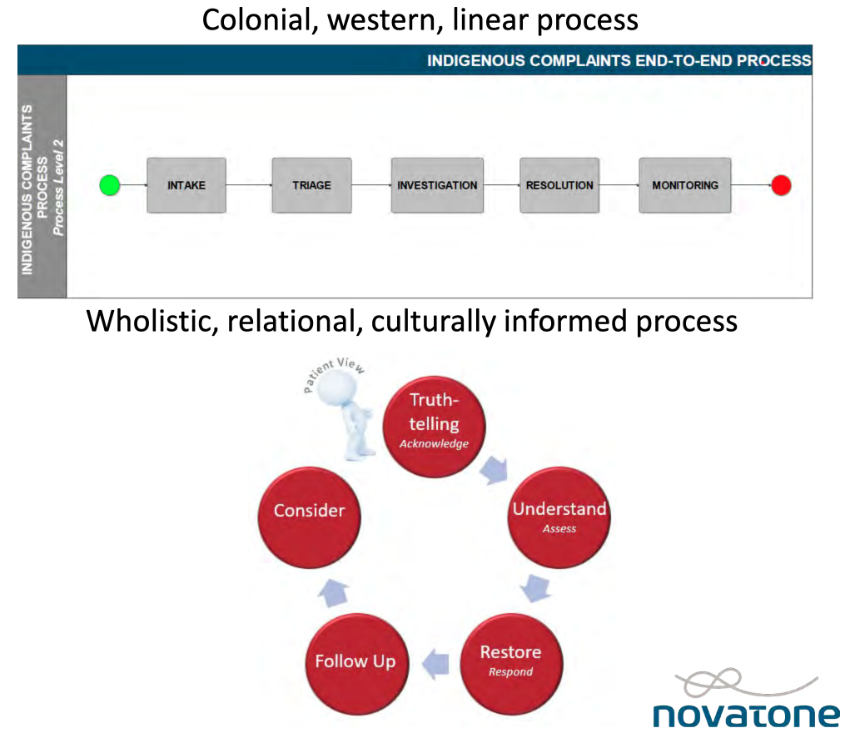
Juxtaposed images from the Novatone report, Looking Back to Look Forward, contrast the “colonial, western, linear” nature of existing BCCNM processes with a “wholistic, relational, culturally informed process” that would supposedly align with Indigenous values.
Ursula von der Leyen touted as NATO Secretary General Jens Stoltenberg’s successor
In Spiked, Fraser Myers is amazed at Ursula von der Leyen’s ability to rise above her own failures time after time:

Ursula von der Leyen with German soldiers during a visit to the Field Marshal Rommel Barracks, Augustdorf, 17 July 2014.
Photo by Dirk Vorderstraße via Wikimedia Commons.
The political career of Ursula von der Leyen, president of the European Commission, has been defined by bungling and incompetence. She is deeply unpopular with voters, distrusted by colleagues and has regularly been mired in scandals. And yet, somehow, she manages to keep rising up the ranks of international politics.
Now von der Leyen has been tipped for another plum job on the global stage. According to reports in the Telegraph this week, US president Joe Biden is pushing for her to be named as secretary-general of NATO. He thinks she is best placed to replace Jens Stoltenberg when he steps down in 2024.
This ought to set off alarm bells. Whatever one thinks of NATO, there could hardly be a worse candidate to lead it than von der Leyen – especially right now, while war wages in Ukraine and NATO faces one of its most serious challenges in its 73-year existence.
Just look at her time leading the EU. She was parachuted into the role in 2019, unelected, over the heads of European citizens. She was a singularly unimpressive candidate. In fact, some argue that this was why she was selected. “When EU leaders picked von der Leyen … they deliberately eschewed candidates with greater experience, charisma or cunning”, according to a Bloomberg report. The European Council apparently wanted a Commission leader that it could easily push around. In the end, despite being the only candidate, she managed to persuade just nine MEPs to back her in the job.
MEPs were right to be sceptical. Her incompetence became all too clear when she faced her first major challenge as president – the Covid pandemic in 2020 and 2021. While von der Leyen boasted of taking “personal charge” of the EU’s vaccination programme, the rollout was infamously slow, lagging behind the rest of the world. At the time, fellow commissioners, civil servants and other officials were openly venting their distress with her leadership.
The Devilish History of Deviled Eggs
Tasting History with Max Miller
Published 4 Apr 2023
(more…)
QotD: Liberalizing the US Army after WW2
And here it ruined them.
They had lived their lives in semibitter alienation from their own culture (What’s the matter, Colonel; can’t you make it on the outside?) but now they were sought after, offered jobs in business, government, on college campuses.
Humanly, the generals liked the acclaim. Humanly, they wanted it to continue. And when, as usual after all our wars, there came a great civilian clamor to change all the things in the army the civilians hadn’t liked, humanly, the generals could not find it in their hearts to tell the public to go to hell.
It was perfectly understandable that large numbers of men who served didn’t like the service. There was no reason why they should. They served only because there had been a dirty job that had to be done. Admittedly, the service was not perfect; no human institution having power over men can ever be. But many of the abuses the civilians complained about had come not from true professionals but from men with quickie diplomas, whose brass was much more apt to go to their heads than to those of men who had waited twenty years for leaves and eagles.
In 1945, somehow confusing the plumbers with the men who pulled the chain, the public demanded that the Army be changed to conform with decent, liberal society.
The generals could have told them to go to hell and made it stick. A few heads would have rolled, a few stars would have been lost. But without acquiescence Congress could no more emasculate the Army than it could alter the nature of the State Department. It could have abolished it, or weakened it even more than it did — but it could not have changed its nature. But the generals could not have retained their new popularity by antagonizing the public, and suddenly popularity was very important to them. Men such as Doolittle, Eisenhower, and Marshall rationalized. America, with postwar duties around the world, would need a bigger peacetime Army than ever before. Therefore, it needed to be popular with the people. And it should be made pleasant, so that more men would enlist. And since Congress wouldn’t do much about upping pay, every man should have a chance to become a sergeant, instead of one in twenty. But, democratically, sergeants would not draw much more pay than privates.
And since some officers and noncoms had abused their powers, rather than make sure officers and noncoms were better than ever, it would be simpler and more expedient — and popular — to reduce those powers. Since Americans were by nature egalitarian, the Army had better go that route too. Other professional people, such as doctors and clergymen, had special privileges — but officers, after all, had no place in the liberal society, and had better be cut down to size.
T.R. Fehrenbach, This Kind of War: A Study in Unpreparedness, 1963.
July 5, 2023
Intersectionality showdown
Chris Bray on the major break in progressive solidarity caused by non-white American Muslims’, Ethiopian Christians’, and Peruvian Catholics’ unexpected reaction to woke teachers wanting to sexually indoctrinate their children:
We’re wading through this culture war sewage because we have a political class that’s deliberately pumping it into the culture to keep us from noticing that, how can I put this in a sophisticated way, they suck.
But this really tedious maneuver is increasingly leading to moments like this — and Twitter still won’t let Substack writers embed tweets, so click to watch video, but here’s the substance of the thing:
The fake conflict is increasingly likely to be a dozen sanpaku-eyed AWFL’s against a thousand genuinely multicultural parents, battling over insane questions like the “book bans” that remove highly explicit sexual content from elementary school libraries. In 2023, the culture war is rapidly cooking down to STOP PREVENTING US FROM TALKING TO YOUR EIGHT YEAR-OLDS ABOUT SUCKING DICK, YOU NAZIS.
If you’ve never read what I wrote about Jim Jones and the Peoples Temple, please take a moment to go read this. About 900 people died at Jonestown in 1978, but Jones started in Indianapolis in the 1950s. He moved his church to a rural property in California, and then to Guyana, by constantly telling his parishioners that they were threatened by hostile forces outside the church that were maneuvering to destroy them. The frequent recourse to invented threats is a sign of a sick movement, not a sign of something the grows and flourishes.
That’s where we are. We’re watching a sick thing die. The question, now, is how long it takes to die, and how much damage it does in its death throes. But the increasingly hysterical tone, against an increasingly matter-of-fact response — a thousand parents saying calmly that no, we won’t let you inflict this curriculum on our children — suggests that the inflection point is getting closer.

The “orgasm gap”, yet another problematic front in the war of the sexes
Janice Fiamengo discusses the faked orgasm scene in When Harry Met Sally and its role in the ongoing arguments over the “orgasm gap”:
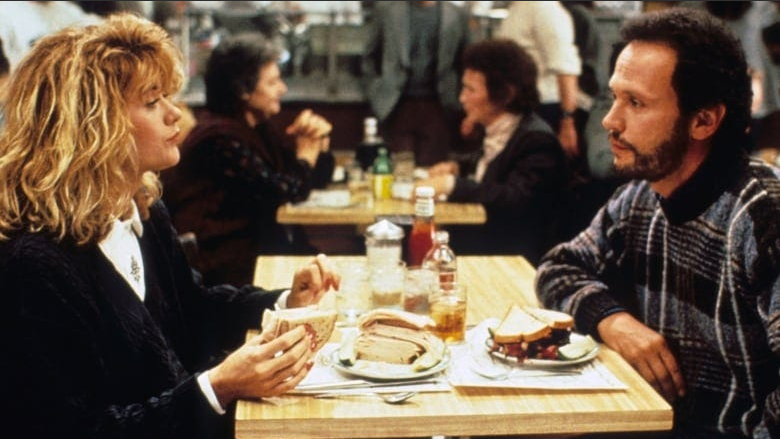
An iconic moment in modern movie history is the diner scene from When Harry Met Sally (1989), when Sally stuns an incredulous Harry with her rendition of a convincing orgasm. Her bravura performance causes shocked silence in the restaurant until one woman, sitting nearby, says admiringly (or enviously), “I’ll have what she’s having.”
The scene and the woman’s amused reaction told of a simple reality with wit and without judgement: some portion of women — perhaps many — are convincing fakers, and even a sexually experienced man will find it hard to be sure.
Many women in the movie audience laughed in recognition, and many men likely scratched their heads, wondering why anyone would need to fake sexual enjoyment. Some men may have remembered times when they faked it too. In the romantic-comedic world of the movie, the scene symbolized one of the differences between the average woman and the average man that only a generous and committed love could bridge.
A few years ago, When Harry Met Sally turned 30 years old, and its anniversary prompted a number of reflection pieces, some turning a harsh feminist lens on the film’s gender politics. In “‘I’ll have what she’s having’: How that scene from When Harry Met Sally changed the way we talk about sex,” Lisa Bonos at The Washington Post found in the fake climax scene a salutary revelation of male sexual arrogance. For Bonos, Harry is a typical macho man, someone who doesn’t care about a woman’s pleasure. The fact that the whole point of his conversation with Sally had been his confidence that he was giving women pleasure simply confirmed his emetic masculinity.
According to Bonos, the fact that some women fake orgasm supposedly reveals that women’s sexual pleasure is “not prioritized” in heterosexual relationships, and Sally’s performance gave sobering evidence of a gendered pleasure gap. It was implicitly the man’s fault that his partner felt the need to lie to him about her sexual satisfaction, and his desire for her to orgasm proved his typically male ego. Bonos’s analysis was an egregious violation of the spirit of the movie but was eminently faithful to the feminist perspective. The politics of grievance had come a long way in three decades.
Right on cue, studies in human psycho-sexuality are now taking up the same theme, alleging a culturally imposed “orgasm gap” between men and women in which men outpace women in the frequency with which they report orgasm during sexual intercourse (86% for men vs. 62% for women, according to one national survey).
Remembering how consistently feminist pundits have expressed outrage at male incels‘ (alleged) sense of “entitlement” to sex, I cannot help but find it ironic how unapologetically researchers assume a female entitlement to orgasm. Apparently, the whole society is to be concerned if women fail to climax every time they have sex, while no one has compassion for young men who face a lifetime of sexlessness. The prime exhibit is “Orgasm Equality: Scientific Findings and Societal Implications“, a paper published in 2020 by three female researchers at the University of Florida. The paper not only surveys the literature on the subject but also makes recommendations for “a world of orgasm equality”.
Why Engineers Can’t Control Rivers
Practical Engineering
Published 4 Apr 2023💧 The unintended consequences of trying to change the course of rivers
(more…)
QotD: The role of merchants in pre-modern societies
It thus tends to come as something of a surprise that with stunning consistency, the merchant class tended to be at best cordially disliked and at worst despised by the broader community (although not typically to the point of suffering legal disability, as did some other jobs; see S. Bond, Trade and Taboo: Disreputable Professions in the Roman Mediterranean (2016) for this in Rome). This often strikes students as strange, both because we tend to think rather better of our own modern merchants but also because the image they have of the merchant class certainly looks elite.
For the farmers who need to sell their crops (for reasons we will get to in a moment) and purchase the things they need that they cannot produce, the merchant feels like an adversary: always pushing his prices to his best advantage. We expect this, but remember that our pre-modern farmers are just not that exposed to market interactions; most of their relationships are reciprocal, not transactional – the horizontal relationships we discussed before. The merchant’s “money-grubbing” feels like a betrayal of trust in a society where you banquet your neighbors in the good years so they’ll help you in the bad years. The necessary function of a merchant is to transgress the “rules” of village interactions which – and this resounds from the sources – the farmers tend to understand as being “cheated”.
At the same time, while most merchant types are humble, the high-risk and potentially high-reward involved in trade meant that some merchants (again, a small number) could become very rich. That, as you might imagine, did not go over well for the traditionally wealthy in these societies, the large landholders. Again, the values here often strike modern readers as topsy-turvy compared to our own, but to the elite large landholders (who dominate the literary and political culture of their societies), the morally correct way to earn great wealth is to inherit it (or capture it in war). The morally correct way to hold that wealth is with large landed estates. Anything else is morally suspect, and so the idea that a successful merchant could – by a process that again, strikes the large landholder, just like the small farmer, as “cheating” – leap-frog the social pyramid and skip to the top, without putting in the work at either having distinguished wealthy ancestors or tremendous military success was an open insult to elite values. Often laws were put in place to limit the ability of wealthy non-aristocrats (likely merchants or successful artisans) from displaying their wealth (sumptuary laws) so as to keep them from competing with the aristocrats; at Rome, senators were forbidden from owning ships with much the same logic (Roman senators being clever, they still invested in trade through proxies while at the same time disapproving of the activity in public politics).
[…] As far as elites were concerned, merchants didn’t seem to produce anything (the theory of comparative advantage which explains how merchants produce value without producing things by moving things to where they are most valued would have to wait until 1776 to be mentioned and the early 1800s to be properly explained) and so the only explanation for their wealth was that they made it by deception and trickery, distorting the “real” value of things (this faulty assumption that the “real value” of things is inherent in them, or a product of their production, rather than their use value to an end user or consumer, does not go away in the modern period).
Merchants also – almost by definition being foreigners in their communities – often suffered as members of “middleman minorities“, where certain tasks, particularly banking, commerce and tax collection are – for the reasons just discussed above – outsourced to foreigners or ethnic minorities who then tend to face violence and discrimination because of the power and prominence those tasks give them in society. Disdain for merchants was thus often packaged with ethnic hatred or racism – anyone exposed to the tropes of European or Near Eastern antisemitism (or more precisely, anti-Jewish sentiment) is familiar with this toxic brew, but the same tropes were applied to other middlemen minorities engaged in trade – Chinese people in much of South East Asia, Armenians in Turkey, Parsis in India and on and on. Violence against these groups was always self-destructive (in addition to being abhorrent on its face) – the economic services they provided were valuable to the broader society in ways that the broader society did not understand.
Bret Devereaux, “Collections: Bread, How Did They Make It? Part IV: Markets, Merchants and the Tax Man”, A Collection of Unmitigated Pedantry, 2020-08-21.
July 4, 2023
Shock! Horror! Apparently you can’t trust that Abraham Lincoln quote about not believing what you read on the internet!
As a long-time collector of quotations, I almost had to take to my fainting couch when it became clear that President Lincoln never said anything about the internet being a tissue of lies. My original quotations collection (webbed here, but no longer actively maintained) was not particularly well-policed in the sense of ensuring that the quotations were both accurate and properly attributed. This is because I began collecting them before the internet was a thing for most people. When I began the blog, I tried to ensure that anything I quoted could at least be traced back to the site I found it on (which isn’t a particularly rigorous chain of evidence, but at the least it ensured I couldn’t be accused of making shit up).
In James Delingpole’s article on this topic, I was sorry to find that the very first fake quote he listed is indeed one that I had included in my original collection:
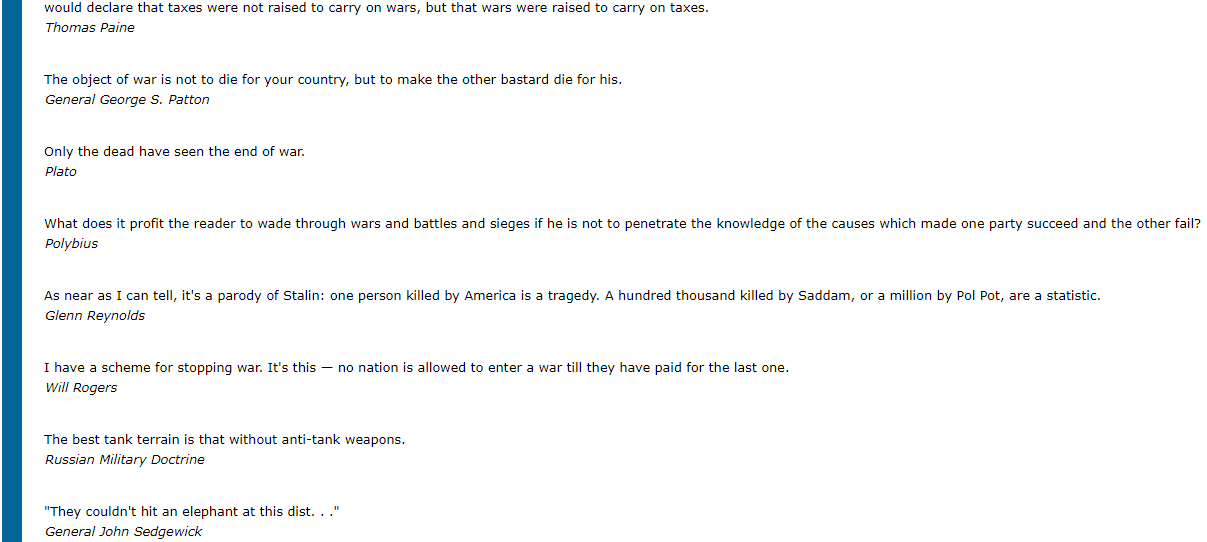
Only the dead have seen the end of war – Plato
I became aware of this marvellous quotation – so wise, pithy and dark – on one of my frequent trips to the Imperial War Museum. It’s one of a series inscribed on the wall beside the ramp leading down to the World War I/trench section. Another of my favourites is attributed to Thucydides: “There were great numbers of young men who had never been in a war and were consequently far from unwilling to join in this one.”
The Plato quote is so good it has been used many times since, inter alia by General Douglas MacArthur in a speech at West Point in 1962, as an aphorism apparently oft-cited by grunts in the ‘Nam, and by Ridley Scott in Black Hawk Down. But the quote is fake. Or at least its attribution is.
In fact it derives not from the Classical Age but from the early 20th century. It was invented by the Madrid-born philosopher, poet and later Harvard professor George Santayana. He clearly had a gift for this sort of thing for he also coined another of those phrases which you’ve always thought was devised by someone much more famous: “Those who cannot remember the past are condemned to repeat it.” Usually this is attributed, in various forms, to Edmund Burke or Winston Churchill. But the former didn’t say it and the latter – as I suspect he quite often did – plagiarised it.
Fake quotes, whether genuine sayings that have been misattributed or fabrications which have been lent authenticity by putting them in the mouths of someone famous, have been a bugbear of mine for a while. I can probably date this to the time someone called me out on my favourite George Orwell quote: “In times of universal deceit, truth-telling becomes a revolutionary act”.
Annoyingly, I had used it a good half dozen times in articles and in internet chats before I learned that Orwell had never said it. I felt cheated and also foolish: surely as an English literature graduate I ought to have known such a thing, in the way that film buffs know that Ingrid Bergman never said “Play it again, Sam”.
But these are easy mistakes to make now that fake quotes are everywhere. Probably, this has always been the case but they have definitely proliferated with the advent of the internet, the shortening of attention spans (which make us more susceptible to gnomic verities that appear to sum everything up and obviate the need for further thought) and the corresponding appetite for meme-friendly aphorisms.
Many of these fake quotes, I’ve noticed, are printed over photographs or images of the alleged author. It’s a cheap trick but an effective one. No one ever is going to be fooled by a joke quote like: “Don’t believe everything you read on the internet. Abraham Lincoln, 1865.” But shove it on top of a picture of the 16th president with those familiar features – the wart, the chin beard, the lined skin and sunken eyes – and for a fraction of a second, the subconscious is taken in.
He finishes off the article thusly:
I’m reminded here, somewhat, of the introductory talk that Mark Crispin Miller used to give his students when he was still allowed by New York University to conduct his course on Propaganda. I paraphrase – you really should listen to this podcast interview for the full account – but essentially Miller warned his audience: “Be prepared to be very upset. You may be shocked to discover how many of the ideas you imagined to be your own are in fact the result of propaganda.”
It would definitely have come as a shock to the younger me. When you’ve had what you consider to be a superb education, steeped in classical literature, you tend to kid yourself that you are just too damn clever, too well-read, to fall for the kind of cheap confidence tricks that fool the unwashed masses.
Which, when you think about it, is what makes the faking of those classical quotes so cunning. They deviously exploit one of one of the cultural assumptions most deeply embedded in both the “educated” and “uneducated” classes alike: this idea that if one of the Ancient Greeks or Romans said it, it must be true because there’s almost nothing about the world that they didn’t know. Another thing they exploit is that the “educated” are rarely as clever as we pretend to be. For example, presented with a vaguely plausible quote with a fancy classical name attached, passing few of us are going to go: “Hang on a second. Did he really say that? Let me check …” Instead, we’ll go “Ah. The great Thucydides. He was the Greek general who wrote Anabasis. The sea! The sea!” and congratulate ourselves on what marvellously well-informed people we are.
Did you catch that palmed card there? Thucydides didn’t write Anabasis because he was far too busy writing the Commentarii de Bello Gallico!


