
World War Two
Published 16 Jul 2022The Allies have begun their fight to take back Western Europe with Operation Husky. That’s not the only news though. They are also trying to extend their foothold in the Solomons, and Germany and the USSR continue smashing into one another at Kursk.
(more…)
July 17, 2022
Who Let the Dogs Out?! – The Invasion of Sicily – WW2 – 203 – July 16, 1943
Comments Off on Who Let the Dogs Out?! – The Invasion of Sicily – WW2 – 203 – July 16, 1943
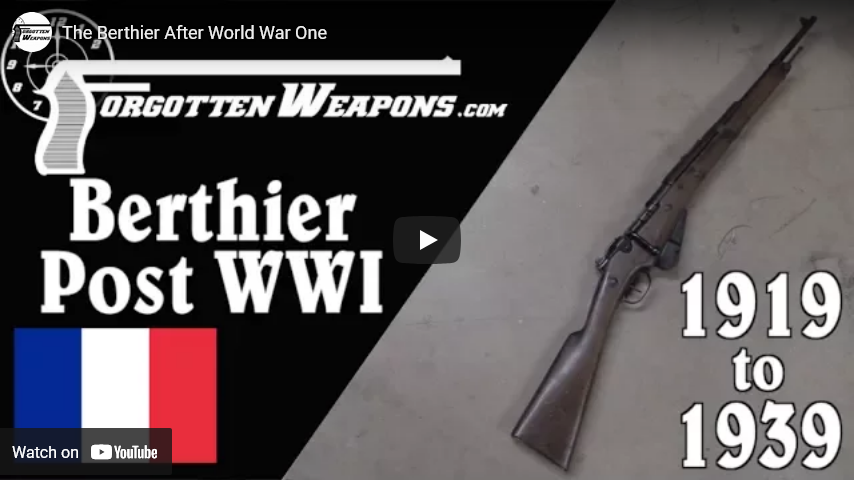
The Berthier After World War One
Forgotten Weapons
Published 31 Jul 2017http://www.patreon.com/ForgottenWeapons
In the aftermath of World War One, France would face the need to replace virtually all of its small arms, because nearly everything it had been using was either a wartime stopgap (like the Ruby, Chauchat, and Berthier 07/15) or had been obsolete before the war began (like the Lebel and Mle 1892 revolver). The first focus of the rearming was a new light machine gun, which would be adopted in the form of the Chatellerault M24/29. Plans were made to develop a semiautomatic infantry rifle and bolt action support troops’ rifle (both in the new 7.5mm rimless cartridge), but these would not prove to be as quickly realized. As a result, the Berthier Mle 1916 carbines would remain in major frontline service right up to the outbreak of World War Two.
During the twenty years between the wars, the Berthiers would see a series of changes and upgrades including:
– Sling bars replacing swivels
– Revised handguard profile
– Raised sights
– Removal of the clearing rods
– Adoption of the 1932N cartridge and associated rechambering
– New metal finishesProduction of new carbines in fact continued all the way until 1939, with at least 160,000 made in 1919 and later. Many of the alterations made during this postwar period are evident on examples found today, and there is a collecting premium on guns that do not exhibit these peacetime modifications. So, let’s have a look, shall we?
If you enjoy Forgotten Weapons, check out its sister channel, InRangeTV! http://www.youtube.com/InRangeTVShow
Comments Off on The Berthier After World War One
July 15, 2022
HMCS Sackville Walkaround
iChaseGaming
Published 25 Jul 2019Moved to Halifax, must visit HMCS Sackville 😀 and here she is!
(more…)
Comments Off on HMCS Sackville Walkaround
July 14, 2022
Prokhorovka: An Avalanche of Armor – WW2 – 202 B – July 13, 1943
World War Two
Published 13 Jul 2022As dawn broke on 12th July 1943, the spearheads of the German II SS Panzer Corps and the Soviet 5th Guards Tank Army were shuffling into their positions. The battle of Zitadelle was entering a pivotal moment. Would the elite of the German Panzers finally achieve a breakthrough into open country? Or would the might of the Soviet Tank Army break them in a pre-emptive attack? The battle and fate of Operation Zitadelle was to be decided in front of a small village called Prokhorovka.
Special thanks to Jason Shafer, pattygman46 and QuinnTheSpin for their support during this episode’s premiere
(more…)
Comments Off on Prokhorovka: An Avalanche of Armor – WW2 – 202 B – July 13, 1943
The plight of 1st Canadian Infantry Division during the opening stages of Operation Husky, July 1943
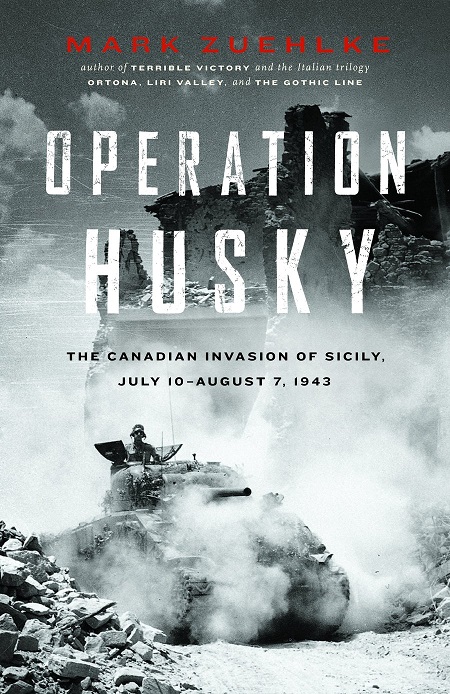
First Canadian Infantry Division had an exciting start to Operation Husky — for certain values of “exciting” — as told in Mark Zuehlke’s Operation Husky: The Canadian Invasion of Sicily, July 10-August 7, 1943:
Every day [during the convoy to Sicily], Major General Guy Simonds and Lieutenant Colonel George Kitching performed the same macabre ritual. Kitching would take a hat filled with equal-sized chits of paper on which the names of every ship bearing Canadian personnel and equipment was written and hold it out to the divional commander. Simonds drew three chits and those three ships were declared lost, victims of torpedoes from a German U-boat — the scenario at times being that about one thousand men aboard the fast convoy had drowned and burned in oil-drenched seas, or hundreds of trucks, tanks, guns, radios, and other equipment in the slow convoy had plummeted to the bottom of the Mediterranean. All lost, gone. Kitching and his staff would then sit down and coldly “examine the effect the loss of these three ships would have on our projected plans.”
On July 3, Simonds pulled from the hat chits for three ships travelling in the Slow Assault Convoy — City of Venice, St. Essylt, and Devis. The coincidence was chilling, for it was aboard these vessels that equal portions of the divisional headquarters equipment — including all the trucks, Jeeps, radio sets, and a panoply of other gear that kept a division functioning — had been distributed. Were one or even, God forbid, two of these ships sunk, the headquarters could function almost as normal. But lose the three and the division was crippled.
Kitching considered the “chance of all three ships being sunk as a million to one”. Deciding there was no point in studying the implications of such a wildly remote possibility, he asked Simonds to draw another three names from the hat, which the general did.
As you’ve probably already figured out, the one-in-a-million situation turned up on schedule. City of Venice took a torpedo during a submarine alert, with Royal Navy escort ships dropping depth charges on a suspected U-boat position. The convoy instructions were for damaged ships to be left behind and for the undamaged ships to carry on, as the danger was greater if the whole convoy slowed or stopped to aid the stricken ship(s). City of Venice could not be saved, and ten crew members and ten Canadian soldiers were killed, but the other 462 men on board were transferred to a rescue ship. A few hours later, two more ships from the convoy were lost: St. Essylt, and Devis.
While the loss of lives aboard the three torpedoed slow convoy ships was relatively small, the amount and nature of equipment and stores sent to the bottom of the Mediterranean was serious. A total of 562 vehicles were lost, leaving 1st Canadian Infantry Division facing a major transportation shortage. Also lost were fourteen 25-pounders [gun-howitzers], eight 17-pounders [heavy anti-tank guns, equivalent to German 88mm guns], and ten 6-pounder anti-tank guns that would significantly reduce the division’s artillery support. “In addition to the above,” the divisional historical officer, Captain Gus Sesia, noted in his diary, “we lost great quantities of engineers’ stores and much valuable signals equipment.” The biggest immediate blow was the loss of all divisional headquaters vehicles and equipment, including many precious wireless sets — precisely the nightmare scenario forecast and rejected by Kitching as infeasible when Simonds had drawn these ships by lot a few days earlier.
Equally serious was the loss in equipment and lives suffered by the Royal Canadian Army Medical Coprs personnel attached to the division. Due to a loading error, instead of No. 9 Field Ambulance’s vehicles being distributed among several ships, fifteen out of eighteen were on Devis. Accompanying the vehicles was a medical officer and nineteen other ranks and medical orderlies. Four of the other ranks were among the fifty-two Canadian troops killed and another four suffered injuries. The other field ambulance, field dressing station, and field surgery units assigned to the division were largely unaffected. No. 5 Field Ambulance’s vehicles had been distributed correctly so only two of them and a ton of medical supplies went down with St. Essylt. City of Venice had just one medical officer, Captain K.E. Perfect, aboard and he escaped uninjured. But Perfect was overseeing safe passage of nine tons of stretchers and blankets, which all went to the bottom.
[…]
A fully accounting of the losses would not be completed for days. Even on July 7, reports were still coming in that City of Venice remained under tow and bound for Algiers. Finally, at 1900 hours on that day, its sinking was confirmed. The report also stated that most of the surviving Canadian troops had been loaded on a Landing Craft, Infantry in Algiers and were en route for Malta. From there, they would eventually rejoin the division.
Compounding the loss of so many vehicles was the fact that the division had left Britain with a smaller than mandated number due to lack of shipping capacity. Once the seriousness of the situation was appreciated, Lieutenant Colonel D.G.J. Farquharson, the division’s assistant director of ordnance services, and his staff “tried to make [the losses] good … by emergency measures, improvising and obtaining what could be obtained buckshee from the Middle East.” They soon had commitments for some vehicles, but these would not be available until after the initial landings. The fact that every vehicle to be found locally was a Dodge posed “a considerable ordnance problem, because what spare parts we had were based on Ford and Chevrolet makes.” Improvisation would be the order of the day.
Comments Off on The plight of 1st Canadian Infantry Division during the opening stages of Operation Husky, July 1943
July 13, 2022
The Irish Fighting for Britain, Mexico’s Role in the War, and Chuikov in Uranus – WW2 – OOTF 27
World War Two
Published 12 Jul 2022How many Irishmen are fighting for Britain and why? And what did Chuikov do during Operation Uranus? And what role has Mexico played in the fighting so far? Find out the answers to these fascinating questions in our latest edition of Out of the Foxholes!
(more…)
July 12, 2022
Kursk, When Titans Clash – 202 – July 9, 1943
World War Two
Published 10 Jul 2022Adolf Hitler launches his huge summer offensive in the USSR, Operation Citadel, known as the Battle of Kursk. Men in the millions clash. The Allies’ New Georgia campaign continues in the Solomons, both on land and with fighting at sea this week, and the preliminary actions begin for the Allied invasion of Sicily, scheduled to go off tomorrow.
(more…)
Comments Off on Kursk, When Titans Clash – 202 – July 9, 1943
Killing the Resistance, and Rockets of Death – War Against Humanity 068 – July 10, 1943
World War Two
Published 10 Jul 2022The Polish and French resistance find themselves weakened by the lots of their leaders. Hitler decided to give Werner von Braun hundreds of thousands of slaves to launch the German rocket program.
(more…)
Comments Off on Killing the Resistance, and Rockets of Death – War Against Humanity 068 – July 10, 1943
July 11, 2022
Troop Deployments for the Battle of Kursk – WW2 Special
World War Two
Published 9 Jul 2022Over the last few weeks entire cities-worth of troops along with all the logistical support needed to support them have gathered in and around the Kursk salient. Here’s how they’ve been deployed, and where they could go from here.
(more…)
Comments Off on Troop Deployments for the Battle of Kursk – WW2 Special
The Master Race of Asia? – WAH 067 – July 3 1943
World War Two
Published 8 Jul 2022
(more…)
Comments Off on The Master Race of Asia? – WAH 067 – July 3 1943
July 7, 2022
M38 Carcano Carbine: Brilliant or Rubbish?
Forgotten Weapons
Published 1 Aug 2017http://www.patreon.com/ForgottenWeapons
Cool Forgotten Weapons merchandise! http://shop.bbtv.com/collections/forg…
Carcano vs K98k Match video: https://www.youtube.com/watch?v=FAyxL…
I would like to propose that the M38 Carcano short rifle was, despite the poor reputation of the Carcano series of rifles, one of the best thought-out bolt action weapons of World War 2. Why, you ask? Well, let’s consider …
Only a few nations actually recognized the short ranges at which combat actually took place. Germany was one, as seen with its 8x33mm cartridge development, and Italy was another. The sights on the M38 series of carbines were made as simple fixed notches, with no adjustments to be knocked out of place unintentionally. With a 200 meter zero (or 150 meters, with the Finnish replacement front sight), the weapon needed no adjustment to make hits out to 300 meters, which is as far as anyone could realistically engage a target.
The M38 is a light and handy weapon compared to its contemporaries — 8.1 pounds and 40.2 inches (3.7kg and 1.02m) — and it fired a significantly lighter cartridge as well. The 7.35x51mm round used a 128gr (8.3g) bullet at 2400-2500 fps (735-755 m/s) depending on barrel length. This produced noticeably less recoil than rounds like the .30-06 or 8mm Mauser, which made it easier for troops to shoot effectively. The Carcano also had a 6-round capacity and fed with Mannlicher type clips, which are potentially faster to load than Mauser-type stripper clips.
Today we will discuss the M38 and these features (along with its predecessor, the M91 rifle) as they appear on paper. At the same time, over on InRangeTV, today we have the first stage of a 2-Gun Action Challenge Match in which I am shooting this M38 Carcano against Karl, who is using a Mauser K98k – so we will see how the theory works out in the field!
If you enjoy Forgotten Weapons, check out its sister channel, InRangeTV! http://www.youtube.com/InRangeTVShow

Comments Off on M38 Carcano Carbine: Brilliant or Rubbish?
July 6, 2022
Decapitating the French Resistance – WAH 066 – June 26, 1943
World War Two
Published 5 Jul 2022The Gestapo deals a devastating blow to French Resistance, and in Bengal, British India the famine is only getting worse.
(more…)
Comments Off on Decapitating the French Resistance – WAH 066 – June 26, 1943
July 5, 2022
How to Fool a Führer – Operation Mincemeat – WW2 – Spies & Ties 19
World War Two
Published 4 Jul 2022Glyndwr Michael, the dead secret agent, has deposited his deceptive letters in Spain. Now the next phase of Operation Mincemeat begins. If Charles Cholmondely of MI5 and Ewen Montagu of Naval Intelligence have done their job right, the letters should make their way into Hitler’s hands.
(more…)
Comments Off on How to Fool a Führer – Operation Mincemeat – WW2 – Spies & Ties 19
July 3, 2022
Tougher than Guadalcanal: New Georgia – 201 – July 2, 1943
World War Two
Published 2 Jul 2022The Allies begin the next phase of their Solomon Islands offensives, the invasion of New Georgia, even as the regional fighting continues on New Guinea. Adolf Hitler schedules his summer Kursk offensive for July 5th, and the Allied invasion of Sicily is set for July 10th.
(more…)
Comments Off on Tougher than Guadalcanal: New Georgia – 201 – July 2, 1943
July 2, 2022
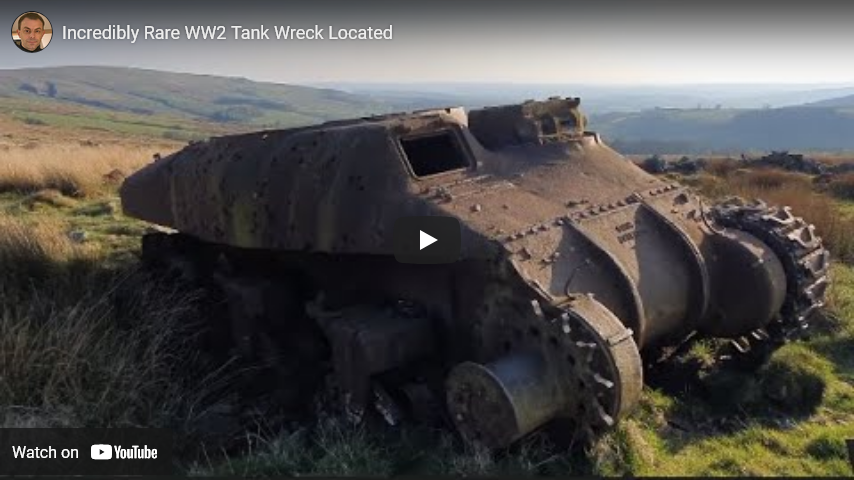
Incredibly Rare WW2 Tank Wreck Located
Mark Felton Productions
Published 5 Mar 2022The story of an incredibly rare WW2 tank that remains forgotten on a UK gunnery range.
Many thanks to Destination Discovery (ADTV) for tank footage. Please visit their wonderful channel for more footage: https://www.youtube.com/channel/UCxyc…
Dr. Mark Felton is a well-known British historian, the author of 22 non-fiction books, including bestsellers Zero Night and Castle of the Eagles, both currently being developed into movies in Hollywood. In addition to writing, Mark also appears regularly in television documentaries around the world, including on The History Channel, Netflix, National Geographic, Quest, American Heroes Channel and RMC Decouverte. His books have formed the background to several TV and radio documentaries. More information about Mark can be found at: https://en.wikipedia.org/wiki/Mark_Fe…
Help support my channels:
https://www.paypal.me/markfeltonprodu…
https://www.patreon.com/markfeltonpro…Disclaimer: All opinions and comments expressed in the ‘Comments’ section do not reflect the opinions of Mark Felton Productions. All opinions and comments should contribute to the dialogue. Mark Felton Productions does not condone written attacks, insults, racism, sexism, extremism, violence or otherwise questionable comments or material in the ‘Comments’ section, and reserves the right to delete any comment violating this rule or to block any poster from the channel.
Credits: US National Archives; Library of Congress; Imperial War Museum; YouTube Creative Commons; LHOON; Martin van Dalen.
Thumbnail: Destination Discovery (ADTV)
Comments Off on Incredibly Rare WW2 Tank Wreck Located


