
World War Two
Published 29 Jun 2022The best tank of World War Two or a piece of junk? Using the original held at the U.S. Army Armor & Cavalry Collection, Chieftain and Rob Cogan take you on a literal deep dive into the iconic Tiger I.
(more…)
June 30, 2022
A Deep Dive into the Tiger I, by the Chieftain
Comments Off on A Deep Dive into the Tiger I, by the Chieftain
June 29, 2022
How to Identify a Real M1A1 Carbine vs a Fake
Forgotten Weapons
Published 10 Feb 2018Looking for a light and compact weapon to equip its new Airborne units, the US military adopted the M1A1 Carbine in May of 1942. This was mechanically identical to the existing M1 Carbine but with a wire-frame side-folding stock in place of the standard wooden stock. This allowed the M1A1 to fit into a very handy leg bag for paratroops.
Deliveries began in October 1942, with all of the guns being manufactured by the Inland company. A total of 140,591 were made in two batches (71,000 between October 1942 and October 1943 and another 69,000 between April and December 1944). This is a very small fraction of the more than 6 million M1 Carbines made during the war, and the M1A1 has become quite notable and desirable for its association with elite Airborne units. As a result, reproduction and fake stocks abound, and are quite difficult to tell from original ones.
Today we are going to look at some of the specific features that can help you authenticate an M1A1 stock.
http://www.patreon.com/ForgottenWeapons
Cool Forgotten Weapons merch! http://shop.bbtv.com/collections/forg…
If you enjoy Forgotten Weapons, check out its sister channel, InRangeTV! http://www.youtube.com/InRangeTVShow
Contact:
Forgotten Weapons
6281 N Oracle #36270
Tucson, AZ 85704

Comments Off on How to Identify a Real M1A1 Carbine vs a Fake
June 26, 2022
Two Hundred Weeks of War – WW2 – 200 – June 25, 1943
World War Two
Published 25 Jun 2022The Allies make some preliminary moves ahead of their next big operation in the Solomon Island as well as a few before their impending invasion of Sicily. Meanwhile, in the Soviet Union, Soviet citizens are laying over a million mines in anticipation of the impending German attack at Kursk.
(more…)
Comments Off on Two Hundred Weeks of War – WW2 – 200 – June 25, 1943
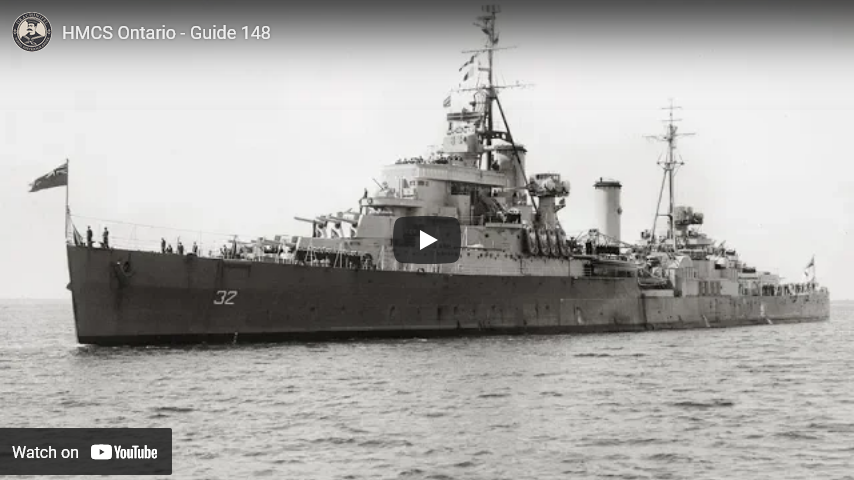
HMCS Ontario – Guide 148
Drachinifel
Published 12 Oct 2019HMCS Ontario, last of Canada’s cruisers and a Minotaur class vessel, is the second subject of the day.
Want to support the channel? – https://www.patreon.com/Drachinifel
Want a shirt/mug/hoodie – https://shop.spreadshirt.com/drachini…
Want a medal? – https://www.etsy.com/uk/shop/Drachinifel
Want to talk about ships? https://discord.gg/TYu88mt
Want to get some books? www.amazon.co.uk/shop/drachinifel
Drydock Episodes in podcast format – https://soundcloud.com/user-21912004
Comments Off on HMCS Ontario – Guide 148
QotD: Breaking the trench stalemate with strategic air power
The first efforts at strategic bombing were made in WWI, though once again the technology wasn’t ready. The range for fixed-wing aircraft was still very limited; the aforementioned Farman F.50 had a range of only 420km, nowhere near enough to really bring entire countries under the threat of bombing. Dirigibles – zeppelins – could manage much longer ranges and the Germans did attempt to bomb British cities with them starting in 1915. The problem was that once aircraft powerful enough to climb to the zeppelin’s altitude were developed, the slow and fragile zeppelins were sitting ducks: lighter than air airships could hardly be armored, after all. Moreover, the bomb loads of zeppelins had always been far too low to make effective strategic bombing possible beyond the initial shock of it.
What no one could have known in WWI was not merely that the technology for effective conventional strategic bombing wasn’t ready, but that it would probably never be ready. Interwar air-power theorists, seeing the potential of strategic airpower to bypass the trench stalemate by flying over it began to try to work out how this would be done. Giulio Douhet (1869-1930) argued that future wars would be fought and won in the air, with fleets of bombers using high explosives and chemical weapons to massacre enemy civilian centers, until civilians forced their governments to surrender. Douhet was not alone; his vision of airpower as shared, for instance, by the “father of the RAF”, Hugh Trenchard (1873-1956).
This concept, “morale bombing” as it is sometimes called, probably deserves its own post discussing its failures. But in brief, the concept was tested, with far larger amounts of bombs than Douhet or any other interwar theorist could have ever dreamed of, during WWII. The argument by air theorists that high altitude bombers could not be stopped was proved false when the British did exactly this, stopping German bombers over Britain in 1940. Moreover, terror bombing against civilian targets in Britain didn’t lead to surrender, but hardened resolve. Likewise, “morale” bombing against German targets by the allies didn’t lead to surrender, but hardened resolve. Later efforts to demoralize the North Vietnamese through a American bombing campaign in the Vietnam War didn’t lead to surrender, but hardened resolve. More recent efforts to demoralize or destroy terrorists and the Taliban through the use of airpower hasn’t lead to surrender, but rather hardened resolve. Likewise, efforts by the Syrian regime to defeat various opposition groups in Syria through the use of chemical weapon-based terror bombing didn’t lead to surrender (siege-and-starve tactics did), but hardened resolve.
It turns out the fundamental premise of the entire idea of morale bombing – that being bombed will make people want to stop fighting – was flawed. Morale bombing has been, depending on how hard you squint at the US air campaign over Japan in WWII (including the use of nuclear weapons) successful either once (out of many attempts) or never. In most cases, the sustained bombing of civilian centers has been shown to increase a population’s willingness to resist, making the strategy worse than useless.
The case for strategic bombing against industrial targets is marginally better, but only marginally. While airpower advocates, particularly in the United States promised throughout WWII that bombing campaigns against German industry could lead to the collapse of the German war machine, in the end many historians posit that the real achievement of the campaign was to lure the Luftwaffe into the air where it could be destroyed, thus denying the German army of air cover and close air support, particularly on the Eastern Front. Some dimunition of German industrial capabilities was accomplished (though it is not clear that this ever approached the vast resources poured into producing the large numbers of extremely expensive bombers used to do it, though the allies had such an industrial advantage over Germany, forcing the Germans to fight in expensive ways in the sky was a winning trade anyway), but the collapse of German industry never happened. As Richard Overy notes, German industrial output continued to rise during strategic bombing and only began to fall as a result of the loss of territory on the ground. Needless to say, “strategic bombing can sucker the enemy into wasting their close air support” was not the result that airpower advocates had promised, nor could it have broken the stalemate.
I don’t want to oversimplify the continued debate over the efficacy of strategic airpower here too much so let’s just say that the jury is still very much out as to if strategic airpower works even with modern technology; it certainly wouldn’t have worked with WWI era technology.
Bret Devereaux, “Collections: No Man’s Land, Part II: Breaking the Stalemate”, A Collection of Unmitigated Pedantry, 2021-09-24.
Comments Off on QotD: Breaking the trench stalemate with strategic air power
June 22, 2022
Johnson M1941 Rifle
Forgotten Weapons
Published 3 Oct 2016Cool Forgotten Weapons Merch! http://shop.bbtv.com/collections/forg…
Designed in 1936 by Melvin Johnson, the M1941 Johnson Automatic Rifle was a competitor to the M1 Garand, but not introduced in time to actually be adopted in place of the Garand. Instead, Johnson hoped to have his rifle accepted as a parallel second option for the US military in case something went wrong with the rollout of the Garand, or production simply couldn’t meet the required levels.
However, Johnson was not able to make his case to the military successfully. A small number of Johnson Light Machine Guns were acquired by the US Paramarines and the First Special Service Force, and a large order (30,000 rifles) was placed by the Dutch government for shipment to the colonies in southeast Asia (it is from this order that the M1941 designation comes). However, those colonies fell to the Japanese before a significant number of rifles were able to be shipped out. This left a substantial number of rifles orphaned in the US, and a small number of these were unofficially put in service by acquisitive Marines, mostly in the Pacific theater.
Mechanically, the Johnson is a short recoil system with a rotating bolt (very similar to the later AR-15 bolt, which Johnson would influence). It is chambered for the standard .30-06 cartridge, and feeds from a 10-round rotary fixed magazine which can be fed by stripper clips or with individual cartridges.

Comments Off on Johnson M1941 Rifle
June 20, 2022
Japan – Liberators of India? – WAH 065 – June 19, 1943
World War Two
Published 19 Jun 2022As the people of Bengal and Iran continue to be tormented by hunger, so are the people of Germany and Yugoslavia by bombs. In Eastern Europe, the Germans continue to kill anyone they deem an enemy.
(more…)
Comments Off on Japan – Liberators of India? – WAH 065 – June 19, 1943
June 19, 2022
Kursk: Soviets Dig-In for Blitzkrieg – WW2 – 199 – June 18, 1943
World War Two
Published 18 Jun 2022The Soviets have put civilians to work by the hundreds of thousands, building line after line of defenses in the Kursk salient, where they are sure the Germans are soon to attack. Meanwhile the Allies are making moves in preparations for two big upcoming offensives of their own — in Sicily and the Central Solomon Islands.
(more…)
Comments Off on Kursk: Soviets Dig-In for Blitzkrieg – WW2 – 199 – June 18, 1943
June 16, 2022
Mussolini’s Pope? – The Geopolitics of the Vatican
World War Two
Published 14 Jun 2022Pope Pius XI is the first Pope to guide the Catholic Church through the age of fascism. How has his Vatican responded to Fascists Italy and Nazi Germany, and what is the geopolitical position of the Papacy on the eve of war of World War Two?
(more…)
Comments Off on Mussolini’s Pope? – The Geopolitics of the Vatican
June 15, 2022
Istanbul: City of Spies – WW2 – Spies & Ties 18
World War Two
Published 14 Jun 2022Neutral Turkey appears to be an island of peace in a sea of war. But if you look a little closer though and there’s another story. Assassins ply their deadly trade. Spies slip in and out of occupied Europe. The Allies and Axis battle for influence. The secret war is in full swing.
(more…)
Comments Off on Istanbul: City of Spies – WW2 – Spies & Ties 18
June 13, 2022
Nazis in a Balkan Mess – WAH 064 – June 12, 1943
World War Two
Published 12 Jun 2022In the Balkans, the Axis powers fail to rout Yugoslav and Greek Partisans. In Bengal, British India starvation is spreading, and in the Netherlands, the Nazis send 1,296 children and infants from the Vught Camp to the gas chambers at Sobibor.
(more…)
Comments Off on Nazis in a Balkan Mess – WAH 064 – June 12, 1943
June 12, 2022
Eisenhower Lays Out His Plans for Sicily – WW2 – 198 – June 11, 1943
World War Two
Published 11 Jun 2022The Allies bomb Mediterranean islands in preparation for their invasion of Sicily next month; they also prepare a lot of deceptions to mislead the enemy as to where they will attack. The German plans for the summer offensive against the Kursk salient are ever more concrete, and in the field this week, the Chinese stop the Japanese offensive cold.
(more…)
Comments Off on Eisenhower Lays Out His Plans for Sicily – WW2 – 198 – June 11, 1943
June 11, 2022
Gas Trap M1 Garand
Forgotten Weapons
Published 29 Sep 2016Cool Forgotten Weapons Merch! http://shop.bbtv.com/collections/forg…
The original design of the M1 Garand as adopted in 1936 used a “gas trap” system instead of a gas port drilled in the barrel. This system used a type of muzzle cap and false muzzle to redirect gas into the gas cylinder in the short distance between the end of the rifled barrel and when the bullet left the muzzle. The system worked, but was not ideal.
Several problems were found with the gas trap system as the guns went into production. These included cleaning complexity, an unstable front sight, and a potentially weak bayonet mounting point. Most significantly, however, one rifle in testing had a screw work loose in the muzzle cap, which allowed parts to shift out of alignment and resulted in a bullet striking the gas plug and blowing the entire assembly off the gun. This led to a decision to redesign the gas system of the M1 to use a simpler gas port drilled in the barrel.
When this design change was made, 18,000 rifles had been completed and parts were made for an additional 33,000. Those guns were completed with the available parts, and the new gas system was used for all further production. Gas trap M1s are very rare today because the guns were updated to the new system when they were overhauled during WWII, and in 1947 the Army ordered all remaining gas trap rifles destroyed.

Comments Off on Gas Trap M1 Garand
June 8, 2022
The Story Behind the Dambuster Raid – WW2 Special
World War Two
Published 7 Jun 2022The thousand-bomber offensive was about to begin as Air-Marshall Harris was assembling his forces. Yet one man was to challenge his strategy. The aircraft designer Barnes Wallis thought: “What if there was a way to destroy Germany’s industrial might not by simply dropping thousands of bombs over its cities, but by a precision strike against its dams?” For this, a new kind of bouncing bomb was to be delivered.
(more…)
Comments Off on The Story Behind the Dambuster Raid – WW2 Special
June 7, 2022
D Day: The First Canadian Parachute Battalion and the Battle for the Village of Varaville
The History Guy: History Deserves to Be Remembered
Published 6 Jun 2022There are so many stories of heroism involved in the massive Operation Overlord, among them the extraordinary story of the little-known first Canadian Parachute Battalion. The lightly armed Canadians were among the first allied soldiers to hit the ground in France on D-Day.
Check out our new community for fans and supporters! https://thehistoryguyguild.locals.com/
This is original content based on research by The History Guy. Images in the Public Domain are carefully selected and provide illustration. As very few images of the actual event are available in the Public Domain, images of similar objects and events are used for illustration.
You can purchase the bow tie worn in this episode at The Tie Bar:
https://www.thetiebar.com/?utm_campai…All events are portrayed in historical context and for educational purposes. No images or content are primarily intended to shock and disgust. Those who do not learn from history are doomed to repeat it. Non censuram.
Find The History Guy at:
New community!: https://thehistoryguyguild.locals.com/
Please send suggestions for future episodes: Suggestions@TheHistoryGuy.netThe History Guy: History Deserves to Be Remembered is the place to find short snippets of forgotten history from five to fifteen minutes long. If you like history too, this is the channel for you.
Awesome The History Guy merchandise is available at:
teespring.com/stores/the-history-guyScript by THG
#history #thehistoryguy #DDay

Comments Off on D Day: The First Canadian Parachute Battalion and the Battle for the Village of Varaville


