
Forgotten Weapons
Published 3 Aug 2017http://www.patreon.com/ForgottenWeapons
With the end of World War One, it was finally possible for the French military to replace the 8mm Lebel cartridge with a modern rimless cartridge, and they wasted no time in doing so. By 1924 a new round had been adopted, and along with it a new modern light machine gun. Next, the arsenals would start working on converting 8mm rifles to the new cartridge. The first candidate was the Lebel, and in 1927 a conversion was approved and a batch of a few hundred made — but this was a more expensive and time-consuming process than anyone wanted. After some brief trials, it was decided to work on adapting the Berthier instead, and in 1934 a conversion designed from St Etienne was approved as the 1907/15-M34.
This new design used a new 22.5″ barrel (570mm), a Mauser style internal 5-round double stack magazine, and new sights. The receivers and trigger parts were retained from the rifles being converted, along with the nosecaps and barrel bands, but not much else. Still, these conversions were put into production alongside the manufacture of new MAS-36 bolt action rifles. By the time of the German invasion about 63,000 M34 Berthiers had been converted, and were issued to frontline troops. They would fight in the Battle of France, and would also be used by German occupation forces as the Gewehr 241(f).
(more…)
August 2, 2022
M34: The Berthier Converted to the 7.5mm Rimless Cartridge
August 1, 2022
Hannah Arendt on Adolf Eichmann’s exemplification of the “banality of evil”
Lawrence W. Reed on what Hannah Arendt observed during Eichmann’s trial:
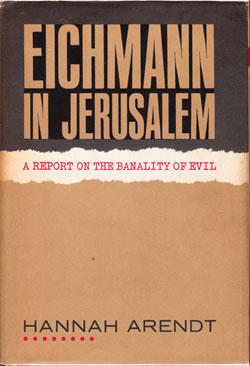
Nine months after the Nazi war criminal Adolf Eichmann died at the end of a noose in Israel, a controversial but thoughtful commentary about his trial appeared in The New Yorker. The public reaction stunned its author, the famed political theorist and Holocaust survivor Hannah Arendt (1906-1975). It was February 1963.
Arendt’s eyewitness assessment of Eichmann as “terribly and terrifyingly normal” took the world by surprise. Her phrase, “the banality of evil”, entered the lexicon of social science, probably forever. It was taken for granted that Eichmann, despite his soft-spoken and avuncular demeanor, must be a monster of epic proportions to play such an important role in one of the greatest crimes of the 20th Century.
“I was only following orders,” he claimed in the colorless, matter-of-fact fashion of a typical bureaucrat. The world thought his performance a fiendishly deceptive show, but Hannah Arendt concluded that Eichmann was indeed a rather “ordinary” and “unthinking” functionary.
[…]
As Arendt explained, “Going along with the rest and wanting to say ‘we’ were quite enough to make the greatest of all crimes possible.”
Eichmann was a “shallow” and “clueless” joiner, someone whose thoughts never ventured any deeper than how to become a cog in the great, historic Nazi machine. In a sense, he was a tool of Evil more than evil himself.
Commenting on Arendt’s “banality of evil” thesis, philosopher Thomas White writes, “Eichmann reminds us of the protagonist in Albert Camus’s novel The Stranger (1942), who randomly and casually kills a man, but then afterwards feels no remorse. There was no particular intention or obvious evil motive: the deed just ‘happened’.”
Perhaps Hannah Arendt underestimated Eichmann. He did, after all, attempt to conceal evidence and cover his tracks long before the Israelis nabbed him in Argentina in 1960 — facts which suggest he did indeed comprehend the gravity of his offenses. It is undeniable, however, that “ordinary” people are capable of horrific crimes when possessed with power or a desire to obtain it, especially if it helps them “fit in” with the gang that already wields it.
The big lesson of her thesis, I think, is this: If Evil comes calling, do not expect it to be stupid enough to advertise itself as such. It’s far more likely that it will look like your favorite uncle or your sweet grandmother. It just might cloak itself in grandiloquent platitudes like “equality”, “social justice”, and the “common good”. It could even be a prominent member of Parliament or Congress.
Hamburg’s Citizens Burnt Alive – WAH 071 – July 31, 1943
World War Two
Published 31 Jul 2022In Italy the Fascists fall from power in a peaceful coup, while in Germany the RAF and USAAF bring down a rain of fire of biblical proportions in Operation Gomorrah, launching the Firestorm of Hamburg.
(more…)
July 31, 2022
Milton Mayer’s They Thought They Were Free
Joshua Styles on a book written after the Second World War that appears to have renewed relevance today:
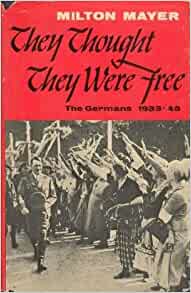
“I came back home a little afraid for my country, afraid of what it might want, and get, and like, under pressure of combined reality and illusion. I felt — and feel — that it was not German man that I had met, but Man. He happened to be in Germany under certain conditions. He might, under certain conditions, be I.” — Milton Mayer, They Thought They Were Free, ix.
It’s been more than seventy-five years since the Nazis were defeated and Auschwitz was liberated. Seventy-five years is a long time — so long, in fact, that while many still learn of the horrors of the Holocaust, far fewer understand how the murder of the Jews happened. How were millions of people systematically exterminated in an advanced Western nation — a constitutional republic? How did such respectable and intelligent citizens become complicit in the murder of their countrymen? These are the questions Milton Mayer sought to answer in his book They Thought They Were Free.
In 1952, Mayer moved his family to a small German town to live among ten ordinary men, hoping to understand not only how the Nazis came to power but how ordinary Germans — ordinary people — became unwitting participants in one of history’s greatest genocides. The men Mayer lived among came from all walks of life: a tailor, a cabinetmaker, a bill-collector, a salesman, a student, a teacher, a bank clerk, a baker, a soldier, and a police officer.
Significantly, Mayer did not simply conduct formal interviews in order to “study” these men; rather, Mayer had dinner in these men’s homes, befriended their families, and lived as one of them for nearly a year. His own children went to the same school as their children. And by the end of his time in Germany, Mayer could genuinely call them friends. They Thought They Were Free is Mayer’s account of their stories, and the title of the book is his thesis. Mayer explains:
“Only one of my ten Nazi friends saw Nazism as we — you and I — saw it in any respect. This was Hildebrandt, the teacher. And even he then believed, and still believes, in part of its program and practice, ‘the democratic part’. The other nine, decent, hard-working, ordinarily intelligent and honest men, did not know before 1933 that Nazism was evil. They did not know between 1933 and 1945 that it was evil. And they do not know it now. None of them ever knew, or now knows, Nazism as we knew and know it; and they lived under it, served it, and, indeed, made it” (47).
Until reading this book, I thought of what happened in Germany with a bit of arrogance. How could they not know Nazism was evil? And how could they see what was happening and not speak out? Cowards. All of them. But as I read Mayer’s book, I felt a knot in my stomach, a growing fear that what happened in Germany was not a result of some defect in the German people of this era.
The men and women of Germany in the 1930s and 40s were not unlike Americans in the 2010s and 20s — or the people of any nation at any time throughout history. They are human, just as we are human. And as humans, we have a great tendency to harshly judge the evils of other societies but fail to recognize our own moral failures — failures that have been on full display the past two years during the covid panic.
Mayer’s book is frighteningly prescient; reading his words is like staring into our own souls. The following paragraphs will show just how similar the world’s response to covid has been to the German response to the “threat” of the Jews. If we can truly understand the parallels between our response to covid and the situation in Hitler’s Germany, if we can see what lies at the end of “two weeks to flatten the curve”, perhaps we can prevent the greatest atrocities from being fully realized in our own day. But to stop our bent toward tyranny, we must first be willing to grapple with the darkest parts of our nature, including our tendency to dehumanize others and to treat our neighbors as enemies.
Mussolini Falls from Power – WW2 – 205 – July 30, 1943
World War Two
Published 30 Jul 2022The Allied advance on Sicily continues, though they’re really gearing up for operations next week. The Soviet advances in the USSR and in New Georgia also continue, with the enemy deciding to withdraw in both; Allied firebombing kills tens of thousands of German civilians, but the big news is still the fall of Benito Mussolini from power in Italy.
(more…)
July 30, 2022
PTRD 41: The Simple Soviet Antitank Rifle of WWII
Forgotten Weapons
Published 25 May 2018http://www.patreon.com/ForgottenWeapons
Cool Forgotten Weapons merch! http://shop.bbtv.com/collections/forg…
The Soviet Union had originally eschewed the use of large numbers of antitank rifles, anticipating that any potential combat use of them would be largely against tanks impervious to AT rifle cartridges. However, when German forces came flooding across the border in 1941, the Soviet Union found themselves being attacked by quite large numbers of tanks which were in fact vulnerable to an antitank rifle cartridge. Stalin ordered an immediate development and production of such a weapon, and the designers responded with concepts. Simonov produced the PTRS-41, a semiautomatic 14.5mm weapon that was sophisticated, expensive, and effective. Degtyarev produced the PTRD-41, a single shot 14.5mm weapon which was simple, cheap, and also effective. Both used the same cartridge, which fires a 980gr armor piercing projectile at a remarkable 3320 fps.
Both the Simonov and Degtyarev rifles were ordered into production, with the PTRD-41 being available and fielded within a month because of its very simple nature. By the end of the war some 185,000 of these rifles had been made, and even after the new German tanks became impervious to them, they remained effective weapons for use on light armored vehicles, field guns, machine gun nests, pillboxes, and other hardened targets.
The PTRD-41 is a mechanically interesting and unusual weapon in that despite being only a single shot system, it is recoil operated. When fired, the entire barrel assembly recoils rearward, absorbing some of the immense recoil energy and also opening the bolt and ejecting the spent case. The shooter then need only drop a new cartridge into the action and close the bolt to be ready for a subsequent shot.
(more…)
July 29, 2022
Why Ghost Division? What did Rommel do?
Military History Visualized
Published 5 Feb 2019Why was Rommel’s 7th Panzer Division called Gespensterdivsion – the “Ghost Division”? From all we know it earned this name during the Battle of France.
(more…)
July 28, 2022
The Posh Brits Betraying Their Country – WW2 – Spies & Ties 20
World War Two
Published 27 Jul 2022Being allies does little to discourage Moscow from recruiting double agents in the British establishment. The most famous of them all, Kim Philby and the Cambridge Five, penetrate deep into MI5, MI6, and Bletchley Park. With friends like the NKVD, who needs enemies?
(more…)
July 27, 2022
When the founder of the SAS was captured by Italian troops in 1943
In The Critic, Saul David describes what happened when Lieutenant Colonel David Stirling was captured during his “most hare-brained scheme” to link up the troops of Britain’s First and Eighth armies in Tunisia:
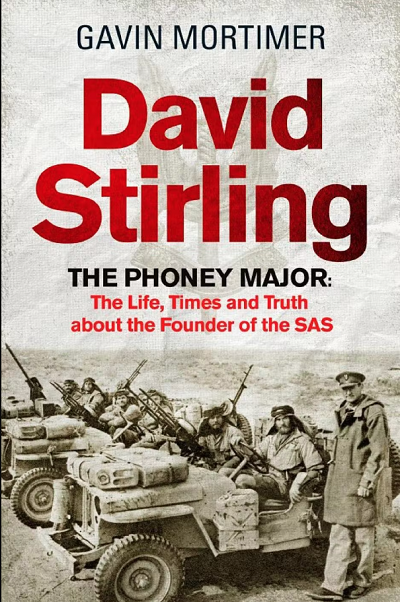
In January 1943 Lieutenant Colonel David Stirling, founder of the SAS, was flown to Rome for interrogation. He had been captured by the Italians on his “most hare-brained scheme yet” — leading a small raiding party deep into enemy territory in Tunisia to attack lines of communication, reconnoitre the terrain and become the first Eighth Army unit to link up with the First Army advancing from the west.
Cautious when speaking to the Italians, he was “vain and voluble” in conversation with a fellow “captive”, Captain John Richards. Unbeknown to Stirling, Richards was an Anglo-Swiss stool pigeon, Theodore Schurch, who had deserted from the British army and was working for fascist intelligence.
Prior to Schurch’s court-martial for treachery in late 1945, Stirling denied he had revealed any sensitive information. If he had, it was inaccurate and “designed to deceive”. This was a lie, told to protect Stirling’s reputation. In fact, as the British authorities knew all too well from intercepted signals, Stirling had told Richards vital details about current SAS operations, including the location of patrols and their orders. He had even given them the name of his probable replacement as SAS commander: Paddy Mayne.
The story of Stirling’s unfortunate encounter with Schurch has been told before, notably by Ben Macintyre in his bestselling SAS: Rogue Heroes. But Macintyre underplays Stirling’s indiscretion and fails to link it to the many other examples of the SAS commander’s recklessness and poor judgement of character. For Gavin Mortimer, on the other hand, both the capture and loose talk were typical of a man who was “imaginative, immature, immoderate and ill-disciplined”. Small wonder that even his own brother Bill thought he would be better off in a prisoner-of-war camp.
The subtitle of Mortimer’s book — a carefully researched and impeccably sourced take-down of the legendary special forces pioneer — is a corrective to the flattering but inaccurate nickname that was first coined for Stirling by British tabloids during the Second World War. “When word reached Cairo of the Phantom Major moniker,” writes Mortimer, “it must have sparked a mix of hilarity and indignation. All the falsehoods and fabrications would have been harmless enough had Stirling not stolen the valour of his comrades.”
Thread by thread, Mortimer unpicks the myth of Stirling’s life and war service that the subject and his fawning admirers had so carefully constructed, both during and after the war. Stirling was not training in North America for an attempt on Mount Everest’s summit when war broke out in 1939, as he later claimed, but rather working as a ranch hand because his exasperated family hoped it might give the feckless youth some focus and direction.
Italy’s Worst Machine Gun: The Breda Modello 30
Forgotten Weapons
Published 28 Jul 2017http://www.patreon.com/ForgottenWeapons
Cool Forgotten Weapons merchandise! http://shop.bbtv.com/collections/forg…
The Breda Model 30 was the standard Italian light machine gun of World War II, and is a serious contender for “worst machine gun ever”. Yes, given the choice we would prefer to have a Chauchat (which really wasn’t as bad as people today generally think).
The Breda 30 suffered from all manner of problems. To begin with, it was far more complicated than necessary. The amount of machining needed to build one is mind boggling compared to contemporary guns like the ZB26/Bren or BAR. And for all that work, it just didn’t work well in combat conditions.
Mechanically, the Breda used a short recoil action with a rotating bolt. The recoil action meant that the barrel moved with each shot, so the sights were mounted on the receiver to keep them fixed. This seems like a good idea, but it meant that the sights would need to be re-zeroed each time the barrel was changed. To compound this, the gun fired from a closed bolt which made it more susceptible to overheating and it was recommended to change barrels every 200 rounds or so. An oiling mechanism was built in to lightly oil each cartridge on feeding. This allowed the gun to extract without ripping rims off the cases, but was a disaster waiting to happen on the battlefield. In places like North Africa, the oil acted as a magnet for sand and dust, leading to quick jamming if the gun were not kept scrupulously clean.
The next huge judgment error on Breda’s part was the magazine. The thought behind it was that magazine feed lips are easily damaged in the field, and they can be protected by building them into the gun receiver rather than in each cheap disposable box magazine (the Johnson LMG and Madsen LMG recognized this issue as well). However, Breda’s solution was to make the 20-round magazine a permanent part of the gun. The magazine was attached to the receiver by a hinge pin, and was reloaded by special 20-round stripper clips. This meant that reloading took significantly longer than changing magazines, and any damage to the one attached magazine would render the gun inoperable. As if anything else were needed, the magazine was made with a big opening on top to allow the gunner to see how many rounds remained – and to let more of that North African sand into the action.
Most of the Breda Model 30s were made in 6.5 Carcano, but a small number were made in 7.35 Carcano when that cartridge was adopted. The rate of fire was about 500 rounds per minute, which was a bit slower than most other machineguns of the day.
(more…)
July 25, 2022
Stalin, Hitler, and Churchill – Architects of Death – WAH 070 – July 24, 1943
July 24, 2022
After a Victory at Kursk, The Soviets Attack Everywhere – WW2 – 204 – July 23, 1943
World War Two
Published 23 Jul 2022The Allied invasion of Italy powers on and puts the future of a key axis power at play. In the USSR, the Soviets have learnt to deal with German offensives, as the Wehrmacht struggles to make a dent.
(more…)
July 20, 2022
The Myth of Rosie the Riveter – On the Homefront 016
World War Two
Published 19 Jul 2022With American men going off to fight the war, there are concerns about a labor shortage. Enter Rosie the Riveter. The women who answered the “We Can Do It” call and entered the factories. But did she really exist?
(more…)
July 18, 2022
General Patton Orders War Crimes – WAH 069 – July 17, 1943
World War Two
Published 17 Jul 2022This week, we see a contrast in the way different civilians behave within occupied Ukraine, Patton orders war crimes, and Jewish resistance give up one of their own fighters.
(more…)
Russian Invasion of Finland – The Winter War 1939-40
Mark Felton Productions
Published 24 Mar 2022Find out why Russia invaded neutral Finland in late 1939, and how the outnumbered and outgunned Finns managed to defend their country for 3 months until making peace with Stalin.
(more…)


