When it comes to crafting winning political narratives, progressives have a natural advantage over conservatives. That’s because progressives have a free hand to project rosy visions of the future while conservatives must constantly defend against progressives’ distorted depictions of the past.
Two fundamental techniques undergird progressives’ success at narrative spinning. The first is skillful framing of the debate through investing heavily in public opinion making machinery. This disarms critics while giving lawmakers cover to vote for bills they’ve neither read nor understood. Thus framed, policies are judged only by their stated intentions, never their actual results. This allows politicians to promote new pieces of legislation named for their lofty objectives, even if the thousands of pages of vague and contradictory content deliver just the opposite.
The second is dodging all responsibility for failure. This is accomplished by blaming insufficient resources, the prior administration, the greedy 1 percent, sabotage by Republicans, or even the people’s obdurate failure to appreciate the progressive benefits conferred upon them. When the going gets tough, reality can be dismissed with a slogan. Forward!
Bill Frezza, “2013: The Year The Progressive Narrative Collided With Reality”, Forbes, 2013-12-30
January 2, 2014
QotD: Why progressive policy ideas get more media attention
Casualties from the most recent copyright term expansion
At Techdirt, Mike Masnick mourns the creative works that should have entered the public domain yesterday, but thanks to Congress will remain locked up for much, much longer:
As they do every year, unfortunately, the good folks at the Center for the Study of the Public Domain at Duke have put together a depressing list of what should have entered the public domain yesterday. As you hopefully know, until 1978, the maximum amount of time that work in the US could be covered by copyright was 56 years (you initially received a 28 year copyright term, which could be renewed for another 28 years). That means, back in 1957, everyone who created the works in that list knew absolutely, and without a doubt that their works would be given back to the public to share, to perform, to build on and more… on January 1, 2014 at the very latest. And they all still created their works, making clear that the incentive of a 56 year monopoly was absolutely more than enough incentive to create.
And yet, for reasons that still no one has made clear, Congress unilaterally changed the terms of the deal, took these works away from the public, without any compensation at all, and will keep them locked up for at least another 40 years. At least.
[…]
And it’s not just arts and entertainment. The post points out plenty of science and technology is still locked up thanks to all of this.
1957 was a noteworthy year for science: the USSR launched Sputnik 1 and Sputnik 2, IBM released the first FORTRAN compiler, and the UK’s Medical Research Council published an early report linking smoking and lung cancer. There were groundbreaking publications in the fields of superconductivity and astrophysics such as “Theory of Superconductivity” by John Bardeen, L.N. Cooper, and J.R. Schrieffer and “Synthesis of the Elements in Stars… ” by Geofrey Burbidge, Margaret Burbidge, William Fowler, and Fred Hoyle.
They further make an important point that while the works listed above grab all the attention, because they were so successful, the real shame is in lots of other works that are simply not available at all any more. And this would likely include all sorts of works from 1985. After all, works created in 1985, if created under the old law, would have been given an initial 28 year copyright term, which would also be expiring, and if history is any guide, the vast majority of those would not have their copyrights renewed. Instead, they’re locked up… and quite frequently completely unavailable, with a very real risk of being lost to history.
The really crazy part about all of this is that it’s the exact opposite of the entire original purpose of copyright. Copyright law was put in place specifically to encourage the creation of works that would be put into the public domain to promote learning, knowledge and understanding. Yet, instead, it’s been distorted, twisted and misrepresented into a system that is used solely to lock stuff up, make it less accessible and less available, limiting the ability to promote knowledge and learning. What a shame.
January 1, 2014
Newest apologist for the Baby Boomers – P.J. O’Rourke
Kathy Shaidle posted a Twitter update that should cause a few shudders:
PJ ORourke goes from writing for National Lampoon to pro-boomer dreck for AARP mag. Sigh. http://t.co/fJpAxAX5ox #DieFaster
— Kathy Shaidle (@kshaidle) January 1, 2014
The article at the AARP website is clearly written to buff up the self-esteem of Baby Boomers everywhere:
We’re the largest, richest, best-educated generation of Americans, the favored children of a strong, confident and prosperous country. Or, as other generations call us, spoiled brats. Born between 1946 and 1964, the 76 million boomers reaped all the benefits of the postwar period’s extraordinary economic growth.
We were dizzy with our aspirations. We’d be rock stars. We’d be spiritual avatars. We’d be social activists. We’d be billionaires. No, better yet, we’d be all those things at the same time. (Steve Jobs came close.)
Every time opportunity knocked, we let it in, even when it should have been locked out for decency’s sake. And behold the boomers’ remarkable experiments with prosperity — the dot-com bubble, the housing bubble, the enormous financial bubble that’s still got the nation trying to get fiduciary gum out of its hair.
And now the boomers run the world. The youngest members of the generation that decided to be young forever are turning 50. That’s the age of maximum privilege and power. We’re giving everybody orders. The oldest boomers are enrolled in Medicare, collecting Social Security and receiving tax-free Roth IRA disbursements. Plus, American life expectancy has increased by almost 12 years since the baby boom was born, so it doesn’t just seem like we’ll never go away. From President Obama, Rand Paul and Jeff Bezos at one end of our age cohort to Hillary Clinton, Rush Limbaugh and Cher at the other, we cannot be escaped or avoided (or shushed).
But running the world means taking responsibility for it. The boomers have been good at taking things: Mom’s car without permission, drugs, umbrage at the establishment, draft deferments, advantage of the sexual revolution, and credit for the civil rights and women’s liberation movements that rightly belongs to prior generations. The one thing that can be left in plain sight without us putting our sticky mitts on it is responsibility. Ask our therapists. Or the parents we haven’t visited at the extended-care facility.
December 26, 2013
December 24, 2013
Reason.tv – The TSA’s 12 Banned Items of Christmas
Published on 23 Dec 2013
As travelers board planes this holiday, please be aware of 12 actual banned items from the Transportation Security Administration.
December 23, 2013
Ambrose Bierce, remembered
In The Weekly Standard, Andrew Ferguson recounts the life and (theories about the) death of Ambrose Bierce:
“We have produced but one genuine wit,” H. L. Mencken wrote, in a survey of American letters: “Ambrose Bierce. And save to a small circle he is unknown today.” Mencken was writing decades after Bierce had gone off to Mexico, by which time his life was best remembered for the way he had left it. And the circle of those who read him is even smaller now, needless to say. When the Library of America finally got around to issuing a canonical selection of his writing, in 2011, the single volume (Philip Roth got nine!) was relatively slender; it was the 219th in the library’s series of great American writers.
His fame was not general, even at its most robust. Those who admired him, mostly his fellow writers, admired him extravagantly. He was a “writer’s writer,” in the deadly phrase. The tributes from William Gladstone, Arnold Bennett, Bret Harte, and many other popular and learned literary men shared a common thread: Why, they all asked, wasn’t Bierce better known? Bierce himself ached for fame as awfully as any writer, but was, in time, amused by the strange status he had achieved: He was famous for not being famous. He wrote to a friend toward the end of his life:
How many times, and during a period of how many years must one’s unexplainable obscurity be pointed out to constitute fame? Not knowing, I am almost disposed to consider myself the most famous of authors. I have pretty nearly ceased to be “discovered,” but my notoriety as an obscurian may be said to be worldwide and everlasting.
The problem with “writers’ writers” — as many readers have discovered — is that they are seldom “readers’ writers.” It depends on the readers as much as the writers, of course, and today’s readers might find they have caught up to Bierce’s jaded view of war, politics, romantic love, religion, family life, and nearly everything else. When he is remembered these days it is usually for the short story “An Occurrence at Owl Creek Bridge,” which, until recently, was one of a handful of short stories — along with “The Lottery,” “The Most Dangerous Game,” “To Build a Fire,” and a few others — that no student could escape an American high school without having pretended to read.
His witticisms, which were of a very high order, reappear sometimes, too. His best aphorisms in The Devil’s Dictionary are easily a match for La Rochefoucauld, maybe even Voltaire. His most reprinted book review consists of a single sentence: “The covers of this book are too far apart.” When a young mother pestered him for advice on bringing up children, he finally replied: “Study Herod, madam. Study Herod.” Democracy he defined as “four wolves and a lamb voting on what to have for lunch.” At the death of a local politician, Bierce volunteered the epitaph: “Here lies Frank Pixley, as usual.” Disdainful of philosophical pretension, he rewrote Descartes’s axiom as “Cogito cogito ergo cogito sum”: “I think I think, therefore I think I am.”
H/T to Jon, my former virtual landlord, for the link.
QotD: Misunderstanding the First Amendment
1. The First Amendment protects you from government sanction, either directly (by criminal prosecution) or indirectly (when someone uses the government’s laws and the courts to punish you, as in a defamation action). It is currently in vogue to exclaim “NOBODY IS ARGUING OTHERWISE” when someone makes this point. Bullshit. People are consistently saying that private action (like criticism, or firings) violates the First Amendment, either directly or through sloppy implication. Promoting ignorance about our most important rights is a bad thing that we should call out, even when we’re currently upset about something. Our rights are under constant assault on multiple fronts, and when we encourage citizens to misunderstand them we make it easier for the government to whittle them away.
2. The phrase “the spirit of the First Amendment” often signals approaching nonsense. So, regrettably, does the phrase “free speech” when uncoupled from constitutional free speech principles. These terms often smuggle unprincipled and internally inconsistent concepts — like the doctrine of the Preferred+ First Speaker. The doctrine of the Preferred First Speaker holds that when Person A speaks, listeners B, C, and D should refrain from their full range of constitutionally protected expression to preserve the ability of Person A to speak without fear of non-governmental consequences that Person A doesn’t like. The doctrine of the Preferred First Speaker applies different levels of scrutiny and judgment to the first person who speaks and the second person who reacts to them; it asks “why was it necessary for you to say that” or “what was your motive in saying that” or “did you consider how that would impact someone” to the second person and not the first. It’s ultimately incoherent as a theory of freedom of expression.
3. Notwithstanding #2, the concepts of proportionality, community, dialogue, love, charity, grace, empathy, forgiveness, humility, and self-awareness are all values decent people ought to apply to a discussion. They aren’t about free speech or the First Amendment; they are about humanity. They are more powerful and convincing when applied consistently — when you do not demand grace of others than you aren’t willing to extend yourself. That doesn’t happen much.
Ken White, “Ten Points About Speech, Ducks, And Flights To Africa”, Popehat, 2013-12-21.
December 22, 2013
Does the US Constitution actually provide any protection against surveillance?
Julian Sanchez talks about dismantling the surveillance state:
On Tuesday, Judge Richard Leon held that the National Security Agency’s controversial phone records program likely violates the Fourth Amendment’s guarantee against “unreasonable searches and seizures.” But when the inevitable appeal comes, far more than a single surveillance program will be at stake. Whether far higher courts are prepared to embrace Leon’s logic could determine if Americans enjoy any meaningful constitutional protection against government monitoring in the information age.
The NSA program — a massive database that logs, and stores for five years, the time, date, duration, and number dialed for nearly every call placed in the United States — is based on Section 215 of the Patriot Act, which authorizes the government to obtain any records it reasonably believes are “relevant” to a foreign intelligence investigation. But that authority itself depends on the so-called “third party doctrine,” which says that business records held by a “third party” like a phone company aren’t protected by the Fourth Amendment.
If not for the third party doctrine, “relevance” would not be enough: The government would have to satisfy the Fourth Amendment’s far stricter demand to show “probable cause” that records it had “particularly described” would yield evidence of wrongdoing. Under Fourth Amendment standards, a program that involved vacuuming up billions of records in order to fish through them later for suspicious calls would be out of the question — the kind of unlimited “general warrant” the framers of the Constitution were especially concerned to prohibit.
The roots of this cramped reading stretch back to 1979, when the Supreme Court unwittingly dealt a profound blow to American privacy in the case of Smith v. Maryland. With the cooperation of the phone company, police had traced a series of obscene phone calls from Michael Lee Smith to a woman he had earlier robbed. Because they had not first obtained a warrant from a judge, Smith argued that the police had conducted an illegal search, akin to a wiretap.
The Court disagreed: Because Smith should have known, based on the itemized list of calls on his monthly bill, that the phone company kept business records of the numbers he dialed, he had voluntarily abandoned his “reasonable expectation of privacy” in that information — and with it, the protection of the Constitution.
Fairytale of New York
Time:
“Fairytale of New York,” The Pogues featuring Kirsty MacColl
This song came into being after Elvis Costello bet The Pogues’ lead singer Shane MacGowan that he couldn’t write a decent Christmas duet. The outcome: a call-and-response between a bickering couple that’s just as sweet as it is salty.
December 21, 2013
Overzealous regulators create nationwide Sriracha shortage
Baylen Linnekin on the latest attempt to be safer-than-safe in food regulation:
Last week California health regulators ordered the makers of Sriracha hot sauce to suspend operations for 30 days. The 30-day hold comes despite the fact the product has been on the market for more than three decades and that “no recall has been ordered and no pathogenic bacteria have been found[.]”
So what’s the issue?
The problem, reports the Pasadena Star News, is that Sriracha is a raw food.
“Because Sriracha is not cooked, only mashed and blended, Huy Fong needs to make sure its bottles won’t harbor dangerous bacteria,” writes the Star News.
Aren’t three decades of sales sufficient proof of that fact?
“The regulations outlining this process have been in existence for years,” writes California health department official Anita Gore, in a statement she sent to L.A. Weekly, “but the modified production requirements were established for the firm this year.”
In other words, the state changed the rules of the game.
I’m starting to think that Megan McArdle is a bit jaundiced about Obamacare
Otherwise, how can you account for running a column titled like this?
Obamacare Initiates Self-Destruction Sequence
On Wednesday, Politico’s Carrie Budoff Brown reported that the administration was saying fewer than 500,000 people had actually lost insurance due to Obamacare-induced cancellations. This struck me as a strange leak: Half a million is a lot less than many people (including me) have been estimating, but it is still not a small number, and the administration has tended to sit on negative information until the last possible moment.
Yesterday, we had a more official announcement from the administration: Anyone who has had their policies cancelled will be exempt from the individual mandate next year. The administration is also allowing those people to buy catastrophic plans, even if they’re over 30.
What to make of these two statements? On the one hand, the administration is trying to minimize the number of people who have been affected by cancellations, and on the other hand, it is unveiling a fix to the problem of cancellations. And these are not minor changes.
[…]
The White House is focused on winning the news cycle, day by day, not the kind of detached technocratic policymaking that they, and the law’s other supporters, hoped this law would embody. Does your fix create problems later, cause costs to spiral or people to drop out of the insurance market, or lead to political pressure to expand the fixes in ways that critically undermine the law? Well, that’s preferable to sudden death right now.
However incoherent these fixes may seem, they send two messages, loud and clear. The first is that although liberal pundits may think that the law is a done deal, impossible to repeal, the administration does not believe that. The willingness to take large risks with the program’s stability indicates that the administration thinks it has a huge amount to lose — that the White House is in a battle for the program’s very existence, not a few marginal House and Senate seats.
And the second is that enrollment probably isn’t what the administration was hoping. I don’t know that we’ll start Jan. 1 with fewer people insured than we had a year ago, but this certainly shouldn’t make us optimistic. It’s not like people who lost their insurance due to Obamacare, and now can’t afford to replace their policy, are going to be happy that they’re exempted from the mandate; they’re still going to be pretty mad. This is at best, damage control. Which suggests that the administration is expecting a fair amount of damage.
December 20, 2013
QotD: (Almost) Winter in Maine
I love the weather channels. Hair farmers and dime-store Kardashians waving their arms over an imaginary map, talking about WINTER STORM FABIAN or WINTER SEMI-BLIZZARD OSAMA or WINTER ARCTIC DEATHSTORM INGA. The least you could do is explain what the hell I’m suppose to expect on Monday on that forecast there. Is the weather going to be serrated on Monday? Will I be expected to swim laps in some sort of frozen pool? Is frozen angel hair pasta going to be made available to me? What are those squiggly weather lines? Should I make out a will, and make out with my wife one last time on Sunday night?
I got up this morning and it was fifteen below zero, car wouldn’t start, because the car is smarter than a person, and we were still shoveling a foot of “partly cloudy” from the day before. I didn’t really mind, exactly, because I didn’t move to Uppastump Maine expecting palm trees and grass skirts on the babes, but there is one aspect about it that rankled. Listen to me, you weather idiots. It’s not the winter. It won’t be winter for four days or so. The average nighttime temperature here in December is fourteen degrees Fahrenheit. That makes last night thirty bleeping degrees below normal. Thirty degrees is a lot, don’t you think?
Sippican Cottage, “I Was Considering Putting On A Sweater”, Sippican Cottage, 2013-12-17
December 19, 2013
Microaggressions
Paul Rowan Brian explains where the suddenly omnipresent term “microaggressions” came from:
Microaggression is a term first coined by Harvard Medical School psychiatrist Chester Pierce in the 1970s that, at least in original meaning, describes situational, spoken or behavioural slights (especially unintentional) that convey ignorance, hostility or dismissal toward individuals belonging to minority or marginalized groups.
Pierce is also quoted as saying that all children of five-years-old entering school are mentally ill. The reason they’re mentally ill, according to Pierce, is the children’s loyalty to their parents, the Founding Fathers, and belief in God or a Supernatural Being. The education system must seek to correct these mental illnesses, Pierce argues. Which is all to say that Pierce is certainly not one to overstate matters or let his rhetoric get away on him. (Not that anyone was worried about that, right)?
To look at how subtly microaggression may manifest, let’s take an example.
A middle-aged, white male in a city with a white majority offers his seat to a kindly-looking black lady of an older age on a crowded subway train; nobody looks twice, perhaps the lady even smiles as she accepts the offer.
But did you know that the male individual may well have committed microaggression?
Well anyway, he likely wouldn’t know if he had, by definition.
In offering his seat to the kindly-looking older black woman (or even, God forbid, thinking of her in those stereotypical terms), the white man has made hurtful assumptions about her needing the seat more than him including her identity as a woman, older individual and member of a minority. Even if none of these thoughts or impressions crossed the man’s mind or the woman’s, they have subtly-imbued the interaction with a harmful aspect, potentially causing or contributing to long-term feelings of marginalization, ‘otherness’ and psychological damage for the woman.
A number of other variables including the woman’s sexual orientation, socio-economic status and religion could make the seemingly-harmless and chivalrous interaction a double, triple or even quadruple microaggressive whammy.
Changing perspectives of gender
Christopher Taylor on how women’s views of boys and men change as they grow:
Something interesting happens to most women when they get married and have a boy: they change their perspective on men. I think its not unreasonable of girls to get a certain grrl power men-are-dumb point of view in modern culture, we’re constantly bombarded with this message. It would take a pretty strong and unusual girl to resist the education that music, film, television, books, and education all imprint on her.
In college, young women are told all men are rapists at heart, and their denials is simply proof of the rape culture that menaces women constantly. Advertisements continually portray men as hapless idiotic children. With few exceptions, television shows almost always show the male characters as barely-literate frat boys and cave men. Music and movies promote the image of the all-powerful kung fu genius girl who looks hot constantly and always has the right put down to make men look bad.
But when a woman marries, she finds out guys aren’t all like that. Her husband has [his] faults, but strengths as well — or why would she love and marry him to begin with? She finds out that he’s no more immature and childish than her, just in different ways. She learns that men have strengths and abilities that women lack, just as they lack things women have.
And when she has a son, she sees things from a different perspective. That shirt that was so cool and empowering that said “Boys suck throw rocks at them” when she was 12 seems horrible and abusive when her son is the target. She finds out that her school treats boys as if they are some awful imposition that need to be drugged into submission and silenced in class. She learns that all the girl-power stuff she grew up with was at the expense of the boys.
But with a culture that so strongly tries to repress and shunt aside boys and treats men like knuckle dragging brutes, its even tougher for a boy to grow up as a man. I feel for the boys of today in school where they learn they should shut up and stop being masculine, that its awful and wrong to be a man and beautiful and good to be a woman. Growing up in the face of that can’t be easy.
December 17, 2013
Legal precedents and technological change
At Ace of Spades HQ, Ace explains why a court decision from the 1970s set a very bad precedent for today’s legal and technological world:
Fifty years ago the police had a very limited ability to utilize your fingerprints record to harm you. If you became a suspect in a case — and only in that case — they could painstakingly compare your fingerprints to those found at a crime scene using slow, precious human labor resources.
There were serious practical limits on what could be done with citizen data held in government files. Yes, the government could use that data to put people in jail, but analysis and comparison was a labor intensive process that at least served as a naturally-existing limiting principle on government intrusion: Sure, the government could search your personally-identifying data to connect you with a crime, but, as a practical matter, it was so time-consuming to do so that they generally would not do so, not unless they had a strong suspicion you were actually a culprit.
They wouldn’t just compare every fingerprint on file with every fingerprint found at unsolved crime scenes, after all.
Well, today, they can — and do — actually do that. So there is no longer any practical limitation on the government’s ability to use your DNA to connect you with unknown DNA found at a crime. They can run everyone’s DNA through the database with virtually no effort.
I exaggerate; there is some lab work needed to process the DNA and reduce it to a 13 allele “genetic fingerprint.” Nevertheless, this can all be done fairly inexpensively, and running it through the database once reduced to a short code is very nearly cost-free.
But within the next ten years all of this will become entirely cost-free.
This is why I disagreed with the Supreme Court’s reliance on an old precedent in claiming that the police can take a DNA sample from every single person arrested. Merely arrested, not convicted. They relied on a precedent established at the dawn of investigatory police science, that every arrestee’s fingerprints may be collected and catalogued.
But way ‘back then, there were natural limitations on the State’s power to make use of such data which simply no longer exist. What would have been considered a silly hypothetical sci-fi objection back then — “But what stops the state from merely searching these fingerprints against every fingerprint ever lifted at a crime scene?” — is actual reality now.
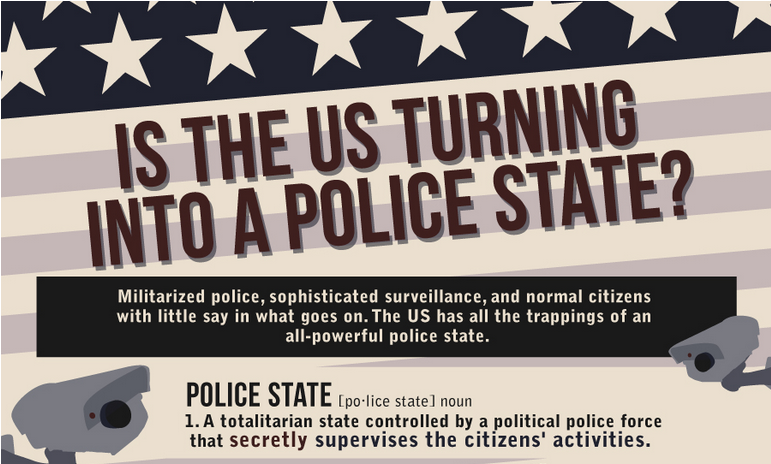
The same arguments apply to all police/FBI/NSA mass data collection: cell-phone usage, internet activity, license plate scanning, facial recognition software, and so on. It resets the baseline assumptions of civil society, where the authorities only look for suspects in actual criminal cases, rather than tracking everyone all the time and deducing “criminal” actions without needing to detect the crime. If your first reaction is to think “if you’ve done nothing wrong, you’ve got nothing to fear”, remember that you cannot possibly know all the laws of your country and that statistically speaking, you probably violate one or more laws every day without realizing it (one author suggests it’s actually three felonies per day).
Update: Ayn Rand explained this phenomenon fictionally in Atlas Shrugged.
“Did you really think that we want those laws to be observed?” said Dr. Ferris. “We want them broken. You’d better get it straight that it’s not a bunch of boy scouts you’re up against — then you’ll know that this is not the age of beautiful gestures. We’re after power and we mean it. You fellows were pikers, but we know the real trick, and you’d better get wise to it. There’s no way to rule innocent men. The only power any government has is the power to crack down on criminals. Well, when there aren’t enough criminals, one ‘makes’ them. One declares so many things to be a crime that it becomes impossible for men to live without breaking laws. Who wants a nation of law-abiding citizens? What’s there in that for anyone? But just pass the kind of laws that can neither be observed nor enforced nor objectively interpreted — and you create a nation of law-breakers and then you cash in on the guilt. Now that’s the system, Mr. Rearden, that’s the game, and once you understand it, you’ll be much easier to deal with.”