Forgotten Weapons
Published 21 Apr 2020http://www.patreon.com/ForgottenWeapons
https://www.floatplane.com/channel/Fo…
Cool Forgotten Weapons merch! http://shop.bbtv.com/collections/forg…
The Hollywood-spawned mythos of the M1 Carbine is that it was created by David Marshall “Carbine” Williams. The reality is far different. In real life, Williams was talented, but short-tempered, stubborn, and unable to work effectively as part of a team — and a cohesive, cooperative team is what the M1 Carbine required.
While Williams was off sulking about how the work was being done wrong, a team of Winchester machinists and engineers including William Roemer and Fred Humiston were actually making it happen.
The most impressive anecdote of the whole story, to me, is from when the solitary Winchester prototype broke its bolt in the middle of the final testing. Fred Humiston was representing Winchester at the trials, and he was told that if he could provide a new bolt within 24 hours the gun could continue the trials — but he could not take the gun off the testing ground. So Humiston went back to the Winchester shop and made a new bolt from memory (no drawings yet existed for the gun) and without being able to test-fit it in the gun. When he returned the next day, his new bolt dropped in perfectly, and the gun went on to win the trials. That is an epic feat of skill, and it is really a shame that he does not get more recognition for it.
Contact:
Forgotten Weapons
6281 N. Oracle #36270
Tucson, AZ 85740
April 22, 2020
The REAL Heroes of the M1 Carbine – not “Carbine” Williams
QotD: Actors
Why waste a whole evening, once or twice a week, in a stuffy and over-red theater, breathing zymotic air, sniffing discordant perfumery, looking at idiotic scenery, listening to the bleeding English of ignorant and preposterous actors? Have you ever, in all your life, seen five leading men who actually looked like civilized gentlemen, or even like the authentic valets, head clerks or unburied corpses of civilized gentlemen? Have you ever sat through a whole performance without wishing it were possible to take at least one of the actors out into the alley, there to do execution of the lex non scripta upon him? Eheu, Postume, what all of us have suffered at the hands of such strutting mummers and mountebanks! How we have writhed and squirmed beneath their astounding outrages upon the vulgate! What is worse than an actor? Two actors? Three actors? A whole stage full of actors! An endless succession of actors! … How we have leaped and squealed under their broad a‘s, their fearful renderings of proper names, their obscene attempts at boarding school French! How our paws have itched to grab them by the collars of their advanced coats, and to strangle them with their futurist shirts, and to anatomize them with the razor edges of their superbly ironed pantaloons! …
There are, of course, such things as good actors. Let us be just and admit it. I have seen and known a few myself, and have heard of a few more. There are half a dozen in England and as many in France. In Germany, I dare say, the police have the names of twenty. (One memorable night, in that strange land, I saw two on the stage at once!) But is the good actor, either at home or abroad, the normal actor, the average actor? Of course he is not. He is the rare actor, the miraculous actor, almost the fabulous actor. Examine a hundred bartenders and you will find that fully sixty of them actually know how to tend bar: they can mix a cocktail that, whatever its faults, is at least fit to drink, and they have the craft needed to draw a Seidel of Pilsner and to beat the cash register. But in the allied art of acting there is no such general dispersion of talent. A handful of outstanding super-actors have it all. The rest of them not only don’t know how to act, but they don’t know that they don’t know.
H.L. Mencken, “Getting Rid of the Actor”, The Smart Set, 1913-09.
April 21, 2020
Homeschooling is bad and should be tightly regulated or banned, says Harvard Professor of Karenism
An article in Harvard Magazine draws heavy fire from people who do not automatically demand to speak to the manager:
Harvard Magazine decided that this moment was the PERFECT time to take a gigantic shit on homeschooling parents. Author Erin O’Donnell decided write a piece on Elizabeth Bartholet, a “professor” who knows the best way to handle child education, and that is to turn them over to the State, immediately. Her rationale? Parents are simply too stupid to educate children without the state looking over their shoulder.
Yet Elizabeth Bartholet, Wasserstein public interest professor of law and faculty director of the Law School’s Child Advocacy Program, sees risks for children — and society — in homeschooling, and recommends a presumptive ban on the practice. Homeschooling, she says, not only violates children’s right to a “meaningful education” and their right to be protected from potential child abuse, but may keep them from contributing positively to a democratic society.”
“We have an essentially unregulated regime in the area of homeschooling,” Bartholet asserts. All 50 states have laws that make education compulsory, and state constitutions ensure a right to education, “but if you look at the legal regime governing homeschooling, there are very few requirements that parents do anything.” Even apparent requirements such as submitting curricula, or providing evidence that teaching and learning are taking place, she says, aren’t necessarily enforced. Only about a dozen states have rules about the level of education needed by parents who homeschool, she adds. “That means, effectively, that people can homeschool who’ve never gone to school themselves, who don’t read or write themselves.” In another handful of states, parents are not required to register their children as homeschooled; they can simply keep their kids at home.”
This practice, Bartholet says, can isolate children. She argues that one benefit of sending children to school at age four or five is that teachers are “mandated reporters,” required to alert authorities to evidence of child abuse or neglect. “Teachers and other school personnel constitute the largest percentage of people who report to Child Protective Services,” she explains, whereas not one of the 50 states requires that homeschooling parents be checked for prior reports of child abuse. Even those convicted of child abuse, she adds, could “still just decide, ‘I’m going to take my kids out of school and keep them at home.'”
Bartholet goes on to cite an example of one woman, who was raised by “Idaho survivalists” and was working in the family business instead of getting an education. Conveniently, while lauding “teachers and other school personnel” as mandated reporters, Bartholet fails to cite or even acknowledge that there is plenty of child abuse that happens on school property, by school employees, and maybe there are just evil people who do evil things to children because they have the opportunity to do so. Giving someone the title of “mandated reporter” does not magically make them into an upstanding citizen and defender of children.
Bartholet – and by extension, O’Donnell – makes no rational argument against homeschooling. It’s only her gut feeling that if the nanny state isn’t over the shoulder, trying to mold “young skulls full of mush” (as Rush Limbaugh has said more than once) into educated and functional adults, then there could be shenanigans afoot! Why, these children might end up RELIGIOUS. *GASP!*
Shruti Rajagopalan noted that the original illustration (which appears to have been corrected since the image at the top of this post was published) included the word “ARITHMATIC” on the spine of one of the books.
The Curator at Home | Film Review: Kelly’s Heroes | The Tank Museum
The Tank Museum
Published 19 Apr 2020Join Curator David Willey at Home, as he reviews the classic film: Kelly’s Heroes.
https://tankmuseumshop.org/products/k…Support the work of The Tank Museum on Patreon: ► https://www.patreon.com/tankmuseum
Visit The Tank Museum SHOP & become a Friend: ► https://tankmuseumshop.org/Twitter: ► https://twitter.com/TankMuseum
Instagram: ► https://www.instagram.com/tankmuseum/
Tiger Tank Blog: ► http://blog.tiger-tank.com/
Tank 100 First World War Centenary Blog: ► http://tank100.com/
One of the few good things happening during the Wuhan Coronavirus epidemic – deregulation
Patrick McLaughlin, Matthew D. Mitchell, and Adam Thierer on the benefits of suspending many existing regulations during the ongoing epidemic:
As the COVID-19 crisis intensified, policymakers at the federal, state, and local levels started suspending or rescinding laws and regulations that hindered sensible, speedy responses to the pandemic. These “rule departures” raised many questions. Were the paused rules undermining public health and welfare even before the crisis? Even if the rules were well intentioned or once possibly served a compelling interest, had they grown unnecessary or counterproductive? If so, why did they persist? How will the suspended rules be dealt with after the crisis? Are there other rules on the books that might transform from merely unnecessary to actively harmful in future crises?
In many cases, rule departures or partial deregulations undertaken during the crisis are tantamount to an admission by policymakers that some policies that were intended to serve the public interest fail to do so. “The explanation for many of these problems is that outdated 20th-century rules stymie 21st-century innovation,” noted former Florida Governor Jeb Bush in a recent Wall Street Journal editorial. “In an emergency, many of those rules can be waived by executive order. After the crisis, there will be momentum to challenge the stale rules that hindered our response. This is likely to go well beyond dealing with pandemics,” he argued. Similarly, lawyer and commentator Philip K. Howard has asserted that “the same kind of energy and resourcefulness will be needed to get America’s schools, businesses, government agencies and nonprofits up and running again” and has suggested the need for a “temporary Recovery Authority with a broad mandate to identify and waive unnecessary bureaucratic hurdles to recovery.” In addition, Wall Street Journal columnist and Brookings Institution Senior Fellow William A. Galston has called for a “Coronavirus 9/11 Commission” to study the governance failures witnessed during the crisis, arguing that “the immediate effects of Covid-19 are bad enough. Failing to learn from it would be criminal negligence for which future generations won’t forgive us.”
The crisis has been a stress test for American institutions. It has laid bare the outdated, overlapping, and often contradictory morass of rules that make it difficult for public and private organizations to respond to changing circumstances. In many cases, these rules persist not because they protect the public from danger but because they protect organized interest groups from new competition. Rules also persist because agencies rarely prioritize retrospective reviews aimed at eliminating unnecessary or potentially harmful rules. On the contrary, agencies typically have a vested interest in maintaining regulations that often took years to generate. Agency employees who have developed expertise in those rules, just like their counterparts in the private sector, have a financial interest in preserving these rules. In this way, “Agencies are stakeholders with respect to their own regulations.”
Once the COVID-19 crisis subsides, there is likely to be considerable momentum to review the rules that have slowed down the response. Some of those rules should probably be permanently repealed and others amended to allow for more flexible responses in the future.
April 20, 2020
“New York City subways were ‘a major disseminator — if not the principal transmission vehicle — of coronavirus infection'”
Randal O’Toole wonders why the lone sacred cow of mass transit is still running, despite its potential role in spreading disease:
Sit‐down restaurants and bars have been shut down. Public officials are discouraging or even forbidding people from doing “unnecessary travel,” even if it is to visit a second home where they might be able to socially distance themselves better than in their first, more urban home. All sorts of other rules are being passed, all supposedly for our own good.
So why are urban transit systems still running? A 2018 study found that “mass transportation systems offer an effective way of accelerating the spread of infectious diseases.” A 2011 study found that people who use mass transit were nearly six times more likely to have acute respiratory infections than those who don’t. Not surprisingly, a study published a few days ago found that New York City subways were “a major disseminator — if not the principal transmission vehicle — of coronavirus infection.”
Transit agencies say they are helping “essential workers” go about their business. But if they are so essential, isn’t it important to find them a safe way of getting to work? If we truly cared about people’s safety, then transit services should have shut down at the same time we closed other non‐essential businesses and asked people to stay at home.
[…]
Unfortunately, the transit lobby has successfully turned government‐subsidized transit into a sacred cow. Transit is supposedly greener than driving when in fact it’s an energy hog. Transit is supposedly needed to help poor people get to work when in fact the people most likely to commute by transit are those earning more than $75,000 a year.
When the pandemic took away most of transit’s customers, instead of shutting down, which would have been the responsible thing to do, transit agencies demanded that Congress give them $25 billion, tripling federal support to transit this year. Thanks to transit’s sacred cow status, Congress agreed without any serious debate.
Effectively, Congress rewarded the agencies for spreading disease. It would have been better to use that money to help transit‐dependent essential workers buy a car so they could have a safe way of getting to work.
Understanding the Lost Cause Myth
The Cynical Historian
Published 16 Apr 2020The Lost Cause Myth has changed American history. Though it is a hateful ideology today, to ignore it is to give it power. We must understand the myth in order to defeat it.
————————————————————
Connected videos [see YouTube description for linked videos to parts of this discussion]
————————————————————
See pinned comment and its replies for references, notes, responses, and errata
————————————————————
Support the channel through PATREON:
https://www.patreon.com/CynicalHistorianLET’S CONNECT:
Discord: https://discord.gg/Ukthk4U
Twitter: https://twitter.com/Cynical_History
Subreddit: https://www.reddit.com/r/CynicalHistory/
————————————————————
Wiki: The Lost Cause of the Confederacy, or simply the Lost Cause, is an American pseudo-historical, negationist ideology which holds the view that the cause of the Confederacy during the American Civil War was a just and heroic one. The ideology endorses the supposed virtues of the antebellum South, viewing the war as a struggle which was primarily waged in order to save the Southern way of life, or to defend “states’ rights”, in the face of overwhelming “Northern aggression.” At the same time, the Lost Cause minimizes or completely denies the central role of slavery in the buildup to and outbreak of the war.Particularly intense periods of Lost Cause activity occurred around the time of World War I, as the last Confederate veterans began to die out and a push was made to preserve their memories, and they also occurred during the Civil Rights Movement of the 1950s and 1960s, in reaction to growing public support for racial equality. Through activities such as building prominent Confederate monuments and writing school history textbooks, they sought to ensure that future generations of Southern whites would know about the South’s “true” reasons for fighting the war, and support white supremacist policies, such as Jim Crow laws. In this manner, white supremacy is a characteristic of the Lost Cause narrative.
The Lost Cause narratives typically portray the Confederacy’s cause as a noble one and they also portray its leaders as exemplars of old-fashioned chivalry, who were defeated by the Union armies through numerical and industrial force that overwhelmed the South’s superior military skill and courage. Proponents of the Lost Cause movement also condemned the Reconstruction that followed the Civil War, claiming that it had been a deliberate attempt by Northern politicians and speculators to keep the South down. The Lost Cause theme has also evolved into a major element in defining gender roles in the white South, in terms of preserving family honor and chivalrous traditions. The Lost Cause has inspired numerous Southern memorials and religious attitudes.
————————————————————
Hashtags: #history #LostCause #Mythology
The four distinct phases of the Great Depression in the United States
An older post from Lawrence W. Reed at the Foundation for Economic Education outlines the low points of the Great Depression and debunks a few widely held myths about that cataclysmic economic era:
Phase 1, the Federal Reserve and the end of the Roaring 20’s:
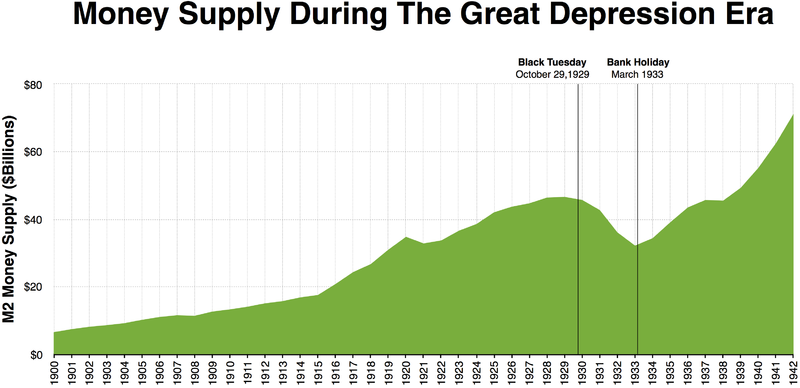
One of the most thorough and meticulously documented accounts of the Fed’s inflationary actions prior to 1929 is America’s Great Depression by the late Murray Rothbard. Using a broad measure that includes currency, demand and time deposits, and other ingredients, Rothbard estimated that the Federal Reserve expanded the money supply by more than 60 percent from mid-1921 to mid-1929. The flood of easy money drove interest rates down, pushed the stock market to dizzy heights, and gave birth to the “Roaring Twenties.”
By early 1929, the Federal Reserve was taking the punch away from the party. It choked off the money supply, raised interest rates, and for the next three years presided over a money supply that shrank by 30 percent. This deflation following the inflation wrenched the economy from tremendous boom to colossal bust.
The “smart” money — the Bernard Baruchs and the Joseph Kennedys who watched things like money supply — saw that the party was coming to an end before most other Americans did. Baruch actually began selling stocks and buying bonds and gold as early as 1928; Kennedy did likewise, commenting, “only a fool holds out for the top dollar.”
Phase 2, Hoover’s interventions and the disaster of Smoot-Hawley:

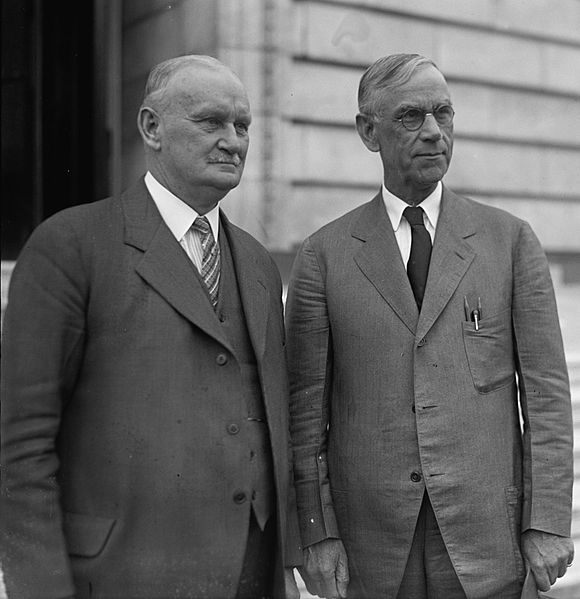
Willis C. Hawley (left) and Reed Smoot in April 1929, shortly before the Smoot–Hawley Tariff Act passed the House of Representatives.
Library of Congress photo via Wikimedia Commons.
Unemployment in 1930 averaged a mildly recessionary 8.9 percent, up from 3.2 percent in 1929. It shot up rapidly until peaking out at more than 25 percent in 1933. Until March 1933, these were the years of President Herbert Hoover — the man that anti-capitalists depict as a champion of noninterventionist, laissez-faire economics.
Did Hoover really subscribe to a “hands off the economy,” free-market philosophy? His opponent in the 1932 election, Franklin Roosevelt, didn’t think so. During the campaign, Roosevelt blasted Hoover for spending and taxing too much, boosting the national debt, choking off trade, and putting millions of people on the dole. He accused the president of “reckless and extravagant” spending, of thinking “that we ought to center control of everything in Washington as rapidly as possible,” and of presiding over “the greatest spending administration in peacetime in all of history.” Roosevelt’s running mate, John Nance Garner, charged that Hoover was “leading the country down the path of socialism.” Contrary to the modern myth about Hoover, Roosevelt and Garner were absolutely right.
The crowning folly of the Hoover administration was the Smoot-Hawley Tariff, passed in June 1930. It came on top of the Fordney-McCumber Tariff of 1922, which had already put American agriculture in a tailspin during the preceding decade. The most protectionist legislation in U.S. history, Smoot-Hawley virtually closed the borders to foreign goods and ignited a vicious international trade war. Professor Barry Poulson notes that not only were 887 tariffs sharply increased, but the act broadened the list of dutiable commodities to 3,218 items as well.
Officials in the administration and in Congress believed that raising trade barriers would force Americans to buy more goods made at home, which would solve the nagging unemployment problem. They ignored an important principle of international commerce: trade is ultimately a two-way street; if foreigners cannot sell their goods here, then they cannot earn the dollars they need to buy here.
Phase 3, FDR and the New Deal:

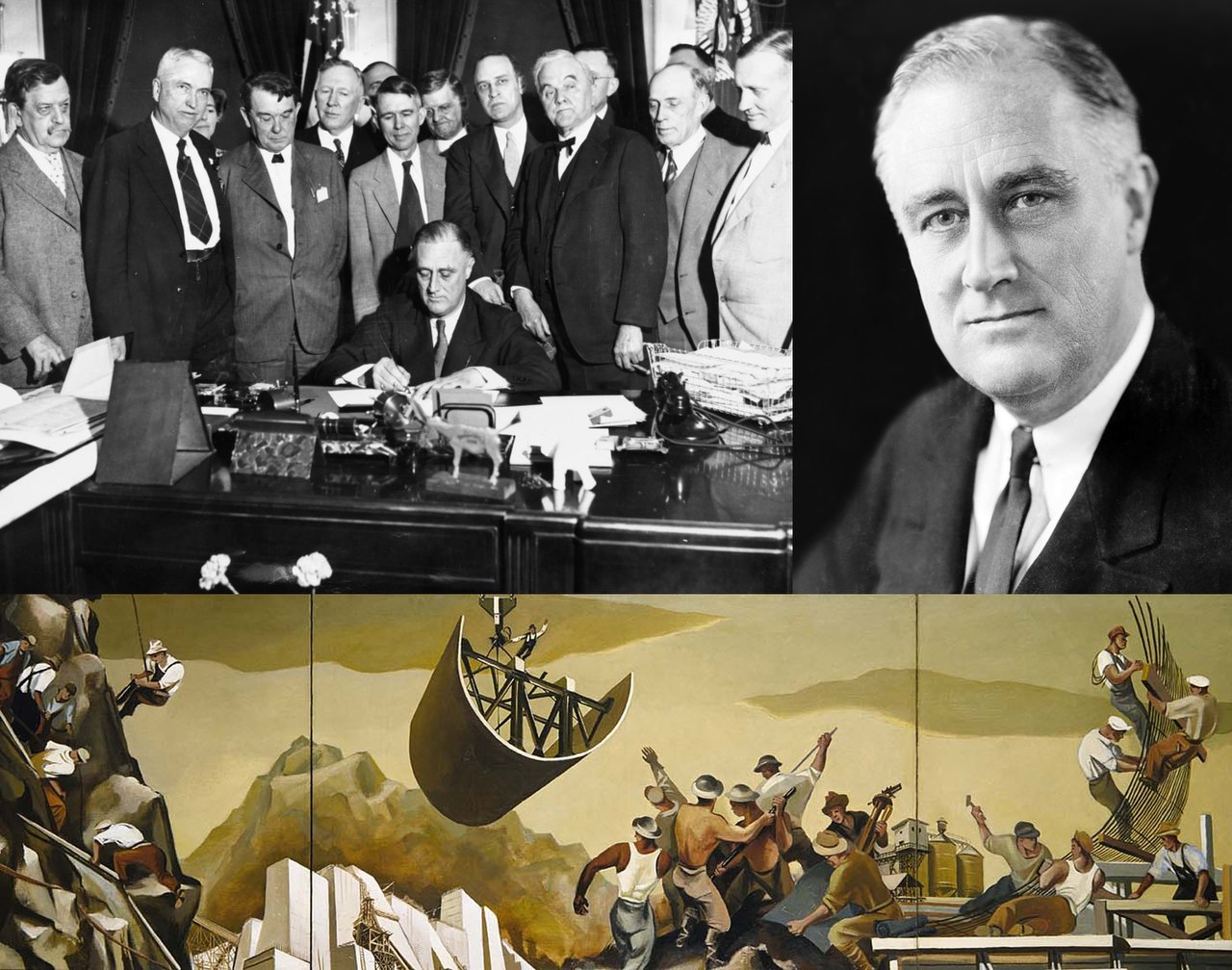
Top left: The Tennessee Valley Authority, part of the New Deal, being signed into law in 1933.
Top right: FDR (President Franklin Delano Roosevelt) was responsible for the New Deal.
Bottom: A public mural from one of the artists employed by the New Deal’s WPA program.
Wikimedia Commons.
Franklin Delano Roosevelt won the 1932 presidential election in a landslide, collecting 472 electoral votes to just 59 for the incumbent Herbert Hoover. The platform of the Democratic Party whose ticket Roosevelt headed declared, “We believe that a party platform is a covenant with the people to be faithfully kept by the party entrusted with power.” It called for a 25 percent reduction in federal spending, a balanced federal budget, a sound gold currency “to be preserved at all hazards,” the removal of government from areas that belonged more appropriately to private enterprise, and an end to the “extravagance” of Hoover’s farm programs. This is what candidate Roosevelt promised, but it bears no resemblance to what President Roosevelt actually delivered.
In the first year of the New Deal, Roosevelt proposed spending $10 billion while revenues were only $3 billion. Between 1933 and 1936, government expenditures rose by more than 83 percent. Federal debt skyrocketed by 73 percent.
[…] in 1935 the Works Progress Administration came along. It is known today as the very government program that gave rise to the new term, “boondoggle,” because it “produced” a lot more than the 77,000 bridges and 116,000 buildings to which its advocates loved to point as evidence of its efficacy. The stupefying roster of wasteful spending generated by these jobs programs represented a diversion of valuable resources to politically motivated and economically counterproductive purposes.
The American economy was soon relieved of the burden of some of the New Deal’s excesses when the Supreme Court outlawed the NRA in 1935 and the AAA in 1936, earning Roosevelt’s eternal wrath and derision. Recognizing much of what Roosevelt did as unconstitutional, the “nine old men” of the Court also threw out other, more minor acts and programs which hindered recovery.
Phase 4, the Wagner Act:
The stage was set for the 1937–38 collapse with the passage of the National Labor Relations Act in 1935 — better known as the Wagner Act and organized labor’s “Magna Carta.” […] Armed with these sweeping new powers, labor unions went on a militant organizing frenzy. Threats, boycotts, strikes, seizures of plants, and widespread violence pushed productivity down sharply and unemployment up dramatically. Membership in the nation’s labor unions soared; by 1941 there were two and a half times as many Americans in unions as in 1935.
[…]
Higgs draws a close connection between the level of private investment and the course of the American economy in the 1930s. The relentless assaults of the Roosevelt administration — in both word and deed — against business, property, and free enterprise guaranteed that the capital needed to jumpstart the economy was either taxed away or forced into hiding. When Roosevelt took America to war in 1941, he eased up on his antibusiness agenda, but a great deal of the nation’s capital was diverted into the war effort instead of into plant expansion or consumer goods. Not until both Roosevelt and the war were gone did investors feel confident enough to “set in motion the postwar investment boom that powered the economy’s return to sustained prosperity.”
April 16, 2020
QotD: Nietzsche’s ideas
… an accurate and intelligent account of Nietzsche’s ideas, by one who has studied them and understands them, is, as Mawruss Perlmutter would say, yet another thing again. Seek in What Nietzsche Taught, by Willard H. Wright, and you will find it. Here in the midst of the current obfuscation, are the plain facts, set down by one who knows them. Wright has simply taken the eighteen volumes of the Nietzsche canon and reduced each of them to a chapter. All of the steps in Nietzsche’s arguments are jumped; there is no report of his frequent disputing with himself; one gets only his conclusions. But Wright has arranged these conclusions so artfully and with so keen a comprehension of all that stands behind them that they fall into logical and ordered chains, and are thus easily intelligible, not only in themselves, but also in their interrelations. The book is incomparably more useful than any other Nietzsche summary that I know. It does not, of course, exhaust Nietzsche, for some of the philosopher’s most interesting work appears in his arguments rather than in his conclusions, but it at least gives a straightforward and coherent account of his principal ideas, and the reader who has gone through it carefully will be quite ready for the Nietzsche books themselves.
These principal ideas all go back to two, the which may be stated as follows:
- Every system of morality has its origin in an experience of utility. A race, finding that a certain action works for its security and betterment, calls that action good; and, finding that a certain other action works to its peril, it calls that other action bad. Once it has arrived at these valuations it seeks to make them permanent and inviolable by crediting them to its gods.
- The menace of every moral system lies in the fact that, by reason of the supernatural authority thus put behind it, it tends to remain substantially unchanged long after the conditions which gave rise to it have been supplanted by different, and often diametrically antagonistic conditions.
In other words, systems of morality almost always outlive their usefulness, simply because the gods upon whose authority they are grounded are hard to get rid of. Among gods, as among office-holders, few die and none resign. Thus it happens that the Jews of today, if they remain true to the faith of their fathers, are oppressed by a code of dietary and other sumptuary laws — i.e., a system of domestic morality — which has long since ceased to be of any appreciable value, or even of any appreciable meaning, to them. It was, perhaps, an actual as well as a statutory immorality for a Jew of ancient Palestine to eat shell-fish, for the shell-fish of the region he lived in were scarecly fit for human food, and so he endangered his own life and worked damage to the community of which he was a part when he ate them. But these considerations do not appear in the United Sates of today. It is no more imprudent for an American Jew to eat shell-fish than it is for him to eat süaut;ss-und-sauer. His law, however, remains unchanged, and his immemorial God of Hosts stands behind it, and so, if he would be counted a faithful Jew, he must obey it. It is not until he definitely abandons his old god for some modern and intelligible god that he ventures upon disobedience. Find me a Jew eating oyster fritters and I will show you a Jew who has begun to doubt very seriously that the Creator actually held the conversation with Moses described in the ninteenth and subsequent chapters of the Book of Exodus.
H.L. Mencken, “Transvaluation of Morals”, The Smart Set, 1915-03.
April 15, 2020
When the Fed Does Too Much
Marginal Revolution University
Published 22 Aug 2017In the 2000s, the Fed kept interest rates low to stimulate aggregate demand. But the cheap credit also helped fuel the housing market bubbles. We’ll look at the case of the Great Recession as an example of where the Fed did too much in one area, and perhaps not enough in others.
April 14, 2020
Chauchat Field Testing vs Mock MG08/15 Nest
Forgotten Weapons
Published 14 Dec 2019http://www.patreon.com/ForgottenWeapons
Cool Forgotten Weapons merch! http://shop.bbtv.com/collections/forg…
Out at the range today with the Chauchat, testing accuracy against a simulated MG08/15 nest at 150 yards. I’ll try out semiauto and full auto (in short bursts), and see how they compare. For reference, the US Army recommended never using the Chauchat beyond 400 yards, as it was not sufficiently accurate to be effective at greater distance.
To see a set of original WW1 American Expeditionary Force Chauchat manuals, check here:
https://www.forgottenweapons.com/chau…
Contact:
Forgotten Weapons
6281 N. Oracle #36270
Tucson, AZ 85704
April 13, 2020
James J. Hill, US railroading’s premier “market entrepreneur”
Dane Stuhlsatz outlines the story of US federal government subsidies and other interventions into the 19th century railroad industry and the one tycoon who avoided the lure:

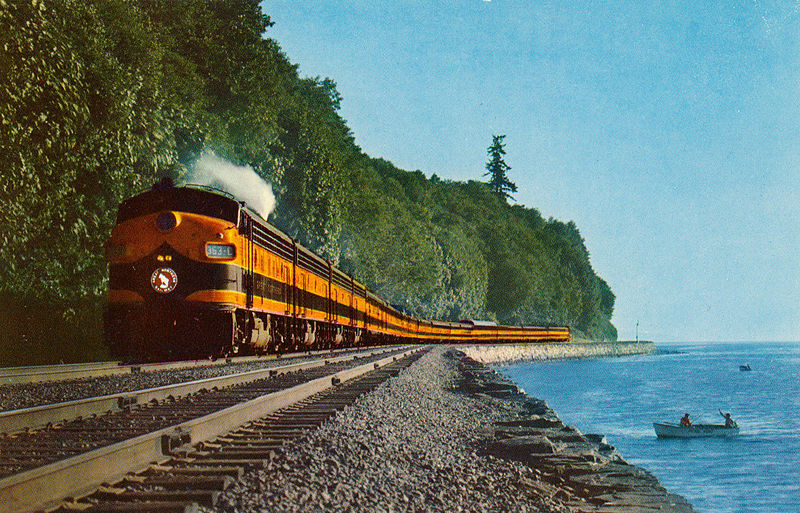
Postcard photo of the Great Northern Railway’s “Empire Builder” streamliner between Everett and Seattle, Washington, circa 1963.
Great Northern Railway postcard via Wikimedia Commons.
Burton W. Folsom, Jr. outlined this story in his book, The Myth of the Robber Barons, identifying two models of entrepreneurship; the “political entrepreneurism” of lines like the Union Pacific and Central Pacific versus the “market entrepreneurism” of James J. Hill and his Great Northern Railway.
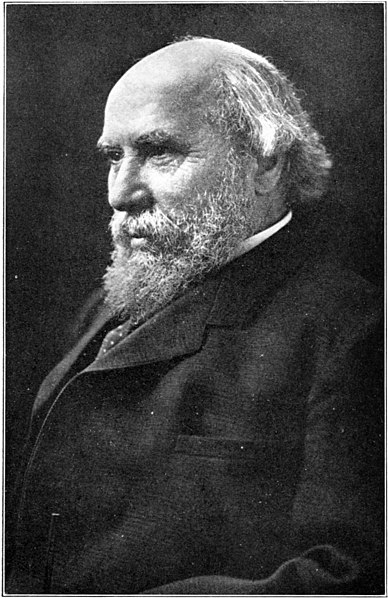
Canadian-born James J. Hill (1838-1916) in 1914.
Photo from Famous Living Americans, edited by Mary Griffin Webb and Edna Lenore Webb via Wikimedia Commons.As Folsom details, the former chased government largesse, ultimately in exchange for loss of control of their business, while the latter chased profits through prudent business decisions. Hill’s success juxtaposed with UP’s and CP’s failure is due in no small part to his steadfast refusal to accept any federal subsidies. In short, UP’s and CP’s government subsidized incentives were vastly different from Hill’s profit driven incentives, which lead to vastly different outcomes.
Federal subsidies incentivized speed, not efficiency. The subsidies were paid in the form of both land grants and direct payments. For each mile of track laid, the UP and CP would receive 20 acres of land and either $16,000 (for track on flat land), $32,000 (for track on hilly terrain), or $48,000 (on mountainous terrain). This incentive for speed resulted in winding, inefficient, routes built with inferior materials, ultimately culminating in a federal price tag of 44,000,000 acres and $61,000,000 (astronomical sums in the 1860s-70s). Despite all this federal assistance, shortly after the golden spike was driven on May 10, 1869 at Promontory Summit, Utah, the UP and CP were nearly bankrupt and required further assistance to stay afloat.
The lines which were born and brought up on federal aid needed federal aid to continue. This led to the passage of the Thurman Law in 1874 which forced UP to pay 25% of its earnings a year to pay its federal debt.
UP’s profitability decisions were also subject to government approval. Branch lines — smaller lines off the main line into rural communities — which could have helped UP’s bottom line, were often not approved by federal bureaucrats. Additionally, the federal Bureau of Railroad Accounts required constant checking of UP’s books. All these measures stifled the ingenuity that UP so desperately needed to make its line profitable. UP quickly found out that the power to subsidize was the power to destroy.
Hill’s line on the other hand was methodically surveyed and built, on the shortest routes possible, with the least gradient possible, and using the best steel and other materials on the market at the time. Rather than political largess, Hill made his decisions based on profit and loss. But, for all the efficiency that Hill built into his line — he was able to transport across the country faster, cheaper, and with less maintenance costs than could the UP and CP — arguably the most important aspect for the viability of his business was the freedom to conduct business untethered by the strings that accompanied government subsidies.
While Hill was free to build when and where he wanted so long as he reached voluntary agreements with landowners, consumers, and employees, UP was tied up in red tape. As Hill’s line grew evermore profitable and reliable for customers, the UP and CP struggled along on federal aid, until they ultimately went bankrupt in 1893.
For his part, Hill’s line was the only transcontinental railroad to never go bankrupt.
April 12, 2020
The Failed Start Of The League of Nations I THE GREAT WAR 1920
The Great War
Published 10 Apr 2020Sign up for Curiosity Stream and Nebula – and get 40% off annual plans right now: https://curiositystream.com/thegreatwar
The League of Nations was US President Woodrow Wilson’s tool for a new and peaceful world after the war of 1914-1918 — and the US should have been their most important member. But the United States never joined and today the League of Nations is often seen as a failure. Was it doomed from the start?
» SUPPORT THE CHANNEL
Patreon: https://www.patreon.com/thegreatwar
Merchandise: https://shop.spreadshirt.de/thegreatwar/» SOURCES
“The Treaty of Peace with Germany (The Treaty of Versailles),” June 28, 1919, United States Statutes at Large, art. 1-440.Walters, F.P. A History of the League of Nations. (Oxford, UK: Oxford University Press, 1952)
Link, Arthur et al., eds., The Papers of Woodrow Wilson, vol. 45 (1984)
Ray S. Baker and William E. Dodd, eds, The Public Papers of Woodrow Wilson: Authorized Edition, Vol. 1, (New York, 1924)
Matz, Nele, “Civilization and the Mandate System under the League of Nations as Origin of Trusteeship” in von Bogdandy, A and Wolfrum, R (eds.), Max Planck Yearbook of United Nations Law, Volume 9, 2005
Braumoeller, Bear F. “The Myth of American Isolationism”, Foreign Policy Analysis Vol. 6, No. 4 (OCTOBER 2010), pp. 349-371
“March 19, 1920: Senate Rejects Treaty of Versailles for Second and Final Time” New York Times, https://learning.blogs.nytimes.com/20… /march-19-1920-senate- rejects-treaty-of-versailles-for-second-and-final-time/
Egerton, George W, “The Lloyd George Government and the Creation of the League of Nations”, The American Historical Review, Vol. 79, No. 2 (Apr., 1974), pp. 419-444
Burkman, Thomas W. “Japan and the League of Nations: AN ASIAN POWER ENCOUNTERS THE ‘EUROPEAN CLUB'”, World Affairs, Vol. 158, No. 1, Woodrow Wilson and the League of Nations: Part Two (SUMMER 1995), pp. 45-57
Rappart, William E. “Small States in the League of Nations”, Political Science Quarterly Vol. 49, No. 4 (Dec., 1934), pp. 544-575
Cox, James Middleston, Journey Through My Years, (Simon & Schuster: New York, 1946)
“THE BRITISH EMPIRE, THE LEAGUE OF NATIONS, AND THE UNITED STATES”, Advocate of Peace through Justice, Vol. 82, No. 7 (JULY, 1920), pp. 229-231
Dorsey, Leeroy G, “Woodrow Wilson’s Fight for the League of Nations: A Reexamination”, Rhetoric and Public Affairs, Vol. 2, No. 1 (Spring 1999), pp. 107-135
“The Covenant of the League of Nations” AVALON PROJECT, Yale Law School, https://avalon.law.yale.edu/20th_cent…
“Woodrow Wilson’s 14 Points”, AVALON PROJECT, Yale Law School, https://avalon.law.yale.edu/20th_cent…
Riddell, George Allardice, The Riddell diaries, 1908-1923, (London ; Dover, N.H. : Athlone Press, 1986)
» SOCIAL MEDIA
Instagram: https://instagram.com/the_great_war
Twitter: https://twitter.com/WW1_Series
Reddit: https://reddit.com/r/TheGreatWarChannel»CREDITS
Presented by: Jesse Alexander
Written by: Mark Newton, Jesse Alexander
Director: Toni Steller & Florian Wittig
Director of Photography: Toni Steller
Sound: Toni Steller
Editing: Toni Steller
Mixing, Mastering & Sound Design: http://above-zero.com
Maps: Daniel Kogosov (https://www.patreon.com/Zalezsky)
Research by: Jesse Alexander
Fact checking: Florian WittigChannel Design: Alexander Clark
Original Logo: David van StepholdA Mediakraft Networks Original Channel
Contains licensed material by getty images
All rights reserved – Real Time History GmbH 2020

QotD: The Gini coefficient
At least for now, most progressives acknowledge that markets and economic growth are necessary. But progressives in academia contend that growth has proved itself secondary to equality efforts — something to be exploited, rather than appreciated. Not just nationally, but worldwide, policymakers and the press regard the subordination of growth to equality to be a benign practice, as in the recent line in the Indian periodical Mint: a policy aimed at “reducing inequality need not hurt growth.”
The redistributionist impulse has brought to the fore metrics such as the Gini coefficient, named after the ur-redistributor, Corrado Gini, an Italian social scientist who developed an early statistical measure of income distribution a century ago. A society where a single plutocrat earns all the income ranks a pure “1” on the Gini scale; one in which all earnings are perfectly equally distributed, the old Scandinavian ideal, scores a “0” by the Gini test. The Gini Index has been renamed or updated numerous times, but the principle remains the same. Income distribution and redistribution seem so crucial to progressives that French economist Thomas Piketty built an international bestseller around it, the wildly lauded Capital.
Through Gini’s lens, we now rank past eras. Decades in which policy endeavored or managed to even out and equalize earnings — the 1930s under Franklin Roosevelt, the 1960s under Lyndon Johnson — score high. Decades where policymakers focused on growth before equality, such as the 1920s, fare poorly. Decades about which social-justice advocates aren’t sure what to say — the 1970s, say — simply drop from the discussion. In the same hierarchy, federal debt moves down as a concern because austerity to reduce debt could hinder redistribution. Lately, advocates of economically progressive history have made taking any position other than theirs a dangerous practice. Academic culture longs to topple the idols of markets, just as it longs to topple statutes of Robert E. Lee.
But progressives have their metrics wrong and their story backward. The geeky Gini metric fails to capture the American economic dynamic: in our country, innovative bursts lead to great wealth, which then moves to the rest of the population. Equality campaigns don’t lead automatically to prosperity; instead, prosperity leads to a higher standard of living and, eventually, in democracies, to greater equality. The late Simon Kuznets, who posited that societies that grow economically eventually become more equal, was right: growth cannot be assumed. Prioritizing equality over markets and growth hurts markets and growth and, most important, the low earners for whom social-justice advocates claim to fight. Government debt matters as well. Those who ring the equality theme so loudly deprive their own constituents, whose goals are usually much more concrete: educational opportunity, homes, better electronics, and, most of all, jobs. Translated into policy, the equality impulse takes our future hostage.
Amity Shlaes, “Growth, Not Equality”, City Journal, 2018-01-21.