At least for now, most progressives acknowledge that markets and economic growth are necessary. But progressives in academia contend that growth has proved itself secondary to equality efforts — something to be exploited, rather than appreciated. Not just nationally, but worldwide, policymakers and the press regard the subordination of growth to equality to be a benign practice, as in the recent line in the Indian periodical Mint: a policy aimed at “reducing inequality need not hurt growth.”
The redistributionist impulse has brought to the fore metrics such as the Gini coefficient, named after the ur-redistributor, Corrado Gini, an Italian social scientist who developed an early statistical measure of income distribution a century ago. A society where a single plutocrat earns all the income ranks a pure “1” on the Gini scale; one in which all earnings are perfectly equally distributed, the old Scandinavian ideal, scores a “0” by the Gini test. The Gini Index has been renamed or updated numerous times, but the principle remains the same. Income distribution and redistribution seem so crucial to progressives that French economist Thomas Piketty built an international bestseller around it, the wildly lauded Capital.
Through Gini’s lens, we now rank past eras. Decades in which policy endeavored or managed to even out and equalize earnings — the 1930s under Franklin Roosevelt, the 1960s under Lyndon Johnson — score high. Decades where policymakers focused on growth before equality, such as the 1920s, fare poorly. Decades about which social-justice advocates aren’t sure what to say — the 1970s, say — simply drop from the discussion. In the same hierarchy, federal debt moves down as a concern because austerity to reduce debt could hinder redistribution. Lately, advocates of economically progressive history have made taking any position other than theirs a dangerous practice. Academic culture longs to topple the idols of markets, just as it longs to topple statutes of Robert E. Lee.
But progressives have their metrics wrong and their story backward. The geeky Gini metric fails to capture the American economic dynamic: in our country, innovative bursts lead to great wealth, which then moves to the rest of the population. Equality campaigns don’t lead automatically to prosperity; instead, prosperity leads to a higher standard of living and, eventually, in democracies, to greater equality. The late Simon Kuznets, who posited that societies that grow economically eventually become more equal, was right: growth cannot be assumed. Prioritizing equality over markets and growth hurts markets and growth and, most important, the low earners for whom social-justice advocates claim to fight. Government debt matters as well. Those who ring the equality theme so loudly deprive their own constituents, whose goals are usually much more concrete: educational opportunity, homes, better electronics, and, most of all, jobs. Translated into policy, the equality impulse takes our future hostage.
Amity Shlaes, “Growth, Not Equality”, City Journal, 2018-01-21.
April 12, 2020
QotD: The Gini coefficient
April 11, 2020
QotD: Zhou Enlai’s famous “too early to say” comment on the French Revolution
So says a retired American diplomat, Charles W. (Chas) Freeman Jr., who was present when Zhou made the comment during President Richard Nixon’s visit to China in February 1972.
Freeman, who was Nixon’s interpreter during the historic, weeklong trip, made the disclosure last week during a panel discussion in Washington about On China, the latest book by former Secretary of State Henry Kissinger.
The discussion was moderated by Richard McGregor, a journalist and China expert who wrote about Freeman’s comments for the Financial Times of London.
In an interview yesterday, Freeman elaborated on his recollection about Zhou’s comment, the conventional interpretation of which is frequently offered as evidence of China’s sage, patient, and far-sighted ways. Foreign Policy magazine, for example, referred last month to that interpretation, saying the comment was “a cautionary warning of the perils of judgments made in real time.”
The Washington Post‘s recent review of Kissinger’s book likewise referred to the conventional understanding of Zhou’s remark.
Freeman described Zhou’s misconstrued comment as “one of those convenient misunderstandings that never gets corrected.”
He said Zhou’s remark probably was made over lunch or dinner, during a discussion about revolutions that had succeeded and failed. They included, Freeman said, the Prague Spring of 1968 and the Hungarian uprising of 1956, both of which the Soviet Union crushed.
He said it was clear from the context and content of Zhou’s comment that in saying it was “too early to say” the Chinese leader was speaking about the events in France in May 1968, not the years of upheaval that began in 1789.
Freeman acknowledged that the conventional interpretation makes for a better story but added that it was “absolutely clear” from the context of the discussion that Zhou was speaking about 1968.
W. Joseph Campbell, “‘Too early to say’: Zhou was speaking about 1968, not 1789”, Media Myth Alert, 2011-06-14.
April 10, 2020
M1 Carbine: A Whole New Class of Weapon
Forgotten Weapons
Published 9 Apr 2020http://www.patreon.com/ForgottenWeapons
https://www.floatplane.com/channel/Fo…
Cool Forgotten Weapons merch! http://shop.bbtv.com/collections/forg…
The United States developed the M1 carbine very quickly at the beginning of World War Two, once the German “blitzkrieg” made it clear that highly mobile enemy forces could threaten rear echelon troops in a modern war. The M1911 pistol was seen as a difficult weapon to use well, and a light carbine would offer much greater effectiveness with less training. It was estimated that 500,000 would be needed, and more than 6 million were eventually produced during the war. The M1 Carbine would equip drivers, artillery crews, mortar men, headquarters staff, paratroops, and many more.
The M1 Carbine was developed by Winchester, but they were not participants in the first round of trials, Instead, their design came about when Rene Studler (head of the Ordnance Department) saw Winchester’s “M2” rifle prototype, a lightweight .30-06 intended to compete with the M1 Garand. He urged them to scale it down for the light rifle trials then ongoing in 1941, and Winchester complied. The design used a Garand-like rotating bolt and a gas tappet system designed by David Marshall Williams for the .30-06 rifle. The new carbine was cobbled together in less than two weeks, and is a truly fantastic achievement.
Thanks to InterOrdnance / Royal Tiger Imports for providing this M1 Carbine for filming!
Contact:
Forgotten Weapons
6281 N. Oracle #36270
Tucson, AZ 85740

April 9, 2020
The (former) captain of USS Theodore Roosevelt
Another example of how civilians interpret an action in a radically different way than the military does (and must):

The Nimitz-class aircraft carrier USS Theodore Roosevelt (CVN 71) underway in the Persian Gulf, 3 December 2005.
U.S. Navy photo by Photographer’s Mate 2nd Class Matthew Bash via Wikimedia Commons.
Okay, about this USS Teddy Roosevelt captain …
No, he’s not some sort of rebel hero who fought the power for his sailors and stuff because only he gave a damn about them. That’s crap, and […] I am not happy to see him get canned. I was an O6 myself, and I would prefer O6s, as a rule, not end up fired. But that was the only course of action available to the SecNav. The guy screwed up, big time.
To believe this CAPT Crozier guy is a hero, you have to believe stupid and wrong things which you should not believe due to their stupidness and wrongness.
You have to believe that the Navy “didn’t care” about sick sailors. Libs take this further to imply that the Navy “didn’t care” about sick sailors because that would have made Trump angry.
This is, as I said, stupid and wrong.
The Navy brass has several things to think about, and there is an order of priority among those things. The priority order is 1) the mission and then 2) the sailors. Notice the order? One of the unique aspects of the military is that it is one of the very few institutions where the lives of its members are expressly and deliberately subordinated to the mission. An aircraft carrier is a major strategic asset, almost incalculably major. And this captain wanted to take it offline. Now, that could have been the decision. Command is about making tough decisions, but it was not his decision. Once he gave his input to his bosses, what he thought meant nothing.
Nothing.
We elect a commander-in-chief to make those decisions. He delegates them in a clear order of precedence to his subordinates. So, CAPT Crozier was not defying admirals or even Trump when he decided he should make the decision. He was defying you and me.
The chain of command is a thing, as he found out when he got his walking papers. And it did not stop being a thing when he did not like the orders it gave him.
If your sailors are your number one priority, you frankly have no business being in command. The mission is the number one priority. That’s hard, and no fun, but [it’s] true. And that’s not an excuse to abuse or neglect your men — far from it. But it is a recognition that you have a mission and that is your priority.
Corzier was the captain of the carrier. There was an admiral down the hall — literally — who was his boss as task force commander. Why did he not go to the admiral? Or maybe he did go to the admiral and didn’t like the answer he got. Your commander disagreed with you? Gee, welcome to military service. Salute and drive on.
There’s no scenario where he’s right on this.
April 8, 2020
If the Wuhan Coronavirus panic feels oddly familiar … there’s a good reason for it
Warren Meyer explains why his skepticism about the dangers of the Wuhan Coronavirus epidemic kicked in quickly because it followed a very familiar pattern:
I have been skeptical about extreme global warming and climate change forecasts, but those were informed by my knowledge of physics and dynamic systems (e.g. feedback mechanics). I have been immensely skeptical of Elon Musk, but again that skepticism has been informed by domain knowledge (e.g. engineering in the case of the hyperloop and business strategy in the case of SolarCity and Tesla). But I have no domain knowledge that is at all relevant to disease transfer and pathology. So why was I immediately skeptical when, for example, the governor of Texas was told by “experts” that a million persons would die in Texas if a lock-down order was not issued?
I think the reason for my skepticism was pattern recognition — I saw a lot of elements in COVID-19 modelling and responses that appeared really similar to what I thought were the most questionable aspects of climate science. For example:
- We seem to have a sorting process of “experts” that selects for only the most extreme. We start any such question, such as forecasting disease death rates or global temperature increases, with a wide range of opinion among people with domain knowledge. When presented with a range of possible outcomes, the media’s incentives generally push it to present the most extreme. So if five folks say 100,000 might die and one person says a million, the media will feature the latter person as their “expert” and tell the public “up to a million expected to die.” After this new “expert” is repetitively featured in the media, that person becomes the go-to expert for politicians, as politicians want to be seen by the public to be using “experts” the public recognizes as “experts.”
- Computer models are converted from tools to project out the implications of a certain set of starting hypotheses and assumptions into “facts” in and of themselves. They are treated as having a reality, and a certainty, that actually exceeds that of their inputs (a scientific absurdity but a media reality I have observed so many times I gave it the name “data-washing”). Never are the key assumptions that drive the model’s behavior ever disclosed along with the model results. Rather than go on forever on this topic, I will refer you to my earlier article.
- Defenders of alarmist projections cloak themselves in a mantle of being pro-science. Their discussions of the topic tend to by science-y without being scientific. They tend to understand one aspect of the science — exponential growth in viruses or tipping points in systems dominated by positive feedback. But they don’t really understand it — for example, what is interesting about exponential growth is not the math of its growth, but what stops the growth from being infinite. Why doesn’t a bacteria culture grow to the mass of the Earth, or nuclear fission continue until all the fuel is used up? We are going to have a lot of problem with this after COVID-19. People will want to attribute the end of the exponential growth to lock-downs and distancing, but it’s hard to really make this analysis without understanding at what point — and there is a point — the virus’s growth would have turned down anyway.
- Alarmists who claim to be anti-science have a tendency to insist on “solutions” that have absolutely no basis in science, or even ones that science has proven to be utterly bankrupt. Ethanol and wind power likely do little to reduce CO2 emissions and may make them worse, yet we spend billions on them as taxpayers. And don’t get me started on plastic bag and straw bans. I am willing to cut COVID-19 responses a little more slack because we don’t have the time to do elaborate studies. But just don’t tell me lockdown orders are science — they are guesses as to the correct response. I live in Phoenix where it was sunny and 80F this weekend. We are on lockdown in our houses. I could argue that ordering everyone out into the natural disinfectant of heat and sunlight for 2 hours a day is as effective a response as forcing families into their houses (initial data, though it is sketchy, of limited transfer of the virus in summertime Australia is interesting — only a small portion of cases are from community transfer. By comparison less than a half percent of US cases from travel).
Debunking the claim that “80% of America’s drugs come from China”
Eric Boehm tries to sort out where the startling claim came from … because it’s not true:
While reading about the COVID-19 outbreak, you’ve probably encountered this particularly shocking statistic at one time or another: 80 percent of America’s pharmaceutical drug supply comes from China.
It’s a statistic that has made the rounds in right-wing publications for a while — offered as proof that China-heavy global supply chains are putting Americans at risk — but it has also popped up in mainstream outlets, including in pieces published in Politico and The Atlantic. Wherever it is deployed, the stat carries an unstated implication: What if China decides to cut us off in the middle of a pandemic? Could America face a dramatic shortage of key pharmaceutical drugs at the moment when we are most in need? And that distorted claim that says America has been too reliant on China has been seized by politicians like Sen. Josh Hawley (R–Mo.) as evidence that globalization has undermined America’s pandemic response.
[…]
How much is a lot? “In all, 80 percent of the U.S. supply of antibiotics are made in China,” [Politico contributors Doug Palmer and Finbarr Bermingham] wrote, linking back to a press release from Sen. Chuck Grassley (R–Iowa).
But that’s not what the press release says.
Grassley’s statement was publicizing a letter Grassley sent on August 9 to the Department of Health and Human Services (HHS) and the FDA, asking them to conduct more inspections of foreign drug manufacturing facilities to make sure they meet American standards.
“Unbeknownst to many consumers … 80 percent of Active Pharmaceutical Ingredients are produced abroad, the majority in China and India,” Grassley wrote.
There’s the first bit of context collapse: the authors of the Politico piece merged Grassley’s “80 percent … are produced abroad” into “80 percent … are made in China.”
All of this also raises another question: Where is Grassley getting that information? His letter sources that claim to a 2016 Government Accountability Office report which itself cited FDA data on pharmaceutical manufacturers around the world. And that report makes it clear that the U.S. has a diverse supply chain for drugs that goes well beyond India and China.
“Nearly 40 percent of finished drugs and approximately 80 percent of active pharmaceutical ingredients (API) are manufactured in registered establishments in more than 150 countries,” is how the GAO summed up America’s pharmaceutical supply chain.
In two jumps, we’ve gone from “80 percent of American drugs are manufactured in more than 150 countries around the world” to “80 percent of drugs come from two countries” to “80 percent of drugs come from China.”
Now, a further complication. The FDA only tracks drug manufacturing facilities — not the supply chains of specific drugs.
That “lack of structural transparency and available supply chain data about drugs,” researchers at the University of Minnesota researchers wrote last month, is one of the reasons why making accurate assessments about potential drug shortages is difficult. Indeed, it was this same bit of missing information that Grassley was encouraging the FDA to address back in August.
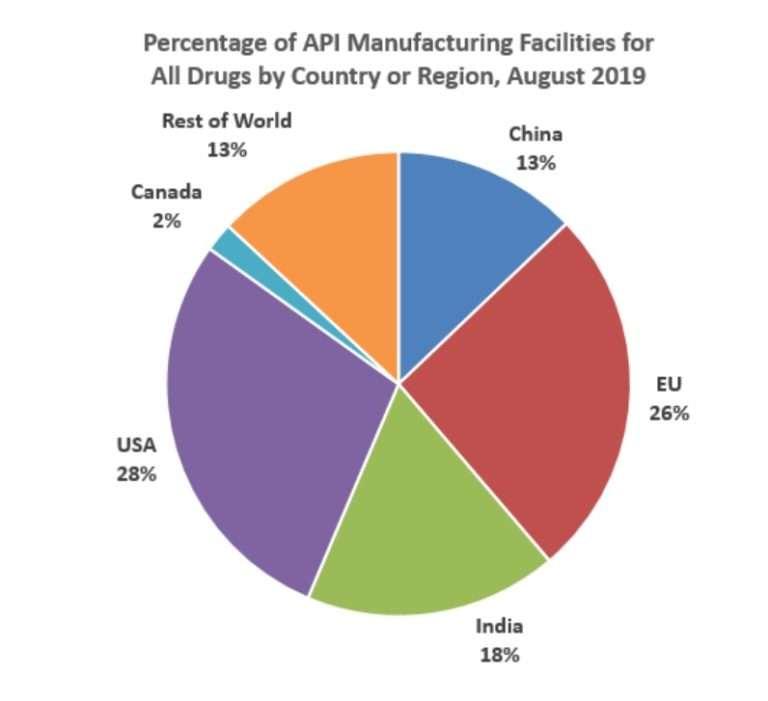
Source: FDA; Safeguarding Pharmaceutical Supply Chains in a Global Economy, October 2019.
April 7, 2020
Cultural factors in the spread of the Wuhan Coronavirus
Sarah Hoyt explains why any computer model involving actual human beings might as well begin with “Assume a Spherical Cow of Uniform Density in a Frictionless Vacuum“:

Image from https://worldbuilding.stackexchange.com/questions/96644/plausibility-of-floating-whales
What I do know is that — are you ready? — human societies, involving multiple nations or even our own culturally diverse, geographically spread out nation, are not now nor will they ever be a spherical cow of uniform density in friction-less vacuum.
So … why is it that even now that they admit the scary Imperial model is insane, our authorities, from federal on down are treating the US as though it were just that mythical cow, and on top of that exactly the same as the cow in Italy, Spain or France.
[…] but here’s the thing: Italy has a completely different culture. Yes, it also has a sclerotic, understaffed and just impoverished healthcare system. (Yes, every time I post that I have to spam a million comments telling me how well the WHO ranked Italy — which is great, except the WHO ranks a single payer system above everything else, including outcomes — and how Lombardy is the envy of Italy or something, which leads me to say “Sucks to be you.”)
However, that’s just a factor in the debacle. The other factor is culture and no one is taking it into account. Multi-generational families live together (I should throw stones, yes) or in the same house which becomes a sort of compound. (This is common to all Mediterranean cultures. I grew up in such a compound until the age of six.) which means that while Grandma isn’t abandoned to the tender mercies of Haitian health workers, it’s also really hard to isolate her when little Guido gets the never-get-well at school and cheerfully brings it home. Even when they don’t live together, extended families have a level of closeness that freaks out even the closest American families. If you and your relatives live within driving distance of each other and don’t see each other every other day, there’s something wrong.
Every house is a continuous cacophony of visiting relatives and friends. In safer times, we just left the back door unlocked because it was easier than answering the doorbell every five minutes. When I first got married, I had the TV on all day, because otherwise the house was so silent, it freaked me out. (I left Disney channel on all day, because it was less likely to startle me with explosions or evil laughter. This led my inlaws to believe I only understood “English for children” (rolls eyes.) I wasn’t even in the room with it. I just needed that noise, or I freaked out, because of the habit of a lifetime.
The freakiest thing in my exchange student years was that my family never had people drop by, several times a week, just because.
On top of that, of course, a lot of the younger people live in stack-a-prole apartments with shared air, and most people commute by train or bus or something.
Now, in Portugal at least most trains and buses aren’t as full as they were in my youth. You are rarely packed in like sardines. But it’s still public transport, and at rush hour every seat is taken and there are people standing.
As much as I get sick here, I got sick way more often there, and had a few really close calls, starting at about thirteen. Because you live in each other’s pockets.
And I understand that in Italy, as in Portugal, as in, for instance, France, people kiss a lot more. Adult men might not, unless they’re close(ish) relatives, but women and children get kissed by everyone from close kin to total strangers.
All of those create conditions for the virus to explode. In Italy, in France, in Spain. I understand it’s not exploded nearly as much in Portugal, but I also wonder how much of that is Portuguese reluctance to go to the doctor or the hospital. Because “the hospital is where you die.” (Yes, sue me. Some cultural assumptions remain. Which is why my husband is the one who normally drags me to the hospital.) Because, you see, we DO know for at least one of the clusters, the hospital was making it worse. Go to the hospital for any other reason, catch Winnie the Flu.
April 6, 2020
QotD: North American downtown “architecture”
The “downtowns” of cities in the eastern half of this American continent were built before the automobile, with pedestrian compactness. So prosperous did we become, so quickly, and so extensive was the building towards the latter end of the nineteenth century, that plentiful evidence remains. The ground-cover is still mostly older buildings, paradoxically thanks to rocketing property values: new buildings must accommodate phenomenal densities, upon tiny footprints. But ten-thousands of apparently “old houses” remain, going on and off market at a million apiece. The principles of money-management have “evolved” over the years, and the idea of “home” as a fungible investment has been universalized. All one needs to acquire one is a small saving and a large credit line. Then one is cut in for all subsequent rounds of poker.
You move in and “re-decorate,” less from personal taste than in anticipation of re-sale. After this process has been repeated a few times, nothing remains of the older building except its “historical” façade, itself somewhat tarted. Travelling about by foot and trolley, I have watched a likely majority of the city’s more attractive “landmark” buildings reduced to fronts only. These are propped by girders, while entirely new (and disproportionately larger) new constructions are bunged in behind.
Thus, nothing remains that is “authentic.” All continuities are destroyed, beyond this tip of the hat — the aesthetic equivalent of that homage which vice pays to virtue.
David Warren, “The scandal of interiors”, Essays in Idleness, 2018-01-25.
April 5, 2020
China’s geostrategic box
ESR looks at the concerns that China may be considering starting a war with the United States in the wake of the Wuhan Coronavirus:
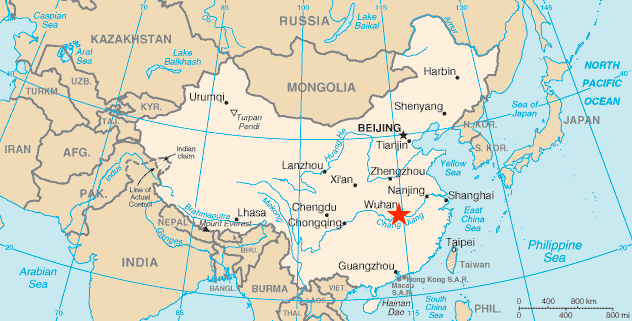
To understand how limited the PRC’s war options are, we can start with a grasp on how difficult and unsatisfying any war of conquest would be due to the geographic box China is in. The obstacles around it are formidable.
To the south, the Himalayan massif makes all of South Asia other than a narrow coastal plain on the Southeast Asian peninsula inaccessible to serious troop movements. There are no roads or rail links. The last time the Chinese tried pushing in that direction, in 1979, they were unable to sustain an offensive at any distance from their railheads and withdrew after less than a month. Their war aim – forcing the North Vietnamese to withdraw its troops from Cambodia – failed.
To the west, the vastness and comparatively undeveloped state of China’s western hinterland is a serious logistical problem before one even gets to the border. At the borders, the Tien Shan and Pamir ranges present a barrier almost as formidable as the Himalayas. External road and rail links are poor and would be easily interdicted.
To the north, movement would be easier. It might be just within logistical possibility for the PLA to march into Siberia. The problem with this idea is that once you’ve conquered Siberia, what you have is … Siberia. Most of it, except for a small area in the south coastal region of Primorsky Kraye, is so cold that cities aren’t viable without food imports from outside the region. Set this against the risks of invading a nuclear-armed Russia and you don’t have a winning proposition.
To the east is the South China Sea. The brute fact constraining the PRC’s ambitions in that direction is that mass movement of troops by sea is risky and difficult. I recently did the math on Chinese sealift craft and despite an expensive buildup since the 1980s they don’t have the capacity to move even a single division-sized formation over ocean. Ain’t nobody going to take Taiwan with one division, they’ve has too much time to prepare and fortify over the last 60 years.
The PRC leadership is evil and ruthless, but it’s also cautious and historically literate and can read maps. Accordingly, the People’s Liberation Army is designed not to take territory but to hold the territory the PRC already has. Its mission is not conquest but the suppression of regional warlordism inside China itself. The capability for the PLA to wage serious expeditionary warfare doesn’t exist, and can’t be built in the near-term future.
It’s often said that the danger of aggressive war by China is a function of the huge excess of young men produced by covert sexual selection and the one-child policy. But to expend those young men usefully you need to get them to where they can fight and are motivated by some prospect of seizing the wives unavailable for them at home. The PRC can’t do that.
The military threat from China is, therefore, a function of what it can do with its navy, its airpower, and its missiles. And what it can do with those against the U.S. is upper-bounded by the fact that the U.S. has nuclear weapons and would be certain to respond to a PRC nuclear or EMP attack on the U.S. mainland by smashing Chinese cities into radioactive rubble.
Within the constraints of conventional warfare waged by navy and air force it is difficult to imagine an achievable set of PRC war aims that gains more than it costs.
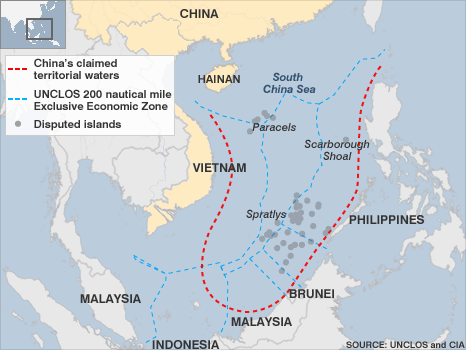
It’s possible — even likely — that the Chinese military has something like the oft-rumoured “ship-killer missiles” that might be able to cripple or sink an American carrier … if it was in range. That makes the South China Sea, the East China Sea, and the west coast of Japan a possible no-go area for US Navy carrier strike groups. A good defensive weapon system to have on hand in case relations with the outside world go “hot”, but not a strategic game-changer. Nobody would be likely to consider anything as dangerous as a seaborne invasion of mainland China, even without the threat of wonder weapons like the ship-killer. And good defensive weapons won’t secure the trade routes that China depends on outside coastal waters.
In a lot of ways your strategic situation is like a scaled-up version of Japan’s in 1941 – you could seize the initiative with a Pearl-Harbor-like initial shock, but you can’t wage a long war because without sealane control you’ll run out of key feedstocks and even food rather rapidly. And unlike the Japanese in 1941, you don’t have the kind of serious blue-water navy that you’d need for sealane control outside the First Island Chain – not with just two carriers you don’t.
There is one way an aggressive naval war could work out in your favor anyway. You can count on the U.S.’s media establishment to be pulling for the U.S. to lose any war it’s in, especially against a Communist or Socialist country. If your war goals are limited to ending U.S. naval power projection in the Western Pacific, playing for a rapid morale collapse orchestrated by agents of influence in the U.S. is not completely unrealistic.
It’s playing with fire, though. One problem is that before you launch your attack you don’t know that your sucker punch will actually work. Another is that, as the Japanese found out after Pearl Harbor, the American public may react to tragic losses with Jacksonian fury. If that happens, you’re seriously screwed. The war will end with your unconditional surrender, and not sooner.
Update: Bone-headed typo in the headline fixed. It’s funny how you can’t see ’em until just after you click the Save button…
QotD: The fear of “becoming” your job
You could see this worry everywhere in our culture, our art. Watch Fast Times at Ridgemont High. Judge Reinhold’s character is wrestling with this type of question, and he’s in high school, fer chrissakes. See what I mean about that movie being made on Mars? Remember that; it’ll be on the final.
There’s a certain type of person, though, who just couldn’t grok those worries, because the very notion of social roles was incomprehensible. We didn’t know about the autism spectrum back then, but that’s what that type of person effectively is: A high-functioning autistic. For the autistic, what’s now is forever. Bob’s nametag says “customer service representative.” Therefore, Bob is a customer service representative, and only a customer service representative, now and forever. Bob the family man, Bob the stamp collector, Bob the bar-band strummer … all those fry the autistic’s circuits. It says “customer service representative,” damn it! The train is fine.
Two sides of the same coin. Normal people were worried that they were becoming their jobs. The autistics couldn’t grasp that anyone could be anything else.
The autistics all went into the ivory tower, which gave us identity politics. “Identity politics” only makes sense to the autistic — that is, to people who can’t process change. Normal people have such a hard time with it because we can’t see the logical connection between, say, being gay and being pro-abortion. I mean, if you’re gay it’s a moot point, right? Nor is there any logical connection between being gay and favoring redistributive economics, or worrying about global warming, or whatever. Maybe you do believe in redistributive economics and are worried about global warming, but those are just individual opinions, right? I’m not obliged to vote Republican because I dig blondes. It’s a non sequitur.
Not to the autistic, it isn’t. They’re told that this — pro-abortion, being “green,” the whole Liberal schmear — just is gayness, and they go with it, because that’s the only way the world makes sense to them. Just how “gay” came to mean all that is above my pay grade, but we all know it’s true. More importantly, we all know they believe it, with all their hearts and souls.
That’s the situation in which we find ourselves, my young friends, here in the Current Year. Most of us would like to be team players, but we have no role models. Because the autistics control the culture, we’ve internalized their worries. If I’m a member of the team, we instinctively feel, then somehow I am the team, and only the team, now and forever. It’s a stark choice: Either I give up my individuality completely to advance the team’s goals, or I take my ball and go home.
But it’s a false choice, kameraden, one that could only be beaten into us by very long, very expensive training — i.e. the American “education” system, K-thru-PhD.
Severian, “Advice to Young Dissidents”, Rotten Chestnuts, 2020-04-01.
April 4, 2020
“Into The Fire” – The Vietnam War – Sabaton History 061 [Official]
Sabaton History
Published 3 Apr 2020During the height of the Cold War, weapons ran hot in the jungles of Vietnam. Combat along the overgrown trails, the wide open fields of rice-paddies or the marshes of the Mekong Delta, was not only exhausting and relentless, but also the place where many of the old doctrines of warfare did no longer apply. The western coalition had to face the elusive guerilla methods of the North Vietnamese forces, who prepared ambushes and traps along the marching routes. The eerie quietness of the jungle was all too often broken by a sudden explosion of violence as troops marched right into the fire.
Support Sabaton History on Patreon: https://www.patreon.com/sabatonhistory
We would like to thank the World of Tanks team for their contribution and help with the video filming. If you’re not yet a World of Tanks player, join the game and get your hands on cool in-game stuff for free via the link: https://redir.wargaming.net/w7fwclmx/…
Listen to “Into the Fire” on the album Primo Victoria:
CD: http://bit.ly/PrimoVictoriaStore
Spotify: http://bit.ly/PrimoVictoriaSpotify
Apple Music: http://bit.ly/PrimoVictoriaAppleMusic
iTunes: http://bit.ly/PrimoVictoriaiTunes
Amazon: http://bit.ly/PrimoVictoriaAmzn
Google Play: http://bit.ly/PrimoVictoriaGooglePlayCheck out the trailer for Sabaton’s new album The Great War right here: https://www.youtube.com/watch?v=HCZP1…
Listen to Sabaton on Spotify: http://smarturl.it/SabatonSpotify
Official Sabaton Merchandise Shop: http://bit.ly/SabatonOfficialShopHosted by: Indy Neidell
Written by: Markus Linke and Indy Neidell
Directed by: Astrid Deinhard and Wieke Kapteijns
Produced by: Pär Sundström, Astrid Deinhard and Spartacus Olsson
Creative Producer: Joram Appel
Executive Producers: Pär Sundström, Joakim Broden, Tomas Sunmo, Indy Neidell, Astrid Deinhard, and Spartacus Olsson
Post-Production Director: Wieke Kapteijns
Edited by: Iryna Dulka
Sound Editing by: Marek Kaminski
Maps by: Eastory – https://www.youtube.com/c/eastoryArchive by: Reuters/Screenocean https://www.screenocean.com
Music by Sabaton.An OnLion Entertainment GmbH and Raging Beaver Publishing AB co-Production.
© Raging Beaver Publishing AB, 2019 – all rights reserved.

April 3, 2020
“And what are your personal pronouns?”
Last week, Amy Alkon considered the demands of “pronoun authoritarians”:
Personally, I’m disturbed by the whole notion that we “include” people through calling them the right pronoun, which requires all this “homework” about a person before you say one word to them.
This new requirement for doing this seems to be a sort of religion that allows people to have power over others — to push them around and deem them thought and speech criminals, even if they simply forget to use somebody’s requested “pronoun.”
This also seems to be a way for people to feel special without earning it — to require people to find out all sorts of information about them, on penalty of being accused of a thought or speech crime and then cancelled.
It seems outrageous to me that some stranger would be required to prep for conversation by investigating my history — that my family are Eastern European Jews, that old friends call me “Flamey” or “Flame-o,” that I eat keto, that I blah, blah, blah, blah, blah — and that they would be seen as disrespectful and even bigoted for failing to find out all the ways I’m (heh) unique and special.
But that’s what we’re requiring people to do with this notion that we have to ask “what is your preferred pronoun?”
And again, this is done now with threats embedded — with the threat that you will lose your job and be deemed a bigot if you don’t make this “What’s your pronoun?” business a priority.
Oh, and I will be very clear on this again: If you want me to call you “zhe” or “they” or “lemon pie with a slight dusting of confectioner’s sugar on top,” I will do my best to remember that and do it, because it’s kind.
But I think the considerations above are important, and I think it’s too easy to just accept the demand to ask people for their “pronouns” as a requirement for being considered decent — with the possible penalty of losing everything as the penalty for failing in some way, even by forgetting.
April 2, 2020
Fallen flag — the Pere Marquette Railway
This month’s fallen flag article for Classic Trains is the story of the Pere Marquette Railway by Kevin P. Keefe:

C&O’s formal acquisition of the Pere Marquette in 1947 did more than help usher in the postwar merger era; it also closed the book on a railroad with a colorful and quirky history. PM was created in 1900 by the consolidation of three roads: Flint & Pere Marquette; Detroit, Grand Rapids & Western; and Chicago & West Michigan. (The town of Pere Marquette; today we know the place as Ludington. Jacques Marquette, the French missionary and explorer, died and was buried here in 1675, and the name Pere Marquette had been given to the inlet lake off Lake Michigan, the river that feeds into it, and an 1847 community there.)
All three carriers had roots in the lumber industry, so the new Pere Marquette Railroad not only connected important Michigan cities, it also operated a branchline network covering much of the state’s Lower Peninsula. PM’s early corporate history was chaotic, marked by receivership and ownership changes. The Cincinnati, Hamilton & Dayton acquired PM in 1904 and for a time leased it to various parties, including the Erie Railroad. Thus did Baltimore & Ohio briefly control the PM through its ownership of the CH&D. When Pere Marquette came out of a receivership in 1907, it would be for only five years.
Those early, troublesome times, however, were marked by two strategic steps forward. One was the chartering of the Pere Marquette of Indiana, which built from New Buffalo, Michigan, southwest to Porter, Indiana, allowing PM to reach Chicago, via trackage rights on the Lake Shore & Michigan Southern (NYC). The second was the lease of the Lake Erie & Detroit River Railway, pushing PM eastward from Walkerville (Windsor), Ontario, to St. Thomas, thence to Suspension Bridge (Niagara Falls), New York, via rights on Michigan Central affiliate Canada Southern, and on to Buffalo on the NYC. Patched together as they were, these additions allowed PM to position itself as a Buffalo–Chicago bridge carrier.

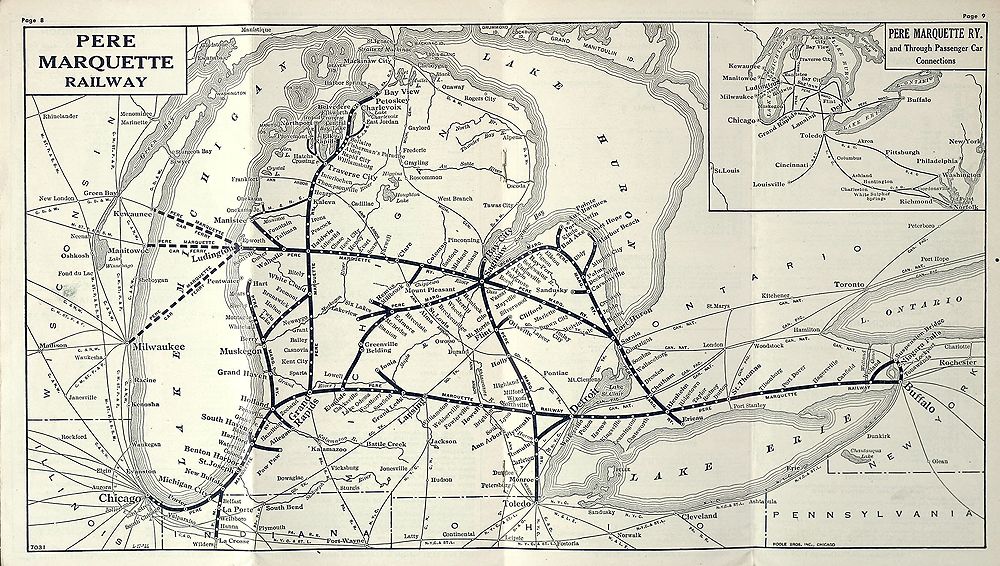
Pere Marquette route map from a 1944 timetable.
Via Classic Trains.
In the ensuing years, the rectangular PM logo would largely disappear from view, although the road’s eventual 12 E7’s wore the script Pere Marquette train name, along with C&O identification, into the mid-1950s, thanks to equipment trust restrictions. PM’s three GE 70-tonners of 1947 were sold, but a few of its 16 EMD switchers (2 SW1’s of 1939 and ’42, 14 NW2’s of 1943–46) carried PM lettering into the 1960s, and C&O kept PM’s color pattern of yellow front-end bands with red pinstriping on a blue body on 11 more EMDs of 1948 that came fully lettered C&O: NW2’s 1850–1856 and E7’s 95–98.
As for the famous Berkshires, they, along with all of Pere Marquette’s steam locomotives, were retired by 1951. Eleven found a temporary reprieve on C&O’s Chesapeake District in Kentucky and West Virginia, but only for a few months. Two, 1223 and 1225, survived as display items in Michigan, and as a student at Michigan State University, I became involved with the restoration of the 1225, which today occasionally operates on excursions.
Perhaps it’s fitting that the Pere Marquette’s last equipment order as an independent railroad was in 1947 for six of EMD’s 1,500 h.p. BL2 “branchline” diesels, Nos. 80–85. Chosen to negotiate PM’s web of secondary lines — most of them rooted in the road’s origins as a logger — the homely diesels were as quirky and as singular as the PM itself. Pointedly, even though they sported the “speed striping” as found on the E7’s, the BL2’s were delivered in full “Chesapeake & Ohio” lettering.

Pere Marquette 1225, a Berkshire 2-8-4 steam locomotive, passes through Alma in March 2009.
Photo by Chelseyafoster via Wikimedia Commons.
The Pere Marquette also had a maritime division and one of their ships had a disastrous voyage (via Wikipedia) 110 years ago:
The Pere Marquette operated a number of rail car ferries on the Detroit and St. Clair Rivers and on Lake Erie and Lake Michigan. The PM’s fleet of car ferries, which operated on Lake Michigan from Ludington, Michigan to Milwaukee, Kewaunee, and Manitowoc, Wisconsin, were an important transportation link avoiding the terminal and interchange delays around the southern tip of Lake Michigan and through Chicago. Their superintendent for over 30 years was William L. Mercereau.
Pere Marquette 18
On September 10, 1910, Pere Marquette 18 was bound for Milwaukee, Wisconsin, from Ludington, Michigan, with a load of 29 railroad freight cars and 62 persons. Near midnight, the vessel began to take on massive amounts of water. The captain dumped nine railroad cars into Lake Michigan, but this was no use — the ship was going down. The Pere Marquette 17, traveling nearby, picked up the distress call and sped to assist the foundering vessel. Soon after she arrived and she could come alongside, the Pere Marquette 18 sank with the loss of 28 lives; there were 33 survivors. Her wreck has yet to be located and is the largest unlocated wreck of the Great Lakes.
April 1, 2020
The end of US neutrality? The Lend-Lease Act – WW2 Special Episode
World War Two
Published 31 Mar 2020The United States of America aims to remain neutral during World War Two. But they see it in their best interest to aid the British in their fight against Nazism. The Lend-Lease Act is designed to do exactly that.
Join us on Patreon: https://www.patreon.com/TimeGhostHistory
Or join The TimeGhost Army directly at: https://timeghost.tvFollow WW2 day by day on Instagram @World_war_two_realtime https://www.instagram.com/world_war_t…
Between 2 Wars: https://www.youtube.com/playlist?list…
Source list: http://bit.ly/WW2sourcesHosted by: Indy Neidell
Written by: Joram Appel
Produced and Directed by: Spartacus Olsson and Astrid Deinhard
Executive Producers: Bodo Rittenauer, Astrid Deinhard, Indy Neidell, Spartacus Olsson
Creative Producer: Joram Appel
Post-Production Director: Wieke Kapteijns
Research by: Scott Grimwood and Joram Appel
Edited by: Mikołaj Cackowski
Map animations: Eastory (https://www.youtube.com/c/eastory)Colorizations by:
Norman Stewart – https://oldtimesincolor.blogspot.com/
Adrien Fillon – https://www.instagram.com/adrien.colo…
Dememorabilia – https://www.instagram.com/dememorabilia/Sources:
Plane by Graphic Enginer from the Noun Project
people by ProSymbols from the Noun Project
Allierte soldater under kampene om Narvik, courtesy Arkiv i Nordland https://flic.kr/p/a829tgSoundtracks from the Epidemic Sound:
Johannes Bornlof – “Deviation in Time”
Rannar Sillard – “March Of The Brave 4”
Phoenix Tail – “At the Front”
Hakan Eriksson – “Epic Adventure Theme 3”
Johannes Bornlof – “The Inspector 4”Archive by Screenocean/Reuters https://www.screenocean.com.
A TimeGhost chronological documentary produced by OnLion Entertainment GmbH.
From the comments:
World War Two
1 hour ago (edited)
On 11 March, 1941, American President Roosevelt signed the Lend-Lease Act, as Indy has covered in the weekly episode on that week. We wanted to revisit that bill in a special episode since it is arguably one of the most consequential American actions of the war before December 1941. Now, the effects of the bill are not visible immediately, but later in the war we will definitely revisit some of the materiel that entered British service under Lend-Lease. We hope you all remain safe and healthy!
Cheers, Joram

Woodrow Wilson (pt.2) | Historians Who Changed History
The Cynical Historian
Published 8 Feb 2018This is the second part of a 2 part episode. The first covered Woodrow Wilson from his early years to the 1912 election. This episode is covering his presidency. I highly recommend you go see the previous one, because I’m going to refer to stuff in it a lot here.
They only allow 5 cards, so here are all the previous episodes referenced:
Wilson Part 1: https://youtu.be/Hm0Gzz53YJo
Birth of a Nation: https://youtu.be/zzsvOBjRXew
Philippine Insurrection: https://youtu.be/mmYk0xxjDDA
WWI causes: https://youtu.be/NTrk7XktTrc
WWI effects: https://youtu.be/G3vKUgoTghg
Border Wars: https://youtu.be/qs4Lp39Y8W8
Russian Intervention: https://youtu.be/1mC1bmzbgxY
1919 Red Scare: https://youtu.be/S4Pi2nYcYNw
————————————————————
[Full references in the YouTube description]Support the channel through Patreon:
https://www.patreon.com/CynicalHistorian
or pick up some merchandise at SpreadShirt:
https://shop.spreadshirt.com/cynicalh…LET’S CONNECT:
https://twitter.com/Cynical_History
————————————————————
Wiki:
The presidency of Woodrow Wilson began on March 4, 1913 at noon when Woodrow Wilson was inaugurated as President of the United States, and ended on March 4, 1921. Wilson, a Democrat, took office as the 28th United States president after winning the 1912 presidential election, gaining a large majority in the Electoral College and a 42 percent plurality of the popular vote in a four–candidate field. Four years later, in 1916, Wilson defeated Republican Charles Evans Hughes by nearly 600,000 votes in the popular vote and secured a narrow majority in the Electoral College by winning several swing states with razor-thin margins. He was the first Southerner elected as president since Zachary Taylor in 1848, and the first Democratic president to win re-election since Andrew Jackson in 1832.
————————————————————
Hashtags: #History #WoodrowWilson #PresidentWilson #KKK #BirthOfANation #Segregation #JimCrow #Wilsonianism #Interventionism #EspionageAct #SeditionAct