Quotulatiousness

August 4, 2024

“Generation loss” in the game Telephone … and in real life

Filed under: Gaming, Media, Technology — Tags: , , — Nicholas @ 03:00

Ted Gioia explains how you can tell if you’re living in what he calls a “doom loop”:

You might have played an old party game called Telephone — in which people sit in a circle, and whisper a simple phrase from ear to ear.

By the time the information has moved around the entire circle, the words have changed. That’s because people mishear and misinterpret.

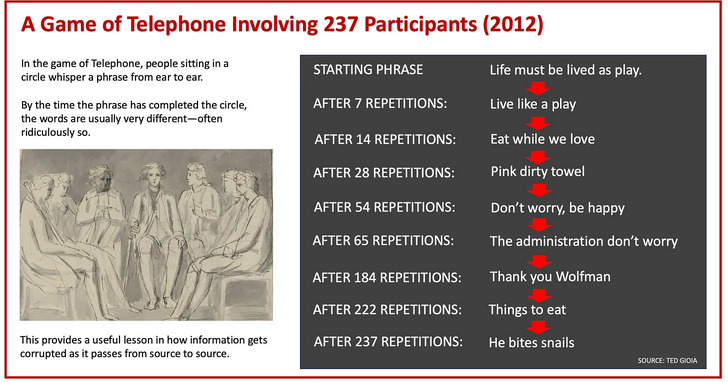
So when a game of Telephone was played in 2012 with 237 individuals, the starting phrase was: “Life must be lived by play” (a quote from Plato). But when it reached the end of the circle, the words had turned into: “He bites snails”.

Here’s how it progressed:

In other instances, people have started with the phrase “Only the good die young” and end up with “The three Vikings visit Christ”. Or “Today the library is hot” somehow morphs into “Sharon Stone is my girlfriend”.

Perhaps a degree of wish fulfillment enters into the game. Or as my mother used to say: “People hear what they want to hear”.

There’s a technical term for this process. It’s called generation loss.

It has nothing to do with a lost generation — which is how Gertrude Stein described the Jazz Age. She famously told Ernest Hemingway: “You are all a lost generation”.

I’m not talking about those kinds of generations.

The generation loss we’re dealing with here refers to deteriorating data quality when a signal is repeated over and over again.

Each time it’s generated, the information gets a little more corrupted.

And it’s not just hearing that leads us astray. You can also measure generation loss if you make a photocopy of a photocopy. Each time you do it, the quality of the image gets worse. If you do it enough times, you can’t recognize what was in the original.

Even digital data — which is supposedly copied and pasted with perfection — deteriorates with each repetition.

Photos that are shared from account to account on Instagram get worse over time. In one experiment, a photo that was copied and reposted 90 times gradually turned into an unrecognizable blur.

August 3, 2024

The Rise, Fall, And Revival Of Art Deco | A Style Is Born W/ @KazRowe

Filed under: Architecture, France, History, Technology, USA — Tags: , , , , , , — Nicholas @ 02:00

Wayfair
Published Jun 15, 2023

Welcome to A Style is Born, hosted by YouTuber, cartoonist, and champion of under-represented history, Kaz Rowe!

Join us as we go down the rabbit hole and uncover the unique histories and origin stories behind your favorite design styles. In this first episode of Season 2, we delve into the history-rich Art Deco movement.

Chapters
Intro – 00:00
History – 00:45
Influences, Elements, & Materials – 04:58
1980s Art Deco Revival Via Memphis Group – 07:46
Conclusion – 09:13
(more…)

August 1, 2024

QotD: Sex and dating in the internet dating age

Filed under: Health, Media, Quotations, Technology — Tags: , , , — Nicholas @ 01:00

… as they encounter each other in the chambers of Tinder, Bumble, Hinge and OkCupid, the climate between men and women is frosty. Everyone is cross and fed up with everyone else for being so rubbish that they have to keep swiping.

In 1996, Helen Fielding’s Bridget Jones helped women realise that half the human race (men) might usefully be called “fuckwits” when it came to dating and romance. The dynamics of internet dating, with its illusion of graspable sexual paradise, has either created a new tsunami of apparent fuckwits, or it has made the sheer extent of them inescapable.

Meanwhile, the boredom and jadedness stitched into heavy use of apps (“nope”, “like”, “nope”, “nope”, “nope”, “like”) has produced a ubiquitous undercurrent of queasy unpleasantness. The result is that men, formerly seen as an alternating source of fun, trouble and heartbreak, become “men: ugh”. Women, once the promised land for many a Romeo, become bitches, gold-diggers, game-players, and, most significantly, for a depressing bloc known as “women: meh”.

This sexual stand-off, characterised by simmering distrust and putrid fatigue, oozes off internet dating portals. I’ve often found myself, after a night of binge-scrolling, surprised to remember that dating is filed under “romance”, which is supposed to be — at least at the start — a little about positive, fuzzy feelings or the potential to develop them.

Zoe Strimpel, “Why the young are falling out of love with sex”, UnHerd, 2019-11-25.

July 25, 2024

Poptimism?

Filed under: Media, Technology, USA — Tags: , , , — Nicholas @ 03:00

Freddie deBoer has a few things to say about “poptimism” (whatever the heck that might be):

this piece is by a literature professor btw

I mean, honestly, what are we doing here? Where does this go? When does the madness end? What degree of all-swallowing society-wide celebration of pop music might be considered sufficient, for pop fans? How much more slavish devotion can Taylor Swift engender before they stop calling her an underdog? What is the endgame? What level of delusion is yet to be achieved, in the space of pretending that pop music is somehow marginalized or disrespected? This is, I’m told, “pop girl summer“, and it is genuinely difficult to find new music that gets any burn that isn’t some 18 to 28 year old photogenic woman, autotuning over shlocky overproduced midtempo backing tracks complete with beats stolen from mid-2010s EDM and muddy indistinct synth lines that all sound exactly the same. (Jack Antonoff should be put to death for his crimes.) My friends: you get all the streams, you get all the good reviews, you get all the Grammys, you get all the magazine covers. There exist almost no mainstream publications that regularly cover any music other than the kind you like. If anyone uses words like “authenticity” in music criticism, they will be sent to the gulag; if anyone suggests that musicians who write their own songs possess some sort of intimate connection to them, that person receives the digital equivalent of being pressed to death like Giles Corey. What more adulation do you want for your stars? What additional level of respect is there for them to secure? What do you want?

NPR says “This summer’s music charts are dominated by pop girl underdogs”. Underdogs cannot dominate! Definitionally! If they are dominating, they are not underdogs! This is the modern hell of crybullying, the person who tells you that you’re oppressing them while they’re busy mashing your face into the asphalt.

And, of course, it’s mostly all a negotiation with aging. As one of the oldest Millennials, I’m watching as my generation reaches middle age and reacts to that transition, and I can give you an initial verdict on how it’s going: not well, at all. We’re mostly adjusting to it by not adjusting to it. So, so many Millennials are confronting the end of their youth by performatively embracing youth culture, loudly declaring that the only music that matters is that which you discover on TikTok. They need everyone to know that they’ve spent the cost of a new Toyota on tickets to the Eras Tour. (Which soaks up seats that might otherwise be available to actual young people, not wine moms with too much money, but nevertheless.) They might like music. But in a much deeper way, they need it. They need what they think it represents.

Of course, this is all made a little bleaker by the fact that elder Millennials were once defined as the “hipster” generation, Williamsburg residents swilling PBR at backyard parties where they listened to the latest indie darling. In other words, they — we — have gone from being ostentatiously countercultural to ostentatiously mainstream, in the span of twenty years, which makes it hard not to conclude that they — we — never actually had aesthetic tastes at all and have instead lived like little reeds in the wind, terrified of ever appearing to not be The Right Kind of Person, which can only ever be defined through our capitalist consumption, since we think that all we are is our capitalist consumption.

July 23, 2024

The next phase of the campaign to replace “Orwellian” with “Trudeaupian”

On the Fraser Institute blog, Jake Fuss and Alex Whalen outline the Trudeau government’s latest attempt to drive the word “Orwellian” out of common usage by making “Trudeaupian” the more authoritarian descriptor:

A Toronto Sun editorial cartoon by Andy Donato during Pierre Trudeau’s efforts to pass the Canadian Charter of Rights and Freedoms. You can certainly see where Justin Trudeau learned his approach to human rights.

This year marks the 75th anniversary of George Orwell’s classic novel 1984 (and it’s been 40 years since the actual year 1984). In the novel, Orwell explains the dangers of totalitarianism by exploring what happens when government exercises extreme levels of control over citizens including censoring and controlling language. While Canada is a relatively free country in 2024, there are aspects of Orwell’s world reflected in government policy today.

The Human Freedom Index, published annually by the Fraser Institute and Cato Institute, defines freedom as a social concept that recognizes the dignity of individuals by the absence of coercive constraint. In a free society, citizens are free to do, say or think almost anything they want, provided it does not infringe on the right of others to do the same.

Canada currently fares relatively well compared to other countries on the Human Freedom Index, placing 13th out of 165 countries. However, our score has dropped six spots on the index since 2008 when Canada recorded its highest ever rank.

This is not surprising given the Trudeau government’s recent efforts to control and manage the free exchange of ideas. The recent Online Streaming Act imposes various content rules on major streaming services such as Netflix, and requirements to extract funds to be redirected toward favoured groups. The Act seemingly seeks to bring the entire Internet under the regulation of a government body.

In another piece of recent legislation, the Online News Act, the government attempted to force certain social media platforms to pay other legacy news outlets for carrying content. In response, the social media platforms chose simply not to allow content from those news providers on their platforms, resulting in a dramatic reduction of Canadians’ access to news.

Now, a new piece of federal legislation — Bill C-63, the Online Harms Act — seeks to control language and grant government power to punish citizens for what the government deems to be unfavourable speech.

The government has sold Bill C-63 as a way to promote the online safety of Canadians, reduce harms, and ensure the operators of social media services are held accountable. In reality, however, the bill is Orwell’s Big Brother concept brought to life, where government controls information and limits free exchange. The legislation seeks to punish citizens not just for what the governments deems as “hate speech” but also grants the state power to bring Canadians before tribunals on suspicion that they might say something hateful in the future. Not surprisingly, many have raised concerns about the constitutionality of the Bill, which will surely be tested in court.

July 4, 2024

“In other words, God is a deliverable for the R&D team”

Filed under: Books, Business, Media, Technology, USA — Tags: , , , , , , — Nicholas @ 05:00

Ted Gioia isn’t impressed with the changes we’ve seen over the years among the Silicon Valley leadership:

Yes, I should have been alarmed when this cult-ish ideology took off in Silicon Valley — where the goal had previously been incremental progress (Moore’s law and all that) and not being evil.

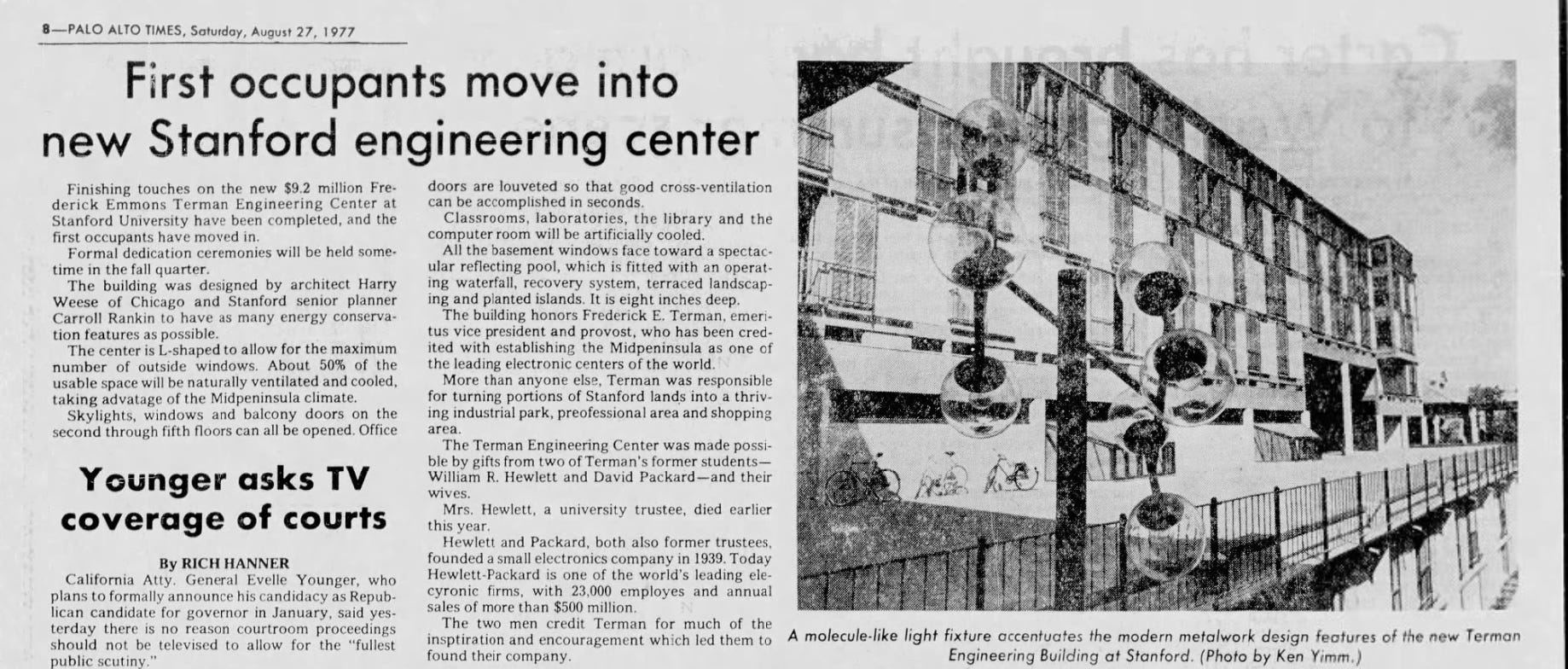
When I first came to Silicon Valley at age 17, the two leading technologists in the region were named William Hewlett and David Packard. They used their extra cash to fund schools, museums, and hospitals — both my children were born at the Lucile Packard Children’s Hospital — not immortality machines, or rockets to Mars, or a dystopian Internet of brains, or worshipping at the Church of the Singularity.

Tech leaders were built differently back then. When famous historian Arnold Toynbee visited Stanford in 1963, he had a chance encounter with William Hewlett. Afterwards Toynbee marveled over his new acquaintance, declaring: “What an amazing fellow. He has more knowledge of history than many historians.”

In other words, Bill Hewlett had more wisdom than ego. He invested in the community where he lived — not the Red Planet. Instead of promulgating social engineering schemes, Hewlett and Packard built a new engineering school at their alma mater, and named it after their favorite teacher.

They wouldn’t recognize Silicon Valley today. The FM-2030s are now in charge.

Bill Hewlett and Dave Packard invested in engineering, not social engineering

Another warning sign came when Google hired cult-ish tech guru Ray Kurzweil — a man who had once created a reasonable music keyboard that even Stevie Wonder used.

But Kurzweil went on to write starry-eyed books of utopian tech worship which come straight out of the weird religion playbook (The Age of Spiritual Machines, The Singularity is Near, etc.)

What does tech look like when it gets turned into a religion? Kurzweil summed it up when asked if there is a God. His response: “Not yet.”

In other words, God is a deliverable for the R&D team.

I note that, when Forbes revisited Ray Kurzweil’s predictions, they found that almost every one went wrong.

So what does he do?

Kurzweil follows up his book The Singularity is Near with a new book entitled The Singularity is Nearer. Give the man credit for hubris. This is exactly what religious cults do when their predicted Rapture doesn’t occur.

They just change the date on the calendar — Utopia has been delayed for another 12 months.

But, of course, Utopia is always delayed another 12 months. Meanwhile the cult leaders can do a lot of damage while preparing for the Rapture.

And despite the techno-elite’s apparent endless quest for perfection in their own lives, the enshittification of the technology they deliver to us proles continues relentlessly:

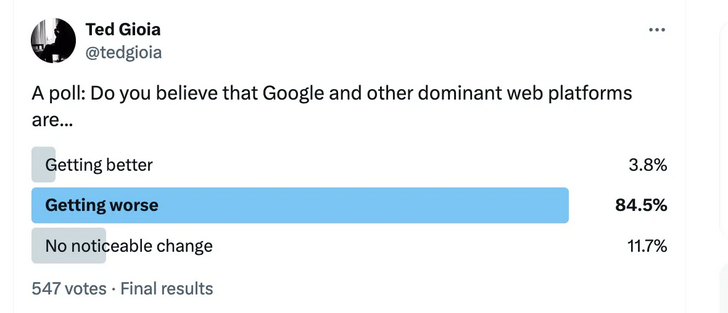
Here’s a curious fact. The more they brag about their utopias, the worse their products and services get.

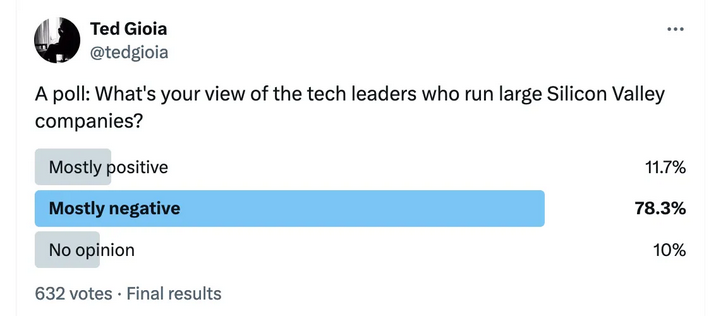
Even the word upgrade is now a joke — whenever a tech company promises it, you can bet it will be a downgrade in your experience. That’s not just my view, but overwhelmingly supported by survey respondents.

For the first time since the dawn of the Renaissance, innovation is now feared by the vast majority of people. And the tech leaders, once admired and emulated, now rank among the least trustworthy people in the world.

It was different when Linus Pauling was peddling his horse pills — he eventually set up shop in Big Sur, far south of the tech industry, in order to find a hospitable home for his wackiest ideas.

Nowadays, Big Sur thinking has come to the Valley.

And when you set up cults inside the largest corporations in the history of the world, we are all endangered.

Just imagine if Linus Pauling had enjoyed the power to force everybody to take his huge vitamin doses. Just imagine if Bill Shockley had possessed the authority to impose his racist eugenics theories on the populace.

It’s scary to think of. But they couldn’t do it, because they didn’t have billions of dollars, and run trillion-dollar companies with politicians at their beck and call.

But the current cultists include the wealthiest people in the world, and they are absolutely using their immense power to set rules for the rest of us. If you rely on Apple or Google or some other huge web behemoth — and who doesn’t? — you can’t avoid this constant, bullying manipulation.

The cult is in charge. And it’s like we’re all locked into an EST training sessions — nobody gets to leave even for bathroom breaks.

There’s now overwhelming evidence of how destructive the new tech can be. Just look at the metrics. The more people are plugged in, the higher are their rates of depression, suicidal tendencies, self-harm, mental illness, and other alarming indicators.

If this is what the tech cults have already delivered, do we really want to give them another 12 months? Do you really want to wait until they deliver the Rapture?

June 28, 2024

The weird and the W.E.I.R.D. gather at Vibecamp

Filed under: Technology, USA — Tags: , , , , , , — Nicholas @ 03:00

Kulak, just back from a road trip to visit two pretty far offbeat gatherings, writes about what she heard and saw at Vibecamp:

VibeCamp is maybe the extreme intersection of Rationalist, Post-Rat, Effective Altruism, Silicon Valley, Quant Finance, and 5-10 other Cyber-Left, Grey-Tribe, autistic-centrist, techno-optimist blogging/twitter world. […]

Given that setup you could probably imagine the two overwhelming facts about Vibecamp:

  1. With rare exception everyone in attendance was shockingly intelligent. At random points throughout the festival I was having deep dive conversation on the geostrategic situation in Israel, the effects of Interest rate increases on venture capital, early 20th century Canadian poetry, and the fate of the petrodollar and the nature of Foreign Exchange markets.
  2. With rare exception everyone in attendance was incredibly weird. Some in very obvious ways visible at 100 paces, some in little uncanny ways it might take you an hour to isolate and identify.

[…]

The shape of the people jumps out at you. There were an incredible number of normal and average looking people, and a much lower portion of obese and Amerifat body-types than almost anywhere else in the US… Perhaps owing to the extreme intelligence and incomes of those involved … But in about 30-45% of people in attendance there’s just some unusual distortion of body proportions that would be remarkable and memorable encountered in an individual, but when assembled together gave the White and Jewish attendees (a combined 90+% of the total) the look that they were all descended from some unusual gothic ethnicity you couldn’t quite put your finger on. Some strange isolated country bordering The Netherlands, Ireland, Estonia, Romania, and the Basque region of Spain … That they’d all come from whatever part of the old country the Adams Family comes from.

[…]

These unusual heights (or lack there-of) were exaggerated by recurring extremes of bodyfat percentage, with several of the attendees (male, female, and between) having a spider-like absence of body fat entirely denoting some unusual hormonal profile expressed in a true kaleidoscope of personalities and interests.

This was expressed most keenly in the faces in which latent autism, and the aforementioned hormonal oddities, were expressed in large eyes and other unusual features, resting positions, and expression creases. Which weren’t all necessarily unattractive, but gave most of the women (and a good percentage of the men) a rather spaced out looks which remained somehow unique in each instance … As if they were all on another planet, but each a very different one from the one each other was on.

Thankfully with psychedelics and other pharmaceuticals they seemed able to meet up on a few mutually agreeable worlds.

[…]

Vibecamp attracts a great deal of biohackers and supplements freaks. Men, women, and others of extreme nutritional theories … and while some of them look like their theories haven’t panned out (the vegans) some look like they’ve discovered the Holy Grail.

This extreme bifurcation and assemblage of extremes was expressed right down to their vehicles… Walking through the parking lot there were $100,000 CyberTrucks and sportscars, whereas 1-2 cars down the line from them there were vehicles practically ripped apart with the engine showing under bodywork that’d long ago been scattered across some guardrail, reassembled just enough to (somehow) get back on the road but with not a dime spent on restoring it’s appearance. This wasn’t 1 car, this was a TYPE of car at the festival. Denoting in the owners some combination of MacGyver resourcefulness, Chadlike indifference, autistic obliviousness, and Victorian Frugality that I can’t but admire … (Or I suppose, possibly, extreme motor impairment. I don’t know that these accidents didn’t happen ON THE WAY to the festival)

[…]

The broken heterosexual male-nerd anxiety and tentativeness around sex and other forms of human interaction and intimacy could be cut with a knife … And it wasn’t like everyone had all been corralled and lectured night one or anything of the sort, somehow this broken progressive Dysgenic (actively failing to generate) culture had infected the urban male technological elite, from Bay Area techfounders, to New York Medical Experts, to DC Military Industrial Complex people, to British Forex Traders, to Dutch and Australians visiting the US for the first time … All of them had had that instinctive flinch trained into them … Some of the Wealthiest, Oddest, Most intelligent, and a small handful of the most attractive men in the world … had all been broken like horses, to flinch and start moving the minute the riding crop is grabbed.

Heartbreaking.

There’s an irony that the places which most engage in therapy language and most proudly proclaim their “acceptance” are almost always the most unforgiving … My friend continued to crash VibeCamp events after they tried to kick him out, and he might have been one of the only people in VibeCamp history to start dating a girl at the festival … (not a man to receive a priestly censor), but the sensitive nerdy men I encountered, with well meaning hearts and souls for poetry, hopeless.

So while I had a blast and enjoyed myself I certainly don’t expect it to be a culture that’s still there in 20-30 years, The people there will maybe produce 100-200 offspring in that time for every 500 that actually attended. If that.

June 9, 2024

Microsoft’s latest ploy to be the most hated tech company

Filed under: Media, Technology, USA — Tags: , , , , , — Nicholas @ 03:00

Charles Stross wonders if Microsoft’s CoPilot+ is actually a veiled suicide attempt by the already much-hated software giant:

The breaking tech news this year has been the pervasive spread of “AI” (or rather, statistical modeling based on hidden layer neural networks) into everything. It’s the latest hype bubble now that Cryptocurrencies are no longer the freshest sucker-bait in town, and the media (who these days are mostly stenographers recycling press releases) are screaming at every business in tech to add AI to their product.

Well, Apple and Intel and Microsoft were already in there, but evidently they weren’t in there enough, so now we’re into the silly season with Microsoft’s announcement of CoPilot plus Recall, the product nobody wanted.

CoPilot+ is Microsoft’s LLM-based add-on for Windows, sort of like 2000’s Clippy the Talking Paperclip only with added hallucinations. Clippy was rule-based: a huge bundle of IF … THEN statements hooked together like a 1980s Expert System to help users accomplish what Microsoft believed to be common tasks, but which turned out to be irritatingly unlike anything actual humans wanted to accomplish. Because CoPilot+ is purportedly trained on what users actually do, it looked plausible to someone in marketing at Microsoft that it could deliver on “help the users get stuff done”. Unfortunately, human beings assume that LLMs are sentient and understand the questions they’re asked, rather than being unthinking statistical models that cough up the highest probability answer-shaped object generated in response to any prompt, regardless of whether it’s a truthful answer or not.

Anyway, CoPilot+ is also a play by Microsoft to sell Windows on ARM. Microsoft don’t want to be entirely dependent on Intel, especially as Intel’s share of the global microprocessor market is rapidly shrinking, so they’ve been trying to boost Windows on ARM to orbital velocity for a decade now. The new CoPilot+ branded PCs going on sale later this month are marketed as being suitable for AI (spot the sucker-bait there?) and have powerful new ARM processors from Qualcomm, which are pitched as “Macbook Air killers”, largely because they’re playing catch-up with Apple’s M-series ARM-based processors in terms of processing power per watt and having an on-device coprocessor optimized for training neural networks.

Having built the hardware and the operating system Microsoft faces the inevitable question, why would a customer want this stuff? And being Microsoft, they took the first answer that bubbled up from their in-company echo chamber and pitched it at the market as a forced update to Windows 11. And the internet promptly exploded.

First, a word about Apple. Apple have been quietly adding AI features to macOS and iOS for the past several years. In fact, they got serious about AI in 2015, and every Apple Silicon processor they’ve released since 2016 has had a neural engine (an AI coprocessor) on board. Now that the older phones and laptops are hitting end of life, the most recent operating system releases are rolling out AI-based features. For example, there’s on-device OCR for text embedded in any image. There’s a language translation service for the OCR output, too. I can point my phone at a brochure or menu in a language I can’t read, activate the camera, and immediately read a surprisingly good translation: this is an actually useful feature of AI. (The ability to tag all the photos in my Photos library with the names of people present in them, and to search for people, is likewise moderately useful: the jury is still out on the pet recognition, though.) So the Apple roll-out of AI has so far been uneventful and unobjectionable, with a focus on identifying things people want to do and making them easier.

Microsoft Recall is not that.

Men In Armour (1949) – The origins and operation of tanks

Filed under: Britain, History, Military, Technology, Weapons, WW1, WW2 — Tags: , , , — Nicholas @ 02:00

FWD Publishing
Published Feb 18, 2024

Lengthy documentary made in 1949 about the men and tanks of the Royal Armoured Corps (RAC).

June 3, 2024

The “hallucination” problem that bedevils all current AI implementations

Filed under: Media, Technology — Tags: , , , , — Nicholas @ 05:00

Andrew Orlowski explains the one problem shared among all of the artificial intelligence engines currently available to the general public:

Gemini’s ultra-woke responses to requests quickly became a staple of social media postings.

AI Overviews hasn’t had the effect that Google hoped for, to say the least. It has certainly garnered immediate internet virality, with people sharing their favourite answers. Not because these are helpful, but because they are so laughable. For instance, when you ask AI Overviews for a list of fruits ending with “um” it returns: “Applum, Strawberrum and Coconut”. This is what, in AI parlance, is called a “hallucination”.

Despite having a market capitalisation of $2 trillion and the ability to hire the biggest brains on the planet, Google keeps stumbling over AI. Its first attempt to join the generative-AI goldrush in February last year was the ill-fated Bard chatbot, which had similar issues with spouting factual inaccuracies. On its first live demo, Bard mistakenly declared that the James Webb Space Telescope, launched only in 2021, had taken “the first pictures” ever of Earth from outside the solar system. The mistake wiped $100 billion off Google’s market value.

This February, Google had another go at AI, this time with Gemini, an image and text generator. The problem was that it had very heavy-handed diversity guardrails. When asked to produce historically accurate images, it would instead generate black Nazi soldiers, Native American Founding Fathers and a South Asian female pope.

This was “a well-meaning mistake”, pleaded The Economist. But Google wasn’t caught unawares by the problems inherent to generative AI. It will have known about its capabilities and pitfalls.

Before the current AI mania truly kicked off, analysts had already worked out that generative AI would be unlikely to improve user experience, and may well degrade it. That caution was abandoned once investors started piling in.

So why is Google’s AI putting out such rotten results? In fact, it’s working exactly as you would expect. Don’t be fooled by the “artificial intelligence” branding. Fundamentally, AI Overviews is simply trying to guess the next word it should use, according to statistical probability, but without having any mooring to reality. The algorithm cannot say “I don’t know” when asked a difficult question, because it doesn’t “know” anything. It cannot even perform simple maths, as users have demonstrated, because it has no underlying concept of numbers or of valid arithmetic operations. Hence the hallucinations and omissions.

This is less of a problem when the output doesn’t matter as much, such as when AI is processing an image and creates a minor glitch. Our phones use machine learning every day to process our photos, and we don’t notice or care much about most of the glitches. But for Google to advise us all to start eating rocks is no minor glitch.

Such errors are more or less inevitable because of the way the AI is trained. Rather than learning from a curated dataset of accurate information, AI models are trained on a huge, practically open-ended data set. Google’s AI and ChatGPT have already scraped as much of the web as they can and, needless to say, lots of what’s on the web isn’t true. Forums like Reddit teem with sarcasm and jokes, but these are treated by the AI as trustworthy, as sincere and correct explanations to problems. Programmers have long used the phrase “GIGO” to describe what is going on here: garbage in, garbage out.

AI’s hallucination problem is consistent across all fields. It pretty much precludes generative AI being practically useful in commercial and business applications, where you might expect it to save a great deal of time. A new study of generative AI in legal work finds the additional verification steps now required to ensure the AI isn’t hallucinating cancel out the time saved from deploying it in the first place.

“[Programmers] are still making the same bone-headed mistakes as before. Nobody has actually solved hallucinations with large-language models and I don’t think we can”, the cognitive scientist and veteran AI sceptic, Professor Gary Marcus, observed last week.

Another problem is now coming into view. The AI is making an already bad job worse, by generating bogus information, which then pollutes the rest of the web. “Google learns whatever junk it sees on the internet and nothing generates junk better than AI”, as one X user put it.

I was actually contacted by someone on LinkedIn the other day asking if I’d be interested in doing some AI training for US$25 per hour. I really, really need the money, but I’m unsure about being involved in AI at all …

June 2, 2024

THIS is how Plastic Model Kits are MADE! I spent a day at the UK Airfix Factory!

Filed under: Britain, Business, China, Technology — Tags: , — Nicholas @ 02:00

Model Minutes
Published Nov 26, 2022

In November 2022 a press day was held at the UK factory which manufactures quickbuild and the NEW Supermarine Spitfire Mk.IXc in 1/24 scale from @OfficialAirfix. During the visit we were given presentations from Luke (researcher) and Chris (designer) on the various elements that go into creating the designs of the tooling.

Join me in this video where I take a look at how plastic model kits are actually manufactured, focusing on the physical creation of the kits through injection moulding and quality control at the Plastech factory in Newhaven.

I’d like to extend my thanks to Airfix and Plastech for putting on this event.

Chapters:
00:00 Intro
00:48 Research & Design
01:36 Plastech Background
02:47 Tooling Prep
03:21 Injection Moulding
06:38 Quality Control
11:31 Boxes & Packaging
13:21 Packing a kit!
16:04 Conclusion
(more…)

June 1, 2024

QotD: When the chimneys rose in London

A coal fire also burns much hotter, and with more acidic fumes, than a wood fire. Pots that worked well enough for wood — typically brass, either thin beaten-brass or thicker cast-brass — degrade rapidly over coal, and people increasingly switched to iron, which takes longer to heat but lasts much better. At the beginning of the shift to coal, the only option for pots was wrought iron — nearly pure elemental iron, wrought (archaic past tense of “worked”, as in “what hath God wrought”) with hammer and anvil, a labor-intensive process. But since the advent of the blast furnace in the late fifteenth century, there was a better, cheaper material available: cast iron.1 It was already being used for firebacks, rollers for crushing malt, and so forth, but English foundries were substantially behind those of the continent when it came to casting techniques in brass and were entirely unprepared to make iron pots with any sort of efficiency. The innovator here was Abraham Darby, who in 1707 filed a patent for a dramatically improved method of casting metal for pots — and also, incidentally, used a coal-fired blast furnace to smelt the iron. This turned out to be the key: a charcoal-fueled blast furnace, which is what people had been using up to then, makes white cast iron, a metal too brittle to be cast into nicely curved shapes like a pot. Smelting with coal produces gray cast iron, which includes silicon in the metal’s structure and works much better for casting complicated shapes like, say, parts for a steam engine. Coal-smelted iron would be the key material of the Industrial Revolution, but the economic incentive for its original development was the early modern market for pots, kettles, and grates suitable for cooking over the heat and fumes of a coal fire.2

In Ruth Goodman’s telling, though, the greatest difference between coal and wood fires is the smoke. Smoke isn’t something we think much about these days: on the rare occasions I’m around a fire at all, I’m either outdoors (where the smoke dissipates rapidly except for a pleasant lingering aroma on my jacket) or in front of a fireplace with a good chimney that draws the smoke up and out of the house. However, a chimney also draws about 70% of the fire’s heat — not a problem if you’re in a centrally-heated modern home and enjoying the fire for ✨ambience✨, but a serious issue if it’s the main thing between your family and the Little Ice Age outdoors. Accordingly, premodern English homes didn’t have chimneys: the fire sat in a central hearth in the middle of the room, radiating heat in all directions, and the smoke slowly dissipated out of the unglazed windows and through the thatch of the roof. Goodman describes practical considerations of living with woodsmoke that never occurred to me:

    In the relatively still milieu of an interior space, wood smoke creates a distinct and visible horizon, below which the air is fairly clear and above which asphyxiation is a real possibility. The height of this horizon line is critical to living without a chimney. The exact dynamics vary from building to building and from hour to hour as the weather outside changes. Winds can cause cross-draughts that stir things up; doors and shutters opening and closing can buffet smoke in various directions. … From my experiences managing fires in a multitude of buildings in many different weather conditions, I can attest to the annoyance of a small change in the angle of a propped-open door, the opening of a shutter or the shifting of a piece of furniture that you had placed just so to quiet the air. And as for people standing in doorways, don’t get me started.

One obvious adaptation was to live life low to the ground. On a warm day the smoke horizon might be relatively high, but on a cold damp one (of which, you may be aware, England has quite a lot) smoke hovers low enough that even sitting in a tall chair might well put your head right up into it. Far better to sit on a low stool, or, better yet, a nice soft insulating layer of rushes on the floor.

Chimneys did exist before the transition to coal, but given the cost of masonry and the additional fuel expenses, they were typically found only in the very wealthiest homes. Everyone else lived with a central hearth and if they could afford it added smoke management systems to their homes piecemeal. Among the available solutions were the reredos (a short half-height wall against which the fire was built and which would counteract drafts from doorways), the smoke hood (rather like our modern cooktop vent hood but without the fan, allowing some of the smoke to rise out of the living space without creating a draw on the heat), or the smoke bay (a method of constructing an upstairs room over only part of the downstairs that still allowed smoke to rise and dissipate through the roof). Wood smoke management was mostly a question of avoiding too great a concentration in places you wanted your face to be. The switch to coal changed this, though, because coal smoke is frankly foul stuff. It hangs lower than wood smoke, in part because it cools faster, and it’s full of sulfur compounds that combine with the water in your eyes and lungs to create a mild sulfuric acid; when your eyes water from the irritation, the stinging only gets worse. Burning coal in an unvented central hearth would have been painful and choking. If you already had one of the interim smoke management techniques of the wood-burning period — especially the smoke hood — you would have found adopting coal more appealing, but really, if you burned coal, you wanted a chimney. You probably already wanted a chimney, though; they had been a status symbol for centuries.

And indeed, chimneys went up all over London; their main disadvantage, aside from the cost of a major home renovation, had been the way they drew away the heat along with the smoke, but a coal fire’s greater energy output made that less of an issue. The other downside of the chimney’s draw, though, is the draft it creates at ground level. Again, this isn’t terribly noticeable today because most of us don’t spend a lot of time sitting in front of the fireplace (or indeed, sitting on the floor at all, unless we have small children), but pay attention next time you’re by an indoor wood fire and you will notice a flow of cold air for the first inch or two off the ground. All of a sudden, instead of putting your mattress directly on the drafty floor, you wanted a bedstead to lift it up — and a nice tall chair to sit on, and a table to pull your chair up to as well. There were further practical differences, too: because a chimney has to be built into a wall, it can’t heat as large an area as a central fire. This incentivized smaller rooms, which were further enabled by the fact that a coal fire can burn much longer without tending than a wood fire. A gentleman doesn’t have much use for small study where he can retreat to be alone with his books and papers if a servant is popping in every ten minutes to stir up the fire, but if the coals in the grate will burn for an hour or two untended he can have some real privacy. The premodern wood-burning home was a large open space where many members of the household, both masters and servants, went about their daily tasks; the coal-burning home gradually became a collection of smaller, furniture-filled spaces that individuals or small groups used for specific purposes. Nowhere is this shift more evident than in the word “hall”, which transitions from referring to something like Heorot to being a mere corridor between rooms.

Jane Psmith, “REVIEW: The Domestic Revolution by Ruth Goodman”, Mr. and Mrs. Psmith’s Bookshelf, 2023-05-22.


    1. Brief ferrous metallurgy digression: aside from the rare, relatively pure iron found in meteors, all iron found in nature is in the form of ores like haematite, where the iron bound up with oxygen and other impurities like silicon and phosphorus (“slag”). Getting the iron out of the ore requires adding carbon (for the oxygen to bond with) and heat (to fuel the chemical reaction): Fe2O3 + C + slag → Fe + CO2 + slag. Before the adoption of the blast furnace, European iron came from bloomeries: basically a chimney full of fuel hot enough to cause a reduction reaction when ore is added to the top, removing the oxygen from the ore but leaving behind a mass of mixed iron and slag called a bloom. The bloom would then be heated and beaten and heated and beaten — the hot metal sticks together while the slag crumbles and breaks off — to leave behind a lump of nearly pure iron. (If you managed the temperature of your bloomery just right you could incorporate some of the carbon into the iron itself, producing steel, but this was difficult to manage and carbon was usually added to the iron afterwards to make things like armor and swords.) In a blast furnace, by contrast, the fuel and ore were mixed together and powerful blasts of air were forced through as the material moved down the furnace and the molten iron dripped out the bottom. From there it could be poured directly into molds and cast into the desired shape. This is obviously much faster and easier! But cast iron has much more carbon, which makes it very hard, lowers its melting point, and leaves it extremely brittle — you would never want a cast iron sword. (The behavior of various ferrous metals is determined by the way the non-metal atoms, especially carbon, interrupt the crystal structure of the iron. Wrought iron has less than .08% carbon by weight, modern “low carbon” steel between .05% and .3%, “high carbon” steel about 1.7%, and cast iron more than 3%.)

    2. The sales of those cooking implements went on to provide the capital for further innovation: Darby’s son and grandson, two more Abrahams, also played important roles in the Industrial Revolution.

May 31, 2024

How To Install a Pipeline Under a Railroad

Filed under: Railways, Technology, USA — Tags: , , — Nicholas @ 02:00

Practical Engineering
Published Feb 20, 2024

I’m on location to document the installation of a water transmission line below two railroad tracks.

Huge thanks to our project partners!
Owner: Crystal Clear Special Utility District
General Contractor: ACP
(more…)

May 27, 2024

“Product recommendations broke Google, and ate the Internet in the process”

Filed under: Business, Economics, Media, Technology — Tags: , , , , — Nicholas @ 04:00

Ted Gioia says the algorithms are broken and we need a way to get out of the online hellscape our techbro overlords have created for us:

Have you tried to get information on a product or service from Google recently? Good luck with that.

“Product recommendations broke Google,” declares tech journalist John Herrman, “and ate the Internet in the process.”

That sounds like an extreme claim. But it’s painfully true. If you doubt it, just try finding something — anything! — on the dominant search engine.

No matter what you search for, you end up in a polluted swamp of misleading links. The more you scroll, the more garbage you see:

  • Bogus product reviews
  • Fake articles that are really advertisements
  • Consumer guides that are just infomercials in disguise
  • Hucksters pretending to be experts
  • And every scam you can imagine (and some that never existed before) empowered by deepfakes or AI or some other innovative new tech

The Google algorithm deliberately makes it difficult to find reliable information. That’s because there’s more money made from promoting garbage, and forcing users to scroll through oceans of crap.

So why should Google offer a quick, easy answer to anything?

Everybody is now playing the same dirty game.

Even (previously) respected media outlets have launched their own recommendation programs as a way to monetize captured clients (= you and me). Everybody from Associated Press to Rolling Stone is doing it, and who can blame them?

Silicon Valley sets the dirty rules and everybody else just plays the game.

Welcome to the exciting world of algorithms. They were supposed to serve us, but now they control us—for the benefit of companies who impose them on every sphere of our lives.

And you can’t opt out.

For example, when I listen to music on a streaming platform, the algorithm takes over as soon as I stop intervening—insisting I listen to what it imposes on me. Where’s the switch to turn it off?

I can’t find it.

That option should be required by law. At a minimum, I should be allowed to opt out of the algorithm. Even better, they shouldn’t force the algorithm on me unless I opt in to begin with.

If this tech really aimed to serve me, opting in and opting out would be an obvious part of the system. The fact that I don’t get to choose tells you the real situation: These algorithms are not for our benefit.

Do you expect the coming wave of AI to be any different?

[…]

The shills who want us to lick the (virtual) boots of the algorithms keep using the word progress. That’s another warning sign.

I don’t think that word progress means what they think it means.

If it makes our lives worse, it isn’t progress. If it forces me into servitude, it isn’t progress. If it gets worse over time — much worse! — it isn’t progress.

All the spin and lobbying dollars in the world can’t change that.

So that’s why I became a conscientious objector in the world of algorithms. They give more unwanted advice than any person in history, even your mom.

At least mom has your best interests at heart. Can we say the same for Silicon Valley?

May 25, 2024

Fathers of Light and Darkness – Rockets and Explosives – Sabaton History 126 [Official]

Filed under: Europe, Germany, History, Media, Military, Science, Space, Technology, USA, Weapons — Tags: , , , , , — Nicholas @ 02:00

Sabaton History
Published Feb 7, 2024

There are many inventors whose creations have been turned into weapons of war. A couple that really stand out are Alfred Nobel and Wernher von Braun. Today we’ll take a deep dive into their stories and the paradox of using destructive weapons for good, or creative weapons for destruction.
(more…)

« Newer PostsOlder Posts »

Powered by WordPress