Quotulatiousness

April 6, 2024

Three AI catastrophe scenarios

Filed under: Technology — Tags: , , , — Nicholas @ 03:00

David Friedman considers the threat of an artificial intelligence catastrophe and the possible solutions for humanity:

    Earlier I quoted Kurzweil’s estimate of about thirty years to human level A.I. Suppose he is correct. Further suppose that Moore’s law continues to hold, that computers continue to get twice as powerful every year or two. In forty years, that makes them something like a hundred times as smart as we are. We are now chimpanzees, perhaps gerbils, and had better hope that our new masters like pets. (Future Imperfect Chapter XIX: Dangerous Company)

As that quote from a book published in 2008 demonstrates, I have been concerned with the possible downside of artificial intelligence for quite a while. The creation of large language models producing writing and art that appears to be the work of a human level intelligence got many other people interested. The issue of possible AI catastrophes has now progressed from something that science fiction writers, futurologists, and a few other oddballs worried about to a putative existential threat.

Large Language models work by mining a large database of what humans have written, deducing what they should say by what people have said. The result looks as if a human wrote it but fits the takeoff model, in which an AI a little smarter than a human uses its intelligence to make one a little smarter still, repeated to superhuman, poorly. However powerful the hardware that an LLM is running on it has no superhuman conversation to mine, so better hardware should make it faster but not smarter. And although it can mine a massive body of data on what humans say it in order to figure out what it should say, it has no comparable body of data for what humans do when they want to take over the world.

If that is right, the danger of superintelligent AIs is a plausible conjecture for the indefinite future but not, as some now believe, a near certainty in the lifetime of most now alive.

[…]

If AI is a serious, indeed existential, risk, what can be done about it?

I see three approaches:

I. Keep superhuman level AI from being developed.

That might be possible if we had a world government committed to the project but (fortunately) we don’t. Progress in AI does not require enormous resources so there are many actors, firms and governments, that can attempt it. A test of an atomic weapon is hard to hide but a test of an improved AI isn’t. Better AI is likely to be very useful. A smarter AI in private hands might predict stock market movements a little better than a very skilled human, making a lot of money. A smarter AI in military hands could be used to control a tank or a drone, be a soldier that, once trained, could be duplicated many times. That gives many actors a reason to attempt to produce it.

If the issue was building or not building a superhuman AI perhaps everyone who could do it could be persuaded that the project is too dangerous, although experience with the similar issue of Gain of Function research is not encouraging. But at each step the issue is likely to present itself as building or not building an AI a little smarter than the last one, the one you already have. Intelligence, of a computer program or a human, is a continuous variable; there is no obvious line to avoid crossing.

    When considering the down side of technologies–Murder Incorporated in a world of strong privacy or some future James Bond villain using nanotechnology to convert the entire world to gray goo – your reaction may be “Stop the train, I want to get off.” In most cases, that is not an option. This particular train is not equipped with brakes. (Future Imperfect, Chapter II)

II. Tame it, make sure that the superhuman AI is on our side.

Some humans, indeed most humans, have moral beliefs that affect their actions, are reluctant to kill or steal from a member of their ingroup. It is not absurd to belief that we could design a human level artificial intelligence with moral constraints and that it could then design a superhuman AI with similar constraints. Human moral beliefs apply to small children, for some even to some animals, so it is not absurd to believe that a superhuman could view humans as part of its ingroup and be reluctant to achieve its objectives in ways that injured them.

Even if we can produce a moral AI there remains the problem of making sure that all AI’s are moral, that there are no psychopaths among them, not even ones who care about their peers but not us, the attitude of most humans to most animals. The best we can do may be to have the friendly AIs defending us make harming us too costly to the unfriendly ones to be worth doing.

III. Keep up with AI by making humans smarter too.

The solution proposed by Raymond Kurzweil is for us to become computers too, at least in part. The technological developments leading to advanced A.I. are likely to be associated with much greater understanding of how our own brains work. That might make it possible to construct much better brain to machine interfaces, move a substantial part of our thinking to silicon. Consider 89352 times 40327 and the answer is obviously 3603298104. Multiplying five figure numbers is not all that useful a skill but if we understand enough about thinking to build computers that think as well as we do, whether by design, evolution, or reverse engineering ourselves, we should understand enough to offload more useful parts of our onboard information processing to external hardware.

Now we can take advantage of Moore’s law too.

A modest version is already happening. I do not have to remember my appointments — my phone can do it for me. I do not have to keep mental track of what I eat, there is an app which will be happy to tell me how many calories I have consumed, how much fat, protein and carbohydrates, and how it compares with what it thinks I should be doing. If I want to keep track of how many steps I have taken this hour3 my smart watch will do it for me.

The next step is a direct mind to machine connection, currently being pioneered by Elon Musk’s Neuralink. The extreme version merges into uploading. Over time, more and more of your thinking is done in silicon, less and less in carbon. Eventually your brain, perhaps your body as well, come to play a minor role in your life, vestigial organs kept around mainly out of sentiment.

As our AI becomes superhuman, so do we.

April 5, 2024

“[T]oo many charlatans of this species have already been allowed to make vast fortunes at the expense of a gullible public”

Colby Cosh on his “emerging love-Haidt relationship” as Jonathan Haidt’s new book is generating a lot of buzz:

If Haidt has special expertise that wouldn’t pertain to any well-educated person, I wonder a little in what precise realm it lies. Read the second sentence of this article again: he’s a psychologist … who teaches ethics … at a business school? Note that he seems to have abandoned a prior career as an evolutionary biology pedlar, and the COVID pandemic wasn’t kind to his influential ideas about political conservatives being specially motivated by disgust and purity. Much of The Anxious Generation is instead devoted to trendy findings from “neuroscience” that it might be too kind to describe as “speculative”. (I’ll say it again until it’s conventional wisdom: a “neuroscientist” is somebody in a newly invented pseudofield who couldn’t get three inches into the previously established “-ology” for “neuro-“.)

These are my overwhelming prejudices against Haidt; and, in spite of all of them, I suspect somebody had to do what he is now doing, which is to make the strongest available case for social media as a historical impactor on social arrangements and child development. Today the economist/podcaster Tyler Cowen has published a delightfully adversarial interview with Haidt that provides a relatively fast way of boning up on the Haidt Crusade. Cowen belongs to my pro-innovation, techno-optimist, libertarian tribe: we both feel positive panic at the prospect of conservative-flavoured state restrictions on media, which are at the heart of the Haidt agenda.

But reading the interview makes me somewhat more pro-Haidt than I would otherwise be (i.e., not one tiny little bit). On a basic level, Cowen doesn’t, by any means, win the impromptu debate by a knockout — even though he is one of the most formidable debaters alive. Haidt has four key reforms he would like to see implemented politically: “No smartphones before high school; no social media before age 16; phone-free schools; far more unsupervised play and childhood independence.”

This is a fairly limited, gentle agenda for school design and other policies, and although I believe Haidt’s talk of “rewiring brains” is mostly ignorable BS, none of his age-limitation rules are incompatible with a free society, and none bear on adults, except in their capacity as teachers and parents.

The “rewiring” talk isn’t BS because it’s necessarily untrue, mind you. Haidt, like Jordan Peterson, is another latter-day Marshall McLuhan — a boundary-defying celebrity intellectual who strategically turns speculation into assertion, and forces us, for better or worse, to re-examine our beliefs. McLuhan preached that new forms of media like movable type or radio do drive neurological change, that they cause genuine warp-speed human evolution — but his attitude, unlike Haidt’s, was that these changes are certain to happen, and that arguing against them was like arguing with the clouds in favour of a sunny day. The children who seem “addicted” to social media are implicitly preparing to live in a world that has social media. They are natives of the future, and we adults are just observers of it.

April 4, 2024

Boeing and the ongoing competency crisis

Niccolo Soldo on the pitiful state of Boeing within the larger social issues of collapsing social trust and blatantly declining competence in almost everything:

By now, most of you have heard of the increasingly popular concept known as “the competency crisis”. For those of you who haven’t, the competency crisis argues that the USA is headed towards a crisis in which critical infrastructure and important manufacturing will suffer a catastrophic decline in competency due to the fact that the people (almost all males) who know how to build/run these things are retiring, and there is no one available to fill these roles once they’re gone. The competency crisis is one of the major points brought up by people when they point out that America is in a state of decline.

As all of you are already aware, there is also a general collapse in trust in governing institutions in the USA (and all across the West). Cynicism is the order of the day, with people naturally assuming that they are being lied to constantly by the ruling elites, whether in media, government, the corporate world, and so on. A competency crisis paired with a collapse in trust in key institutions is a vicious one-two punch for any country to absorb. Nowhere is this one-two combo more evident than in one of America’s crown jewels: Boeing.

I’m certain that all of you are familiar with the “suicide” of John Barnett that happened almost a month ago. John Barnett was a Quality Control Manager working for Boeing in the Charleston, South Carolina operation. He was a “lifer”, in that he spent his entire career at Boeing. He was also a whistleblower. His “suicide” via a gunshot wound to the right temple happened on what was scheduled to be the third and last day of his deposition in his case against his former employer.

In more innocent and less cynical times, the suggestion that he was murdered would have had currency only in conspiratorial circles, serving as fodder for programs like the Art Bell Show. But we are in a different world now, and to suggest that Barnett might have been killed for turning whistleblower earns one replies like “could be”, “I’m pretty sure that’s the case”, and the most common one of all: “I wouldn’t doubt it”. No one believes that Jeffrey Epstein killed himself. Many people believe the same about John Barnett. The collapse in trust in ruling institutions has resulted in an environment where conspiratorial thinking naturally flourishes. Maureen Tkacik reports on Boeing’s downward turn, using Barnett’s case as a centre piece:

    “John is very knowledgeable almost to a fault, as it gets in the way at times when issues arise,” the boss wrote in one of his withering performance reviews, downgrading Barnett’s rating from a 40 all the way to a 15 in an assessment that cast the 26-year quality manager, who was known as “Swampy” for his easy Louisiana drawl, as an anal-retentive prick whose pedantry was antagonizing his colleagues. The truth, by contrast, was self-evident to anyone who spent five minutes in his presence: John Barnett, who raced cars in his spare time and seemed “high on life” according to one former colleague, was a “great, fun boss that loved Boeing and was willing to share his knowledge with everyone,” as one of his former quality technicians would later recall.

Please keep in mind that this report offers up only one side of the story.

A decaying institution:

    But Swampy was mired in an institution that was in a perpetual state of unlearning all the lessons it had absorbed over a 90-year ascent to the pinnacle of global manufacturing. Like most neoliberal institutions, Boeing had come under the spell of a seductive new theory of “knowledge” that essentially reduced the whole concept to a combination of intellectual property, trade secrets, and data, discarding “thought” and “understanding” and “complex reasoning” possessed by a skilled and experienced workforce as essentially not worth the increased health care costs. CEO Jim McNerney, who joined Boeing in 2005, had last helmed 3M, where management as he saw it had “overvalued experience and undervalued leadership” before he purged the veterans into early retirement.

    “Prince Jim” — as some long-timers used to call him — repeatedly invoked a slur for longtime engineers and skilled machinists in the obligatory vanity “leadership” book he co-wrote. Those who cared too much about the integrity of the planes and not enough about the stock price were “phenomenally talented assholes”, and he encouraged his deputies to ostracize them into leaving the company. He initially refused to let nearly any of these talented assholes work on the 787 Dreamliner, instead outsourcing the vast majority of the development and engineering design of the brand-new, revolutionary wide-body jet to suppliers, many of which lacked engineering departments. The plan would save money while busting unions, a win-win, he promised investors. Instead, McNerney’s plan burned some $50 billion in excess of its budget and went three and a half years behind schedule.

There is a new trend that blames many fumbles on DEI. Boeing is not one of those. Instead, the short-term profit maximization mindset that drives stock prices upward is the main reason for the decline in this corporate behemoth.

April 2, 2024

Publishing and the AI menace

Filed under: Books, Business, Media, Technology — Tags: , , , , — Nicholas @ 03:00

In the latest SHuSH newsletter, Ken Whyte fiddles around a bit with some of the current AI large language models and tries to decide how much he and other publishers should be worried about it:

The literary world, and authors in particular, have been freaking out about artificial intelligence since ChatGPT burst on the scene sixteen months ago. Hands have been wrung and class-action lawsuits filed, none of them off to auspicious starts.

The principal concern, according to the Authors Guild, is that AI technologies have been “built using vast amounts of copyrighted works without the permission of or compensation to authors and creators,” and that they have the potential to “cheaply and easily produce works that compete with — and displace — human-authored books, journalism, and other works”.

Some of my own work was among the tens of thousands of volumes in the Books3 data set used without permission to train the large language models that generate artificial intelligence. I didn’t know whether to be flattered or disturbed. In fact, I’ve not been able to make up my mind about anything AI. I’ve been playing around with ChatGPT, DALL-E, and other models to see how they might be useful to our business. I’ve found them interesting, impressive in some respects, underwhelming in others.

Unable to generate a newsletter out of my indecision, I called up my friend Thad McIlroy — author, publishing consultant, and all-around smart guy — to get his perspective. Thad has been tightly focused on artificial intelligence for the last couple of years. In fact, he’s probably the world’s leading authority on AI as it pertains to book publishing. As expected, he had a lot of interesting things to say. Here are some of the highlights, loosely categorized.

THE TOOLS

I described to Thad my efforts to use AI to edit copy, proofread, typeset, design covers, do research, write promotional copy, marketing briefs, and grant applications, etc. Some of it has been a waste of time. Here’s what I got when I asked DALL-E for a cartoon on the future of book publishing:

In fairness, I didn’t give the machine enough prompts to produce anything decent. Like everything else, you get out of AI what you put into it. Prompts are crucial.

For the most part, I’ve found the tools to be useful, whether for coughing up information or generating ideas or suggesting language, although everything I tried required a good deal of human intervention to bring it up to scratch.

I had hoped, at minimum, that AI would be able to proofread copy. Proofreading is a fairly technical activity, based on rules of grammar, punctuation, spelling, etc. AI is supposed to be good at following rules. Yet it is far from competent as a proofreader. It misses a lot. The more nuanced the copy, the more it struggles.

April 1, 2024

“The loss of capacity for memory or real experience is what makes people susceptible to the work of cartoon pseudo-intellectuals”

Matt Taibbi strongly encourages his readers to exercise their brains, get out of the social media scroll-scroll-scroll trap, and stay sane:

After a self-inflicted wound led to Twitter/X stepping on my personal account, I started to worry over what looked like the removal of multiple lanes from the Information Superhighway. Wikipedia rules tightened. Google search results seemed like the digital equivalent of a magician forcing cards on consumers. In my case, content would often not even reach people who’d registered as social media followers just to receive those alerts.

I was convinced the issue was political. There was clear evidence of damage to the left and right independents from companies like NewsGuard, or the ideologically-driven algorithms behind Google or Amazon ad programs, to deduce the game was rigged to give unearned market advantages to corporate players. The story I couldn’t shake involved video shooter Jon Farina, whose footage was on seemingly every cable channel after J6, but which he himself was barred from monetizing.

Now I think differently. After spending months talking to people in tech, I realize the problem is broader and more unnerving. On top of the political chicanery, sites like Twitter and TikTok don’t want you leaving. They want you scrolling endlessly, so you’ll see ads, ads, and more ads. The scariest speech I heard came from a tech developer describing how TikTok reduced the online experience to a binary mental state: you’re either watching or deciding, Next. That’s it: your brain is just a switch. Forget following links or connecting with other users. Four seconds of cat attacking vet, next, five ticks on Taylor Ferber’s boobs, next, fifteen on the guy who called two Chinese restaurants at once and held the phones up to each other, next, etc.

Generations ago it wasn’t uncommon for educated people to memorize chunks of The Iliad, building up their minds by forcing them to do all the rewarding work associated with real reading: assembling images, keeping track of plot and character structure, juggling themes and challenging ideas even as you carried the story along. Then came mass media. Newspapers shortened attention span, movies arrived and did visual assembly for you, TV mastered mental junk food, MTV replaced story with montages of interesting nonsensical images, then finally the Internet came and made it possible to endlessly follow your own random impulses instead of anyone else’s schedule or plot.

I’m not a believer in “eat your vegetables” media. People who want to reform the press often feel the solution involves convincing people that [they] just should read 6,000-word ProPublica investigations about farm prices instead of visiting porn sites or watching awesome YouTube compilations of crane crashes. It can’t work. The only way is to compete with spirit: make articles interesting or funny enough that audiences will swallow the “important” parts, although even that’s the wrong motive. Rolling Stone taught me that the lad-mag geniuses that company brought in in the nineties, who were convinced Americans wouldn’t read anything longer than 400 words in big type, were wrong. In fact, if you treat people like grownups, they tend to like a challenge, especially if the writer conveys his or her own excitement at discovery. The world is a great and hilarious mystery and if you don’t have confidence you can make the story of it fun, you shouldn’t be in media. But there is one problem.

Inventions like TikTok, which I’m on record saying shouldn’t be banned, are designed to create mentally helpless users, like H addicts. If you stand there scrolling and thinking Next! enough, your head will sooner or later be fully hollowed out. You’ll lose the ability to remember, focus, and decide for yourself. There’s a political benefit in this for leaders, but more importantly there’s a huge commercial boon. The mental jellyfish is more susceptible to advertising (which of course allows firms to charge more) and will show less and less will over time to walk out of the Internet’s various brain-eating chambers.

A cross of Jimmy Page and Akira Kurosawa probably couldn’t invent long-form content to lure away the boobs-and-cat-video addicts these sites are making. The loss of capacity for memory or real experience is what makes people susceptible to the work of cartoon pseudo-intellectuals like Yuval Noah Harari, who seem really to think nothing good or interesting happened until last week. The profound negativity of these WEF-style technocrats about all human experience until now reminds me of Ray Bradbury’s Fahrenheit 451, whose dystopian characters feared books because “They show the pores of the face of life”.

How Railroad Crossings Work

Filed under: Cancon, Railways, Technology, USA — Tags: , , — Nicholas @ 02:00

Practical Engineering
Published Jan 2, 2024

How do they know when a train is on the way?

Despite the hazard they pose, trains have to coexist with our other forms of transportation. Next time you pull up to a crossbuck, take a moment to appreciate the sometimes simple, sometimes high-tech, but always quite reliable ways that grade crossings keep us safe.
(more…)

March 31, 2024

“Nobody trusts the technocracy anymore. People suffer from it.”

Ted Gioia is both surprised and pleased that so many people responded to his recent anti-technocatic message:

When I launched The Honest Broker, I had no intention of writing about tech.

My main vocation is in the world of music and culture. My mission in life is championing the arts as a source of enchantment and empowerment in human life.

So why should I care about tech?

But I do know something about the subject. I have a Stanford MBA and spent 25 years at the heart of Silicon Valley. I ran two different tech companies. I’ve pitched to VCs and raised money for startups. I’ve done a successful IPO. I taught myself coding.

I’ve seen the whole kit, and most of the kaboodle too.

I loved it all. I thought Silicon Valley was a source of good things for me — and others.

Until tech started to change. And not for the better.

I never expected that our tech leaders would act in opposition to the creative and humanistic values I held so dearly. But it’s happened — and I’m not the only person who has noticed.

I’ve published several critiques here about the overreaching of dysfunctional technology, and the response has been enormous and heartfelt. The metrics on the articles are eye-opening, but it’s not just the half million views — it’s the emotional response that stands out.

Nobody trusts the technocracy anymore. People suffer from it.

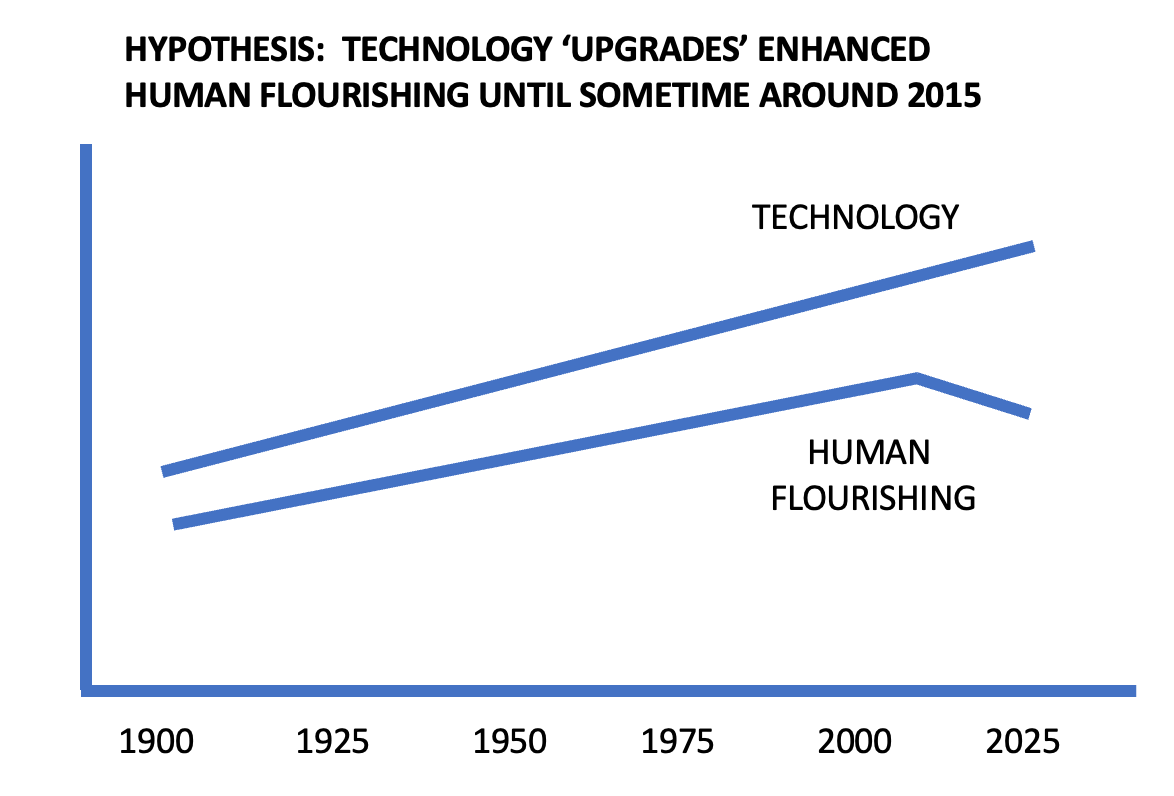
Almost everybody I hear from has some horror story to share. Like me, they loved new tech until recently, and many worked in high positions at tech companies. But then they saw things go bad. They saw upgrades turn into downgrades. They watched as user interfaces morphed into brutal, manipulative command-and-control centers.

Things got worse — and not because something went wrong. The degradation was intentional. It happened because disempowerment and centralized control are profitable, and now drive the business plans.

So search engines got worse — but profits at Alphabet rose. Social media got worse — but profits at Meta grew. (I note that both corporations changed their names, which is usually what malefactors do after committing crimes.)

Scammers and hackers got more tech tools, while users got locked in — because those moves were profitable too.

This is the context for my musings below on the humanities.

I don’t want to summarize it here — I encourage you to read the whole thing. My only preamble is this: the humanities aren’t just something you talk about in a classroom, but are our core tools when the human societies that created and preserved them are under attack.

Like right now.

March 29, 2024

QotD: Pay no attention to the empty suit behind the social media curtain!

Filed under: Business, Media, Quotations, Technology, USA — Tags: , , , , — Nicholas @ 01:00

These days, there’s no discernible relationship between “content” and “revenue”, because Facebook doesn’t have “revenue”. All it has is a ticker symbol. Much like Enron, whatever physical product Facebook might once have theoretically produced — all those cat pictures — has been totally subsumed into share price fuckery. Yeah yeah, theoretically their “revenue” comes from ads, but as is well known, a) there is not, and never has been, in any industry, a discernible causal relationship between ads and revenue, and b) Facebook lies through its teeth about it anyway. How many times have they been caught now, including in sworn testimony to Congress?

Given all that, why not censor? Why not let your freak flag fly? Just as being innovative actually counts against you in the music biz these days — sure, sure, y’all might be the next Beatles, but we know Taylor Swift’s lab-grown replacement will move fifty million units — so there are considerable drawbacks, in the social media moguls’ minds, to letting just any old schmoe post anything he wants up on their platforms. What if Faceborg’s ad-generation algorithm decides to put a #woke company’s ad on a badthinker’s page? Faceborg’s entire business model rests on getting #woke companies to keep buying ads, since those ad buys are the only thing that keep the stock price up. And since those #woke corporations have made it abundantly clear that they don’t want those people’s business …

Swing it back to the top. Faceborg et al have figured out a surefire way to “make money” by manipulating their stock price. They don’t need a physical product to do it, but what they absolutely must have, the one thing from which all others flow, is “clicks”. Eyeballs. Whatever you want to call it, the whole house of cards is built on the premise that there are actual users out there — real, physical people, who exist in meatspace — who might theoretically buy the advertisers’ products. But … what if there aren’t?

Zuck et al have been pretty good at faking it so far, but as everyone knows, they are faking. For one thing, they keep getting caught. For another, even academics — the dumbest critters in captivity, Commodore 64-level NPCs who can be counted on to swallow the SJW narrative hook line and sinker — keep publishing studies showing that some huge number of all social media accounts, on all platforms, are bogus.

Indeed, you can test it for yourself. I know, I know, FED!!!!, but hear me out: Get a VPN. Sign up for a burner email. Rejigger the VPN, then use the burner email to sign up for Faceborg, Twitter, whatever. Don’t actually post anything; just sign up. It’s 1000 to 1 that even with no activity whatsoever, you’ll still be deluged with friend requests. The algorithms will take care of that, because as we’ve noted, they have to push the illusion that people are using these platforms, that eyeballs are landing on pages, that fingers are clicking on ads. You’ll get a whole list of “suggestions” of which accounts to follow, all of which — surprise surprise — are never more than a click away from some big advertiser.

Severian, “Own Goals”, Rotten Chestnuts, 2021-07-21.

March 28, 2024

Justin Trudeau never misses an opportunity to make a performative announcement, even if it harms Canadian interests

Canadian Prime Minister Justin Trudeau made an announcement last week that the Canadian government was cutting off military exports to Israel … except that Canada buys more military equipment from Israel than vice-versa:

Israeli Spike LR2 antitank missile launchers, similar to the ones delivered to the Canadian Army detachment in Latvia in February.
Wikimedia Commons.

When the Trudeau government publicly cut off military exports to Israel last week, the immediate reaction of the Israeli media was to point out that Canada’s military was far more dependent on Israeli tech than was ever the case in reverse.

“For some reason, (Foreign Minister Melanie Joly) forgot that in the last decade, the Canadian Defense Ministry purchased Israeli weapon systems worth more than a billion dollars,” read an analysis by the Jerusalem Post, which noted that Israeli military technology is “protecting Canadian pilots, fighters, and naval combatants around the world.”

According to Canada’s own records, meanwhile, the Israel Defense Forces were only ever purchasing a fraction of that amount from Canadian military manufacturers.

In 2022 — the last year for which data is publicly available — Canada exported $21,329,783.93 in “military goods” to Israel.

This didn’t even place Israel among the top 10 buyers of Canadian military goods for that year. Saudi Arabia, notably, ranked as 2022’s biggest non-U.S. buyer of Canadian military goods at $1.15 billion — more than 50 times the Israeli figure.

What’s more — despite Joly adopting activist claims that Canada was selling “arms” to Israel — the Canadian exports were almost entirely non-lethal.

“Global Affairs Canada can confirm that Canada has not received any requests, and therefore not issued any permits, for full weapon systems for major conventional arms or light weapons to Israel for over 30 years,” Global Affairs said in a February statement to the Qatari-owned news outlet Al Jazeera.

The department added, “the permits which have been granted since October 7, 2023, are for the export of non-lethal equipment.”

Even Project Ploughshares — an Ontario non-profit that has been among the loudest advocates for Canada to shut off Israeli exports — acknowledged in a December report that recent Canadian exports mostly consisted of parts for the F-35 fighter jet.

“According to industry representatives and Canadian officials, all F-35s produced include Canadian-made parts and components,” wrote the group.

March 25, 2024

Vernor Vinge, RIP

Filed under: Books, Technology — Tags: , , , — Nicholas @ 04:00

Glenn Reynolds remember science fiction author Vernor Vinge, who died last week aged 79, reportedly from complications of Parkinson’s Disease:

Vernor Vinge has died, but even in his absence, the rest of us are living in his world. In particular, we’re living in a world that looks increasingly like the 2025 of his 2007 novel Rainbows End. For better or for worse.

[…]

Vinge is best known for coining the now-commonplace term “the singularity” to describe the epochal technological change that we’re in the middle of now. The thing about a singularity is that it’s not just a change in degree, but a change in kind. As he explained it, if you traveled back in time to explain modern technology to, say, Mark Twain – a technophile of the late 19th Century – he would have been able to basically understand it. He might have doubted some of what you told him, and he might have had trouble grasping the significance of some of it, but basically, he would have understood the outlines.

But a post-singularity world would be as incomprehensible to us as our modern world is to a flatworm. When you have artificial intelligence (and/or augmented human intelligence, which at some point may merge) of sufficient power, it’s not just smarter than contemporary humans. It’s smart to a degree, and in ways, that contemporary humans simply can’t get their minds around.

I said that we’re living in Vinge’s world even without him, and Rainbows End is the illustration. Rainbows End is set in 2025, a time when technology is developing increasingly fast, and the first glimmers of artificial intelligence are beginning to appear – some not so obviously.

Well, that’s where we are. The book opens with the spread of a new epidemic being first noticed not by officials but by hobbyists who aggregate and analyze publicly available data. We, of course, have just come off a pandemic in which hobbyists and amateurs have in many respects outperformed public health officialdom (which sadly turns out to have been a genuinely low bar to clear). Likewise, today we see people using networks of iPhones (with their built in accelerometers) to predict and observe earthquakes.

But the most troubling passage in Rainbows End is this one:

    Every year, the civilized world grew and the reach of lawlessness and poverty shrank. Many people thought that the world was becoming a safer place … Nowadays Grand Terror technology was so cheap that cults and criminal gangs could acquire it. … In all innocence, the marvelous creativity of humankind continued to generate unintended consequences. There were a dozen research trends that could ultimately put world-killer weapons in the hands of anyone having a bad hair day.

Modern gene-editing techniques make it increasingly easy to create deadly pathogens, and that’s just one of the places where distributed technology is moving us toward this prediction.

But the big item in the book is the appearance of artificial intelligence, and how that appearance is not as obvious or clear as you might have thought it would be in 2005. That’s kind of where we are now. Large Language Models can certainly seem intelligent, and are increasingly good enough to pass a Turing Test with naïve readers, though those who have read a lot of Chat GPT’s output learn to spot it pretty well. (Expect that to change soon, though).

March 24, 2024

“[A] term was coined in Britain for playing music on your phone in public: ‘sodcasting’ – after ‘sod’ for ‘sodomite’, i.e. something that only a total ASSHOLE would do”

Filed under: Media, Technology, USA — Tags: , , , — Nicholas @ 03:00

We’ve all been there at some point, especially in waiting rooms or on public transit: someone is either accidentally or deliberately subjecting everyone else in the vicinity to their personal soundtrack:

The modern world is noisy, I get that. I’m fine dealing with busy, urban places. But that surely makes those other places where you can escape the noise all the more vital in the constant struggle for sanity in this century. This is perhaps the one issue on which uber-leftist Elie Mystal and I agree. He found himself this week in a waiting room, full of peeps “listening to content on their devices with no headphones … LOUDLY. What the SHIT is this?? Is this normal?” His peroration: “I’M DEAD. I CAN FOR REAL FEEL THE VEINS IN MY HEAD THROBBING. THIS IS HOW I DIED.” #MeToo, my old lefty comrade.

The degradation of public space in America isn’t entirely new, of course. As soon as transistor radios became portable, people would carry them around — for music or sports scores on construction sites or wherever. But the smartphone era — thanks once again, Steve Jobs, you were so awesome! — gave us an exponential jump in the number of people with highly portable sound-broadcasting machines in every public space imaginable. In other words: Hell on toast.

At the beginning of this phone surge, a term was even coined in Britain for playing music on your phone in public: “sodcasting” — after “sod” for “sodomite”, i.e. something that only a total ASSHOLE would do. Sodcasting was just an amuse bouche, though, compared with our current Bluetooth era, where amplifiers the size of golf-balls have dialed it all up to 11, and the age of full-spectrum public cacophony — including that thump-thump-thump of the bass that carries much farther than the sodcasting treble — has truly begun.

National parks? They are now often intermittent raves, where younger peeps play loud, amplified dance music as they walk their trails. On trains? There is now a single “quiet car” when once they all were, because we were a civilized culture. Walk down a street and you’ll catch a cyclist with a speaker attached to the handlebars, broadcasting at incredible volume for 50 feet ahead and behind him, obliterating every stranger’s conversation in his path.

On a bus? Expect the person sitting right behind you with her mouth four inches from your ears to have a very loud phone conversation, with the speaker turned up, and the phone held in front of her like a waiter holding a platter. The things she’ll tell you! Go to a beach and have your neighbors play volleyball — but with a loud speaker playing Kylie Minogue remixes to generate “atmosphere”.

When did we decide we didn’t give a fuck about anyone else in public anymore?

It’s not as if there isn’t an obvious win-win solution for both those who want to listen to music and those who don’t. Let me explain something that seems completely unimaginable to the Bluetoothers: If you can afford an iPhone, you can afford AirPods, or a headset, or the like. Put them in your ears, and you will hear music of far, far higher quality than from a distant Bluetooth, and no one else will be forced to hear anything at all! What’s not to like? It follows, it seems to me, that those who continue to refuse to do so, who insist that they are still going to make you listen as well, just because fuck-you they can, are waging a meretricious assault on their fellow humans.

What could be the defense? The Guardian — who else? — had a go at it:

    the ghetto blaster reminds us that defiantly and ostentatiously broadcasting one’s music in public is part of a history of sonically contesting spaces and drawing the lines of community, especially through what gets coded as “noise” … it represents a liberation of music from the private sphere in the west, as well as an egalitarian spreading of music in the developing world.

The first point is not, it seems to me, exculpatory. It’s describing an act of territorial aggression through sound. The second point may have some truth to it — but it hardly explains the super-privileged NYC homos on the beach or the white twenty-something NGO employees in the park. But would I enjoy living in Santo Domingo where not an inch — so far as I could see and hear when I was there — was uncontaminated by overheard fluorescent lights and loud, bad club music? Nope.

Whenever I’ve asked the sonic sadists whether they actually understand that they are hurting others, they blink a few times, their mouths begin to form sentences, and then they look away. Or they’ll tell me to go fuck myself, or say I’m the only one who has complained, which is probably true because most people don’t want public confrontation, and have simply given up and moved on. Then there is often the implication that I’m the one being the asshole. On no occasion has anyone ever turned their music off after being asked to. Too damaging to their pride.

One reddit forum-member had this excuse: “It’s because earbuds hurt my ears and headphones don’t stay on.” Another got closer: “A lot of people that play their music out loud think that others won’t mind it.” Self-absorption. One other factor is simply showing off: at Herring Cove, rich douchefags bring their expensive boats a little off-shore so they can broadcast with their massive sound systems. It strengthens my support for the Second Amendment every summer.

March 20, 2024

Google’s unmissable leftward biases

Filed under: Media, Politics, Technology, USA — Tags: , , , — Nicholas @ 04:00

Tom Knighton on a recent New York Post article calling out Google for their strong political biases and how they inform everything that Google and its subsidiaries and affiliates do:

Once, the company was well-known for having the phrase “Don’t be evil” painted on a wall in their headquarters. It’s a noble sentiment, but apparently, it’s now more like “Don’t be evil.”

That’s pretty clear after what we learned from the New York Post:

    Google has been putting its thumb on the scale to help Democratic candidates win the presidency in the last four election cycles during which it censored Republicans, according to a right-leaning media watchdog.

    The Media Research Center published a report alleging 41 instances of “election interference” by the search engine since 2008.

    The MRC published a report accusing Google of having “utilized its power to help push to electoral victory the most liberal candidates…while targeting their opponents for censorship.”

    The report comes weeks after AllSides conducted an analysis which found that news aggregator Google News skewed even more off the charts in 2023.

    Google has also come under fire after its Gemini AI image generator produced “woke”-inspired and historically inaccurate images such as black Vikings, female pope and Native Americans among the Founding Fathers.

Now, Google denies the claims and someone close to the company took issue with the methodology used to detect this supposed interference.

But the truth of the matter is that there’s absolutely no reason to believe Google on this because we’ve seen enough of it previously to know better.

For example, YouTube has a profoundly leftward bias. The site is notorious for silencing right-wing voices while allowing leftists to get away with trampling community standards willy-nilly. YouTube is owned by Google, which means they’re at least tacitly endorsing the strategy.

From there, it’s not difficult to see the mothership taking on a similar role, if not originating it. They’re just able to hide it easier.

But even there, we can see it.

I use Google’s news feed regularly, particularly for my work at Bearing Arms. It’s common for me to look up “gun rights” and the first article that shows up, unless I set it for the most recent stories, be one treating them as a negative thing.

So yeah, I have no doubt that Google is playing favorites.

The worst part is that there isn’t anything that can be done through the legal system as far as I’m aware. But that doesn’t mean someone there didn’t realize what they are doing is wrong.

Most probably didn’t, though. They believe the Holy Progressive Cause is so vital, so unerringly good, that they can and should do anything to serve it. That includes displaying a staggering degree of bias in the service of what you believe to be the greater good, your business be damned.

But they knew it would be considered wrong by a great many people, which is why they’re hiding it.

This “should be a reality check for the technocracy”

Ted Gioia on the SXSW audience reaction to being presented with full-quill AI enthusiasm that didn’t match the presenters’ expectations at all:

Tech leaders gathered in Austin for the South-by-Southwest conference a few days ago. There they showed a video boasting about the wonders of new AI technology.

And the audience started booing.

At first, just a few people booed. But then more and more — and louder and louder. The more the experts on screen praised the benefits of artificial intelligence, the more hostile the crowd got.

The booing started in response to the comment that “AI is a culture.” And the audience booed louder when the word disrupted was used as a term of praise (as is often the case in the tech world nowadays).

Ah, but the audience booed the loudest at this statement:

    I actually think that AI fundamentally makes us more human.

The event was a debacle — the exact opposite of what the promoters anticipated.

And it should be a reality check for the technocracy.

If they were paying attention, they might already have a hunch how much people hate this stuff — not just farmers in Kansas or your granny in Altoona, but hip, progressive attendees at SXSW.

These people literally come to the event to learn about new things, and even they are gagging on this stuff.

It’s more than just fears about runaway AI. Prevailing attitudes about digital tech and innovation are changing rapidly in real time — and not for the better. The users feel used.

Meanwhile the tech leaders caught in some time warp. They think they are like Steve Jobs launching a new Apple product in front of an adoring crowd.

Those days are gone.

Not even Apple is like Apple anymore. A similar backlash happened a few weeks ago, when Apple launched its super-high-tech virtual reality headset. The early response on social media was mockery and ridicule — something Steve Jobs never experienced.

This is the new normal. Not long ago we looked to Silicon Valley as the place where dreams came from, but now it feels more like ground zero for the next dystopian nightmare.

He’s not just a curmudgeonly nay-sayer (that’s more me than him), and has some specific things that are clearly turning a majority of technology users against the very technology that they once eagerly adopted:

They’re doing so many things wrong, I can’t even begin to scratch the surface here. But I’ll list a few warning signs.

You must be suspicious of tech leaders when …

  1. Their products and services keep getting worse over time.
  2. Their obvious goal is to manipulate and monetize the users of their tech, instead of serving and empowering them.
  3. The heaviest users of their tech suffer from depression, anxiety, suicidal impulses, and other negative effects as a result.
  4. They stop talking about quality, and instead boast incessantly about scalability, disruption, and destruction.
  5. They hide what their technology really does — resisting all requests for transparency and disclosure.
  6. They lock you into platforms, forcing you to use new “features” and related apps if you want to access the old ones.
  7. They force upgrades you don’t like, and downloads you don’t want.
  8. Their terms of use are filled with outrageous demands and sweeping disclaimers.
  9. They destroy entire industries not because they offer superior products, but only because as web gatekeepers they have a chokehold on information and customer flow — which they use ruthlessly to kill businesses and siphon off revenues.

Every one of those things is happening right here, right now.

We’re doing the technocracy a favor by calling it to their attention. If they get the message, they can avoid the coming train wreck. They can return to real innovation, with a focus on helping the users they now so ruthlessly exploit.

March 16, 2024

The “TikTok ban” isn’t really about banning TikTok

Filed under: China, Government, Media, Technology, USA — Tags: , , , , — Nicholas @ 04:00

Matt Taibbi explains why the movement to ban TikTok is so dangerous to Americans’ civil liberties:

As discussed on the new America This Week, passage of the TikTok ban represents a perfect storm of unpleasant political developments, putting congress back fully in line with the national security establishment on speech. After years of public championing of the First Amendment, congressional Republicans have suddenly and dramatically been brought back into the fold. Meanwhile Democrats, who stand to lose a lot from the bill politically — it’s opposed by 73% of TikTok users, precisely the young voters whose defections since October put Joe Biden’s campaign into a tailspin — are spinning passage of the legislation to its base by suggesting it’s not really happening.

“This is not an attempt to ban TikTok, it’s an attempt to make TikTok better,” is how Nancy Pelosi put it. Congress, the theory goes, will force TikTok to divest, some kindly Wall Street consortium will gobble it up (“It’s a great business and I’m going to put together a group to buy TikTok,” Steve Mnuchin told CNBC), and life will go on. All good, right?

Not exactly. The bill passed in the House that’s likely to win the Senate and be swiftly signed into law by the White House’s dynamic Biden hologram is at best tangentially about TikTok.

You’ll find the real issue in the fine print. There, the “technical assistance” the drafters of the bill reportedly received from the White House shines through, Look particularly at the first highlighted portion, and sections (i) and (ii) of (3)B:

As written, any “website, desktop application, mobile application, or augmented or immersive technology application” that is “determined by the President to present a significant threat to the National Security of the United States” is covered.

[…]

As Newsweek reported, the bill was fast-tracked after a secret “intelligence community briefing” of Congress led by the FBI, Department of Justice, and the Office of the Director of National Intelligence (ODNI). The magazine noted that if everything goes as planned, the bill will give Biden the authority to shut down an app used by 150 million Americans just in time for the November elections.

Say you’re a Democrat, however, and that scenario doesn’t worry you. As America This Week co-host Walter Kirn notes, the bill would give a potential future President Donald Trump “unprecedented powers to censor and control the internet“. If that still doesn’t bother you, you’re either not worried about the election, or you’ve been overstating your fear of “dictatorial” Trump.

We have two decades of data showing how national security measures in the 9-11 era evolve. In 2004 the George W. Bush administration defined “enemy combatant” as “an individual who was part of or supporting Taliban or al Qaeda forces, or associated forces that are engaged in hostilities against the United States”. Yet in oral arguments of Rosul et al v Bush later that year, the government conceded an enemy combatant could be a “little old lady in Switzerland” who “wrote a check” to what she thought was an orphanage.

March 14, 2024

The insane pursuit of a “zero waste economy”

Filed under: Britain, Economics, Environment, Government, Politics, Technology — Tags: , , , — Nicholas @ 04:00

Tim Worstall explains why it does not make economic sense to pursue a truly “zero waste” solution in the vast majority of cases:

It’s entirely possible to think that waste minimisation is a good idea. It’s also possible to think that waste minimisation is insane. The difference is in what definition of the word “waste” we’re using here. If by waste we mean things we save money by using instead of not using then it’s great. If by waste we mean just detritus then it’s insane.

Modern green politics has — to be very polite about it indeed — got itself confused in this definitional battle. Which is why we get nonsense like this being propounded as potential political policy:

    A Labour government would aim for a zero-waste economy by 2050, the shadow environment secretary has said.

    Steve Reed said the measure would save billions of pounds and also protect the environment from mining and other negative actions. He was speaking at the Restitch conference in Coventry, held by the thinktank Create Streets.

    Labour is finalising its agenda for green renewal and Reed indicated a zero-waste economy would be part of this.

    This would mean the amount of waste going to landfill would be drastically reduced and valuable raw materials including plastic, glass and minerals reused, which would save money for businesses who would not have to buy, import or create raw materials.

The horror here does depend upon that definition of waste. Or, if we want to delve deeper, the definition of resource that is being saved.

[…]

OK. So, we’ve two possible models here. One is homes sort into 17 bins or whatever the latest demand is. Or, alternatively, we have big factories where all unsorted rubbish goes to. To be mechanically sorted. Right — so our choice between the two should be based upon total resource use. But when we make those comparisons we do not include that household time. 25 million households, 30 minutes a week, 450 million hours a year. At, what, minimum wage? £10 an hour (just to keep my maths simple) is £4.5 billion a year. That household sorting is cheaper — sorry, less resource using — than the factory model is it?

And that little slip — cheaper, less resource using — is not really a slip. For we are in a market economic system. Resources have prices attached to them. So, we can measure resource use — imperfectly to be sure but usefully — by the price of different ways of doing things. Cool!

At which point, recycling everything, moving to a zero waste economy, is more expensive than the current system. Therefore it uses more resources. We know this because we always do have to provide a subsidy to these recycling systems. None of them do make a profit. Or, rather, when they do make a profit we don’t even call them recycling, we call them scrap processing.

Which all does lead us to a very interesting even if countercultural conclusion. The usual support for recycling is taken to be an anti-price, anti-market, even anti-capitalist idea. Supported by the usual soap dodging hippies. But, as actually happens out in the real world, recycling is one of those things that should be — even if it isn’t — entirely dominated by the price system and markets. Even, dread thought, capitalism. We should only recycle those things we can make a profit by recycling. Because that’s now prices inform us about which systems actually save resources.

« Newer PostsOlder Posts »

Powered by WordPress