
I came across an article on my phone about a women’s rugby championship. It is unseemly for women to play rugby, and they will never be any good at it. It is a game made for men and increasingly for monsters. In the days when it was still a genuinely amateur sport, those who played it were of ordinary dimensions and often young men who went on to sensible careers in medicine, law, business, and the like.
Now, however, the sport is professional and played by men who seem to be eight feet wide and run straight into one another, very fast and often headfirst. Not surprisingly, a significant proportion of them suffer from traumatic dementia very early in their lives, and some, understandably though I do not think justifiably, try in the early stages of their sad condition to obtain financial compensation. The sport has become so violent that even people who are not unduly sensitive to violence shrink from observing it close-up.
Freud might have taken these women’s desire to participate in a sport that is so radically unsuited to them as an instance of what, in one of his absurd speculations about the psychology of women, he called penis envy. I think, rather, it is a sign of the masculinization of at least some women, who are responding to the overvaluation in our culture of the exercise of power as the supreme end in life. The exercise of all power is fleeting, sporting prowess being among its most fleeting forms; but the illusion dies hard.
Theodore Dalrymple, “All in a Day’s Irk”, New English Review, 2025-08-29.
December 20, 2025
QotD: Women’s Rugby
December 18, 2025
QotD: Reserved for women
Tears do help, no matter what the cynics say. The resilience and longer life of women probably are due to our ability to clear supercharged emotional atmosphere with occasional violent storms.
The symptoms follow a pattern. For days you feel low. You mope, and worry over nothing. Then some little upset comes and you hit bottom. Waves of misery wash over you. They flatten you out.
Then grief grips your soul and sobs rack your body. When ended it’s as if you were born again. The good old “I’m alive” feeling floods your being. You wash your face, and powder your nose and for the next six months the family can expect reasonable behavior from you. Such outbursts are better than a bottle of drug store tonic for feminine nerves.
Men, poor things, can’t have such a release for fear of becoming softies. Instead, they indulge in profanity, which is a poor substitute for tears.
They mention their great achievements with pride, but not one ever emerged from months of discomfort and pain, clasping a live baby.
Life’s high moments are rare and brief. And God saved the best for us.
“Nonsense,” I can hear the realists say. “Babies are a commonplace biological fact.” Which proves that they talk nonsense, for every woman knows that her baby is a miracle made of Heaven-spun dreams.
Mrs. Walter Ferguson, “Reserved for women”, The Pittsburgh Press, 1946-09-17.
December 4, 2025
“… the biggest problem facing disabled people is that they aren’t eager enough to call themselves disabled”
On his Substack, Freddie deBoer decries the New York Times viewpoint that “there is no such thing as a person, only beings that exist to function as sets of interlocking identities”:
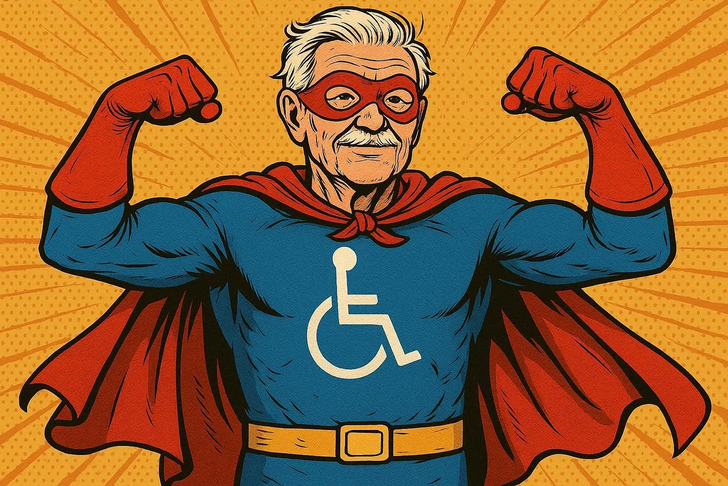
(you would find this horribly condescending too)
Image from Freddie deBoer
I’m not joking! Paula Span has produced this particular bit of scolding for The Official Publication of Liberals Who Occasionally Look Up From Their Crosswords to Disapprove of Everyone and Everything. Span writes
Identifying as a person with a disability provides other benefits, advocates say. It can mean avoiding isolation and “being part of a community of people who are good problem-solvers, who figure things out and work in partnership to do things better”
Of course, you can enjoy those benefits without identifying as disabled, without allowing one unfortunate aspect of your life become an entire identity. But that doesn’t fly in the world of the brownstone liberals who fund and run the New York Times, who seem to believe that there is no such thing as a person, only beings that exist to function as sets of interlocking identities.
Here’s the maddening thing about this piece: it quietly smuggles in a worldview that has metastasized across the discourse, a worldview in which the biggest problem facing disabled people is that they aren’t eager enough to call themselves disabled. Not, you know, being blind or paralyzed or suffering from dementia or constantly wracked with chronic pain, no, all of that is subservient to the only question anybody seems to care about anymore, the all-devouring question of identity. The whole thing hums along with the cheery institutional conviction that the answer to every human frailty is more identitarian self-labeling. If only the elderly would embrace the capital-D Disability identity, we’re told, everything would be better — their health care would run smoother, their interactions with institutions would be less demeaning, their sense of community would blossom. Maybe they’d even be happier! The Times treats this as self-corroborating common sense, like, well, everything else argued in the New York Times.
What this kind of thinking actually represents is the natural endpoint of a cultural project that has turned medical pathology into a personality type. It’s the codification of a worldview where suffering is not something to address, treat, alleviate, or recover from, but a new kind of boutique identity, complete with community membership, branded discourse, and moral status. It turns vulnerability into a form of social currency, rewarding performance over authenticity and turning genuine suffering into a spectacle for peer validation. In doing so, it erodes the very possibility of meaningful treatment, because the focus is no longer on recovery or well-being, but on cultivating a carefully curated self-image that fixates on impairment. And what I think, as I read this person tut-tutting senior citizens for not embracing that new ethos, is “Maybe they just feel like they’re too fucking old to take part in such nonsense?”
The piece insists, without evidence or even really argument, that treating disability as an identity will improve access to accommodation. Disability accommodations matter; of course they do. But what this article is concerned with is patently not getting older adults the practical support they need. The piece is instead fixated on the idea that the real issue here is that people don’t want to be disabled in the metaphysical, self-defining sense, as though the reluctance of an 84-year-old to call herself Disabled-with-a-capital-D is some retrograde psychological failure rather than a perfectly sane human impulse born of a lifetime of struggle. Span frames this as a story about insufficiently enlightened seniors who need to be ushered into the disability “community”. But maybe the reluctance they’re describing is the whisper of something older and much wiser: the understanding that disability is not a polity you join, not a club whose membership conveys special epistemic authority, but a condition of life that you endure and attempt to mitigate. These older people don’t identify as disabled because they remember, stubbornly enough, the distinction between having a problem and being the problem. They treat disability as a practical reality, not an existential category. And they’re right to do so.
Update, 5 December: Welcome, Instapundit readers! Please do have a look around at some of my other posts you may find of interest. I send out a daily summary of posts here through my Substack – https://substack.com/@nicholasrusson that you can subscribe to if you’d like to be informed of new posts in the future.
November 30, 2025
The plight of most young western men
At Postcards from Barsoom, John Carter explores the dangerous psychological rift in western thought that casts young men into a literal no-win situation and yet blames them for not succeeding:
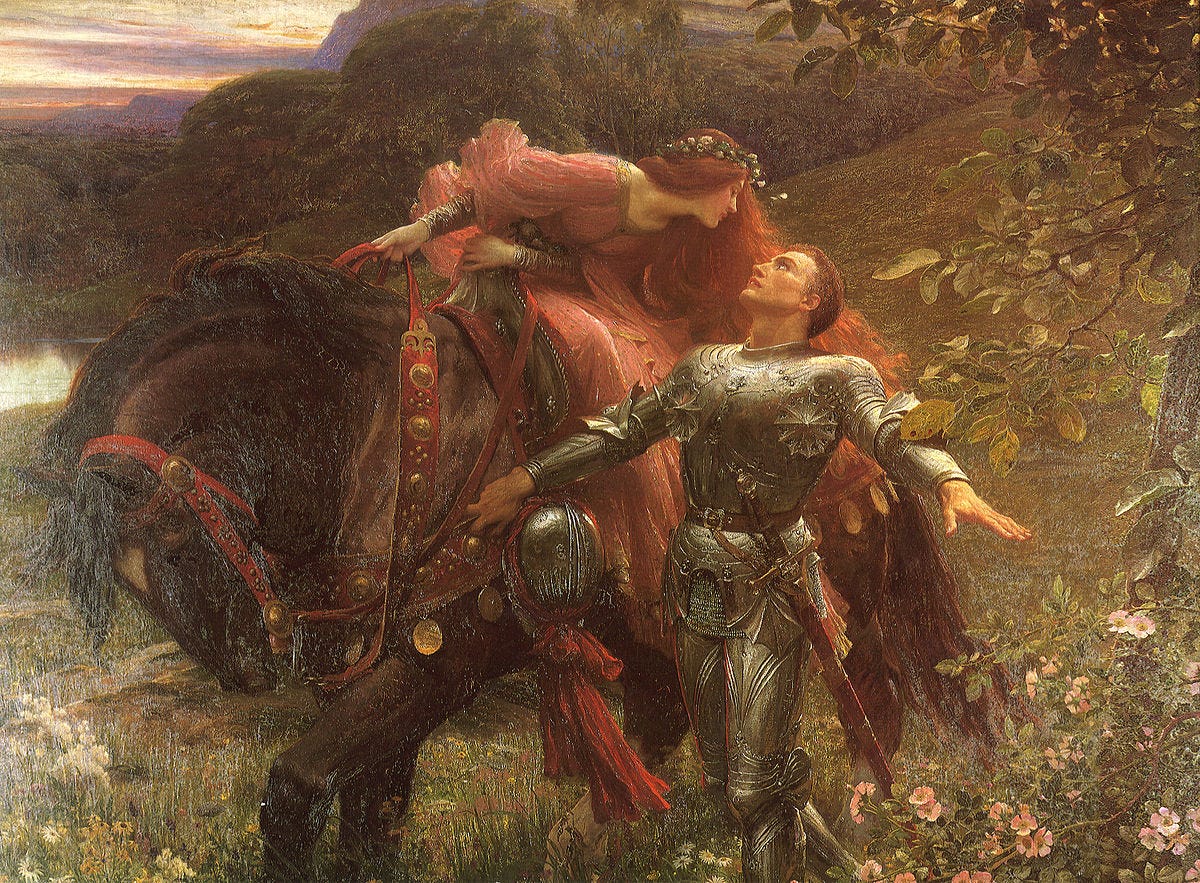
La Belle Dame Sans Merci by Frank Bernard Dicksee, 1901
A great deal of Discourse revolves around the desultory state of the broken modern young man. We wring our hands about porn brained incels, and about the incel’s mirror image in the sociopathic gym bro fuckboy. We talk about how men need to man up, put down the console controller, get out of the basement, talk to real girls, and wife them up. At the same time, we do everything we can to make this as difficult and unappealing as possible. Male sexuality is relentlessly demonized, and this is at the root of great deal of social dysfunction.
Our society has established new social norms that make talking to girls in the wild, or even looking at them, tantamount to a sex crime. Buying a girl a drink at the bar is an imposition, an implicit expectation that she will at the very least say thank you, and this is essentially sexual harassment. As a result of this men do not buy girls drinks anymore. Glance at a girl’s cameltoe as she places her yoga pants between you and the mirror to do hip thrusts while you’re trying to focus on your deadlift, and get put on blast on TikTok as a perv. As a result men carefully avoid looking at girls, and girls wonder why they don’t get attention. Office romances are right out: ask Betty from accounting if she’d like to get a coffee, and you’re rolling the dice between getting lucky and getting a talking to from HR (if you’re lucky). Friend-group romances are discouraged: they bring too much drama.
The only romantic avenue still permitted is the dating apps. The de facto proscription of every other venue was so abrupt and thorough that I can’t help but wonder if MeToo was engineered by Match Group, in order to do to dating what Uber did to taxis. Just like Uber took an occupation that was able to provide a reasonable living standard for working class guys and turned it into piece-work for an imported third-world precariat, so Tinder wiped away thousands of years of accumulated social technologies optimized for the purpose of bringing young men and women together into stable, loving, and fecund matrimony, and replaced it with a winner-take-all meat market in which a small minority of the best-looking men swipe their way through a digital harem of emotionally crippled cum-dumpsters, while women retaliate by using their matches to get free meals and ghosting as soon as the cheque comes without so much as a thanks for the company. Commoditizing romance left everyone more lonesome and miserable than ever, but would you look at that market cap.
The decay set in long before Tinder, however.
Feminists have gotten a great deal of mileage out of Freud’s Madonna-whore complex. This is the idea of a Manichean division of femininity: the chaste purity of the innocent nurturing mother, contrasted with the wanton looseness of the degraded prostitute. The Madonna is embodied by the Virgin Mary, whose only begotten child was conceived immaculately, which is to say without actually having sex. Both archetypes are caricatures that fail to capture the full range of feminine sexuality, but a traditional, god-fearing society effectively forced women to choose between one or the other. Either she represses her instincts and lives a passionless life of quiet misery, or she becomes a fallen woman.
Unlike much of Freud’s oeuvre, which largely consisted of the author’s barely concealed fetishes, the Madonna-whore complex has held up fairly well in the era of evolutionary psychology. Freud’s explanation for the phenomenon – that it is rooted in the Oedipal desire to rut with your own mother – is of course nonsense (except possibly insofar as it may have applied to him). Its origin is more plausibly in the predicament of paternal uncertainty which has bedevilled men since before the dawn of mankind, and which leads to a trade-off between short- and long-term mating strategies with easy women on the one hand (with whom paternity is always in question, and in whom investment should therefore be kept to a minimum, but since they’re easy you can sow your seed in lots of them), and chaste women on the other (with whom paternity can be more reliably determined, and in whom greater investment is therefore warranted). It doesn’t matter that we have paternity tests now: evolved instincts don’t care about your technology.
In the aftermath of the sexual revolution female sexuality was freed from these ancient constraints. Women are permitted to dress as they please, date who they want, have sex with as many partners as they desire. Any attempt to dissuade women from such behaviour is attacked as slut shaming, a ploy by the patriarchy to control their bodies.
Promiscuous premarital sex was once a one-way street to single motherhood. The pill and legal abortion reduced that risk considerably, which provided the justification for eliminating sexual restraint in the first place. Male sexual psychology presents its own problems, however. Revealing attire invites male attention, and often not from the males whose attention a woman wants to attract. Women enjoy male attention, and so dress to attract it. Sexually excited men are liable to behave badly. Badly behaving men result in women getting hurt. Obviously, if a man behaves badly, society will punish him … but the wise course is to avoid putting temptation in his way in the first place. Those ancient restrictions on female sexuality weren’t there to oppress women: they were there to protect women from themselves.
Women may have chafed under the chastity belt of the Madonna-whore complex, but it caused problems for men too. Men don’t generally want either a frigid Victorian schoolmarm or a drunken slattern for a wife: he wants the happy medium between the two, purity in the streets but a prostie in the sheets, a girl who enjoys sex and is good at it, but only has it with him. The Madonna-whore complex is a schizoid separation of these two conflicting desires, which then leads to the romantic frustration of both sexes: men have to choose between two equally unappealing options, and women are required to deny one or the other aspect of their own sexuality.
Just like men, women tend to want two, somewhat contradictory things from the opposite sex. First, they want men to protect and provide for them: to build what needs building, fix what needs fixing, pay for dinner, buy them pretty jewellery. In other words, they want men to sacrifice their time and energy of their behalf. At the same time they want men who are dominant, strong, confident, and at least potentially dangerous, for the obvious reason that men must compete with other men, and men who do not possess these traits make terrible protectors and providers in comparison with men who do. The necessary tension is that dominant, aggressive men are generally much less interested in protecting and providing: a man who won’t submit easily to other men, won’t submit to women either; a man who can force other men to submit to his will, can also force a woman to do the same. This mirrors the tension in male desires: a girl who’s a good lay might not be the most impeccably virginal of innocent maidens.
We can’t call women whores anymore in order to enforce virginal purity, but bad romantic decisions still carry bad consequences, and women also need to be protected from those consequences (and can’t ever be held responsible for them). The emphasis has therefore shifted from policing female sexuality to policing male sexuality. The result of this is the emergence of the simp-rapist complex.
The only way to create a safe environment for women whose behaviour is entirely unrestricted is to ruthlessly suppress precisely those masculine traits of dominance and aggression that women find attractive in the first place. All of these traits get included into the broad category of “rape culture”. Even looking at a woman without her expressly stated positive consent becomes a problematic act. Men who violate these norms become, according to this standard, “rapists”.
Update, 1 December: Welcome, Instapundit readers! Please do have a look around at some of my other posts you may find of interest. I send out a daily summary of posts here through my Substack – https://substack.com/@nicholasrusson that you can subscribe to if you’d like to be informed of new posts in the future.
November 29, 2025
QotD: Are there no prisons? Are there no asylums?
The US is often pilloried for having a high level of imprisonment per capita relative to other countries. The US is also quite unusual in having shut down most of its insane asylums many decades ago.
My perspective on these facts changed a great deal when I learned that if you aggregate rates of imprisonment with rates of commitment to mental institutions, the US stops looking like an outlier.
The low-level mentally ill didn’t go away when we closed the asylums. Nor did they magically become more able to function in society when we pushed them out the doors. Instead, they now land in our prisons.
Another implication of all this is that it’s not “structural racism” or any other specific evil that gives the US high imprisonment rates. It’s an inevitable consequence of the social decision to make it very difficult to involuntarily commit people to asylums.
I’m not going to argue today about whether that decision should be reversed. I have an opinion about that, but this post is about facts and consequences, not value claims or what “should” be.
Let’s return to the homeless. It is now common knowledge that homeless people are almost never simply poor or down on their luck. Almost all have serious issues with mental illness or drug addiction, or both. Many refuse to go to shelters because they don’t want to — or are not capable of — complying with a homeless shelter’s behavioral restrictions.
While I don’t have firsthand knowledge or controlled studies to back me up, it seems obvious that the shelters are acting as a filter — the least damaged and most functional homeless go to them, leaving the crazies to inhabit the streets.
Thus, throwing homeless people who won’t go to shelters in prison is an exact functional equivalent of involuntary commitment to a mental asylum.
My question for people who object to imprisoning the mentally ill and drug-addicted homeless is: what do you propose we do instead? Are we prepared to reopen the asylums and lower the bar for involuntary commitment?
I don’t think there’s a third alternative anymore. Donald Trump, whatever his other failings might be, has an acute sense of the zeitgeist; popular tolerance for having the streets of our cities inhabited by crazy people is collapsing. It turns out we can only tolerate so many news stories about naked screaming nut-jobs on the subway.
I’m not going to propose an answer to the question I just raised, because I’m conflicted about it myself. My goal is to start people thinking about the right question, which is a very large one.
What is the humane way to treat people who are too damaged or broken to be functional members of society, and who inflict large costs on others if they’re not separated from society?
If it’s not prisons or asylums, what are we going to do? And given how ineffective psychiatric treatment is at anything beyond management of symptoms, is “prison” vs. “asylum” even a meaningful distinction?
ESR, The social media site formerly known as Twitter, 2025-08-13.
November 27, 2025
We’re not quite at the point that we get trigger warnings for trigger warnings, but …
On her blog, Sarah Hoyt discusses the continued expansion of trigger warnings in fan fiction, but not because the readers demand it:
Image from According to Hoyt
… I’ve noticed a creep up of trigger warnings in fanfic. Some of these would be incomprehensible to non-Jane-Austen fans and are actually not so much trigger warnings as sub-genre warnings. There are subgenres some fans (sometimes I’m some fans) hate, like “Lizzy is not a Bennet” or “Bingley is evil” or … whatever. That’s fine. It saves me the trouble of reading a fanfic that’s going to annoy me. Unless I’m in the mood to be annoyed, in which case I will read it so I can grit my teeth and mentally yell at the writer. (Bingley is evil is a problem because it usually turns into a revenge-fest on EVERYONE. Everyone is evil. Etc. I don’t think there’s ever a time I want to read that. You find yourself wanting to take a shower for the soul. With a wire scrub brush.)
We make fun of trigger warnings, often, but it’s a real measure of how stupid things have gotten. When I’m having to read a trigger warning for say “kissing without consent.” or “violence against children” (Okay, you’ll think that last makes perfect sense, until you find out it’s because a kid gets slapped once in the novel) or “verbal violence” or –
And you start wondering, on the serious, if the ideal novel for these people has no plot at all, just people sitting around having a nice meal and talking.
This is disturbing, because the whole point of a novel is to make you feel emotions and experience things you either can’t in your real life, or which wouldn’t be safe to experience in your real life, followed by resolution and catharsis. That’s what a novel offers you. The opportunity to be the someone else far away experiencing “Adventure” (which as we all know is really a series of unpleasant events.)
Anyway, I’ve slowly come to the conclusion all this demand for warnings and screeching about offense isn’t by real readers.
No, seriously. Real readers know that no one can insulate them against all surprises in a book (or blog) and that in fact the point of reading is to get out of your head and experience different things, different events, different emotions and different points of view. You might disagree vehemently with them (I actually do with most of the really old science fiction. Really, scientists in charge? Who thinks that’s even safe? Oh, yeah, the Soviet Union. But even they didn’t DO IT. They just paid lip service. They might have killed a lot more people if they’d done it, at that.) but that forces you to think about why you disagree and how you’d do it differently. If you’re of a certain frame of mind, you [might] end up becoming a novelist and writing your response to what you disagree with. Though if you are worth spit, even then, your “response” will be less of a response and more of this whole new thing it became, with the response buried somewhere inside it. And if you’re not of that frame of mind, you’ll still end up a more considered and self-reflective thinker than you were before. For one, while you might think that the other POV is stupid, if you read a whole novel with it, you’ll be aware that thought went into it, and might even have to confront that the worst stupid takes a lot of thought and self deception.
Anyway, the point is, I don’t think the offense-monsters read. Because the whole point of their screeching is to shut down the thinking and prevent ANYONE ELSE from being exposed to the material, and maybe thinking.
That’s not what they say, of course. They say “I’m offended”. And “I’m hurt”. And “You’re mean because you offended me”.
But what they really mean is “this you cannot think” “This you cannot see” and “this you cannot read” and “this you cannot write”. And “this you cannot say”.
They have, you see, completely surrendered their very core to the herd. They have given up their right to think and feel and be, in favor of belonging completely to the herd. (They used to have a term for this and said it as though it were praiseworthy: “mind-kill”.) So being exposed to contrary things hurts, and they have no defense, because they have taught themselves not to think and/or reason through things.
The pain they feel at the slightest hint of disagreement is true. It is also a symptom of what they have done to themselves, and has nothing to do with being mentally or emotionally healthy.
Just like the pain of withdrawal of a chronic alcoholic denied alcohol is real, and continued and too fast withdrawal might kill him, however continuing to feed his drinking habit will also kill him, faster.
To give them trigger warnings, apologize for any offense and handle them with kid gloves is not only bad for them but bad for society in general.
November 24, 2025
Fairy tales for Canadian boomers – “we have the best healthcare system in the world”
Older Canadians, especially the Baby Boom generation, have a huge blind spot when it comes to any discussion about healthcare … because they believe what they were told as children about Canada’s healthcare system being the “envy of the world” and other such comforting notions. (It’s not just Canada, as British belief in the quality of their National Health Service is very much at odds with the evidence.) This rose-coloured nostalgic faith makes it very difficult to address some of the very real problems that beset Canada’s hospitals and doctors. The media are understandably reluctant to publish anything that goes against this, as Peter Menzies explains:

Grok image from The Rewrite
About the same time as William Watson’s outstanding book Globalization and the Meaning of Canadian Life was being published in the late 1990s, the newspaper I worked for was sending a journalist to Europe to research a series of articles on how health care systems work in some of those countries.
I mention Bill’s book, which was runner-up for a public policy Donner Prize, because it exquisitely details many of the things Canadians believe about themselves that simply aren’t true. Which was the same reason why the Calgary Herald sent its health reporter (yes, there used to be such a thing), Robert Walker, to Europe — to expose its readers to the fact that there are more than two health care systems: our “defining” one and America’s, both of which are extremes. To the best of my knowledge, that remains the only time a Canadian news organization has taken on that task.
In every country examined in Walker’s reports, as is the case with almost every country in the world, public and private health care and insurance systems maintained a peaceful coexistence and the public’s needs were being met. Almost 30 years later, that remains the case. Also almost 30 years later, neither Bill’s book nor the Herald‘s reporting has had the slightest impact on the prevailing media narrative in Canada. It remains determined to perpetuate the fear that any move to increase the role of private health providers or even allow doctors to work in both systems (as was proposed this week by Alberta Premier Danielle Smith) is the first step on the slippery slope to “American-style” health care. This line has been successfully used for decades — often hyperbolically and occasionally hysterically — by public monopoly advocates for Canada’s increasingly expensive and difficult to access systems. We have known for 40 years that once Baby Boomers like your faithful servant turned bald and grey that the system would be unsustainable. But that single, terrifying “American-style” slur has halted reform at every turn.
The Tyee responded with a “Danielle Smith’s secret plan to Destroy Public Health Care” column while the Globe and Mail‘s Gary Mason, a Boomer, challenged my thesis here by suggesting it was time for open minds because “the reality is, the health care system in Canada is a mess”.
It is. And at least some of the blame — a lot, in my view — belongs at the door of Canadian news organizations that for decades have failed to fully inform readers by making them aware that there are a great many alternatives to just “ours” and “US-style”.
I was reminded of this in a recent Postmedia story concerning the perils of private health care provision. Referencing a study on MRIs, the story, right on cue, quotes the part of a study that states “It’s a quiet but rapid march toward U.S.-style health care”.
One would not want to suggest that those clinging to that parochial view should be denied a platform. But at the same time, readers have every right to demand that journalists push back and ask advocates for state monopolies simple questions such as “Why do you say that? Could it not be the first step towards UK-, German-, Dutch-, French-, Portugese- or Swedish-style health care?” and open the debate.
November 10, 2025
QotD: “Is it a boy or a girl?”
People are intrinsically fascinated by psychological sex differences — the average differences between men and women in personality, behavior, and preferences. Psychologists have studied this topic systematically for decades, beginning with landmark works like The Psychology of Sex Differences (1974) by Eleanor Maccoby and Carol Jacklin. That book helped spark a wave of research that continues to this day. Since then, increasingly sophisticated methods have enabled researchers to detect subtle but consistent differences in how men and women think, feel, and act.
Men and women use language and think about the world in broadly similar ways. They experience the same basic emotions. Both seek kind, intelligent, and attractive romantic partners, enjoy sex, get jealous, make sacrifices for their children, compete for status, and sometimes resort to aggression in pursuit of their interests. In the end, women and men are more alike than different. But they are not identical.
To be sure, sociocultural influences play a role in creating those differences. But environmental factors don’t act on blank slates. To understand young men and young women, we must consider not only cultural context but also evolved sex differences. We are, after all, biological creatures. Like other mammals, we share similar physiology and emotional systems, so it’s not surprising that meaningful differences exist between human males and females.
To understand why psychological and behavioral sex differences evolved, the key concept is parental investment theory, developed by evolutionary biologist Robert Trivers in 1972. The basic idea is straightforward: the sex that invests more in offspring tends to be more selective when choosing a mate. This selectivity follows basic evolutionary logic: those with more to lose are more cautious and risk-averse. To put the stakes in perspective: raising a child from birth to independence in a traditional, preindustrial society requires an estimated 10 million to 13 million calories — the equivalent of about 20,000 Big Macs. For women, reproduction is enormously expensive.
Men also incur reproductive costs, though of a different kind. On average, they have about 20 percent more active metabolic tissue — such as muscle — that fuels their efforts in competition, courtship, and provisioning. While pregnancy requires a large, immediate investment from women, men’s reproductive effort is more gradual, spread out over a lifetime. In evolutionary terms, both sexes pay a price for reproduction, but in different currencies — women through gestation and caregiving, men through physical competition and resource acquisition.
Yet while nature can inform our understanding of human behavior, it does not dictate how we ought to live. A clearer grasp of sex differences can help guide our decisions. It cannot define our values.
Rob Henderson, “Sex Differences Don’t Go Away Just Because You Want Them To”, Rob Henderson’s Newsletter, 2025-08-03.
November 7, 2025
“BookTok on its own sounds innocent enough”
I’ve seen occasional references to BookTok on other platforms but as it seemed to be as female-coded as an online community can be, I’d never bothered to pay close attention to it. If Zoomertea is to be believed, it’s a weird and disturbing space for the unprepared to visit:

Image from “The Female Gooner Epidemic” at Zoomertea
If you’re smart enough to have never downloaded TikTok, then you’ve probably never heard of BookTok and the resulting epidemic of female gooners (a term borrowed from porn culture to describe obsessive arousal and fixation). BookTok on its own sounds innocent enough, women rediscovering the joys of reading, romanticising cozy nights in, or even joining a book club. In theory, what could be more wholesome? However, the reality is more concerning. It turns out the bookish girls have traded the likes of Pride and Prejudice for highly pornographic dark fantasy erotica, stories that make Fifty Shades of Grey seem tame.
Women have always enjoyed a flair for romance. Once it was the slow burn longing of Romeo & Juliet or Wuthering Heights – the stories weren’t explicit, yet still roused deep, passionate feelings. By the 2000s, romance had evolved into “chick lit” – breezy novels about friendship, love and self-discovery. Books like Bridget Jones and the Devil Wears Prada swapped tragic love for witty realism, capturing the struggles of modern women navigating careers, dating, and independence. It seems like in all aspects of modern culture, people have been pushing for the “reliability factor” – they wanted to see themselves in the characters and storylines. But somewhere along the way, the realism and reliability factor lost its appeal.
During the pandemic, while the virus spread and the world stayed home, TikTok spread too, surpassing 2 billion downloads by mid-2020. With endless free time, people picked up new hobbies: some tried Chloe Ting’s “Get Abs in 2 Weeks” workouts, others turned to BookTok and rediscovered their love for literature. Booktok isn’t just for explicit romantasy novels, however it’s become synonymous with women who obsessively consume dark romance. On BookTok, desire isn’t intimate anymore; it’s performed.
While Fifty Shades of Grey, a book very explicitly about sex, came almost ten years before BookTok, it wasn’t exposed to the algorithmic amplification loop we see today. Although its release did shock readers and spark feminist critiques about patriarchal relationships and sexual themes, it still felt more like a dirty secret. Its eroticism was discussed privately, even sheepishly. It was a book club secret, not a TikTok performance. Now, even the most unassuming women are flocking to BookTok and demanding books with a maximum “spice rating”, without an ounce of shame. But how did this happen?
Somewhere between the isolation and scrolling, the lines between fantasy and reality began to blur. The algorithm on TikTok can be very dangerous for enforcing unhealthy habits on its users. When a woman watches or likes just one “spicy book” video, even just out of curiosity, TikTok interprets it as interest in similar content. Without the user’s knowledge, suddenly their ForYou page is filled with similar videos, “books with a max spice rating”, “extreme taboo book recommendations” or “Top five dark romance recs”. The more they see, the more they engage, the more the algo pushes darker more extreme content. Essentially, the algorithm learns: You like desire, here’s more. Louder. Darker
October 30, 2025
Cowardice & Courage – Fear, Flying & Combat Stress
HardThrasher
Published 24 Oct 2025Just getting into a bomber took guts. To do it twice required balls of steel. What happened when men wouldn’t or couldn’t continue to fly? We’ll look at the dangers they faced, what the RAF and the USAAF did to tackle the problem and talk about the infamous “LMF” cases in the RAF
00:00 – Come with Me
03:51 – Intro
04:16 – Shell Shock
06:00 – Inter War vs Early War
09:17 – Night Terrors
10:31 – Death in the Daylight
11:00 – Common Fears
13:22 – Raw Numbers
14:55 – The Mew Who Flew
16:35 – In The Hands of the CO
18:53 – LMF
21:01 – Combat Stress in the USAAF
22:03 – Attempts at treatment
24:47 – Wrap up and Closing Message
(more…)
QotD: When species’ mating rituals are disturbed, they don’t mate … and Humans are a species
Rob Henderson @robkhenderson
The actual truth is a lot of guys are naturally timid and are secretly grateful that approaching women was stigmatized because it gave them a righteous-sounding excuse for their own cowardice.
Is thirty seconds’ thought before posting too much to ask?
If cold approaching strange women was part of the natural human reproductive cycle, no men would [be] afraid to do it, because those who were would not have had descendants.
Every species has mating rituals. If those rituals are not disrupted, they will mate. If they are disrupted, they will not mate.
This is why a cattery run by a middle aged housewife in her own home can breed Occicats, Russian Blues, or Bengals, but the best zoos in the world can’t make two pandas into three pandas.
The basic mating ritual of human beings does not begin with a man cold approaching a strange woman.
It begins with a woman covertly signalling a willingness to be approached, either to a specific man, or in general. Only then is the man supposed to respond with an overt approach.
Women raised under the heel of feminism not only don’t know how to signal, they don’t even know that they should.
Men raised under the heel of feminism not only don’t know how to spot a signal, they don’t know they should be looking for one. And even if they did, it wouldn’t do them any good, because the women are not signalling.
This is why women’s twitter histories are an endless litany of “don’t approach me at the park, don’t approach me in the dark, don’t approach me here or there, don’t approach me anywhere”, alternating with “why don’t I get any attention? *sob*”.
They instinctively know that an approach from a man they do not favor is an affront, so they are affronted, and demand not be approached, when it happens.
Then everyone stops approaching, and they cry.
They want only men they like to approach them, but they have no idea that it’s their responsibility to make this happen.
If you attempt to make them understand this, most of them think you are telling them to overtly cold approach men, and they hate this idea, because it’s not natural to them, either.
Blank slatists, who don’t think humans have mating rituals, or at least don’t want them to, will insist that men “man up” and do all the work of solving this problem by cold approaching a steady stream of women until something clicks.
Or they will try to get women to do the approaching by building a dating website where only women can make first contact.
Doesn’t work.
Because mating rituals aren’t just “things you’re afraid to stop doing”, they are “things that make you feel attracted at all”.
When I was in my 20s, I would certainly cold approach women. But only for sex. If a woman didn’t make some sort of “come-hither” signal to me, sex was all I was in it for, and sex was the highest level of commitment she could expect from me.
Because it was firmly fixed in my mind, on an instinctive level, that she wasn’t actually that enthusiastic about me. And if she wasn’t enthusiastic about me, how could I be about her?
No thanks. I wanted to be appreciated, and so do most men.
Walking around with your breasts on display may attract the male gaze, but it’s not a substitute for contributing some energy and enthusiasm to the process.
This is what men really mean when they say “you told us not to approach you”.
It doesn’t mean “I am afraid of being called a creepy pervert or even arrested”.
It means “I can’t drum up much enthusiasm if you don’t show any”.
It means “You told everyone not to approach you, and you never shot me that eye contact and smile to say ‘I didn’t mean you'”.
It means “You project an air of defensiveness, and I’m not interested in rowing upstream. I want to be appreciated.”
No one wants to dance with a mannequin.
Devon Eriksen The social media site formerly known as Twitter, 2025-07-26.
October 29, 2025
QotD: Having kids
There are, of course, downsides: I am typing this very slowly because one of my arms is full of a baby who doesn’t like to nap unless I’m holding him. You have to label the leftover lasagna you’re taking for lunch tomorrow or else someone will have it for a snack. I am staring down the barrel of at least another decade of the exact same Mother’s Day musical program at the kids’ school, and it would probably be rude if I started singing along. And there are days when we’re waiting around like Kurt Russell at the end of The Thing to see where the stomach bug will strike next. But come on, nobody doesn’t have kids because of the existence of norovirus.
So … why don’t more people do this? (Either having a bunch of kids or, increasingly, just having kids period.) I’ve heard a lot of theories: just recently and off the top of my head, I’ve been told that kids cost too much money, that kids don’t actually have to cost a lot of money but we have very high standards for our parenting, that there are too many fun things you can’t do anymore when you have kids, that having a lot of kids is low status, and that being a housewife (an increasingly sensible choice the more kids you have) is low status. And, of course, car seat mandates. There’s something to most of those theories, but they all boil down to one fundamental claim: we’ve built a world where having kids, and especially having a lot of kids, just … kind of sucks.
It’s never going to be easy — there will always be sleepless nights and bickering siblings and twelve different people who all need incompatible things from you all at once — but anything worth doing is hard sometimes. It’s also often wonderful, and it doesn’t need to be this hard.
Tim Carney agrees with me, providing a guided tour of the cultural and structural factors that combine to make American parenting so overwhelming that many couples are stopping after one or two children — or opting out altogether. We think our children require our constant close attention. We worry about them incessantly. We think anything that’s not absolute top-tier achievement is failure. We build neighborhoods that mean they need to be driven everywhere, and then between car trips we all stare at our glowing rectangles. We, and they, are sad and lonely, and then no one around us has kids and we all get sadder and lonelier.
Jane Psmith, “JOINT REVIEW: Family Unfriendly, by Timothy P. Carney”, Mr. and Mrs. Psmith’s Bookshelf, 2024-10-14.
October 20, 2025
QotD: Wanting to be a pet, not an adult human
Sagu @Sagutxis
Seeing so many men happy to replace us with robots is very blackpilling nglI didn’t go to college until I was 30. This gave me a chance to see it with the perspective of an adult.
One lecture in Industrial Psychology, in particular, I will never forget.
The professor spoke about how an effective job description focused on concretely measurable tasks, not vague instructions, or characteristics.
For example, “maintain an 85% or greater average on customer feedback surveys”, instead of “be cheerful and upbeat”, or even “interact positively with customers”.
This means that goals are clear, and performance is measurable. A job is to do something, not be something.
Once some of the students had wrapped their minds around this concept, the professor decided to do a class exercise.
He asked the female students to come up with a job description for “husband”. At first, this went fine. The girls noodled around a bit with things they wanted their husbands to be (tall, etc), but he was able to gradually steer them towards describing what they wanted in terms of actions.
But then he asked the male students to define a wife in the same way.
And all the girls became upset. Some of them had full-on meltdowns.
Every single thing that a male student wanted, or expected, from his hypothetical future wife was sexist, oppressive, old-fashioned, misogynistic, patriarchal, etc.
They were literally screaming. Some of them in tears.
And I realized something pretty quickly. It wasn’t the actual, concrete responsibilities of the female role that they objected to.
It was the idea of there being a female role at all, with any attached responsibilities.
These women didn’t want to be wives. They wanted to be pets.
What’s a pet? Well a pet is not a wife, or a friend. A pet is a creature of instinct, which you bring into your home because you like how it naturally behaves.
You get a cat because you want [it] to behave like a cat, and do things a cat naturally does, like play with string, and purr when you pet him. If he’s smart, he’ll adapt [to] you somewhat, but he doesn’t have responsibilities other than “be a cat”.
If you get a wife, you get a wife so she will do things for you, specific things that are the responsibilities of wife, like care for your home, bear and raise your children, cook nutritious meals so you don’t have to eat processed slop, look after your emotional well-being, and so on.
These girls didn’t want to be held responsible for those things. As married women, they might have anticipated doing some of them, but some of the time. When they felt like it.
The cat chases the string if and when it wants to, not because chasing the string is its job.
These young millennial women didn’t realize it, but they wanted to be pets. And that’s what they were in their college relationships. They hung out with guys when they wanted to, had sex with them when they wanted to, broke up with them for someone new when they wanted to.
Their relationships had no element of reciprocal responsibilities. They were perfectly at home with the idea of men having responsibilities to them, but they would repay those men if they chose, and how they chose, not how the men actually wanted.
And as I’ve said twice already, someone you have responsibilities to, but who has none to you, is a pet, or a child.
The reason that a significant portion of men want to invent sentient feminine robots so that they can marry them is because they want wives, and they have given up on the possibility of young women re-embracing the concept of sex roles and actually having to do something for someone else.
Women didn’t spontaneously became more selfish than previous generations, of course. They were the targets of a concerted psyop whose purpose was to convince them that female responsibilities were demeaning. It was tailored to their unique psychological vulnerabilities, and they swallowed it hook, line, and sinker.
Who mounted that psyop, and why, is a conversation most of us aren’t ready for yet.
But our point for today is don’t worry, young ladies.
The robots aren’t being brought in to replace you.
Just to do the jobs you won’t do.
Devon Eriksen, The social media site formerly known as Twitter, 2025-07-18.
October 14, 2025
QotD: The trade in fake doctor’s notes
A reporter for the Daily Telegraph newspaper managed to obtain a certificate from the company to excuse him from work for five months, because he claimed (falsely) to be suffering from the long-term effects of COVID. He obtained the note without providing any medical evidence whatsoever.
The only thing that surprised me about this was that anyone thought that it was necessary in Britain to buy or pay for such a certificate. I thought of the famous lines of Humbert Wolfe, the otherwise all-but-forgotten England man of letters:
You cannot hope
to bribe or twist,
thank God! the
British journalist.
But, seeing what
the man will do
unbribed, there’s
no occasion to.The same might almost be said of British doctors, many of whom, I suspect, issue such certificates incontinently, for one of two reasons: fear of their patients, and sentimentality.
Not surprisingly, doctors do not like unpleasant scenes in their consulting rooms, and refusal of requests for time off sick can easily lead to such scenes, and occasionally to threatened or actual violence.
Naturally, no doctor likes to think of himself as a coward, the kind of person who caves in to such threats. The best way to avoid so humiliating a thought is never to risk having to think it, that is to say by granting the patients’ wishes in this matter immediately.
But in order to do this without feeling self-contempt, it is necessary to rationalize, that is to say to find supposed reasons for why everyone who wants a certificate should be given one. The English philosopher F.H. Bradley once said that metaphysics is the finding of bad reasons for what we believe on instinct, adding however that it was a human propensity to do so. In like fashion, we could say that doctors find bad reasons for giving sick certificates when they suspect that not to do so might lead to a confrontation with a patient.
Thus they convince themselves that if a person tells them that they are unfit for work, for whatever reason, it would be wrong to question it. No one would make a claim to be unable to work unless he were in some way discontented, unhappy, depressed, anxious, stressed, in a word suffering, and it is the object of doctors to reduce human suffering.
The doctor is aided in this train of thought by the looseness of psychiatric diagnosis, so that practically all forms of distress can be fitted into the procrustean bed of diagnosis. Even outright faking can now be construed as an illness or disorder, provided only that it goes on for long enough or is deceptive enough.
Does this mean that the patients seeking sick notes are all faking it? The matter is more complex than this would suggest. There is, of course, conscious, outright fraud, but this is comparatively rare. Just as doctors don’t like to think of themselves as cowards in the face of their patients, so patients don’t like to think of themselves as frauds.
Distress can be conjured out of almost anything and is not necessarily proportional to whatever causes it. Dwelling on the ill treatment one has suffered — and who has not suffered ill treatment at some time in his life? — can magnify something minor into something major, to the point at which it seems almost to have ruined one’s life. And it is certainly capable of rendering a person unfit for work in his own estimation — though in fact continuing at work would be a remedy for, rather than an exacerbation of, the problem.
However, where economic loss is not too severe when stopping work on medical grounds is possible, medical grounds will be both sought and found. In the days of the Soviet Union, the workers had a saying: “We pretend to work, and they pretend to pay us.” In our kinder and more enlightened societies, we pretend to be ill, and they pretend to treat us — except that the word “pretend” does not quite capture the subtlety of the transactions between doctor and patients.
Theodore Dalrymple, “Make Me Sick”, New English Review, 2025-07-04.
October 12, 2025
QotD: Male privilege revealed
Vincent described herself as a “bull dyke” and held strong feminist views. She expected, throughout the course of the experiment to uncover the secrets of male privilege and the societal advantages that, she was sure, are afforded to men. She anticipated that living life as a man would validate her beliefs that men lead easier lives and wield unchecked power. She figured that, at the very least, she could enjoy a couple of years as a powerful male.
Vincent disguised herself as a man by getting a new hair style and giving herself a fake five o’clock shadow, among other things. She had always been considered rather masculine in her usual feminist and lesbian circles, so she figured she could pass rather easily as a man, if perhaps a slightly effeminate one. She was right.
Her initial assumptions changed when Vincent discovered that men, contrary to her expectations of power and privilege, face their own unique set of pressures and struggles. Men, she discovered, were expected to suppress any signs of vulnerability. This quickly led to feelings of extreme isolation that she did not expect. Nobody “had her back” because, as far as they knew, she was just a man, and should “man up”. She quickly realized that men do not have inherently easier lives. Her preconceived notions of in-born male advantage evaporated. She was getting worried.
She realized that women do not have empathy for the struggles of men.
Norah, as Ned, experienced the behavior of women toward men firsthand. At one point, she tried dating women as a man. She figured this would be incredibly easy for her. Not only was she a woman herself and knew how women think, but she was also a lesbian and already liked women. She worried at first that she’d be too good at it and would have to tell interested women that she was a woman to stop them from pursuing her.
The reality was sharply different from her expectations. Her apparent femininity came across as her simply being an effeminate man. This caused women to be disinterested in her and their rejections were dismissive, cold, and often extremely brutal. Women would sometimes treat her with suspicion or outright hostility as they assumed her intent was negative.
These interactions eventually led Vincent to start developing misogynistic thoughts. That’s right: women treated her so poorly when they believed her to be a man that she started to develop misogynistic thoughts.
Interestingly, many of the supposedly straight women she had attempted to date, even those who had been brutal and cold toward her, immediately expressed interest in a lesbian “hook-up” when she told them she was a woman who had been disguised as a man for the sake of journalism.
Perhaps there’s no such thing as a “straight woman”. Is there even a such thing as a lesbian?
CTCG, “UNDERCOVER: A Feminist’s Year Living as a Man”, Codex Trivium Cosmic Genesis, 2025-06-16.


