
Locke held the same assumptions about life, because life was almost inconceivably cheap in his day. Locke was born in 1632. A person born then would have a decent shot at making it to age 50 if he survived until age 5 … but only about half did. And “a decent shot” needs to be understood blackjack-style. Conventional wisdom says to hit if the dealer shows 16 and you’re holding 16 yourself — even though you’ve got a 62% chance of going bust, you’re all but certain to lose money if you stand. Living to what we Postmoderns call “middle age” was, in Locke’s world, hitting on a 16. We Postmoderns hear of a guy who dies at 50 and we assume he did it to himself — he was a grossly obese smoker with a drug problem or a race car driver or something. In Locke’s world, they’d wonder what his secret was to have made it so long.
Severian, “Overturning Locke: Life”, Rotten Chestnuts, 2019-09-11.
October 27, 2022
QotD: Life expectancy before the modern age
October 25, 2022
QotD: How con-men and charlatans use the Forer Effect
- You have a great need for other people to like and admire you.
- You have a tendency to be critical of yourself.
- You have a great deal of unused capacity which you have not turned to your advantage.
- While you have some personality weaknesses, you are generally able to compensate for them.
- Your sexual adjustment has presented problems for you.
- Disciplined and self-controlled outside, you tend to be worrisome and insecure inside.
- At times you have serious doubts as to whether you have made the right decision or done the right thing.
- You prefer a certain amount of change and variety and become dissatisfied when hemmed in by restrictions and limitations.
- You pride yourself as an independent thinker and do not accept others’ statements without satisfactory proof.
- You have found it unwise to be too frank in revealing yourself to others.
- At times you are extroverted, affable, sociable, while at other times you are introverted, wary, reserved.
- Some of your aspirations tend to be pretty unrealistic.
- Security is one of your major goals in life.
… most people will agree that the statements accurately describe them. In fact, most people will feel like they’re unusually accurate descriptions, which is how astrologers get you.
What statements show a Forer effect? Wikipedia just says they should be vague and somewhat positive. Can we do better?
A lot of Forer statements above are about the contrast between internal experience and outward behavior — for example “disciplined and self-controlled outside, you tend to be worrisome and insecure inside”. All of this is implicitly comparative — since there’s no objective measure for how disciplined you should be, “disciplined” implicitly means “more disciplined than other people”. Take this into account, and you can rephrase many of these statements as “Although everyone else is really X, you are Y pretending to be X”.
Now the trick is obvious. You can access your internal experience, and you know what kind of things you’re pretending. But you can only access everyone else’s external presentation, which (absent specific evidence otherwise) you mostly believe. So whenever everyone is Y pretending to be X, it will feel like “although everyone else is really X, I am Y pretending to be X”.
Consider the fifth statement above: “Your sexual adjustment has presented problems for you”. Everyone has to go through their own sexual adjustment. But usually they hide it from everyone else except maybe some unlucky early sexual partners. Sexual adjustment is terrible, and so without any opportunity to calibrate, most people assume it can’t possibly be quite that bad for other people. So if an astrologer reads a star-chart and predicts “I bet you had an unusually tough sexual adjustment”, most people will agree the astrologer is right.
Scott Alexander, “Forer Statements as Updates And Affirmations”, Astral Codex Ten, 2022-07-27.
October 24, 2022
The rise of “Queer Theory”
In City Journal, Christopher F. Rufo provides the background that has lead to the widespread phenomenon of “Drag Queen Story Hour”:
Start with queer theory, the academic discipline born in 1984 with the publication of Gayle S. Rubin’s essay “Thinking Sex: Notes for a Radical Theory of the Politics of Sexuality”. Beginning in the late 1970s, Rubin, a lesbian writer and activist, had immersed herself in the subcultures of leather, bondage, orgies, fisting, and sado-masochism in San Francisco, migrating through an ephemeral network of BDSM (bondage, domination, sadomasochism) clubs, literary societies, and New Age spiritualist gatherings. In “Thinking Sex”, Rubin sought to reconcile her experiences in the sexual underworld with the broader forces of American society. Following the work of the French theorist Michel Foucault, Rubin sought to expose the power dynamics that shaped and repressed human sexual experience.
“Modern Western societies appraise sex acts according to a hierarchical system of sexual value,” Rubin wrote. “Marital, reproductive heterosexuals are alone at the top erotic pyramid. Clamouring below are unmarried monogamous heterosexuals in couples, followed by most other heterosexuals. … Stable, long-term lesbian and gay male couples are verging on respectability, but bar dykes and promiscuous gay men are hovering just above the groups at the very bottom of the pyramid. The most despised sexual castes currently include transsexuals, transvestites, fetishists, sadomasochists, sex workers such as prostitutes and porn models, and the lowliest of all, those whose eroticism transgresses generational boundaries.”
Rubin’s project — and, by extension, that of queer theory — was to interrogate, deconstruct, and subvert this sexual hierarchy and usher in a world beyond limits, much like the one she had experienced in San Francisco. The key mechanism for achieving this turn was the thesis of social construction. “The new scholarship on sexual behaviour has given sex a history and created a constructivist alternative to” the view that sex is a natural and pre-political phenomenon, Rubin wrote. “Underlying this body of work is an assumption that sexuality is constituted in society and history, not biologically ordained. This does not mean the biological capacities are not prerequisites for human sexuality. It does mean that human sexuality is not comprehensible in purely biological terms.” In other words, traditional conceptions of sex, regarding it as a natural behavior that reflects an unchanging order, are pure mythology, designed to rationalize and justify systems of oppression. For Rubin and later queer theorists, sex and gender were infinitely malleable. There was nothing permanent about human sexuality, which was, after all, “political”. Through a revolution of values, they believed, the sexual hierarchy could be torn down and rebuilt in their image.
There was some reason to believe that Rubin might be right. The sexual revolution had been conquering territory for two decades: the birth-control pill, the liberalization of laws surrounding marriage and abortion, the intellectual movements of feminism and sex liberation, the culture that had emerged around Playboy magazine. By 1984, as Rubin acknowledged, stable homosexual couples had achieved a certain amount of respectability in society. But Rubin, the queer theorists, and the fetishists of the BDSM subculture wanted more. They believed that they were on the cusp of fundamentally transforming sexual norms. “There [are] historical periods in which sexuality is more sharply contested and more overtly politicized,” Rubin wrote. “In such periods, the domain of erotic life is, in effect, renegotiated.” And, following the practice of any good negotiator, they laid out their theory of the case and their maximum demands. As Rubin explained: “A radical theory of sex must identify, describe, explain, and denounce erotic injustice and sexual oppression. Such a theory needs refined conceptual tools which can grasp the subject and hold it in view. It must build rich descriptions of sexuality as it exists in society and history. It requires a convincing critical language that can convey the barbarity of sexual persecution.” Once the ground is softened and the conventions are demystified, the sexual revolutionaries could do the work of rehabilitating the figures at the bottom of the hierarchy — “transsexuals, transvestites, fetishists, sadomasochists, sex workers”.
Where does this process end? At its logical conclusion: the abolition of restrictions on the behavior at the bottom end of the moral spectrum — pedophilia. Though she uses euphemisms such as “boylovers” and “men who love underaged youth”, Rubin makes her case clearly and emphatically. In long passages throughout “Thinking Sex”, Rubin denounces fears of child sex abuse as “erotic hysteria”, rails against anti–child pornography laws, and argues for legalizing and normalizing the behavior of “those whose eroticism transgresses generational boundaries”. These men are not deviants, but victims, in Rubin’s telling. “Like communists and homosexuals in the 1950s, boylovers are so stigmatized that it is difficult to find defenders for their civil liberties, let alone for their erotic orientation,” she explains. “Consequently, the police have feasted on them. Local police, the FBI, and watchdog postal inspectors have joined to build a huge apparatus whose sole aim is to wipe out the community of men who love underaged youth. In twenty years or so, when some of the smoke has cleared, it will be much easier to show that these men have been the victims of a savage and undeserved witch hunt.” Rubin wrote fondly of those primitive hunter-gatherer tribes in New Guinea in which “boy-love” was practiced freely.
Such positions are hardly idiosyncratic within the discipline of queer theory. The father figure of the ideology, Foucault, whom Rubin relies upon for her philosophical grounding, was a notorious sadomasochist who once joined scores of other prominent intellectuals to sign a petition to legalize adult–child sexual relationships in France. Like Rubin, Foucault haunted the underground sex scene in the Western capitals and reveled in transgressive sexuality. “It could be that the child, with his own sexuality, may have desired that adult, he may even have consented, he may even have made the first moves,” Foucault once told an interviewer on the question of sex between adults and minors. “And to assume that a child is incapable of explaining what happened and was incapable of giving his consent are two abuses that are intolerable, quite unacceptable.”
Rubin’s American compatriots made the same argument even more explicitly. Longtime Rubin collaborator Pat Califia, who would later become a transgender man, claimed that American society had turned pedophiles into “the new communists, the new niggers, the new witches”. For Califia, age-of-consent laws, religious sexual mores, and families who police the sexuality of their children represented a thousand-pound bulwark against sexual freedom. “You can’t liberate children and adolescents without disrupting the entire hierarchy of adult power and coercion and challenging the hegemony of antisex fundamentalist religious values,” she lamented. All of it — the family, the law, the religion, the culture — was a vector of oppression, and all of it had to go.
October 21, 2022
QotD: The real reason for Upton Sinclair writing The Jungle
As a result, the Federal Meat Inspection Act passed Congress, and consumers were saved from ghastly diseases. The lesson is that government is essential to stop enterprise from poisoning us with its food.
To some extent, this mythology accounts for the wide support for government’s involvement in stopping disease spread today, including Covid and the catastrophic response.
Not only that, but the story is also the basis for the US Department of Agriculture’s food inspection efforts, the Food and Drug Administration’s regulation of medical drugs, the central plan that governs food production, the Centers for Disease Control and Prevention, and the legions of bureaucrats who inspect and badger us every step of the way. It is the founding template for why government is involved in our food and health at all.
It’s all premised on the implausible idea that people who make and sell us food have no concern as to whether it makes us sick. It only takes a quick second, though, to realize that this idea just isn’t true. So long as there is a functioning, consumer-driven marketplace, customer focus, which presumably includes not killing you, is the best regulator. Producer reputation has been a huge feature of profitability, too. And hygiene was a huge feature of reputation — long before Yelp.
Sinclair’s book was not intended as a factual account. It was a fantasy rendered as an ideological screed. It did drum up support for regulation, but the real reason for the act’s passage was that the large Chicago meat packers realized that regulation would hurt their smaller competitors more than themselves. Meat inspections imposed costs that cartelized the industry.
That’s why the largest players were the law’s biggest promoters. Such laws almost have more to do with benefiting elites than protecting the public. It was not really about safety, the best scholarship shows, but exclusionary regulation to raise competitors’ costs of doing business.
Jeffrey A. Tucker, “Poke and Sniff: A Lesson from 1906”, Brownstone Institute, 2022-06-29.
October 20, 2022
QotD: “Medical gaslighting”
Of course, sometimes doctors will be wrong, because in my experience most of them are not great diagnosticians. And it will usually involve women because women visit doctors with complaints much more often than men. But “medical gaslighting” imports a notion of bad faith instead of error. It’s the medical version of “believe all women”, and you know how well that turned out …
Glenn Reynolds, Instapundit, 2022-07-17.
October 19, 2022
Jonathan Kay reviews 18 Months by Shannon Thrace
At Quillette, a review of a new book on the breakdown of a once-happy marriage when one partner decides that mere transvestism isn’t enough any more and becomes transgendered:
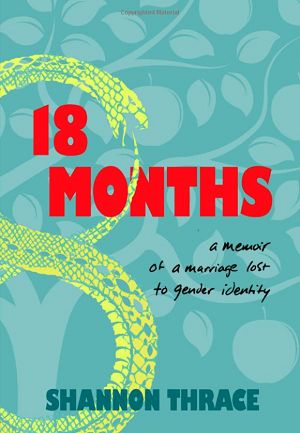
The trans community is diverse, especially when it comes to attitudes toward sex. As writer Angus Fox noted in a seven-part Quillette series, When Sons Become Daughters, some biologically male trans-identified teenagers live a sexless existence; and are drawn to puberty blockers and androgynous aesthetics precisely because they seem to offer safe harbour from male sexual development. In the case of middle-aged men who abruptly adopt a trans identity later in life, on the other hand, it can be the opposite: the presentation is often hyper-sexualized.
(more…)
October 18, 2022
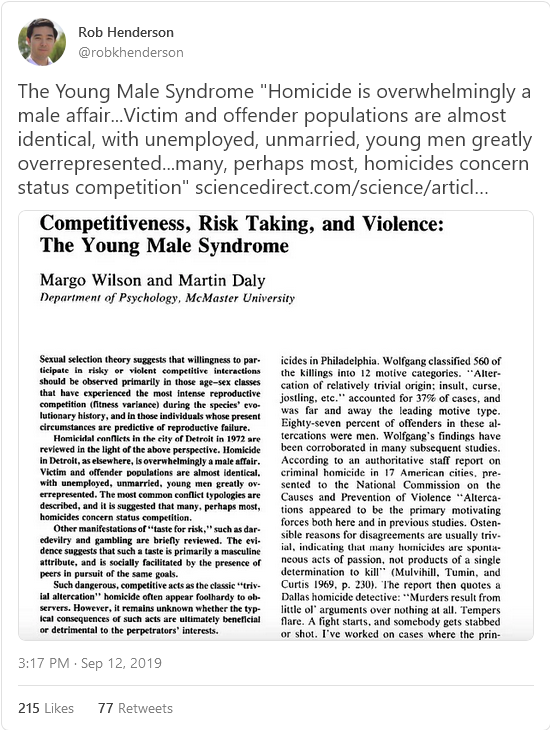
“On average, a twenty-five year old man has the same level of impulse control as a 10 year old girl”
Rob Henderson considers how early humans managed to overcome violent tendencies as human communities got larger, and specifically considers the social role of young men, then and now:
One challenge to overcome involves the behavioral tendencies of young males.
[Oxford evolutionary psychologist Robin] Dunbar writes:
When males (and younger males, in particular) are deprived of social, economic, and mating opportunities, they are prone to behaving in ways that both stress other group members (especially reproductive females) and threaten the stability and cohesion of the group. This is as true of the more social primates as it is of humans, and is often associated with high mortality rates. Under these circumstances, males are also likely to indulge in raiding neighbouring groups, which can result in poor inter-community relations as well as retaliation. Managing male behaviour may, thus, be critical to maintaining an environment conducive to successful reproduction.
Young males are (unknowingly) experts at disrupting social cohesion. To be fair, they are also required to maintain and defend it. They’re a mixed bag.
Disputes that spill over into violence and homicide have been an ever-present risk in both contemporary and pre-modern small scale societies. Young men make up the overwhelming majority of such conflicts, both as perpetrators and as victims.
[…]
The vast majority of violence is carried out by young men.
Psychologically, a key reason for this is that women are more sensitive than men to penalties. Men are more inclined to take risks, oblivious to the punishments they may receive. Men also have lower levels of empathy and a higher tolerance for pain.
The psychologist Simon Baron-Cohen has posited the hypothesis of the “extreme male brain”, suggesting that males are at higher risk for a clinical diagnosis of autism because of the constellation of traits men tend to score higher on (e.g., systematizing over empathizing, favoring things over people, etc). It also implies that most males may be a little bit autistic. Of course, some women score highly on these traits, and there are girls and women who are diagnosed with autism. Just at much lower rates than males.
I have wondered if, in addition to autism, the idea of the “extreme male brain”, could just as easily apply to psychopathy.
For both psychopathy and autism, the ratio of males to females is about three to 1.
Men (especially young men) are more pronounced than women on just about every trait that characterizes psychopathy.
Relatively low impulse control, low empathy, low fear, high sensation seeking, relatively shallow emotions, need for stimulation, proneness to boredom, violent fantasies, desire for revenge, and increased likelihood of criminality. Of course, some women score highly on these traits, and there are women who are psychopaths. But far fewer than males.
The psychologist John Barry has pointed out that when he was a student, he learned he couldn’t use standard adult psychopathy tests to administer to teenage boys. The reason? Because adult tests might give teen males a false positive.
Just as (relative to women) most men might be a little bit autistic, most (young) men might be a little bit psychopathic.
On average, a twenty-five year old man has the same level of impulse control as a 10 year old girl.
October 14, 2022
When Potatoes were Illegal
Tasting History with Max Miller
Published 7 Jun 2022
(more…)
QotD: High school
You didn’t understand this back then, of course, but your parents did, and — crucially — your teachers did. If you wanted to be a Metalhead this semester, they’d treat you like a Metalhead, complete with the “Why are you wasting your potential (and ruining your ears) with that godawful noise?” They’d make a show of having a Very Serious Conversation with you about the dangers of drugs and satanism … knowing full well that you weren’t on drugs, weren’t sacrificing virgins to Moloch (if for no other reason than you didn’t actually know any girls), and would, in fact, come back as a clean-scrubbed Preppie after summer break your junior year.
The key word in “adolescent rebellion”, after all, is adolescent. All of that stuff was just practice. If it proceeded in the normal way, what going through all the permutations of high school identity taught you was:
- you’re a fairly normal person; and
- that’s ok.
In other words, you are not a collection of externals — clothes, music, hairstyles. You’re you. The externals can change, fairly radically — remember that one summer you broke your nose trying to be a skater? — but there’s a core in there that’s you. Which is great, because it means that you are just a person who takes customer service calls in a cubicle farm to pay the bills; they’re not going to put “Here lies Bill, a Customer Service Representative” on your tombstone.
Severian, “The Basic College Girl”, Rotten Chestnuts, 2019-07-24.
October 12, 2022
Medically assisted suicide in Canada
In Common Sense, Rupa Subramanya discusses how quickly MAID (Medical Assistance in Death) became a commonality in Canada:
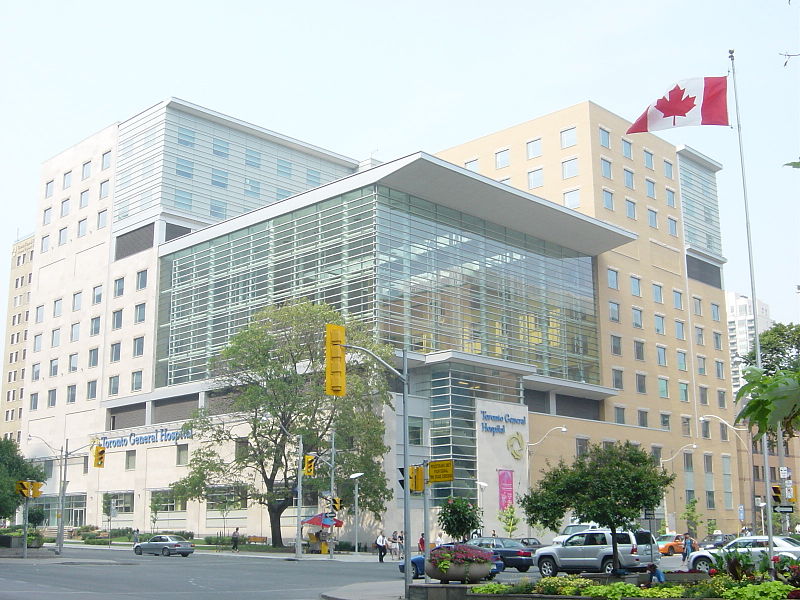
Toronto General Hospital in 2005.
Photo via Wikimedia Commons.
When we think of assisted suicide or euthanasia, we imagine a limited number of elderly people with late-stage cancer or advanced ALS in severe pain. The argument for helping them die is clear: Death is imminent. Why should they be forced to suffer?
In 2015, Canada’s Supreme Court ruled that assisted suicide was constitutional. In June 2016, Parliament passed Bill C-14, otherwise known as the Medical Assistance in Dying Act. MAiD was now the law of the land. Anyone who could show that their death was “reasonably foreseeable” was eligible. In this respect, Canada was hardly alone: The Netherlands, Switzerland, Belgium, Spain, Australia, and New Zealand, among others, allow assisted suicide. So do ten states in the U.S.
In 2017, the first full year in which MAiD, which is administered by provincial governments, was in operation, 2,838 people opted for assisted suicide, according to a government report. By 2021, that figure had jumped to 10,064 — accounting for more than 3 percent of all deaths in Canada that year.
There have been a total of 31,664 MAiD deaths and the large majority of those people were 65 to 80 when they died. In 2017, only 34 MAiD deaths were in the 18- to 45-year-old category. In 2018, that figure rose to at least 49. In 2019, it was 103; in 2020, 118; and in 2021, 139.
Today, thousands of people who could live for many years are applying — successfully — to kill themselves.
Indeed, in some Canadian provinces nearly 5 percent of deaths are MAiD deaths. In 2021, the province of Quebec reported that 4.7 percent of deaths in the province were due to MAiD; in British Columbia, the number was 4.8 percent. Progressive Vancouver Island is unofficially known as the “assisted-death capital of the world”, doctors told me.
Why the dramatic increase? Over the past few years, doctors have taken an increasingly liberal view when it comes to defining “reasonably foreseeable” death. Then, last year, the government amended the original legislation, stating that one could apply for MAiD even if one’s death were not reasonably foreseeable. This second track of applicants simply had to show that they had a condition that was “intolerable to them” and could not “be relieved under conditions that they consider acceptable”. This included applicants like Margaret Marsilla’s son, Kiano.
In 2023, those numbers are almost certain to rise.
Next March, the government is scheduled to expand the pool of eligible suicide-seekers to include the mentally ill and “mature minors”. According to Canada’s Department of Justice, parents are generally “entitled to make treatment decisions on their children’s behalf. The mature minor doctrine, however, allows children deemed sufficiently mature to make their own treatment decisions.” (The federal government does not define “mature”, nor does it specify who determines whether one is mature. On top of that, the doctrine varies from one province to another.)
Dr. Dawn Davies, a palliative care physician who supported MAiD when it was first conceived, said she had “tons of worries” about where this might lead. She could imagine kids with personality disorders or other mental health issues saying they wanted to die. “Some of them will mean it, some of them won’t,” she said. “And we won’t necessarily be able to discern who is who.”
Hugh Scher, an attorney advising Margaret Marsilla, told me: “While other countries have explored extending assisted suicide to minors, those governments have insisted on substantial safeguards, including parental notification and consent. Canada is poised to become the most permissive euthanasia regime in the world, including for minors and people with only psychiatric illness, having already removed the foreseeability of death or terminal illness as an essential condition to access euthanasia or assisted suicide.”
October 6, 2022
The pendulum swings back toward institutionalization
During the 1950s and 60s, many mental institutions were shut down due to concerns about the way the patients in those institutions were being treated. Those suffering from mental health issues were, to a large degree, just discharged into the larger community with few supports to help them re-integrate. Today, the concerns about severely mentally ill peoples’ actions may be pushing the system back toward some form of formal re-institutionalization, as Michael Shellenberger reports for Common Sense:
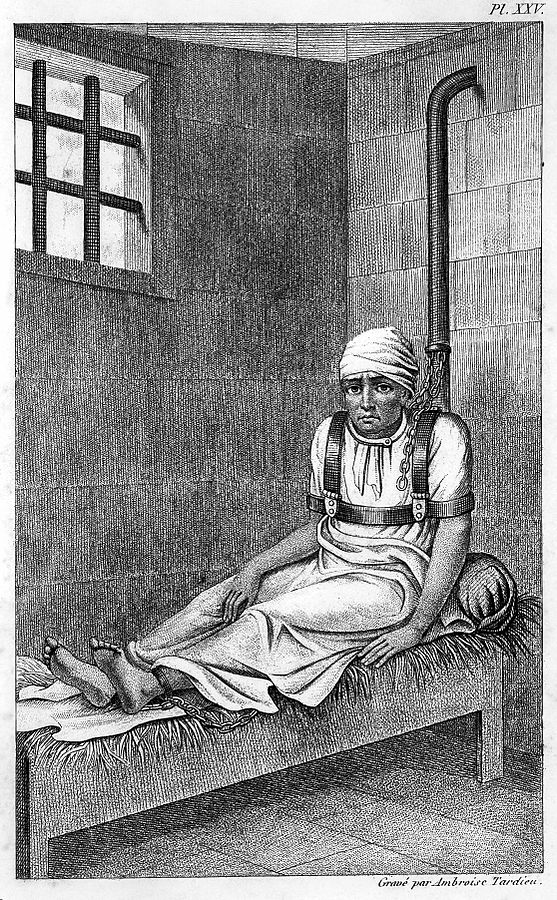
William Norris, shackled sitting upright on his bed at Bedlam, 1838.
Engraving by Ambroise Tardieu, Des maladies mentales Esquirol via Wikimedia Commons.
Though it is difficult to get an exact estimate, a large body of research makes clear that people like Zisopoulos, Mesa, and Simon are just three among hundreds of cases of people in New York alone — to say nothing of cities like Los Angeles, Seattle, San Francisco and others — in which mentally ill people off their medication have assaulted or killed people. And if you think the problem is getting worse, you are right.
In 2021, felony assaults in New York’s subway were almost 25 percent higher compared to 2019, despite a lower ridership because of the pandemic. The number of people pushed onto tracks rose from 9 in 2017 to 20 in 2019 to 30 in 2021. Psychiatrists and emergency department workers in San Francisco and Los Angeles tell me that they have seen a significant increase in homeless patients in psychotic states over the last few years.
How have we arrived at the point where we leave people with psychosis to their demons, and leave the public to take their chances? How have we allowed so many of our cities to have no decent plans or places for the burgeoning number of the violent mentally ill on the streets?
There are two major forces at work. The first is that the U.S. never created a functioning mental health care system. The second is that powerful groups have effectively prevented dangerously mentally ill people from getting treatment.
Starting in the late 19th century, the U.S. created large psychiatric hospitals, often in the countryside, known as asylums, for the mentally ill. Asylums were a major progressive achievement because they delivered, for many decades, significantly more humane, evidence-based care to people who, until then, had often been neglected, abused, or even killed.
But by the middle of the 20th century, the reputation of psychiatric hospitals was in tatters — and deservedly so. Conditions in many of them were appalling, even barbaric. People who were not severely mentally ill were sometimes subjected to years of involuntary hospitalization.
Many reformers just wanted better funding and oversight, but other reformers were more radical, and proposed shutting the hospitals down entirely and replacing them with community-based clinics. Some reformers claimed that serious mental illnesses were the result of poverty and inequality, not biology, and argued that they could be cured through radical social change.
The reformers largely won. State hospitals were shut down in droves before sufficient community centers could be built to treat the suffering. Over the next two decades, as state mental hospitals emptied out, many released patients ended up on the street, or incarcerated. Those community clinics that did start operating tended to treat “the worried well” — those suffering from comparatively low-level anxiety and depression, rather than psychosis.
Decades later, governments were still cutting funding for the treatment of the mentally ill. New York State in 2010 reduced Medicaid reimbursement for inpatient stays of the mentally ill in hospitals beyond 12 days. As a result, New York hospitals released the mentally ill earlier than they should have. From 2012 to 2019, the number of mentally ill adults in inpatient psychiatric care in hospitals and mental institutions in New York City declined from 4,100 to just 3,000. Meanwhile, the number of seriously mentally ill homeless people rose from 11,500 to 13,200.
The story is similar in California. Between 2012 and 2019, more than one-third of the group homes in San Francisco that served mentally ill and disabled people under the age of sixty closed their doors. Why? The measly Medi-Cal and Medicare reimbursement of $1,058 per person per month, and rising estate prices, made it more valuable for the private owners of group homes to sell than to keep operating them.
At the national level, the same dynamic was in play. The U.S. as a whole lost 15,000 board and care beds for the mentally ill and disabled between 2010 and 2016. Today, approximately 121,000 mentally ill people are conservatively estimated to be living on America’s streets.
October 3, 2022
“Still, what about the boys?”
Janice Fiamengo on the far-from-impartial emphasis of concern on young people being pushed toward radical “solutions” to gender dysphoria:
Last year, conservative educational institution Prager U published “Why Girls Become Boys“, a short video by journalist Abigail Shrier, the author of Irreversible Damage: The Transgender Craze Seducing Our Daughters, published in 2020. Shrier’s focus is evident from the titles: girls. Previously, Shrier had been profiled in an interview with Candace Owens when she was still working on the book. Though the interview is now three years old, its canvassing of teen transitioning — in a discussion that moves from concern about girls being “seduced” into trans, to anger at society’s failure to protect girls from boys who transition — provides a fairly accurate representation, I believe, of conservative positioning on this subject. Girls who transition are seen as victims; while boys who transition are seen (if they are seen at all) as predators.
This double emphasis is clear in the interview. Shrier and Owens describe the collusion of media influencers, the public school system, woke punditry, and medical authorities to encourage girls (but not boys, it seems) to consider their gender identity “fluid”. Feelings of discomfort are too readily interpreted as signs of a trans identity. Girls can be made to believe themselves trans very quickly, sometimes simply from viewing one or more internet videos; and schools are not required to tell parents if their daughter begins identifying as male. From age fifteen, girls can find gender clinics willing to prescribe testosterone without their parents’ consent; a girl can have her breasts amputated as early as age sixteen. The lifetime of dependency on hormones (their consequences unknown), the risky surgeries, and the tragic missed opportunities — of motherhood in particular, but even of having breasts — were emphasized by both pundits.
It’s almost impossible to imagine these two women discussing the tragedy of losing a penis, of being denied the opportunity to become a father, of being denied the joy of male sexuality.
From this point, the conversation moved seamlessly into discussing the victimhood of girls forced to share their private spaces — and of course their sporting competitions — with biological males (often called “men” as in “Men are invading girls’ sports”). These males are not discussed as vulnerable innocents duped into taking body-altering hormones or undergoing dangerous surgeries. No imaginative effort was spent on why these boys want to live as trans female. The underlying assumption seemed to be that boys’ transition, far from being an attempt to relieve real distress, is an act of appropriation of female experience. The boys were depicted as aggressors who invade girls’ locker-rooms and deny girls opportunities (or, even worse, masquerade as trans in order to prey on girls sexually). Are there boys made uncomfortable in their change rooms or other private spaces by the presence of biological girls? The question seems never to have occurred to Shrier and Owens.
Shrier and Owens agree in decrying feminism for failing to protect girls and for failing (allegedly) to affirm femininity and girlhood. “Girls aren’t being told how wonderful it is to be a girl!” Their own feminist — or at least female-centered — assumptions are clearly evident in their conviction that the trans phenomenon is about multiple harms to females, harms which must always take precedence over the legitimate needs and experiences of males. And in fact, contrary to what Shrier and Owens seem to believe, there are many feminists who vehemently denounce biological male incursions into female bodies and spaces; many of them, such as Meghan Murphy, Julie Bindel, and Sheila Jeffreys, to name only a few, advocate from an avowedly anti-male perspective.
Shrier might respond that the overwhelming majority of adolescents who believe themselves to be trans are female (as she states in her Prager U video). This may be true (a recent Psychology Today article puts the number at greater than 80% female) but does not mitigate my objection. Teen suicide is about 80% male (more on this later), but it is hard to imagine concerned pundits ignoring the troubles of girls. Many discussions of teen suicide, in fact, make much of the fact that girls attempt suicide more often than boys, downplaying the fact that boys carry out their suicides in such distinctively high numbers. Don’t get me wrong: I have no objection to a focus on girls’ difficulties in adolescence — except when it improperly ignores and even maligns boys.
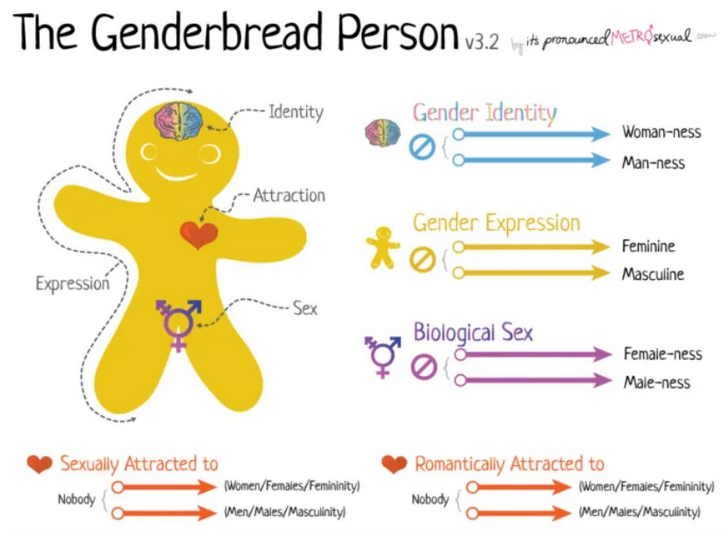
It wasn’t all that long ago that the vast majority of young people seeking “gender-affirming” therapy were males hoping to become trans-females. In the last few years, that proportion has flipped completely.
September 28, 2022
There are two kinds of people online talking about mental illness: those suffering with mental illness and those glorying in the attention they get for faking it
Freddie deBoer on the phenomenon of mental health culture online and the two primary kinds of participants (my headline over-dramatizes the case he’s actually making):
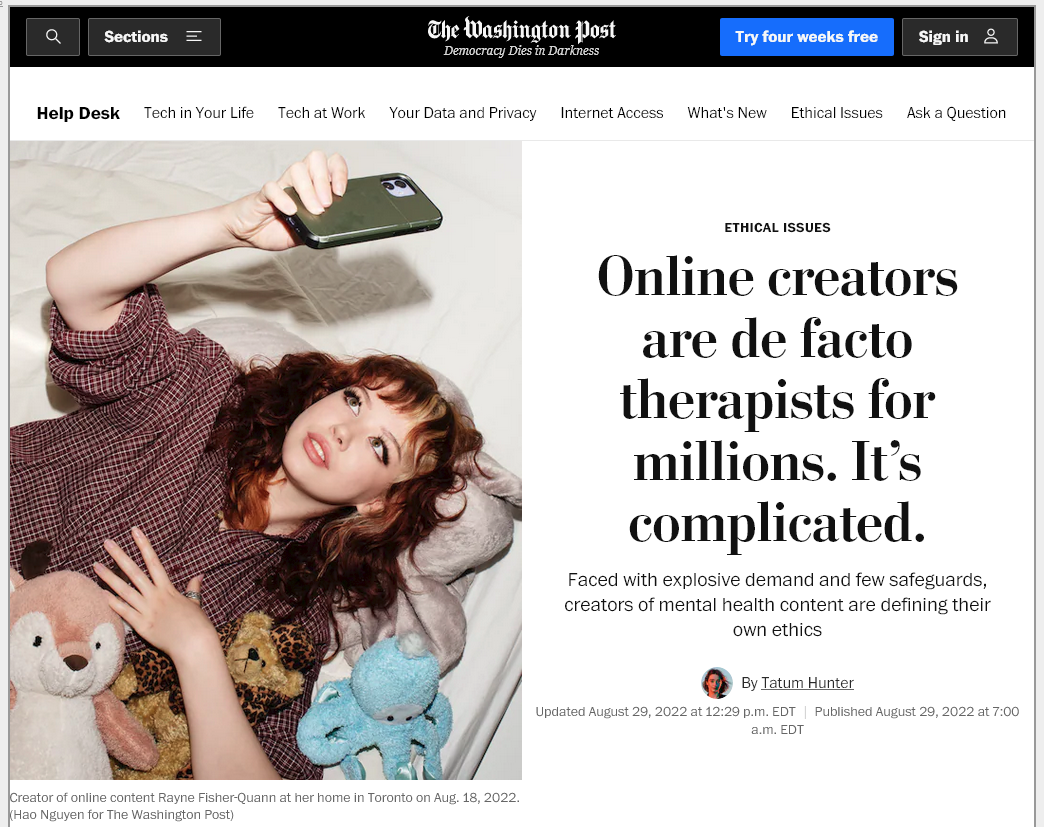
I was not, at first glance, inspired with confidence by this Washington Post piece on online mental illness culture. The piece has a header image of a “mental illness influencer” lounging in bed, taking a selfie. I’m someone who’s committed to de-glamorizing mental illness, and I’ve been begging people to stop romanticizing pathology for a long time. I suppose there’s an implied critique in that photograph, but it’s not ideal.
On substance, Tatum Hunter’s piece fails the way so many others have failed in this milieu: it studiously avoids the possibility that some people who talk about their mental illnesses online don’t really have them. I’m not specifically talking about simple fraud and lies, which I suspect are rare, but rather the weird combination of hypochondria, Munchausen’s syndrome, and social contagion that we see all around us in these spaces. Spend any time at all in these communities on Tumblr or Tik Tok and you will find many people, most of them young, who are using mental illness as a means to self-define, to differentiate themselves from the hordes of other people they see online who are just like them. I’ve written again and again about why it’s a bad idea to want to be your mental illness, and it’s even worse to want to be mentally ill, period – not just bad for other people, but bad for you. But there are people who have become influencers and garnered hundreds of thousands of followers on their apps of choice by performing mental illness. People use their disorders to chase clout. That’s just reality.
Hunter considers the problems of misdiagnosis, of self-diagnosis, of people undertaking mental health care on the advice of internet randoms rather than under the care of a doctor, but nowhere does she seriously consider the possibility that the basic problem for many people is that they believe they have mental disorders they don’t in fact have. I think doing so is seen, at this point, as a kind of identity crime, and thus unlikely to be found in the Washington Post.
But hypochondria exists. Munchausen’s syndrome exists. Psychosomatic illness exists. I can get people to admit to those realities in the abstract, now, but they stay entirely in the abstract – to suggest that any group of people is suffering under those conditions, rather than under authentic mental illness, is treated as a sin. This was my biggest disappointment with Ross Douthat’s book on his chronic illness, which I quite liked overall; Douthat never stops his narrative to ask whether any of the people who believe themselves to be sick from chronic illness actually aren’t. (Surely he himself suffered, but because of the woo and mysticism found in that space, an accounting was necessary.) And I don’t know how we confront the spiraling number of people claiming to have illnesses for which there are no objective tests without being frank about the existence of hypochondria, Munchausen’s, and psychosomatic illness – particularly when people insist on deepening the social incentives by giving the sick more and more attention.
Even for the authentically ill, online culture is fraught. The meta-problem with pieces like that in WaPo, obviously, is that by giving certain members of this community the glamour shot treatment (literally in this case), they’re creating direct incentive for people to make illness their identity -and to not get better. Young people understand the allure of being seen; they don’t yet understand the horror of being frozen in other people’s gazes. They don’t understand the costs of being defined. There have been many opportunities for me to make myself the mental illness guy, certainly including financial opportunities. Perhaps I’ve already fallen into that trap, despite my efforts to remain a generalist. But I’ve fought to avoid that because I know just how painful and limiting self-definition can become. I’m sorry to pull wizened old guy here, but young people don’t understand. They don’t understand that pinning yourself down that way can produce a kind of horror.
September 27, 2022
Is Kayla Lemieux the leading edge of LGBT tolerance or a “dude gaming the system”?
Back on September 16, I posted a link to the then-breaking story of the teacher in Halton whose prosthetic breasts had poked into news headlines everywhere: “This is either the teacher of the year (come on, you know that’s inevitable because reasons) or someone doing an epic physical and psychological parody of our culture right now.” It’s nearly two weeks later, and we’re still not really clear on which of those two possibilities is closest to the truth. At PJ Media, Athena Thorne is making a case for the epic prank case:
There is the most titillating rumor being bandied about the interwebs right now. And while it may or may not be true, it’s certainly food for thought. It concerns “Kayla Lemieux”, the infamous trans-woman shop teacher at Oakville Trafalgar High School (OTHS) in Ontario, Canada.
An anonymous poster on an online forum recently made a claim about Lemieux’s shop class back when “Kayla” was still Mr. Kerry Luc Lemieux. The post reads:
This dude is gaming the system. An anon here yesterday was in this dude’s class. This teacher was almost fired for ‘toxic masculinity’ last year, as well as not embracing woke culture. He’d drop redpills to his class, such as how silly gender neutral bathrooms are. The school board hates him.
He’s now upping the ante to exploit the very clown world the school and society itself created. His long game is most likely to get fired, and then sue for discrimination. There is no other explanation… No better way to troll clown world than to become an over-the-top caricature of a woman.
File this allegation under “Huge if True” (lol). Imagine for a moment that the anonymous person is telling the truth. If that is the case, then this teacher is the greatest hero the sane world has fronted yet.
If Lemieux is indeed pranking the school board, then he is a genius. When images of the trans-busty high school shop teacher began spreading like wildfire online, the outrage was swift and formidable. OTHS and the Halton District School Board (HDSB) went on the defensive — and it quickly became evident that they had painted themselves into a corner with their mindless commitment to “inclusion”.
“We are aware of discussion on social media and in the media regarding Oakville Trafalgar High School. We would like to take this opportunity to reiterate to our community that we are committed to establishing and maintaining a safe, caring, inclusive, equitable and welcoming learning and working environment for all students and staff”, said OTHS in an email sent to parents and obtained by feminist news site Reduxx.

September 22, 2022
QotD: In my 20s … and in my 40s
Me in my 40s: Sleeps with head at slightly different angle than usual. Spends 3 weeks taking painkillers for neck pain whilst sobbing and wondering if my life will ever be the same again.
Amanda (@Pandamoanimum), Twitter, 2022-06-13.


