Quotulatiousness

March 31, 2023

Bill C-11 should properly be called the “Justin Trudeau Internet Censorship Bill”

In The Free Press, Rupa Subramanya explains why the federal government’s Bill C-11 is a terrible idea:

Canada’s Liberals insist the point of Bill C-11 is simply to update the 1991 Broadcasting Act, which regulates broadcasting of telecommunications in the country. The goal of the bill, according to a Ministry of Canadian Heritage statement, is to bring “online broadcasters under similar rules and regulations as our traditional broadcasters”.

In other words, streaming services and social media, like traditional television and radio stations, would have to ensure that at least 35 percent of the content they publish is Canadian content — or, in Canadian government speak, “Cancon”.

The bill is inching toward a final vote in the Canadian Senate as soon as next month. It’s expected to pass. If it does, YouTube CEO Neal Mohan said in an October blog post, the same creators the government says it wants to help will, in fact, be hurt.

[…]

If you’re confused by all this — if you’re wondering why the Liberal Party and its allies in these quasi-governmental organizations are suddenly so worried about Canada’s national identity — that’s understandable.

In a 2015 interview with The New York Times, Trudeau proudly declared, “There is no core identity, no mainstream in Canada.” Canada, he explained, is “the first postnational state”. The authorized, two-volume biography of Trudeau’s father, former prime minister Pierre Trudeau, is called Citizen of the World. Pablo Rodriguez maintains dual citizenship — in Canada and in Argentina, where he was born.

So why is Trudeau, of all people, championing this legislation? There’s an easy explanation — and it has nothing to do with borders or culture.

“Bill C-11 is a government censorship bill masquerading as a Canadian culture bill,” Jay Goldberg, a director at the conservative Canadian Taxpayers Federation, told me. Referring to the Canadian Radio-television and Telecommunications Commission, Goldberg said, “The government is intending to give the power to the CRTC to be able to filter what we see in our news feeds, what we see in our streaming feeds, what we see on social media.”

Supporters of Bill C-11 emphasize it would affect only YouTube, Netflix, Amazon, TikTok, and other Big Tech platforms; the Heritage Ministry statement notes “the bill does not apply to individual Canadians”. But the language is so vague that it’s unclear how it would actually be implemented.

For example, it would be up to CRTC regulators to decide what constitutes “Canadian” content. The singer The Weeknd was born in Toronto but now mostly lives in Los Angeles. Does he still count as Canadian? What about rock n’ roller Bryan Adams, who was born in Kingston, Ontario, and spends a great deal of time in Europe?


March 30, 2023

“Food insecurity” – one of the neat new benefits of our over-regulated economy

Filed under: Bureaucracy, Cancon, Environment, Food, Government, Politics — Tags: , , , , , , — Nicholas @ 04:00

Elizabeth Nickson on how western governments (in her case, the provincial government of British Columbia) are working hand-in-glove with environmental non-governmental organizations to create “food insecurity”:

Original image from www.marpat.co.uk

In Canada, the British Columbia government in order to increase “food security” is handing out $200,000,000 to farmers in the province. Food insecurity, which means crazy high food prices, comes to us courtesy of the sequestration of the vast amounts of oil and gas in the province and the ever increasing carbon tax, which (like a VAT in Europe), as you probably know, is levied at every single step in food production. Add the hand-over-fist borrowing in which the government has indulged for the last 20 years, and you have created your own mini-disaster.

Ever since multinational environmental non-governmental organizations (ENGOs) took over public opinion in the province, our economy has been wrenched from resource extraction to tourism. Tourism is, supposedly, low-impact. The fact that it pays $15 an hour instead of $50 an hour and contributes very much less to the public purse than forestry, mining, farming, ranching, oil and gas, means we have had borrow to pay for health care and schooling. This madness spiked during Covid, and, as in every “post-industrial” state, has contributed to making food very, very much more expensive, despite the fact that British Columbia where I live, is anything but a food desert. We could feed all of Canada and throw in Washington State.

Inflation comes from a real place, it has a source, it is not mysterious and arcane. Regionally, it comes from “green” government decisions. I pay almost 70 percent more for food now than I did five years ago. Of course one cannot know with any confidence how much the real increase is. The Canadian government was caught last week hiding food price statistics and well they might. The Liberal government leads with its “compassion”, blandishing the weak and foolish, hiding the fact that in this vast freezing country they are trying to make it even colder by starving and freezing the lower 50 percent of the population.

Even the Wasp hegemony that ran this country pre-Pierre Elliot Trudeau knew not to try that. But not this crew! It doesn’t touch them. They don’t see and wouldn’t care if they did, about the single mother working in a truck stop on the Trans-Canada Highway, who steals food for her kids because all her money is going towards keeping them warm.

[…]

The region in which I live used to grow all the fruit for the province, now, well good luck with that buddy. Last year under the U.N. 2050 Plan, local government tried to ban farming and even horticulture. That was defeated so hard that the planner who introduced it was fired and the plan scrubbed from the website. Inevitably it will come again in the hopes that citizens or subjects, as we in Canada properly are, have gone back to sleep. U.N. 2050, an advance on 2030, locks down every living organism, and all the other elements that make up life, assigns those elements to multinationals, advised by ENGOs, which can “best decide” how to use them.

If the only tool you have is a hammer, it’s tempting to treat everything as if it were a nail. It is only the most arcane and numerate think tanks who bang on and on about over-regulation and how destructive it is. Regulation is so complex that most people would rather do anything than think about it, much less deconstruct it.

QotD: Revealed preference in the teenage hellscape of high school

Filed under: Health, Politics, Quotations, USA — Tags: , , , — Nicholas @ 01:00

This demonization of masculinity conflicts with the reality that any boy can see with his own two eyes: The cutest girls in school are attracted to the most masculine boys, and masculine not just in terms of physical traits, but also in terms of personality traits — confidence, assertiveness, “swagger”. Here we see a problem with what Rational Male author Rollo Tomassi calls the feminine-primary social order. Every observant man knows that there is a yawning chasm between (a) what women say they value most in a man and (b) the kind of man women actually go for. Listen to what women say, and you’d think they are magnetically attracted to “sensitive” guys. Watch what women actually do, and you can see that women obviously don’t actually care about “sensitivity”. Women want men who are tall and muscular and, ceteris parabus, rich, although no amount of money is going to make a short chubby guy sexy. As for the claim that women go for “sensitive” guys, anyone with two eyes and a brain knows this is nonsense. You don’t see throngs of lovestruck college girls chasing after guys who major in sociology or English literature (unless, of course, these guys are also tall, muscular and rich). No, it’s the jocks and frat boys who get the best action on campus, and if you pay attention to the choices women make, you’ll begin to suspect that their professed preference for “sensitive” men is the exact opposite of truth. That girl who was lecturing you about your need to be more “sensitive” will, with surprising regularity, end up falling head-over-heels for some selfish creep or dimwit brute who can’t even spell the word “sensitivity”.

Robert Stacy McCain, “Conflicting Signals”, The Other McCain, 2019-05-23.

March 27, 2023

The vicious – not virtuous – circle of green

Filed under: Economics, Environment, Government, Media, Politics — Tags: , , , — Nicholas @ 05:00

Elizabeth Nickson thinks that our societal pursuit of green technology will be the undoing of everything we have built:

Some of us have been saying this for a very long time: green will bring down the world. Green creates a vicious circle, a term you may remember from Economics 101. It is when the serpent eats itself, no wealth is created and collapse results. That is what we are doing with ESG, with carbon taxes, with the forced adoption of unreliable vertiginously expensive green energy. It has skewed every single market. No one is investing in sound enterprise, and anything once sound is a Jenga tower, unstable, rotting from within. This. This is what threatens to bring down the world.

Green is built on subsidies. And not just government subsidy. Every mutual fund, every hedge fund, every multinational and every local or national corporation has a green monster within preventing innovative investments, sucking profits and growth. Every local, regional and state government leaks millions to green morons promising to “bring sustainable prosperity”. The only prosperity is theirs. They fiddle around in lakes and watercourses, producing “studies”, all of which are hysterical and exaggerated. They muck around in forests, buying as much as possible, shut them down, never visit again, leaving them to desertify. They buy farms and ranches, leaving them to rot. They are termites, eating us alive.

These outfits have burrowed into every level of government and every ministry. They are purely extractive. They do not produce anything of value. They leech. They move in and out of government. When in government, they identify sources of funds to plunder once out of government. In 2015, I did a cross-ministry analysis of just how much money these folks take from the government annually. It is in the hundreds of billions in the US alone. From private foundations they take more billions. All this money is used to shut down economic activity.

[…]

Here is the nasty little secret that lies at the heart of environmentalism. It has been long captured by plutocrats and WEFers, who use it to take resources once thought to belong to the people, to everyone, to use in order to innovate and develop. This freedom and access, and only this was the source of prosperity in the United States. It powered the entire world. It made America the beacon, the lighthouse of the world. It produced strong healthy brilliant young people who performed one feat of innovation, athleticism, and creation after another. All those kids today are working on ever more vicious ways to surveil, control and supress via AI.

And the interior is being cleared of people, businesses, farms, ranches, working forests, mines, and oil and gas installations.

In pursuit of 2030 goals, Biden’s agents are busily acquiring hundreds of millions of acres from private owners, from state and regional land banks, which they will then lock down. Many ranchers, including the heroic Wayne Hage, believe that government is taking that land to use as collateral for its massive debt to the Bank for International Settlements. The only people who will be able to use those resources are multinationals who pay a fee to government and to the BIS to pay down the loans. No citizens will be able to access those resources to make money for themselves, to build families and businesses and towns and cities. The environmental movement has, within 40 years, returned us to serfdom, where we eat what we are told to eat, go where we are told to go, take whatever medicine they want to give us, and eventually, fight when we are told to fight.

The environmental movement is so evil, it has twisted ethical standards to the point where we are able to kill each other with impunity. Their PR is so strong, so invasive, that every school child now believes there are too many people (this is nonsense), and population must be drastically drawn down (a genocide unrivalled in history). Every adult secretly fears this is true. This appalling lie has created a culture of death. What are the effects of this thinking, that life is no longer sacred, but a threat?

The war against fertility

Filed under: Britain, Cancon, Media, Politics, USA — Tags: , , , , , , , — Nicholas @ 03:00

Chris Bray:

The effacement of women’s bodies is changing from a cultural signal to a battlefield maneuver. The acceleration of the presence of men as dominant participants in women’s sports, the growing intensity of casually monstrous blue zone attacks on families and parenting, the emergence of drag queens — men playacting as women, burlesque cartoons about sexual identity — as The Most Important Symbol Ever (and something children should definitely see) …

… and now this:

That’s footage from a Let Women Speak event in Auckland, New Zealand, where women arguing that “women” are “adult human females” were physically attacked by a mob of “transwomen” — by men — and their allies. It’s very progressive when men dressed as women silence women and hurt them. More here, also linked above.

In the opening paragraph of this post, you may have thought that one of the things I mentioned was different than the other things — that the blue state assault on families and parenting isn’t specifically gendered, and is equally an assault on the role of mothers and fathers. And it is. But.

It seems to me that the very very strange thing breaking out all over the world — or all over the Anglosphere, because I don’t see Nigeria and Peru and Singapore going all-in on transgendered everything — is loaded with subtext about a febrile loathing for fertility. In policy, we’re incentivizing childlessness, and disincentivizing childbearing. Birthrates are declining sharply, and were declining even before the mRNA injections, while blue state governments work on laws that tell would-be parents their children can vanish from their custody on political pretexts. Who has the future children while the state says that hey, nice family you have there, be a shame if something were to happen to it?

I suspect the reason so much hate and rage is being directed at women is that their bodies can produce babies, which means that the hate and rage is being directed at the future. Peachy Keenan, who’s all over this stuff in multiple forums, wrote recently about Hicklibs on Parade, describing “how deeply the postmodern, anti-human gender ideology has penetrated into what we used to call ‘middle America'”:

    In Plano, Texas last fall, an “all-ages” drag brunch attracted some unwanted attention from people who thought they lived in a conservative state. At the brunch — which was held at Ebb & Flow, an eatery in an upscale strip mall — a buffoonish man in a dress wearing cat ears sings, “My p*ssy good, p*ssy sweet, p*ssy good enough to eat”, while flashing his underwear.

    In the video from the event, a four-year old girl stares in shock as the “drag” performer twerks and grinds for the ladies in attendance.

    The people in the crowd watching this man systematically strip away a little girl’s innocence look like nice friendly Texans; plump grandmas and families and the types you’d run into at the local Costco. They are not hipsters; they are not edgy. They look normal!

    This is what makes all of this so striking. These slightly downmarket Texan and Midwestern prairie home companion women have, historically, been the only thing holding this rickety old country together.

QotD: Homo electronicus and the problem of instant communications

Filed under: Media, Politics, Quotations, USA — Tags: , , , , , — Nicholas @ 01:00

There are lots of problems with instant communications, and they really need a whole post (or series, or book) to themselves, but one is particularly relevant here. As discussed above, it’s not the technology itself, it’s the application. The internet, like TV, is one of those gadgets that are almost impossible not to use. If it’s there, you’re going to log on – it takes serious, frustrating effort not to. Try it!

One obvious consequence of this is that it turns the whole world into a giant hen party. Karen has always been with us, probably with equal prevalence. But as late as the mid-1990s, she’d have to confine her scolding to PTA meetings and places like that. But now everyone has the Internet, and social media’s a thing, and it’s just sitting there, compelling you to use it. Woman’s natural role as the guardian of the tribe’s mores becomes Karen-ism on crack.

Severian, “Recent Evolution”, Rotten Chestnuts, 2020-09-28.

March 26, 2023

Newspeak 2023

Filed under: Media, Politics — Tags: , , , , , — Nicholas @ 03:00

Andrew Sullivan on how our language keeps changing, top-down, whether we want it or not, from 9/11 through to tomorrow:

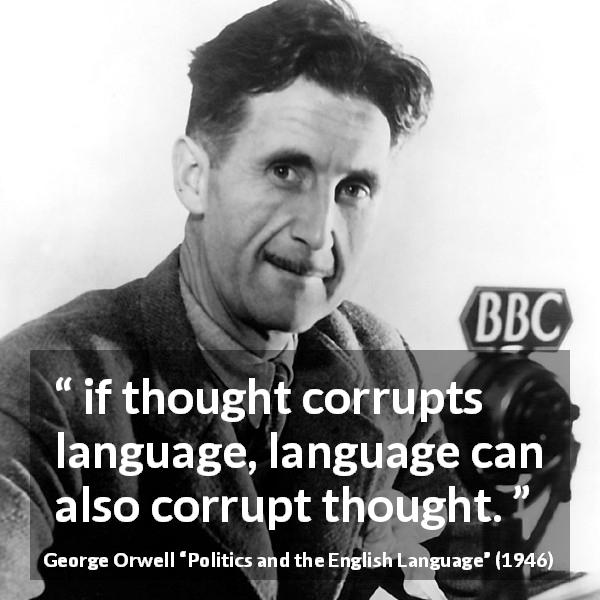
It was during the war in Iraq that Orwell’s insistence on clear language first came roaring back. This time, the newspeak was coming from the neocon right. We heard the term “enhanced interrogation techniques” to describe what any sane person would instantly call “torture”. Or “extraordinary rendition” — which meant kidnapping in order to torture. There was “environmental manipulation” — freezing naked human beings to near-death and back again. All the terms followed Orwell’s rules for new words “needed if one wants to name things without calling up mental pictures of them”. All the new terms were opaque and longer than the original.

And then, in the era of “social justice”, the new words began to come from the far left. Words we thought we knew — “queer” for example — were suddenly re-purposed without notice. Gay men and lesbians, with our very distinct experiences, were merged into a non-word, along with transgender people: “LGBT”. That was turned into “LGBTQIA+” — an ever-expanding acronymic abstraction that, in Orwell’s words, “falls upon the facts like soft snow, blurring the outlines and covering up all the details”.

Orwell’s insight was that these terms are designed to describe things you want to obscure. Hence one of his rules: “Never use a foreign phrase, a scientific word or a jargon word if you can think of an everyday English equivalent.” Writing the English that people speak every day is essential for a flourishing democracy.

Which brings me to that old English term “sex change”. Everyone instantly understands it. Which is, of course, precisely the problem. So now we say: “gender-affirming care”. Or take another word we all know: “children” — kids usually up to puberty. Also way too understandable. So “sex changes for children” suddenly becomes “gender-affirming care for minors”. These are the words, again, that are “needed if one wants to name things without calling up mental pictures of them”.

Or take the term “transgender” itself. Remember when it was “transsexual”? Or when “sex” was first distinguished from “gender” — and then replaced by it? The usual refrain is that “the community” switched the terms, which means to say that a clique of activists decided that gender would be the new paradigm, and include any number of “queer” postmodern identities, while sex — let alone “biological sex” — was to be phased out and, with any luck, forgotten. Now notice how the new word “transgender” has recently changed its meaning yet again, and now includes anyone, including straights, outside traditional gender roles — whatever those are supposed to mean.

Or check out the new poll from the Washington Post yesterday, in which a big majority of transgender people do not consider themselves either a “trans man” or a “trans woman” at all. They prefer “nonbinary” and “gender-nonconforming” — and distance themselves from both sexes. Less than a third physically present as another sex “all the time”. The vast majority have no surgery at all.

Now read Masha Gessen’s recent interview with The New Yorker, and get even more confused. Gessen denies that transness is one thing at all. S/he says it’s a different thing now than it was a decade ago, and that “being transgender in a society that understands that some people are transgender is fundamentally different from being transgender in a society that doesn’t understand”.

S/he says that there are “different ideas about transness within the trans community … probably different trans communities”. S/he denies a “single-true-self narrative” as some kind of anchor for identity. S/he believes that transitioning can be done many times, back and forth: “Some people transition more than once. Some people transition from female to male, and then transition from male to female, and then maybe transition again.”

If gender is entirely a social construct, with no biological character, why do transgender people want hormones — an entirely biological intervention? Because “being trans is not a medical condition, but it marries you for life to the medical system”. Huh? By the end of the interview, you get the feeling that trans is whatever Gessen bloody well wants it to be, and yet at the same time it remains beyond interrogation.

March 25, 2023

South Africa – from bad to indescribably worse

John Psmith reviews South Africa’s Brave New World: The Beloved Country Since The End Of Apartheid by R.W. Johnson. It isn’t a pretty picture at all:

    The whole world had come to Pretoria to see the inauguration of Nelson Mandela as the first democratically elected South African President. It was the greatest assemblage of heads of state since John F. Kennedy’s funeral … But it was the flight of nine SAAF [South African Air Force] Mirages overhead, dipping their wings in salute, which brought tears to many eyes. It said so many things: the acceptance of, indeed, the deference to, Mandela by the white establishment, the acknowledgement that he was fully President, able to command all the levers of power — and, for many black people in the crowd, it meant that for the first time the Mirages’ awesome power and white pilots were on their side, part of the same nation … All the products of that white power, including South Africa’s sophisticated economy and infrastructure, were being handed over intact.

A little over a decade later and that same South African Air Force was no longer able to fly. It wasn’t for lack of planes: new ones were procured from European arms manufacturers in an astonishingly expensive and legendarily corrupt deal. But once purchased the planes rotted from lack of maintenance and languished in hangers for lack of anybody able to fly them. Most of the qualified pilots and technicians had been purged, and most of the remainder had resigned. The air force did technically still have pilots, after all it would be a bit embarrassing not to, but those pilots were chosen for patronage reasons and didn’t technically have any idea how to fly a fighter jet.

It isn’t just the air force. That whole “sophisticated economy and infrastructure” that got “handed over intact” now by and large no longer exists. Consider something as basic as running water: in 1994, South Africa had some of the most sophisticated water infrastructure on earth, with a whole system of dams, reservoirs, and long-distance inter-basin conduits working together to conquer the geographical challenges of having several major cities and mining centers located on an arid plateau. All of this water was safe, drinkable, and actually came out of the tap when you turned the handle. This picture was marred of course by poor delivery to black rural communities and squatter camps, but in the early 90s the government was making rapid progress towards serving more of those people too.

Like the air force, that water system is now basically non-functional. It’s estimated that something like 10 million people no longer have reliable access to running water. When the water does run, it’s frequently filthy and contaminated with human sewage. South Africa had its first urban cholera outbreak in the year 2000, and they are now a regular occurrence. Again, like the air force, this isn’t for lack of money or effort. The state has spent billions on trying to fix the water problems, and the government’s water bureaucracy has tripled in size since 1994. Something else has gone wrong.

Neither of these examples is cherry-picked. Ask about literally any of the necessities for human life, and the picture is the same: basically first-world quality under the apartheid Nationalist government, and basically post-apocalyptic today. The electric grid is failing, with rolling blackouts consuming the country on a daily basis. The rail network, once one of the finest on earth, is now so degraded that mines in the North of the country prefer to truck their products overland to ports in Mozambique rather than risk the rail journey to Durban. The medical system was once the jewel of Africa and now teeters on the brink of collapse, with qualified doctors and nurses fleeing the country in droves. As for education, one South African author notes: “When Anthony Sampson’s authorized biography of Mandela appeared one of its more embarrassing asides was that all the educational institutions which had nourished Mandela had since collapsed. A Mandela could be produced in colonial times, but no longer.”

Had enough yet? At last count between a third and a half of the population is unemployed. Public order is non-existent outside gated communities and tourist areas patrolled by private security. The murder rate in South Africa exceeds that of many active war zones. Every major city in South Africa is among the most dangerous cities on earth, and the countryside is much worse than the cities. The reported cases of rape alone establish South Africa as the worst country on earth for rape, and the vast majority of cases are likely unreported, since the police have essentially stopped prosecuting this crime.

Something has gone very wrong. What happened? That’s the subject of this book by R.W. Johnson, an ultra-detailed examination of the 10 or so years following the end of apartheid in 1994. Johnson is the right guy to write this book — he’s lived in South Africa since the 1960s, and was active in the movement against apartheid from its earliest days, so he personally knows most of the players who’ve been running the country. And now he has the bittersweet task of writing a book documenting how what happened is “just what white racists predicted and what white radicals like myself scorned”.

March 23, 2023

Sometimes, it helps to know how the sausage is actually made

Filed under: Media, Politics, USA — Tags: , , , — Nicholas @ 03:00

Apologies to the ghost of Otto von Bismarck for misappropriating his famous quote “Laws are like sausages. It is best not to see them being made.” In this case, it’s actually quite enlightening to see how video magic helps make the progressive media experience:

Among the worst disasters for progressivism in recent decades has been the work of Aaron Sorkin, whose impossibly articulate ratatat dialogue made it way too easy to imagine sexy technocrats saving the world. It’s great entertainment, but normalized unreasonable expectations of the flawed human beings who happen to have high IQs and impeccable credentials.

As a child of the New Left, I never missed The West Wing: it was irresistible catnip for my adolescent hopes and dreams, and so much more satisfying than whatever was on the news — except for the eloquent public intellectuals on the Bill Moyers show on PBS. Later, as an idealistic policy major at Brown, I was surprised and disappointed to find basically nobody operating on that level.

It was only when I’d lucked into joining the Moyers organization that I began to understand how such Sorkinesque eloquence was manufactured each week — not with deliberate dishonesty, but ever more misleading as years passed and the scene grew shallower.

We’d typically tape on Thursday or Friday mornings to turn around by Friday nights. Being of Bill Moyers’ approximate height, I was tasked with showing up early to fill his chair as gruff union guys set up cameras and lighting. Then, as Bill’s blogger and research assistant, I’d watch live interviews from the control room to highlight quotable moments.

Uncut conversations were eye-opening; it was astonishing how often our esteemed guests hemmed and hawed and got basic facts embarrassingly wrong. And how many came off batshit crazy: one, later an anchor on MSNBC, speculated that Captain Sully’s Miracle on the Hudson — visible from our west side offices — had been God blessing the Obamas.

Drafting the Moyers Blog and promotional listings, I’d sit in with producers and video editors to consult on coalescing broadcasts. They were like wizards, casting away awkwardness and errors to sculpt artful vignettes of the most compelling bits of conversations that often stretched well over an hour or more.

So many of the most rousing clips came from when guests were at their most factually inaccurate, and editors deftly dipped in and out to pull and seamlessly reassemble the very best parts. It was wondrous alchemy, and a privilege to work with super-talented creatives, but the reality of our academic pundits remained the same.

Viewers, or at least those motivated enough to weigh in, frequently testified that their social-democratic faith had been wavering until they’d seen whichever inspiring interview affirming what they’d always believed. I always found that frustrating, wondering if they might have reacted more thoughtfully to the real deal than the perfected package that aired.

By no means were Bill Moyers and team operating with any less than the highest of ethics or best of intentions—from their perspective, we were clarifying what our distinguished guests were truly saying. The problem was that the intellectual scene our show channeled was dwindling, but my colleagues so badly wanted things to be better that it was all too easy to paper over the accelerating collapse of discourse. I remember trying to explain to Bill what a Brooklyn hipster was, or how to click around tumblr, but he didn’t really want to know.

H/T to Jesse Walker, by way of Colby Cosh for the link.

March 22, 2023

California – Embrace the Unicorn! No, the other Unicorn!

Chris Bray on California’s hoped-for path to transition away from fossil fuels:

California has the progressive vision to go all-electric, with laws and regulations that phase out gas water heaters, furnaces, and cars in the near future — while transitioning away from the production of electricity through the use of nuclear and natural gas technologies. Putting the teensy-weensy engineering questions aside and embracing the unicorn, this deep blue vision of the future means the state needs to build wind and solar power facilities in massive quantities, and now. California currently has about half the power it needs to do what it says it plans to do in just ten years.

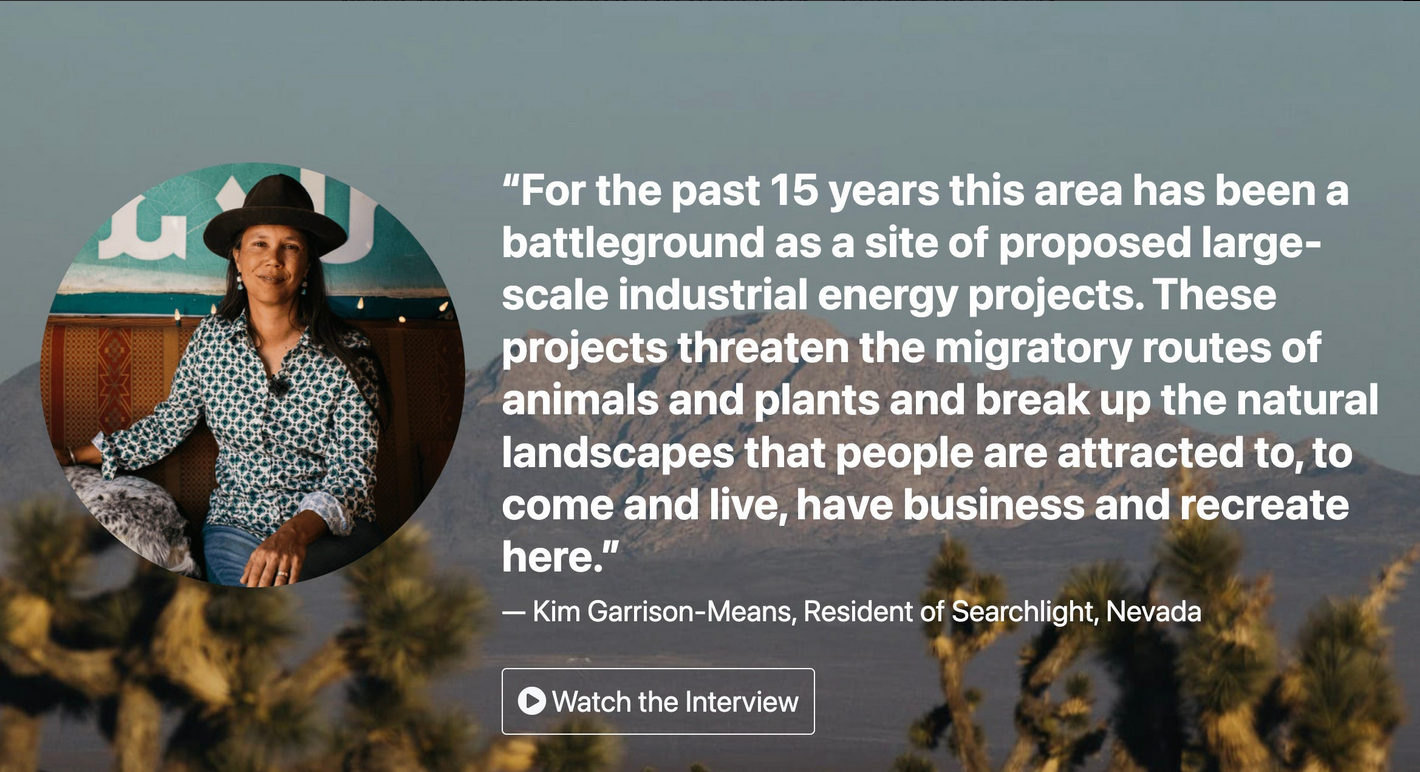
But President Joe Biden just announced a move that aggressively advances the progressive vision of preserving wilderness and preventing development, naming the Avi Kwa Ame National Monument in the Mojave Desert — preventing solar and wind development on 506,814 acres of lightly populated and federally owned desert land. The coalition of tribal and community groups that has worked to get the national monument designated make the anti-solar point explicit on their website:

Where progressive coastal urbanites see the progressive project of decarbonization, people in wilderness-adjacent areas see industrial blight, and express that view in the language of progressive conservationism. To a degree not explored by the false binary of media-defined American politics, in which good people on the left face bad people on the right, California’s future is an increasingly sharp conflict between left and left — and note what kind of permits energy companies have to get to build big wind and solar plants in the desert:

When progressive California builds its progressive energy infrastructure, it’s going to incidentally take a shit-ton of bighorns and tortoises and birds. I assume I don’t have to explain the euphemism.

QotD: “[T]he Conservatives were a party whom its enemies need not fear and its friends did not trust”

[Theresa May’s] party is deeply divided on the question of Brexit, and the situation is eerily reminiscent of that which followed Joseph Chamberlain’s sudden conversion from Free Trade to protectionism in 1903. Though the times then were generally prosperous (judged by their own and not by subsequent standards), Chamberlain argued that unfair foreign competition was harming, and even destroying, British agriculture and industry. The solution that he proposed was protectionism within the then extensive British Empire.

The Conservative Party, led (or at least, headed) by the highly intellectual Arthur Balfour, was deeply divided on the question. It appeared not to be able to make up its mind; as one brilliant young Conservative Member of Parliament, Harry Cust put it, “I have nailed my colours to the fence”. Balfour, the Prime Minister, refused to express himself clearly on the subject, for fear of alienating one or other of the factions of his own party, and thereby bringing the government down. Intellectually brilliant as he was, he proved incapable of exercising any leadership.

In the election that followed Chamberlain’s conversion to protectionism, the Conservatives were swept from power. Neither free-traders nor protectionists trusted them, and the opposition Liberal Party, which at least was clear on this question, soon became a government of reforming zeal. For many years, the Conservatives were a party whom its enemies need not fear and its friends did not trust.

Theodore Dalrymple, “On Brexit, Remember that Politics Is Not a Dinner Party”, New English Review, 2018-03-11.

March 20, 2023

“It amounts to nothing less than a declaration of all-out war between the government and the Big Tech companies”

Filed under: Business, Cancon, Government, Liberty, Media, Politics, Technology — Tags: , , , — Nicholas @ 05:00

The editors of The Line have strong opinions on the federal government’s decision to batter Google, Facebook, and other online “giants” over their opposition to the proposed internet legislation in bills C-11 and C-18:

As a result of C-18, both Google and Meta have considered dropping news distribution from their platforms, or have outright promised to do so. To which we have responded: “Well, no shit, Sherlocks.” We have, in fact, warned all of the parties involved with this misguided bill that that’s exactly what was going to happen.

Nonetheless, the dim-witted government officials and corporate media barons who have pinned their hopes of survival to the apparent money spigot of Big Tech didn’t believe us. So when Meta came right out and said it would drop news last week, the ashen-faced Minister of Heritage accused them of using “intimidation and subversion” tactics. And, thus, these demands for private correspondence appear to have been drafted.

It amounts to nothing less than a declaration of all-out war between the government and the Big Tech companies — and, by extension, the many independent media creators like ourselves.

Well. Okey Dokey then.

*cracks knuckles*

Let’s start with two very obvious points: firstly, we at The Line don’t object to forcing these tech companies to disclose funding to third parties for the purpose of opposing C-18 et al. That is perfectly reasonable, in our minds. Further, if these companies are being accused of anything illegal, by all means, investigate away — after you get a warrant.

The rest of these demands are nothing short of banana crackers; it’s an extraordinary interpretation of the committee’s mandate. It’s the kind of overbroad dragnet that will necessarily create privacy breaches for the unknown numbers of ordinary citizens, dissidents and journalists who have corresponded with these companies about these bills.

We will remind the government that private citizens and private companies do not owe the government a full accounting of their private business or communications. The government is subject to this kind of transparency and disclosure because the government works for us. Not the other way around.

We will also point out the irony. The government is demanding years worth of correspondence from private entities within a very short time frame: this is a level of transparency that no government department would subject itself to. Don’t believe us? Just try to draft a similar ATIP request to any ministry; it would take years to get such a request fulfilled, and half if it would come back redacted.

“The New American Empire lasted, at most, twenty years, if one counts the two falls of Kabul as brackets”

Filed under: History, Media, Middle East, Military, Politics, USA — Tags: , , , , , , — Nicholas @ 03:00

Ed West on the brief — and largely unacknowledged by Americans — high-water mark of the 21st century’s biggest empire:

A Boeing CH-47 Chinook transport helicopter appears over the U.S. embassy compound in Kabul, 15 Aug 2021. Image from Twitter via libertyunyielding.com

This century has already seen its fair share of great delusions, society-changing disasters built on wishful thinking: you can loan mortgages to people who obviously can’t pay them back; you can cure pain with an opiate that won’t make people addicted; and now the unstoppable idea of equality of outcomes between races, a project doomed to failure and tragedy.

But none was perhaps so spectacularly disastrous as liberal imperialism. Twenty years ago, George W Bush sent the most powerful military the world had ever seen into the birthplace of Abraham to overthrow Saddam Hussein, and as Niall Ferguson wrote in the Wall Street Journal at the time: “the greatest empire of the modern times has come into existence without the American people even noticing”.

The New American Empire lasted, at most, twenty years, if one counts the two falls of Kabul as brackets. This was despite enormous technological supremacy, and genuine goodwill and benevolence among many of the state-builders.

The United States was “born liberal”, as historian Louis Hartz said, even if the crime wave of the late 20th century made that a dirty word, and the “New American Empire” would spread the benefits of liberalism to grateful beneficiaries around the world.

Yet what is so striking about the imperialists of the 21st century, compared to their forebears in the 19th, was just how little interest they seemed to show in the subject people. Their naivety about human nature, and their utopian belief that people around the world just wanted “freedom”, chimed with a lack of curiosity about humanity.

To think that people around the world might not be the same, that they might not want “freedom” nor have the social structure or culture that suited democracy, might be to venture into dangerous territory. To suggest that Iraq was incapable of democracy was insulting to Iraqis, since as the US president said ahead of the war: “There was a time when many said that the cultures of Japan and Germany were incapable of sustaining democratic values. Well, they were wrong. Some say the same of Iraq today. They are mistaken.”

Yet the defeated nations in 1945 had very old, well-established institutions and very strong national identities, something Iraq did not. The latter was extremely clannish, something no one seemed to consider. Sovereignty and strong institutions take generations to build, and cannot just be imposed by foreigners working on abstract principles like “democracy”.

Bush was not alone. That same year, John McCain had said: “There is not a history of clashes that are violent between Sunnis and Shias, so I think they can probably get along”. And on March 1, 2003, two weeks before the war started, Bill Kristol, editor of the Weekly Standard, had dismissed warnings about sectarian conflict: “We talk here about Shiites and Sunnis as if they’ve never lived together. Most Arab countries have Shiites and Sunnis, and a lot of them live perfectly well together.” On top of that, “Very few wars in American history were prepared better or more thoroughly than this one by this president.” He was totally wrong, while in contrast the American Conservative‘s pessimistic warnings about Iraq’s social fabric proved correct.

March 19, 2023

Ron DeSantis as an American Neville Chamberlain

Filed under: Media, Politics, USA — Tags: , , , , , — Nicholas @ 05:00

Andrew Sullivan points out the inanity of comparing Florida Governor and potential presidential candidate to former British PM Neville Chamberlain over DeSantis not including the idea of increasing support to Ukraine as “a new Munich”:

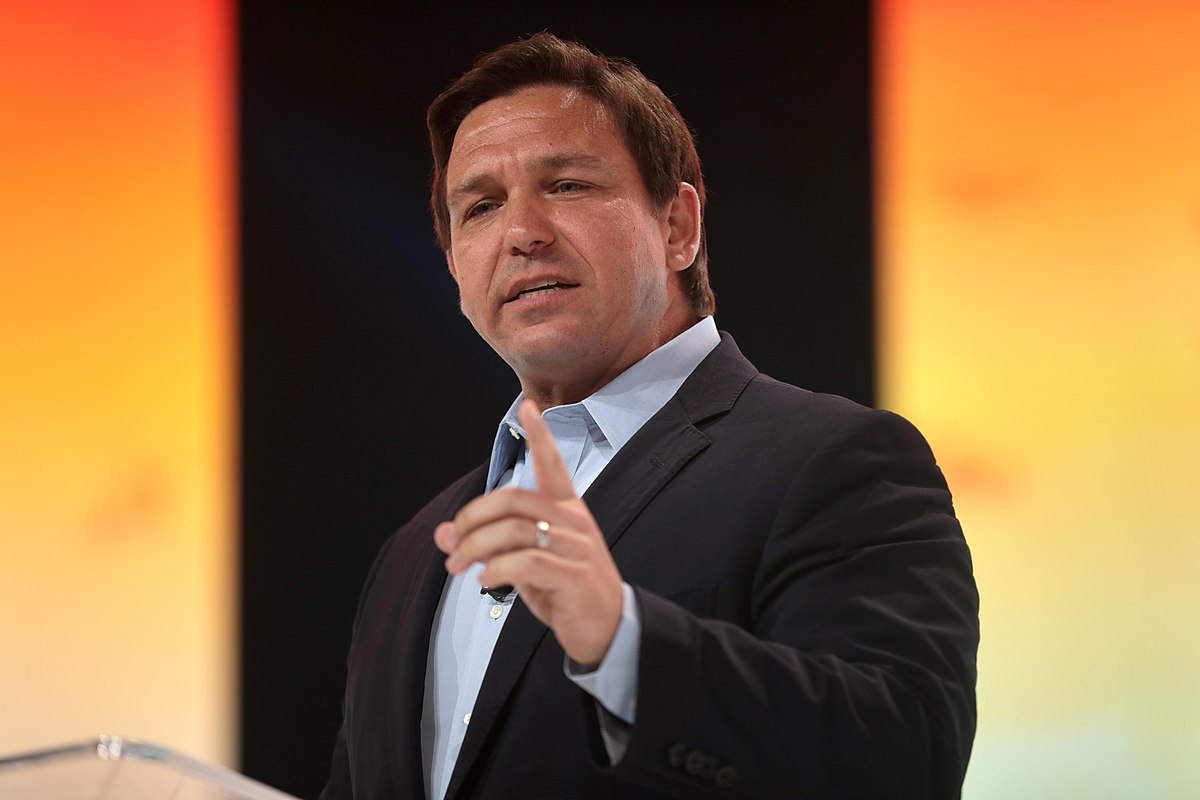
Governor Ron DeSantis speaking with attendees at the 2021 Student Action Summit hosted by Turning Point USA at the Tampa Convention Center in Tampa, Florida on 18 July, 2021.
Photo by Gage Skidmore via Wikimedia Commons.

For a written statement on foreign policy from a potential presidential candidate, it was, I suppose, a big deal. The salient sentence from Governor Ron DeSantis:

    While the U.S. has many vital national interests — securing our borders, addressing the crisis of readiness with our military, achieving energy security and independence, and checking the economic, cultural and military power of the Chinese Communist Party — becoming further entangled in a territorial dispute between Ukraine and Russia is not one of them.

It’s open to some interpretation. DeSantis says the Ukraine war is not in the “vital national interests” of the US, but is it maybe still in our general interests? Not clear. And he commits to no further entanglement, which could mean sticking with where we are now, but no more. Sure: no F-16s. But that’s also Biden’s position.

“Territorial dispute?” That set a lot of people off. But of course it’s undeniably, at some level, a border dispute. The entire post-Soviet settlement was a redrawing of national borders — and marked an extraordinarily rapid advance of Western arms and allies to the edge of Russia itself. In any kind of perspective, the current war has come at the end of that now-disputed settlement, and is indeed a debate over where Russia ends and Ukraine — which literally means “borderland” — begins. DeSantis didn’t blame Ukraine for its self-defense. He didn’t defend Putin. He merely proffered a different view of vital US national interests in the medium-term.

The gall!

The Blob declared another “Munich!” — an ancient neocon ritual — and declared the DeSantis candidacy all-but-over. Chris Christie called DeSantis “Neville Chamberlain“; Chuck Schumer asked, “I have to wonder what [DeSantis] would’ve thought if he was around in the 1930s”; Jenn Rubin called DeSantis “pro-Putin“; and the WSJ warned of a return to “isolationism in the 1930s”. This morning, the WaPo dusted down and wheeled out their perennial “appeasement!” editorial. And we got a French-Brooks double-whammy direct from 1983. Churchill envy never dies.

And I’m sorry. But I don’t get it. It is surely perfectly fine for a country to have two political parties that differ on foreign policy. In fact, it’s a critical advantage that democracies have over more rigid regimes: it helps us correct mistakes in time (and sometimes not), change personnel, and adjust to an always changing reality.

And in the 21st century, after the collapse of the imperial ideologies of the 20th, the role and reach of the United States is legitimately open to debate. It makes sense that one party would be more interventionist and one would be less so; it makes even more sense for the conservative party to be the one more skeptical of wars, small and large, and the unintended consequences they invariably entail.

That’s what’s happening — partly in reaction to the catastrophic, and bipartisan, hyper-interventionism of the first two decades of this century, and partly because of the rise of China. And it’s a good, normalizing thing. It will keep pressure on Biden not to escalate any further; and force us to think through the ugly compromises that will almost certainly confront us in the future. DeSantis’ position is pretty much where Obama was on Ukraine — and Obama was not some far-right fanatic. Money quote:

    The fact is that Ukraine, which is a non-NATO country, is going to be vulnerable to military domination by Russia no matter what we do. … We have to be very clear about what our core interests are and what we are willing to go to war for. And at the end of the day, there’s always going to be some ambiguity.

Replace “core” with “vital” and it’s DeSantis’ outrageous position. Yes, Putin miscalculated badly and invaded Ukraine, which means a new situation, and defense of Ukraine. But the core reality of America’s and Russia’s interests is unchanged. And Putin is not in command of a huge war economy and occupying the Sudetenland. He’s stuck in Eastern Ukraine, for Pete’s sake, and can barely move. China is maneuvering to counter and exploit our escalation. We need flexibility. What we absolutely do not need is some kind of shrill, bipartisan consensus on yet another war — and the usual McCarthyite smears of critics.

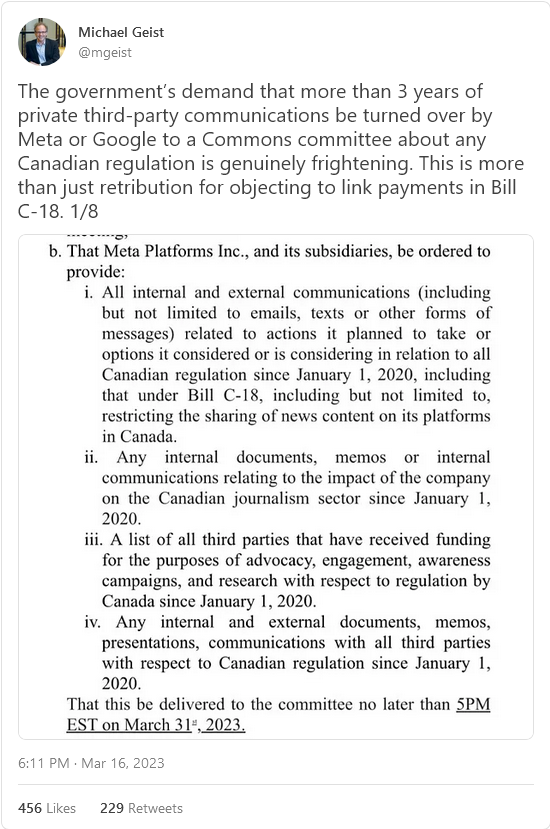
Disagree with the Canadian government’s attempt to take over significant parts of the internet? Get ready for administrative punishment, citizens!

Michael Geist, who often seems like the only person paying close attention to the Canadian government’s growing authoritarian attitudes to Canadians’ internet usage, shows the utter hypocrisy of the feds demanding access to a vast array of private and corporate information on a two-week deadline, when it can take literally years for them to respond to a request for access to government information:

Senator Joe McCarthy would be in awe of the Canadian government’s audacious power grab.
Library of Congress photo via Wikimedia Commons.

The government plans to introduce a motion next week requiring Google and Facebook to turn over years of private third-party communication involving any Canadian regulation. The move represents more than just a remarkable escalation of its battle against the two tech companies for opposing Bill C-18 and considering blocking news sharing or linking in light of demands for hundreds of millions in payments. The motion – to be introduced by the Parliamentary Secretary to the Minister of Canadian Heritage (yes, that guy) – calls for a series of hearings on what it describes as “current and ongoing use of intimidation and subversion tactics to avoid regulation in Canada”. In the context of Bill C-18, those tactics amount to little more than making the business choice that Heritage Minister Pablo Rodriguez made clear was a function of his bill: if you link to content, you fall within the scope of the law and must pay. If you don’t link, you are out of scope.

While the same committee initially blocked Facebook from even appearing on Bill C-18 (Liberal MP Anthony Housefather said he was ready for clause-by-clause review after just four hearings and no Facebook invitation), bringing the companies to committee to investigate the implications of their plans is a reasonable approach. But the motion isn’t just about calling executives before committee to answer questions from what will no doubt be a hostile group of MPs. The same motion sweeps in the private communications of thousands of Canadians, which is a stunning disregard for privacy and which could have a dangerous chilling effect on public participation. Indeed, the intent seems fairly clear: guilt by association for anyone who dares to communicate with these companies with an attempt to undermine critics by casting doubt on their motivations. Note that this approach is only aimed at those that criticize government legislation. There has been a painfully obvious lobbying campaign in support of the bill within some Canadian media outlets, but there are no efforts to uncover potential bias or funding for those that speak out in favour of Bill C-18, Bill C-11, or other digital policy initiatives.

It is hard to overstate the broad scope of the disclosure demands. Canadian digital creators concerned with Bill C-11 who wrote to Youtube would find their correspondence disclosed to the committee. So would researchers who sought access to data from Google or Facebook on issues such as police access to social media records or anti-hate groups who contacted Facebook regarding the government’s online harms proposal for automated reports to law enforcement. Privacy advocates focused on how Google administers the right to be forgotten in Canada would ironically find their correspondence disclosed as would independent media sites that wrote to Facebook about the implications of Bill C-18.

« Newer PostsOlder Posts »

Powered by WordPress