Quotulatiousness

April 20, 2023

We strongly believe in academic freedom, except when research turns up “inconvenient” results

Filed under: Britain, Education, Health, Politics — Tags: , , , , — Nicholas @ 03:00

Tom Knighton on a sad situation at a London university with publicly funded research having arrived at a politically unwelcome result:

Two people at EuroPride 2019 in Vienna holding an LGBTQ+ pride rainbow flag featuring a design by Daniel Quasar; this variation of the rainbow flag was initially promoted as “Progress” a PRIDE Flag Reboot.
Photo by Bojan Cvetanović via Wikimedia Commons.

In the UK, one academic decided to look at the “gender wars”, particularly how academics feel silenced on the whole trans issue.

It sounds to me like both an interesting subject for study and one that might be very necessary in this day and age.

It seems that while the researcher in question was approved to study it, her findings are problematic and that got her canned.

From The Telegraph:

    A university has “confiscated” the findings of an academic studying Britain’s gender wars in a row over her “dangerous” research data, The Telegraph can reveal.

    Dr Laura Favaro began the first ever taxpayer-funded study into whether social scientists at universities feel censored over their views on transgender issues in March 2020 at City, University of London.

    But it has descended into chaos, with the study’s author allegedly hounded out of the university, stripped of the findings she collected and barred from publishing them amid claims of transphobia.

    […]

    Her study involved 50 individual interviews with academics in gender studies who identified as feminists, a representative survey of social scientists with 650 responses and hundreds of documents and tweets.

    Scholars told her that they had threats of violence in the gender debate, hostility from colleagues, and others said they felt their careers “can’t survive that sort of backlash”, and that they have to have “secret conversations” to avoid reprisal and because “we are all so afraid”.

    Her final work has not been published, as it was derailed by complaints about an article for Times Higher Education in which she warned that “a culture of discrimination, silencing and fear has taken hold”.

    Following this, she says, her line managers told her that the study had “become an institutionally sensitive issue” and that “City considers my data to be dangerous” and is “frightened of making it public”.

So, what Favaro was finding was accurate.

That’s the big takeaway for me here. She said that academics were concerned about being attacked or that they had been because they didn’t play along with the trans agenda, and she was attacked and basically canceled because of it.

What’s even dumber is that Favaro was lured to City University from Spain so that she could conduct this research. She received roughly £28,000 from the British government via two different governmental entities to conduct the research.

Then she was silenced because the research found inconvenient truths.

That’s not what academia is supposed to be about. That’s not what academic freedom is about.

Freedom of any kind requires one to accept things that we would rather not have to accept. If you’re not free to say or do something that doesn’t actually harm a specific person but is otherwise objectionable, you don’t really have any freedom.

QotD: Food fascism

Filed under: Environment, Food, Health, Media, Politics, Quotations, USA — Tags: , , , — Nicholas @ 01:00

I think the liberal elite – which you don’t see bellying up to a creepy-crawly buffet – just likes the idea of not only nagging us but seeing how much they can make us humiliate ourselves by bending to their will. I can see a bunch of kale grazers in Brooklyn sitting around giggling about how they convinced those stupid rubes in gun/Jesusland to start chewing cicadas.

But the diet dictatorship craze is a real thing. You’ve seen the war on beef by the likes of Alexandria Ocasio-Genius, who runs her oversized novelty mouth about how we have to stop cooking cows because doing so displeases the great and terrible climate goddess Gaia. See, cows may contribute to the world being slightly warmer in a century, so stop doing something you enjoy. Consider not eating beef as a sacrifice made on behalf of the weird weather cult.

Here’s a locust. Now, don’t you feel better about your slightly reduced carbon footprint?

What do you think the chances are that the di Caprios and the Gores and the rest of the climate hucksters won’t be dining on filet mignon in their private jets flying from their mansions to Davos to save the planet from your carbon crimes, while you pedal your bike in the rain back to your unheated 500 square foot apartment to gnaw on a dinner of arugula and raw moths?

Remember, food fascism is for your own good, since you are evidently unable to make decisions about what you put in your mouth for yourself. You see, if you are allowed to make your own choices about your body you might make the wrong ones – with “wrong” being defined as choices Michael Bloomberg or the other members of Team Helper would not make.

Kurt Schlicter, “Tell The Nags To Go Pound Sand”, Townhall.com, 2019-11-19.

April 18, 2023

“Here it is then. This is The Hill.”

Filed under: Books, Britain, Politics — Tags: , , — Nicholas @ 06:00

Simon Evans rightfully decides that fighting the bowdlerization of P.G. Wodehouse is the hill to die on:

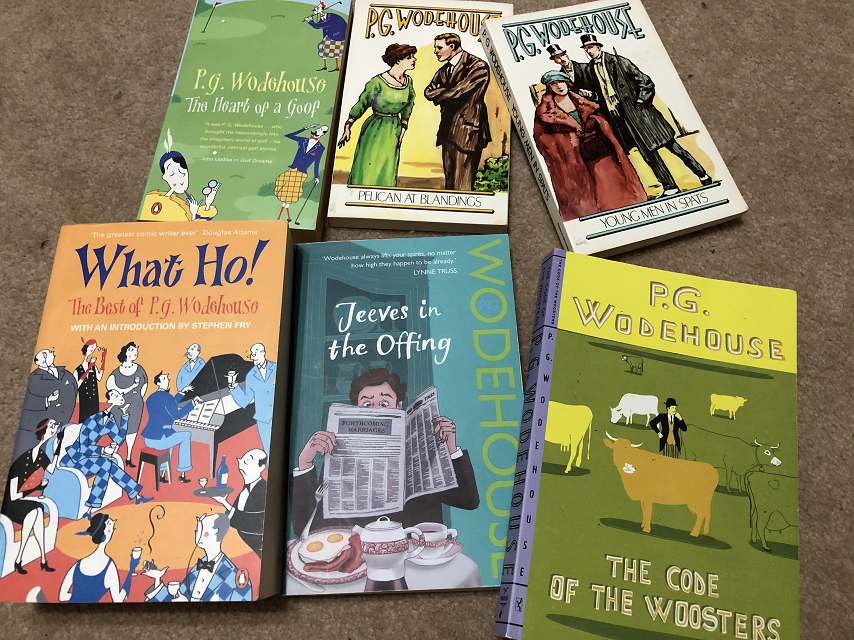
PG Wodehouse has become the latest author to fall victim to the “sensitivity readers”. Passages have been purged and words have been altered for the new editions of his Jeeves and Wooster novels, including Thank You, Jeeves and Right Ho, Jeeves. According to Penguin, the publishers, some of the racial language and themes of these 1930s novels are “outdated” and “unacceptable”. This includes the use of the n-word.

When I saw the news, my tweet sort of fell out of me before I’d consciously drafted it: “Here it is then. This is The Hill.”
There is an interesting contrast here. We live in a time when every much-loved and out-of-copyright literary artefact that is brought to the screens is being stiffened, like an old Christmas pudding recipe that clearly needs more brandy, with swearing and novel scenes of sexual deviation never imagined in the original. Just think of the BBC’s recent modernising and coarsening of Charles Dickens, Agatha Christie et al, which have rendered them all but unwatchable for millions. So it is more than a little odd that Wodehouse, the mildest, most weightless comedy of the last century, should suddenly seem deserving of the nit comb.

Yes, it is true that Wodehouse uses the n-word. And no other word is now, or arguably ever has been, quite so radioactive, so sui generis in its capacity for offence. It is not that I want to defend this word. Rather, the hill on which I will die is the pristine perfection of Wodehouse’s prose, and its right to remain so. He is – and by an extraordinary degree of consensus, in a field that is almost maddeningly subjective – the Bach of comic literature. And I’m sorry, but you just don’t tinker with Bach.

Though a fan, Christopher Hitchens, in a review of a Wodehouse biography, wrote of the tiresome habit of certain people in referring to Wodehouse as “The Master”, so I will try to avoid that unctuous, fulsome tone. But one of the very few writers of my lifetime who approached him for touch (though sadly not in output) was Douglas Adams, who often referred to Wodehouse as just that: “He’s up in the stratosphere of what the human mind can do, above tragedy and strenuous thought, where you will find Bach, Mozart, Einstein, Feynman and Louis Armstrong, in the realms of pure, creative playfulness.”

The point is not that the presence of the odd unfortunate archaic usage, which might indeed jolt the casual reader into a brief awareness that they are reading something older than their grandfather, is necessarily a good thing. It is simply, who the hell do the sensitivity readers think they are, to decide what stays and what goes?

Canada’s Prime Minister was never supposed to be like a US or French President

Filed under: Cancon, Government, History, Politics — Tags: , — Nicholas @ 05:00

In The Line, Mitch Heimpel shows a few of the “presidential” accretions to the Canadian political system that really don’t belong in a Parliamentary system like ours:

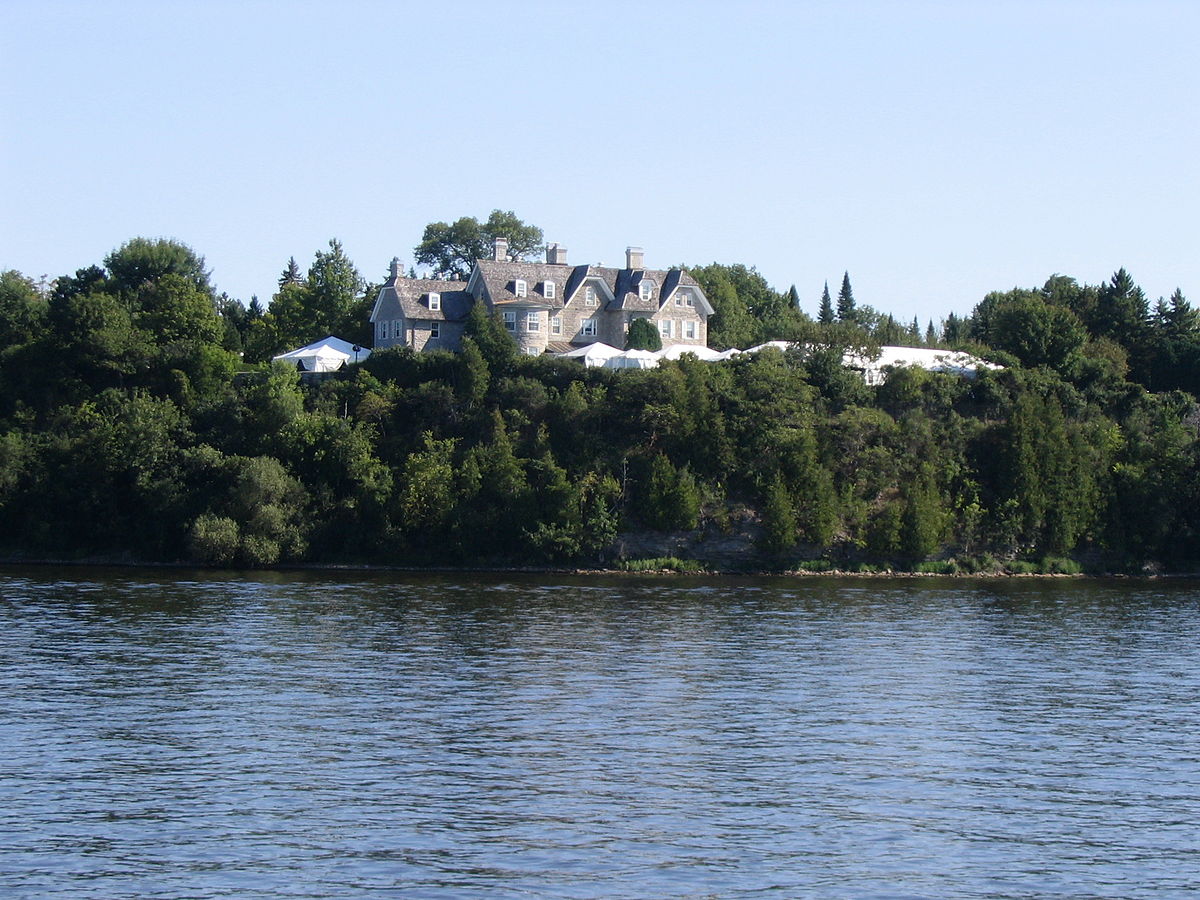
The official residence of the Prime Minister of Canada, 24 Sussex Drive, as seen from the Ottawa River. Ottawa, Ontario, Canada. (La résidence officielle du Premier ministre du Canada 24, promenade Sussex vu de la rivière des Outaouais).
Photo by sookie via Wikimedia Commons.

A couple of recent news stories, first about the Prime Minister’s Chief of Staff appearing (again) before a parliamentary committee, and the second about the level of decay of the official residence at 24 Sussex, have led me to realize how thoroughly we have presidentialised Canadian politics, and how thoroughly it has been to our detriment.

Parliamentary systems are not supposed to operate as presidential systems. They are intended to be far more managerial and transitory. They are intended to handle the affairs of state, without embodying the state. That distance is supposed to allow us all to access to a degree of patriotism without allowing partisanship to evolve into some kind of invasive cyst. This is why the weird, presidential appendages that have evolved in our own system over the years have proven so awkward and, ultimately, unwelcome. And unhealthy.

Let’s start with the easier target, 24 Sussex Drive, and get this out of the way off the top. The prime minister of a G7 nation should not live in squalor. Rat infestations, like the ones that recently contributed to the full closure of the prime minister’s ostensible home, are not acceptable. Official residences in various states of disrepair are a poor reflection on the nation, if for no other reason than it shows that we can’t even get basic carpentry and maintenance correct.

But the official residences of prime ministers are not supposed to be grand palaces either. They are supposed to emphasize the temporary nature of the occupant. The change of a prime minister, even without an election, should be a regular occurrence — and not just in Australia. Something that functions as a secure and defensible site with pleasant family home while also including the ability to host cabinet meetings or small events and maybe some staff as a working residence seems more than adequate.

It should not be the White House. It should not be the Elysée Palace. Nor should it attempt to compete with them. That’s not the job, or at least it’s not supposed to be. It should never be the subject of all this controversy and scrutiny, because it shouldn’t symbolize anything. It should be a secure place where the head of government and their family sleep until replaced by the next head of government and family.

Our fixation on it, and the fear every PM has of being seen spending a penny on its upkeep and repair, is a small but telling sign of how we’ve invested too much importance and symbolism in one person.

“People who pivot this quickly need to make sure their pants are securely buckled”

Filed under: Health, Media, Politics, USA — Tags: , , , — Nicholas @ 04:00

We’ve apparently reached the “Republicans Pounce” stage of yet another progressive crusade:

The memo has gone out, and the pivot has arrived.

Ten days ago, you may remember, the suddenly high-profile Nebraska Senator Machaela Cavanaugh went on NPR to play make-believe, expressing consternation over this weird new focus on transgender issues over on the political right: “I don’t know why, as a nation, as policymakers, there is this newfound focus on trans children… And all of the sudden, there is a decision by policymakers that we need to do something about them. It doesn’t make any sense to me.” It’s the why are you guys so obsessed with this DARVO maneuver, spun with bald-faced shamelessness by people who’ve been talking for years about the thing that they suddenly want you to know it’s creepy to talk about.

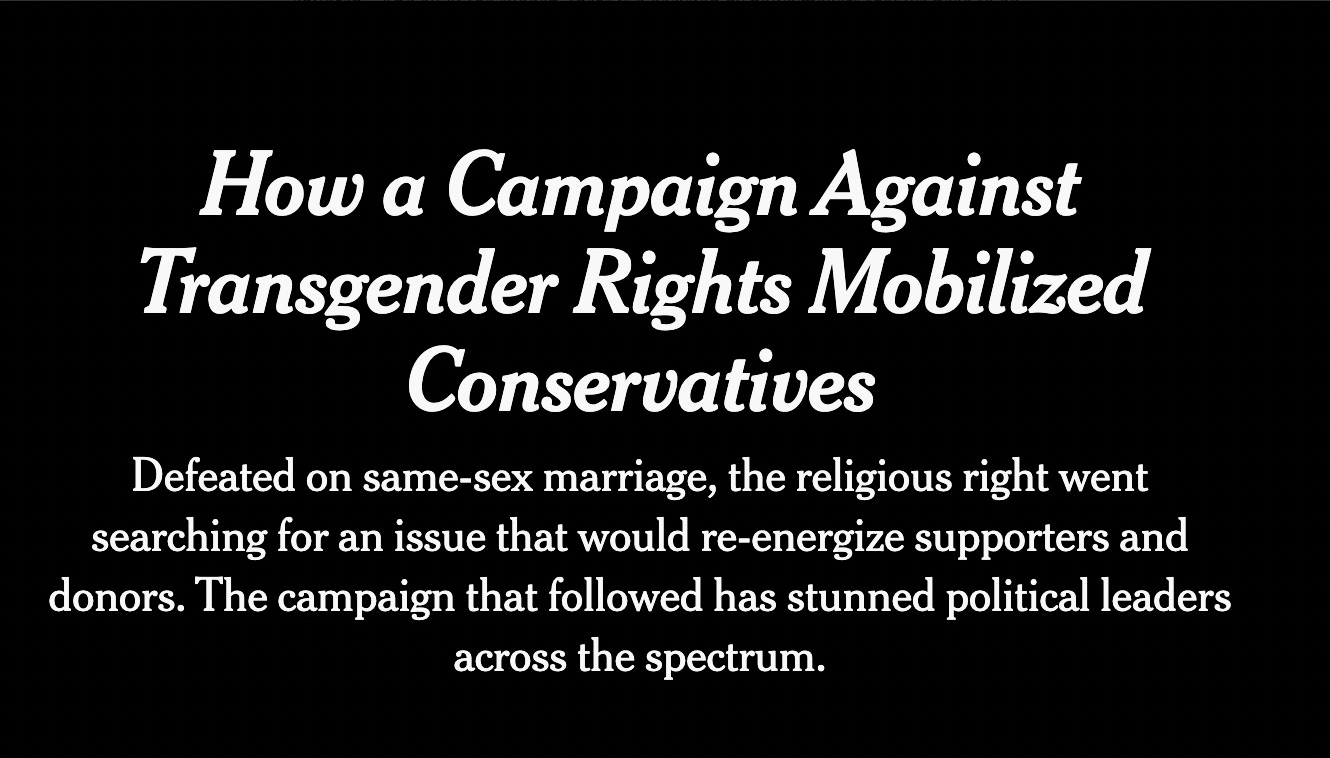
Now the New York Times explains the same thing in a similar way, writing that transgender issues have suddenly become a big deal in America because scheming right-wingers decided to cook it up as a fake wedge issue:

“The religious right went searching for an issue.” To get donors to write some checks, see. They just made it up, in a cynical act of invention. A bunch of social conservatives were sitting around the office, lamenting how no one gives them money anymore because everybody stopped hating the gays, so they decided, tactically, to pretend that transgender rights was a thing, now, so that they could trick people into giving them money again. Completely out of left field! Trans rights was just sitting there watching some Netflix with a tub of Cherry Garcia when suddenly the doorbell rang.

There’s no pouncing, but you’ve heard this descriptive maneuver before:

    Nadine Smith, the executive director of Equality Florida, a group that fights discrimination against L.G.B.T.Q. people, said there was a direct line from the right’s focus on transgender children to other issues it has seized on in the name of “parents’ rights” — such as banning books and curriculums that teach about racism.

“Seized on”. The story also says that the issue of men participating in women’s sports “was accelerated by a few influential Republican governors who seized on the issue early”. There’s a lot of seizing on, and it’s all mysterious. Why did the seizers seize the seized thing? Dunno. They just suddenly, for no apparent reason at all, seized on the issue of women’s sports. Weird. Similarly, that paragraph about “banning books” and forbidding “curriculums that teach about racism” is presented as a given, not as a thing that requires explanation or illustration. It’s tactical murk: half-accusations as smoke and chaff, designed to leave you with the general outlines of a thing that it’s convenient to have you believe. The right-wingers are something something something, and it’s scary.

Canada Council for the (decolonized) Arts

Filed under: Cancon, Media, Politics — Tags: , , , — Nicholas @ 03:00

In the latest SHuSH newsletter, Kenneth Whyte follows up on an earlier report on the mission of the Canada Council for the Arts, as outlined by Simon Brault:

… the founders of the Canada Council felt so strongly about the dangers of bureaucratic and political impositions on the arts — officials using federal money to force artistic and cultural activities in one direction or another — that they built checks and balances into its founding legislation.

The checks and balances haven’t checked or balanced. The Canada Council is now fully dedicated to teaching, censoring, and directing artistic endeavour.

The occasion for last year’s piece was a decision by Simon Brault, chief executive of the Canada Council, to halt funding for any “activity involving the participation of Russian or Belarusian artists or arts organizations … This includes partnerships, direct and indirect financing of tours, co-productions, participation in festivals or other events held in Russia.”

The outcome of Brault’s edict was that Canadians last summer weren’t able to enjoy a variety of planned tours by performers who had the misfortune to be born in Moscow, even if they loathed Putin like the rest of us.

It wasn’t the extremity of Brault’s position that set me off — he reserved to himself the right to ban artistic interaction with artists from any country whose government was involved in a conflict he considered unjust — so much as his implication that the arts community was too stupid to have noticed what was happening in Ukraine or to have known how to respond without his guidance.

A few months ago, Brault upped the ante, speaking at the council’s annual general meeting of his “vision for a decolonized future of the arts”.

    To actualize this vision, we must also decolonize the Council itself by questioning our own assumptions and convictions.

    It is important to acknowledge that decolonization is a complex, evolving, and open concept and journey.

    There’s no definitive guide on how to undertake this work.

    And it has different implications for different organizations and sectors in our society.

    So far, our understanding is that to decolonize the Council, we must agree to reframe our understanding of what constitutes art, which is a big thing for an arts council.

    We need also to question the notion of professionalism and artistic disciplines, which are deeply rooted in a very specific time in history, mostly Eurocentric, and often from a very colonialist perspective.

    So, we need to challenge the notion of “artistic excellence”, again a concept that upholds hierarchies of good taste and values that confirm and perpetuate the status of the dominant culture.

    We also need to move beyond limited notions of artistic expertise because those notions are often the direct product of an education system built to reproduce power relations and safeguard the privilege of a dominant colonial discourse on arts and culture.

There you have it. Brault committed the leading funding agency for the arts in Canada to “challenging” the prevailing understandings of art, artistic professionalism, artistic disciplines, artistic excellence, good taste, artistic values, and artistic expertise.

He’s not quite clear on what he’s going to replace it all with — he’s just sure that the way you think about art is wrong and that Keynes statement that the work of the artist is by nature individual and free, undisciplined, unregimented, uncontrolled, etc., is colonialist claptrap.

Let the regimentation and control begin.

QotD: The worldview of the fanatic

Filed under: History, Media, Politics, Quotations, Religion, USA — Tags: , , , , — Nicholas @ 01:00

More importantly, though, this is the logical endpoint of “democracy”, and now everyone gets to see it firsthand. In theory, democracy works by channeling competing vices. If men were angels, no government would be necessary, James Madison said, but since they’re not the best we can do is incentivize bad people to do good things in pursuit of their own selfish interest. It’s a nice thought, but it can only work (if, indeed, it can work) in a culture like Madison’s, in which public men are concerned about their dignity, honor, and posthumous reputation.

Obviously none of those hold in Current Year America, since they were all invented by the Pale Penis People, and even if they weren’t, they can’t matter to atheists anyway — one only defends one’s dignity and honor if one believes he’ll be called to account for them, and who’s going to do the accounting? There is no God, and as for the bar of History, what could that possibly matter to a cultural marxist? To them, as to their Puritan forbears, “history” is really soteriology. The past is nothing but a catalog of freely chosen error. For the fanatic, “history” begins anew each dawn, because why study endless iterations of Error when you already have the Truth?

Severian, “The Stakeholder State”, Rotten Chestnuts, 2020-01-22.

April 17, 2023

“… capitalism is a ‘virus’ composed of ‘systems that oppress’ …”

Filed under: Cancon, Government, Politics — Tags: , , , , — Nicholas @ 05:00

In Quillette, Jonathan Kay tells the story of a civil servant in British Columbia who objected to the content of a “Gender Workshop”:

If you’re a white-collar Canadian, chances are good that you’ve received workplace lectures on the subject of “decolonization” — a vaguely defined project aimed at “deconstructing colonial ideologies of the superiority and privilege of Western thought”. It’s a decidedly cultish pedagogical genre that I’ve come to know well, because exasperated workers often send me screenshots and recordings from their training sessions. Since raising complaints about these materials internally would risk career-threatening accusations of “white fragility” and such, leaking them to journalists is seen by many employees as the only viable option.

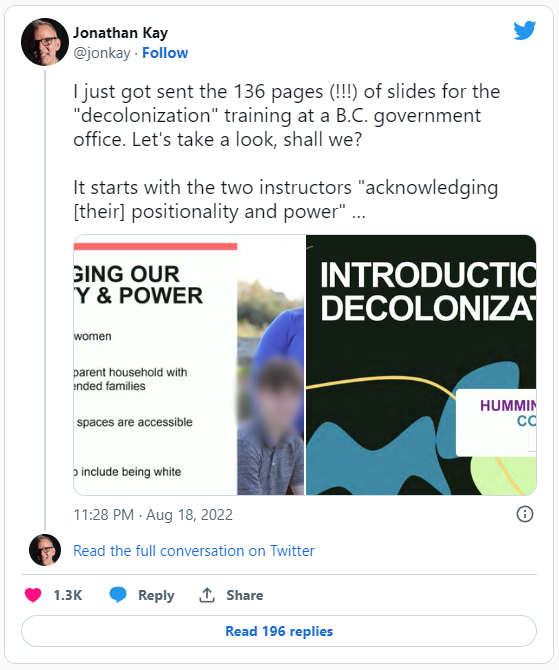
One notable specimen I received last year was a 136-page module titled Introduction to Decolonization, which had been presented earlier that year by the Hummingbirds Rising consultancy to staff at British Columbia’s Office of the Ombudsperson (an entity self-described as “B.C.’s independent voice for fairness and accountability, [working] to make sure public sector organizations are treating people fairly and following the rules”). The roughly 100 attendees were told by the trainers that this would be a “brave space”, in which those who had concerns about decolonization could “be bold and brave [with their] questions and comments”. (According to a Deputy Ombudsperson, attendance at the organization’s all-staff Diversity & Inclusion events is typically listed as optional. In practice, staff told me, almost everyone feels that they are expected to attend.)

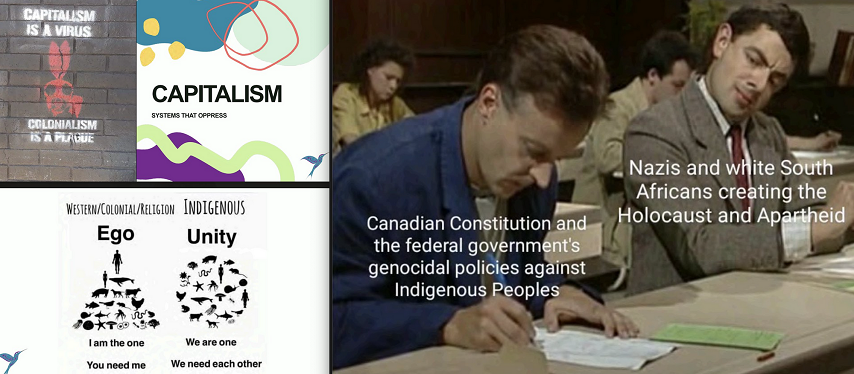
Much of the historical material presented in that session was perfectly accurate — including descriptions of the injustices associated with Canada’s system of Indigenous reserves. But as the presentation wore on, the content began to raise eyebrows. A section on economics declared flatly that capitalism is a “virus” composed of “systems that oppress”. A capsule lesson on spirituality presented Western values as inherently narcissistic, in contradistinction to Indigenous peoples’ quest for universal harmony. An array of listed terms that the presenters evidently associate with “white supremacy” included “being on time”, “manners”, and “perfectionism”. Most scandalously (as it would turn out), one slide indicated that the Nazi slaughter of six million European Jews had been directly inspired by the Canadian Constitution. Even more bizarrely, the slide was illustrated with a screen grab from an episode of Mr. Bean, a madcap 1990s-era British comedy show.

(When asked about the presentation, the Office of the Ombudsperson’s Communications Lead told Quillette that Hummingbirds Rising had been listed on the BC Public Service’s public pre-qualified supply list, and that prior vetting of the presentation had not been conducted by office staff. The Communications Lead added that the training was part of the Office’s “commitment to reconciliation with Indigenous people. Staff knowledge of cultural safety and the impacts of colonization on Indigenous people is an important component of the office’s Indigenous Communities Services Plan. We recognize that there may be some people who find some of the content of the Hummingbirds presentation controversial. We want to underscore, however, the value for our staff to fully understand the plurality of Indigenous perspectives in our province.”)

Slides from Introduction to Decolonization

After sharing these images on Twitter, I was contacted by the Vancouver office of a prominent Jewish organization, whose leadership (understandably) found the Mr. Bean/Holocaust slide to be in extremely poor taste. Thanks to their efforts, the issue was reportedly taken up internally by BC’s provincial government. And in the months that followed, I later learned, managers at the Office of the Ombudsperson took pains to find out who’d leaked the materials.

If the goal was to prevent more leaks, it didn’t work: Earlier this year, I received more documents pertaining to the Office of the Ombudsperson, the most interesting of which involved another over-the-top all-staff Diversity and Inclusion (D&I) workshop—this one on the topic of “challenges facing transgender and gender non-conforming people.” The presenter, Vancouver lawyer Adrienne Smith, is a well-known activist in this area, having helped lead the campaign to strip public funding from a local women’s shelter on the basis of its refusal to let biological males work as rape-crisis counsellors.

Orwell’s The Road to Wigan Pier

Filed under: Books, Britain, Economics, History, Politics — Tags: , , , , — Nicholas @ 04:00

Daniel Nuccio on one of George Orwell’s early works that prefigured the bestsellers he is best known for today:

Written for a group of British socialists known as the Left Book Club, the oeuvre is part documentation of the life of Britain’s impoverished working class with particular focus on the dignity and importance of coal miners and part autobiographical account of Orwell overcoming his own class prejudices, united by themes developed throughout regarding the economic commonalities of and social distinctions between Britain’s low-level bourgeoisie and working class, as well as the downside of industrialization and hypocrisy of fashionable socialism.

By Orwell’s account, Britain’s class system at the time, partly based on economic stratification, partly in an unofficial caste system, fostered a seemingly contradictory world in which middle-class bourgeoisie and the working class might experience little difference in income, but drastic differences in their respective places in British society. Yet, even as unemployment and poverty festered and spread, with the middle class eventually “feeling the pinch”, social distinctions, Orwell reported, naturally won out over the narrowing economic gap between classes. Lower-level middle class Brits, despite being working class by any objective economic metric, still chose to identify as bourgeoisie.

Rampant industrialism likely exacerbated these problems as it fundamentally transformed Britain into a machine society, likely to its detriment, according to Orwell’s description. Consequently, these and other factors, Orwell argued, positioned Britain at a crossroads at which the country and its people inevitably would be forced to choose between socialism and fascism.

From his depiction of 1930s British society, it would seem fascism was perhaps going to win out (and perhaps would have if not for later events unbeknownst to Orwell at the time). His prescribed antidote was socialism. Yet, Orwell claimed, the hypocrisy, offensiveness, and buffoonish self-satirizing nature of many socialists tended to drive most normal people away.

Reading The Road to Wigan Pier as an American more than eighty years after its publication, the world Orwell depicts in some ways seems foreign. In many others it is amusingly, if not unsettlingly familiar.

Although not as ingrained as in Britain, the United States maintains its own version of a class system in the form of a superficial yet meaningful distinction between middle class and working class that many Americans yoke to personal character and economic reality.

Nowhere is this more obvious than America’s approach to higher education and the jobs afforded to those with a college degree versus those without. Attaining a degree from a four-year college or university, at least to many members of the American middle class, is seen as something of a sacrament that affirms one’s position in the American middle class. Receiving the sacrament of higher education signals one’s position along with one’s sophistication, respectability, and intelligence. It saves one from the indignity of blue-collar work and the impecunious state with which such work is associated.

April 16, 2023

Raising the minimum retirement age may be necessary, but it will never be politically popular

Filed under: France, Government, Politics — Tags: , , , , , , — Nicholas @ 05:00

As protests and riots continue against the French government’s attempt to raise the minimum retirement age from 62 to 64, Theodore Dalrymple explains why he finds sympathy with the working poor who will be most directly hurt by the change:

Riot police on the streets of Bordeaux as violent protests against French government plans to raise the retirement age continue.
YouTube screen capture from an AFP report.

As I hope to be able to work till my dying day, I am perhaps not the right person to animadvert on the present disturbances in France about the raising of the retirement age from 62 to 64. My work has always been pleasing to me, and it remains so; I even manage to delude myself sometimes that it is important.

I am forced to recognize, however, that not everyone is in the same happy position as I. I am sure that if I had been a dustman all my life, I should not hope to be emptying dustbins at my present age (73), let alone at the age of 85. While my work remains work, and in a certain sense occasionally even hard work, especially when I have to think, what I do is not physically demanding. No one ever got arthritis or fibrosis of the lung by writing a few articles.

The reform of the pension system in France, from my limited understanding of it, is rather unfair. It is true that some reform is necessary: There are ever fewer workers to fund the pensions of ever more pensioners (the system being entirely unfunded by investment). On the other hand, it is those who do the most unpleasant and unremunerative jobs who have to work the longest, and the reform only increases this unfairness. As the old cockney song has it, it’s the rich what gets the pleasure.

Nevertheless, the extreme opposition to the reform, which is hardly a radical one, strikes most foreigners as rather strange. In a way it is also sad, for it implies that a long retirement is the main aim of all that precedes it, which in turn implies that all the work done for several decades before retirement has been an unpleasant imposition rather than something of value in itself. That the quid pro quo for a longer life expectancy is a greater number of years spent working seems not to strike anyone with force.

The demonstrators probably think, no doubt correctly, that the reform is the thin end of a wedge: If it is allowed to pass without a fuss, there will be further such reforms until the retirement age will be 70, 80, or never, depending on life expectancy. As for the younger demonstrators, they do not seem to worry much that it is they who will be paying for the people older than themselves to retire early, the distant prospect of early retirement being more real to them than the far more proximate high rates of taxation.

Do Foucault and Derrida deserve the blame for PoMo excesses?

Filed under: Books, France, History, Media, Politics, USA — Tags: , , , — Nicholas @ 03:00

In Spiked, Patrick West says that it’s a misunderstanding of Foucault and Derrida to blame them for the rise of wokeness:

Michel Foucault speaking at the Hospital das Clínicas of the State University of Guanabara in Brazil, 1974.
Public domain image from the Arquivo Nacional Collection via Wikimedia Commons.

It has become common to blame wokeness on its supposed philosophical parent: postmodernism. As the standard narrative goes, postmodernism is the ideology that entrenched itself in Anglophone universities in the 1980s and 1990s. It talked of relativism, of the absence of objective truth, of the spectre of a pervasive, invisible power, and it was generally anti-Western. A whole generation of professors, writers, journalists and a fair few activists have subsequently been raised on this diet of postmodern thinking. And the result is a cultural elite that is wedded to wokeness.

[…]

For these critics of woke, Foucault’s influence, in particular, is seemingly everywhere. According to [Douglas] Murray [in The War on The West], it’s through the “anti-colonial” philosophy popularised by the Foucault-inspired scholar, Edward Said, that Foucault and therefore postmodernism have filtered down into woke philosophy, which holds that Western society is uniquely racist and to blame for all of today’s ills. Equally, right-wing critics of wokeness will claim that the trans movement has sprung from the postmodern contention that sexuality and gender are entirely socially constructed and therefore plastic and malleable.

If Foucault is regarded as the father of wokeness then 19th-century philosopher Friedrich Nietzsche tends to be regarded as the grandfather. After all, Foucault was profoundly influenced by Nietzsche and even proudly declared himself to be “Nietzchean”. Nietzsche, like Foucault, also saw all human behaviour stemming from the desire for power. And he conceived of morality – good and evil, right and wrong – as the mere manifestation of the will to power. As he wrote of the “origin of knowledge”, in The Joyous Science (1883): “Gradually, the human brain became full of such judgements and convictions, and a ferment, a struggle, and lust for power developed in this tangle. Not only utility and delight but every kind of impulse took sides in this fight about ‘truths’.” One can see this Nietzschean sentiment at work in Foucault’s Discipline and Punish (1975): “Power produces knowledge … power and knowledge directly imply one another.”

So, according to this largely right-wing narrative, wokeness is the product of a 20th-century philosophical assault on truth, objectivity and the West. And it was inspired by Nietzsche and led by several “cultural Marxist” thinkers.

There are several problems with this rather neat story. The first error is to use the phrase “cultural Marxism” to talk of postmodernism or wokeness. This term doesn’t really make sense. Marx himself conceived of his work as a historical materialism. It was focussed on class and the means of production, not on culture. Yes, in the 1940s and 1950s, some Frankfurt School thinkers, who sometimes presented themselves as Marxist, did focus on culture rather than class. But as Joanna Williams writes in How Woke Won (2022), their thinking “represented less a continuation of Marxism and more a break with Marx”.

Moreover, postmodern thinkers were broadly opposed to Marxism. Many may have been signed-up Communists in their youth (the French Communist Party dominated left-wing politics at the time), but by the 1960s they had become highly critical of Marxist politics. They rejected the idea that history was progressing “dialectically” towards a communist future, or “telos”. And they were often hostile to the scientific objectivity and “Enlightenment” values so central to Marxism. Foucault wrote that history was not the story of progress; it was but a series of non-linear discontinuities and contingencies. And Jean-François Lyotard (1924-1998), in his highly-influential The Postmodern Condition (1979), announced and celebrated the end of “grand narratives”, and with it the end of the Marxist “grand narrative” of progress. Lyotard’s writings from the 1970s onwards were violently antithetical to Marxism, especially its claims to objective truth.

As for wokeness itself, it has nothing to do with Marxism. With their myopic focus on race and gender, woke activists are utterly blind to the material, class-structure of society. Today, bizarrely, it’s often conservatives who are more attuned to the plight of the working class than woke “radicals”. As Williams writes, “critics who insist that woke is simply Marxism in disguise are wide of the mark”.

April 14, 2023

The trust deficit is getting worse every day

Filed under: Media, Politics, Technology, USA — Tags: , , , , , — Nicholas @ 05:00

Ted Gioia provides more evidence that the scarcest thing in the world today is getting ever more scarce:

Here are some news stories from recent days. Can you tell me what they have in common?

  • Scammers clone a teenage girl’s voice with AI — then use it to call her mother and demand a $1 million ransom.
  • Millions of people see a photo of Pope Francis wearing a goofy white Balenciaga puffer jacket, and think it’s real. But after the image goes viral, news media report that it was created by a construction worker in Chicago with deepfake technology.
  • Twitter changes requirements for verification checks. What was once a sign that you could trust somebody’s identity gets turned into a status symbol, sold to anybody willing to pay for it. Within hours, the platform is flooded with bogus checked accounts.
  • Officials go on TV and tell people they can trust the banking system—but depositors don’t believe them. High profile bank failures from Silicon Valley to Switzerland have them spooked. Over the course of just a few days, depositors move $100 billion from their accounts.
  • ChatGPT falsely accuses a professor of sexual harassment — and cites an article that doesn’t exist as its source. Adding to the fiasco, AI claims the abuse happened on a trip to Alaska, but the professor has never traveled to that state with students.
  • The Department of Justice launches an investigation into China’s use of TikTok to spy on users. Another popular Chinese app allegedly can bypass users’ security to “monitor activities on other apps, check notifications, read private messages and change settings.”
  • The FBI tells travelers to avoid public phone charging stations at airports, hotels and other locations. “Bad actors have figured out ways to use public USB ports to introduce malware and monitoring software onto devices,” they warn.

The missing ingredient in each of these stories is trust.

Everybody is trying to kill it — criminals, technocrats, politicians, you name it. Not long ago, Disney was the only company selling a Fantasyland, but now that’s the ambition of every tech empire.

The trust crisis could hardly be more intense.

But it’s hidden from view because there’s so much information out there. We are living in a culture of abundance, especially in the digital world. So it’s hard to believe than anything in the information economy is scarce.

Whatever you want, you can get — and usually for free. You can have free news, free music, free videos, free everything. But you get what you pay for, as the saying goes. And it was never truer than right now — when all this free stuff is starting to collapse in a fog of fakery and phoniness.

    Tell me what source you trust, and I’ll tell you why you’re a fool. As B.B. King once said: “Nobody loves me but my mother — and she could be jivin’ too.”

Years ago, technology made things more trustworthy. You could believe something because it was validated by photos, videos, recordings, databases and other trusted sources of information.

Seeing was believing — but not anymore. Until very recently, if you doubted something, you could look it up in an encyclopedia or other book. But even these get changed retroactively nowadays.

For example, people who consult Wikipedia to understand the economy might be surprised to learn that the platform’s write-up on “recession” kept changing in recent months — as political operatives and spinmeisters fought over the very meaning of the word. It got so bad that the site was forced to block edits on the entry.

There’s an ominous recurring theme here: The very technologies we use to determine what’s trustworthy are the ones most under attack.

Trust used to be a given in most western countries … it was a key part of what made us all WEIRD. Mass immigration from non-WEIRD countries dented it, but conscious perversion of trust relationships by government, media, public health, and education authorities has caused far more — and longer lasting — damage to our culture. Trust used to be given freely, but now must be earned. And that’s difficult for organizations that have proven repeatedly that they can’t be trusted.

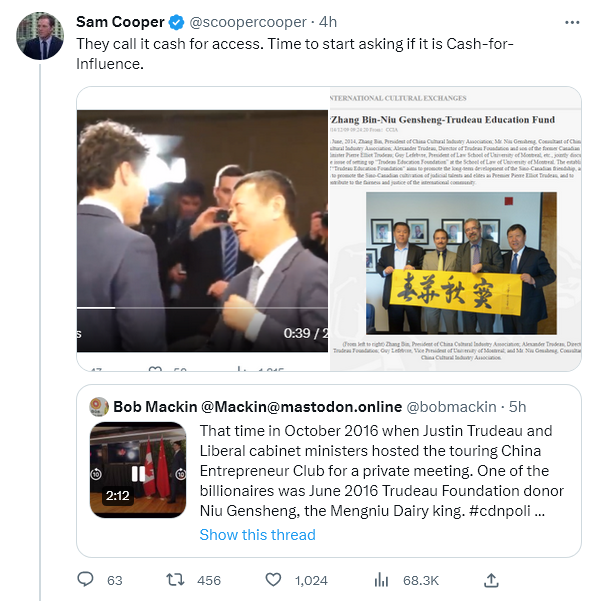
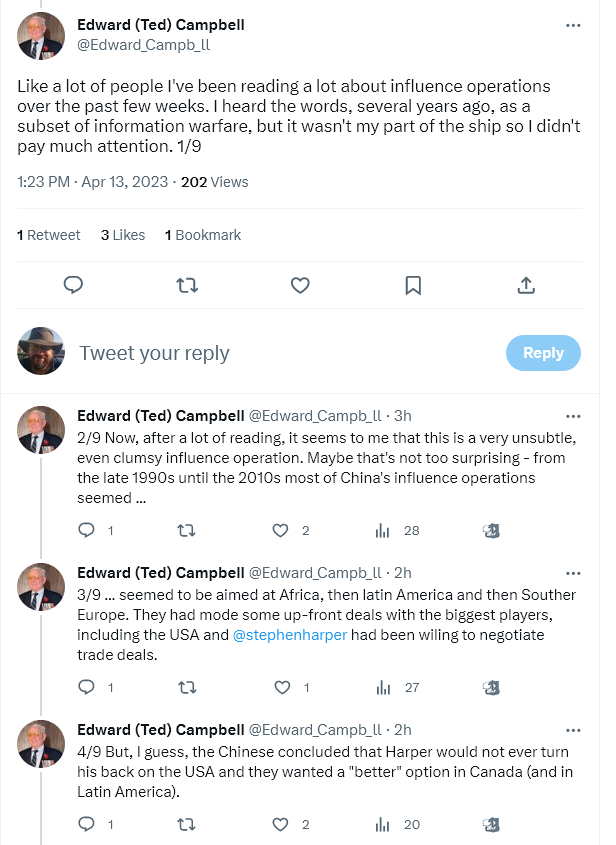
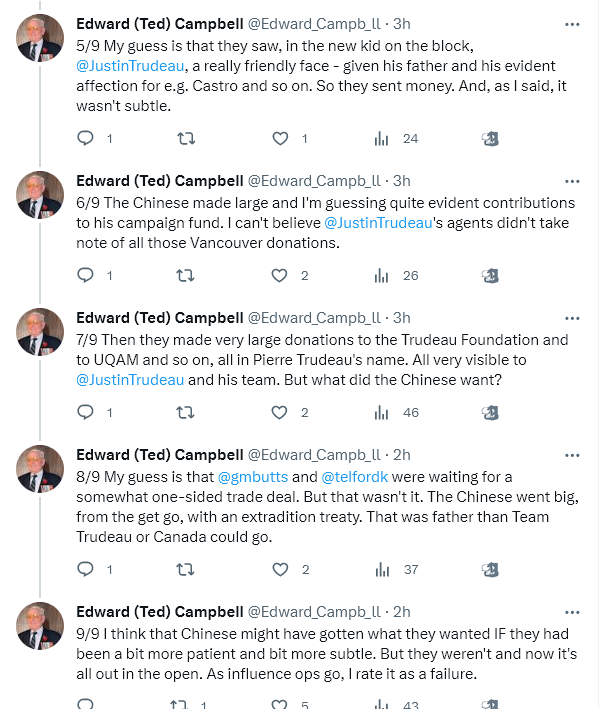
From “cash for access” it’s a very short step to “cash for influence”

Filed under: Cancon, China, Government, Media, Politics — Tags: , , , , — Nicholas @ 04:00

Ted Campbell shut down his blog some time ago — unfortunately for those of us interested in Canadian military affairs — but he’s still active on Twitter. Here he responds to a tweet from Sam Cooper of Global News:

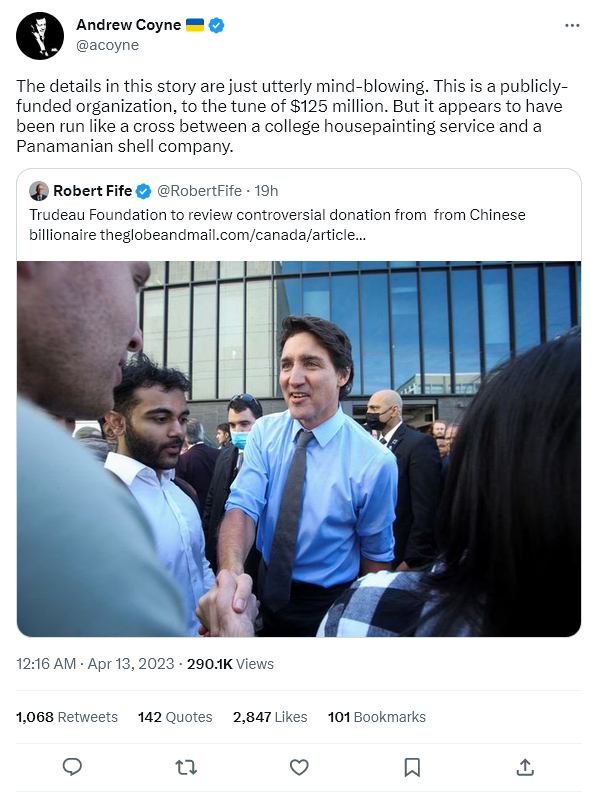
Andrew Coyne highlights some of the boggling details in this thread:

Twists and turns in the “Twitter Files” narrative

Filed under: Business, Government, Media, Politics, Technology, USA — Tags: , , , , — Nicholas @ 03:00

Matt Taibbi recounts how he got involved in the “Twitter Files” in the first place through the hysterical and hypocritical responses of so many mainstream media outlets up to the most recent twist as Twitter owner Elon Musk burns off so much of the credit he got for exposing the information in the first place:

I was amazed at this story’s coverage. From the Guardian last November: “Elon Musk’s Twitter is fast proving that free speech at all costs is a dangerous fantasy.” From the Washington Post: “Musk’s ‘free speech’ agenda dismantles safety work at Twitter, insiders say.” The Post story was about the “troubling” decision to re-instate the Babylon Bee, and numerous stories like it implied the world would end if this “‘free speech’ agenda” was imposed.

I didn’t have to know any of the particulars of the intramural Twitter dispute to think anyone who wanted to censor the Babylon Bee was crazy. To paraphrase Kurt Vonnegut, going to war against a satire site was like dressing up in a suit of armor to attack a hot fudge sundae. This was an obvious moral panic and the very real consternation at papers like the Washington Post and sites like Slate over these issues seemed to offer the new owners of Twitter a huge opening. With critics this obnoxious, even a step in the direction of free speech values would likely win back audiences that saw the platform as a humorless garrison of authoritarian attitudes.

This was the context under which I met Musk and the circle of adjutants who would become the go-betweens delivering the material that came to be known as the Twitter Files. I would have accepted such an invitation from Hannibal Lecter, but I actually liked Musk. His distaste for the blue-check thought police who’d spent more than a half-year working themselves into hysterics at the thought of him buying Twitter — which had become the private playground of entitled mainstream journalists — appeared rooted in more than just personal animus. He talked about wanting to restore transparency, but also seemed to think his purchase was funny, which I also did (spending $44 billion with a laugh as even a partial motive was hard not to admire).

Moreover the decision to release the company’s dirty laundry for the world to see was a potentially historic act. To this day I think he did something incredibly important by opening up these communications for the public.

Taibbi and the other Twitter File journalists were, of course, damned by the majority of the establishment media outlets and accused of every variant of mopery, dopery, and gross malfeasance by the blue check myrmidons. Some of that must have been anticipated, but a lot of it seems to have surprised even Taibbi and company for its blatant hypocrisy and incandescent rage.

But all was not well between the Twitter Files team and the new owner of Twitter:

We were never on the same side as Musk exactly, but there was a clear confluence of interests rooted in the fact that the same institutional villains who wanted to suppress the info in the Files also wanted to bankrupt Musk. That’s what makes the developments of the last week so disappointing. There was a natural opening to push back on the worst actors with significant public support if Musk could hold it together and at least look like he was delivering on the implied promise to return Twitter to its “free speech wing of the free speech party” roots. Instead, he stepped into another optics Punji Trap, censoring the same Twitter Files reports that initially made him a transparency folk hero.

Even more bizarre, the triggering incident revolved around Substack, a relatively small company that’s nonetheless one of the few oases of independent media and free speech left in America. In my wildest imagination I couldn’t have scripted these developments, especially my own very involuntary role.

I first found out there was a problem between Twitter and Substack early last Friday, in the morning hours just after imploding under Mehdi Hasan’s Andrey Vyshinsky Jr. act on MSNBC. As that joyous experience included scenes of me refusing on camera to perform on-demand ritual criticism of Elon Musk, I first thought I was being pranked by news of Substack URLs being suppressed by him. “No way,” I thought, but other Substack writers insisted it was true: their articles were indeed being labeled, and likes and retweets of Substack pages were being prohibited.

April 13, 2023

Old and tired – “Conspiracy Theories”. The new hotness – “Coming Features”

Kim du Toit rounds up some not-at-all random bits of current events:

So Government — our own and furriners’ both — have all sorts of rules they wish to impose on us (and from here on I’m going to use “they” to describe them, just for reasons of brevity and laziness — but we all know who “they” are). Let’s start with one, pretty much picked at random.

They want to end sales of vehicles powered by internal combustion engines, and make us all switch to electric-powered ones. Leaving aside the fact that as far as the trucking industry is concerned, this can never happen no matter how massive the regulation, we all know that this is not going to happen (explanation, as if any were needed, is here). But to add to the idiocy, they have imposed all sorts of unrealistic, nonsensical and impossible deadline to all of this, because:

There isn’t enough electricity — and won’t be enough electricity, ever — to power their future of universal electric car usage. Why is that? Well, for one thing, they hate nuclear power (based on outdated 1970s-era fears), are closing existing ones and will not allow new ones to be built by dint of strangling environmental regulation (passed because of said 1970s-era fears). Then, to add to that, they have forced the existing electricity supply to become unstable by insisting on unreliable and variable generation sources such as solar and wind power. Of course, existing fuel sources such as oil. coal and natural gas are also being phased out because they are “dirty” (they aren’t, in the case of natgas, and as far as oil and coal are concerned, much much less so than in decades past) — but as with nuclear power, the rules are being drawn up as though old technologies are still being used (they aren’t, except in the Third World / China — which is another whole essay in itself). And if people want to generate their own electricity? Silly rabbits: US Agency Advances New Rule Targeting Portable Gas-Powered Generators. (It’s a poxy paywall, but the headline says it all, really.)

So how is this pixie dust “new” electricity to be stored? Why, in batteries, of course — to be specific, in lithium batteries which are so far the most efficient storage medium. The only problem, of course, is that lithium needs to be mined (a really dirty industry) and even assuming there are vast reserves of lithium, the number of batteries needed to power a universe of cars is exponentially larger than the small number of batteries available — but that means MOAR MINING which means MOAR DIRTY. And given how dirty mining is, that would be a problem, yes?

No. Because — wait for it — they will limit lithium mining, also by regulation, by enforcing recycling (where have we heard this before?) and by reducing battery size.

Now take all the above into consideration, and see where this is going. Reduced power supply, reduced power consumption, reduced fuel supply: a tightening spiral, which leads to my final question:

JUST HOW DO THEY THINK THIS IS ALL GOING TO END?

If there’s one thing we know, it’s that increased pressure without escape mechanisms will eventually cause explosion. It’s true in physics, it’s true in nature and it’s true, lest we forget, in humanity.

Of course, as friend-of-the-blog Severian often points out, these people think Twitter is real life. Of course there’ll be enough pixie dust to sprinkle over all their preferred solutions to make them come true. Reality is just a social construct — they learned that in college, and believe it wholeheartedly.

« Newer PostsOlder Posts »

Powered by WordPress