
Army University Press
Published 22 Nov 2024The Battle of Huế is known for urban combat, destruction, and anguish. The city of Huế mattered to all the combatant forces. The city and its people paid the price. Interviews with noted subject matter experts Drs. Pierre Asselin, Gregory Daddis, James Willbanks, and Cpt. Wyatt Harper are augmented with archival audio and film, and detailed maps. This documentary places the Battle of Huế within the context of Hanoi’s 1968 Tet Offensive. How North Vietnam, South Vietnam, and the United States perceived the Vietnam War in 1967 and 1968 are central to this documentary. Covered are the key moments of the battle — including the People’s Armed Forces of Vietnam (PAVN) and People’s Liberation Armed Forces (PLAF) planning and assault on Hue. The responses of the Army of the Republic of Vietnam (ARVN), Vietnam Marine Corps (VNMC), the United States Marine Corps (USMC), and the U.S. Army (USA) are addressed to offer insight into an informative example of urban warfare.
0:02:39 – Why the Tet Offensive
0:10:53 – Why Huế
0:15:53 – Military Decision Making Process | Doctrine
0:26:51 – Warfighting Function | Doctrine
0:27:59 – Paralysis by analysis | Doctrine
0:33:15 – Courses of action | Doctrine
0:38:22 – Weather and operations | Doctrine
0:40:52 – Huế Massacre
0:41:18 – My Lai
0:46:05 – Huế and Modern Warfare
April 14, 2025
Huế: Battle for the Heart of Vietnam
QotD: Pax Americana replaces Pax Britannica
Britain […] inherited responsibility for a century of the “Pax Britannica” by the simple expedient of being the strongest economy standing after the Napoleonic Wars. (The United States – the only potentially economically healthy rival post the devestation of Europe – having shot itself in the foot by joining in briefly on Napoleon’s “anti-British coalition” movement in 1812, and having its trade smashed and most of its ports and the capital reduced to smoking ruins as a result. Bad timing.)
The British government spent most of the next century being dragged – reluctantly – into being arbitrators of conflicts they wanted nothing to do with. Finishing with being stuck with the Great War, and then responsibility for some of the most hopeless basket-case states handed over to “Mandate Powers” by the Versailles peace … as one British minister presciently pointed out, no one wanted Palestine, and it would be nothing but a disaster for whoever gets stuck with it … (Fortunately for the US, their Congress repudiated Wilson’s ridiculous League of Nations before the plan to lumber the US with the Mandate for places like Georgia – the Russian bit on the Black Sea that is! – could be put through.)
It is unsurprising that the British taxpayer spent the next 50 years trying to get out of international police-keeping obligations. With the sole exception of reluctantly agreeing to fight against the expansionary dictatorships in World War Two, British taxpayers voted for disarmament and de-colonisation whenever they could. (Abandoning some states – particularly in Africa – that might eventually have developed into safe and secure states, way before they were ready for independence … much to the cost of world peace and security since …)
The United States has had a similar experience more recently. Having inherited responsibility for maybe 50 years of the “Pax Americana” by the simple expedient of being the strongest economy standing after the Second World War. (Their only potential rival being the British Commonwealth of Nations — who between them had 5 of the next 10 biggest and healthiest post-war economies — being more than happy to let the dumb Americans have a go at being world policemen for a time, and see how they liked being blamed by everyone else for absolutely everything.)
The Americans discovered pretty quickly that the things they had been complaining about the British doing for the last 200 years were exactly what they had now signed up for, and finding even quicker that their taxpayers simply weren’t willing to carry the can, and take the blame, for very long at all.
Arguably the US’s fun with being world policeman was already pretty much over after Korea, and certainly after Vietnam. It is notable that the first Gulf War was NOT paid for by the US taxpayer … the US troops turned up but only if Saudi Arabia and Europe paid for them to do so (and preferably with a British Division on one flank, Australian warships on the other, and NATO fighters overhead …) none of this “we will carry the can and our taxpayers will just cope” crap for post-Vietnam American taxpayers.
Nigel Davies, “Types of Empires: Security, Conquest, and Trade”, rethinking history, 2020-05-02.
April 13, 2025
The Most Pointless Battle of WW1? – Passchendaele 1917
The Great War
Published 11 Apr 2025For more than three long months in 1917, Allied and German soldiers fought tooth and nail over a battlefield churned into a sea of sucking mud and shellholes by the guns. Hundreds of thousands were killed and wounded, some of them drowning in the soupy ground — for Allied gains of just a few kilometers. So why did the Battle of Passchendaele happen at all, and was it the most pointless battle of the First World War? (more…)
April 11, 2025
Beretta 93R: The Best Machine Pistol?
Forgotten Weapons
Published 13 Dec 2024The Beretta 93R (“Raffica”) was developed in the 1970s by Beretta engineer Paolo Parola at the request of Italian military special forces. It took the basic Beretta 92 pistol design and added a well-thought-out burst mechanism under the right-side grip panel. It does not have a plain full-auto setting, but only semiauto and 3-round burst. To help keep the gun controllable, it has a heavier slide to reduce cyclic rate, a detachable shoulder stock, and a folding front grip to help control the muzzle. It uses extended 20-round magazines and is actually remarkably controllable (or so I am told; I have not had a chance to shoot one myself).
(more…)
April 9, 2025
Stretching the RCN’s limited number of AOPS too thin?
I admit that I doubted the overall utility of the Harry DeWolf-class of Arctic/Offshore Patrol Ships when they were announced, but aside from the typical teething troubles of new ship designs they seem to be doing a good job at their initial taskings. Noah, on the other hand, proudly describes himself as “perhaps their [the AOPS] biggest online defender“, but he’s raising concerns that the Harry DeWolf class will soon be expected to pick up the slack as the Kingston-class Maritime Coastal Defence Vessels come to the end of their working lives with no obvious replacements under construction:
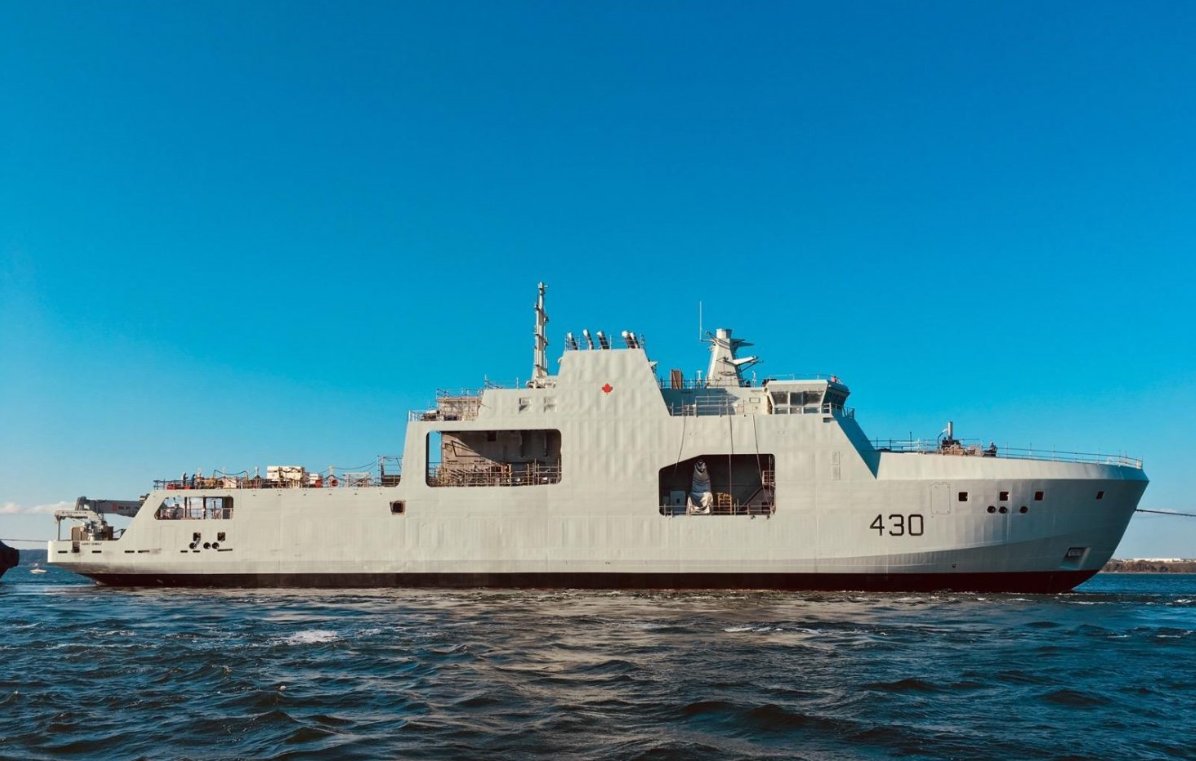
Arctic Offshore Patrol Ship HMCS Harry DeWolf shortly after launch in 2018. The ship was commissioned into the Royal Canadian Navy in June, 2021.
It’s a common fact that I love the AOPS.
I am perhaps their biggest online defender, despite the hate, the early issues, and the slander. They, to me, are the perfect vessel for what we require up North, modular, flexible, with a whole world’s of potential.
The six vessels that make up the DeWolfe-class have kept themselves busy, so busy that you often forget that they are, primarily, Arctic vessels. Now that isn’t to say they can’t take other tasks, nor should they be limited.
OP CARRIBE, a trip to Antarctica, hosts of exercises. The AOPS manage to be kept busy, while still finding time for trips up North, although not nearly as much as many would seem to like.
Their ability to hold containerized payloads has also seen them used as testbeds for various capabilities, including towed arrays for ASW, submarine rescue equipment, and in the future, RMDS and unmanned systems like Cellula Robotics’ Guardian AUV.
Indeed, the AOPS are slowly, though surely coming into their own. Yet it is those things it does well, that potential, that puts them in the spotlight among a fleet that is aging and soon set to dwindle in numbers over the next decade.
The looming writing off of the Kingston-class is coming faster and faster everyday, and soon, they will be gone. The little workhorses, whom performed far more than anyone could have asked of them.
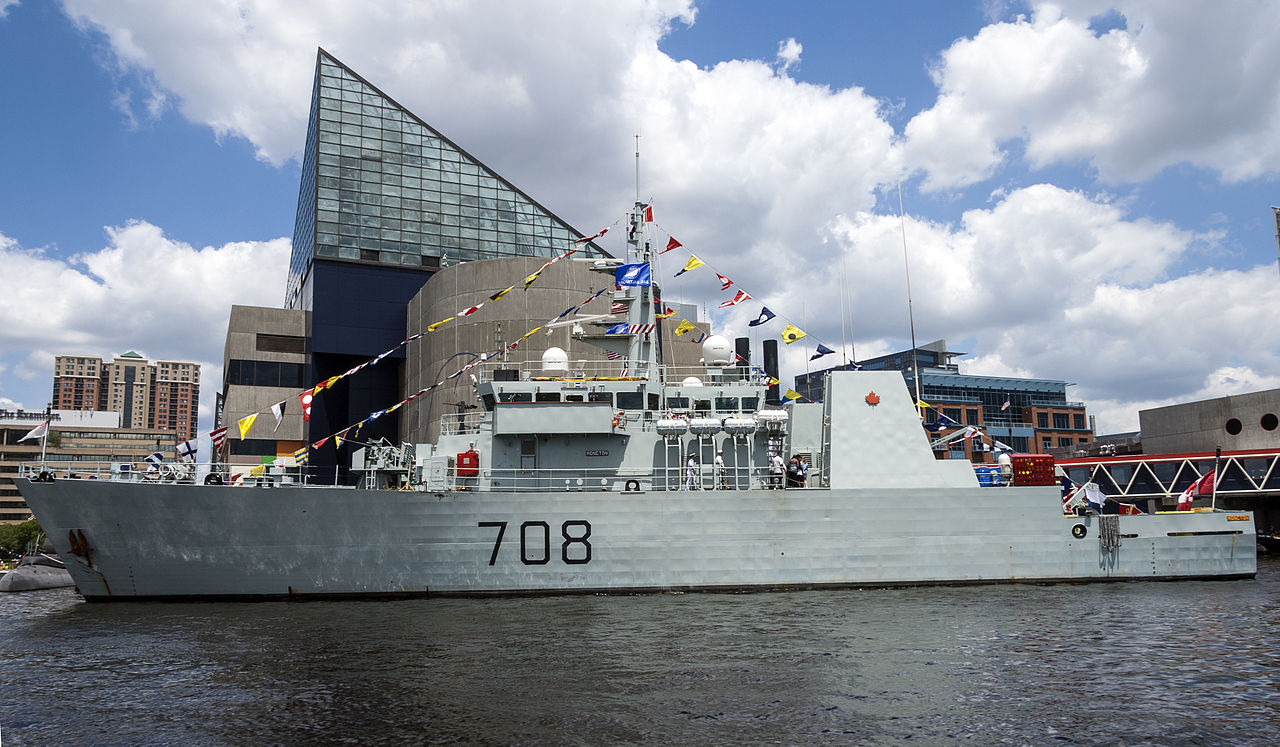
The Kingston-class Maritime Coastal Defence Vessel (MCDV) HMCS Moncton in Baltimore harbour for Sailabration 2012.
Photo by Acroterion via Wikimedia Commons.The Kingstons have been a backbone, beyond the littoral-patrolling minesweeper they were envisioned as when the MCDV project was first stood up.
Yet the Kingstons as we know them are to be retired with no true replacement, their original tasks overtaken by other systems and automation.
Their original replacement, as part of the OPV project has evolved into the Canadian Multi-Mission Corvette, a vessel envisioned to one day be a true second-line combatant to complement the River-class destroyers.
Instead the tasks of the Kingstons shall fall onto the small number of AOPS in service. They will be tasked, not only to fulfill their role as Arctic Patrol ships, but now take the mantle of fulfilling a host of growing secondary tasks that has been filled by these cheaper, smaller vessels.
Add on a Halifax-class that is struggling to stay afloat, bouncing around various states of condition and expected to keep sailing for another decade. Even as the River enter service, the tasks of the Kingstons will not be filled by them.
It’s a lot of strain and demand to put on vessels that are not only significantly larger than the Kingstons, but also significantly more expensive to operate on fulfilling tasks like OP CARRIBE, where while they may be very valuable assets, might not be optimal in lieu of smaller vessels that can easily fill the same role just as efficiently.
On that note it also can’t be understated that the more we put on the AOPS, the more we take it away from its Arctic taskings, and the more we expect of these six vessels to do almost every secondary task, the more we create gaps in our continental defence.
Six AOPS not only for Arctic Patrol, but MCM, Submarine Support, Seabed Warfare, things like OP CARRIBE … How can we expect these vessels to remain in service for the next quarter-century with all this strain?
We don’t talk about these vulnerabilities a lot, but as it stands Canada is severely vulnerable to adversaries and foreign actors ability to leverage asymmetric methods to limit our ability to respond abroad and severely harm Canada’s strategic infrastructure.
The Korean War Week 42 – Seize Hwacheon Reservoir? A Dam Good idea – April 8, 1951
The Korean War by Indy Neidell
Published 4 Apr 2025Operation Rugged is in full swing, and it’s taking a decent amount of territory, but Matt Ridgway is worried about the possibility of the enemy blowing the dam at the Hwacheon Reservoir and flooding his army, so he gets set to try and soon take it. Meanwhile there’s an explosion in Congress in Washington DC, when the Minority Leader openly reads Douglas MacArthur’s letter of his plans for the war that are diametrically opposed to those of President Harry Truman. Truman realizes that he’s going to have to remove MacArthur from UN command.
Chapters
00:57 Recap
01:31 When to Fire MacArthur?
03:53 Joe Martin Speaks
07:11 Operation Rugged
09:23 The Hwacheon Reservoir Dam
13:35 Summary
13:51 Conclusion
(more…)
Battle of Saipan 1944: Total War in the Pacific
Real Time History
Published 15 Nov 2024In June 1944, an armada of warships and landing craft is getting ready for D-Day. Thousands of American soldiers are about to attack a prepared enemy with formidable defenses. But this isn’t Normandy, this is the island of Saipan. And the bloody battle there will bring total war to the Pacific.
Chapters:
00:00 Why the US Landed on Saipan
01:46 American Plan for Saipan
03:38 Japanese Defenses on Saipan
05:08 Preparations for D-Day on Saipan
06:39 D-Day on Saipan
08:46 Marine Combat Shotguns on Saipan
14:48 Japanese Counterattack
16:30 D-Day Plus 3 on Saipan
17:01 Battle of the Philippine Sea
20:45 D-Day Plus 7-9 on Saipan
22:33 D-Day Plus 11-15 on Saipan
24:10 Japanese Banzai Charge on Saipan
26:46 Civilian Casualties on Saipan
27:57 End of the Battle of Saipan
28:48 Battles of Tinian and Guam
30:04 Epilogue
(more…)
April 7, 2025
Dambusters Part 1 – The Battle of the Ruhr
HardThrasher
Published 5 Apr 2025The background to the Dams raid; how it came into being and how it fitted into the assault on Nazi Germany. In which we discuss Banes Wallis, Arthur Harris and a man called Winterbotham.
THESE LINKS ARE ONLY FOR THE SERIOUSLY SEXY
Merch! – https://hardthrasher-shop.fourthwall.com
Patreon – https://www.patreon.com/LordHardThrasherBibliography
James Holland – Dambusters: the Races to Smash the Dams 1943
Max Hastings – Chastise – The Dambusters Story
Alan Cooper – The Battle of the Ruhr
Adam Tooze – The Wages of Destruction
Martin Millbrook and Chris Everett – The Bomber Command War Diaries
Edward Westerman – Flak German Anti Aircraft Defences [sic] 1914-1945
Tami Davis Biddle – Rhetoric and Reality in Air Warfare
Donald A Miller – Masters of the Air
Best of American and Europe: the Webley No5 Express New Army
Forgotten Weapons
Published 6 Dec 2024Webley introduced their No5 Express New Army model revolver in 1878. This was essentially a ruggedized and scaled up variation on the No5 RIC revolvers that was very popular with police forces. The RIC was chambered for just the .450 Adams cartridge, and its ejection system in particular was not suitable to serious military campaigning. Hoping for a military contract, Webley took that No5 double-action clockwork and put it into a much bigger frame, capable of handling all patterns of British service cartridge as well as the American .45 Colt powerhouse. It then proceeded to lose the military adoption to the Enfield MkI, a frankly not very good design.
However, British officers had their own choice of sidearms, and many opted for the No5 Army Express, as evidenced by significant sales through the Army & Navy CSL catalog. The model was well liked and popular, but only for a fairly brief span. In 1887 the British adopted the top-break Webley MkI, and the development of new technology like smokeless powder and tip-out cylinders quickly rendered the No5 obsolete. But for about a decade, this was a very compelling choice, offering a reliably double action system with a powerful cartridge.
(more…)
April 6, 2025
Judgement Day at Nuremberg: Hitler’s Butchers Meet Their Fate
World War Two
Published 5 Apr 2025The Nuremberg Trials begin. Twenty-four of Hitler’s closest Nazi allies face judgment for crimes of aggressive war, mass enslavement, and genocide. At stake is more than justice for the dead; it’s the birth of a new legal order. We examine the trials, the accused, and whether Nuremberg delivered justice or simply vengeance.
(more…)
QotD: The basics of army logistics before railways
But in the pre-railroad era (note: including the early gunpowder era well into the 1800s) that wasn’t the case. Soldiers could carry their own weapons and often their own ammunition (which in turn put significant limits on both). For handheld weapons, the difference gunpowder made here was fairly limited, since muskets were fairly slow firing and soldiers had to carry the ammunition they’d have for a battle in any event. The major difference with gunpowder came with artillery (that is, cannon), which needed the cannon, their powder and shot all moved. The result was a substantial expansion of the “siege train” of the army, which did not change the structure of logistics but did place new and heavy demands on it, because the animals and humans moving all of that needed to be fed. But overwhelming all of that was food and, if necessary, water.
Adult men need anywhere from 2,000 to 3,200 calories per day in order to support their activity; soldiers marching under heavy load will naturally tend towards the higher end of this range. Now, these requirements can be fudged; as John Landers notes, soldiers who are underfed do not immediately shut off. On the other hand, they cannot be ignored for long: no matter the morale an undernourished army will struggle to perform. Starvation is real and does not care how many reps you could do or how motivated you were when the campaign started (in practice, armies that are not fed sufficiently dissolve away as men desert rather than starve).
Different armies and different cultures will meet that nutritional demand in different ways, but staple grains (wheat, barley, corn, rice) dominate rations in part because they also dominated the diet of the peasantry (being the highest calories-per-acre-farmed-and-labor-added foods) and because they were easy to move and store. Fruits and vegetables were, by contrast, always subject to local availability, since without refrigeration they were difficult to keep or move; meat at least could be smoked, salted or made into jerky, but its expense made it an optional bonus to the diet rather than the core of it. So the diet here is mostly bread; many armies reliant on wheat and barley agriculture came up with a fairly similar idea here: a dense but simple flour-and-water (and maybe salt) biscuit or cracker which if kept dry could keep for long periods and be easy to move. The Romans called this buccelatum; today we refer to a very similar modern idea as “hardtack“. However, because these biscuits aren’t very tasty, for morale reasons armies try to acquire actual bread where possible.
In practice the combination of calorie demands with calorie-dense grain-based foods is going to mean that rations tend to cluster in terms of weight, even from different armies. Spartan rations on Sphacteria were two choenikes of barley alphita (a course barley flour) per man per day (Thuc. 4.16.1) which comes out to roughly 1.4kg; Spartan grain contributions to the syssitia (Plut. Lyc. 12.2) were 1 medimnos of barley alphita per month, which comes out to almost exactly 1kg per day (but supplemented with meat and such). Both Roth and Erdkamp (op. cit. for both) try to calculate the weight of Roman rations based on reported grain rations and interpolations for other foodstuffs; Roth suggests a range of 1.1-1.327kg (of which .85kg was grain or bread), while Erdkamp simply notes that they must have been somewhat more than the .85kg grain ration minimum.1 The Army of Flanders was given pan de munición (“munition” or “ration” bread) made of a mix of wheat and rye in loaves of standard size; the absolute minimum ration was 1.5lbs (.68kg) per day (Parker, op. cit. 136), somewhat less than the more logistically capable (as we’ll see) Roman legions, but in the ballpark, especially when we remember that soldiers in the Army of Flanders often supplemented that with purchased or pillaged food. Daily U.S. Army rations during the American Civil War were around 3lbs (1.36kg; statistic via Engels (op. cit.) who inexplicably thinks this is a useful reference for Macedonian rations), but some of the things included (particularly the 1.6oz of coffee) were hardly minimum necessities; the United States much like the Romans has a well-earned reputation for better than average rations, though this is admittedly a low bar.
So we can see a pretty tight grouping here around 1kg, especially when we account for some of these ration-packages being supplemented by irregular but meaningful amounts of other foods (especially in the case of the Army of Flanders, where we know this happened). There is some wiggle room here, of course; marching rations like hardtack are going to be lighter per-day than raw grains or good bread (or other, even tastier foods). But once meat, vegetables and fruits – and the diet must be at least sometimes supplemented with non-grain foods for nutritional reasons – are accounted for, you can see how the rule of thumb around 3lbs or 1.36kg forms out of the evidence. Soldiers also need around three liters of water (which is 3kg, God bless the metric system) per day but we are going to operate on the hopeful assumption that water is generally available on the route of our march. If it isn’t our daily load jumps from 1.36kg to 4.36kg and our operational range collapses into basically nothing; in practice this meant that if local water wasn’t available an army simply couldn’t go there.2
Marching loads vary by army and period but generally within a range of 40 to 55kg or so (60 at the absolute upper-end). As you may well imagine, convincing soldiers to carry heavier loads demands a greater degree of discipline and command control, so while a general may well want to push soldier’s marching load up, the soldiers will want to push it down (and of course overloading soldiers is going to eventually have a negative impact on marching speed and movement capabilities). But you may well be thinking that 40-55kg (which is 90-120lbs or so) sounds more than ample – that’s a lot of food!
Except of course they need to carry everything and weapons, armor and (for gunpowder armies) shot are heavy. Roman soldiers were and are famous for having marched heavy, carrying as much of their equipment and supplies as possible in their packs, which the Romans called the sarcina (we’ll see why this could improve an army’s capabilities). This practice is often attributed to Gaius Marius in the last decade of the second century (Plut. Marius 13.1) but care is necessary as this sort of “reform” was a trope of Roman generalship and is used of even earlier generals than Marius (e.g. Plut. Mor. 201BC on Scipio Aemilianus). Various estimates for the marching load of Roman troops exist but the best is probably Marcus Junkelmann’s physical reconstruction (in Die Legionen des Augustus (1986); highly recommended if you can read German; alas for the lack of an English translation!) which recreated all of the Roman kit and measured a marching load of 54.8kg (120.8lbs), with ~43 of the 54.8kg reserved for weapons, armor, entrenching kit and personal equipment, leaving just 11.8kg for food (about ten days worth). Other estimates are somewhat less, but never much less than 40kg for a Roman soldier’s equipment before rations, leaving precious little weight in which to fit a lot of food.
The same exercise can be run for almost any kind of infantryman: while their load is often heavy, after one accounts for weapons, armor and equipment (and for later armies, powder and shot) there is typically little space left for rations, usually amounting to not more than a week or two (ten days is a normal rule of thumb). Since the army obviously has more than two weeks of work to do (and remember it needs to be able to march back to wherever it started at the end), it is going to need to get a lot more food.
Bret Devereaux, “Collections: Logistics, How Did They Do It, Part I: The Problem”, A Collection of Unmitigated Pedantry, 2022-07-15.
1. To be clear, we know with some certainty that Roman rations were supplemented, but not by how much. If you read much older scholarship, you will find the notion that Roman soldier’s diet lacked regular meat; both Erdkamp and Roth reject this view decisively and for good reason.
2. I may return to the logistics of water later, but some range can be extended here by taking advantage of the fact that pack animals, while they need a lot of water per day over a long period, can be marched short periods with basically no water and still function, whereas water deprived humans die very quickly. Consequently an army can do a low-water “lunge” over short distances by loading its pack animals with water, not watering them, having the soldiers drink the water and then abandoning the pack animals as they die (the water they carried having been consumed). This is, to say it least, a very expensive thing to do – animals are not cheap! – but there is some evidence the Romans did this, on this see G. Moss, “Watering the Roman Legion” M.A. Thesis, UNC Chapel Hill (2015).
April 5, 2025
Troops, Tanks, Trucks: What’s Inside A Division? – A Korean War Special
The Korean War by Indy Neidell
Published 4 Apr 2025Who exactly is fighting in Korea? What’s changed under the hood since the start of the war? How many showers do you need to keep 17,214 soldiers smelling like roses? Today Indy breaks down the units that make up the frontline and answers these questions, looking at American, North Korean, Chinese, South Korean, and British units and what they consist of.
Chapters
00:00 Intro
00:44 Benefits and Limitations
02:04 A US Division
06:12 The Communist Forces
09:56 Other UN Forces
13:00 Conclusion
(more…)
World of Warships – Battle Of Jutland
Sea Lord Mountbatten
Published 14 Jul 2024Hey guys! Today I am happy to bring you guys Jutland! Our cinematic on the 1916 Naval Battle of Jutland! Enjoy!
(more…)
April 4, 2025
Wine, Urine, Paperclips: America’s Secret Weapons of WWII
World War Two
Published 3 Apr 2025Today Astrid and Anna explore the Simple Sabotage Field Manual, a top-secret WWII guide that taught ordinary people how to disrupt the Nazi war machine. From factory slowdowns to derailed trains, they show how small acts of sabotage targeted Hitler’s regime, and how resistance often came from unexpected places.
(more…)
SVD Dragunov: The First Purpose-Built DMR
Forgotten Weapons
Published 3 Dec 2024The development of the Dragunov designated marksman’s rifle was spurred by the NATO adoption of the 7.62x51mm cartridge. The Red Army had standardized on a new suite of infantry weapons using the intermediate-sized 7.62x39mm round, and feared being out-ranged in open terrain by NATO units. The Soviet squad needed some way to reach out and engage a NATO machine gun or antitank weapon that might be beyond the range of their RPD light machine gun. And so in 1957, specifications were issued for a new 7.62x54Rmm precision rifle.
Three designers responded with proposals; Dragunov, Konstatinov, and Simonov. The Simonov was not really suitable (it was a scaled-up SKS in essence), and the Konstantinov was not as accurate as the Dragunov. And so, Evgeniy Dragunov’s rifle was adopted in 1963 as the SVD. Dragunov himself was a talented competitive marksman, and this experience undoubtedly contributed to the quality of his design. The SVD is a rotating bolt rifle with a lightweight short-stroke gas piston and a light-be-accurate barrel. It was issued to ever squad in mechanized infantry units, and was an important part of infantry armament, still in service today.
(more…)


