Quotulatiousness

December 4, 2009

Britain lowers defences against alien invasion

Filed under: Britain, Government, Military, Space — Tags: , — Nicholas @ 10:02

It’s true . . . the British are now wide-open to invaders from Rigel: they’ve re-assigned their UFO investigation forces to other duties:

The Ministry of Defence has closed its UFO unit after more than 50 years of investigating reported UK sightings.

A hotline and e-mail address for the public to report possible sightings was shut on 1 December because it had no “defence value”, the MoD said.

The officer handling reports has moved to another post, saving £44,000 a year.

The MoD said the unit had received thousands of reports, although none had yielded proof of aliens or any security threat to the UK.

Well of course they’d say that, wouldn’t they? Expect the mothership to show up any day now . . .

December 1, 2009

US Army bows to the inevitable

Filed under: Middle East, Military — Tags: , — Nicholas @ 08:23

With more than one in ten of the troops deployed to Afghanistan being female, the US Army had been trying desperately to prevent healthy young soldiers doing what healthy young soldiers are often most interested in. The army has finally acknowledged that their King Canute imitation wasn’t realistic, given human nature:

Last year, the U.S. Army in Afghanistan has removed the prohibition on sex between male and female soldiers. There are 68,000 U.S. troops in Afghanistan, and about ten percent of them are female. So far this year, about fifteen percent of these female troops have had pregnancy tests, and a few percent of the female troops have gone home because they were pregnant.

Since the 1990s, the army has been big on clean living (or whatever you want to call it) in combat zones. No booze, no sex and not cavorting (you know what that means) with the locals. But with most of the troops in combat zones being young and single, things happened. Some couples got caught. Commanders got tired of having to punish (usually with an Article 15, which is just short of a court martial) troops for “unauthorized fornication.” So now it is, if not authorized, not likely to get you punished (aside from the occasional unexpected pregnancy).

November 26, 2009

It’s not a protective force field . . .

Filed under: Military, Technology — Tags: , , — Nicholas @ 08:35

. . . but if it provides a useful degree of protection against splinters and shell fragments, it’s certainly worth testing in a combat zone:

The U.S. Army has developed shell proof wallpaper. The fabric is applied, like wallpaper, on the inside of troop work and living quarters, in areas where the enemy fires rockets and mortar shells into the area. Thus when fast moving fragments or debris hit the structure, the new material, called X-Flex, stretches and halts, or slows down, the fast moving object. This makes it much less likely that anyone inside the structure will be killed.

Over the last five years, the U.S. Army has gone to great lengths to protect troops in camps. Tight perimeter security has kept suicide bombers, and terrorists in general, out of the camps. But there are still rocket and mortar attacks. These usually cause few casualties, but those that do occur are the result of shell fragments or debris coming through the walls.

If it works as well in real life application as it apparently has done in controlled testing, it’ll be a welcome addition to the defenses.

November 24, 2009

Corruption and imaginary museum thefts

Filed under: Media, Middle East, Military — Tags: , , , , — Nicholas @ 07:13

Do you remember the reports from Iraq in the wake of the invasion about the mass looting of museums? If any of it happened, it was a small-scale effort, not the major haul that was so breathlessly reported:

Western archeologists are finding that many of the news stories coming out of Iraq about the theft or destruction of ancient artifacts were false. The national museum had preserved nearly all its treasures, and there was no widespread damage to archeological sites. Like much of the reports from Iraq over the last six years, the main intent was to get an exciting headline, not report what was actually going on. Some reporters, especially those embedded with U.S. troops, reported having their stories rewritten, or simply not published, because their editors felt what was actually happening over there contradicted the U.S. medias belief about what was actually going on. Some of this attitude persists.

A recent international corruption survey found Iraq at the bottom of the list (of over 160 nations) in the company of Somalia, Afghanistan, Burma and Sudan. Because of election laws, that force people to vote for “lists” rather than individuals, it’s difficult to hold anyone accountable for corruption. A new election law, that fixed many of these problems, was recently passed, but senior (and often corrupt) officials are still trying to block this reform. Many of the Shia politicians running the government would be happy to see a Shia dictatorship established, with them running things. Most Iraqis are not so sure about that idea.

RN ship stood by, failing to do anything

Filed under: Africa, Britain, Bureaucracy, Military — Tags: , , , , — Nicholas @ 01:11

Max Hastings contrasts the Royal Navy of Churchill’s day with the modern one:

On February 16, 1940, the destroyer Cossack, acting on Churchill’s personal orders, steamed headlong into neutral Norwegian territorial waters in defiance of international law, boarded the German freighter Altmark and freed 299 captive British merchant seamen.

Legend held that the first the prisoners knew of their deliverance was a shout down a hatchway from a sailor on deck: ‘The Navy’s here!’ The episode passed into folklore, exemplifying the Royal Navy’s centuries-old tradition of triumphant boldness.

On October 28, 2009, the armed Royal Fleet Auxiliary tanker Wave Knight met Somali pirates transferring the British couple Paul and Rachel Chandler from their yacht Lynn Rival to a hijacked Singaporean container vessel.

When warning shots from Wave Knight failed to deter the pirates, its 100-strong crew stood by and did . . . absolutely nothing.

We know of this sorry incident only because a British sailor leaked the truth. The Ministry of Defence’s original statement declared, evasively and deceitfully, that Wave Knight had encountered the yacht unmanned. Nothing was said about the British ship witnessing the hostages’ removal.

I guess it’s a sign of progress that the Somali pirates were content with just capturing two civilians and didn’t also take the Wave Knight and her crew as well. That might count as a win — no formal inquiry, so the lawyers won’t be sent in to bayonet the survivors.

Today, instead, lawyers reign supreme, not least in the Ministry of Defence and even on Afghan and Iraqi battlefields. No warship’s captain feels able to take action that might breach the rights of others, even when those others are murderous Somalis.

The Royal Navy’s officers in the Indian Ocean know that every shot they fire is liable to be the subject of a later inquiry, possible litigation, even a criminal trial.

Then there is the galling question of human rights. You can almost hear the MoD’s solicitors putting forward the following argument: you have to be careful because any captured pirates might claim political asylum in the UK and that it would be a breach of their rights to send them back to the anarchy in Somalia.

Alternatively, suppose a pirate swims ashore from a craft sunk by the Navy, and uses some saved-up hijack plunder to fly to Europe. He finds a smart human rights lawyer and pleads that he was an innocent fisherman pulling in his nets when British cannon fire killed half his family.

The European Court in Strasbourg might award him almost as much booty as he would gain from ransoming a family of European yachtsmen.

It’s so bad that it may be a serious breach of human rights to refer to the pirates as pirates . . .

November 19, 2009

Female fighter pilots in Pakistan, but not in India

Filed under: China, India, Military — Tags: , , — Nicholas @ 08:30

Strategy Page looks at the differing outlooks for female pilots in Indian and Pakistani service:

The Indian Air Force does not plan to train women to be fighter pilots. Neighboring Pakistan is not much better, even though it has seven female fighter pilots. They fly F-7s, a Chinese version of the Russian MiG-21. None have been in combat yet, despite the heavy use of jet fighter-bombers in nearly a year of fighting in the tribal territories. There, the more modern F-16s are doing most of the bombing of Taliban targets. The Indian air force leaders believe that it costs so much (over $2 million) to train a fighter pilot, that they air force needs 10-15 years of active service to get that investment back. But women tend to leave the air force to have children, thus making them much more expensive fighter pilots than their male counterparts. So the Indian leadership is holding off on female fighter pilots.

Women flying Pakistani F-7s are a very recent development, part of a program that only began six years ago. Pakistan is not alone using women as fighter pilots, with China graduating its first 16 female fighter pilots this year. There are already 52 women flying non-combat aircraft, and another 545 in training. India has female military pilots, who only operate helicopters and transports.

[. . .]

All the nations considering female fighter pilots, are having a hard time keeping male pilots in uniform. Too many of the men depart for more lucrative, and less stressful, careers as commercial pilots. Women may not be the solution. Currently, only about half of Indian female officers stay in past their initial five year contract. Indian women, even military pilots, are under tremendous social and family pressure to marry. Those that do may still be pilots, but married women expected to have children. The Indian Air Force provides its female officers with ten months leave for this, six months during pregnancy, and four months after delivery. The air force does all this because pilots are very expensive to train. Fuel costs the same everywhere, as are spare parts. So what India may save in lower salaries, is not enough. A good pilot costs over half a million dollars for training expenses, and requires over five years flying experience to become effective in a first line fighter (the Su-30 for India). It’s all that expensive aviation fuel that pushes the final “cost of a fighter pilot” to over $2 million. Many women are willing to take up the challenge. But they have already heard from their peers in Western air force, that motherhood and piloting can be a very exhausting combination.

November 17, 2009

India to purchase “spare” British carrier?

Filed under: Britain, India, Military — Tags: , , — Nicholas @ 18:23

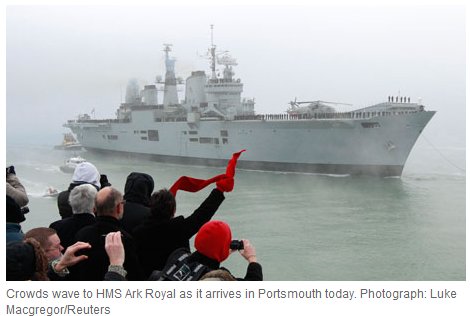
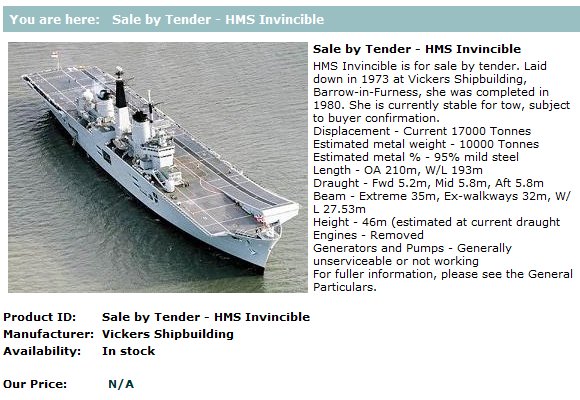
Ah, it must be a nightmare to be in the Royal Navy’s forward planning department these days. First, they gave up half the fleet now in exchange for guarantees that they’d get two new aircraft carriers in the near future. Then it became known that the government was considering equipping only one of the new ships as an aircraft carrier and converting the second to a helicopter carrier. Now, India’s growing navy appears to have a strong interest in taking one of those under-construction vessels off the Royal Navy’s hands. You can almost hear the gleeful cackling from the Brown government’s financial whizzes:

Yet another scheme by the MoD for cutting costs on the Royal Navy’s new aircraft carriers has surfaced in the media, with claims now being aired that one of the two ships might be sold to India.

The Guardian reports that India “has recently lodged a firm expression of interest to buy one of the two state-of-the-art 65,000 tonne carriers” and that an unnamed “defence source” has told the paper’s Tim Webb that “selling a carrier is one very serious option”.

As Webb is the Graun’s industrial editor, and glovepuppeting of biz correspondents by big companies is the most common way for such stories to appear, we can probably take it that the tale emanates from someone in the industrial consortium building the ships, led by BAE Systems. This is the more so as the article repeatedly states that contract penalties would make it impossibly expensive for the government to cancel one or both of the ships, which is probably the main message that Webb’s industry informant was trying to push.

F-35B to be too hot to handle?

Filed under: Military, Technology, USA — Tags: , , , , — Nicholas @ 16:59

Well, handling isn’t really the issue . . . it’s landing where there’s some strong concern for US Navy carrier captains:

It’s now official. The new generation of high-tech hovering aircraft — namely the famous V-22 “Osprey” tiltrotor and the upcoming F-35B supersonic stealth jump-jet — have an unforeseen flaw. Their exhaust downwash is so hot as to melt the flight decks of US warships, leading Pentagon boffins to look into refrigerated landing pads.

[. . .]

The jarheads* will want to operate their new machines from their existing helicopter-carrier amphibious assault vessels, which can’t practically be torn apart and refitted with massively reinforced upper decks as this would be likely to make them capsize. Similarly it would be extremely difficult to refrigerate the whole deck from beneath.

Hence the Marines would like someone to invent “a system that can be installed on top of the existing decks”, capable of resisting the hot breath of the F-35B and less than one inch thick. It should also, of course, be tough enough not to suffer any damage from the aircraft landing on it. This miracle fridge-sheet assembly should be covered with “thermally stable non-skid” finish — this latter perhaps incorporating “amorphous metal coatings”.

QotD: Characteristics of death-squads

Filed under: Military, Quotations, Religion, USA — Tags: , , , , , — Nicholas @ 12:30

This is not at all a matter of the usual stupid refusal of the FBI and other security services to understand an early warning even when they have detected one. It is a direct challenge to the unity and integrity of the armed services, which have been one of our society’s principal organs and engines of ethnic and religious integration. A U.S. soldier who wonders about the reliability of his, let alone her, Muslim colleague is not being “Islamophobic.” (A phobia is an irrational or uncontrollable fear.) If Maj. Hasan has made this understandable worry in the ranks more widespread, he has done his fanatical preacher friend the greatest possible service. But that’s his fault for doing what he did, and his superiors’ fault for letting him openly rehearse it for so long, not mine for pointing it out.

I wrote some years ago that the three most salient characteristics of the Muslim death-squad type were self-righteousness, self-pity, and self-hatred. Surrounded as he was by fellow shrinks who were often very distressed by his menacing manner, Maj. Hasan managed to personify all three traits — with the theocratic rhetoric openly thrown in for good measure — and yet be treated even now as if the real word for him was troubled. Prepare to keep on meeting those three symptoms again, along with official attempts to oppose them only with therapy, if that. At least the holy warriors know they are committing suicide.

Christopher Hitchens, “Hard Evidence: Seven salient facts about Maj. Nidal Malik Hasan”, Slate, 2009-11-16

November 16, 2009

Harrier replacement moves to next stage

Filed under: Britain, Military, Technology, USA — Tags: , , , , — Nicholas @ 13:28

The F-35B has been delivered to an American base for testing of its vertical take-off and hover capabilities:

The F-35 “Lightning II” B model will, like other versions of the same aircraft, offer supersonic performance and stealth technology – a combo so far offered in only one aircraft in the world, the famous F-22 Raptor ultrasuperfighter. But the F-35B, unlike its tailhook and normal-runway counterparts, is also equipped with a central lift fan mounted in a shaft through the fuselage and can swivel its jet exhaust downwards too.

This means that an armed and fuelled F-35B should be able to make a very short takeoff run to get airborne and then, having burned fuel and perhaps released weapons, make a vertical landing supported entrirely by engine thrust. This Short Takeoff and Vertical Landing (STOVL) capability has so far been offered in the Western-aligned world only by the famous Harrier, originally developed in Britain and now in service with the RAF, the Royal Navy and the US Marines.

Of course, Britain’s interest is moving toward being purely intellectual . . . the bookies are offering long odds on Britain ever commissioning even one of those two new aircraft carriers, never mind both of them. Back story here, here, and here.

November 14, 2009

Sneak peak at the next “Modern Warfare” game

Filed under: Humour, Military — Tags: , , — Nicholas @ 14:25


Ultra-Realistic Modern Warfare Game Features Awaiting Orders, Repairing Trucks

November 13, 2009

Follow-up on Northwest’s overflight situation

Filed under: Bureaucracy, Military, USA — Tags: , , — Nicholas @ 19:41

The New York Times reports on the FAA’s investigation into the October 21st incident (see blog post here, including commmentary from one of the spokesmen involved):

Air traffic control supervisors delayed nearly an hour in notifying Norad, the military air defense command, that a Northwest Airlines jetliner was not responding to radio calls, the head of the Federal Aviation Administration said on Friday. The delay was a violation of detailed procedures put in place after the quadruple hijackings of Sept. 11, 2001.

The lapse probably made no difference to Norad, said the administrator, J. Randolph Babbitt, because while the Air Force did ready fighter jets in the incident, it never decided to order them into the air.

Decisions on how to handle planes that do not respond to air traffic control instructions are based on a variety of factors, Mr. Babbitt said. Among them are whether the plane is in a metropolitan area, whether it is flying erratically and whether it is sending signals that it has been hijacked. None of those was the case on Oct. 21, when Northwest Flight 188, from San Diego to Minneapolis, flew about 150 miles past the airport.

November 11, 2009

In memorium

Filed under: Britain, History, Military, WW1, WW2 — Tags: , , — Nicholas @ 11:00

A simple recognition of some of our family members who served in the First and Second World Wars:

The Great War

  • Private William Penman, Scots Guards, died 1915 at Le Touret, age 25
    (Elizabeth’s great uncle)
  • Private David Buller, Highland Light Infantry, died 1915 at Loos, age 35
    (Elizabeth’s great grandfather)
  • Private Walter Porteous, Northumberland Fusiliers, died 1917 at Passchendaele, age 18
    (my great uncle)
  • Corporal John Mulholland, Royal Tank Corps, died 1918 at Harbonnieres, age 24
    (Elizabeth’s great uncle)

The Second World War

  • Flying Officer Richard Porteous, RAF, survived the defeat in Malaya and lived through the war
    (my uncle)
  • Able Seaman John Penman, RN, served in the Defensively Equipped Merchant fleet on the Murmansk Run (and other convoy routes), lived through the war
    (Elizabeth’s father)
  • Private Archie Black (commissioned after the war and retired as a Major), Gordon Highlanders, captured at Singapore (aged 15) and survived a Japanese POW camp
    (Elizabeth’s uncle)

In Flanders fields the poppies blow
Between the crosses row on row,
That mark our place; and in the sky
The larks, still bravely singing, fly
Scarce heard amid the guns below.

We are the Dead. Short days ago
We lived, felt dawn, saw sunset glow,
Loved and were loved, and now we lie
In Flanders fields.

Take up our quarrel with the foe:
To you from failing hands we throw
The torch; be yours to hold it high.
If ye break faith with us who die
We shall not sleep, though poppies grow
In Flanders fields.

Lieutenant Colonel John McCrae, MD (1872-1918)

November 10, 2009

Korean War flare-up at sea

Filed under: Asia, Military — Tags: , , — Nicholas @ 08:25

The technically still-at-war Korean navies had a brief sea battle yesterday:

Warships from North and South Korea exchanged fire in disputed waters off the western coast of the Korean peninsula on Tuesday, leaving one North Korean vessel engulfed in flames, South Korean officials said.

The two Koreas accused each other of violating their territorial waters to provoke the two-minute skirmish. It was the first border fighting in seven years between the two countries, which remain technically at war.

[. . .]

North Korea appeared to have intended the clash to highlight its long-standing argument: the 195-53 Korean War never officially ended and the United States must negotiate a peace treaty with it if it wants the North to give up its nuclear weapons program, according to analysts in Seoul.

“Our high-speed patrol boat repelled the North Korean patrol boat,” the South Korean Office of the Joint Chiefs of Staff said in a statement following the skirmish. “We are fully prepared for further provocations from the North Korean military.”

South Korea said it suffered no casualties. Speaking in Parliament, Prime Minister Chung Un-chan said the North Korean boat limped back to its waters “enveloped in flames.”

Military ATV usage

Filed under: Military, Technology — Tags: , — Nicholas @ 08:17

I can understand the attraction of riding an ATV, as carrying a full pack and combat gear is exhausting, but I would have thought the noise of the vehicle would make them tactically useless:

ATVs (all terrain vehicles) have proved particularly useful, and popular in Afghanistan. There are many models in use, all of them militarized civilian vehicles. The British use a militarized versions of the Yamaha Grizzly 450. Basically, the Grizzly is a four wheel, 628 pound, cross country motorcycle. This ATV is six feet long and 3.5 feet wide. In addition to the driver, there are racks on the bike that can carry another 175 pounds. In addition, the vehicle can tow a trailer carrying another 350 pounds of cargo. Top speed, on a flat surface, without a trailer, is about 75 kilometers an hour. Cross country, it’s usually about half that, and a bit less if a trailer is being hauled.

Four years ago, the British Army bought 250 of the Grizzly 450s, and these were very popular with the troops in Afghanistan. There they are used for patrolling, and hauling supplies to troops in isolated positions. The army is paying $41,000 for each bike, although that includes a trailer, spare parts and technical services. The civilian version goes for about $8,000 each.

« Newer PostsOlder Posts »

Powered by WordPress