
The history of the 24th Regiment (later the South Wales Borderers) is certainly one of the most interesting stories of any regiment in the British army. Throughout its long history, going back to 1689, it had been an exceptionally courageous regiment and also exceptionally unlucky. In 1694 it had taken part in the ill-fated descent on Brest. In the War of Jenkins’s Ear and the attack on Cartagena it lost more than half its number from disease in the West Indies. In 1756 it was forced to surrender to the French at Minorca. The entire regiment was captured in the American War. Forty-six per cent of the second battalion were casualties at the Battle of Talavera in the Peninsula War — more than any other British regiment engaged. In 1810 about 400 men, nearly half the regiment, were captured by the French while on troopships from South Africa bound for India.
Perhaps it is as well to outline here the story of this gallant but ill-starred regiment after the Battle of Chilianwala. The catastrophe which overtook it in the Zulu War will be described later. In World War I it was in the disastrous Gallipoli campaign, and on 3 December 1917 the second battalion marched out of the lines in France with only two officers, the doctor and seventy-three men. In World War II a battalion was captured by the Germans near Tobruk and, naturally, it was part of the unfortunate expedition to Norway in 1940 — even the ship carrying them struck a rock and sank.
Byron Farwell, Queen Victoria’s Little Wars, 1972
August 18, 2013
QotD: The unluckiest regiment in the British army
August 17, 2013
Delays in India’s submarine program
In the Times of India, Rajat Pandit reviews the state of the Indian Navy’s submarine fleet:
Is India’s aging fleet of conventional submarines threatening to go the MiG-21 way? The Tejas light combat aircraft (LCA), already 30 years in the making, was slated to replace the obsolete MiG-21 in the 1990s but is still at least two years away from becoming fully-operational.
Similarly, the Navy too was to induct 12 new diesel-electric submarines by last year, with another dozen to follow in the 2012-2030 timeframe. This was the 30-year submarine building plan approved by the Cabinet Committee on Security (CCS) way back in July, 1999. But the Navy has not inducted even one of the 24 planned submarines till now, and is forced to soldier on with just 14 aging conventional vessels.
“The Navy is steadily modernizing in the surface warship and aircraft arenas. But our aging and depleting underwater combat arm is a big worry. But it also must be kept in mind that INS Sindhurakshak‘s accident is the first such incident we have had in over four decades of operating submarines,” said a senior officer.
Sources said INS Sindhurakshak, after Wednesday’s accident, is “a clear write-off”. Of the 13 submarines left now, as many as 11 are over 20 years old. The setback comes when China and Pakistan are systematically bolstering their underwater combat capabilities, with the former being armed with over 55 submarines.
Update: MarineLink reports on the investigation into the INS Sindhurakshak explosion.
The Indian Navy diving teams have been working nonstop to reach into the compartments of the submarine since rescue operations commenced early noon of August 14. The boiling waters inside the submarine prevented any entry until noon that day. Access to the inner compartments of the submarine was made almost impossible due to jammed doors and hatches, distorted ladders, oily and muddy waters inside the submerged submarine resulting in total darkness and nil visibility within the submarine even with high power underwater lamps. Distorted and twisted metal within very restricted space due extensive internal damage caused by the explosion further worsened conditions for the divers. This resulted in very slow and labored progress. Only one diver could work at a time to clear the path to gain access. After 36 hours of continuous diving effort in these conditions, Navy divers have finally reached the second compartment behind the conning tower in the early hours of August 16.
Three bodies have been located and extricated from the submarine from this compartment. The bodies are severely disfigured and not identifiable due to severe burns. The bodies have been sent to INHS Asvini, the naval hospital, for possible DNA identification which is likely to take some more time.
The state of these two bodies and conditions within the submarine leads to firm conclusion that finding any surviving personnel within the submarine is unlikely.
August 16, 2013
The military dilemmas of a middle power
Sir Humphrey explains in detail the problems facing the Canadian Forces:
The biggest question arguably facing Canada today is how to address what is a three pronged axis of interest. As an Atlantic and Pacific power, with substantial economic interests in both areas, Canada has an inevitable interest in both regions, which have extremely different challenges. At the same time, the emerging interest in the Arctic, where global warming and climate change is seemingly allowing an opening of trade routes, means a previously neglected region suddenly takes on far more strategic role. Beyond this home position, Canada continues to play a major role overseas, providing troops, aircraft and ships to participate in operations across the globe from the Gulf to Afghanistan.
[…]
The problem which looms is that Canada has deferred expenditure for so long on so many fronts that it is rapidly reaching the point where barring a major change of budget; something is going to have to give. As a nation Canada is a superb example of the many mid-tier powers, other examples being the Netherlands, Spain, Italy, Australia to name but a few, who have historically been able to afford and operate armed forces capable of working across a wide range of areas, but where future budgets may constrain this over time. All of these nations are typified by having a lot of legacy equipment in service, and a willingness to employ their militaries overseas on operations. These nations all face a similar challenge — the cost of military equipment is so great that all face a problem — what has to be sacrificed in order to keep some form of capability, and what are they no longer willing to do militarily?
[…]
Considering the Navy alone, one sees a fleet which has been hard worked for many years, and which has not seen new surface ships enter service for nearly twenty years. The destroyers are so old that it is nearly fifty years since the design was approved, and forty years since they entered service. The decision to continually defer replacements means that no military shipbuilding capability exists in Canada any more. This means any replacement will be built at far greater cost on a shipbuilding industry which will be created from scratch. This issue alone highlights the real challenge for many medium powers — the inability for domestic political reasons to consider purchasing certain from overseas. Despite there being several designs (such as the Royal Navy’s Type 26 / Global Combat Ship) entering service in the time-frame for replacement, the desire by Canada to retain a ‘made in Canada’ label on its surface warships means that the Canadian taxpayer will not get the best value for money. One only has to consider that most warship replacement programmes these days will only replace half to two thirds of the hulls in the preceding class due to cost, and it quickly becomes clear that Canada is going to be forced to establish a military shipbuilding capability for just 8-10 hulls.
Domestically there are many good reasons to build at home — creation of jobs in vulnerable constituencies, a sense of national control over a hugely visible symbol of national prestige, and an ability to support domestic industries (e.g. having far greater sovereignty over the weapons and equipment than may otherwise be the case with a foreign purchase). Additionally even with offsets, it is difficult to justify to taxpayers spending huge sums of money abroad, particularly for a capability traditionally built at home. There are several nations who have traditionally built their large warships at home, and who face a need to build replacement hulls in the next 10-15 years. It becomes increasingly difficult to see how they can afford to do this without making major cuts elsewhere to their procurement plans, or buying overseas.
August 15, 2013
Egyptian military empowered by Western approval
Brendan O’Neill says that we should not be surprised by the bloody turn of events in Egypt … after all, we collectively acted as enablers:
There is ‘world outcry’ over the behaviour of the Egyptian security forces yesterday, when at least 525 supporters of the deposed Muslim Brotherhood president Mohamed Morsi were massacred. The killings were ‘excessive’, says Amnesty, in a bid to bag the prize for understatement of the year; ‘brutal’, say various handwringing newspaper editorials; ‘too much’, complain Western politicians.
Such belated expressions of synthetic sorrow are not only too little, too late (hundreds of Egyptians have already been massacred by the military regime that swept Morsi from power); they are also extraordinarily blinkered. To focus on the actions of the security forces alone, on what they did with their trigger fingers yesterday, is to miss the bigger picture; it is to overlook the question of where the military regime got the moral authority to clamp down on its critics so violently in the name of preserving its undemocratic grip on power. It got it from the West, including from so-called Western liberals and human-rights activists. The moral ammunition for yesterday’s massacres was provided by the very politicians and campaigners now crying crocodile tears over the sight of hundreds of dead Egyptians.
The fact that General Abdel Fattah al-Sisi, the head of the Egyptian armed forces who swept Morsi from power on 3 July, feels he has free rein to preserve his coup-won rule against all-comers isn’t surprising. After all, his undemocratic regime has received the blessing of various high-ranking Western officials, even after it carried out massacres of protesters campaigning for the reinstatement of Morsi, who was elected with 52 per cent of the vote in 2012.
Baroness Catherine Ashton, the European Union’s chief of foreign affairs, who, like al-Sisi, is unelected, visited Egypt at the end of July. She met with al-Sisi and his handpicked, unelected president, Adly Mansour. She called on this junta disguised as a transitional power to start a ‘journey [towards] a stable, prosperous and democratic Egypt’. This was after it had massacred hundreds of protesters, placed various politicians and activists in prison, and reinstated the Mubarak-era secret police to wage a ‘war on terror’ against MB supporters. For Ashton to visit al-Sisi and talk about democracy in the aftermath of such authoritarian clampdowns was implicitly to confer authority on the coup that brought him to power and on his brutal rule and actions.
Meanwhile, the US has refused to call the military’s sweeping aside of Morsi a coup. The Democratic secretary of state, John Kerry, has gone further and congratulated al-Sisi’s regime for ‘restoring democracy’. Kerry said the military’s assumption of power was an attempt to avoid ‘descendance into chaos and violence’ under Morsi, and its appointment of civilians in the top political jobs was a clear sign that it was devoted to ‘restoring democracy’. He said this on 2 August. After hundreds of Morsi supporters had already been massacred. If al-Sisi’s forces believe that killing protesters demanding the reinstatement of a democratically elected prime minister is itself a democratic act, a necessary and even good thing, it isn’t hard to see where they got the idea from.
August 14, 2013
Fatal explosion on Indian submarine
A report from FirstPost.India on the worst naval disaster in Indian history:
The Indian Navy suffered a huge blow Wednesday when a frontline submarine exploded and sank here at dawn with 18 sailors after two explosions turned it into a deadly ball of fire.
The deep sea attack vessel INS Sindhurakshak, recently refurbished in Russia, suffered an unexplained explosion just after Tuesday midnight and an immediate deafening blast heard almost in the whole of south Mumbai.
Naval officials said the rapid spread of the blaze and the intensity of the explosions left the trapped 18 sailors, including three officers, with apparently no chance of escaping.
“We cannot rule out sabotage,” navy chief Admiral D.K. Joshi told the media after Defence Minister A.K. Antony visited the disaster site at the Mumbai naval dock.
“But indications at this point do not support the (sabotage) theory,” he said. “At this point of time we are unable to put a finger on what exactly could have gone wrong.”
An inquiry set up to probe the disaster will submit its report within four weeks.

The Indian Navy submarine INS Sindhurakshak (S 63) at anchorage off the port city of Mumbai, India
The most recent update to the Wikipedia page says:
On 14 August 2013, the Sindhurakshak sank after explosions caused by a fire took place onboard when the submarine was docked at Mumbai. The fire, followed by a series of ordnance blasts on the armed submarine, occurred shortly after midnight. The fire was put out within two hours. It is unclear exactly what caused the fire. Due to damage from the explosions, the submarine sank at its berth with only a portion visible above the water surface.[10][14][15] Sailors on board reportedly jumped off to safety. Navy divers were also brought in as there was a possibility that 18 personnel were trapped inside. India’s defence minister confirmed that there were fatalities.[6]
Due to the explosion, the front section of the submarine was twisted, bent and crumpled, and water had entered the forward compartment. Another submarine, INS Sindhuratna, also sustained minor damage when the fire on Sindhurakshak caused its torpedoes to explode.[14][16] Defence minister A. K. Antony briefed the Prime Minister Manmohan Singh on the submarine incident, and would leave for Mumbai to visit the accident site.[17][18]
Official sources said it was “highly unlikely” the submarine could be returned to service.[19]
August 13, 2013
Master Sergeant Anonymous
Justine Sharrock talks to someone who claims that there are many members of Anonymous in the ranks of the US military:
Are there a lot of members of Anonymous in the Army?
There are more than you would think, more heavily in the techie world [of the military] — especially at Fort Huachuca, where all the intel people are. A lot of them wanted to get the job [there] because they want to learn secret stuff and have a better personal understanding of how the world actually works.How do you know who is in Anonymous?
Initially we have the handshaking phase. The lingo is still relatively unknown. In conversation, you drop in jokes. If you are with someone on a mission, you’re like, “Man, there are over 9,000 reasons that this is a bad idea.” That initially establishes friendship. Once you feel comfortable with the person and they aren’t just posing as part of the culture, then you talk about what they’ve done and how much a part of it they are. It gets to the point where you are discussing individual operations.What are the most popular operations amongst soldiers?
Anonymous is so distributed and leaderless that everyone has operations they love and hate. Operation Cartel, especially at Fort Bliss. Operation Dark Net was universally loved. And Operation Payback was pretty well received.[…]
Does the military know about the Anonymous presence?
Pre-Manning, there were several academic papers put out trying to analyze it and school the leadership. Because the Army is a very top-down organization, they assume that [Anonymous] is too. Leadership wasn’t concerned with it until Manning happened. Then they read everything under the [lens] of what Manning did and it just scared them — scared them blind. They know we are in there and they assume that we are all going to do a Manning or a Snowden.How have they addressed it?
Every six months you are mandated to get a Threat Awareness and Reporting Procedures Brief. It used to be very much like how to … spot the Iraqi contractor who is pacing off your base. Now it is, “Look at the person at your left and right. Are they espousing social beliefs that don’t line up with Army values? What websites do they go to at work?” With the caveat that it is OK to have political beliefs that are different. You get a heavy-handed feeling.I have had more than a few officers come up to me and as we are trying to talk about [Anonymous] they are worried, like, “Are you CID [working undercover for the Central Investigative Division]?” Because you always worry about that.
August 12, 2013
The controversy over Japan’s latest “destroyer”
Apparently our eyes can deceive us. For most people looking at this image — at least if they know much about naval vessels — the description that comes to mind is “aircraft carrier”:
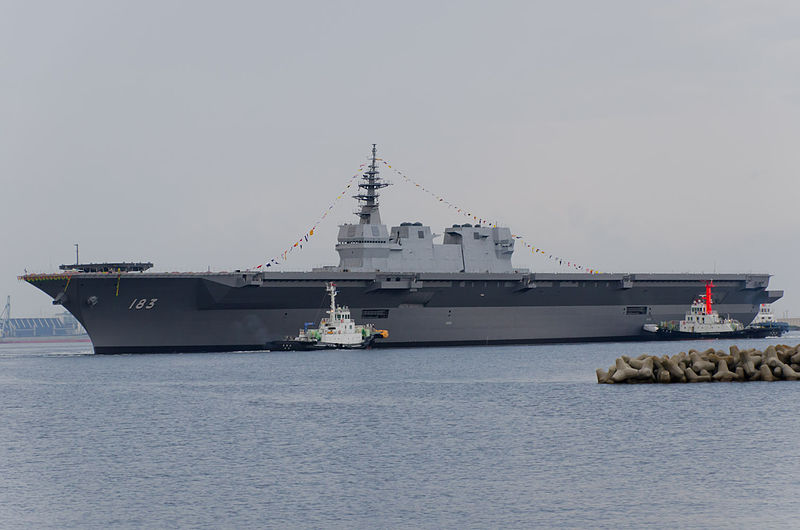
JS Izumo DDH-183
However, for constitutional reasons she is officially classified as a “destroyer”. In the South China Morning Post, Stefan Soesanto explains why this classification matters:
The Izumo‘s distinctive features certainly do not resemble anything one would typically classify as a destroyer. Indeed the warship currently under construction in Yokohama harbour is an aircraft carrier in anything but in name. Its size, tonnage and speed are closer to the US Essex aircraft carrier class, than to any of the two previous helicopter destroyers Japan has built so far.
At a cost of US$1.14 billion, the Izumo is officially conceptualised to host up to 14 helicopters whose missions would range from anti-submarine warfare and maritime border surveillance to humanitarian relief operations. In this regard, the Izumo‘s objectives are identical to the two Hyuga-class helicopter destroyers that were put into service in 2009 and 2011.
The current discussion among analysts and military brass as to whether Japan’s helicopter destroyers are considered aircraft carriers is not new. According to The Japan Times, Maritime Self-Defence Force chief of staff Admiral Keiji Akahoshi stated in 2009 that the Hyuga-class falls outside the conventional definition of an aircraft carrier because it lacks a fair degree of offensive functions. This argumentation has been notably employed by the Japanese government to circumvent Article 9 of the peace constitution to portray its helicopter destroyers as purely defensive military assets.
While Beijing’s criticism towards the Hyuga-class has been largely used as a means to support its own aircraft carrier expansion plans, the unveiling of the much larger Izumo has prompted widespread fears in China. Major Chinese media outlets went to great lengths to link Japan’s militaristic past to plans by the Japanese government towards constitutional revision. Indeed, the Chinese defence ministry even put out a statement saying that it is “concerned over Japan’s constant expansion of its military equipment”.
Reflecting on its own aircraft carrier plans, however, Chinese experts such as Li Daguang, professor at the National Defence University of the People’s Liberation Army, seem to make a simple leap of faith by suggesting that “the Chinese aircraft carrier Liaoning was mainly built for training purposes while the Izumo was built for real war”.
Of course, this isn’t a new thing, as a quick glance at the JS Hyūga also shouts “aircraft carrier” rather than “destroyer”:

JS Hyūga
August 11, 2013
The Fort Hood court-martial
Mark Steyn on the trial of Major Hasan for “workplace violence”:
On December 7, 1941, the U.S. naval base at Pearl Harbor was attacked. Three years, eight months, and eight days later, the Japanese surrendered. These days, America’s military moves at a more leisurely pace. On November 5, 2009, another U.S. base, Fort Hood, was attacked — by one man standing on a table, screaming “Allahu akbar!” and opening fire. Three years, nine months, and one day later, his court-martial finally got under way.
[…]
He’s admirably upfront about who and what he is — a “Soldier of Allah,” as he put on his business card. On Tuesday, he admitted he was a traitor who had crossed over from “the bad side” (America’s) to “the good side” (Islam’s). He has renounced his U.S. citizenship and its effete protections such as workplace-violence disability leave. He professes loyalty to America’s enemies. He says, “I am the shooter.” He helpfully informs us that that’s his gun. In this week’s one-minute statement, he spoke more honestly and made more sense than Obama, Gates, Casey, the Armed Forces Court of Appeals, two judges, the prosecution and defense lawyers, and mountains of bureaucratic reports and media coverage put together.
But poor old Hasan can say “Yup, I did it” all he wants; what does he know?
Unlike the Zimmerman trial, Major Hasan’s has not excited the attention of the media. Yet it is far more symbolic of the state of America than the Trayvon Martin case, in which superannuated race hucksters attempted to impose a half-century-old moth-eaten Klan hood on a guy who’s a virtual one-man melting pot. The response to Nidal Hasan helps explain why, in Afghanistan and elsewhere, this war is being lost — because it cannot be won because, increasingly, it cannot even be acknowledged. Which helps explain why it now takes the U.S. military longer to prosecute a case of “workplace violence” than it did to win World War Two.
August 6, 2013
Second Chinese aircraft carrier appears to be under construction
Strategy Page has the details:
Recent photos from a Chinese shipyard appear to show a section of a new Chinese aircraft carrier under construction. This appears to be a carrier similar to the American Nimitz class ships (100,000 ton vessels using a catapult rather than a ski jump flight deck for launching aircraft). Large ships, including warships, are often built in sections than the sections are welded and bolted together. The section of what appears to be a carrier does not indicate the exact size of the new carrier other than that it appears larger than the new carrier China commissioned at the end of 2012.
Last September China commissioned its first aircraft carrier, the Liaoning. At the time China was believed to be building the first of several locally designed aircraft carriers but the Chinese officially denied this. The only official announcements have alluded to the need for two or three aircraft carriers, in addition to the Liaoning. Construction of such large ships had not yet been seen in any shipyard. That has changed with the appearance of these new shipyard pictures.
[…]
The new Chinese “larger carrier” apparently means something like the recently decommissioned American USS Enterprise (CVN 65). This was the first nuclear powered carrier and it served as the prototype for the subsequent Nimitz class. It’s unclear if the new Chinese carrier will be nuclear powered. The Enterprise was an expensive design, and only one was built (instead of a class of six). While a bit longer than the later Nimitz class, it was lighter (92,000 tons displacement, versus 100,000 tons). The Enterprise was commissioned in 1961, almost 40 years after the first U.S. carrier (the Langley) entered service in 1923. In the two decades after the Langley there were tremendous changes in carrier aviation. While the innovation slowed after World War II, major changes continued into the 1950s (jet aircraft, nuclear propelled carriers, SAMs). But in the ensuing half century there has been no major innovation in basic carrier design. This has not been a problem because the carriers have proven useful, at least for the U.S. Navy (the only fleet to use such large carriers) and no one else has maintained a force of these large carriers. Only the U.S. has felt a constant need to get air power to any corner of the planet in a hurry. More importantly, no navy has been able to give battle to the U.S. carrier force since 1945. The Soviets built new anti-carrier weapons and made plans to use them but that war never occurred. China is building carriers but is not committed to having a lot of them to confront the U.S. but to intimidate its neighbors.
BBC News has a series of photos of the Liaoning from purchase to commissioning:
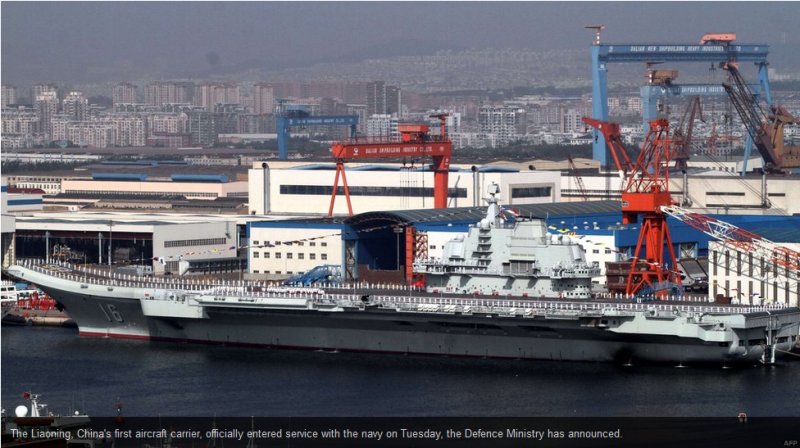
Click to see full-size images at the BBC website
Earlier reports on the progress of the Liaoning (under the name Shi Lang) can be found here.
Update: James R. Holmes on why China might be interested in becoming a 21st century naval power.
A couple of years back, when Beijing made its aircraft-carrier aspirations official, the fine folks at Foreign Policy asked me to explain why a historic land power like China cared about flattops. Being a bear of small brain, I reached into my mental bag of tricks and came up with Thucydides’ claim that fear, honor, and interest are three of the prime movers for human actions. Beijing feared U.S. containment, a relic of the Cold War; saw an opportunity to recoup honor lost during the century of humiliation at the hands of the imperial powers; and hoped to add to the naval power it was amassing to advance China’s interests in maritime Asia.
What’s changed since then? Fear and honor are emotional needs. It may be that sending the carrier Liaoning (formerly the Soviet Varyag) to sea helped satisfy China’s need to banish bad cultural memories. But who knows when fear will be at bay? The United States and its allies have ruled the sea in East Asia long enough that their navies may inspire fears disproportionate to their actual margin of supremacy. Or, the Chinese leadership may see value in protesting too loudly, and thus making Western powers fearful of creating a self-fulfilling prophecy, namely Sino-American antagonism.
Most importantly, it may be that having ameliorated anxieties arising from honor and fear grants Beijing the luxury of operating mostly from calculations of interest. Simply deploying a carrier, Liaoning, may forestall fears while satisfying Chinese society’s desire for a capability that every other great power enjoys.
July 29, 2013
Spanish border guards stage virtual blockade of Gibraltar
The Spanish claim to Gibraltar is being pursued by other means, it would seem:
Spanish police stopped every one of 10,000 vehicles leaving Gibraltar for the mainland yesterday, causing six-hour traffic jams in the latest escalation in the standoff over the Rock.
Officers from the Royal Gibraltar Police were forced to impose diversions and create beachside holding areas as Spanish authorities ‘choked’ the border, causing massive tailbacks in 30C heat.
It was the second day that border guards had blocked links to the mainland, in a move that seemed calculated to bring Gibraltar to a standstill.
[…]
Most recently Spanish fishermen sparked a stand-off with the Royal Navy as they attempted to disrupt the creation of an artificial reef in the Bay of Gibraltar last week.
The fishermen used fast boats to weave in between British vessels involved in the reef-laying operation in a bid to create large waves to disrupt the work, the Sunday Express reported.
Intervention by a Royal Navy patrol boat brought an end to the protests. A Gibraltar government spokesman has accused Spain of launching the ‘draconian’ border checks which continued yesterday in ‘retaliation’.
He said the decision to lay the reef, which consists of large concrete blocks sunk to the bottom of the bay, had been taken on environmental grounds.
However, he added, it had infuriated Spanish fishermen since it would also foil any attempts by their vessels to carry out illegal trawling of the bottom of the Bay of Gibraltar.
Criticising the Spanish government’s response, the spokesman added to the Sunday Express: ‘Not only are these measures affecting thousands of innocent Spanish workers who make their living on Gibraltar, but we are extremely concerned about pensioners and families with young children being forced to suffer in this way just because they want to visit the mainland.’
July 25, 2013
Hard times for Somalia’s pirates
Strategy Page on the plight of a number of kidnapped ship crews in the hands of Somali pirates and the hard times those pirates are facing themselves:
Somalia is a sad place and one of the saddest tragedies ever is being played out where pirates in the north are holding 40 sailors and several ramshackle ships that no one will pay a ransom for. These are seagoing fishing boats and small freighters owned by small operators with no insurance to cover ransoms and not enough cash, or inclination, to pay what the pirates demand. The negotiators (who work for the pirates) have explained all this to the pirate chiefs, who are facing hard times themselves and stubbornly refuse to face the fact that they will never get anything for these 40 sailors and their ramshackle ships (one of which recently sank at anchor). Just killing the remaining prisoners (some held for three years) and sinking the ships risks retribution from the anti-piracy patrol off shore. Countries the prisoners are from have been pressured to pay ransom, but all of them adhere to the “no negotiating with terrorists” code. There is growing pressure on the pirates to simply release the unwanted prisoners on “humanitarian grounds” and at least get some good press out of this mess. That’s a bitter solution for the pirates, who have not captured a ship that could be ransomed in over a year. Several pirate gangs have disbanded and those still around have shrunk and cut the payroll considerably.
The big time piracy is largely out of business because warship patrols and better security aboard large ships passing Somalia has made it nearly impossible to seize these vessels. Holding ships for ransom only worked initially because Somalia, a state without a government since 1991, provided small ports on the coast of East Africa where pirates could bring the merchant ships they had captured, and keep them there, safe from rescue attempts, until a ransom could be negotiated.
[…]
Pirates usually function on the margins of society, trying to get a cut of the good life in situations where there aren’t many options. This is usually in areas where state control is weakest or absent, in failing and “flailed” states (a flailing state is something like Nigeria, Indonesia, or the Philippines, where the government is managing to just barely keep things together, unlike a failed state such as Somalia, where there isn’t any government at all).
The solution to piracy is essentially on land, where you go into uncontrolled areas and institute some law and order and remove the pirate safe havens. This has been the best approach since the Romans eliminated piracy in the Mediterranean over 2,000 years ago. Trying to tackle piracy just on the maritime end can reduce the incidence of piracy but can’t eliminate it. In the modern world the “land” solution often can’t be implemented. Who wants to put enough troops into Somalia to eliminate piracy? And flailing states are likely to be very sensitive about their sovereignty if you offer to help them control marginal areas.
A new industry has developed that attempts to “pirate proof” ships operating off Somalia. The most successful (and most expensive) technique is to put a small number of armed guards on each ship. That, and warship patrols, has greatly reduced piracy off East Africa (Somalia). But off West Africa (especially the Gulf of Guinea) the piracy threat is growing because pirates have found ways to get more valuables off ships before security forces (police, coast guard, or navy) can show up.
July 22, 2013
Examining post-traumatic stress disorder
In the New Yorker, David J. Morris looks at the psychological chameleon we call PTSD:
As it is understood today, post-traumatic stress disorder is a grab bag of symptoms that emerges after experiencing trauma, like nearly dying or having one’s bodily integrity violated. It includes a persistent sense of hypervigilance and recurrent, intrusive memories of past traumatic events. In the worst cases, veterans with P.T.S.D. may hallucinate the voices of dead comrades, enemy combatants, or their commanding officers. A 1995 study of combat veterans with P.T.S.D. published in Traumatology found that sixty-five per cent of subjects reported hearing voices, including command hallucinations that they felt compelled to obey. As the psychiatrist Jonathan Shay, the author of Achilles in Vietnam: Combat Trauma and the Undoing of Character, put it, “P.T.S.D. can unfortunately mimic virtually any condition in psychiatry.”
But there are a growing number of psychiatrists and researchers who are challenging our understanding of P.T.S.D. — even its very nature as an ailment. Modern psychiatry, they argue, is locked into a mindset that systematically overdiagnoses P.T.S.D. without nurturing veterans’ ability to heal themselves. American culture, meanwhile, vacillates between elevated ideas of hero worship and victimhood in its conception of veterans, which can be destructive to the veterans themselves. One of the chief proponents of this school of thought is Ben Shephard, a leading British historian of military psychiatry. In his provocative book, A War of Nerves: Soldiers and Psychiatrists in the Twentieth Century, he describes a historical cycle that governs the treatment of war stress: “the problem is at first denied, then exaggerated, then understood, and finally, forgotten.” Shephard claims that the West, and America in particular, are deeply mired in the exaggeration phase of that cycle. These skeptics of the prevailing model of P.T.S.D. were described in Scientific American as a “broad array of experts indeed, giants of psychology, psychiatry and epidemiology.” One of the major tenets of this argument is a fact that, on its face, suggests that P.T.S.D. is a culturally determined phenomenon as well as a medical one: American veterans are 2.5 to four times more likely to be diagnosed with P.T.S.D. than British veterans.
[…]
As Jonathan Shay, the author of Achilles in Vietnam, shows in his follow-up, Odysseus in America: Combat Trauma and the Trials of Homecoming, while the problem of returning from war is one of humanity’s oldest struggles, the use of P.T.S.D. to frame a wide variety of traumatic experiences is a relatively recent development. The growing criticism of our current understanding of P.T.S.D. suggests that what was once ignored or treated as a failure of character — the soldier’s weakness — has now been medicalized to the exclusion of discussing its moral and spiritual dimensions. “It feels to me as if the U.S. civilian population has pathologized the veteran experience,” Elliott Woods, an Iraq veteran-turned-reporter, told me not long ago. “One well-intentioned person said to me the other day, ‘I can’t see how anyone could go to Iraq and not come back with P.T.S.D.’
H/T to Tim Harford for the link.
July 18, 2013
The cost of withdrawal
A couple of days ago, I posted an item on the costs of removing military equipment from Afghanistan (that is, due to lack of direct port access, thousands of tons of gear have to be flown out at an eye-watering $14,000 per ton). The Washington Post had an article yesterday discussing the customs dispute between the US military and the Afghan government which is making the situation even more fraught:
An escalating dispute between the Afghan government and the United States over customs procedures has halted the flow of U.S. military equipment across Afghanistan’s borders, forcing commanders to rely more heavily on air transport, which has dramatically increased the cost of the drawdown, according to military officials.
The Afghan government is demanding that the U.S. military pay $1,000 for each shipping container leaving the country that does not have a corresponding, validated customs form. The country’s customs agency says the American military has racked up $70 million in fines.
If left unresolved, the disagreement could inflate the price tag of the U.S. military drawdown by hundreds of millions, if not billions, of dollars because of the higher cost of shipping by air — an unwelcome expenditure at a time when the Pentagon is scrambling to cope with steep congressionally mandated budget cuts and the White House is attempting to jump-start negotiations over a long-term security cooperation deal with Kabul.
The Afghan government’s demand for payment is part of a broader dispute over Kabul’s authority to tax entities from the United States, its chief benefactor. As the war economy that for years bankrolled Afghanistan’s political elite starts to deflate, the government is increasingly insisting that U.S. defense contractors pay business taxes and fines for a range of alleged violations.
H/T to Doug Mataconis who also wrote:
We invaded Afghanistan, arguably liberating them from the grip of the Taliban and their al Qaeda allies. We’ve spent ten years or so fighting to protect the government of Hamid Karzai from those same forces. And now they want to charge us to leave? Surely, this is a first, isn’t it? On the other hand, I can see a benefit here. If we knew going into a war that we’d have to pay money to get out at the end perhaps we’d be less willing to start it.
July 15, 2013
Expensive military gear to become piles of scrap
Strategy Page explains why billions of dollars in military equipment will be scrapped in Afghanistan:
It’s going to cost some $14 billion to deal with $26 billion worth of American equipment in Afghanistan. Half that cost will be for shipping gear out, but the other $7 billion will be the cost of equipment not worth shipping home and either destroyed or donated to the Afghans. About 78,000 tons of gear will be destroyed, including over 2,000 armored vehicles. Some has to be moved, given to the Afghan security forces, sold locally or destroyed. About 9,000 MRAPs will be sent back to the United States.
Unlike Iraq, where heavy stuff, like armored vehicles and trucks, could simply drive to a nearby port and put on a ship, Afghanistan has no ports. The nearest ones are in Pakistan and the road trip is expensive and dangerous because of the theft and the threat of attacks (by terrorists or gangsters seeking “protection” fees). So a lot more gear will be flown out of Afghanistan, which is quite expensive. The current plan calls for 28,000 vehicles and 20,000 shipping containers of gear are to be moved by the end of 2014.
The U.S. and NATO supplies coming in (or going out) via railroad from Western Europe, go through Ukraine, Belarus, Russia, Kazakhstan and Uzbekistan, to Afghanistan. This approach costs $400 a ton to move material to or from Afghanistan, versus three times that to truck it in from Pakistani ports, or $14,000 a ton to fly stuff in, or $10,000 a ton if you just fly material in from a friendly (Persian Gulf) port. For example, $600,000 MRAPs (Mine Resistant Ambush Protected) cost $140,000 to fly in from the Gulf. Some 2,000 of these MRAPs in Afghanistan are no longer needed by the United States or the Afghan forces so are being cut up for scrap in Afghanistan.
July 14, 2013
“The very definition of grand strategy is holding ends and means in balance to promote the security and interests of the state”
At the Anti-War blog, John Glaser looks at the ongoing costs of empire:
In Foreign Affairs, Michael O’Hanlon and Bruce Riedel suggest a cost-saving measure for America’s empire in the Middle East: opening more U.S. military bases in the region. Instead of relying as it has on expensive “aircraft carriers in and near the Persian Gulf,” the U.S. should move its military presence back onto land in at least three different Gulf states.
The primary purpose of having U.S. military bases peppered throughout the Middle East has traditionally been to exert control over geo-politically vital oil-rich countries and to allow for a rapid and coordinated use of military force at Washington’s command. As a Top Secret National Security Council briefing put it in 1954, “the Near East is of great strategic, political, and economic importance,” as it “contains the greatest petroleum resources in the world” as well as “essential locations for strategic military bases in any world conflict.”
O’Hanlon and Riedel don’t even consider the legitimacy of America’s military presence in the Middle East; for them, it is a natural law that can’t be questioned. So when faced with strained budgets that can’t support a sprawling, costly, and unwarranted empire, they try to figure minor cost cutting measures around the edges instead of reevaluating our military postures as a whole.
A CSIS report last year took a different tack, arguing that “disappearing finances; rising alternative power centers; declining US military predominance; lack of efficacy of key non-military instruments of power; and reduced domestic patience for global adventures,” all require a rethinking of U.S. grand strategy with an eye towards roll-back.
The very definition of grand strategy is holding ends and means in balance to promote the security and interests of the state. Yet, the post-war US approach to strategy is rapidly becoming insolvent and unsustainable – not only because Washington can no longer afford it but also, crucially, because it presumes an American relationship with friends, allies, and rivals that is the hallmark of a bygone era. If Washington continues to cling to its existing role on the premise that the international order depends upon it, the result will be increasing resistance, economic ruin, and strategic failure.
That first sentence there is one of the most honest you’ll ever see from an elite DC foreign policy think tank. U.S. foreign policy is ultimately promoting “the security and interests of the state.” It isn’t for your sake. It benefits the government and the private interests aligned with it.


