
This necessity for taking risks had previously been stressed by a passage in a letter written by James Wolfe when a colonel on the staff in 1757, a passage that has become justly famous:
Experience shows me that … pushing on smartly is the road to success; that nothing is to be reckoned an obstacle to your undertaking which is not found really so upon trial; that in war something must be allowed to chance and fortune, seeing it is in its nature hazardous and on option of difficulties; that the greatness of an object should come under consideration as opposed to the impediments that lie in the way; that the honour of one’s country is to have some weight; and that in particular circumstances and times the loss of a thousand men is rather an advantage to a nation than otherwise, seeing that gallant attempts raise its reputation and make it respected; whereas the contrary appearance sink the credit of a country, ruin the troops, and create infinite uneasiness and discontent at home.
General Robert E. Lee puts it in fewer words:
There is always hazard in military movements, but we must decide between the possible loss from inaction and the risk of action.
Napoleon laconically brings out the same basic idea:
Shuffling half-measures lose everything in war.
Lt. Colonel Alfred H. Burne, “The Strands of War”, The Art of War on Land, 1966.
September 6, 2013
QotD: Risk-taking
September 5, 2013
Sea King replacement program branded as “the worst in Canada’s history”
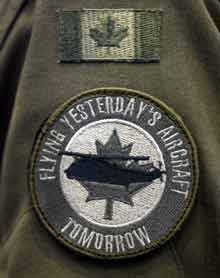 The Royal Canadian Navy is still operating the Sea King helicopter — which is 50 years old — and the planned replacement helicopters appear to be no closer to delivery than they were 20 years ago:
A naval helicopter procurement program described as the worst in Canada’s history was doomed from the start but could be made “viable and operationally relevant” if the federal government urgently adopts a new approach, says a confidential new report obtained by CBC News.
The independent evaluation of the multibillion-dollar purchase of 28 CH-148 Cyclone helicopters to replace a 50-year-old fleet of Sea Kings, obtained by CBC News Network’s Power & Politics host Evan Solomon, concludes the government can get the problem-plagued program back on track by negotiating with primary supplier Sikorsky to “re-scope” the project’s structure, specifications and delivery approach.
“[The] project could be viable and operationally relevant with a new structure and governance model as described in our recommendations,” reads the report from Hitachi Consulting.
[…]
“A fundamental problem existed at the outset of this project — this set the stage for significant misalignment,” reads the key finding.
The report says the government believed it was buying an “off-the-shelf” product by Sikorsky — a conclusion also drawn in a 2010 auditor general’s report. Yet the project should have been treated as a development program because the “state-of-the-art” aircraft incorporates advanced technology and an in-service support capability “that is likely unsurpassed in the world today,” according to the report.
While the fleet was to begin delivery in late 2008, so far only four of the Cyclone helicopters have been delivered — and only on an “interim” basis. The government won’t formally accept them because they don’t fully meet the specifications.
Last year, then defence minister Peter MacKay cited the Sikorsky deal as an example of how procurement can “go badly wrong.”
“This is the worst procurement in the history of Canada, including the $500-million cancellation costs that are attached to the maritime helicopter program and then the costs of the further maintenance to fly the 50-year old helicopters,” he said at the time. “They’re going to go right out of aviation service and into the museum in Ottawa. And that’s not a joke.”
H/T to Mark Collins for the link.
September 4, 2013
Air-Sea Battle as a response to Chinese military expansion
The Diplomat‘s Amitai Etzioni looks at the US Air-Sea Battle plan:
On the face of it, the Pentagon’s Air-Sea Battle plan makes eminently good sense; it is a clear response to a clear challenge. China has been developing a whole slew of weapons (especially anti-ship missiles) over the past two decades that are of great concern to the U.S. military. These weapons, known in Pentagon-speak as anti-access/area-denial (A2/AD) capabilities, could undermine the international right to free passage in China’s surrounding waters or, in the case of a conflict over Taiwan or contested islands in the South and East China Seas, prevent the U.S. from making good on defense commitments to its friends in the region.
In response, the Pentagon developed Air-Sea Battle (ASB), the employment of which entails, according to position papers developed to promote it, a blistering assault on China’s mainland. A report by the Center for Strategic and Budgetary Assessments (CSBA) gives a detailed account of how an ASB-style war with China would unfold. In the opening “blinding campaign,” the U.S. attacks China’s reconnaissance and command-and-control networks to degrade the PLA’s ability to target U.S. and allied forces. Next, the military takes the fight to the Chinese mainland, striking long-range anti-ship missile launchers. Given that this is where the anti-ship missiles are located, it is only logical that the U.S. would target land-based platforms. And to go after them, one of course needs to take out China’s air defense systems, command control centers, and other anti-access weapons. In short, ASB requires a total war with China.
[…]
The main flaw Air-Sea Battle it is not merely that it is a particularly aggressive military response to the anti-access/area-denial challenge. The problem is that ASB is developing in a foreign policy vacuum. If the U.S. were to conduct a thorough review of China’s military capabilities and its regional and global ambitions — and found that the Chinese were planning to forcefully expand their territory or unseat the U.S. as the global power, perhaps Air-Sea Battle might be deemed appropriate.
More on Britain’s aircraft carrier program
The always informative Sir Humphrey responds to yesterday’s Daily Mail and other media reports on the CVF program:
The first thing that struck the author on reading it was that it highlighted the challenges posed in bringing any large piece of equipment into service. There was a lot of comments about the risk posed to the UK by not having the so-called ‘Crowsnest’ AEW capability in service until 2022 which left the platform at risk. It is very easy to focus on the idea that a carrier is late, and that is a relatively simple piece of kit, so why should it take so long to bring into service? In reality the introduction into service of CVF is a watershed moment for the Royal Navy — it will represent a step change in capability, and merge together several very different capabilities which the RN has either not operated for a while, or which it has not operated at all. At its heart the RN is having to simultaneously introduce a brand new class of ship into service, with all the technical risk that this entails. This is then backed up by the near simultaneous introduction into service of the most technically advanced jet the UK has ever operated, and also bring the UK back into the world of fixed wing carrier operations, a skill which even with the mitigation measures in place will still be a challenge to regain. Its also about bringing a new AEW platform into service, after a near 6 year gap in cover, and again with all the very considerable technical risk posed by this. Finally its about bringing the whole package together and working with the rest of the RN to ensure that what exists isn’t just a collection of equipment of very levels of operational utility and capability, but is in fact a fully worked up and integrated system which has an effect far beyond the sum of its parts.
[…]
One thing that reads through very clearly in the evidence is the clear emphasis that CVF is seen as a joint asset for Coalition operations. While obviously it provides a national capability in extremis, it is clear that provision of a CVF hull and airwing is seen as a major means of the UK working with coalition partners. This is an important part of the reality of future naval operations — while we like to fondly imagine that CVF provides the UK with the ability to work in isolation, in reality its an asset that will provide great influence in coalition work. The evidence is clear that in future the UK sees provision of CVF on operations as being part of a wider multi-national force, and particularly early in its life, there is an expectation that capability gaps such as AEW would be met either by working with partner nations, or by wider UK assets (e.g. AEW Sentry).
This is important as it highlights the gradual shift in UK thinking away from funding the provision of an entire wholesale package of capabilities into assuming that risks can be taken in some areas. When one reads the evidence though, it is suddenly clear how far fetched the scenarios sound — for instance it was only under heavy questioning, when the line of assumptions reached ‘fighting an enemy with French and US cover in high seas away from landbased cover’ did we discover that the RN may struggle a wee bit without CROWSNEST. One would hope that between 2020 and 2022 the RN is not going to be re-enacting scenes from a Tom Clancy novel?
September 3, 2013
Britain’s new aircraft carriers in the news again
It’s from the Daily Mail, so a certain level of de-hystericization is called for…along with salt to taste. First, the discovery that the two carriers will initially be without radar for early warning of incoming planes and missiles:
The Royal Navy’s new aircraft carriers could set sail without a crucial radar which warns commanders of incoming enemy warplanes and missiles.
A damning report by MPs reveals the Crowsnest early warning system will not be ready until six years after the first of the £5.5billion Queen Elizabeth-class warships enters service in 2016.
Delays in fitting the ‘eyes in the sky’ system to military helicopters until 2022 were a ‘concern’, the Commons’ Public Accounts Committee (PAC) says today.
And the costs incurred by changing the planned acquisition of F-35 aircraft to equip the carriers is rather eye-watering:
The bill for the two new warships, given the green light in 2008, is almost twice the original £3.6billion — and there are ‘huge risks’ it will increase further, says the report.
MPs heap criticism on the Coalition for wasting money after a U-turn over the type of warplanes to fly from the aircraft carriers.
In 2010 ministers controversially decided to scrap the last Labour government’s plans to buy a fleet of jump jets, which take off and land vertically.
Instead, Prime Minister David Cameron ordered conventional versions of the US-built F-35 Joint Strike Fighter that would need catapults and arrester gear to take off from and land on the vessels.
But this was based on ‘deeply flawed information’, say the committee. When the cost of fitting the ships with ‘cats and traps’ more than doubled to £2billion, Mr Cameron flip-flopped and returned to buying the jump jet.
The move cost a staggering £74million in squandered in lost man hours, administrative costs and needless planning.
Labour MP Margaret Hodge, the PAC’s chairman, said: ‘The Committee is still not convinced that the MOD has this programme under control. It remains subject to huge technical and commercial risks, with the potential for further uncontrolled growth in costs.’

Queen Elizabeth class side and overhead views
The switch back to the jump jet was made last year. Back in 2010, I was rather pessimistic that the carriers would even be built and I suggested that India would likely take them off the Royal Navy’s hands once they were complete.
QotD: Some things never change, military division
Then for the first time since I had left the Kotwali I had a moment to run over in my mind the actions I had taken during the last half-hour. The soldier always knows that everything he does on such an occasions will be scrutinized by two classes of critics — by the Government which employs him and by the enemies of that Government. As far as the Government is concerned, he is a little Admiral Jellicoe and this his tiny Battle of Jutland. He has to make a vital decision on incomplete information in a matter of seconds, and afterwards the experts can sit down at leisure, with all the facts before them, and argue about what he might, could, or should have done. Lucky the soldier if, as in Jellicoe’s case, the tactical experts decide after twenty years’ profound consideration that what he did in three minutes was right. As for the enemies of the Government, it does not much matter what he has done. They will twist, misinterpret, falsify, or invent any facts as evidence that he is an inhuman monster wallowing in innocent blood.
Field Marshal William Slim, “Aid to the Civil”, Unoficial History, 1959.
September 2, 2013
South Korea decides against the F-35 and the Eurofighter Typhoon
The South Korean government is in the same situation as the Canadian government: needing to purchase replacements for Cold War era combat aircraft and having a very limited budget to do so. After analyzing their specific needs, South Korea isn’t going to buy either the F-35 or the Eurofighter Typhoon:
On August 18th South Korea selected Boeing’s F-15SE Silent Eagle as the sole candidate for Phase III of its Fighter eXperimental Project (F-X) over Lockheed Martin’s F-35A and the Eurofighter Typhoon. The decision has drawn vociferous criticism from defense experts who fear the selection of F-15SE may not provide the South Korean military with the sufficient Required Operational Capabilities (ROCs) to counterbalance Japan and China’s acquisition of 5th generation stealth fighters.
In hindsight, Zachary Keck of The Diplomat believes that Republic of Korea’s (ROK) preference for the F-15SE over two other competitors was “unsurprising.” After all, Boeing won the previous two fighter competitions with its F-15-K jet. In 2002 and 2008, South Korea bought a total of 61 F-15K jets from Boeing. South Korea’s predilection for the F-15SE is understandable given its 85% platform compatibility with the existing F-15Ks.
However, the most convincing explanation seems to be the fear of “structural disarmament” of the ROK Air Force should it choose to buy yet another batch of expensive fighters to replace the aging F-4 Phantom and F-5 Tiger fighters. Simply stated, the more advanced the fighter jet, the more costly it is. The more expensive the jet, the fewer the South Korean military can purchase. The fewer stealth fighters purchased, the smaller the ROK Air Force.
Here is a mock-up of the F-15SE, courtesy of Wikipedia:

Mockup of the F-15SE Silent Eagle
September 1, 2013
The military tablet – appearing now in combat zones around the world
Strategy Page talks about the US Air Force use of Windows tablet computers for aircraft pilots and the wider adoption of tablets in the rest of the military:
Air forces all over the world are catching up when it comes to iPads. These devices were soon being adopted by officers and troops after they first appeared in 2010, without waiting for official permission. The iPad mini showed up in 2012. While using PDF files to replace maps and manuals was one of the first military uses, this was quickly followed by military-specific smart phone apps.
Early on combat pilots in Afghanistan, like many businesses, discovered how useful the iPad could be on board. U.S. Marine Corps helicopter pilots found the iPad a useful way to carry hundreds of military maps, rather than the hassle of using paper versions. Marine commanders quickly realized this “field expedient” (a military “hack” that adopts something for unofficial use while in the combat zone) worked, and made it official. That meant buying iPads for this and getting to work coming up with more uses. Meanwhile, support troops that have to handle a lot of data, quickly found ways to get it done on iPads. This was pretty simple for technical troops who rely on lots of manuals. They are often already available in PDF format, and can easily be put on an iPad. But the iPads are basically hand-held computers, and can do so much more. The troops quickly began making that happen themselves.
About the same time iPad appeared the U.S. Army decided to establish an app store (the Army Marketplace) for military smart phone users. This quickly included the iPad, which soldiers were instant big fans of. The army app store included an “App Wanted” section where users could post descriptions of an app they need. If a developer (in uniform, or an army approved civilian with access to the Army Marketplace) was interested, a discussion could be started on an attached message board. The army found that many needed apps were quickly created and made available at the Army Marketplace. Developers could charge for their apps, although the army is also would pay developers to create needed apps that have been described by military smart phone users. The other services quickly adopted a similar attitude towards app development and many of the U.S. Army apps have shown on smart phones outside the country.
August 31, 2013
New rule of thumb for military adventures
James Joyner suggests a new rule of thumb needs to be used:
Could anyone have imagined a decade ago a scenario when the United States would go to war with France by our side and England on the sidelines?
I anticipate English muffins being renamed Freedom muffins any day now. And jokes about kippers eating surrender bulldogs or some such.
More seriously, perhaps recent experience has provided us a rule of thumb: if Washington can not persuade both London and Paris of the advisability of military action, perhaps said action is inadvisable?
August 29, 2013
British parliament defeats government motion on Syria
Twitter just lit up with the news that Prime Minister David Cameron’s motion to allow military action against Syria has been soundly defeated in parliament. The reported voting line was 272 in favour and 285 against. This was not a confidence motion — the government will not be forced to resign over this vote, but it’s a strong slap in the face to Clegg and Cameron.
House of Commons votes against the Government motion on #Syria by 285 votes to 272
— House of Commons (@HouseofCommons) August 29, 2013
"I believe in respecting the will of the House of Commons. The British people do not want to see military action. I get that," Cameron.
— Tom Newton Dunn (@tnewtondunn) August 29, 2013
Dignified, decent, democratic response by the PM. A truly stunning shift in power from executive to legislature.
— Daniel Hannan (@DanHannanMEP) August 29, 2013
The US Navy’s overstretch
Sir Humphrey points out that the Syrian situation actually shows how thin the US Navy’s resources have become:
This crisis has been dominated by impressive images of US warships firing cruise missiles, and maps showing large warships steaming menacingly in the Eastern Med. Publicly we know that four USN escorts are currently in the region, each armed with a significant quantity of missiles. What is so striking though is how this illustrates just how thinly stretched the USN is these days. Until the end of the Cold War, the Med was practically a British, then US lake. Dominated by naval bases, and home to large numbers of carriers, escorts and other vessels, any crisis would quickly have seen an almost overwhelming concentration of US firepower.
Today, the 6th Fleet has no permanently assigned escorts, and is instead reliant on other vessels transiting the area. At present it seems that three US vessels were in the area (although it is unclear I they were taken off other tasks) and one more has joined them. This is the totality of the US escort fleet in the Med (and quite possibly Europe as a whole). It is telling that there is no carrier deployed in the AOR, and that the next nearest escorts and Carrier are deployed in the Gulf. Although they could move, this would leave the Arabian Gulf without a carrier, and it is questionable whether any commander would be willing to see a CVN conduct a Suez transit right now, particularly if strikes against Syria are occurring. Partly this is a result of fewer ships, and also an impact of sequestration, where planned deployments were cancelled. The harsh reality though is that US naval power has been heavily emasculated — claims of the Med being a US lake are simply no longer true.
The worry is that this problem is only going to get worse with time; the USN faces a major challenge in keeping hull numbers up, and more importantly maintained to a reasonable level. The challenge of handling major budget cuts is that this sort of presence will inevitably be reduced. So, perhaps closer attention should be paid to how the US is meeting the response, as this is likely to be the sort of thing we’ll see in future — not overwhelming numbers of ships and aircraft, but a small number of escorts, taken off other tasks in order to do the job. One lesson is clear — the USN remains an immensely potent navy, but its ability to project the sort of power that the world is used to is perhaps far less than many realise.
August 28, 2013
Military deployments near Syria
Zero Hedge passes on a bit of analysis from Stratfor:
In the event of a punitive strike or a limited operation to reduce Syrian President Bashar al Assad’s chemical weapons delivery capability — for instance, by targeting key command and control facilities, main air bases and known artillery sites — the United States already has enough forces positioned to commence operations.
Four Arleigh Burke-class destroyers — and probably a nuclear-powered cruise missile submarine — are already within Tomahawk cruise missile range of Syrian targets. In addition, the United States can call upon strategic bombers based in the continental United States as well as B-1 bombers from Al Udeid Air Base in Qatar. In such an operation, the United States would be able to carry out standoff attacks beyond the range of Syrian air defenses, while B-2 bombers could stealthily penetrate the Syrian air defense network to drop bunker-busting bombs with minimal risk.
Considering that al Assad’s forces have a number of ways to deliver chemical weapons, ranging from air power to basic tube and rocket artillery, an operation that seeks to degrade the regime’s ability to launch chemical weapons would necessarily be far wider in scope and scale. This means tactical aviation would have to play a key role in such a campaign, which in turn would entail the deployment of significant enabler aircraft such as aerial refueling tankers and intelligence, surveillance and reconnaissance assets.
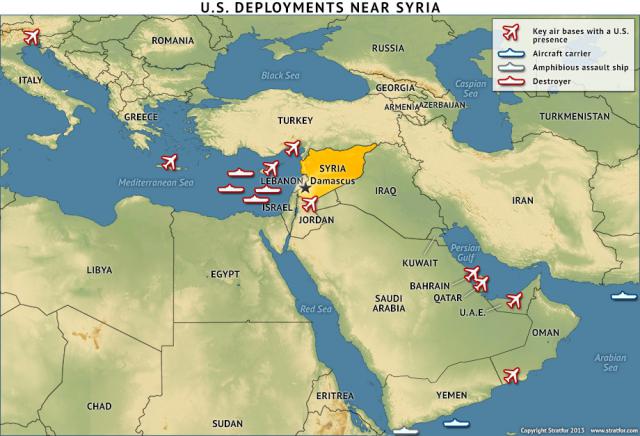
In addition, as reported the other day, the French carrier Charles de Gaulle has been ordered to move east from Toulon and the British are reported to have a nuclear submarine in the region as well.
Update: The Iranian Farsnews site says the US military will be in for a serious defeat if they attack Syria.
Syria’s supersonic and anti-ship missiles as well as the Lebanese Hezbollah movement will inflict astonishing damage on any invading force, specially the US Navy’s giant warships, an expert said, adding that the missile capability is working as a deterrent to a US naval attack on Syria.
“The supersonic and long-range anti-ship Yakhont missiles of the Syrian army and the Lebanese Hezbollah (resistance movement) are serious deterrents to a US naval attack by its warships in the Mediterranean Sea,” Dr. Mostafa Zahra, a military analyst and strategic studies expert, told FNA on Monday.
He said that Syria’s Iskandar high-precision ballistic missiles and its anti-ship Scud missiles will also target the US warships in case of a US naval invasion of Syria, reminding that the American military vessels are not equipped with any weapons system to intercept or divert the Syrian anti-ship missiles.
Did you hear that, Great Satan? “Astonishing damage“. You’d better back off now, infidel.
August 26, 2013
Suddenly of greater interest to the media – where are the carriers now?
Zero Hedge pulled a quick summary of US, French, and British naval units in light of the rumours of some kind of attack on Syria:
- A U.S. military source said on Friday the U.S. Navy was increasing its number of cruise missile-carrying destroyers in the Mediterranean to four from three by delaying the return to the United States of the Arleigh Burke class destroyer USS Mahan.
- The aircraft carrier USS Harry S Truman, by far the most powerful warship in the region, left the Mediterranean last weekend, passing through the Suez Canal into the Red Sea.
- Defence experts say the carrier could still strike Syria from south of Suez. As well as the strike aircraft carried by the Truman, several of her escort ships are also capable of firing Tomahawk land attack cruise missiles.
- Since earlier this year, the United States has also had F-16 jets in Jordan, where they remained after a major military exercise this year at the request of the Jordanian government. It also has a major air base at Incirlik in Turkey that could easily house multiple aircraft as part of a wider military campaign.
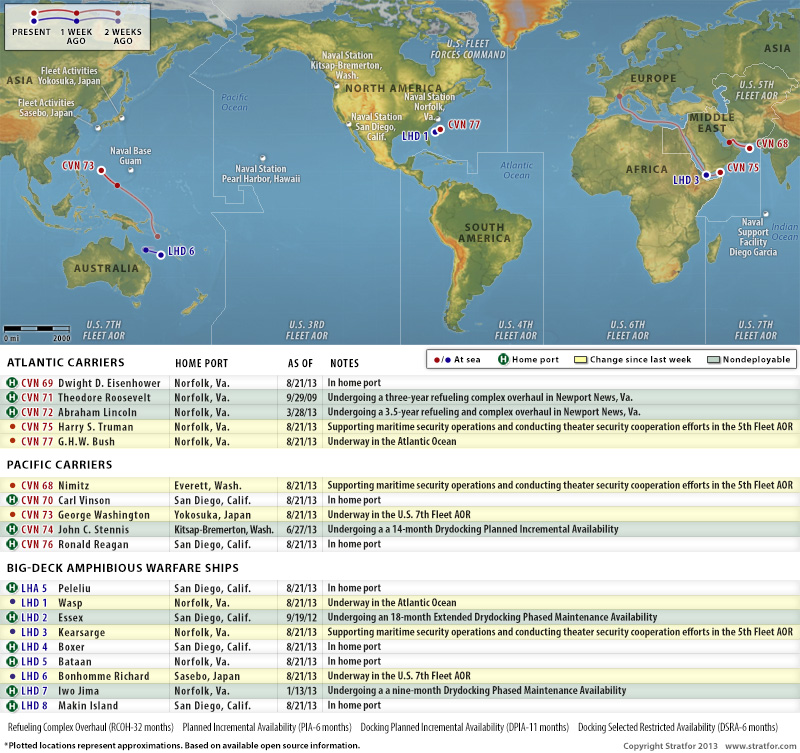
The French aircraft carrier Charles de Gaulle is still in or near Toulon, while the Royal Navy is said to have at least one Trafalgar or Astute class submarines in the Mediterranian. The RN no longer has in-service aircraft carriers, so any British air support would have to be from the RAF, possibly based in Cyprus (but subject to local government approval).
Update: This report says that the USS Ramage is also being retained in the Mediterranean along with the USS Mahan.
Update, 27 August: It was just mentioned (no link) that the Charles de Gaulle has been ordered to leave port, bound for the Eastern Mediterranean.
August 19, 2013
US Navy’s littoral combat ship (LCS) program under budget threat
The US Navy is betting big on the eventual success of their Littoral Combat Ship program despite the early teething troubles (earlier posts here and here). The more traditional hull design (there are two distinct designs in the same class) is being built by Wisconsin’s Marinette Marine, as a subcontractor to Lockheed-Martin. The Milwaukee Journal Sentinel reports on the latest political hitch in the program:
The littoral program has been dogged by problems, including early cost overruns. The completed ships have suffered from mechanical problems as well as from delays in producing switchable mission modules aimed at making the ships adaptable to varied types of warfare.
Testing has revealed deficiencies with “core ship systems,” according to the July 25 GAO report, which says Congress should consider restricting funding for additional littoral combat ships until the Navy completes technical and design studies.
Littoral combat ships are meant to be fast and capable of operating in shallow waters close to shore in places such as the Persian Gulf.
“We continue to believe that the acquisition approach for this program, with large quantities of ships and modules being bought ahead of key test events, is risky, especially for a new class of ship like LCS,” Paul Francis, a GAO official, said in recent testimony before a House of Representatives subcommittee looking into the program.
“The current LCS program is not the program envisioned over a decade ago,” Francis said, adding the Navy still doesn’t know how well the ships will perform their missions, how well the unique crew and maintenance concepts will work, or how much it will cost to equip and support the ships.
Further, the Navy is still considering changes to the ships and determining whether there are advantages to having two radically different designs — one built by Lockheed and Marinette, and the other by Austal USA in Mobile, Ala.
“These are things the Navy and Congress should know before contracting for more than half of the ships,” Francis said.

The Dieppe Raid
The Laurier Centre for Military Strategic and Disarmament Studies has a two-part post on the Dieppe raid and the decision-making process that led up to the operation:
Professor Emeritus Terry Copp, director of the Laurier Centre for Military Strategic and Disarmament Studies presents “The Dieppe Raid: A Decision-Making Exercise – Part 1: Operation Rutter.” This lecture, which explores Operation Rutter – the precursor to Operation Jubilee (the Dieppe Raid) – is the first in a series of two videos which will make up this decision-making exercise. The next video (Part Two) focuses entirely on Operation Jubilee and can be found here.
This decision-making exercise is offered as part of the outreach activities of the Laurier Centre for Military Strategic and Disarmament Studies at Wilfrid Laurier University, Waterloo, Ontario, Canada. The exercise is based on the one we use to engage students in critical historical thinking at the strategic and operational level without the benefit of hindsight.
The main question we would like you to consider while watching these lectures is:
After being presented with the same information that decision-makers had in 1942, would you still launch the Dieppe Raid?
Additional information will pop up throughout the video through the “Annotations” feature, so please do not disable this option while viewing.


