
Forgotten Weapons
Published on 13 Oct 2018https://www.forgottenweapons.com/shoo…
http://www.patreon.com/ForgottenWeapons
Today we are out shooting the H&R M14 “Guerrilla Gun” prototype, but fitted with a standard M14 stock and barrel. With these parts, it handles and fires exactly like a standard M14 – so I can answer the most pertinent question:
Is the M14 really so uncontrollable in full auto?
Contact:
Forgotten Weapons
PO Box 87647
Tucson, AZ 85754If you enjoy Forgotten Weapons, check out its sister channel, InRangeTV! http://www.youtube.com/InRangeTVShow
November 3, 2018
Shooting the M14: Full Auto Really Uncontrollable?
Comments Off on Shooting the M14: Full Auto Really Uncontrollable?
November 2, 2018
Austria-Hungary Disintegrates – The Ottoman Empire Leaves the War I THE GREAT WAR Week 223
The Great War
Published on 1 Nov 2018The Ottoman Empire has been on the retreat in the Middle East since the renewed British offensive in September and now, as the allies are threatening the Turkish heartland and also Constantinople, the Ottoman Empire calls for an armistice. The Armistice of Mudros is signed as the remaining Central Powers also struggle to keep their Empires together.
Comments Off on Austria-Hungary Disintegrates – The Ottoman Empire Leaves the War I THE GREAT WAR Week 223
October 31, 2018
Great Britain Before World War 1 I THE GREAT WAR Special
The Great War
Published on 29 Oct 2018Check out War2Glory: http://bit.ly/TheGreatWar_W2G
Great Britain was the center of a vast colonial empire and a rapidly changing world during the 19th and early 20th century. But what happened in the country in the years leading up to World War 1?
Comments Off on Great Britain Before World War 1 I THE GREAT WAR Special
Some Criticism of The Infographics Show – Best World War 2 Battleships and Battlecruisers
iChaseGaming
Published on 10 Oct 2018There is something called Wikipedia. You can find it here: https://en.wikipedia.org/wiki/Main_Page
Comments Off on Some Criticism of The Infographics Show – Best World War 2 Battleships and Battlecruisers
October 30, 2018
RE: Bren vs Spandau – which was better? @Lindybeige
Military History Visualized
Published on 17 May 2016Patreon: https://www.patreon.com/mhv
Response video, it was necessary, I like Lindybeige, but his latest video “Bren vs Spandau – which was better?” had too many errors. So here is my response to his video.
Comments Off on RE: Bren vs Spandau – which was better? @Lindybeige
October 29, 2018
Baseball Season 1918 I OUT OF THE ETHER
The Great War
Published on 27 Oct 2018Der Deutsche Baseball!
Comments Off on Baseball Season 1918 I OUT OF THE ETHER
October 28, 2018
Stalin’s Murderous Adventures – WW2 – 009 October 27 1939
World War Two
Published on 27 Oct 2018The persecution, incarceration, enslavement and murder of the Polish people in occupied Poland is driven by ideological hatred for both Nazi Germany and Soviet Russia, but it’s also a personal matter for Joseph Stalin.
WW2 day by day, every day is now live on our Instagram account @World_war_two_realtime
Cuban Missile Crisis Day by Day: https://www.youtube.com/watch?v=oo2Av…
Between 2 Wars: https://www.youtube.com/playlist?list…
Join us on Patreon: https://www.patreon.com/TimeGhostHistory
Or join The TimeGhost Army directly at: https://timeghost.tvWritten and Hosted by: Indy Neidell
Produced and Directed by: Spartacus Olsson and Astrid Deinhard
Executive Producers: Bodo Rittenauer, Astrid Deinhard, Indy Neidell, Spartacus Olsson
Research by: Indy Neidell
Edited by: Spartacus Olsson an Ben Ollerenshaw
Trainee editor SarveshColoring by Spartacus Olsson, Olga Shirnina and Norman Stewart
Olga’s pictures: https://klimbim2014.wordpress.com
Norman’s pictures https://oldtimesincolor.blogspot.com/Archive by Screenocean/Reuters https://www.screenocean.com
A TimeGhost chronological documentary produced by OnLion Entertainment GmbH
Comments Off on Stalin’s Murderous Adventures – WW2 – 009 October 27 1939
Panzerschreck: Germany Makes a Bazooka
Forgotten Weapons
Published on 10 Oct 2018http://www.forgottenweapons.com/panze…
http://www.patreon.com/ForgottenWeapons
The German military first encountered American Bazookas in Tunisia in 1943, and quickly put in place a program to copy and improve on the design. At that point, the latest German antitank weapons was the Raketenwerfer 43 “Puppchen”, which was a locked-breech rocket launcher built on a carriage like a standard AT gun. It had a substantial range and a very effective 88mm shaped charge warhead, but lacked the one-man mobility offered by the Bazooka. So, the Raketenpanzerbuchse 43 – shortly thereafter renamed the Panzerschreck – was developed in late 1943.
The Panzerschreck kept the 88mm bore of the Puppchen, so that the warhead could be kept unchanged. The rear half of the munition was redesigned to fit an open tube type of launcher. The early Bazookas captured by German forces were at that time fitted with a battery-powered firing system, which the Germans opted to replace (as would the Americans, in later versions). The Panzerschreck trigger used a small generator, where a heavy spring pushed an iron core through a copper winding and magnet, this creating an electrical charge to fire the rocket.
One shortcoming of the Panzerschreck compared to the Bazooka was that the German rockets did not burn completely within the launch tube – the motors continued to fire for about the first 2 meters of flight. This meant that the shooter would receive substantial burns to the face and hands if protective gear was not worn when firing. Initially, troops were instructed to wear filter-less gas masks and winter gloves when shooting, but it was quickly recognized that this was an impractical burden. Soldiers in the field began to craft protective shields to mount on the tubes, and these were formalized in a windowed shield was introduced in 1944 as standard on new production launchers and as a kit to retrofit existing weapons in the field.
If you enjoy Forgotten Weapons, check out its sister channel, InRangeTV! http://www.youtube.com/InRangeTVShow
Contact:
Forgotten Weapons
PO Box 87647
Tucson, AZ 85754
Comments Off on Panzerschreck: Germany Makes a Bazooka
October 27, 2018
HMS Queen Elizabeth to depend on Shock! Horror! Dutch escort!
At the Thin Pinstriped Line, Sir Humphrey explains to “Disgusted of Tunbridge Wells” and all the other would-be Admirals of the Fleet why having a non-RN escort for Britain’s newest aircraft carrier is hardly a bad thing:
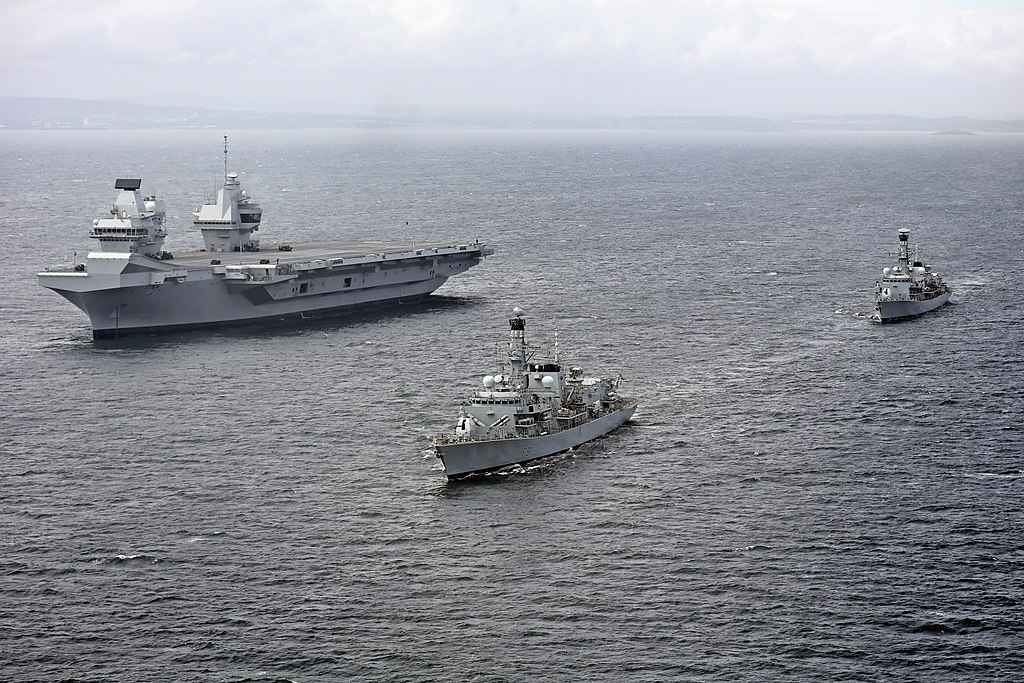
Aerial view of HMS Queen Elizabeth with Type 23 frigates HMS Iron Duke (centre) and HMS Sutherland (right) in June 2017 off the coast of Scotland.
Photo by MOD via Wikimedia Commons.
The United Kingdom has few allies closer than the Netherlands. Both nations are modern, outward looking and instinctively maritime in their view of the world. Long standing NATO partners and with significant experience of working together across the globe, the Netherlands Armed Forces are highly respected as being capable, well equipped and staffed with first rate personnel.
The relationship between the RN and the Royal Netherlands Navy is extremely close, particularly between the Marine Corps and the Submarine Services. It is therefore extremely pleasing to hear that the Netherlands will be deploying a warship to form part of the inaugural ‘Carrier Strike Group’ (CSG) deployments for HMS Queen Elizabeth in 2021 HERE. This is a significant announcement and it has several ramifications that are good news for the Royal Navy.
[…]
There seems to be an exceptionally British trait of moaning at good news. Some people felt that it wasn’t good enough for the RN to be ‘reliant’ on a foreign warship operating as part of the CSG, and that the UK should be going it alone. What utter rot.
It does not mean, despite what some naysayers were desperate to bleat about on social media without any evidence to the contrary, that defence cuts mean the UK is reliant on the Dutch to protect the carrier. The RN has spent a lot of time working out what escorts are needed and ensuring they will be available when necessary as part of the CSG to properly protect the carrier. Any foreign participation is a nice bonus capability to have, not a tacit hint that the RN is short of ships.
The reality of future operations is that the UK is going to operate as part of an international coalition with our friends and allies. Despite the fantasies of some, desperate to see a huge purely British task force sailing around the world looking for a fight and a free trade deal, the fact is that any future military operation is going to be international by design.
Working with allies is critically important but isn’t something you can just do at the drop of a hat. One of the reasons why NATO works so well is because it has spent 70 years investing in common processes, tactics and procedures and exercising them regularly to ensure everyone can work together coherently.
Integrating a Dutch vessel now is vital because it helps build and cement an understanding at operational level of how to work with each other, to learn the capabilities of each other’s ships and how to work them to best effect together. It can also spot unintended issues or problems and help work out how to fix them quickly. This takes time to do, so it is likely that any Dutch vessel assigned in 2021 will have spent a considerable period working up in advance before beginning the deployment proper.
For those who complain that the Royal Navy hasn’t got enough ships to escort the carrier, it is worth reflecting that the Netherlands have a total of 6 frigates. Assuming the normal serviceability rates for escorts apply, then two are likely to be in refit and another in maintenance or training. This leaves just three active vessels at any one time – so in reality, the Netherlands commitment to support the Carrier Strike Group represents them committing a third of their available escort force for a significant amount of time.
Comments Off on HMS Queen Elizabeth to depend on Shock! Horror! Dutch escort!
October 26, 2018
Italy Attacks – The Battle of Vittorio Veneto I THE GREAT WAR Week 223
The Great War
Published on 25 Oct 2018After the Battle of the Piave, the Italian front had been relatively quiet and stable. But just as unrest and instablity spread through the Austro-Hungarian Empire, the Italian Army and its allies attack along the whole front. From Monte Grappa and across the Piave, the Austro-Hungarians are caught off guard.
Comments Off on Italy Attacks – The Battle of Vittorio Veneto I THE GREAT WAR Week 223
The German WWII Standby: The MP38 and MP40 SMGs
Forgotten Weapons
Published on 4 Aug 2017http://www.patreon.com/ForgottenWeapons
The MP40 is an iconic piece of World War 2 weaponry, and it’s about time we took a closer look at its development…
Thanks to the Institute of Military Technology for allowing me to have access to these three examples so I can bring them to you! Check out the IMT at:
If you enjoy Forgotten Weapons, check out its sister channel, InRangeTV! http://www.youtube.com/InRangeTVShow
Comments Off on The German WWII Standby: The MP38 and MP40 SMGs
October 23, 2018
Austria During World War 1 I THE GREAT WAR Special
The Great War
Published on 22 Oct 2018The Austrian part of the dual monarchy that was the Austro-Hungarian Empire experienced the war quite distinctly and the inner political machinations directly influenced the outbreak of the war.
Comments Off on Austria During World War 1 I THE GREAT WAR Special
October 22, 2018
Looting – Pilates – Suicides Among Soldiers I OUT OF THE TRENCHES
The Great War
Published on 20 Oct 2018Crisis Call Center (US): http://crisiscallcenter.org/crisisser…
Crisis Service Canada: http://www.crisisservicescanada.ca/
Mind (UK): https://www.mind.org.uk/
Deutsche Depressionshilfe: https://www.deutsche-depressionshilfe…
Comments Off on Looting – Pilates – Suicides Among Soldiers I OUT OF THE TRENCHES
The Last German E-Boat
Mark Felton Productions
Published on 24 Sep 2018S-130 is the very last of Germany’s sleek S-Boats, the fast motor torpedo boats known to the British as E-boats, that ravaged shipping around the shores of the UK. Now being restored in Britain, this boat is a rare wartime survivor with an equally fascinating postwar story to match.
Photo credits: British Power Boat Trust, Exercise Tiger Memorial, Barry Lewis, Jim Linwood.
Comments Off on The Last German E-Boat
October 21, 2018
The Submarine War – WW2 – 008 October 20 1939
World War Two
Published on 20 Oct 2018For the men in the navies of the warring nations in Europe, there was nothing phony about WW2 in October 1939 – mortal danger was immediately under the cold surface at the receiving end of a torpedo or a depth charge…
Join us on Patreon: https://www.patreon.com/TimeGhostHistory
Or join The TimeGhost Army directly at: https://timeghost.tvWritten and Hosted by: Indy Neidell
Produced and Directed by: Spartacus Olsson and Astrid Deinhard
Executive Producers: Bodo Rittenauer, Astrid Deinhard, Indy Neidell, Spartacus Olsson
Research by: Indy Neidell
Edited by: Spartacus Olsson an Ben Ollerenshaw
Trainee editor SarveshColoring by Spartacus Olsson, Olga Shirnina and Norman Stewart
Olga’s pictures: https://klimbim2014.wordpress.com
Norman’s pictures https://oldtimesincolor.blogspot.com/Archive by Screenocean/Reuters https://www.screenocean.com
A TimeGhost chronological documentary produced by OnLion Entertainment GmbH
Comments Off on The Submarine War – WW2 – 008 October 20 1939


