
World War Two
Published 31 Mar 2022The Nazis and the Soviets discover each other’s atrocities, while resistance is on the rise, and a half-dormant conspiracy against Hitler comes back to life to take his life.
(more…)
April 1, 2022
Denazify the World. Resist Now. – WAH 055 – March 1943, Pt. 2
Comments Off on Denazify the World. Resist Now. – WAH 055 – March 1943, Pt. 2
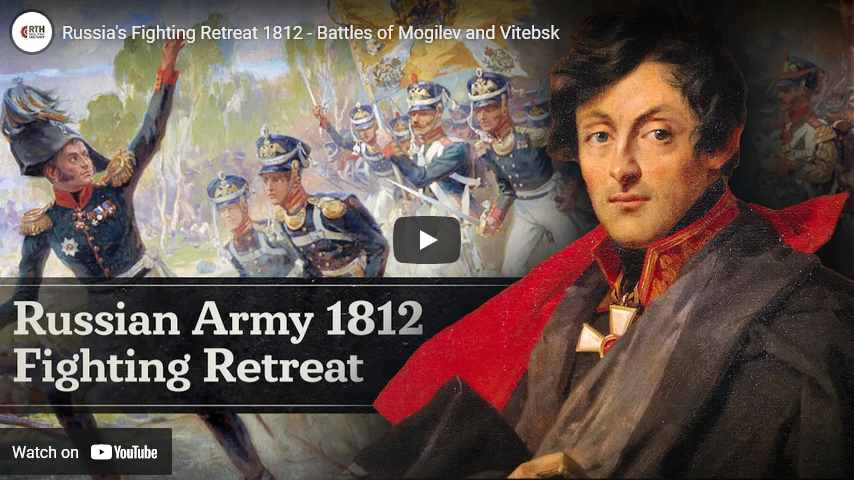
Russia’s Fighting Retreat 1812 – Battles of Mogilev and Vitebsk
Real Time History
Published 31 Mar 2022Support our Napoleon Series on Patreon: https://patreon.com/realtimehistory
The two Russian western armies are trying to join up to mount a defense against Napoleon’s invasion of Russia. But the speed of the French advance, particularly Marshal Davout and Marshal Murat, are putting pressure on the Russians. And so late July sees a series of battles at Mogilev/Saltanovka and Vitebsk/Ostrovno. Meanwhile the Russian 3rd Observation Army is dangerously close to the border of the Duchy of Warsaw — the Austrians under Schwarzenberg and Reynier’s Corps need to stand and fight around Kobryn.
» THANK YOU TO OUR CO-PRODUCERS
John Ozment, James Darcangelo, Jacob Carter Landt, Thomas Brendan, Kurt Gillies, Scott Deederly, John Belland, Adam Smith, Taylor Allen, Rustem Sharipov, Christoph Wolf, Simen Røste, Marcus Bondura, Ramon Rijkhoek, Theodore Patrick Shannon, Philip Schoffman, Avi Woolf,» SOURCES
Becker, Carl August. Tagebuch 28.03.1812-21.09.1812 (Beiträge zur sächsischen Militärgeschichte zwischen 1793 und 1815). Ed Joerg Titze, 2019.
Boudon, Jacques-Olivier. Napoléon et la campagne de Russie en 1812. 2021.
Durova, Nadezhda. Cavalry Maiden. Journals of a Female Russian Officer in the Napoleonic Wars. 1990.
Holzhausen, Paul. Die Deutschen in Russland 1812. Leben und Leiden auf der Moskauer Heerfahrt. Berlin 1912.
Lieven, Dominic. Russia Against Napoleon. 2010.
Rey, Marie-Pierre. L’effroyable tragédie: une nouvelle histoire de la campagne de Russie. 2012.
Zamoyski, Adam. 1812: Napoleon’s Fatal March on Moscow. 2005.
[Additional Russian resources listed on the YouTube description]» OUR STORE
Website: https://realtimehistory.net»CREDITS
Presented by: Jesse Alexander
Written by: Jesse Alexander
Director: Toni Steller & Florian Wittig
Director of Photography: Toni Steller
Sound: Above Zero
Editing: Toni Steller
Motion Design: Toni Steller
Mixing, Mastering & Sound Design: http://above-zero.com
Digital Maps: Canadian Research and Mapping Association (CRMA)
Research by: Jesse Alexander, Sofia Shiorogova
Fact checking: Florian WittigChannel Design: Simon Buckmaster
Contains licensed material by getty images
Maps: MapTiler/OpenStreetMap Contributors & GEOlayers3
All rights reserved – Real Time History GmbH 2022
Comments Off on Russia’s Fighting Retreat 1812 – Battles of Mogilev and Vitebsk
March 31, 2022
Canada’s F-35 procurement process — “Dysfunctional, but, like, a masterpiece of dysfunction.”
In The Line, Matt Gurney reveals the embarrassing secret of his life: he has “a favourite Canadian military procurement fiasco”. He’s quite right that there’s a distressingly wide variety of procurement cock-ups to choose from since the 1960s, but in his opinion the F-35 saga is the best:
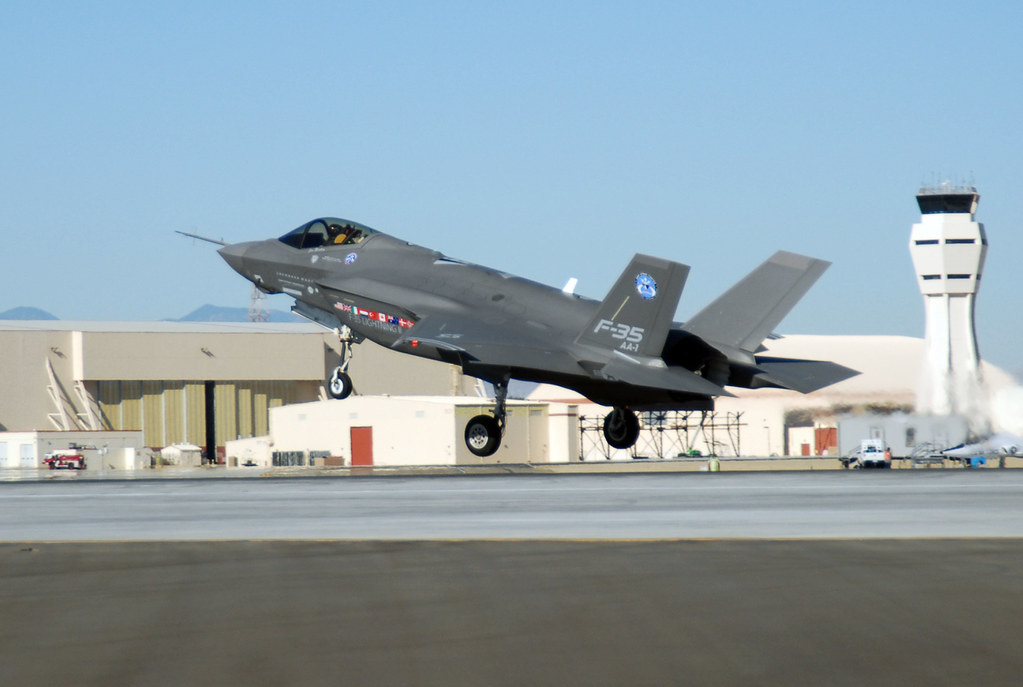
“F-35 Lightning II completes Edwards testing” by MultiplyLeadership is licensed under CC BY 2.0

Having a favourite Canadian military procurement fiasco feels perverse, in a way. It’s like having a favourite gruesome sports injury. Procurement fiascos are bad. We want fewer of them. There’s nothing to be celebrated when yet another one barfs all over the national rug. And yet I find myself indulging a bizarre fondness for a mostly overlooked low point in our long, embarrassing journey to this week’s re-decision to buy a fleet of F-35 fighter jets for the Royal Canadian Air Force. As bad as the low point was — and it was really bad — it also so perfectly summed up our utterly manifest dysfunction that I’ve come to almost admire it. It’s awful, but it’s a pure form of awful. Dysfunctional, but, like, a masterpiece of dysfunction. You couldn’t ask for a better example of what’s wrong with us.
[…]
That wasn’t the original plan; the Liberals first proposed buying 18 new F-18 SuperHornets, the more advanced American successor to the original F-18. That idea fell through due to a trade spat between Canadian darling Bombardier and Boeing, the SuperHornet manufacturer. This was the point of no return: the Boeing dispute was another opportunity for the Liberals to sigh, pop a few Tums and then just do the right thing and proceed with the full replacement as quickly as possible.
They did not. And this, dear readers, is where this embarrassing chapter of our already pathetic history of military procurement reached maximum absurdity.
With our CF-18 fleet at a state of exhaustion, and Boeing in Trudeau’s dog house, instead of actually replacing our old, exhausted jets with new jets, we just gave the air force enough old, exhausted Australian jets so that the RCAF could cobble enough workable jets and spare parts together to allow the Liberals to further delay any decision on a real replacement program.
When you write a lot about military procurement, as I certainly have, you can’t help but grow a bit (!) jaded and cynical. Even by the standards of my appallingly lowered expectations, though, this was an outrageous decision. As I said above, it’s so bad, so cynical, so crassly political, that it has perversely become something I almost admire, in a twisted way. It’s an almost too-brutal-to-be-believed example of politicians dodging accountability and leadership like Keanu bobbing and weaving out of the path of CGI bullets. Every dollar and hour of time we put into scooping up Australia’s leftover jets — they were unneeded because Australia was competent enough to procure more advanced SuperHornets and, ahem, F-35s — was money and time spent not to improve the readiness and capabilities of the Canadian Armed Forces, but to permit the Liberals to avoid acknowledging they’d made a dumb campaign promise.
Stephen Harper failed the Canadian Armed Forces and Canada generally by not getting the ball rolling on a replacement during his majority term. This was a major failure by the Conservatives that they get all awkward and squirmy about when you bring up, but we should bring it up. The CPC botched this, badly, and should feel shame. Justin Trudeau then repeated that failure, and then took it up a level. In this race to the bottom, where no one looks good, Trudeau “wins” by simple virtue of snapping up used jets — the last of which only arrived last spring! — to buy his government time to do absolutely nothing.
Comments Off on Canada’s F-35 procurement process — “Dysfunctional, but, like, a masterpiece of dysfunction.”
March 30, 2022
The RCAF’s long, sad F-35 story
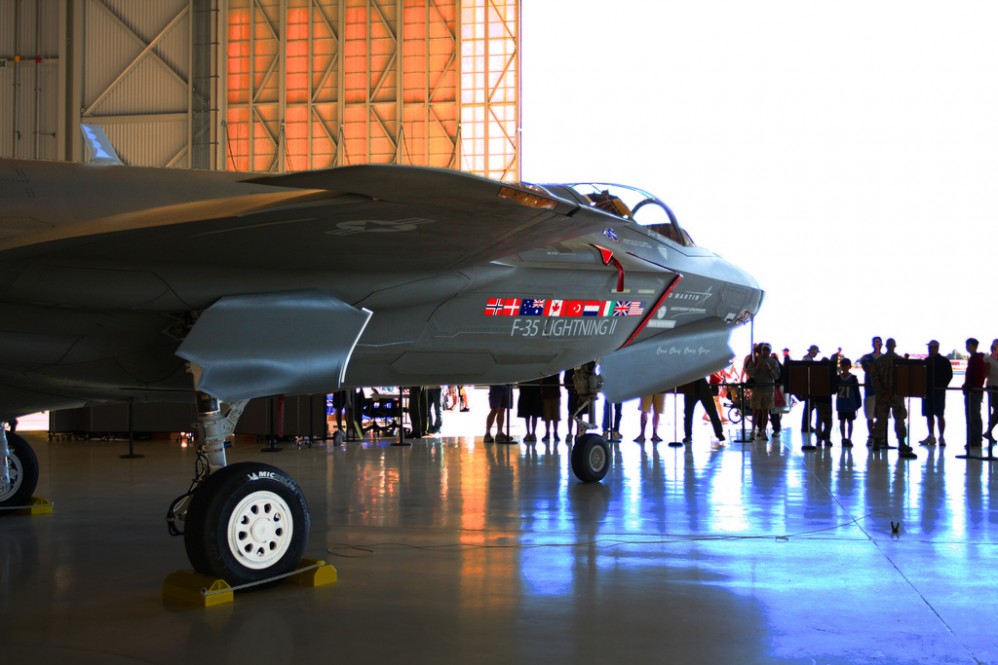
In The Line, Mitch Heimpel tries (without either laughing or crying) to tell the story of how the Canadian government finally got around to admitting they should have bought the F-35 fourteen years ago (when the RCAF told them it was the best fit for our national requirements):
If you’re looking for a simple meta-explanation for all of us, it would be this: Canadian politicians refuse to tell the public one simple truth — military procurement is expensive. There isn’t an inexpensive version of this. That doesn’t mean we should accept any and all costs just because it’s going to be expensive. It does mean that politicians have to stop trying to sell us on there being an inexpensive, or perfect, version of this. There is no MacGyver version of military procurement. No amount of rubber bands and paper clips replaces jet engines and submarines, no matter how many times we pretend it will. Indeed, the longer you delay, the more it’ll cost — the weapons generally get more expensive, and you end up spending more money to wring every last bit of use out of what equipment you already have, instead of replacing it in an efficient, orderly way.
So, let’s recap: We are, in fact, so bad at procurement that we ran a process for years, and then cancelled it. And then pledged not to buy the jets we’d originally pleged to buy. We then bought seven old Australian F-18s so we could keep our elderly and dwindling CF-18 fleet from experiencing a “capability gap” caused mostly by not just buying the F-35 in the first place. Then, almost 12 years after announcing we were going to buy the F-35, after all the drama above, we’ve announced we’ll buy the F-35, after all. Eighty eight of them, in fact. So there’s that, I guess.
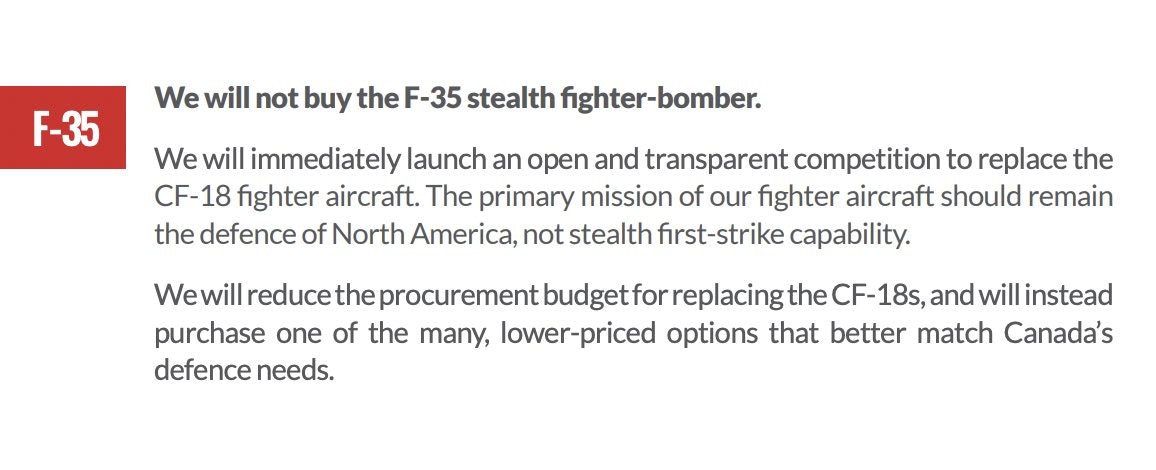
In so many ways, the F-35 saga is another symbol of seven years of Trudeau governance. In 2015, the Liberals could not have been more clear in their campaign platform, which included a whole section titled “We will not buy the F-35 stealth bomber-fighter.”
What were Ministers Anand and Tassi out saying when the F-35 announcement was made this week? “Best plane” and “best price.” Which was true in 2008 when we were first told it was the only fighter that met our needs. It was still true when the Harper government blinked in 2012, and still true when Justin Trudeau was accusing the government of “whipping out” our CF-18s while on the opposition benches in 2014. Remained true in 2015 when the Liberals campaigned against it, too, and every year since.
We have no reason to believe that what is supposed to be a $19-billion announcement for 88 planes to begin delivery in 2025 will actually end up being any of those things. Don’t be surprised if we spend more money to get fewer jets at a later date. But we are now well past the point of being able to blame anyone other than ourselves for cost overruns or late deliveries. The Canadian government failed the Royal Canadian Air Force in this procurement. That is beyond dispute. These guys need the planes. They have for years.
Let’s hope we’ve at least been sufficiently embarrassed by this experience to be more serious when we have to talk about submarines, which is now, come to think of it.
But I doubt it.
Comments Off on The RCAF’s long, sad F-35 story
Combat Boots Save Lives – WW2 Special
World War Two
Published 29 Mar 2022Boots on the ground! Despite all the mobility provided by tanks, trucks and planes, the infantryman had to rely on his own two feet above all else. To march, run and fight, soldiers needed sturdy and comfortable footwear. Choosing between ankle-boots, service-shoes and jackboots, the warring nations were looking for the perfect combat-boot for their soldiers.
(more…)
Comments Off on Combat Boots Save Lives – WW2 Special
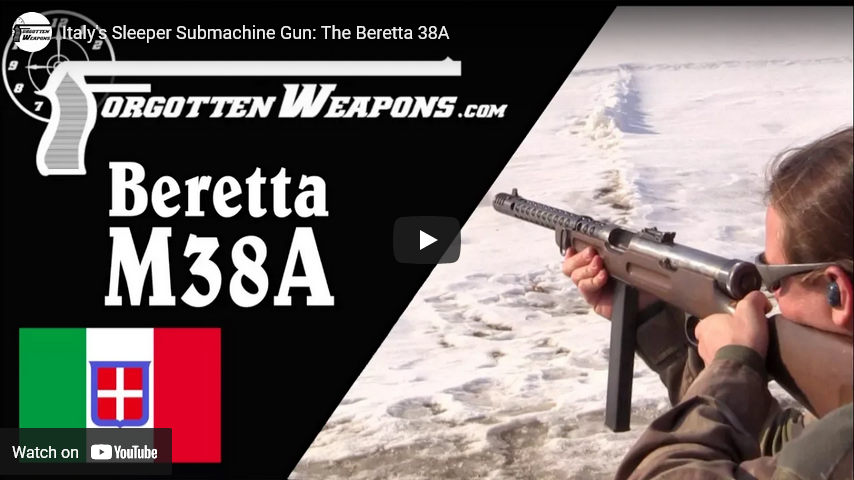
Italy’s Sleeper Submachine Gun: The Beretta 38A
Forgotten Weapons
Published 16 Mar 2018The Beretta 38A is not a gun that comes to mind for many people today when discussing World War Two submachine guns, but at the time it was one of the most desirable guns of its type. So — does it live up to that reputation?
http://www.patreon.com/ForgottenWeapons
Cool Forgotten Weapons merch! http://shop.bbtv.com/collections/forg…
If you enjoy Forgotten Weapons, check out its sister channel, InRangeTV! http://www.youtube.com/InRangeTVShow
Comments Off on Italy’s Sleeper Submachine Gun: The Beretta 38A
March 29, 2022
Roman Battle Tactics
Historia Civilis
Published 9 Jul 2015Patreon | http://historiacivilis.com/patreon
Donate | http://historiacivilis.com/donate
Merch | http://historiacivilis.com/merch
Mailing List | http://historiacivilis.com/mailinglist
Twitter | http://historiacivilis.com/twitter
Website | http://historiacivilis.comMusic is Beethoven’s Sonata 8, ‘Pathetique’ – II. Adagio cantabile, performed by Daniel Veesey

Comments Off on Roman Battle Tactics
March 28, 2022
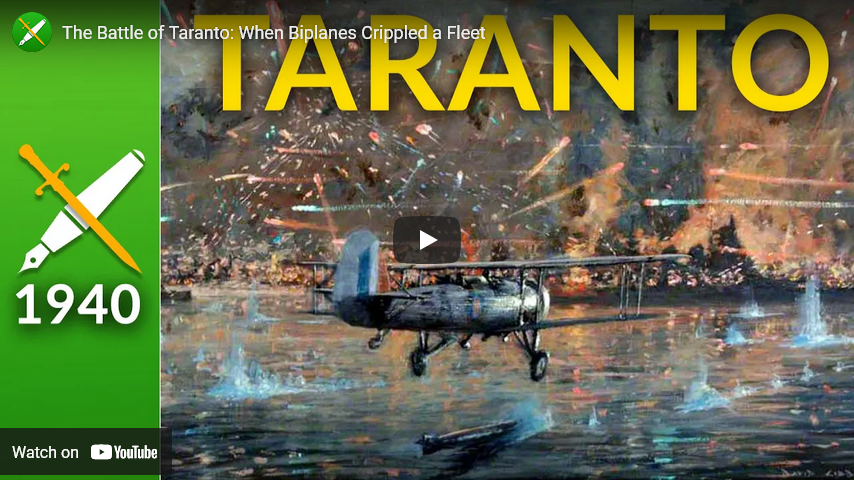
The Battle of Taranto: When Biplanes Crippled a Fleet
Historigraph
Published 23 Feb 2019If you enjoyed this video and want to see more made, consider supporting my efforts on Patreon: https://www.patreon.com/historigraph
#BattleOfTaranto #Historigraph
► Twitter: https://twitter.com/historigraph
► Instagram: https://www.instagram.com/historigraph
► My Gaming Channel: https://www.youtube.com/c/Addaway
► My Twitch: https://www.twitch.tv/addaway
Comments Off on The Battle of Taranto: When Biplanes Crippled a Fleet
QotD: The evolution of tanks through World War 2
One interesting thing about tank evolution that never gets mentioned in America is just how good the Soviets were at making tanks. The Germans are always assumed to have been the great tank builders, followed by the Americans, but it was the Russians who dominated the field in the tank game. Russian tanks were fast, powerful and easy to operate by their crews. Most important, they were reliable in all weather. The Russians assumed they would be fighting in horrible conditions and built a tank for it.
The Germans, in contrast, made one error after another when it came to tank design and tank building. They were obsessed with coming up with the biggest, most powerful tank, rather than making lots of good enough tanks. The result was lots of innovative designs, but most were failures and there was never enough of them. The Panzer IV was a very good tank with a platform that was flexible, but the Germans kept trying to come up with a super tank, rather than make lots of these. That was a costly error.
The American tank, which was used by the British, was not a great tank, but they were cheap and reliable, which meant there were loads of them. It was also a flexible platform for all sorts of other uses. The Sherman tank was about using the two advantages the Americans had over the Germans. One was more industry and the other was more soldiers. The plan was to beat the Germans with volume. While it would take five Sherman tanks to take out a German tank, that was math that worked in favor of the Americans.
This conflict between the perfect and the good enough showed up in many places during the war. The Germans seemed to look at the whole thing as an engineering project. The first step was to accept the restraints and then solve for the variables. The Russian and American view was always to limit the constraints and thereby increase the number of possible right answers. The Germans had much better human capital, but their opponents always had many more choices. They also had numbers, which counts for a lot.
The Z Man, “Tanking It”, The Z Blog, 2019-03-01.
Comments Off on QotD: The evolution of tanks through World War 2
March 27, 2022
American Army Finally Does Something Right – WW2 – 187 – March 26, 1943
World War Two
Published 26 Mar 2021The British are attacking the Mareth Line in North Africa while the Americans hit the Axis flank, but the Allies are withdrawing in Burma. It’s the Germans who are pulling back in the USSR, though, and there is another attempt from within German Command to assassinate Adolf Hitler.
(more…)
Comments Off on American Army Finally Does Something Right – WW2 – 187 – March 26, 1943
The zombie Russian empire under Tsar Vladimir I
In the most recent Weekly Dish, Andrew Sullivan looks at the quasi-Imperial goals of Vladimir Putin:
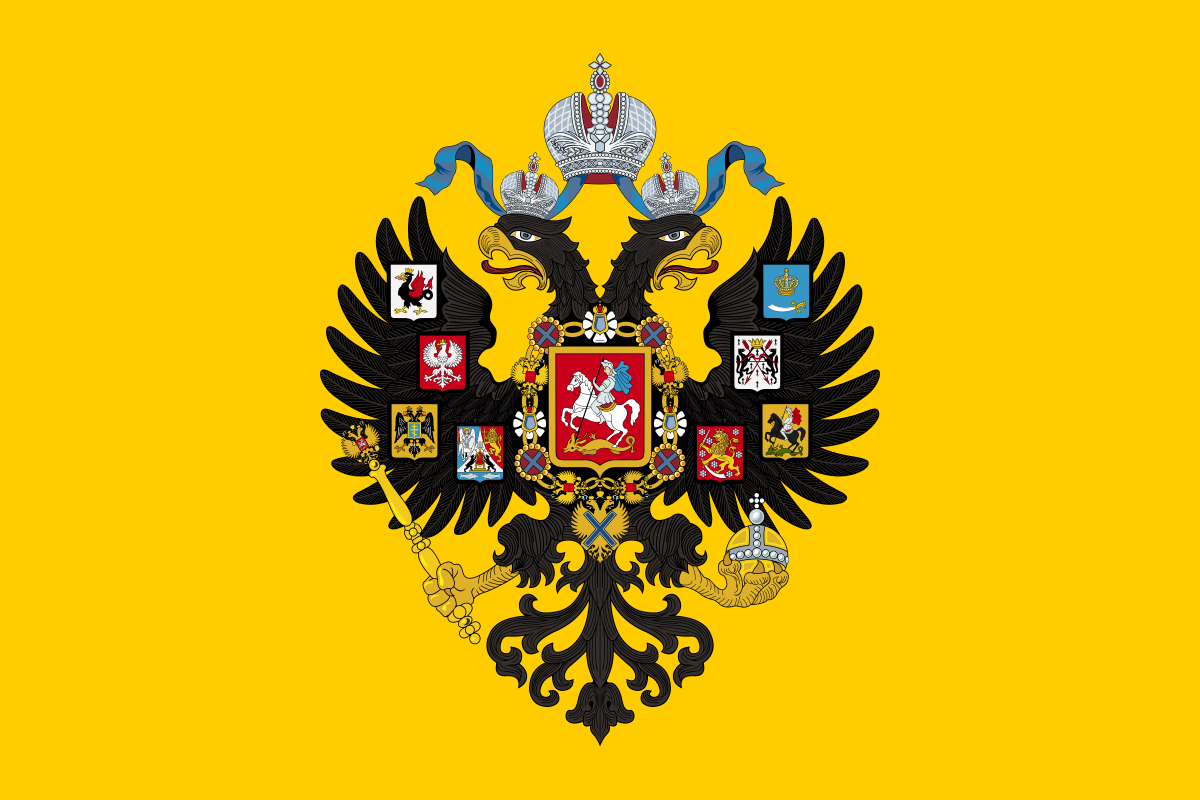
Imperial Standard of the Emperor of Russia, used from 1858 to 1917.
Image by Trajan 117 via Wikimedia Commons.
“The huge iceberg Russia, frozen by the Putin regime, cracked after the events in Crimea; it has split from the European world, and sailed off into the unknown,” – Vladimir Sorokin, New York Review of Books, 2017.
The greatest mistake liberals make when assessing reactionaryism is to underestimate it. There is a profound, mesmerizing allure — intensified by disillusion with the shallows of modernity — to the idea of recovering some great meaning from decades or centuries gone by, to resurrect and resuscitate it, to blast away all the incoherence and instability of post-modern life into a new collective, ancient meaning.
Even when it’s based on bullshit. You’d be amazed how vacuous slogans about returning to a mythical past — “Make America Great Again!”, “Take Back Control!” — can move public opinion dramatically in even the most successful modern democracies. That’s one reason it’s self-defeating for liberals to press for maximal change in as many things as possible. National identity, fused often with ethnic heritage, has not disappeared in the human psyche — as so many hoped or predicted. It has been reborn in new and strange forms. Now is the time of monsters, so to speak. Best not to summon up too many.
This, it seems to me, is what many of us have missed about the newly visible monster of post-Communist Russia. It would be hard to conjure up a period of post-modern bewilderment more vividly than Russia in the post-Soviet 1990s. A vast empire collapsed overnight; an entire totalitarian system, long since discredited but still acting as some kind of social glue and cultural meaning, unraveled in chaos and confusion.
Take away a totalitarian ideology in an instant, and a huge vacuum of meaning will open up, to be filled by something else. We once understood this. When Nazi Germany collapsed in total military defeat, the West immediately arrived to reconstruct the society from the bottom up. We de-Nazified West Germany; we created a new constitution; we invested massively with the Marshall Plan, doing more for our previous foe than we did for a devastated ally like Britain. We filled the gap. Ditto post-1945 Japan.
But we left post-1991 Russia flailing, offering it shock therapy for freer markets, insisting that a democratic nation-state could be built — tada! — on the ruins of the Evil Empire. We expected it to be reconstructed even as many of its Soviet functionaries remained in place, and without the searing experience of consciousness-changing national defeat. What followed in Russia was a grasping for coherence, in the midst of national humiliation. It was more like Germany after 1918 than 1945. It is no surprise that this was a near-perfect moment for reactionism to stake its claim.
It came, like all reactionary movements, not from some continuous, existing tradition waiting to be tweaked or deepened, but from intellectuals, making shit up. They created a near-absurd mythology they rescued from the 19th and early 20th centuries — packed with pseudo-science and pseudo-history. Russia was not just a nation-state, they argued; it was a “civilization-state”, a whole way of being, straddling half the globe and wrapping countless other nations and cultures into Mother Russia’s spiritual bosom. Russians were genetically different — infused with what the reactionary theorist Lev Gumilev called “passionarity” — a kind of preternatural energy or will to power. They belonged to a new order — “Eurasia” — which would balance the Atlantic powers of the US and the UK, and help govern the rest of the world.
Comments Off on The zombie Russian empire under Tsar Vladimir I
Book Review: The Uzi Submachine Gun Examined, by David Gaboury
Forgotten Weapons
Published 13 Aug 2017The UZI Submachine Gun: Examined is a newly published book this year by David Gaboury — long time owner and operator of the uzitalk.com forum. Until now there has not really been any substantive written reference material on the Uzi, but Gaboury has certainly changed that!
The Uzi has not really seen many major variations in its design beyond the Uzi/Mini Uzi/Micro Uzi scaling (and the semiauto and full auto variations of each), but it has lived two rather distinct lives. One is the Uzi as a global military arm, and the other is the Uzi as an American commercial product — and this book covers both in excellent detail.
On the military side, the book begins with a substantial chapter on the initial development of the Uzi and Israeli submachine gun trials. A remarkably wide variety of guns were considered by the Israeli armed forces, and the trial ultimately came down to two domestic designs. The influence of the Czech ZK-476 and SA vz 23/4/5/6 designs are well explained, and much of the mythology about where the design came from is dispelled. Gaboury makes good use of both original documentary sources and firsthand conversation with those who were involved at the time to tell this story.
With the gun accepted, in production, and becoming very popular with Israeli troops, international sales become a possibility. Gaboury covers the adoption of the gun by the Dutch armed forces, followed by the German and South African militaries — as well as the licensed production by FN. He also examines other copies and adaptations, including Croatian, Japanese, and Chinese.
The second half of the Uzi story is that of its sale in the United States (including the use by US security organizations including the Secret Service). This is a story every bit as complex and detailed as the international military use of the gun, as US legal changes in 1968, 1986, 1989, 1994, and 2004 all play a major role in dictating changes that must be made to the guns for import and sale. In particular, Gaboury has detailed chapters on the major sellers of Uzis in the US — Action Arms, Group Industries, and Vector Arms (as well as many other smaller players).
While there may not be many major variations of the Uzi, there are a multitude of smaller changes to individual parts in both design and production technique, and Gaboury covers these in remarkable detail. If there is a flaw to the book, it is not in lack of detail, but perhaps in a bit of dryness to the writing. The information is clearly presented, but not particularly engaging to the reader who is only mildly interested in the subject. This is a minor criticism, however, and the book is an outstanding reference for anyone who has, well, really any questions at all about the Uzi.
http://www.patreon.com/ForgottenWeapons
Cool Forgotten Weapons merchandise! http://shop.bbtv.com/collections/forg…
If you enjoy Forgotten Weapons, check out its sister channel, InRangeTV! http://www.youtube.com/InRangeTVShow

Comments Off on Book Review: The Uzi Submachine Gun Examined, by David Gaboury
March 26, 2022
Hollywood: Government Propaganda? – WW2 Special
World War Two
Published 24 Mar 2022Along with its arsenal of carriers, bombers, and tanks, America has perhaps the most powerful weapon of all: Hollywood. Hollywood is pumping out American and Allied propaganda as quickly as it can. But was this always the case?
(more…)
Comments Off on Hollywood: Government Propaganda? – WW2 Special
March 25, 2022
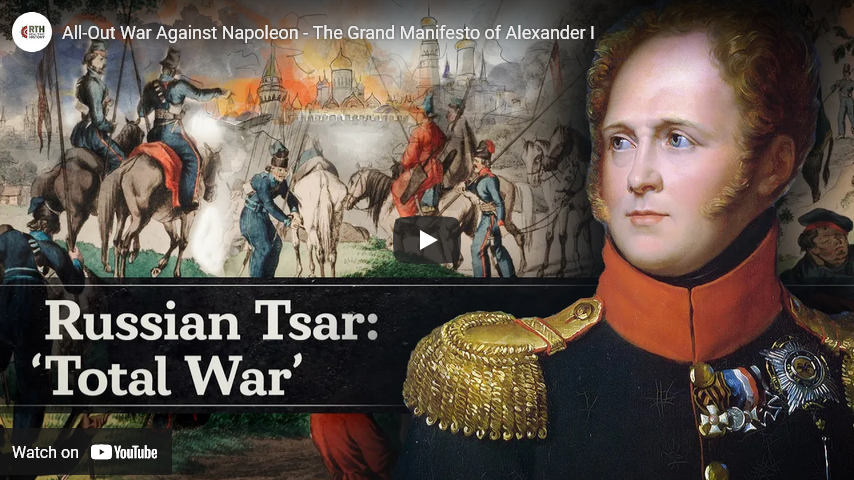
All-Out War Against Napoleon – The Grand Manifesto of Alexander I
Real Time History
Published 24 Mar 2022Get Nebula and CuriosityStream in a great bundle deal: https://curiositystream.com/realtimeh…
In the beginning of Napoleon’s invasion of Russia, the Russian Tsar Alexander I was under pressure to rally his people. A month into the campaign he declared the The Patriotic War (Отечественная война) to fight back Napoleon — who was already having serious supply issues and a deteriorating logistics network.
» SUPPORT US ON PATREON
https://patreon.com/realtimehistory» THANK YOU TO OUR CO-PRODUCERS
John Ozment, James Darcangelo, Jacob Carter Landt, Thomas Brendan, Kurt Gillies, Scott Deederly, John Belland, Adam Smith, Taylor Allen, Rustem Sharipov, Christoph Wolf, Simen Røste, Marcus Bondura, Ramon Rijkhoek, Theodore Patrick Shannon, Philip Schoffman, Avi Woolf,» SOURCES
Boudon, Jacques-Olivier. Napoléon et la campagne de Russie en 1812. 2021.
Chandler, David. The Campaigns of Napoleon, Volume 1. New York 1966.
Clausewitz, Carl von. Hinterlassene Werke des Generals Carl von Clausewitz über Krieg und Kriegsführung. Siebenter Band, Der Feldzug von 1812 in Rußland, der Feldzug von 1813 bis zum Waffenstillstand und der Feldzug von 1814 in Frankreich. Berlin 1835.
Geschichte der Kriege in Europa seit dem Jahre 1792 als Folgen der Staatsveränderung in Frankreich unter König Ludwig XVI., neunter Teil, 1. Band. Berlin 1839.
Hartwich, Julius von. 1812. Der Feldzug in Kurland. Nach den Tagebüchern und Briefen des Leutnants Julius v. Hartwich. Berlin 1910.
Holzhausen, Paul. Die Deutschen in Russland 1812. Leben und Leiden auf der Moskauer Heerfahrt. Berlin 1912.
Lieven, Dominic. Russia Against Napoleon. 2010.
Mikaberidze, Alexander. “The Lion of the Russian Army”: Life and Military Career of General Prince Peter Bagration 1765-1812. PhD Dissertation, 2003.
Rey, Marie-Pierre. L’effroyable tragédie: une nouvelle histoire de la campagne de Russie. 2012.
Robson, Martin. A History of the Royal Navy: the Napoleonic Wars. 2014.
Tagebuch des Königlich Preußischen Armeekorps unter Befehl des General-Leutnants von Yorck im Feldzug von 1812. Berlin 1823.
Zamoyski, Adam. 1812: Napoleon’s Fatal March on Moscow. 2005.
Безотосный В. М. Россия в наполеоновских войнах 1805–1815 гг. (Москва: Политическая энциклопедия, 2014)
Отечественная война 1812 года. Энциклопедия (Москва: РОССПЭН, 2004)» OUR STORE
Website: https://realtimehistory.net»CREDITS
Presented by: Jesse Alexander
Written by: Jesse Alexander
Director: Toni Steller & Florian Wittig
Director of Photography: Toni Steller
Sound: Above Zero
Editing: Toni Steller
Motion Design: Toni Steller
Mixing, Mastering & Sound Design: http://above-zero.com
Digital Maps: Canadian Research and Mapping Association (CRMA)
Research by: Sofia Shiogorova, Jesse Alexander
Fact checking: Florian WittigChannel Design: Simon Buckmaster
Contains licensed material by getty images
Maps: MapTiler/OpenStreetMap Contributors & GEOlayers3
All rights reserved – Real Time History GmbH 2022
Comments Off on All-Out War Against Napoleon – The Grand Manifesto of Alexander I
Avro Canada CF-105 Arrow; Footage from its first flight
Polyus Studios
Published 7 Jul 2020Full documentary is still in development, enjoy the teaser!
(more…)
Comments Off on Avro Canada CF-105 Arrow; Footage from its first flight


