
The greatest military asset the Spartans had was not actual military excellence – although, again, Spartan capabilities seem to have been somewhat better than average – but the perception of military excellence.
Herodotus seems to be at the start of it, at least in our sources – he relates a story where, after an embarrassing failure in an effort to reduce tiny Tegea to helotage (the Tegeans kicked the Spartans’ asses) in the mid-sixth century, the Spartans supposedly stole the bones of the hero Orestes. Consequently, Herodotus notes, the Spartans were from that point on able to always beat Tegea and subdued the Peloponnese (Hdt. 1.68), resulting in the creation of the Spartan-led Peloponnesian League. The unbeatable Spartans thus appear. It’s possible the Spartan reputation predated this, but – as we’ll see – Herodotus will be the one who codifies that reputation and cements it.
Except, hold on a minute – how hard was it to subdue the Peloponnese? It seems to have been done with a fairly adept mix of diplomacy and military force (champion one side in a local dispute, beat the other, force both into your alliance, repeat, see Kennell (2010), 51-3 for details). But it is little surprise that Sparta would be dominant in the Peloponnese. Messenia and Laconia together was around 2,600 square miles or so. This is – if you’ll pardon the expression – flippin’ massive by the standards of Greek poleis. More than twice as large as the next largest polis in all of Greece (Athens). Sparta is fully one-third of the Peloponnese (the peninsula Sparta is located on). The remaining two-thirds is home to many other poleis – Corinth, Argos, Elis, Tegea, Mantinea, Troezen, Sicyon, Lepreum, Aigeira and on and on. Needless to say, Sparta was several times larger than all of them – only Corinth and Argos came even remotely close in size. The population differences seem to have roughly followed land area. Sparta was just much, MUCH larger and more powerful than any nearby state by the start of the fifth century.
Sparta thus spends the back half of the 500s as the teenager beating up all of the little kids in the sandbox and making himself leader. When you are upwards of three times larger (and in some cases, upwards of ten times larger) than your rivals, a reputation for victory should not be hard to achieve. And, in the event, it turns out it wasn’t.
Which brings us back to Herodotus […] because he isn’t just observing the Spartan reputation, Herodotus is manufacturing the Spartan reputation. Herodotus is our main source for early Greek history (read: pre-480) and for the two Persian invasions of Greece. Herodotus’ Histories cover a range of places and topics – Persia, Greece, Scythia, Egypt – and contain a mixture of history, ethnography, mythology and straight up falsehoods. But – as François Hartog famously pointed out in his The Mirror of Herodotus (originally in French as Le Miroir d’Hérodote), Herodotus is writing about Greece, even when he is writing about Persia – those other cultures and places exist to provide contrasts to the things that Herodotus thinks bind all of the fractious and fiercely independent Greek poleis. And he is perfectly willing to manufacture the past to make it fit that vision.
Sparta has a role to play in that narrative: the well-governed polis, a bastion of freedom, ever opposed to tyranny, be it Greek or Persian. We’ll come back to Sparta’s … let’s say relationship … with Persian “tyranny” next week. But for Herodotus, Sparta is the expression of an ideal form of “Greekness” and in Herodotus’ logic, being well-governed (eunomia is the Greek term) results primarily in military excellence. For the story Herodotus is telling to work, Sparta – as one of the leading states resisting Persia – must be well governed and it must be militarily excellent. That’s what will make a good story – and Herodotus never lets the facts get in the way of a good story.
(Sidenote: Athens – at least post-Cleisthenic Athens – gets this treatment too. Athens ends up embodying a different set of “Greek” virtues and where Sparta shows its prowess on land, the Athenians do so at sea.)
And so, Herodotus – the myth-maker – talks up the Spartiates at Thermopylae (you know, the brave 300) and quietly leaves out the other Laconians (who, if you scrutinize his numbers, he knows must be there, to the tune of c. 900 men), downplaying the other Greeks. Spartan leadership is lionized, even when it makes stupid mistakes (Thermopylae, to be clear, was a military disaster and Spartan intransigence nearly loses the battle of Plataea, but Herodotus represents this as boldness in the face of the enemy; even more fantastically inept was the initial Spartan plan to hold on the Isthmus of Corinth as if no one had ever seen a boat before).
Bret Devereaux, “Collections: This. Isn’t. Sparta. Part VI: Spartan Battle”, A Collection of Unmitigated Pedantry, 2019-09-20.
March 25, 2022
QotD: Herodotus as Spartan propagandist
March 24, 2022
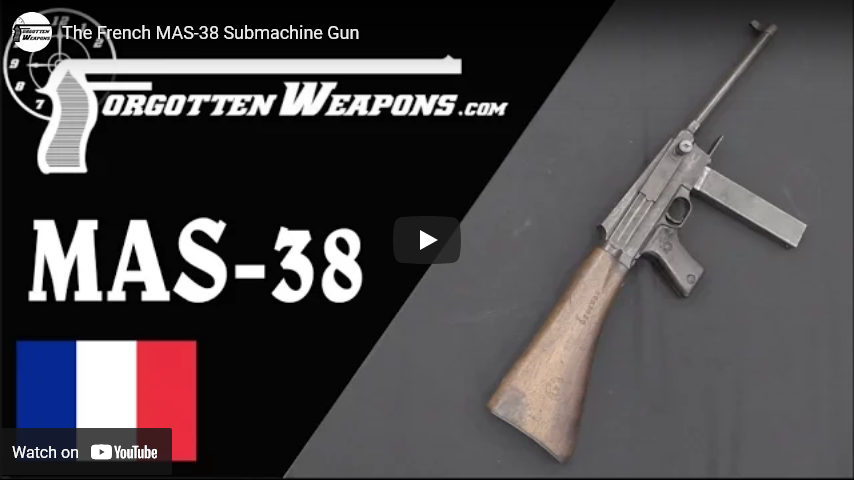
The French MAS-38 Submachine Gun
Forgotten Weapons
Published 4 May 2017The MAS-38 was France’s first officially adopted submachine gun, rushed into service in 1940. It was basically too late to help with the defense of France, with less than a thousand delivered by June 1940. The Germans kept the gun in production, making 20-30 thousand under the designation MP722(f). French production picked up immediately after the war, and 203,000 were made by the end of 1951. The gun would see service mostly in Indochina.
Mechanically, the MAS 38 is a simple blowback SMG, although it has a few unusual features. One is the approximately 6 degree angle between the barrel and receiver, which was done in order to drop the stock and allow a sight picture with shorter iron sights. As a result, the bolt face is also cut at about a 6 degree angle off perpendicular. The safety is the trigger itself, which folds up and forward to engage, locking the bolt in place. The weapon is chambered for the 7.65 French Long cartridge, which was also used in the 1935A and 1935S pistols. It is lighter than most other military submachine gun rounds, roughly on par with 9x18mm Makarov. That reduced ballistic peer does make for a very comfortable and controllable weapon, however.
http://www.patreon.com/ForgottenWeapons
Cool Forgotten Weapons merch! http://shop.bbtv.com/collections/forg…
If you enjoy Forgotten Weapons, check out its sister channel, InRangeTV! http://www.youtube.com/InRangeTVShow
QotD: Tolkien’s wartime experiences and The Lord of the Rings
Tolkien arrived on the Western Front in June 1916 as a signals officer in the 11th Lancashire Fusiliers, and experienced the agony of the Somme at first hand. In just three and a half months, his battalion lost 600 men. Yet it was now, amid the horror of the trenches, that he began work on his great cycle of Middle-earth stories. As he later told his son Christopher, his first stories were written “in grimy canteens, at lectures in cold fogs, in huts full of blasphemy and smut, or by candlelight in bell-tents, even some down in dugouts under shell fire”.
But he never saw his work as pure escapism. Quite the opposite. He had begun writing, he explained, “to express [my] feeling about good, evil, fair, foul in some way: to rationalise it, and prevent it just festering”. More than ever, he believed that myth and fantasy offered the only salvation from the corruption of industrial society. And far from shaking his faith, the slaughter on the Somme only strengthened his belief that to make sense of this broken, bleeding world, he must look back to the great legends of the North.
Yet The Lord of the Rings is not just a war book. There’s yet another layer, because it’s also very clearly an anti-modern, anti-industrial book, shaped by Tolkien’s memories of Edwardian Birmingham, with its forges, factories and chimneys. As a disciple of the Victorian medievalists, he was always bound to loathe modern industry, since opposition to the machine age came as part of the package. But his antipathy to all things mechanical was all the more intense because he identified them — understandably enough — with killing.
And although Tolkien objected when reviewers drew parallels between the events of The Lord of the Rings and the course of the Second World War, he often did the same himself. Again and again he told his son Christopher that by embracing industrialised warfare, the Allies had chosen the path of evil. “We are attempting to conquer Sauron with the Ring,” he wrote in May 1944. “But the penalty is, as you will know, to breed new Saurons, and slowly turn Men and Elves into Orcs.” Even as the end of the war approached, Tolkien’s mood remained bleak. This, he wrote sadly, had been, “the first War of the Machines … leaving, alas, everyone the poorer, many bereaved or maimed and millions dead, and only one thing triumphant: the Machines”.
“Trivial”, then? Clearly not. Tolkien was at once a war writer and an ecological writer; a product of High Victorianism and also a distant relative of the modernist writers who, like him, were trying to make sense of the shattered world of the Twenties and Thirties. But he wasn’t just a man of his time; he remains a guide for our own.
Dominic Sandbrook, “This is Tolkien’s world”, UnHerd, 2021-12-09.
March 23, 2022
In The Highest Tradition — Episode 6
British Army Documentaries
Published 9 Nov 2021This is the final part of the six-part series which delves into the world of the British Army’s regimental traditions and the stories behind them. This is a world where a Napoleonic Drum Major’s staff remains prized booty, a dog wears campaign medals awarded at Queen Victoria’s command, and snuff is served from a ram called George.
© 1989
This production is for viewing purposes only and should not be reproduced without prior consent.
This film is part of a comprehensive collection of contemporary Military Training programmes and supporting documentation including scripts, storyboards and cue sheets.
All material is stored and archived. World War II and post-war material along with all original film material are held by the Imperial War Museum Film and Video Archive.
March 22, 2022
The LAST Tribal-Class Destroyer — HMCS Haida
Royal Canadian Navy / Marine Royale Canadienne
Published 21 Mar 2022HMCS Haida has a long and distinguished naval career of service during the Second World War, the Korean Conflict and the Cold War, that’s why Canada’s “fightingest ship” is today a National Historic Site and the ceremonial flagship of the Royal Canadian Navy.
BUT … have you heard the rest of the story?
The incredible journey of saving Haida after being decommissioned in 1963 is told as you’ve never heard it before directly from the last survivor of HAIDA Inc., the group responsible for rescuing the aging Tribal-class destroyer from the scrap heap.
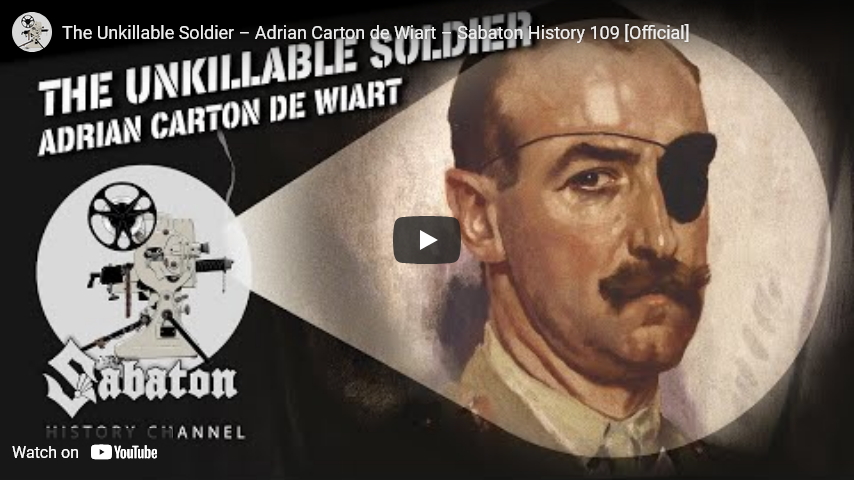
“The Unkillable Soldier” – Adrian Carton de Wiart – Sabaton History 109 [Official]
Sabaton History
Published 21 Mar 2022Adrian Carton de Wiart fought in a variety of wars over more than forty years, and he was wounded … again and again and again, and yet he always came back for more. This episode is his sometimes ridiculous but always interesting and incredible story.
Support Sabaton History on Patreon: https://www.patreon.com/sabatonhistory
Listen to “The Unkillable Soldier” on the album The War To End All Wars: https://music.sabaton.net/TheWarToEnd…
Watch the Official Music Video of “The Unkillable Soldier” here: https://www.youtube.com/watch?v=b4vj_…
Watch more videos on the Sabaton YouTube channel: https://www.youtube.com/user/Sabaton
Listen to Sabaton on Spotify: https://sabat.one/Spotify
Official Sabaton Merchandise Shop: http://bit.ly/SabatonOfficialShopHosted by: Indy Neidell
Written by: Markus Linke and Indy Neidell
Directed by: Astrid Deinhard and Wieke Kapteijns
Produced by: Pär Sundström, Astrid Deinhard and Spartacus Olsson
Creative Producer: Maria Kyhle
Executive Producers: Pär Sundström, Joakim Brodén, Tomas Sunmo, Indy Neidell, Astrid Deinhard, and Spartacus Olsson
Community Manager: Maria Kyhle
Post-Production Director: Marek Kaminski
Editor: Iryna Dulka
Sound Editor: Marek Kaminski
Archive: Reuters/Screenocean – https://www.screenocean.com
Colorization:
– Julius Jääskeläinen – https://www.facebook.com/JJcolorization/Sources:
National Army Museum, London
IWM HU 94459, Q 4511, Q 7105, Q 3140, IWM 32, IWM 162, IWM Q 68300, IWM 130-09+10
National Library of Scotland
All music by: SabatonAn OnLion Entertainment GmbH and Raging Beaver Publishing AB co-Production.
© Raging Beaver Publishing AB, 2019 – all rights reserved.
Tank Chats #141 | AEC Armoured Car | The Tank Museum
The Tank Museum
Published 3 Dec 2021Tune in to our weekly YouTube content today with David Fletcher as he details the AEC Armoured Car!
00:00 – Intro
00:25 – History of the AEC
04:46 – Key Features
(more…)
March 21, 2022
Republic to Empire: Sulla A Failed Reaction
seangabb
Published 10 Feb 2021In 120 BC, Rome was a republic with touches of democracy. A century later, it was a divine right military dictatorship. Between January and March 2021, Sean Gabb explored this transformation with his students. Here is one of his lectures. All student contributions have been removed.
(more…)
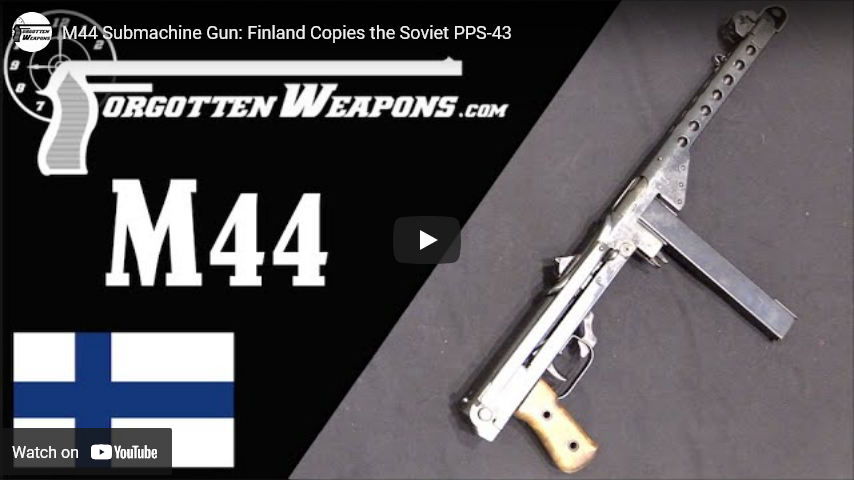
M44 Submachine Gun: Finland Copies the Soviet PPS-43
Forgotten Weapons
Published 17 Nov 2021http://www.patreon.com/ForgottenWeapons
https://www.floatplane.com/channel/Fo…
Cool Forgotten Weapons merch! http://shop.forgottenweapons.com
The kp/31 Suomi submachine gun in Finnish service was an outstanding weapon, but it was slow and expensive to manufacture. When Finnish forces began capturing Soviet PPS-42 and PPS-43 submachine guns from the Soviets in the Continuation War, it was very quickly decided that Finland should copy the design. This was a far simpler, far cheaper stamped sheet-metal design that was not as refined as the Suomi, but much more efficient to make.
The Sudayev design was changed only minimally; primarily to fit the Finnish cartridge (9x19mm Parabellum) and magazines. The guns were originally designed to use the 50-round quad-stack boxes and 71/72 round drums of the Suomi, but also used the Swedish Carl Gustaf m/45 magazine that was adopted by Finland after WW2.
Two companies were approached to produce the M44; Tikkakoski and Ammus Oy. Ammus was unable to source raw materials for the project, and only Tikka put the guns into production. Marshal Mannerheim initially wanted 50,000, but the order was reduced to 20,000 — of which only 10,000 were actually made, due to limited material availability before the end of the war led to production ending. Another 400 were assembled from remaining parts after the war.
In the 1950s, a plan was begun to resume M44 production in order to completely replace the Suomi in Finnish inventory. However, this plan was interrupted when Sam Cummings of InterArms made a deal to trade Finland about 75,000 surplus Sten guns for Finland’s supply of 7.35mm Carcano rifle (received as aid from Italy during the war) along with a melange of old machine guns. This was a sufficient quantity of Stens to handle the duties of the Suomi, and so the Sten went into Finnish service and M44 production was never resumed.
Those Carcano rifles were in turn imported into the United States, and this is why the majority of 7.35mm Carcano here bear Finnish “SA” property stamps. The same is true for the significant number of Chauchat automatic rifles in the US with Finnish property marks, which were also part of the deal.
Contact:
Forgotten Weapons
6281 N. Oracle 36270
Tucson, AZ 85740
March 20, 2022
Kharkov Falls Once Again – WW2 – 186 – March 19, 1943
World War Two
Published 19 Mar 2022The British are attacking the Mareth Line in North Africa while the Americans hit the Axis flank, but the Allies are withdrawing in Burma. It’s the Germans who are pulling back in the USSR, though, and there is another attempt from within German command to assassinate Adolf Hitler.
(more…)
Canada Carries On — The Fighting Sea Fleas (1944)
PeriscopeFilm
Published 24 Dec 2012Support Our Channel: https://www.patreon.com/PeriscopeFilm
World War 2 propaganda film narrated by Lorne Greene about Canadian Motor Torpedo Boats crews and their actions. Shows life aboard Motor Torpedo Boats during the Battle of the Atlantic, fending off attacks by German U-Boats and commerce raiders. Motor Torpedo Boat (MTB) was the name given to fast torpedo boats by the Royal Navy and the Royal Canadian Navy. The “Motor” in the formal designation, referring to the use of petrol engines, was to distinguish them from the majority of other naval craft that used steam turbines or reciprocating engines. Produced & Directed by Sydney Newman, and released in 1944.
This film is part of the Periscope Film LLC archive, one of the largest historic military, transportation, and aviation stock footage collections in the USA. Entirely film backed, this material is available for licensing in 24p HD. For more information visit http://www.PeriscopeFilm.com
March 19, 2022
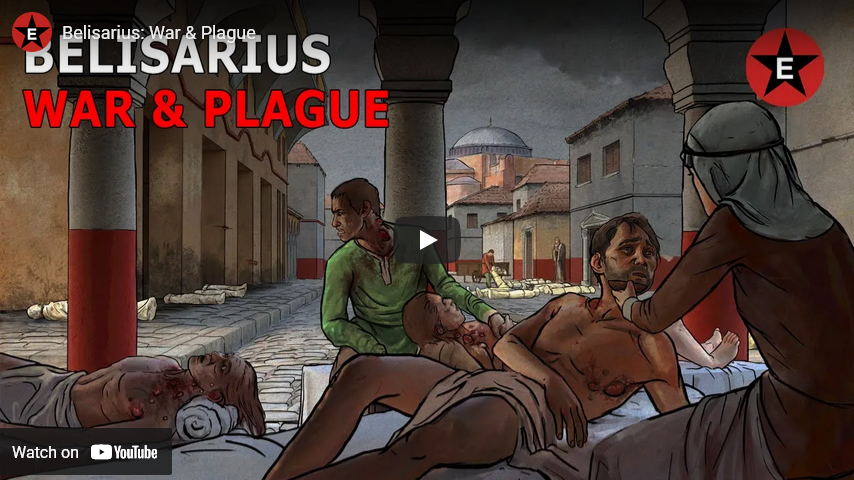
Belisarius: War & Plague
Epic History TV
Published 18 Mar 2022Download Endel here, first 100 downloads get 1 week of free audio experiences!
https://app.adjust.com/b8wxub6?campai…Big thanks to Legendarian for Total War: Attila gameplay footage, check out his YouTube channel here: https://www.youtube.com/channel/UCOI2…
Big thanks also to our series consultant Professor David Parnell of Indiana University Northwest, who you can follow on Twitter here: https://twitter.com/byzantineprof
Total War: Attila gameplay footage used with kind permission of Creative Assembly – buy the game here: https://geni.us/qDreR
Support Epic History TV on Patreon from $1 per video, and get perks including ad-free early access & votes on future topics https://www.patreon.com/EpicHistoryTV
🎨 Original artwork by Miłek Jakubiec https://www.artstation.com/milek
📚 Recommended reading (as an Amazon Associate I earn from qualifying purchases):
📖 Procopius, History of the Wars https://geni.us/L3Pgc
📖 The Wars of Justinian by Michael Whitby https://geni.us/Xxrd3
📖 Rome Resurgent by Peter Heather https://geni.us/ZFoU1
📖 The Armies of Ancient Persia: the Sassanians by Kaveh Farrokh https://geni.us/jMQo3z
📖 Late Roman Cavalryman AD 236–565 (Osprey) by Simon MacDowall https://geni.us/XMGl👕 Buy EHTV t-shirts, hoodies, mugs and stickers here! teespring.com/en-GB/stores/epic-histo…
🎶Music from Filmstro: https://filmstro.com/?ref=7765
Get 20% off an annual license with this exclusive code:EPICHISTORYTV_ANN“Rites” by Kevin MacLeod https://incompetech.filmmusic.io/song…
License: https://filmmusic.io/standard-license#EpicHistoryTV #RomanEmpire #EasternRomanEmpire #Justinian #Belisarius #ByzantineEmpire #Romans #Ostrogoths
March 18, 2022
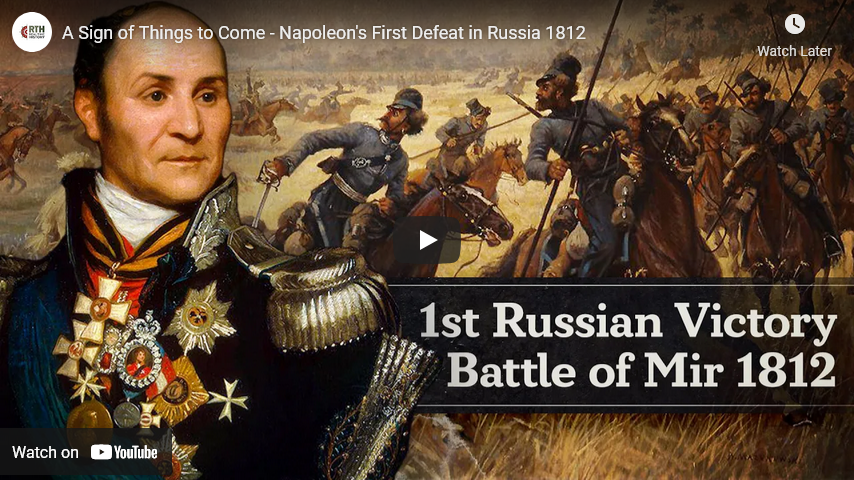
A Sign of Things to Come – Napoleon’s First Defeat in Russia 1812
Real Time History
Published 17 Mar 2022» SUPPORT US ON PATREON
https://patreon.com/realtimehistoryThe Battle of Mir in 1812 was the first battle of Napoleon’s invasion of Russia. Polish Uhlans ride right into a trap set by Platov’s Cossacks and under the Russian summer sun a cavalry skirmish ensues.
» THANK YOU TO OUR CO-PRODUCERS
John Ozment, James Darcangelo, Jacob Carter Landt, Thomas Brendan, Kurt Gillies, Scott Deederly, John Belland, Adam Smith, Taylor Allen, Rustem Sharipov, Christoph Wolf, Simen Røste, Marcus Bondura, Ramon Rijkhoek, Theodore Patrick Shannon, Philip Schoffman, Avi Woolf,» SOURCES
Boudon, Jacques-Olivier. Napoléon et la campagne de Russie en 1812. 2021.Chandler, David. The Campaigns of Napoleon. 1978.
Dujil, Nicolas. “Les armées russes en 1812”, in Rey, Marie-Pierre and Thierry Lentz, eds. 1812, la campagne de Russie. 2012.
Kagan Frederick. Russia’s Wars with Napoleon 1805-1815. The Military History of Tsarist Russia (NY.: Palgrave, 2002).
Lieven, Dominic. Russia Against Napoleon. 2010.
Mikaberidze, Alexander. “The Lion of the Russian Army”: Life and Military Career of General Prince
Peter Bagration 1765-1812. PhD Dissertation, 2003.
Rey, Marie-Pierre. L’effroyable tragédie : une nouvelle histoire de la campagne de Russie. 2012.
Zamoyski, Adam. 1812: Napoleon’s Fatal March on Moscow. 2005.
[Other Russian-language sources listed on the YouTube description]
» OUR STORE
Website: https://realtimehistory.net»CREDITS
Presented by: Jesse Alexander
Written by: Jesse Alexander
Director: Toni Steller & Florian Wittig
Director of Photography: Toni Steller
Sound: Above Zero
Editing: Toni Steller
Motion Design: Toni Steller
Mixing, Mastering & Sound Design: http://above-zero.com
Digital Maps: Canadian Research and Mapping Association (CRMA)
Research by: Sofia Shirogorova, Jesse Alexander
Fact checking: Florian WittigChannel Design: Simon Buckmaster
Contains licensed material by getty images
Maps: MapTiler/OpenStreetMap Contributors & GEOlayers3
All rights reserved – Real Time History GmbH 2022
Schindler’s First Rescue Mission – WAH 054 – March 1943, Pt. 1
World War Two
Published 17 Mar 2022In the weeks after Goebbels’ Sportpalast speech, we realize that Total War might mean an apocalyptic end for Germany, with Hitler’s blessing. No wonder that some Germans are looking to end Hitler before he ends them, and what a blessing that at least one Nazi with influence on the fate of thousands of Jews turns out to have a heart and soul.
(more…)
Jean Charest tries to position himself as the pro-military Conservative leadership candidate
Canadian politicians — generally speaking — are unwilling to tread too far into discussions of the Canadian Armed Forces and the utter disaster that is our federal government’s procurement “process”. There are lots of good, electoral reasons for this: Canadians have been propagandized over the last two generations to see Canada as a country with no real enemies and having no need of military force except for overseas peacekeeping and disaster relief. Any identified need for new equipment or even just updated replacements for existing capabilities is always a politically dangerous discussion, as it’s remarkably easy to get public support for almost any non-military spending instead of anything even vaguely warlike. Worse, on those few occasions when the government of the day bites the bullet to buy new ships/tanks/planes/helicopters/etc., the top priority isn’t military effectiveness or even lowest-price but where the money will be spent. Bidders for Canadian military contracts can’t just crank off a few extra units of the weapon or vehicle on existing production lines (which in almost every case would be both militarily better and economically cheaper): the government almost always demands new, expensive production facilities be constructed in Canada or for the foreign supplier to “partner” with an existing Canadian company to produce as much in Canada as possible.
This procurement charade usually means the Canadian Forces end up with far fewer weapons or vehicles because the increased costs of partial or complete production in Canada gobble up far more of the allocated budget. For example, back in 2017, we purchased a batch of new machineguns. It was the same model already in use with the Canadian army and with many of our NATO allies. If we’d just bought from one of the foreign manufacturers who already had production lines and tooling set up, each gun would have cost between US$6,000 and US$9,000 depending on configuration. But because we insisted on having Colt Canada set up a new production line, each weapon ended up costing C$28,000!
Multiply this across the entire range of equipment needed by the Canadian Army, the Royal Canadian Navy, and the Royal Canadian Air Force, and it’s quickly obvious that we’re running one of the least efficient military procurement systems in human history. And even on a domestic spin-off/job creation/vote buying spectrum, it’s insanely expensive and wasteful.
All of that out of the way, here’s Conservative leadership hopeful Jean Charest deliberately touching one of the “third rails” of Canadian politics by proposing an increase in funding for the military:
Our military procurement system is broken. For years experts have been warning about our incompetence at making major defence purchases. The past few weeks have shown us the price of our inaction.
While our allies, the United States, the United Kingdom and Australia, have entered into a new security pact to counter China in the Pacific, Canada wasn’t even invited to the table.
Germany, Sweden, and other NATO allies promise to increase their military spending to prepare for the uncertain times ahead. Canada has a moral responsibility to act. Now is the time.
If elected as the leader, my Conservative government will make significant changes and upgrades to our nation’s military capabilities. I will move quickly to ramp up Canadian defence spending to two percent of GDP, increase personnel to 100,000 and equip our forces for the challenging times ahead. I will modernize our cyber security infrastructure to prepare for future risks. And I will fix our embarrassing procurement system to ensure we get the equipment we desperately need.
The current conflict has also driven home the need to assert our sovereignty, especially in our North. As major sea lanes, essential to global trade and export of our natural resources, open within our arctic territory, we must be on high alert to Russian and Chinese encroachment. Neither recognizes our sovereignty there. In fact, no one really recognizes our sovereignty there and the imbalance in our military investments compared to our allies explains why that’s the case.
The war in Ukraine is a cruel reminder of why we cannot ignore these threats. Russia has a modern military base in the arctic — another area where indecision and delay could be extremely costly unless addressed.
A proud Canada must assert its sovereignty in the North and generate military support through major investments in equipment and coordination with our NATO allies. We need to get our act together.
The threats remain real and demand immediate attention from leaders willing to act in the best interests of their respective nations.
Canadians need experience and expertise overseeing our military. We need a government that supports our military.


