
World War Two
Published 23 Aug 2022In 1943, the British are working on a radical plan which could revolutionize the Allies’ productive capacity. It might sound crazy, but ice might be the magic material they need.
(more…)
August 24, 2022
A Floating Airfield Made of Ice – WW2 Newsflash
Comments Off on A Floating Airfield Made of Ice – WW2 Newsflash
Serbia ensures that we still have fresh concerns this summer
CDR Salamander on yet more potential trouble in the Balkans that has drawn some serious attention from the US Air Force:
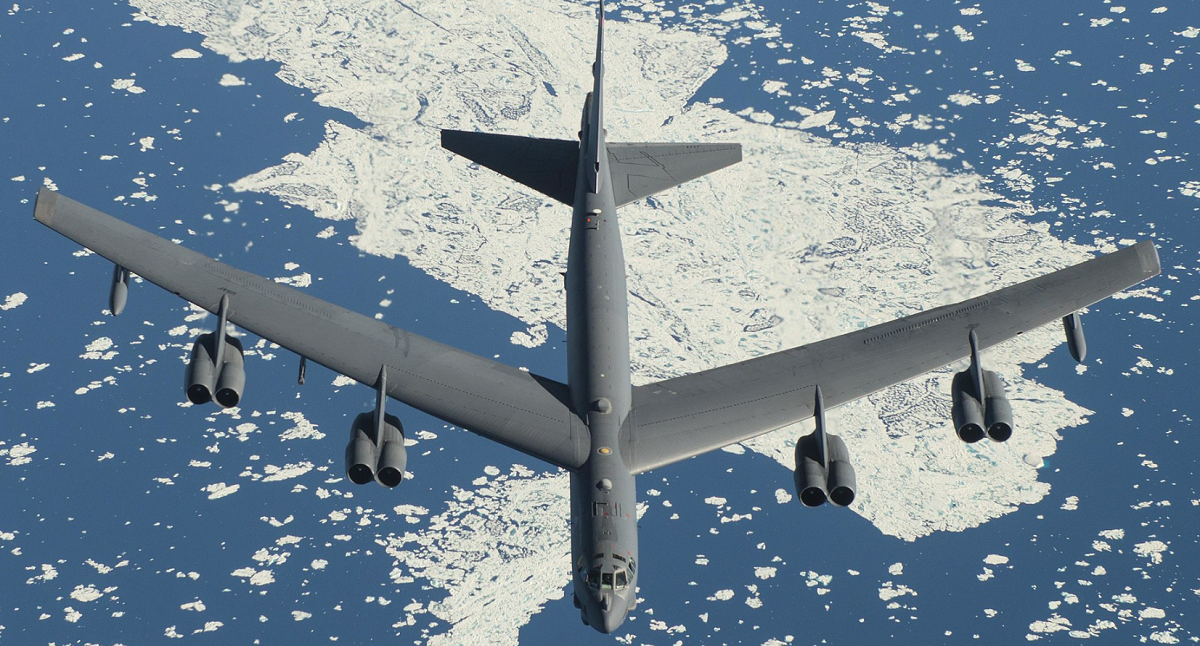
USAF B-52 Stratofortress near the North Pole on 31 July, 2016 during the Polar Roar exercise.
Detail of original USAF photo by Senior Airman Joshua King via Wikimedia Commons.
I know everyone is busy and all … but you need to keep an eye on the usual problem areas.
You would think one war in Europe at a time would be enough, but you should never underestimate the Serbs.
As with most of us who were on active duty in the 1990s, I have more than a passing interest in the former Yugoslavia — and invested my quota of effort in its wars.
Later in my career I later served in NATO with Slovenes, Croatians, and N. Macedonians. I’ve vacationed a few times in Slovenia and Croatia. One of my daughters has studied, twice, in Serbia.
I keep an eye on it … and thankfully so are some smart people in The Pentagon.
The Balkans is always on the edge and has been for centuries, so it is only natural that now and then it bubbles over.
You may have missed with all the other news that the frozen conflict in Kosovo was throwing sparks again. That is why on Friday I tilted my head a bit with this announcement;
Two U.S. Air Force B-52 Stratofortress aircraft assigned to the 23rd Bomb Squadron currently operating out of RAF Fairford, United Kingdom, will conduct low approach flyovers over Southeastern Europe scheduled on August 22.
The purpose of each flyover is to demonstrate U.S. commitment and assurance to NATO Allies and partners located in Southeastern Europe. Additionally, this will provide citizens an opportunity to take photos, videos, and enjoy the aircraft flying overhead.
That told me that the Balkans desk has run their concerns up the chain and whatever they briefed was enough to greenlight a not insignificant display.
Sure enough, off it went Monday;
A pair of U.S. Air Force B52 strategic bombers on Monday flew low over the Croatian resort of Dubrovnik and three other NATO-member states in the region as a sign of support amid the Russian aggression in Ukraine.
In addition to the walled Croatian tourist resort of Dubrovnik, the aircraft flew over the government headquarters in Skopje, North Macedonia, the downtown Skanderbeg Square in the Albanian capital, Tirana, and up the Adriatic coast of Montenegro.
The Balkans and the Adriatic Sea have lately seen increased military, intelligence and propaganda activity by Moscow, which considers the region of its strategic interest because of its access to the Mediterranean.
Serbia is about Russia’s last friend in Europe and make no mistake … the Serbs do not consider borders settled anywhere — they are just waiting for the moment to be ripe.
Comments Off on Serbia ensures that we still have fresh concerns this summer
August 23, 2022
Greece Burns Under Nazi Occupation – WAH 074 – August 21, 1943
World War Two
Published 21 Aug 2022The aerial bombing of Germany takes a new turn but continues to fail to bring long-term results. In occupied Greece and Poland, over a thousand children are murdered by the Nazis.
(more…)
Comments Off on Greece Burns Under Nazi Occupation – WAH 074 – August 21, 1943
Reject Modernity; Embrace Tradition: The Type 95 Shin Gunto
Forgotten Weapons
Published 28 Apr 2022When Japan opened up to the outside world and began to industrialize in the late 1800s, it instituted major military reforms. In place of the samurai tradition, the new Japanese Imperial armed forces emulated the major European powers — France, Germany, and the United Kingdom. One element of this was the replacement of traditional swords with European styles for officers and civil officials.
These swords remained until the mid 1930s, when a wave of nationalist sentiment ran through Japanese society. In 1934, a new model of officer’s sword was adopted, which took the style of a traditional katana. A similar (but less fancy) model was adopted in 1935 for non-commissioned officers. These were the Type 34 and Type 35 respectively, and they are some of the most common Japanese swords in the United States, as many were brought back as souvenirs by American soldiers.
Today we are looking at my Type 95, using Headstamp’s upcoming book Swords of the Emperor as a guide.
(more…)
Comments Off on Reject Modernity; Embrace Tradition: The Type 95 Shin Gunto
August 22, 2022
QotD: The inevitability of World War 1
If they bother to teach it at all these days, World War I is still presented as a big mystery. You get some stuff about the Triple Entente, some other stuff about the assassination of the Archduke, maybe something about the Zimmerman Telegram. Why any of that should’ve led to the most horrific war in human history up to that point is left unexplained. Also left unexplored is how nobody seemed to see it coming. World War I just kinda … happened, kids are taught.
You can blame the usual suspects for a lot of this — the Kaiser et al are far too White and male to be worth spending time on, especially when you’ve got to devote so many weeks to Harriet Tubman and Rosa Parks. But the other reason — the far more important one for our purposes — is this: It’s a mystery to the teachers, too.
As academics who have never set foot in the real world, they take other academics’ words at face value. And the academics of 1913 couldn’t figure it out either. They pointed out that a general European war would cause the world’s financial system to collapse; ergo there would be no war. Besides, they argued, even if Germany did go to war, she lacked the natural resources to sustain the fight. And finally, they claimed, the firepower of modern infantry is just too overwhelming — given their rates of fire, two regiments equipped with machine guns would wipe each other out in less than two minutes.
Credit where it’s due: The eggheads were right about all of that. The global financial system did collapse; Germany as constituted at the outbreak of war didn’t have the resources to keep fighting; and the initial skirmishes showed the overwhelming impact of massed firepower. But the eggheads never learned that people are people, and since people love fighting more than anything else in the world, solutions were quickly found.
The United States, with its shiny new Federal Reserve system (created late 1913), was more than happy to step into the financial breach, just as American companies were more than happy to help Germany (and everyone else) with their armaments shortage. And Walther Rathenau happened, as my students would write, keeping the raw materials flowing to German industry. And faced with the overwhelming firepower of machine guns, soldiers ducked. Then they dug, and there’s your four years of bloody trench warfare.
Even the outbreak of the war, far from being a mystery, is painfully obvious if you know the first thing about the major players. In what historians call the Long 19th Century (1789-1914), it was taken for granted that a nation needed colonies to be a serious power. The reasoning behind this was never too sound, and by the turn of the 20th century various smart guys had figured out that on balance colonies were more trouble than they were worth, but pretty much by definition smart guys don’t hold on to the reins of power. Bismarck didn’t — the Berlin Conference was supposed to keep jingo knuckleheads like Wilhelm II from starting a war over a few acres of scrub jungle, but since Wilhelm II shared his class’s raging hardon for colonial expansion, all it ended up doing was sweeping Bismarck out of office. And as for Tsar Nicholas and his colonial adventures in the Balkans (and the Far East), one could write an entire book about that stupidity and still not cover all of it. Throw in England’s stuffed shirt of a king, and France’s legendary inability to maintain a stable government, and tragedy was inevitable.
In short, World War 1 was a massive, indescribably bloody dick-measuring contest between a few inbred yokels. To anyone who has met the Sons of Privilege*, or who is passingly familiar with the Peter Principle, this comes as no surprise. Hell, Lenin saw it, and a guy with his egg head further up his own ass you’ll never find.** All you have to do is look at the people, not the paper.
* they’re like the Sons of Anarchy, but effete and usually gay.
** though he basically just stole the idea from Hobson, who, though a goofy love-the-worlder, was actually a pretty smart guy.Severian, “1913”, Rotten Chestnuts, 2019-08-20.
August 21, 2022
Sicily Liberated; Italy in the Firing Line – WW2 – 208 – August 20, 1943
World War Two
Published 20 Aug 2022The British and Americans race for Messina to complete the conquest of Sicily — who will reach it first? On New Guinea, the Allies destroy a substantial Japanese air force; there are several major Allied air raids over Europe, the fighting in the USSR around Kharkov is brutal and costly for both sides, and a secret Allied leadership conference in Quebec begins to determine the course of the war. Busy week.
(more…)
Comments Off on Sicily Liberated; Italy in the Firing Line – WW2 – 208 – August 20, 1943
August 20, 2022
How Turkey Fought a WW1 Peace Treaty – The Greek-Turkish War 1919-1923
The Great War
Published 19 Aug 2022The defeat of the Ottoman Empire in 1918 meant that it got its own peace treaty like the other three Central Powers. But the emerging Turkish National Movement under Mustafa Kemal resisted the Treaty of Sevres and occupation by various Entente Powers. Their successful resistance led to the creation of modern Turkey and the Treaty of Lausanne in 1923.
(more…)
Comments Off on How Turkey Fought a WW1 Peace Treaty – The Greek-Turkish War 1919-1923
Czech M14: The ZK-420S Battle Rifle
Forgotten Weapons
Published 7 Apr 2017The ZK-420S is an experimental Czech rifle that is virtually unknown today, but which was remarkably influential, bearing significant elements of the Garand and several other Czech designs, and influencing the M14 and Kalashnikov rifles. Originally designed by Josef Koucky in 1942, the plans were hurriedly dusted off and improved at the end of World War 2. With many nations looking at the possibility of adopted self-loading military rifles, Brno hoped to make export sales of the design.
The ZK420S uses the trigger mechanism of the M1 Garand and a gas-operated rotating bolt action very similar to the Garand and AK rifles. It has a simple adjustable 3-position gas system, and a quick and simple disassembly procedure. It uses detachable box magazines (10 round, and not copied from an existing design) and was made in a variety of calibers for testing — including 8×57, 7×57, 7.5 Swiss, 6.5 Swedish, and .30-06. Examples were trialed or examined in the United States, Argentina, Israel, Ethiopia, England, Switzerland, Sweden, Norway, Denmark, and elsewhere — this particular rifle is from the Norwegian trials.
In my opinion, it is an excellent rifle, and its failure to sell was probably due to price and the combination of tight budgets and cheap surplus war material in the late 1940s. It is handy, well balanced, and has a good magazine design and good sights. Recoil is comparable to the Garand. Ultimately the development program in Czechoslovakia would lead to the ZK-472 in 7.5x49mm, which would proceed to the 7.62x45mm in the vz.52 rifle.
(more…)
Comments Off on Czech M14: The ZK-420S Battle Rifle
August 19, 2022
How Accurate is Saving Private Ryan? – WW2 D-Day Special
World War Two
Published 16 Aug 2022How accurate is that famous beach scene in Saving Private Ryan? Is it true to the history or just another Hollywood story? Seeing as we’re about to start the filming for our massive D-Day project, we figured we’d break it down, shot by shot.
(more…)
Comments Off on How Accurate is Saving Private Ryan? – WW2 D-Day Special
August 18, 2022
The Communist Spies in America’s Atomic Program – WW2 – Spies & Ties 22
World War Two
Published 15 Aug 2022The NKVD have wormed their way into British society. Across the pond, America is also teeming with communist spies. They’re in the government, military, even OSS, and the FBI. Now they’re going for the biggest secret of all – the atomic bomb.
(more…)
Comments Off on The Communist Spies in America’s Atomic Program – WW2 – Spies & Ties 22
The bridge design that helped win World War II
Vox
Published 12 Mar 2021It’s a simple innovation that helped win a war.
The Bailey bridge was Donald Bailey’s innovative solution to a number of wartime obstacles. The allies needed a way to cross bodies of water quickly, but bombed-out bridges — or an absence of crossings entirely — made that incredibly difficult. That was only compounded by new, heavy tanks that needed incredibly strong support.
Bailey’s innovation — a modular, moveable panel bridge — solved those problems and gave the allies a huge advantage. The 570-pound steel panel could be lifted by just six men, and the supplies could fit inside small service trucks. Using those manageable materials, soldiers could build crossings sufficient for heavy tanks and other vehicles.
As impressive, the Bailey bridge could be rolled across a gap from one side to the other, making it possible to build covertly or with little access to the other side. Together, all the Bailey bridge’s advantages changed bridge construction and may have helped win the war.
(more…)
Comments Off on The bridge design that helped win World War II
August 17, 2022
Amazing Money Heist by Polish Resistance – WAH 073 – August 14, 1943
World War Two
Published 14 Aug 2022The reality of war finally seeps through to the majority of Germans, and it didn’t match up with the propaganda. Meanwhile resistance is increasing, and part of that is a classic money carriers when the Polish Home Army robs a money transport.
(more…)
Comments Off on Amazing Money Heist by Polish Resistance – WAH 073 – August 14, 1943
Prototype Gustloff 206 Rifle
Forgotten Weapons
Published 17 Aug 2016http://www.patreon.com/ForgottenWeapons
German arms development during World War II was quite the chaotic mess, in many ways. While it is not uncommon for different service branches to have independent procurement systems, in fascist-era Germany this was coupled with the close collaboration between industry and the Party structure. This led to competing and conflicting policies between military and political offices.
Semiautomatic rifle development was no exception. While the Walther and Mauser companies won the competitions to develop the Gewehr 41, the Gustloff concern had also produced a number of designs and these were continued after the trials by political decree. The best of these designs (apparently, from the sparse information available) was the model 206.
The Gustloff 206 is a largely sheet metal rifle with a gas piston operating system and an unusual vertically traveling locking block, akin to the Type 94 Nambu and Bergmann 1910 (as well as the much more recent Arsenal Strike One). The rifle is semiautomatic only (although it sounds like some select-fire models were also made) and feeds from MG-13 box magazines — cut down from 25 rounds to 10 rounds capacity on this example.
The rifle may be related to the Gustloff submission for the Luftwaffe’s FG-42 project, but may not be. All I have been able to find on that rifle is that Gustloff did submit one and it did not progress into any trials, most likely because it failed to meet the design criteria set out by the Luftwaffe. The model 206 would fit that description.
Comments Off on Prototype Gustloff 206 Rifle
August 16, 2022
Manstein Goes Great War Style – WW2 – 207 – August 13, 1943
World War Two
Published 13 Aug 2022From Sicily to Spas-Demensk, the Axis continue conceding ground to the Allies this week. But the fighting is still tough. The Wehrmacht has halted the Red Army offensive in the Kuban, and the British and American armies have neither the strength nor the willpower to press the advantage against Axis troops retreating to the Italian mainland.
(more…)
Comments Off on Manstein Goes Great War Style – WW2 – 207 – August 13, 1943
Nimble, Sleek, And Almost Useless In A Real Fight; the story of the Canadair CF-5 Freedom Fighter
Polyus Studios
Published 8 May 2021Don’t forget to like the video and subscribe to my channel!
Support me on Patreon – https://www.patreon.com/polyusstudiosThe multi-role CF-5 was intended to replace the nuclear-armed CF-104 Starfighter and CF-101 Voodoo squadrons with a conventional warfighter. However, as an air superiority fighter, it was useless against all but the oldest relics in the Warsaw Pact arsenal. It fared little better as a close air support tactical fighter, thanks to its short range, relatively small weapons load, lack of all-weather navigation, and its inability to survive in a sophisticated, integrated air defense environment. Despite this, 240 were built in Canada and served with the Canadian Armed Forces for 27 years, not as a replacement for the existing fleet, but as an addition to them no one in the military seemed to really want. So why did Canada operate the CF-5? As you might well have assumed, the story behind the acquisition and operation of the CF-5 is a complicated one.
(more…)
Comments Off on Nimble, Sleek, And Almost Useless In A Real Fight; the story of the Canadair CF-5 Freedom Fighter


