
Royal Marines
Published 31 Aug 2012Commando, made for the Admiralty in 1945, is a drama-documentary covering Commando training in Wrexham, Anchnacarry and St. Ives. Fascinating archive footage shows wartime Commando units on amphibious assault exercises, perfecting cliff-top assaults and practicing both armed and unarmed combat techniques.
September 1, 2022
The Royal Marines at War: Commando – The Story of the Green Beret (1945)
Comments Off on The Royal Marines at War: Commando – The Story of the Green Beret (1945)
Rheinmetall MG42/59: The Slow-Fire Commercial MG42
Forgotten Weapons
Published 4 May 2022After World War Two, when West Germany was allowed to reconstitute its army and join NATO, it needed small arms. The new Bundeswehr chose the MG42 as its standard GPMG, and the Rheinmetall firm undertook the project of recreating the technical data package to build them. The work was completed in 1958, and the company began making new MG42s in 7.62 NATO for the commercial export market as well as for the Bundeswehr (which designated the gun the MG1). Rheinmetall made a number of iterative improvements to the design, including nearly doubling the bolt weight (from 550g/1.2lb to 950g/2.1lb) for their MG42/59 model to bring the rate of fire down to a reasonable 700-900 rpm. The bolt (and its associated heavy buffer) was not adopted by the Bundeswehr, but was bought by other clients.
The MG42/59 also includes many of the other upgrades that would be implemented on the final MG3 version adopted by the military. These include:
– Top cover hinge that holds the cover in a raised position
– Feed tray to mount modern belt boxes and prevent belts from falling out when opened
– Integrated AA rear sight
– New muzzle booster designThis particular one is a beautiful example made in 1964 and brought to the US early enough to be a registered, transferrable, C&R piece.
(more…)
Comments Off on Rheinmetall MG42/59: The Slow-Fire Commercial MG42
August 31, 2022
Tank Chats #153 | Jagdpanther | The Tank Museum
The Tank Museum
Published 6 May 2022Discover the origins of Jagdpanther with Curator David Willey and learn more about this German tank destroyer.
(more…)
Comments Off on Tank Chats #153 | Jagdpanther | The Tank Museum
QotD: John Keegan’s The Face of Battle
The Face of Battle (1976) is in some ways an oddly titled book. The title implies there is a singular face to battle that the author, John Keegan, is going to discover (and indeed, to take his forward, that is certainly the question he looked to answer). But that plan doesn’t survive contact with the table of contents, which makes it quite clear that Keegan is going to present not one face of battle, but the faces of three different battles and they will look rather different. Rather than reinventing the wheel, I am going to follow Keegan’s examples to make my point here (although I should note that of course The Face of Battle is a book not without its flaws, as is true with any work of history).
Keegan’s first battle is Agincourt (1415). While famous for the place of the English longbow in it, at Agincourt the French advance (both mounted and dismounted) did reach the English lines; of this the sources for the battle are quite clear. And so the terror we are discussing is the terror of shock; not shock in the sense of a sudden shock or in the sense of a jolt of electricity, rather shock as the opposite of fire. Shock combat is the combat when two bodies of soldiers press into each other in mass hand-to-hand combat (which is, contrary to Hollywood, not so much a disorganized melee as a series of combats along the line of contact where the two formations meet). The advancing French had to will themselves forward into a terrifying shock encounter, while the English had to (like our hoplites above) hold themselves in place while watching the terrifying prospect of a shock engagement walk steadily towards them.
There is actually quite a bit of evidence that the terror of a shock engagement is something different from the other terrors of war (to be clear, not “better” or “worse”, merely different in important ways). There are numerous examples of units which could stand for extend periods under fire but which collapsed almost immediately at the potential of a shock engagement. To draw a much more recent example, at Bai Beche in 2001, a force of Taliban withstood two days of heavy bombing and had repulsed an infantry assault besides, but collapsed almost immediately when successfully surprised by a cavalry charge (yes, in 2001) in their rear (an incident noted in S. Biddle, “Afghanistan and the Future of Warfare”, Foreign Affairs 82.2 (2003)).
And so our sources for state-on-state pre-gunpowder warfare (which is where you tend to find more fully “shock” oriented combat systems) stress similar sequences of fear: the dread inspired by the sight of the enemy army drawing up before you (Greek literature is particularly replete with descriptions of teeth-chattering and trembling in those moments and it is not hard to imagine why), followed by the steady dread-anticipation as the armies advanced, each step bringing that moment of collision closer. Often in such engagements one side might break before contact as the fear not of what was happening, but what was about to happen built up. And only then the long anticipated not-so-sudden shock of the formations coming together – rarely for long given the overpowering human urge not to be near an enemy trying to stab you with a sharp stick. There is something, I think, quite fundamental in the human psyche that understands another human with a sharp point, or a huge horse rapidly closing on a deeper level than it understands bullets or arrows.
Which brings us to Keegan’s second battle, Waterloo (1815), defined in part by the ability of the British to manage to hold firm under extended fire from artillery and infantry. The French artillery in an 80-gun grand battery opened fire at 11:50am and kept it up for hours until the French cavalry advanced (hoping that the British troops were suitably “softened” by the guns to be dislodged) at 4pm. In contrast to Agincourt (or a hoplite battle) which may have ended in just a couple of hours and consisted mostly of grim anticipation, soldiers (on both sides) at Waterloo were forced to experience a rather different sort of terror: forced to stand in active harm for hours on end, as bullets and cannon shot whizzed overhead.
The difference of this is perhaps most clearly extreme if we move still forward to the Somme (1916) and bombardment. The British had prepared for their assault with a week long artillery barrage, in which British guns fired 1.5 million shells (that is about 148 shells fired a minute, every minute for a week). At the first sound of guns, soldiers (in this case, the Germans, but it had been the French’s turn just that February to be on the receiving end of a bombardment at Verdun) rushed into their dug-out bomb shelters at the base of their trench and then waited. Unlike the British at Waterloo, who might content themselves that, one way or another, the terror of fire would not last a day, the soldier of WWI had no way of knowing when the barrage would cease and the battle proper begin. Indeed, they could not see the battlefield at all, only sit under the ground as it shook around them and try to be ready, at any moment when the barrage stopped to rush back up to the lip of the trench to set up the machine guns – because if they were late to do it, they’d arrive to find British grenades and bayonets instead.
We will get into wounds, both physical and mental, next week, but it is striking to me that repeatedly there are reports after such barrages of soldiers so mentally broken by the strain of it that they wandered as if dazed or mindless, apparently driven mad by the bombardment. Reports of such immediate combat trauma are vanishingly rare in the pre-modern corpus (Hdt. 6.117 being the rare example). And it is not hard to see why the constant threat of sudden, unavoidable death hanging over you, day and night, for days or in some cases weeks on end produces a wholly different kind of terror.
And yet, to extend beyond Keegan’s three studies, in talking to contemporary veterans, it seems to me this terror of fire – being forced to stand (or hide) under long continuous fire – is not always quite the same as the terror of the modern battlefield. Of course I can only speak to this second hand (but what else can a historian generally do?), but there seems to be something different about a battlefield where everything might seem peaceful and fine and even a bit boring until suddenly the mortar siren sounds or a roadside IED goes off and the peril is immediate. The experience of such fear sometimes expresses itself in a sort of hypervigilance which seems entirely unknown to Greek or Roman writers (who in most cases could hardly have needed such vigilance; true surprise attacks were quite rare as it is extremely hard to sneak one entire army up on another) and doesn’t seem particularly prominent in the descriptions of “shell-shock” (which today we’d call PTSD) from the First World War, compared to the prominence of intense fatigue, the thousand-yard-stare and raw emotional exhaustion. I do wonder though if we might find something quite analogous looking into the trauma of having a village raided by surprise under the first system of war.
Bret Devereaux, “Collections: The Universal Warrior, Part IIa: The Many Faces of Battle”, A Collection of Unmitigated Pedantry, 2021-02-05.
Comments Off on QotD: John Keegan’s The Face of Battle
August 30, 2022
A cynical (or realistic) view of the fighting in Ukraine
Severian put up a guest post at Founding Questions from “Pickle Rick” analyzing a recent article in the Marine Corps Gazette on the Russo-Ukrainian War so far:
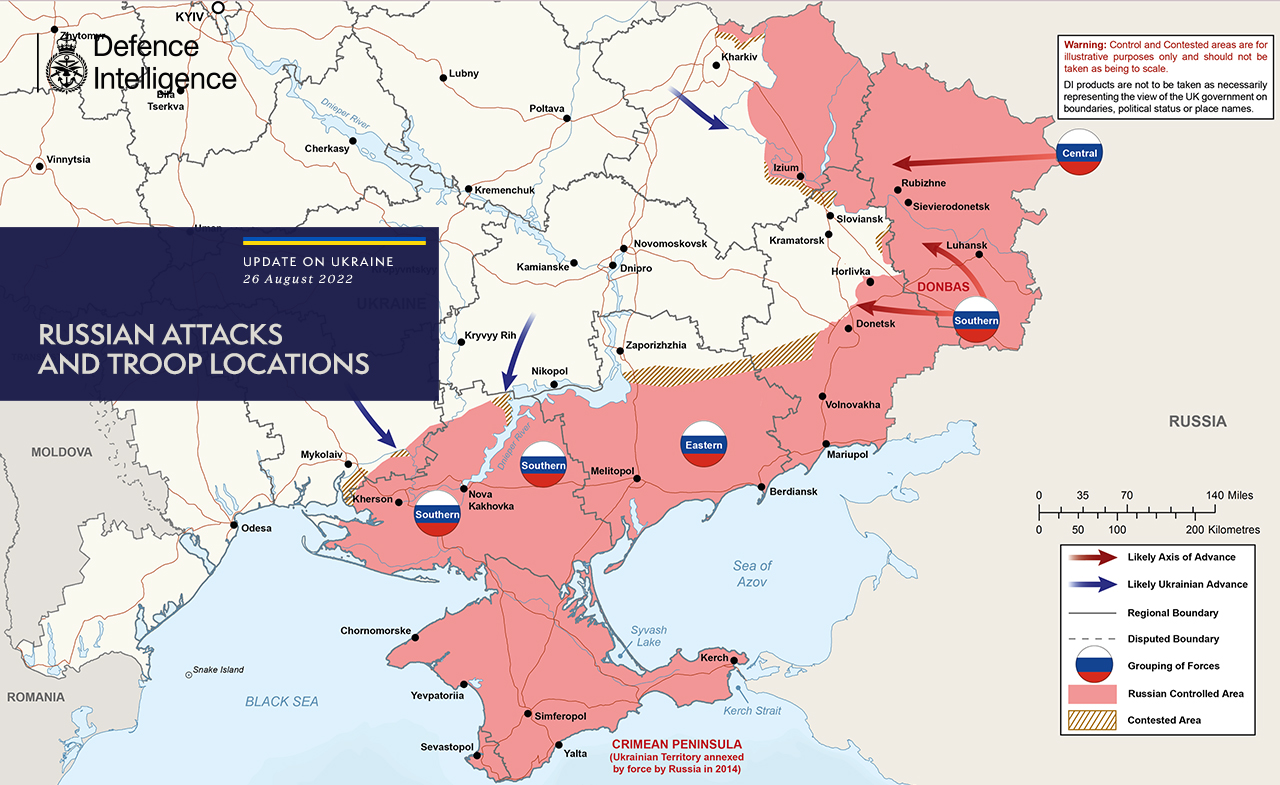
Marinus divides Russian operations, and operational goals, thus tactics, into three discrete geographic parts. Northern Raiding and feints realized through mobile warfare, Southern Occupation through clear and hold, and Central Attrition operations through artillery firepower.
1. Northern operation. Marinus’s central thesis is that the Northern operation was a giant raid, intended to fix Ukrainian commanders’ attention on the threat to Kiev, and prevent them from reinforcing their defenses in the south. In this, mobile warfare, using the battalion tactical group, was the main strategy used. Marinus posits that taking and holding Kiev was never a goal in this operation. Left unsaid in his assessment were two key points that go beyond his narrower operational focus.
First, I’m sure that the Ukrainian Army’s top command was likely not in complete control of defensive strategy or deployment. Zelensky, the Ukrainian Auto Parts King — (“I make politics for the Ukrainian working man, because that’s who I am, and that’s who I care about!”), and his American “advisors” were. Note that we have no idea who Ukrainian General Marshall is, who his Supreme Commander Eisenhower is, or his battlefield Patton is, even if one existed. I mean, we got fawning coverage of President Comedian, looking tough in his cammies on TV, a lot — by which I mean every fucking day, a mythical fighter ace, the “Ghost of Keeeeeev”, but nobody wanted to manufacture a real hero Uke general, steadfastly leading his troops with steely eyed resolve from the front?
C’mon, that’s Propaganda 101. Shit, even Big Red let Marshal Zhukov ride a white horse at the Victory Parade.
I don’t think that is inadvertent. The goons at State and the Clown Intelligence Agency, having engineered one coup, sure as fuck don’t want an actual no shit popular hero, ethnically Ukrainian general to be a viable political alternative to the UAPK they handpicked and installed after this clown folds the Big Top. (Francisco Franco, Kemal Ataturk, or Wladislaw Sikorski say hi from history!). To hear it from the Ministry of Propaganda, Zelensky is commanding the troops himself, and that’s for once likely not far from the truth. It’s Zelensky being “advised” by whatever retards from [Washington DC] who are actually commanding the Ukes, which brings me neatly into my next point — Putin and his generals initiated this feint to Kiev precisely because they correctly predicted that Zelensky and his American masters would expect it and react to it as they did, regardless of anything the Ukrainian generals said.
Why is that, you might ask? Because that is the only strategy that AINO’s Very Clever Boys, Girls and Trannies can conceive of, and the only way they conduct war. Send in the Air Force to blow up everything in an enemy capital, launch a blitzkrieg style invasion aimed at cutting off the enemy army, encircling it, forcing the unmotivated piss poor enemy conscripts to surrender in place or die trying to pull back, and driving on to the capital to pull down the statues of the recently deceased or deposed Dear Leader who was The Next Hitler, declare victory, then institute Regime Change and Operation Endless Occupation. Putin and the rest of his generals are just stupid vodka fueled gopnik Ivans, and couldn’t possibly be headfaking us and outsmarting us. We went to West Point and Harvard, and are automatically the Best and Brightest. Remember when the MoP and the Fistagon were squeeing like little girls at those incompetent Ivans floundering about within artillery range of Keeeev, and the 100 mile long convoy that everyone saw “stuck” on the road to the Sacred Capital, that was so visible and obvious you could see the fucker from space, that just sort of disappeared, along with the great and decisive Battle of Keeeeev that was going to be a bloody defeat for the evil Russians?
You’ll never hear anyone ever admit it, but they just got posterized because their hubris and arrogance was exactly the thing [Putin] used against them.
маскировка (Maskirovka), you stupid fucks, is a Russian MILITARY CONCEPT, and you forgot it. Check yo self before you wreck yo self, as von Clausewitz wrote. Master P didn’t fight your war, he fought a modern Kabinettskreige and that is fought for an entirely different set of objectives, as we will see below.
2.Southern operation. This is the forgotten stepchild of the war so far, but quietly could be the one front with the longest lasting strategic effects. Marinus disposes of this front relatively quickly, noting that it really is operationally the bread and butter of traditional warfare, take ground and hold ground, move on to the next objective. Strategically, this is different from ground taken in the northern front or even parts in the central, however.
The object here is permanent occupation and Russification to deny the rump state of Ukraine any coastline and landlock it. This, unlike territory in the north or even in the Donbass, is not a bargaining chip on the table at the peace talks. Denying this to the Ukrainians after the war prevents them from ever “inviting” any US Navy ships into the Black Sea to base themselves at a Ukrainian port and serve as a potential casus belli, hamstrings Ukraine from seaborne economic activity with Turkey across the Black Sea, thus making sure whatever left of Ukraine is unable to function without massive land route economic as well as military aid, making it a drain, not an asset, to Globohomo and AINO.
[…]
3. Central operation. Marinus here details the real decisive front in the war, calling it “Stalingrad in the East” (Clunky, since Stalingrad was a very different kind of battle, but it has name recognition as a byword for the Eastern Front and the Russian way of war). Honestly, it is far more like a giant Battle of Verdun, but only for one side.
Here is where I’m going to proclaim how happy my artilleryman’s heart is […] because Marinus says that in the Russian way of winning wars, you can’t spell PARTY without ARTY. Not Special Operations Operating Operationally, not drone warfare “fought” by fatass pimply nerds in some air conditioned room half a world out of danger, not bombs away from 30,000 feet, or armored divisions imitating Rommel. Fucking old school howitzers, chucking metric tons of high explosive on infantry, dropping regimental sized TOT and Shake and Bake when they get in the open. I predicted that here in the beginning of the war and a lot of you can look that shit up if you don’t believe me. Guess we ain’t obsolete anymore, assholes.
Everything the Russians are doing in the Donbass and Central front, operationally and tactically, hinges around artillery as the decisive arm, the fulcrum that the other arms orbit around, which is very, very different than the American way of war. Again, as in the north, the Americans “advising” the Ukes had never, literally never in living memory, faced an enemy with air superiority and firepower superiority, much less both combined. They have absolutely no answer for it.
Comments Off on A cynical (or realistic) view of the fighting in Ukraine
Barbarian Europe: Part 10 – The Vikings and the End of the Invasions
seangabb
Published 5 Sep 2021In 400 AD, the Roman Empire covered roughly the same area as it had in 100 AD. By 500 AD, all the western provinces of the Empire had been overrun by barbarians. Between April and July 2021, Sean Gabb explored this transformation with his students. Here is one of his lectures. All student contributions have been removed.
(more…)
Comments Off on Barbarian Europe: Part 10 – The Vikings and the End of the Invasions
How did Rome defend its empire? ⚔️
HistoryMarche
Published 29 Apr 2022🚩 In this video we analyze the three defensive strategies the Roman Empire deployed from c.27BC to 350 AD, as described in Edward Luttwak’s book The Grand Strategy of the Roman Empire.
(more…)
Comments Off on How did Rome defend its empire? ⚔️
August 29, 2022
The Astonishing Nazi Underground Slave Factories – WAH 075 – August 28, 1943
World War Two
Published 28 Aug 2022While the RAF and USAAF continue to try to bomb Germany into submission, the German Nazis move their war production underground. In the process they create an underground slave camp that defies imagination.
(more…)
Comments Off on The Astonishing Nazi Underground Slave Factories – WAH 075 – August 28, 1943
1930s German Rearmament: JP Sauer’s Pre-K98k Rifle
Forgotten Weapons
Published 3 May 2022When the German Army announced in 1934 that it would be adopting a new standard rifle, the JP Sauer company jumped at the chance to submit a model for consideration. Sauer had a complete production line for the Mauser pattern rifles, having produced Gewehr 98s during World War One, and it had access to Mauser’s “Gewehr für Deutsches Reichspost” rifles that were clearly the basis for what the Army wanted. So Sauer didn’t just submit a model for Army consideration, they actually put it into full production without waiting for the Army’s decision (Mauser did the same).
As it turned out, the Sauer rifle differed from the final K98k standard only in its barrel-band retention system. After this pattern was announced in June 1935, the company transitioned its production to meet those details. The rifles already made were still taken into military service, though.
This example is marked S/147/K, indicating Sauer production in 1934. It is the highest known serial number of this year, and a beautiful example. It is all matching, and still has very good finish and very nice stock markings. A really interesting piece of the story of German 1930s rearmament!
(more…)
Comments Off on 1930s German Rearmament: JP Sauer’s Pre-K98k Rifle
August 28, 2022
Kharkov Changes Hands for the Fourth Time – WW2 – 209 – August 27, 1943
World War Two
Published 27 Aug 2022As the war grows ever more ferocious, some people are unfortunate enough to see the front line arrive to their villages, towns, and cities multiple times.
(more…)
Comments Off on Kharkov Changes Hands for the Fourth Time – WW2 – 209 – August 27, 1943
Jersey – Millennia of Maritime Defence Preserved
Drachinifel
Published 4 May 2022Today we take a look at the island of Jersey, part of the Channel Islands off the coast of France, to examine the many generations of maritime defence that have been built and upgraded there.
It’s an excellent place to visit! https://www.jersey.com/
(more…)
Comments Off on Jersey – Millennia of Maritime Defence Preserved
August 27, 2022
Prussia’s Rise & Denmark’s Decline: The Schleswig Wars 1848-1864
Real Time History
Publisheed 26 Aug 2022The two Schleswig Wars of 1848-51 and 1864 mark an important period in European History. Intertwined with the 1848 revolutions, the First Schleswig War’s settlement tries to uphold the European status quo. But the unhappy belligerents soon find themselves at war again in 1864 when Prussian Prime Minister Otto von Bismarck uses the Second Schleswig War as a first step towards German unification.
(more…)
Comments Off on Prussia’s Rise & Denmark’s Decline: The Schleswig Wars 1848-1864
August 26, 2022
Bristol/Magellan CRV7 Ground Attack Rockets; Simply The Best
Polyus
Published 19 Aug 2022Sometimes a weapon is produced that no one can ignore. Something so much better than anything else on the market that it becomes the de facto standard. Winnipeg, Manitoba’s Bristol Aerospace created such a weapon in the early 1970s. It combined high speed and long range with a powerful knockout punch. It was the CRV7 rocket and it would eventually become ubiquitous among western aligned armed forces.
(more…)
Comments Off on Bristol/Magellan CRV7 Ground Attack Rockets; Simply The Best
Winchester Proto-M14 Rifle
Forgotten Weapons
Published 30 Dec 2016In the aftermath of World War II, the United States spent 12 years looking for a successor to the M1 Garand rifle. The new standard infantry arm was expected to be select-fire, lightweight, accurate, controllable, and fire a heavy .30-caliber projectile. It would replace not just the M1, but also the BAR and perhaps the M1 Carbine as well — a true universal weapon. Of course, these requirements were complete fantasy, unachievable in the real world — but that did not prevent Remington, Springfield Arsenal, and Winchester from trying to meet them.
This rifle is a Winchester prototype, which has been substantially lightened from the M1 it began life as. A pistol grip has been added, along with a fire selector lever and a box magazine system. A detachable lightweight bipod allows it to be used for supporting fire. I do not know exactly when it was made, but it is chambered for the T65 or 7.62 NATO cartridge, which dates it as definitely post-WWII.
(more…)
Comments Off on Winchester Proto-M14 Rifle
August 25, 2022
The Polish Navy – Founding to the Fall of Poland
Drachinifel
Published 14 Apr 2021Today we take a look at the how the Polish Navy came to be, how the core of their ships got away to form the start of the Free Polish Navy, and the last stand the remaining ships and men undertook.
(more…)
Comments Off on The Polish Navy – Founding to the Fall of Poland


