
Quotulatiousness

May 8, 2010

Facebook’s business model

Filed under: Media, Technology — Tags: , , , — Nicholas @ 09:47

Ryan Singel looks at where Facebook started and why it’s changed its privacy protections:

Facebook used to be a place to share photos and thoughts with friends and family and maybe play a few stupid games that let you pretend you were a mafia don or a homesteader. It became a very useful way to connect with your friends, long-lost friends and family members. Even if you didn’t really want to keep up with them.

Soon everybody — including your uncle Louie and that guy you hated from your last job — had a profile.

And Facebook realized it owned the network.

Then Facebook decided to turn “your” profile page into your identity online — figuring, rightly, that there’s money and power in being the place where people define themselves. But to do that, the folks at Facebook had to make sure that the information you give it was public.

So in December, with the help of newly hired Beltway privacy experts, it reneged on its privacy promises and made much of your profile information public by default. That includes the city that you live in, your name, your photo, the names of your friends and the causes you’ve signed onto.

This spring Facebook took that even further. All the items you list as things you like must become public and linked to public profile pages. If you don’t want them linked and made public, then you don’t get them — though Facebook nicely hangs onto them in its database in order to let advertisers target you.

Every time Facebook changes their privacy policies, well-meaning folks try to explain how to retain as much of your previous settings as possible . . . and every time, Facebook’s defaults have changed further towards exposing everything. There’s money in that information, money that Facebook is determined to obtain. Privacy? The inevitability of zero-privacy is Facebook’s unspoken motto.

May 5, 2010

Three reasons not to remove the Downfall parodies

Filed under: History, Law, Media, WW2 — Tags: , , , , — Nicholas @ 12:50

3 Reasons YouTube Shouldn’t Censor Downfall Parodies

[. . .]

It’s understandable why Downfall’s production company, Constantin Film, might be upset that such a serious movie is being burlesqued, but pushing YouTube to ban the parodies is a terrible idea for at least three reasons:

1. It’s fair use! The parodies, which transform a few minutes of a three-hour movie, are clearly legit under existing copyright laws. Because they clearly transform the original and have no possibility of confusing viewers, the parodies are clearly protected speech.

2. This is free promotion! As George Lucas could tell the filmmakers, fan-generated videos help keep the original source material vital and relevant. Lucas used to try to police all Star Wars knock-offs, until he realized that his audience was promoting his films more effectively than he ever could. More people have surely seen Downfall due to the popularity of the parodies.

3. Let’s keep the Internet creative! The greatest cultural development over the past 20 or so years has been technologies that allow producers and consumers to create and enjoy an ever-increasing array of creative expression in an ever-increasing array of circumstances. This development is nowhere more powerful than on the Internet, which has unleashed a whole new universe of writing, music, video, and more. Indeed, YouTube is itself one of the great conduits of cyberspace. Pulling down the Downfall parodies may be within YouTube’s rights, but it nonetheless strikes a blow to the heart of what is totally awesome about the Internet.

May 4, 2010

Introducing the Greaves Underdog Strategy

Filed under: Britain, Media, Politics — Tags: , , , , , — Nicholas @ 07:04

Occasional commenter Chris Greaves sent me this link, saying

Read down towards the bottom:

“Duffy told the Mail she wasn’t impressed. “Sorry is a very easy word, isn’t it,” she was quoted as saying, adding that she would not be casting her vote for Brown — or anyone else — in the election.”

Herein lie the seeds for the Greaves Underdog Strategy:

* If you are the underdog, insult as many bigoted voters as you can reach; it inoculates them against voting, thereby reducing the overdog’s lead.

Gordon Brown is right on track . . .

May 3, 2010

“Remember when reporters had guts?”

Filed under: Media, Politics — Tags: , , , , , — Nicholas @ 13:16

Frequent commenter “Lickmuffin” sent this interesting link, suggesting:

This is sort of related to your “White House threatens to yank the ovaries out of those who would criticize The One” post [. . .] same tactics, really. And considering how reporters have become such wusses — perhaps they’ve all been hit with the German girlification spray — I believe it is accurate to say that all of them, especially the “males”, fear for their ovaries.

The White House post is here and the “girlification” post is here, in case you didn’t see them before.

Michael Malone is wondering where all the real reporters went, and remembers what it was like when he started in the field:

Remember when reporters had guts?

In the late Seventies, when I was just out of college, and even before I began my career as a journalist, I worked in public relations at Hewlett-Packard Co.

[. . .]

Simon broke insider stories, published internal strategy memos and pre-introduced secret projects, all with seeming abandon . . . leaving corporate PR departments, like us at HP, scrambling to do damage control and plug the leaks.

As the kid in HP corporate PR department, I both feared Simon for the damage he could do with his breaking stories — my turf was a hugely successful calculator business — and was in awe of his reporting skills. I also wasn’t allowed to talk much with him when he came into our offices for fear I would slip up and accidentally give my counterpart another news hook.It wasn’t until years later, when I was a reporter myself (and talked with Mark) that I came to realize that all Simon was doing was just good hard reporting.

So, what does this trip down memory lane have to do with modern reporters?

This week, Chen’s house was raided by officers from California’s Rapid Enforcement Allied Computer Team (REACT), a special task force of police officers and federal agents created to combat computer-related crimes — and which just happens to have Apple on its steering committee. The cops took all of Chen’s computer equipment. Meanwhile, the San Mateo County District Attorney is considering whether to bring charges against Chen. It all hinges around whether California’s journalist shield law covers bloggers. Well, speaking as someone who was an investigative reporter for one of the nation’s top ten newspapers: of course it does.

This is appalling. As Instapundit uber-blogger Glenn Reynolds has rightly noted, this is basically “gangland politics” with one side getting to use to the police as its muscle. He’s also correct in noting that neither the police nor Apple would never have tried this against, say, the San Jose Mercury-News (I know because I worked there).

I’m still not clear if Apple played the role of Mafia don and ordered up a hit on Chen (to be performed by their soldiers in the REACT mob), or if someone with authority over REACT used them to attempt to curry favour with “Don” Jobs. Either way, it’s a very disturbing development.

Either way, it will function to continue and even accellerate the subservience of the media to (certain) corporate and political interests, which is not good for the public, the media, or even the temporarily favoured entities.

May 1, 2010

Press corps afraid to criticize White House for fear of “retaliation”

Filed under: Media, Politics, USA — Tags: , , , , , — Nicholas @ 08:10

Ah, the brave and intrepid journalists in the White House beat — are afraid to actually criticize the President for fear of losing access:

Just think about that for a minute. National political reporters are furious over various White House practices involving transparency and information control, but are unwilling to say so for attribution due to fear of “retaliation,” instead insisting on hiding behind a wall of anonymity (which Politico, needless to say, happily provides). Isn’t that a rather serious problem: that the White House press corps is afraid to criticize the President and the White House for fear of losing access and suffering other forms of retribution? What does that say about their “journalism”? It’s the flip side of those White House reporters who need the good graces of Obama aides for their behind-the-scenes books and thus desperately do their bidding: what kind of reporter covering the White House would possibly admit that they’re afraid to say anything with their names attached that might anger the President and his aides? How could you possibly be a minimally credible White House reporter if you have that fear? Doesn’t that unwillingness rather obviously render their reporting worthless?

April 29, 2010

Parents, don’t let your kids grow up to be fiction authors

Filed under: Economics, Media — Tags: , — Nicholas @ 12:26

Charles Stross lays out the miserable truth about the practical issues when you try to write fiction for a living:

Most people have a very romanticized view of what it is that authors do. Firstly, there’s a widespread perception that the workload involved is relatively easy — in modern western nations, the level of functional literacy is high enough that a majority of the population can read a book, and write (at least to the extent of thumbing a 160-character text message on their phone). Because there is no obvious barrier to entry as with music (where proficiency with musical instruments clearly takes practice), most people assume that writing a novel is like writing a text message — you put one word in front of another until you’re done. The skills of fiction composition are largely invisible, until you try to actually do it. Secondly, many people harbour peculiar ideas about how much money there is in commercial publishing — and when disabused of the idea that selling a first novel is a road to riches, they assume it’s because the evil publishers are conspiring to keep all the money to themselves (rather than the unpalatable truth — publishing commercial fiction is hard work for little reward). Finally, there’s the Lifestyle chimera.

In short: it’s actually work to write for a living. The pay sucks for the vast majority of fiction writers. You face all the risks of a start-up business, but the potential pay-off is lottery-odds unlikely to come your way. Unlike other work, creative writing can’t be done (for most authors) in a predictable regular way:

Putting words in a row is wearying work. When they’re flowing fast, I can sometimes reach a dizzying peak output of 2000 words per hour for a couple of hours — not in fiction, but in a blog entry or a non-fiction essay. I’ve occasionally had death march sessions in which I pumped out as much as 10,000 words in a day. But such Stakhanovite output isn’t sustainable; a 10,000 word day is usually followed by a three-day-weekend to recover from it. A more realistic target for a full-time professional writer is 500-1000 words of finished prose per workday, corresponding to about 1-2 hours of writing, 2-4 hours of polishing, and another couple of hours of thinking about what they want to say, and how to say it. Like anyone else, they need weekends and vacation weeks and time to do the housekeeping. 1000 words per day for a 250-day working year (50 weeks of 5 days a week) works out at 250,000 words per year — or two 320 page novels.

There’s one SF/Fantasy author who seems to publish a new book every month, but he’s extremely unusual. For most authors, one or two books per year is pretty good output.

Did Bruno Ganz do too good a job playing Adolf Hitler?

Filed under: History, Media, Technology — Tags: , , , , , , — Nicholas @ 12:11

Now that you actually have to work at it to find some of the Downfall parodies on YouTube, John Naughton looks at the cultural power of remix culture, which has been most recently popularized by Bruno Ganz in his mesmerizing performance as Adolf Hitler:

Ganz’s performance is a real tour de force, so much so that the New Yorker critic wondered aloud if it would have the effect of humanising Hitler. But the scene had another, equally extraordinary, side-effect. It became the basis for a wildly successful and entertaining comic virus, in which people used everyday video-editing software to remix the scene in modern contexts (politics, sports, technology, popular culture). The German soundtrack was left unchanged, but new subtitles were added and then the results were posted on YouTube.

[. . .]

Some of these parodies are tiresome. But many are side-splittingly funny, a testimony to the power of remixing as a way of enlivening cultural life. Nevertheless, not everyone is delighted by this new art form. Jewish organisations have been understandably disturbed by the way the architect of the Holocaust has been turned into a comic turn. “Hitler,” said the director of the Anti-Defamation League, “is not a cartoon character”.

[. . .]

The YouTube remix culture is thus a new take on a venerable tradition. I wouldn’t argue that the Downfall spoofs are high art, but they are evidence of bottom-up creativity and intelligence in a new medium. And if we allow narrow considerations of intellectual property to stifle this creativity, then we may all, except for the lawyers, live to regret it.

All the spin that’s fit to print: Bigotgate

Filed under: Britain, Media, Politics — Tags: , , , , — Nicholas @ 07:52

After British PM Gordon Brown accidentally threw himself into the political woodchipper with a remark about a “bigoted woman”, the spin doctors are having a time with it:

Matthew Taylor, former chief adviser on political strategy to Tony Blair

“It is clearly disastrous and also a terrible thing to happen before the final leaders’ debate, which Gordon Brown has to win. He’s given Clegg and Cameron ammunition. The only thing is that expectations now will be so low. They won’t be on the floor, they will be in the cellar. Rock bottom. He’ll have to pull off the performance of the century.”

Olly Grender, former director of communications for the Lib Dems:

“This is the second electric moment in the campaign, the first being the first leaders’ debate. It is going to dominate every news bulletin and will be trailed particularly by the rightwing media. It was classic Gordon Brown, speaking to somebody, giving her a list of six things without asking her anything.

[. . .]

Iain Dale, Conservative political commentator and former political lobbyist

“I can’t remember any politician doing anything this crass. We’ve had this sort of thing before. Who would have thought that when Prescott punched someone it would do his reputation good? But he called a 66-year-old woman a bigot. If we call anyone a bigot who mentions immigration, then that covers thousands of people.

[. . .]

Charlie Whelan, former press secretary for Gordon Brown

“It’s all media clatter rubbish. What makes this story exciting is the media are involved. You’ve got human interest, then you fling in the media and, hey bingo: the wonderful moment the media have been looking for. It’s wonderful to talk about it and to Twitter about it, but normal people looking at it don’t see it in the same way.

Actually, Whelan may have the right idea: the whole situation has galvanized the British media, but it’s not yet clear if it will cause anything more than a temporary blip on the radar as far as the actual voting public is concerned.

April 27, 2010

QotD: The NFL draft is like a lottery

Filed under: Football, Media, Quotations — Tags: , , — Nicholas @ 12:45

Forty-yard dash numbers analyzed to the hundredths of seconds . . . elaborate, heated debates about what round a player “should” be chosen in . . . hours spent viewing film of men in underwear racing around cones. Mysterious lingo: Corey Chavous of NFL Network praised one player during draft weekend for “hip explosion,” Todd McShay of ESPN said another prospect was “tight in the upper chest.” Tim Tebow drafted before Jimmy Clausen — that can’t be right, contact the National Academy of Sciences!

Fascination with the NFL draft is plenty nutty, but the zaniest aspect of this event is the pretense — shared by NFL scouts, draftniks and spectators alike — that drafting is a science. Stare at enough film, click enough stopwatches and you’ll be able to determine who “should” be drafted in what round.

NFL scouts and media draftniks have a self-interest stake in maintaining this illusion, because it makes them seem the possessors of incredible insider information. But in truth, NFL draft choices are like lottery tickets. They may succeed. They may bust. The buyer has no clue what’s going to happen, just like the buyer of a lottery ticket.

Gregg Easterbrook, “Is the NFL draft science or lottery?”, Tuesday Morning Quarterback, 2010-04-27

Almost right

Filed under: Europe, Humour, Media, USA — Tags: , , , , , — Nicholas @ 09:43

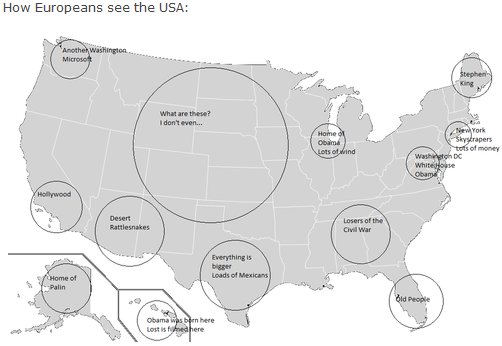
Kathy Shaidle linked to this map at Spleenville, showing an approximation of how Europeans (and implicitly the rest of the world) view the United States:


(Click map to see original image)

[. . .] As a matter of fact, from what I’ve garnered from across the pond, the rest of the world thinks the USA consists of one large metropolis — Newyorkangeles — with a sunny beach where only blond, tanned, perfectly-toned twenty-something models are allowed to go, and the rest of it is a desert wasteland full of racist white cowboys who wear big hats and shoot their guns in the air.

You forgot the teeth: Europeans all seem to believe that Americans all have identical “Hollywood” smiles. Oh, except for the gun-toting racist yahoos, who only have a few teeth each.

April 23, 2010

When old folkies get bitter and vindictive

Filed under: Cancon, History, Media — Tags: , — Nicholas @ 08:42

An interviewer for the Los Angeles Times found Joni Mitchell in a mood to settle some old scores with fellow 60’s icons:

The Times interviewer referred to Old Nasal Voice in passing, citing his name-change from Robert Zimmerman to Bob Dylan. (Mitchell also abandoned her birth name, Roberta Joan Anderson.) Mitchell launched into an unprovoked assault. “We are like night and day, he and I,” she scoffed. “Bob is not authentic at all. He’s a plagiarist, and his name and voice are fake. Everything about Bob is a deception.”

Cowed, the interviewer moved on to safer topics — such as Prince (apparently a Mitchell fan) and sex appeal. Yet Mitchell still had time to slag off Grace Slick and Janis Joplin (allegedly they were “[sleeping with] their whole bands and falling down drunk”), and Madonna. Railing against the “stupid, destructive” era we live in, Mitchell took aim at the Material Girl. “Americans have decided to be stupid and shallow since 1980. Madonna is like Nero; she marks the turning point.”

It wasn’t all piss and vinegar. Mitchell fondly recalled Hendrix, “the sweetest guy”, and late-night listening sessions together. But even this memory is shaded in frustration. “He made his reputation by setting his guitar on fire, but that eventually became repugnant to him,” she recalled. “‘I can’t stand to do that anymore,’ he said, ‘but they’ve come to expect it. I’d like to just stand still like Miles.'”

April 22, 2010

The iPad is “the ultimate Steve Jobs device”

Filed under: Media, Technology — Tags: , , , , , — Nicholas @ 15:05

I’m still quite happy with my iPhone, although I’ll pay attention when the next annual hardware refresh is released. I don’t quite “get” the attraction of the iPad, but perhaps it’s because I’m not typically swayed by glamour. Eric Raymond is amazed, but not at the device itself. He’s amazed at how closesly it approaches the Platonic ideal of a Steve Jobs device:

The iPad is the ultimate Steve Jobs device — so hypnotic that not only do people buy one without knowing what it’s good for, they keep feeling like they ought to use it even when they have better alternatives for everything it does. It’s a triumph of style over substance, cool over utility, form over actual function. The viral YouTube videos of cats and two-years-olds playing with it speak truth in their unsurpassable combination of draw-you-in cuteness with utter pointlessness. It’s the perfect lust object of postmodern consumerism, irresistibly attractive but empty — you know you’ve been played by the marketing and design but you don’t care because your complicity in the game is part of the point.

This has to be Steve Jobs’s last hurrah. I predict this not because he is aging and deathly ill, but because he can’t possibly top this. It is the ne plus ultra of where he has been going ever since the Mac in 1984, with his ever-more obsessive focus on the signifiers of product-design attractiveness. And it’s going to make Apple a huge crapload of money, no question.

Sorta related, from BoingBoing:

April 21, 2010

When copyright goes bad

Filed under: Law, Media, Technology — Tags: , , , , — Nicholas @ 12:09

H/T to Cory Doctorow.

“The biggest defeat for internet freedom in the UK since it opened for business”

Filed under: Britain, Law, Media, Technology — Tags: , , , , — Nicholas @ 10:12

Andrew Orlowski looks at the overwhelming legislative victory for the music industry in the UK:

Back in January, a senior music business figure explained to me that Clause 17, which gave open-ended powers to the Secretary of State, was unlikely to survive the wash-up. But he didn’t much care; the other sections which compelled the ISPs to take action against infringers were good enough. Anything else was a bonus – possibly even a distraction. Yet to the amazement of the music business, web blocking is now legislation.

I think this is a watershed in internet campaigning. It’s not just a tactical defeat, it’s a full-on charge of the light brigade, and the biggest defeat for internet freedom in the UK since it opened for business. I’ve spent time talking to legislators and protagonists, and concluded that it was avoidable. Much of the argument was already lost when the Bill was introduced last November, admittedly, but campaigners’ tactics made a bad situation worse. This explodes the idea — sometimes called the ‘Overton Window’ in the jargon — that by adopting an extreme position, you pull the centre ground your way. The digital rights campaigners forced waverers into the music business camp, and hardened their support for tougher measures against file sharers.

In the end, the BPI wiped the floor with the Open Rights Group.

Is the Tea Party movement racist?

Filed under: Media, Politics, USA — Tags: , , , — Nicholas @ 07:44

An interesting article at the Wall Street Journal on how a charge of “racism” works, even when there’s no actual racist action involved:

Blogger Conor Friedsdorf notes that there is a heads-I-win-tails-you-lose quality to the Blow approach [. . .]

Or, for that matter, to any nonpolitical institution that aspires to become more inclusive. Imagine Kelly O’Donnell questioning a black man in a largely white company or university or country club or suburb the way she interrogated Darryl Postell. She would come off as clueless and prejudiced — as, come to think of it, she does. (Kudos to NBC for airing this revealing though embarrassing footage.)

The political left claims to love racial diversity, but it bitterly opposes such diversity on the political right. This is an obvious matter of political self-interest: Since 1964, blacks have voted overwhelmingly Democratic. If Republicans were able to attract black votes, the result would be catastrophic for the Democratic Party.

[. . .]

These charges of racism are partly based on circular reasoning. Among Blow’s evidence that the tea-party movement is racist is “a New York Times/CBS News poll released on Wednesday [that] found that only 1 percent of Tea Party supporters are black and only 1 percent are Hispanic.” Other polls have put the black proportion as high as 5% (and, as Tom Maguire notes, Blow misreports his own paper’s Hispanic figure, which is actually 3%). But with blacks constituting some 12% of the population, there’s no question that the tea-party movement is whiter than the nation as a whole.

Yet to posit racism as an explanation is to ignore far more obvious and less invidious causes for the disparity.

H/T to LibertyIdeals for the link.

« Newer PostsOlder Posts »

Powered by WordPress


