
IMAO_ (Frank J. Fleming): You can’t watch “It’s a Wonderful Life” these days without thinking how much sense Mr. Potter is making about irresponsible lending.
June 2, 2010
Tweet of the day
Comments Off on Tweet of the day
June 1, 2010
Media emphasis distorts extent of conflicts
Strategy Page points out one of the baleful aspects of modern media coverage of wars and other conflicts:
Worldwide violence continues to decline, but most people are unaware of this because the mass media will feature whatever wars and disorder they can find. This is an old journalistic technique, and it’s good for business. But not so helpful if you are trying to keep track of what’s really happening out there. Oddly enough, the most bloody conflicts (like Congo) get the least media coverage. Reporting tends to be distorted by how accessible wars are, as well as how easily your viewers could identify with the combatants. The media also has a hard time keeping score. For years, Iraq was portrayed as a disaster until, suddenly, the enemy was crushed. Even that was not considered exciting enough to warrant much attention, and that story is still poorly covered by the mass media. Same pattern is playing out in Afghanistan, where the defeats of the Taliban, and triumph of the drug gangs, go unreported or distorted. If you step back and take a look at all the wars going on, a more accurate picture emerges.
Worldwide, violence continues the decline is has exhibited for most of the decade. For example, violence has greatly diminished, or disappeared completely, in places like Iraq, Nepal, Haiti, Sri Lanka, Nigeria, Ivory Coast, Chechnya, Congo, Indonesia and Burundi. Even Afghanistan, touted as the new war zone, was not nearly as violent this past six months as the headlines would deceive you into believing.
All this continues a trend that began when the Cold War ended, and the Soviet Union no longer subsidized terrorist and rebel groups everywhere. The current wars are basically uprisings against police states or feudal societies, which are seen as out-of-step with the modern world. Many are led by radicals preaching failed dogmas (Islamic conservatism, Maoism), that still resonate among people who don’t know about the dismal track records of these creeds. Iran has picked up some of the lost Soviet terrorist support effort. That keeps Hezbollah, Hamas, and a few smaller groups going, and that’s it. Terrorists in general miss the Soviets, who really knew how to treat bad boys right.
Comments Off on Media emphasis distorts extent of conflicts
May 26, 2010
The pandemic juggernaut of doom . . . that failed to materialize
Lorne Gunter has a good wrap-up of the bone-headed approach of public health officals in Canada to the Swine H1N1 flu “pandemic”:
Good on ordinary Torontonians. Despite all the H1N1/swine flu hype this past winter, just 28.2% of that city’s residents bothered to get vaccinated against the “pandemic;” that’s less than the 35% who usually get shots each year against the seasonal flu.
Even Toronto health care workers couldn’t be stampeded into getting the shots. Only 60% of them bothered.
[. . .]
Even from the start, the World Health Organization and other experts where told this strain of flu was weak and easily defeated. Infection rates never came remotely close to forecasts and death tolls were thankfully much, much lower than for typical seasonal infections.
The trouble, I think, was that so many public health officials have predicted so many pandemics for so long — SARS, bird flu, swine flu — that they simply got caught up in their own warnings and projections. They wouldn’t listen to contrary evidence.
The relevant public health authorities would have served the public interest (and their own credibility for the future) if they’d been much more forthcoming as the early stages of the pandemic showed H1N1 not to be the second coming of the Black Death. Instead, they doubled-down and raised the propaganda bar even higher.
October 27, 2009: Given that regular seasonal flu causes thousands of deaths annually, you’d think it would be good statistical discipline to count the cases of H1N1 separately, both the gauge the severity of the disease and to chart the effectiveness of the vaccination program. Lumping seasonal flu and “flu-like symptoms” together with H1N1 seems a big step backward from normal public health practice.
This would have been a good opportunity for de-escalating the panic mongering (and perhaps even attempting to rein-in the media, who were equally to blame for the tone of the information getting to the public). They chose, instead, to actively hide the fact that H1N1 cases were running below the level of ordinary seasonal flu cases (total H1N1 deaths: approximately 18,000 — typical annual death toll from seasonal flu: 250,000-500,000).
The biggest problem isn’t that they over-reacted this time, it’s that it has reduced their credibility the next time they start issuing health warnings. And that’s a bad thing. Unless they pull the same stunt next time, too. In which case, we may start hearing talk about setting up competing organizations to do the job the current entities appear to have given up on.
Comments Off on The pandemic juggernaut of doom . . . that failed to materialize
More on the Michael Bryant case
It’s rather surprising how strongly this Globe and Mail editorial expresses the paper’s approval of the decision not to press charges against former Ontario attorney-general Michael Bryant:
Everyone deserves justice, even a former Ontario attorney-general driving an expensive car who finds himself in an altercation with a cyclist in which the cyclist is killed. Irrespective of whatever wealth, power or connections Michael Bryant may have, he was an Everyman. Anyone might find himself in his place one day, reacting in fear and panic to a wild, unexpected aggressor, and subject afterward to police charges and condemnation by the community. When criminal charges were dropped against him yesterday, it was a good day for justice.
Much of what was publicly believed about Michael Bryant’s fatal encounter on Aug. 31, 2009, with Darcy Sheppard turns out to have been false. He did not swerve across a street and ram Mr. Sheppard into a light post or tree or mailbox. He was not speeding along at 60 to 100 kilometres an hour.
Nor were any of the terrible events that night emblematic of the problems that car drivers and cyclists have sharing the road. Mr. Sheppard was simply a man out of control. Given that he paid for his actions with his life, it may seem an unnecessary further blow that he now be publicly judged. But it is necessary, because another man, Michael Bryant, was facing up to life in prison if convicted of criminal negligence causing death. He, not Mr. Sheppard, had the power of the state lined up against him. And everything that happened proceeded inexorably as a result of Mr. Sheppard’s own actions.
Other than the initial flurry of interest in the case immediately following the incident, I didn’t follow the details. This is an excellent example of media coverage severely biased against the defendant: what little I thought I knew about the case made it seem to be an open-and-shut case of vehicular manslaughter. As the Globe editorial points out, very little of what I “knew” about the case (from the media) turns out to have been true.
May 25, 2010
The dangers of writing near-future SF
Charles Stross gets sandbagged by the unforeseen:
Back in mid-2008 I mentioned that what I thought was a futuristic-circa-2023 technology for the next novel was too damn close. Slightly more recently, in Living through interesting times, I mentioned that it was becoming near-as-dammit impossible to write near-future SF; I was sore because Bernie Madoff had stolen the plot of my next novel.
Well, I picked myself up, dusted myself down, re-framed the novel in question, and I’m currently about 80% of the way through writing it when it all happened again. First of all, Lothian and Borders Police actually established a recognizable-as-the-embryonic-form version of the unit that one of my protagonists, circa 2023, manages. (Only I got the staffing level and departmental mission statement slightly off-whack …) Next, there’s just been another revolution in Kyrgyzstan (a country which, for reasons I’m not going to discuss here, plays a significant role in “Rule 34”).
But the worst thing? I’ve been sandbagged by an unanticipated event.
Of course, it’s quite understandable — after all these years, who knew there even was a “libertarian arm of the Conservative party” to mess up Charlie’s plot of the near-future?
Comments Off on The dangers of writing near-future SF
May 23, 2010
It’s been 100 years . . . time to publish
According to The Independent, Mark Twain didn’t want his memoirs published until at least 100 years after his death:
Scholars are divided as to why Twain wanted the first-hand account of his life kept under wraps for so long. Some believe it was because he wanted to talk freely about issues such as religion and politics. Others argue that the time lag prevented him from having to worry about offending friends.
One thing’s for sure: by delaying publication, the author, who was fond of his celebrity status, has ensured that he’ll be gossiped about during the 21st century. A section of the memoir will detail his little-known but scandalous relationship with Isabel Van Kleek Lyon, who became his secretary after the death of his wife Olivia in 1904. Twain was so close to Lyon that she once bought him an electric vibrating sex toy. But she was abruptly sacked in 1909, after the author claimed she had “hypnotised” him into giving her power of attorney over his estate.
Their ill-fated relationship will be recounted in full in a 400-page addendum, which Twain wrote during the last year of his life. It provides a remarkable account of how the dying novelist’s final months were overshadowed by personal upheavals.
“Most people think Mark Twain was a sort of genteel Victorian. Well, in this document he calls her a slut and says she tried to seduce him. It’s completely at odds with the impression most people have of him,” says the historian Laura Trombley, who this year published a book about Lyon called Mark Twain’s Other Woman.
Comments Off on It’s been 100 years . . . time to publish
May 21, 2010
Your iPod is even more valuable than you think

Comments Off on Your iPod is even more valuable than you think
May 20, 2010
QotD: Recruiting protesters for the G20 in Toronto
Are you a woman, person of colour, indigenous person, poor person, queer, trans-gendered or disabled?
If so, the G8/G20 Toronto Community Mobilization team assumes you must sympathize with civic disruption, lawbreaking and maybe even a little good old fashioned terror. They want your help. They’re mobilizing to disrupt the gathering of democratically elected politicians who are meeting in Toronto next month and they assume — just because you’re a woman or a disabled person — that you must hate civilized society as much as they do.
That’s their logo, above.
The CN Tower, torn from its roots, used to stab the G20 like a knife in the heart. Gee, isn’t that inclusive, co-operative and non-violent. Hard to imagine anything more likely to attract widespread public support than an image like that. Hey, women and indiginous people, wanna stab some white guys? How about you, queers and indigenous people? Because we here at the Community Mobilization team take for granted that you must be as twisted, angry, vengeful and keening for violence as we are.
Kelly McParland, “Anti-G20 activists want your help in spreading the hate”, National Post, 2010-05-20
Comments Off on QotD: Recruiting protesters for the G20 in Toronto
May 19, 2010

May 18, 2010
Someone has to make this campaign video
Frank J. considers what his campaign video would be like if he was running for office:
This makes me think of the ad I might run if I one day campaigned for an office. I think I could improve on his ad, though. Here’s what I would do in my campaign ad:
* Ride into the commercial on a Liger.
* Every scene, I’d be stroking a different gun.
* Vow that if elected, our enemies will be eaten by genetically resurrected dinosaurs.
* In the middle of the ad, pause to shoot a hippy dead.
* Not only call the other politicians “thugs and criminals” but also promise to lock them in a room with a bear.
* Draw a picture of Muhammad while talking.
* Look up at the moon and yell, “You’re going down!”
* End with an awesome guitar solo while my farm explodes behind me.Yeah, I’d be so awesome commissioning agriculture or whatever.
By the last item, I was already seeing it . . . someone’s got to make this video. It doesn’t even matter what he’s running for!
Comments Off on Someone has to make this campaign video
QotD: Time to kill the “information wants to be free” meme
“Information wants to be free” (IWTBF hereafter) is half of Stewart Brand’s famous aphorism, first uttered at the Hackers Conference in Marin County, California (where else?), in 1984: “On the one hand information wants to be expensive, because it’s so valuable. The right information in the right place just changes your life. On the other hand, information wants to be free, because the cost of getting it out is getting lower and lower all the time. So you have these two fighting against each other.”
This is a chunky, chewy little koan, and as these go, it’s an elegant statement of the main contradiction of life in the “information age”. It means, fundamentally, that the increase in information’s role as an accelerant and source of value is accompanied by a paradoxical increase in the cost of preventing the spread of information. That is, the more IT you have, the more IT generates value, and the more information becomes the centre of your world. But the more IT (and IT expertise) you have, the easier it is for information to spread and escape any proprietary barrier. As an oracular utterance predicting the next 40 years’ worth of policy, business and political fights, you can hardly do better.
But it’s time for it to die.
Cory Doctorow, “Saying information wants to be free does more harm than good”, The Guardian, 2010-05-18
Comments Off on QotD: Time to kill the “information wants to be free” meme
Brontë Sisters Power Dolls
H/T to Lois McMaster Bujold, who “especially liked the fire extinguisher among the accessories included.”
Comments Off on Brontë Sisters Power Dolls
May 12, 2010
May 10, 2010
Graphical illustration of the death of privacy on Facebook
Matt McKeon has a very persuasive set of images, showing the extent of changes to your private information on Facebook between 2005 and last month:
2005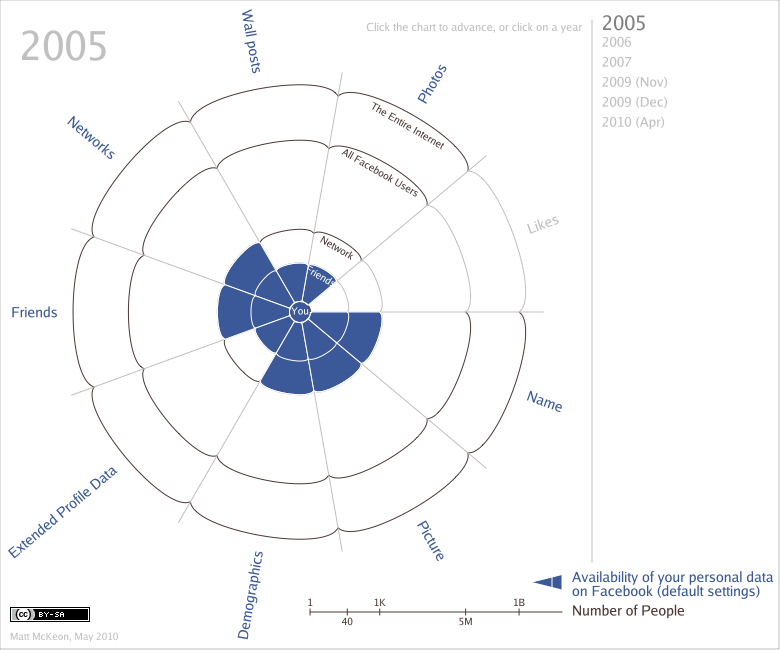
Compare that to the latest set of changes to the default Facebook privacy settings:
April 2010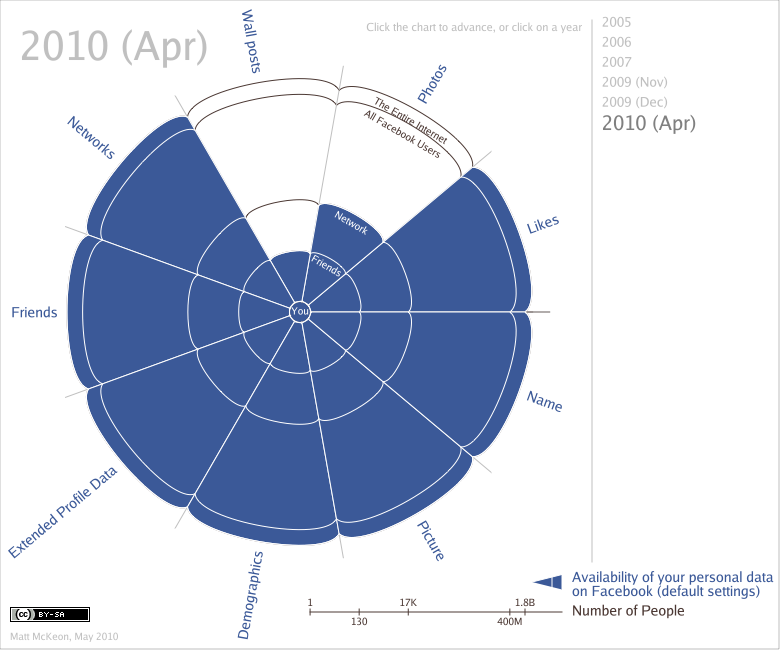
Facebook is a great service. I have a profile, and so does nearly everyone I know under the age of 60.
However, Facebook hasn’t always managed its users’ data well. In the beginning, it restricted the visibility of a user’s personal information to just their friends and their “network” (college or school). Over the past couple of years, the default privacy settings for a Facebook user’s personal information have become more and more permissive. They’ve also changed how your personal information is classified several times, sometimes in a manner that has been confusing for their users. This has largely been part of Facebook’s effort to correlate, publish, and monetize their social graph: a massive database of entities and links that covers everything from where you live to the movies you like and the people you trust.
Comments Off on Graphical illustration of the death of privacy on Facebook
Six years of blogging
Six years ago today, Jon installed a copy of MovableType on his server and invited me to start my own blog. He got tired of his own blog fairly quickly, but in an odd sort of way it still lives on — I named my blog Quotulatiousness as a joking reference to his Blogulatiousness.
The very first post was pretty indicative of what I’d be doing on the blog for the next six years: a brief introduction, a long-ish quote from the linked item of interest, and a brief closing comment (in that case, no actual commentary).
2004 was a pretty busy year, so if you’re terminally bored, you can sample a bit of blog history here (most of these entries don’t follow the pattern of the first blog post):
- First wine post — 2004-05-11
- Attributing links correctly — 2004-06-14
- First attempt at political wonkery (Leaders debate) — 2004-06-16
- Exorcising the AVRO Arrow — 2004-06-26
- Analyzing the party platforms — BQ — 2004-06-26
- Analyzing the party platforms — Tory — 2004-06-27
- Analyzing the party platforms — Greens — 2004-06-27
- Analyzing the party platforms — Libs — 2004-06-27
- Election results reaction — 2004-06-29
- First “busted hockey stick” post — 2004-07-13
- Air security — 2004-07-16
- Remembering Apollo 11 — 2004-07-22
- First “sell off the LCBO” post — 2004-07-28
- First visit to PE County wineries — 2004-08-03
- Psychopathic Narcissists (politicians) — 2004-08-03
- The importance of property rights — 2004-08-09
- First rant on China’s economy — 2004-08-10
- Dieppe raid anniversary — 2004-08-19
- Paul Martin’s Peacekeeping Brigade — 2004-08-21
- First post on BMI — 2004-08-22
- First global warming post — 2004-08-23
- Blogging the cat (first photos) — 2004-08-29
- How big is blogging — 2004-09-02
- Redaction and domestic security — 2004-09-03
- What is a hate crime? — 2004-09-07
- Writing vs Technical Writing — 2004-09-09
- After Beslan — 2004-09-14
- Canuck ingratitude — 2004-09-20
- The over-protected generation — 2004-09-23
- Healthcare: pets vs. humans — 2004-09-23
- I’m in favour of — 2004-09-28
- Garnet Rogers — 2004-10-03
- French complicity in holocaust — 2004-10-04
- Calculating the NFL passer rating — 2004-10-08
- SAS versus Militia — 2004-10-09
- Macdonnell on the heights — 2004-10-14
- How Europe went left — 2004-10-18
- Healthcare — 2004-10-19
- Soldering woes — 2004-10-22
- Economic Feng Shui — 2004-10-25
- Scrooge to Bob Cratchit — 2004-10-28
- Scrutineering — 2004-11-02
- Greater Soviet Canuckistan — 2004-11-05
- Extended childhood — 2004-11-15
- Power — 2004-11-23
- Laws of war — 2004-11-24
- Ego-surfing — 2004-11-26
- Woodworking — 2004-11-26
- Criminals have more rights than victims — 2004-12-01
- Home-schooling — 2004-12-06
- Christmas music — 2004-12-06
- Retirement planning — 2004-12-07
- I’m a racist — 2004-12-07
- Lennon’s death — 2004-12-08
- French winemakers are revolting! — 2004-12-09
- Wine tour part 1 — 2004-12-12
- Wine tour part 2 — 2004-12-12
- Wine tour part 3 — 2004-12-12
- Wine tour part 4 — 2004-12-12
- Wine tour part 5 — 2004-12-12
- Corkage — 2004-12-16
- My first takedown notice — 2004-12-17
In short, I’m still one of the laziest bloggers on the planet, but I’m still blogging after half a century in blog-years (most blogs start up with a few quick posts, then fade out never to be updated again).
Thanks again to Jon, both for getting me started in blogging, and for continuing to host my archives from the first five years.


