Quotulatiousness

June 21, 2010

Junk science round-up

Filed under: Media, Science — Tags: — Nicholas @ 09:43

Those sceptical curmudgeons at the Financial Post just finished their “Junk Science Week”:

FP Comment’s 12th annual Junk Science Week comes to a triumphant close with today’s 2nd annual Rubber Duck Awards to recognize the scientists, NGOs, activists, politicians, journalists, media outlets, cranks and quacks who each year advance the principles of junk science. Junk Science occurs when scientific facts are distorted, when risk is exaggerated or discounted, when science is adapted and warped by politics and ideology to serve another agenda. The Rubber Duckies are named in honour of Rick Smith, president of Environmental Defence Canada and co-author of a remarkable piece of junk science literature, the 2009 Slow Death by Rubber Duck. In the book, Mr. Smith perpetrated a science scam over the Bisphenol A and established himself as Canada’s leading scaremonger and distorter of science. Let this year’s awards begin!

June 19, 2010

Penn still waiting for that call from Hitler’s booking agent

An amusing interview in Vanity Fair points out that Penn Jillette would even go on Hitler’s talk show:

Is that why you don’t have a problem going on Glenn Beck’s show, because he doesn’t pretend to be objective?

Well, it’s complicated. Tommy Smothers, who’s one of my heroes, got really angry at me about it. We actually had this argument in public, on another show that’s going to be on Showtime this summer called The Green Room With Paul Provenza. Tommy attacked me for being on Glenn Beck, and he ended up saying, and I don’t think this part made it on the air, “If Hitler had a talk show, you’d probably do that too.”

And your retort?

I said yes, I would, and I would tell the truth.

Wow. O.K. then.

I’m not kidding.

Just don’t mention the part about telling the truth to Hitler’s talent bookers, and I’m pretty sure you’ll get a guest slot.

Oh, I won’t say a word. But you know what I mean, right? It does have an effect. I go on Glenn Beck as an atheist and talk about atheism. And I have people come up to me and say, “You know, until I saw you on Glenn Beck, speaking so passionately about atheism, I’d never considered that as a moral decision.” That’s incredibly powerful. These are people watching a hardcore Christian show and being exposed to an atheist point of view.

Your intentions seem genuine, but I can’t help myself, Penn. Every time I hear you’ve been on Glenn Beck, it makes me a little sick.

It makes me sick too! When people come up to me and say they love the show, I feel sick. Because I do disagree with a lot of what he says. But I also feel a little sick whenever people say they saw me on Keith Olbermann.

And yet you continue to do it. You know, there’s an easy way to stop making yourself sick.

But I think it’s important. I may be the only person who goes on Keith Olbermann and Glenn Beck and says the exact same shit. I am so much more socially liberal than Olbermann will ever be. You can’t believe how pro gay and pro freedom of speech I am. I’m way out beyond anyone on the Left. And as for fiscal conservatism and small government, I’m so much further to the right than Glenn Beck. Nobody is further left and further right than me. As I’m fond of saying, if you want to find utopia, take a sharp right on money and a sharp left on sex and it’s straight ahead.

And I love Penn’s suggestion for the Obama re-election campaign in 2012 at the end of the article.

June 18, 2010

When it’s rational to be irrational

Filed under: Books, Media, Science — Tags: — Nicholas @ 09:08

Cory Doctorow really likes Dan Ariely’s The Upside of Irrationality:

. . . there are sections in which the science of irrationality is readily converted into practical techniques for living better, and these really shine. My favorite is the section on adaptation, that is, the way in which both terrible pain and incredible delights fade down to a kind of baseline normal over time. Ariely points out that adaptation can be slowed or even prevented through intermittent exposure to the underlying stimulus — that is, if you take a break, the emotional sensation comes back with nearly full force.

Here’s where our intuitive response is really wrong: we have a tendency to indulge our pleasures without respite, and to take frequent breaks from those things that make us miserable. This is exactly backwards. If you want to maximize your pleasure — a great dessert, the delight of furnishing your first real apartment after graduation, a wonderful new relationship — you should trickle it into your life, with frequent breaks for your adaptive response to diminish. If you want to minimize your pain — an unpleasant chore, an awful trip — you should continue straight through without a break, because every time you stop, your adaptive response resets and you experience the discomfort anew.

June 17, 2010

“Most culture funding inevitably pays for crap”

Filed under: Cancon, Government, Media — Tags: , , — Nicholas @ 07:52

While providing some deeper explanation for the not-really-in-context sound bite provided by Alberta’s culture minister, Lindsay Blackett, Colby Cosh points out the truth of the matter:

The other knowledge that critics ought to be prepared to display is some familiarity with the material Blackett’s department actually funds. I figure you can’t say it’s not crap unless you’ve at least poked it with a stick. Can the indignant Paul Gross, who received $5.5 million from the Alberta taxpayer for Passchendaele, claim intimate familiarity with In a World Created by a Drunken God or Caution: May Contain Nuts or The Last Rites of Ransom Pride? If not, then why is he shooting off his mouth? It would surely be much more sensible for Gross and for like-minded critics to admit that most culture funding inevitably pays for crap — that the arts world is, in fact, a colossal pyramid of crap, inherently necessary to provide the nurturing and elevating environment from which a few items of permanent value might spring.

But that is something the culturati can never admit. Kirstine Stewart, the general manager of CBC’s English television operations, reacted in the Globe to Blackett’s comments by saying “Nobody can ever question the quality of what we do here in Canada, creatively or otherwise.” Surely this is a much more revealing and intriguing comment than Blackett’s. Does she mean that questioning the quality of Canadian television and film is literally impossible? Or just that criticism is inherently objectionable, a malum in se? And at the risk of appearing to take sides, I must ask: which attitude ultimately seems more healthy and likely to encourage improvement — Blackett’s, or Stewart’s?

Of course, a sensible government wouldn’t be spending any tax money on subsidies for TV and movie production (New Zealand’s most recent study showed a pretty big net loss for their various cultural tax breaks and subsidy programs).

June 16, 2010

You mean, the sky really isn’t falling?

Filed under: Books, Liberty, Media, USA — Tags: , , — Nicholas @ 12:12

Greg Swann has some advice for the new libertarian who may be inclined to panic over the current state of the world:

I’ve seen the gravely-predicted collapse of the starry firmament before. More than once. More than twice. More than a dozen times. It does seem plausible to me that the-world-as-we-know-it will someday come to an end. But with every passing day, I become more resolved in the belief that that day will not be tomorrow, regardless of the breathless weather reports.

It’s like this: New libertarians can be excitable. You’ve lived your whole life in an eyes-glazed-over sleep-walking state, and then, all at once, you wake up. The precipitant cause might be Atlas Shrugged or a John Stossel TV special or a reading from Jefferson on a radio talk show. Doesn’t matter, really. What matters is that you suddenly see the world as if had just been made, as if you had never seen it before. And you become acutely aware of the many defects in the way the world has been assembled.

That much is good, but, even so, in this state you are more than unusually likely to conclude that things are so bad that they are beyond repair. The timeline in Atlas Shrugged is only 13 short years, after all. How could we have shambled this far down The Road to Serfdom without being in imminent danger of being immediately enserfed?

H/T to Kathy Shaidle.

June 14, 2010

Deadly would-be killers, or incompetent bumblers?

Filed under: Media, Middle East — Tags: , , , — Nicholas @ 12:32

An interesting article in The Atlantic points out that the formidable image the media has bestowed upon Al Qaeda and other terrorist organizations belies much of the reality:

To be sure, some terrorists are steely and skilled — people like Mohamed Atta, the careful and well-trained head of the 9/11 hijackers. Their leaders and recruiters can be lethally subtle and manipulative, but the quiet truth is that many of the deluded foot soldiers are foolish and untrained, perhaps even untrainable. Acknowledging this fact could help us tailor our counterterrorism priorities — and publicizing it could help us erode the powerful images of strength and piety that terrorists rely on for recruiting and funding.

Nowhere is the gap between sinister stereotype and ridiculous reality more apparent than in Afghanistan, where it’s fair to say that the Taliban employ the world’s worst suicide bombers: one in two manages to kill only himself. And this success rate hasn’t improved at all in the five years they’ve been using suicide bombers, despite the experience of hundreds of attacks — or attempted attacks. In Afghanistan, as in many cultures, a manly embrace is a time-honored tradition for warriors before they go off to face death. Thus, many suicide bombers never even make it out of their training camp or safe house, as the pressure from these group hugs triggers the explosives in suicide vests. According to several sources at the United Nations, as many as six would-be suicide bombers died last July after one such embrace in Paktika.

Many Taliban operatives are just as clumsy when suicide is not part of the plan. In November 2009, several Talibs transporting an improvised explosive device were killed when it went off unexpectedly. The blast also took out the insurgents’ shadow governor in the province of Balkh.

In the early 1980s, I remember reading a book (possibly Dean Ing’s Soft Targets), which made a strong case for the use of a very different anti-terrorism tactic: ridicule. Instead of investing these shadowy enemies with mystique and cunning, point out their all-too-human failings and poke fun at them for these weaknesses. An attribute of many fanatics is a total lack of any sense of humour or irony: this makes them very attractive foils for this kind of media counter-attack.

It’d be hard to come up with anything to make the Taliban appear more ridiculous than what they’re doing themselves:

If our terrorist enemies have been successful at cultivating a false notion of expertise, they’ve done an equally convincing job of casting themselves as pious warriors of God. The Taliban and al-Qaeda rely on sympathizers who consider them devoted Muslims fighting immoral Western occupiers. But intelligence picked up by Predator drones and other battlefield cameras challenges that idea — sometimes rather graphically. One video, captured recently by the thermal-imagery technology housed in a sniper rifle, shows two Talibs in southern Afghanistan engaged in intimate relations with a donkey. Similar videos abound, including ground-surveillance footage that records a Talib fighter gratifying himself with a cow.

Hallmark gets attacked for “racist” message

Filed under: Media, Randomness, USA — Tags: — Nicholas @ 07:06

Sometimes a company will innocently create a message that is completely misunderstood. Hallmark is having an attack of the “racist” accusers, based on someone mis-hearing the term “black hole” as “black whore”:

The bad news? Rather than stand up to this idiocy, Hallmark looked at its bottom line and figured a PR war with the NAACP wasn’t worth it. The card’s been yanked from the market. The good news? The clip’s destined to be a viral hit and big media outlets like FNC have already picked up the story. (A segment ran within the past hour or so.) I hope the outrageously outraged enjoy the widespread derision they’re going to draw for it. The best news? If this is what the L.A. NAACP now considers a priority for direct action, Los Angeles must be completely racism-free. Three cheers for progress.

H/T to Jon (my former virtual landlord) for the link.

June 10, 2010

Photography: locals versus tourists

Filed under: Cancon, Media — Tags: , , , — Nicholas @ 09:27

By way of BoingBoing, here’s a Flickr collection showing the different photo locations chosen by locals and tourists for many cities. Toronto doesn’t show as much difference as many other cities do:

Blue dots are by locals, red dots are by tourists, and yellow dots could be by either (not enough information to determine).

Penn Jillette wants more politicians like Rand Paul

Filed under: Liberty, Media, Politics, USA — Tags: , , — Nicholas @ 09:10

June 9, 2010

Glee as piracy central

Filed under: Law, Media — Tags: , , , — Nicholas @ 13:13

Christina Mulligan points out that a popular mainstream TV show is not only encouraging illegal behaviour, it’s actually indulging in it:

The fictional high school chorus at the center of Fox’s Glee has a huge problem — nearly a million dollars in potential legal liability. For a show that regularly tackles thorny issues like teen pregnancy and alcohol abuse, it’s surprising that a million dollars worth of lawbreaking would go unmentioned. But it does, and week after week, those zany Glee kids rack up the potential to pay higher and higher fines.

In one recent episode, the AV Club helps cheerleading coach Sue Sylvester film a near-exact copy of Madonna’s Vogue music video (the real-life fine for copying Madonna’s original? up to $150,000). Just a few episodes later, a video of Sue dancing to Olivia Newton-John’s 1981 hit Physical is posted online (damages for recording the entirety of Physical on Sue’s camcorder: up to $300,000). And let’s not forget the glee club’s many mash-ups — songs created by mixing together two other musical pieces. Each mash-up is a “preparation of a derivative work” of the original two songs’ compositions — an action for which there is no compulsory license available, meaning (in plain English) that if the Glee kids were a real group of teenagers, they could not feasibly ask for — or hope to get — the copyright permissions they would need to make their songs, and their actions, legal under copyright law. Punishment for making each mash-up? Up to another $150,000 — times two.

I’ve never watched Glee, but I find this quite an amusing juxtaposition, as the corporate owners of Fox are among the loudest and most active copyright enforcement goons around.

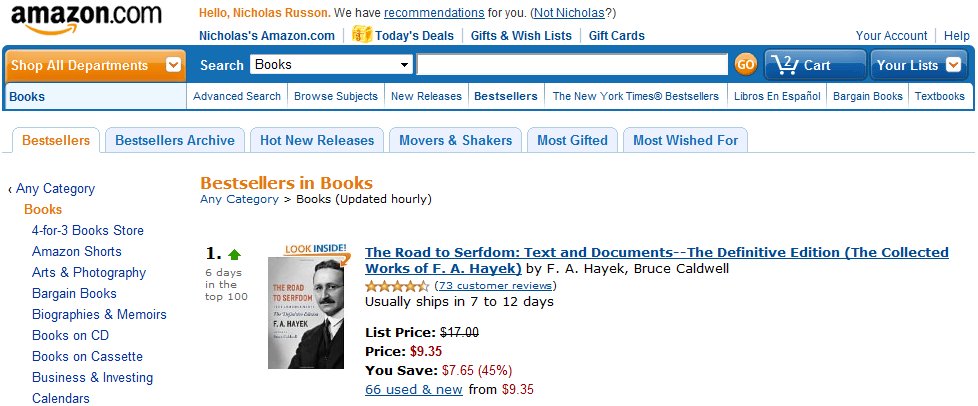
Book written in 1944 tops Amazon bestseller list

Filed under: Books, Economics, Government, Media, Politics — Tags: , , — Nicholas @ 07:57

Admittedly, this is an updated and supplemented version of the original text, but it’s still impressive to see it selling so well.

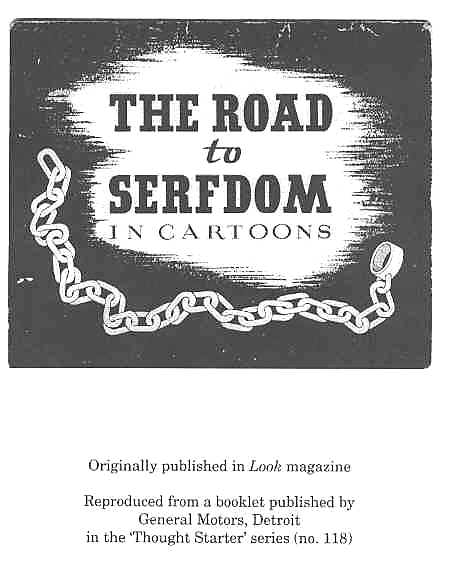
Update: American Digest has pages from the picture book version:

June 8, 2010

QotD: Remaking Gulliver’s Travels

Filed under: Humour, Media, Quotations — Tags: , — Nicholas @ 11:56

The reimagined Gulliver’s Travels is probably going to be bad. But at least we’re in for an entertaining time when Swift inevitably rises from the grave to seek revenge on everyone involved.

“Gulliver”, “Jack Black meets Jonathan Swift?”, The Economist, 2010-06-05

Consumer debt doesn’t follow the script

Filed under: Economics, Media, USA — Tags: , , , — Nicholas @ 07:49

Or, in a demonstration of individual rationality, doesn’t follow the script where consumers sacrifice themselves and go even deeper in debt to spark further economic recovery:

While some pundits out there might have you believe that the US economic recovery remains solidly on track, Friday’s May jobs report threw a spanner into those notions, and the latest reading on consumer credit offers little evidence that the crucial consumer intends to share with Uncle Sam the burden of bolstering the economy.

The Federal Reserve’s report on April consumer credit today shows total credit outstanding rose a little less than $1 billion, following a revised $5.4 billion drop in March; March credit was originally reported up $2 billion.

Within the details, the item that jumps out most is the decrease in revolving credit, which fell at a 12% annual rate and declined for the 19th straight month. Revolving credit outstanding has fallen 14%, or roughly $138 billion, since autumn of 2008. Non-revolving is roughly flat since late ‘08.

It would help if the pundits would settle on one of the two diametrically opposed roles that consumers are “supposed to” assume. At an individual level, consumers are being lashed for their profligate spending and borrowing habits, and excoriated for their unprecedented levels of personal debt. This is bad, the pundits say (and I don’t disagree): individuals and families should not be taking on so much debt and efforts to reduce outstanding debt are praised. However, consumers as a group are expected to spend, spend, spend in order to help pull the retail sector back into healthy growth.

So if they do the right thing as individuals, they’re doing the wrong thing for the economy as a whole? Perhaps the emphasis on consumer-led recovery is mistaken, especially given the levels of debt that consumers have already taken on.

June 4, 2010

Turkey’s media-distorted view of the world

Filed under: Media, Middle East, Religion — Tags: , , , — Nicholas @ 12:05

A couple of pieces came to my attention today, discussing the Turkish view of the rest of the world. What used to be the most secular Muslim-majority middle eastern country appears to be shifting in some unfortunate directions. First, Claire Berlinski reports from Istanbul (where she lives) on what is actually known about the Mavi Marmara incident:

Here is what we don’t know. We don’t know why the Turkish government allowed the Mavi Marmara to sail. While it’s clear that some indeterminate proportion of the passengers were Islamist thugs, it’s also clear that many of the passengers were naive civilians. (You cannot argue that a one-year-old child is anything but a naive civilian.) We don’t yet know whether there was an active plot, among the thugs, to provoke this confrontation, or whether they decided to attack the Israeli commandos in an access of spontaneous enthusiasm. If the former, we don’t know whether the AKP government was aware of the organizers’ intentions or whether it never seriously considered the possibility. We can speculate, based on known connections between the İnsan Hak ve Hürriyetleri İnsani Yardım Vakfı, which organized the expedition, and well-known extremist groups, that this was a trap, set deliberately. We can speculate that the Turkish government conceived of the trap or lent it tacit support. But thus far we have no evidence.

Why might the Turkish government have permitted a Turkish boat packed with women, children, stupid people, and Islamic extremists to sail into the world’s most volatile military conflict zone? Why, especially, did they permit this while knowing that the Israeli government had made explicit its intention to stop that boat, by force if necessary? It’s tempting to think that the Turkish government anticipated or desired this outcome, all the more so if one looks at this conflict through a certain prism, to wit: one in which Prime Minister Recep Tayyip Erdoğan is an Islamist nut intent upon establishing Turkish hegemony over the Islamic world by becoming the populist champion of the Palestinians, even at the risk of provoking an all-out regional war. I don’t dismiss that possibility.

But in fact, bad decisions can be made in infinitely many human ways. It’s also possible that Erdoğan sincerely believed that the boats had been properly inspected and were free of any weapons, and therefore no serious conflict could occur. It’s possible that he spoke to the organizers of the flotilla and came away with assurances about their intentions; or that he simply thought the Israelis were bluffing; or that his mind was on other things.

And Robert Pollock looks at how the media has portrayed events since Prime Minister Erdoğan came to power:

To follow Turkish discourse in recent years has been to follow a national decline into madness. Imagine 80 million or so people sitting at the crossroads between Europe and Asia. They don’t speak an Indo-European language and perhaps hundreds of thousands of them have meaningful access to any outside media. What information most of them get is filtered through a secular press that makes Italian communists look right wing by comparison and an increasing number of state (i.e., Islamist) influenced outfits. Topics A and B (or B and A, it doesn’t really matter) have been the malign influence on the world of Israel and the United States.

For example, while there was much hand-wringing in our own media about “Who lost Turkey?” when U.S. forces were denied entry to Iraq from the north in 2003, no such introspection was evident in Ankara and Istanbul. Instead, Turks were fed a steady diet of imagined atrocities perpetrated by U.S. forces in Iraq, often with the implication that they were acting as muscle for the Jews. The newspaper Yeni Safak, Prime Minister Tayyip Erdogan’s daily read, claimed that Americans were tossing so many Iraqi bodies into the Euphrates that local mullahs had issued a fatwa ordering residents not to eat the fish. The same paper repeatedly claimed that the U.S. used chemical weapons in Fallujah. And it reported that Israeli soldiers had been deployed alongside U.S. forces in Iraq and that U.S. forces were harvesting the innards of dead Iraqis for sale on the U.S. “organ market.”

The secular Hurriyet newspaper, meanwhile, accused Israeli soldiers of assassinating Turkish security personnel in Mosul and said the U.S. was starting an occupation of (Muslim) Indonesia under the guise of humanitarian assistance. Then U.S. ambassador to Turkey Eric Edelman actually felt the need to organize a conference call to explain to the Turkish media that secret U.S. nuclear testing did not cause the 2004 Indian Ocean tsunami. One of the craziest theories circulating in Ankara was that the U.S. was colonizing the Middle East because its scientists were aware of an impending asteroid strike on North America.

I had no idea that the media in Turkey were so . . . what’s the best way to describe it? Rabid? Insane? Unbalanced? Every country (with a free-ish press) has some news outlets that have an uneven relationship with reality, but it sounds like most of the media in Turkey would qualify as detached from the mundane world.


June 2, 2010

New copyright bill introduced

Filed under: Cancon, Law, Media, Technology — Tags: , , , , , , — Nicholas @ 16:21

It’s not yet online, so I haven’t read it myself (and, not being a lawyer, it might not be a good use of my time). Michael Geist has, however, and provides a useful summary of the good and the bad:

The bill contains some important extensions of fair dealing, including new exceptions for parody, satire, and (most notably) education. It also contains more sensible time shifting and format shifting provisions that still feature restrictions (they do not apply where there is a digital lock) but are more technology neutral than the C-61 model. There is also a “YouTube exception” that grants Canadians the right to create remixed user generated content for non-commercial purposes under certain circumstances. While still not as good as a flexible fair dealing provision, the compromise is a pretty good one. Throw in notice-and-notice for Internet providers, backup copying, and some important changes to the statutory damages regime for non-commercial infringement and there are some provisions worth fighting to keep.

Yet all the attempts at balance come with a giant caveat that has huge implications for millions of Canadians. The foundational principle of the new bill remains that anytime a digital lock is used — whether on books, movies, music, or electronic devices — the lock trumps virtually all other rights. In other words, in the battle between two sets of property rights — those of the intellectual property rights holder and those of the consumer who has purchased the tangible or intangible property — the IP rights holder always wins. This represents market intervention for a particular business model by a government supposedly committed to the free market and it means that the existing fair dealing rights (including research, private study, news reporting, criticism, and review) and the proposed new rights (parody, satire, education, time shifting, format shifting, backup copies) all cease to function effectively so long as the rights holder places a digital lock on their content or device.

It’s not quite the total surrender to the entertainment rights holders that many feared, but it’s certainly not the best deal for consumers. Bottom line:

For the glass half-full, the compromise positions on fair dealing, the new exceptions, and statutory damages are not bad — not perfect — but better than C-61. For the glass half-empty, the digital lock provisions are almost identical to C-61 and stand as among the most anti-consumer copyright provisions in Canadian history. Not only are they worse than the U.S. DMCA, but they undermine much of the positive change found in the rest of the bill. In the days and weeks ahead, Canadians must speak out to ensure that the compromise positions found in C-32 remain intact and that the digital lock provisions move from the no-compromise category to the compromise one.

« Newer PostsOlder Posts »

Powered by WordPress