
I believe the blogosphere first truly gained traction in America for a good reason. There is something about blogging’s freedom from the constraints of conventional journalism that captures an American ideal: civic engagement totally free of anyone else’s influence. It is an ideal of a fourth estate hostile to authorities public and private, suspicious of conventional wisdom, and, above all, confident, even when confidence seems absurd, in the power of the word and the argument to make a difference . . . in the end. The rise of this type of citizen journalism has, in my view, increasingly exposed some of the laziness and corruption in the professional version — even as there is still a huge amount to treasure and value in the legacy media, and a huge amount of partisan, mendacious claptrap on the blogs.
But what distinguishes the best of the new media is what could still be recaptured by the old: the mischievous spirit of journalism and free, unfettered inquiry. Journalism has gotten too pompous, too affluent, too self-loving, and too entwined with the establishment of both wings of American politics to be what we need it to be.
We need it to be fearless and obnoxious, out of a conviction that more speech, however much vulgarity and nonsense it creates, is always better than less speech. In America, this is a liberal spirit in the grandest sense of that word – but also a conservative one, since retaining that rebelliousness is tending to an ancient American tradition, from the Founders onward.
Andrew Sullivan, “Happy 4th”, Daily Dish, 2010-07-04
July 5, 2010
QotD: Blogging and the spirit of journalism
July 2, 2010
QotD: Overworked word of the year
Okay, I want to hear everyone in the auditorium this time, okay? Even all of you folks there in back! I want it loud, and I want it proud! Ready? And . . . UNEXPECTEDLY!!! Truly, it was a flabbergasting, never-to-be-repeated freakish turn of events that absolutely no one could have anticipated. A lighting bolt out of a clear blue sky, as it were. The asymptote just raced off to infinity, leaving only gobsmacked surprise in its wake.
Monty, “Friday Financial Briefing”, Aces of Spades HQ, 2010-07-02
June 28, 2010
Running with the nihilists
Tony Keller walked with the main union-led protest marchers on Saturday, pointing out that there was no single, unifying principle — it was a “grievance smorgasbord, an all-you-can-eat buffet of complaints, and apparently anyone protesting anything — anything — was invited”. What interested him the most, however, were the “hobbits”:
Standing in front of Cafe Lettieri, which was still open and doing a booming business even as protesters were packed so tightly outside that they pressed up against its windows, I heard someone to my right say, “Black Bloc, meet up on Queen!”
I turned to see six hobbits in black hoodies shuffling past me. It was on. Whatever “it” was going to be.
[. . .]
And then the non-peaceful part of our program started. The crowd suddenly began to surge away from the police lines at Spadina and Richmond, and back onto Queen Street. We were now heading east, violently following the route the non-violent march had just taken. A mass of maybe 100 people in black hoodies and balaclavas was moving at almost a run, accompanied by several hundred journalists and riot tourists. Occasionally someone would dart out from the group to smash a window or spray paint a slogan: “Against Police Against Prisons,” “F– the Police,” “F- Corporate Rule.”
[. . .]
The hoodie people weren’t just small in number, they were also small in stature. A lot of skinny white boys. And white women. (Some skinny, some really not). They looked like the kind of people who spend a lot of time playing video games in their parents’ basements. Or the graduating class of an art college. They were not marauding toughs. More like marauding geeks. Geeks marauding in a spontaneous yet carefully choreographed manner.
There’s a point in most peoples’ lives when getting out and protesting seems like such a good idea. And then you graduate and get a job . . .
June 27, 2010
The stars were aligned for ugliness
Peter Kuitenbrouwer enumerates the reasons why the violence this weekend was pretty much inevitable:
Prime Minister Stephen Harper has something to answer for tonight. It is hard for this writer to escape the feeling that this summit was designed with every possible star aligned for ugliness to occur. The summit is held on a summer weekend, after university and high school exams are over; all the students are out and free and have time on their hands. Summer weather is perfect for a march. The summit takes place in the heart of Toronto: everybody in Canada has a friend in Toronto where they can stay during a protest.
And can we not say that assembling the greatest number of police in one spot in the history of Canada, and spending more on fences and security than Canada has ever spent before, has a provocative effect?
Why didn’t they keep both summits in Huntsville? Or, as several people have pointed out, at a remote Canadian Forces base where air transport and physical security are already in place?
Update: Jonathan Kay thinks the media and the echo chamber of Twitter, Facebook, blogs, and instant messaging combine to make a few incidents appear far bigger and more scary than they really are:
This is one of those stories the social media has gotten wrong: a million tweeters all tweeting up the same three burning police cruisers and few dozen wrecked storefronts. The number of protestors wasn’t even that big (even if the media insists on calling the protests “massive.”) The estimate I’ve seen thrown around is about 10,000. To put that figure in perspective, the number of protestors who swarmed Quebec City at the Summit of the Americas in 2001 was approximately 100,000 — tens times as large.
[. . .]
As I approached the intersection of Queen and Spadina, I could see a rowdy crowd of several thousand gathered. There were a few earnest placards in evidence (“Mother earth convenes the G-6billion. Fuck the G20″). But mostly, it was just excited-looking teenagers surrounding the cop car, like hyenas around their kill. In that moment, it looked like things were about to get truly ugly. I began eying the stores lining Queen, trying to predict which one would get trashed first.
But then came the sirens, and the atmosphere changed very quickly. From down Queen Street, headed eastbound, a speeding convoy of unmarked white busses stopped outside the Silver Snail comic store, and out poured police in full riot gear — helmets, batons, body armor. From an accompanying black suburban came a few even more serious-looking fellows, including at least one with a military-style assault rifle. They never said a word, never issued a threat, never fired any of their crowd-control weapons. They just advanced, in a line, several officers deep, toward the heart of Spadina and Queen. There wasn’t any violence — at least none that I saw. The worst I witnessed was a single protestor who threw a bottle from amidst the anonymity of the crowd, which gained a few oohs and ahs after it fell harmlessly on the concrete.
QotD: Toronto Saturday Night, G20 edition
You can walk a block or two from the action and Toronto is seen carrying on as normal. It’s not quite dangerous, but it’s not quite safe. The crowds are a mix of the indignant, the earnest and the opportunistic. Some obviously carry bad intentions. A lot seem simply bored. When the lights went out in 2003 and order unravelled slightly, Toronto turned into a party. Tonight, again, people are out in the streets, but the mood is simply dumb.
Aaron Wherry, “Toronto, tonight”, Macleans, 2010-06-26
June 26, 2010
The smell of burning police cars
Just when you think the anarchists have decided to let the government look like fools, they pull stuff like this, allowing the security forces to justify the billion+ they’ve spent on the G8/G20 summit meetings:
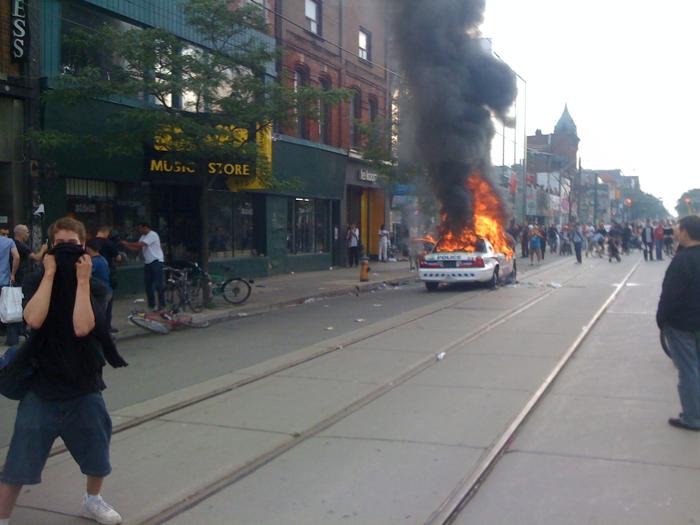
Pic from Eric Squair.
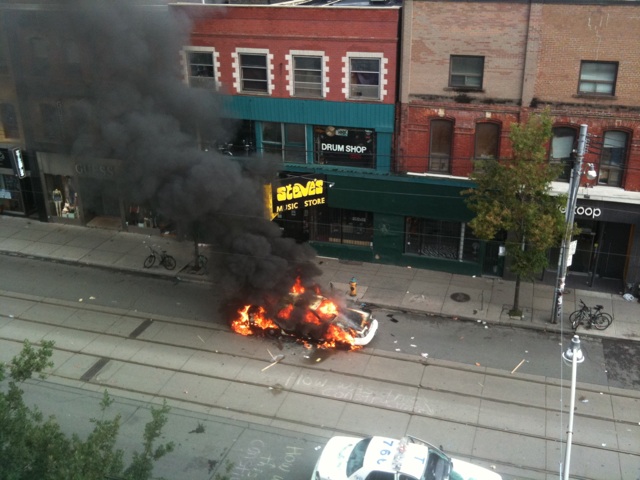
Pic from Pete Forde. The second police car in this photo also gets the warm treatment from the anarchists.
For those not familiar with Toronto, this is approximately here:
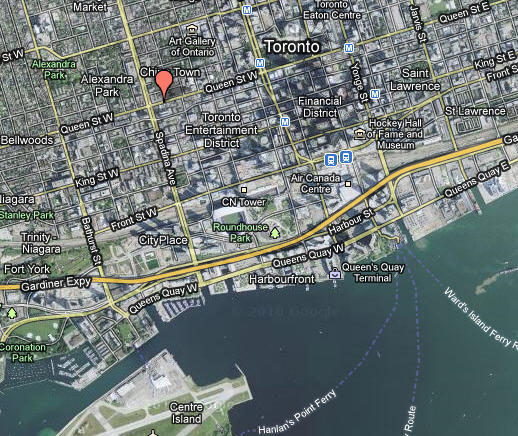
Update: Michael Coren has a suggestion to get the police more involved in deterring the rioters:
An idea. Tell the cops that these anarchist criminals are actually confused, gentle Polish visitors trying to find help at an airport. Not only will deadly force ensue but the police will lie about it all after the fact.
Update, the second: Another burning police car, further east at (I assume) Queen King St. and Bay St.
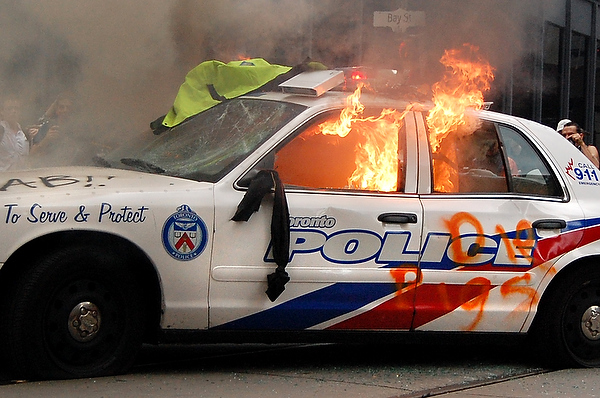
Pic by Marissa Nelson.
Update, the third: In spite of all the images available of burning or burnt-out police vehicles, the three above were the only ones. Rarely have so many twittered so much about so few . . .
The ungentlemanly art of reporting
Paul Wells looks at the methods employed by now-famous reporter-to-the-generals Michael Hastings:
Hastings is blunt about the fun a reporter on short-term assignment can have when he doesn’t have to worry about the repercussions of what he writes. “My job was basically: Ride the buses and planes with the candidates, have big lunches and dinners on the expense account, get sources drunk and singing, then report back the behind-the-scenes story.”
Then there is this paragraph. The sentence with the bad word is the most interesting to me as it will be to you, but the whole paragraph, with its tensions and contradictions, is worth considering:
The dance with staffers is a perilous one. You’re probably not going to get much, if any, one-on-one time with the candidate, which means your sources of information are the people who work for him. So you pretend to be friendly and nonthreatening, and over time you “build trust,” which everybody involved knows is an illusion. If the time comes, if your editor calls for it, you’re supposed to fuck them over; and they’ll throw you under a bus without much thought, too. (I should say that personal friendships can actually develop, despite the odds.) For the top campaign officials and operatives, seduction and punishment of reporters is an art. Write this fluff piece now; we’ll give you something good later. No, don’t write it this way, write it that way. We’ll give you something good later.
This deserves to stand as one of the great bits of journalistic self-flagellation and revelation, only a notch below Janet Malcolm’s famous confession that “Every journalist who is not too stupid or too full of himself to notice what is going on knows that what he does is morally indefensible.”
H/T to Taylor Empire Airways for the link.
G20 arrests not considered “major enough” to release details
Siri Agrell notes the inconsistency of Toronto police over the (32 at time of writing) arrests made around the G20 area:
When asked for details of the arrest of a deaf man at Friday night’s demonstration, Burrows [of the Integrated Security Unit] said he had neither a name or the charges.
“Very rarely do we ever release information unless it’s a major arrest, major charges, big investigation or something like that,” he said. “That’s our standard practice. This guy was arrested last night, there’s nothing major about it. we’d never put a release out about that.”
And yet, the police regularly release information about minor incidents, ranging from lost property to suspicious behaviour. Surely, the arrest of Toronto citizens exercising their right to protest during a major international event warrents some transparency?
Yet another example of the police taking advantage of the situation to expand their practical reach?
So teenagers sending sext messages, a lost urn and some guy trying to pick up Toronto women are worthy of police updates, but details of arrests made during the G20, when police have been given huge powers, aren’t worth releasing?
In a nutshell, yes.
Was the “fake lake” outrage itself fake?
Andrew Coyne says we’ve all been faked out of our boots over the “fake lake” issue:
It’s not an “indoor lake,” as the first story I read suggested. It is a reflector pool, about the size of a backyard swimming pool, only no more than two inches deep. There can’t be more than 10 gallons of water in it, tops. It is bordered by a small wooden platform simulating a dock, with Muskoka chairs casually strewn about. There’s a bank of canoes on either side, and a large screen showing some quite breathtaking high-def footage of Canadian lakeland scenes. And that’s it.
It’s not extravagant in the slightest. Modest would be closer to the mark. The government puts the cost at about $57,000, which sounds about right: about what it would cost to finish your basement. Or to be precise, it represents just over two 100,000ths of one per cent of federal spending. All in all it’s rather a pleasant spot, a small oasis of calm and comfort away from the conference churn, and shows every sign of being a hit with the foreign press.
So either we all got hoodwinked over the vast cost and outright fakery, or they’ve brainwashed Andew Coyne!
June 25, 2010
Ghost town T.O.
Scott Stinson finds that the constant warnings about disruptions, delays, closures, and protests has had a positive effect: anyone who can avoid downtown Toronto is avoiding the place.
We were to be besieged by The Man, and those who would shake their fists at The Man.
So it was more than a little surprising to find the commute on Thursday morning not one of snarled traffic and honking horns, but one of fast-moving, wide-open freeways. Given the number of vehicles on Toronto’s normally packed roads, you’d think the area had been hit a day earlier not by a mild earthquake, but by a nuclear bomb. From northeast of the city to the western waterfront in 40 minutes? If this is nuclear winter, then sign me up for Armageddon!
I’ve certainly been avoiding going into downtown since the barricades started to go up. I’m apparently one of the majority following the same basic script.
And why wouldn’t residents have made alternate plans? Consider this traffic advisory, issued on Tuesday: “Expect closures and restrictions in and around Toronto resulting in significant delays on major highways such as the 427, 401, Queen Elizabeth Way, Gardiner Expressway, the Don Valley Parkway and connecting roads.”
If you are unfamiliar with Toronto’s highways, a little background about those mentioned in that advisory: That’s pretty much all of them. Other than one highly expensive toll road across the north of the city, there’s no way to cover much ground in this place without traversing those highways that officialdom warns will have “significant delays.” Due to the prevailing security-first practice of releasing as little information as possible — which is to say, nothing — that road closure advisory doesn’t say which highways will be closed when, either. If we knew that, at least we could plan around the delays. Instead we get travel warnings that boil down to this: Seriously, stay away.
Update: Don Martin thinks it’s like a scene from a post-apocalyptic movie:
This is what a billion-dollar security net buys you. Canada’s largest city as a post-apocalyptic movie set. Massive worker inconvenience. Horrific productivity losses. Legions of bored cops on overtime. And a tourist scare-off that makes SARS look like a Halloween prank.
Everywhere in a city core swept clean of garbage collection bins and newspaper boxes, a fence runs through it.
The notorious barricade has gaps too small even for a child’s fingers to grasp and that makes it impossible to scale although, protesters take note, at three metres high it’s only half the world pole vault record so there’s at least one way to leap over it into the waiting hands of riot police.
Speaking of police, they already gather in jawdropping numbers as omnipresent clusters at every intersection or wander aimlessly as enforcement groups around buildings and down streets, wearing bulletproof vests with helmets dangling from their belts and earpieces connected to voices of undetermined origin.
At least there’s the scene set for some great TV and photography moments later in the weekend, when the massed forces of global anarchism (plus every other disgruntled group with both an axe to grind and physically active membership) look for their golden opportunities to induce police over-reaction. The only tourists in town aren’t interested in the sights or the shopping: they’re here for media appearances, protest marching, and (hopefully a tiny minority) a taste of violence.
Update, the second: Kelly McParland points out that the massive security precautions have actually made the protesters redundant:
[. . .] The [Toronto] Star edited out Dave and dwelt instead on the new law, which wasn’t debated in the legislature and resulted from an ‘extraordinary request’ by Toronto Police Chief Bill Blair, who wanted additional policing powers shortly after learning the G20 was coming to Toronto.” Evidently it didn’t occur to Premier Dalton McGuinty that he could say no. And why should he? It’s pretty clear that no one in any government — municipal, provincial or federal — has said no to anything dreamed up by any level of the national security apparatus since the day Stephen Harper told them he’d agreed to hold two summits at once. A billion dollar budget? You got it. New sound blasters for Toronto cops? You got it. An asinine fence snaking through the centre of the city? Done. The country’s financial centre brought to a screeching halt . . . all the major tourist spots closed . . . restaurants emptied . . . hotels commandeered . . . the waterfront shut down on a hot summer weekend . . . a million or so people kept from earning a living? Done, done and done.
This is what happens when you give security people a blank cheque and let them impose whatever paranoid restrictions they can dream up at their most fevered moments. Hey, let’s rip the saplings out of the ground! Let’s get a fork lift and move that three-ton elephant sculpture someplace where less ‘dangerous’! What’s dangerous about a three-ton elephant sculpture? Who knows, but we can do whatever we want! It’s about security!
What the protesters have missed is that they weren’t needed. The government’s done a fine job of making itself look foolish without any help from them. They could have stayed home for the weekend and watched the Michael Jackson testimonials. They sure wouldn’t have missed anything important.
Internet access forces retirement of military TV network
Strategy Page notes the imminent demise of two media staples: Armed Forces Network (AFN) broadcast television and the traditional base newspaper:
U.S. military television stations in Europe are halting the broadcasting of their signals. Not because so many American troops have left Europe since the end of the Cold War, but because everyone has cable. A few broadcasting towers will keep operating, for the few areas where barracks are not yet wired for cable. The big losers are American retirees and military families living off the base. In addition, a lot of locals enjoyed the availability of the “American Channel” and the military oriented content. It was something they could not find on the largest local cable plans. AFN often broadcast American TV shows before they were bought by local networks for broadcast in dubbed format. The dubbing is often poor, and many Europeans speak English, and like to get American TV shows as soon as they come out. But now that’s all history.
[. . .] the technology tidal wave is also destroying the oldest form of American military media; the base newspaper. Four years ago, U.S. Air Force bases began to scrap a century old tradition; the base newspaper. Some bases later brought the papers back, because they found there were a significant minority of base residents who did not use the Internet (which was supposed to replace the newspaper.) But that is not going to last long.
These weeklies were almost standard on military bases, mainly as a vehicle for getting out information of use to all those who lived or worked there. There were administrative announcements, as well as social ones. The base newspapers served a morale function, as well as a practical one. But the news papers cost money, some $3,000-$5,000 a week. The papers were distributed for free, and now there’s a trend towards eliminating the papers, and just putting out all the information on the base web site. All bases now have web sites, and troops, especially younger ones, find these more useful than newspapers. Surveys indicate that most junior troops don’t even read newspapers (nor do their civilian peers). But all these young troops rely on the web for news, and other information. The troops also note that, when they are deployed overseas, or just away from the base for a few days, they only way to stay in touch with what’s happening on the base is via the web site. But many older NCOs and officers, along with their spouses, do still read newspapers. It’s a generational thing, so the base newspaper is still doomed.
June 24, 2010
Apple’s latest media circus
I’ve been accused of being an Apple fanboy because I have an iPhone 3G (that which was shiny and new barely two years ago is already considered steam-powered and antique). Stephen Fry has a review up on his site, which starts with this summary not of the iPhone 4, but of the reaction to the release:
The hooplah that surrounds the release of a new Apple product is enough to make many otherwise calm and balanced adults froth and jigger. That some froth with excited happiness and others with outraged contempt is almost irrelevant, it is the intensity of the response that is so fascinating. For the angry frothers all are fair game for their fury — the newspapers, the blogosphere, the BBC and most certainly people like me for acting, in their eyes, as slavish Apple PR operatives. Why should these iPads and iPhones be front page news when, the frothers froth, there are plenty of other manufacturers out there making products that are as good, if not better, for less money? And isn’t there something creepy about Apple’s cultiness and the closed ecosystem of their apps and stores? The anti-Applers see pretension and folly everywhere and they want the world to know it. The enthusiastic frothers don’t really mind, they just want to get their hands on what they perceive as hugely desirable objects that make them happy. The two sides will never agree, the whole thing has become an ideological stand-off: the anti-Apple side has too much pride invested in their point of view to be able to unbend, while Apple lovers have too much money invested in their toys to back down. It is an absorbing phenomenon and one which seems to get hotter every week.
The iPhone 4 isn’t available in Canada yet, and I suspect won’t be taken up with quite the same vigour displayed in its US debut: unlike American customers who signed up for two years with AT&T, Canadian customers of Rogers had to take a three-year contract. None of them will be at their end-of-contract when the new iPhone is released here. It will take some of the demand away, compared to the US market . . . but certainly not enough to make the release a flop.
June 23, 2010
Bunch of “radical extremists”
Protest groups at the G20? No, the Heritage Minister’s sweeping characterization of the people and organizations opposed to the new copyright bill:
So when Moore warns about radical extremists opposing C-32, who is he speaking of? Who has criticized parts of the bill or called for reforms? A short list of those critical of the digital lock provisions in C-32 would include:
* Liberal MPs
* NDP MPs
* Bloc MPs
* Green Party
* Canadian Consumer Initiative
* Association of Universities and Colleges of Canada
* Canadian Association of University Teachers
* Canadian Federation of Students
* Canadian Library Association
* Business Coalition for Balanced Copyright
* Retail Council of Canada
* Canadian Bookseller Association
* Documentary Organization of Canada
While there are bound to be a few individual “radical extremists” in any organization, these particular groups aren’t known for their bomb-throwing agitator ways.
June 21, 2010
Junk science round-up
Those sceptical curmudgeons at the Financial Post just finished their “Junk Science Week”:
FP Comment’s 12th annual Junk Science Week comes to a triumphant close with today’s 2nd annual Rubber Duck Awards to recognize the scientists, NGOs, activists, politicians, journalists, media outlets, cranks and quacks who each year advance the principles of junk science. Junk Science occurs when scientific facts are distorted, when risk is exaggerated or discounted, when science is adapted and warped by politics and ideology to serve another agenda. The Rubber Duckies are named in honour of Rick Smith, president of Environmental Defence Canada and co-author of a remarkable piece of junk science literature, the 2009 Slow Death by Rubber Duck. In the book, Mr. Smith perpetrated a science scam over the Bisphenol A and established himself as Canada’s leading scaremonger and distorter of science. Let this year’s awards begin!


