
Quotulatiousness

October 25, 2011

Gangs not to blame for London’s August riots

Filed under: Britain, Government, Media — Tags: , , , , , , — Nicholas @ 09:15

Brendan O’Neill debunks the widespread story that the August riots were either gang-led or pre-planned by gangsters:

In the aftermath of the riots, police, politicians and penmen all arrived at the same conclusion: gangs have taken over parts of England. Organised cliques of mask-wearing, territory-protecting youth, who divide themselves into ‘elders’, ‘soldiers’ and ‘youngers’, are turning bits of London and other English cities into something akin to south-central LA. These gangs orchestrated the violence, we’re told, as a way of staking their claim over local patches of land and warning off the ‘Feds’ (police). It is now apparently time, says David Cameron, for a war against ‘gang culture’.

There’s only one problem with these claims: they are complete and utter bunkum. No doubt gangs exist in some parts of urban England, and no doubt some of them are criminal. But there is no ‘gang culture’ and gangs were not responsible for the recent rioting in London and elsewhere. ‘Gang culture’ is almost entirely the imaginary creation of a political elite which prefers to fantasise that urban implosion is a product of gang conspiracies, rather than face up to the harsh reality that the riots were triggered by the twin crises of community solidarity and state authority.

[. . .]

Perusing the press, it was hard to tell if you were reading genuine reports about English cities or drafts for a movie about the life and times of 50 Cent. ‘Inside the deadly world of gangs’, screamed newspaper headlines, inviting readers to peer at these violent groups where new recruits as young as nine are referred to as ‘Tinies’ or ‘Babies’, while teenage members are known as ‘Soldiers’ and the overlords have the title ‘General’. Apparently there are 171 such gangs in London alone. Journalists write about being ‘embedded’ with the police, as if they’re in Iraq rather than England, and observing an ‘inner-city underworld’. This underworld exploded into the overworld two weeks ago, we’re told, when these military-style gangs ‘orchestrated’ looting through social media or by ‘laying on minibuses to ferry yobs into and around towns’.

[. . .]

Often, the hotheaded claims about Britain being overrun with hundreds of gangs simply do not stand up to scrutiny. So the Metropolitan Police claims there are 171 gangs in London, while the Home Office says there are 356 gang members in London. As one study pointed out, this would mean ‘around two people per gang’

October 24, 2011

Obama organizers seeks poster artists to work for free on jobs campaign

Filed under: Media, Politics, USA — Tags: , , — Nicholas @ 08:59

No, really, the irony meter just pegged:

The Obama campaign has more than $60 million cash on hand. In an economy this bad, you’d think a presidential campaign that flush would be happy to pay good money for a talented designer to create a campaign poster.

But the folks at Obama campaign have taken a page from the Arianna Huffington book of economic exploitation and called on “artists across the country” to create a poster … for free.

And here’s the kicker. It’s a jobs poster.

Yes, the Obama campaign is soliciting unpaid labor to create a poster “illustrating why we support President Obama’s plan to create jobs now, and why we’ll re-elect him to continue fighting for jobs for the next four years.”

H/T to Virginia Postrel (via Google+) for the link.

October 22, 2011

IPCC authors: “They are people who are at the top of their profession”

Filed under: Books, Environment, Media, Science — Tags: , , — Nicholas @ 12:15

Whether you’re a global warming/climate change skeptic or not, Donna Laframboise has a book that might be of interest to you:

The people who write the IPCC’s report — which is informally known as the Climate Bible — are supposedly the crème de la crème of world science. Rajendra Pachauri, the person who has been the IPCC’s chairman since 2002, tells us this repeatedly. In 2007 he explained to a newspaper how his organization selects individuals to help write the Climate Bible: “These are people who have been chosen on the basis of their track record, on their record of publications, on the research that they have done,” he said. “They are people who are at the top of their profession.”

Two years later, when testifying before a committee of the U.S. Senate, Pachauri argued that “all rational persons” should be persuaded by the IPCC’s conclusions since his organization mobilizes “the best talent available across the world.”

[. . .]

A close look at the IPCC’s roster of authors reveals that — on a wide range of topics including hurricanes, sea-level rise, and malaria — some of the world’s most seasoned specialists have been left out in the cold. In their stead, the IPCC has been recruiting 20-something graduate students.

For example, Laurens Bouwer is currently employed by an environmental studies institute at the VU University Amsterdam. In 1999-2000, he served as an IPCC lead author before earning his Masters degree in 2001.

How can a young man without even a master’s degree become an IPCC lead author? Bouwer’s expertise is in climate change and water resources. Yet the chapter for which he first served as a lead author was titled Insurance and Other Financial Services.

It turns out that, during part of 2000, Bouwer was a trainee at Munich Reinsurance Company. This means the IPCC chose as a lead author someone who was a trainee, who lacked a master’s degree, and was still a full decade away from receiving his 2010 PhD.

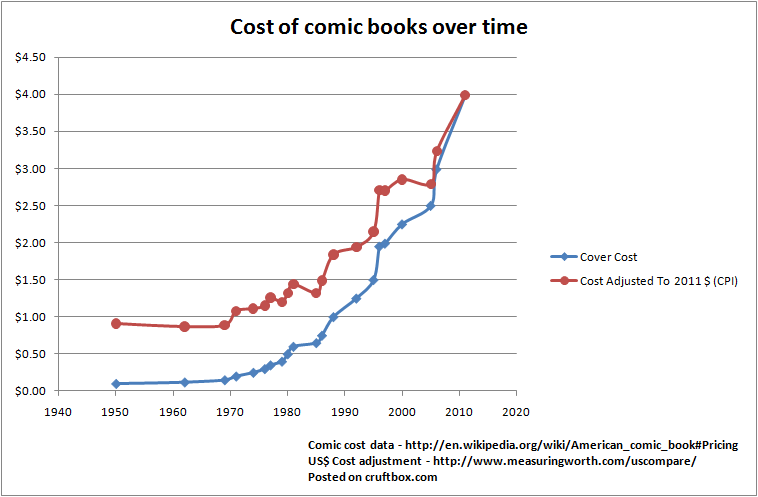
This probably explains why the “typical” comic book reader is no longer a young teen

Filed under: Economics, Media — Tags: , , — Nicholas @ 11:30

It’s all in the economics of the comic book world:

Looking at the graph we can see that the relative price of a comic book stayed around a buck until 1970 or so, slowly ramping up to a buck fifty over the next 15 years. That’s a 50% increase. From 1985 to 2000 the price almost doubles (100%) getting neat three dollars. From 2000 to 2011, it’s around a 33% increase.

It’s a fact that costs increase over time, so I’m not saying prices could remain at a buck forever. But it is hard to see how young kids and teenagers can get into comic books, it’s simply too expensive. For $20 you get 5-7 books. Serious comic readers will pick up 10-20 books a week. A few years ago, when I was a more regular reader, I would the totals of other people routinely $30-50 a week. That’s $120-200 per MONTH. There can’t be many parents helping pay that much for a kid’s comic habit.

When my family came to Canada in 1967, one of the things I missed the most were British comics. Canadian American comics were very different from what I was used to, so I never really became much of a comic collector. I’d pick up the odd few, but it never was a “have to buy” item for me. I remember having to decide whether I wanted the immediate satisfaction of a chocolate bar or a can of pop, or the slightly longer-term satisfaction of a comic book. Immediate satisfaction won more of the time, and with my princely 25 cents per week allowance, there wasn’t a lot of satisfaction whichever way I decided to go.

October 21, 2011

Neuroscientists and neurononsense

Filed under: Books, Media, Science — Tags: , , , , — Nicholas @ 09:11

Stuart Derbyshire and Nina Powell review Cordelia Fine’s Delusions of Gender:

Given that objective measures show gender differences are in decline, it is surprising that there has been such an increase in books and reports describing hard-wired differences in male and female brains and that so many people are using them to explain why men and women live different lives. The most famous British example is Simon Baron-Cohen who has extrapolated from his research on autism (a predominantly male disorder) the more general conclusion that the female brain is predominantly hard-wired for empathy while the male brain is predominantly hard-wired for understanding and building systems.

Cordelia Fine’s Delusions of Gender brilliantly demolishes these overly simplistic and, essentially, wrong conclusions about male and female brains. She does this in two different ways. First, she points out that supposedly fixed differences between men and women are quite plastic. For example, merely asking men to consider the social value and benefits of empathising will lead them to be more empathic. And when men are paid to detect and correctly identify emotional states they perform as well as women. Similarly, when women are told that women perform better on a spatial rotation task their performance matches those of men. It appears that male and female differences in task performance can be fairly easily overcome by changing the motivation to do well or by changing the way the task is framed. That doesn’t sound like something hard-wired or fixed in the brain.

[. . .]

Fine also points to a problem that is, perhaps, more important. The brain is a complicated organ that we barely understand in anything but the most basic detail. Furthermore, brain imaging is a technology that is in its infancy and the data generated by imaging is also highly complicated. A typical brain imaging study will generate a matrix involving hundreds of thousands of numbers replicated across time and people. Analysis of these kinds of data sets is difficult, tedious and complicated, often requiring many years of experience and containing a surprising element of subjectivity and argument about what is the right and wrong thing to do. It is perhaps understandable that brain imaging throws up contradictory results and that brain researchers reach contradictory conclusions. Fine notes that this can lead to theories about brain function being untouched by the collection of brain activation data:

‘As the contradictory data come in, researchers can draw on both the hypothesis that men are better at mental rotation because they use just one hemisphere, as well as the completely contrary hypothesis that men are better at mental rotation because they use both hemispheres. So flexible is the theoretical arrangement that researchers can even present these opposing hypotheses, quite without embarrassment, within the very same article.’

It is a strange science where exactly opposite data support the same interpretation. Fine’s conclusion is scathing. She suggests that neuroscientists are merely projecting cultural assumptions about the sexes on to the vast unknown that is the brain. This process she dismisses as ‘neurosexism’, which is part of a larger discipline called ‘neurononsense’. It is hard to argue.

October 20, 2011

Brendan O’Neill: Occupy movement is the death rattle of the old Left

Filed under: Economics, Media, Politics — Tags: , , , , — Nicholas @ 08:46

For a self-described man of the left, Brendan O’Neill is not afraid to critique leftist movements:

In the increasingly whiffy camp outside St Paul’s Cathedral, amid placards declaring ‘The End is Nigh’, apparently a new kind of politics is being born. Young women talk about ‘politics starting again’. The media cheerleaders of the Occupy movement claim it represents ‘a substantive change not just to the nature of modern politics, but to the way in which it is done, demanded and delivered’. From New York to Madrid to Tokyo, the inhabitants of the so-called tent cities proudly declare themselves ‘citizens of a new world’.

Is all this occupying really the start of something new? No. And not only because on the rare occasion when the protesters issue a coherent demand they end up echoing ideas we’ve heard a thousand times before. (Their call for tougher independent regulation of the financial industry was pilfered from the Financial Times.) More fundamentally, their globally contagious protest represents the death agony of something old rather than the birth pang of something new. What we’re witnessing is the demise of the progressive left, but — and here is the Occupy movement’s twist — that demise is dolled up as something good, something positive, where instead of addressing the vacuum at the heart of modern left-wing thinking, the occupiers make a virtue out of it.

Around the world, the occupiers are adapting to the decayed state of radical left-wing thinking, moulding themselves around the organisational and political disarray of the left. All the negative things about the left today — the lack of big ideas, the dearth of daring leaders, the withering of organisational structures — are repackaged as positives. Leaderlessness is transformed into a virtue, the enabler of a fairer, more consensual form of politics. The absence of overarching ideology is sexed up as ‘liberation from dogma’. Even the thoughtlessness of the Occupy movement, both in terms of its lack of deep thinking and the way it has spread across the globe in a fairly thoughtless, meme-like fashion, is turned into a good thing: this is ‘unthought’, declares one observer, where creeds emerge ‘without much articulation of why they’re necessary, [almost] as reflexes’.

October 19, 2011

Selley: Milewski is right on Tories’ “tough on crime” policies

Filed under: Cancon, Law, Media — Tags: , , — Nicholas @ 12:03

Chris Selley can’t be accused of being a Terry Milewski fan, but he does agree with Milewski’s message:

The CBC recently sent Terry Milewski to Texas, the blood and guts state, where he asked conservative politicians and various experts what they thought of building more prisons, and filling them up, as a means of driving down crime. “Don’t,” was the basic answer. “It doesn’t work. That’s why we’re doing the opposite.”

It was a nice piece on a serious policy issue. It reminded us that the federal government seems to consider crime legislation inside a hermetically sealed chamber. But for that very reason, nothing any journalist says is likely to make any difference. If contrary evidence carried any weight in Cabinet, the omnibus tough-on-crime bill, C-10, wouldn’t be before Parliament. The fact that elites recoil at its provisions and spew champagne out of their noses is a feature, not a bug.

And, if I may briefly adopt the voice of a partisan blogger, the mainstream media would denounce the law of gravity if it somehow helped the Liberals (or the NDP, depending what day it is). The CBC, in the memorable words of Citizenship and Immigration Minister Jason Kenney, “lies all the time.” And Mr. Milewski, as we all know, chairs the left-wing media conspiracy.

This is not an ideal policy-making environment. But I’m going to try to change minds on a single, narrow, easily fixable issue: Mandatory minimum sentences for non-serious crimes. I can’t see any level on which they are supportable.

Supreme Court rules that linking to defamatory material is not libel

Filed under: Cancon, Law, Media, Technology — Tags: , , , , — Nicholas @ 12:03

The Supreme Court of Canada makes the common sense ruling:

Hyperlinking to defamatory material on the internet does not constitute publishing the defamatory material itself, the Supreme Court of Canada ruled Wednesday.

The ruling will alleviate fears that holding someone liable for how they use hyperlinks on websites, personal ones or others, could cast a chill on internet use.

The responsible use of the internet and how traditional defamation law applies to modern technologies were at issue in this case, which was watched closely by media organizations and civil liberties groups.

How someone can protect their reputation in the internet age when content is passed around with the quick click of a button was also considered in the case. On social media websites such as Facebook and Twitter, users often share links, and the court’s ruling could have dramatically disrupted that function had it gone the other way.

In its unanimous decision, the court said a hyperlink, by itself, should never be considered “publication” of the content to which it refers. But that doesn’t mean internet users shouldn’t be careful about how they present links. The court says that if someone presents content from the hyperlinked material in a way that repeats the defamatory content, they can be considered publishers and are therefore at risk of being sued for defamation.

Questioning the “income inequality” argument

Filed under: Economics, Media, Politics, USA — Tags: , , , — Nicholas @ 09:19

James Pethokoukis doesn’t find the income inequality talk particularly convincing, and has a few reasons why:

Sorry, the story just doesn’t hold together. According to left-wing think tanks, columnist and bloggers — and, of course, the Occupy Wall Street radicals — the top 1 percent have been exploiting the 99 percent for decades. The rich have been getting richer at the expense of the middle class and poor.

Really? Just think for a second: If inequality had really exploded during the past 30 to 40 years, why did American politics simultaneously move rightward toward a greater embrace of free-market capitalism? Shouldn’t just the opposite have happened as beleaguered workers united and demanded a vastly expanded social safety net and sharply higher taxes on the rich? What happened to presidents Mondale, Dukakis, Gore, and Kerry? Even Barack Obama ran for president as a market friendly, third-way technocrat.

Nope, the story doesn’t hold together because the financial facts don’t support it. And here’s why:

[. . .]

5. Set all the numbers aside for a moment. If you’ve lived through the past four decades, does it really seem like America is no better off today? It doesn’t to Jason Furman, the deputy director of Obama’s National Economic Council. Here is Furman back in 2006: “Remember when even upper-middle class families worried about staying on a long distance call for too long? When flying was an expensive luxury? When only a minority of the population had central air conditioning, dishwashers, and color televisions? When no one had DVD players, iPods, or digital cameras? And when most Americans owned a car that broke down frequently, guzzled fuel, spewed foul smelling pollution, and didn’t have any of the now virtually standard items like air conditioning or tape/CD players?”

No doubt the past few years have been terrible. But the past few decades have been pretty good—for everybody.

October 18, 2011

Politicians should stop lecturing us about our “obesity epidemic”

Filed under: Britain, Government, Health, Media — Tags: , , , — Nicholas @ 09:32

Rob Lyons in the Yorkshire Post:

I would argue that the obesity panic is greatly exaggerated, that the “cure” for it doesn’t work, and that it usually gets promoted by politicians who have no better way to justify their existence.

For starters, obesity rates have stopped rising for adults, and are actually falling for children. The latest figures from the Health Survey for England, the best source of information we have, show that in 2009, 22.1 per cent of men were obese — compared to 24.1 per cent in 2008; for women, the new figure was 23.9 per cent, as against 24.9 per cent in 2008.

In 2004, 19.4 per cent of boys aged two to 15 were regarded as obese; in 2009, that figure was down to 16.1 per cent. The equivalent figures for girls were 18.5 per cent (2004) and 15.3 per cent (2009).

Even then, what the medical profession regards as obesity and what we commonly recognise as obesity are two different things. About one in four adults is classed as obese.

Now, think about your workmates and friends. Would you really regard a quarter of them as obese? I’ll bet few of them match up to the typical picture that accompanies every story about obesity: a morbidly obese person, whose clothes are straining to hold in their tummies. Such very overweight people only make up about two per cent of the population.

In truth, distinctions between normal weight, overweight and obesity are pretty arbitrary lines, based on something called body mass index (BMI) — that’s your weight in kilos divided the square of your height in metres. BMI is not a particularly good predictor of health, except at the extremes. Those who are mildly obese have much the same life expectancy and health outcomes as those who are normal weight. Being a little underweight is almost certainly worse for you than being mildly obese.

October 17, 2011

It was “a moment of mass credulity on the part of the nation’s media”

Filed under: Britain, Media, Technology — Tags: , , , , , , , — Nicholas @ 12:59

Cory Doctorow points out that no “adult content” filter is a replacement for parental guidance and supervision:

Last week’s announcement of a national scheme to “block adult content at the point of subscription” (as the BBC’s website had it) was a moment of mass credulity on the part of the nation’s media, and an example of how complex technical questions and hot-button save-the-children political pandering are a marriage made in hell when it comes to critical analysis in the press.

Under No 10’s proposal, the UK’s major ISPs — BT, Sky, TalkTalk and Virgin — will invite new subscribers to opt in or out of an “adult content filter.” But for all the splashy reporting on this that dominated the news cycle, no one seemed to be asking exactly what “adult content” is, and how the filters’ operators will be able to find and block it.

Adult content covers a lot of ground. While the media of the day kept mentioning pornography in this context, existing “adult” filters often block gambling sites and dating sites (both subjects that are generally considered “adult” but aren’t anything like pornography), while others block information about reproductive health and counselling services aimed at GBLT teens (gay, bisexual, lesbian and transgender).

[. . .]

The web is vast, and adult content is a term that is so broad as to be meaningless. Even if we could all agree on what adult content was, there simply aren’t enough bluenoses and pecksniffs to examine and correctly classify even a large fraction of the web, let alone all of it (despite the Radio 4 newsreader’s repeated assertion that the new filter would “block all adult content”.)

What that means is that parents who opt their families into the scheme are in for a nasty shock: first, when their kids (inevitably) discover the vast quantities of actual, no-fooling pornography that the filter misses; and second, when they themselves discover that their internet is now substantially broken, with equally vast swathes of legitimate material blocked.

What’s in a name?

Filed under: Media, Technology — Tags: , , , — Nicholas @ 09:22

Jean-Louis Gassée contrasts what was expected and what was delivered:

On 4 October, after months of speculation, Apple finally launched the iPhone 5. The commentariat were ecstatic and approvingly listed the new smartphone’s strongest points: twice the processor speed; seven times the graphics oomph; a new camera with an Apple-designed lens, 8MP and improved image processing; the power of the new iOS 5; iCloud integration and synchronisation with iDevices; a new smart antenna; Siri, the innovative intelligent assistant. And, courageously resisting the temptation of capricious cosmetic changes, the iPhone 5 stayed with Jonathan Ive’s elegant, timeless design.

The preternaturally modest Apple execs cringe at the gushing praise, but what can they do? It’s their cross to bear.

That’s what we expected. Now let’s consider the reality: Same phone, same features, same design, but it’s now called 4S instead of 5. This changes everything. The pundits are indignant: The iPhone 4S is a lame, evolutionary product; the bosses’ presentation (video here) is flat, uninspiring. This dog won’t sell. Apple has lost its mojo.

(Regarding the “flat” presentation, Apple executives knew Steve Jobs was just a few breaths away from his last, but they got on stage and delivered anyway. When news of Jobs’s demise came out the following day, many critics, such as blogger Robert Scobble, had the good grace to apologise to Cook & Co for railing about their subdued performance.)

Nostalgia for the monoculture that never was

Filed under: Media, USA — Tags: , , — Nicholas @ 08:58

Steven Hyden points out that waxing nostalgic for a mythical time when “we” had a monoculture is farcical:

Like Touré, I get nostalgic for the monoculture. It certainly seems like an alluring idea. The monoculture reinforces the belief that what we as critics spend so much time thinking about really is a central part of the way our society lives and breathes. Otherwise it might be hard to believe in the primacy of pop music when millions of people are out of work and our government is crippled by deep systemic dysfunction. But the best thing (or the worst thing, if you’re writing a think piece) about the monoculture is that it exists safely in the past, where it can live on in our imaginations as a mythical place where, as Touré recently wrote in Salon, “an album becomes so ubiquitous it seems to blast through the windows, to chase you down until it’s impossible to ignore it” — an all-powerful communal unity that comments on the shortcomings of the present.

[. . .]

I’ll remember going back to my junior high school that afternoon and talking about the video with all of my classmates. We knew instantly that “Smells Like Teen Spirit” signaled the dawn of a new era in pop music; it expressed our joys and fears, and pointed the way to a new future. We pledged to commit all the details of this moment (sorry, Moment) to memory, so that when our children asked us what it was like When The World Changed Forever, we would be able to pass down the tale.

Oh, wait a second: It didn’t happen that way at all.

Yes, I saw “Smells Like Teen Spirit” video over lunch, but nobody seemed to know who Nirvana was when I got back to school. It wasn’t like my friends could just punch up the video on their iPhones after I told them about it; the clip was in heavy rotation on MTV, but you still had to watch the channel for an hour or two (and at certain times of the day) to see it. Once my classmates did see it, a number of them purchased “Nevermind,” as I did. But many of them didn’t. Some preferred Pearl Jam. Some liked N.W.A.’s “Niggaz4life.” Some didn’t care about music at all; they’d rather play Tecmo Bowl. Then there were the millions and millions of Americans who bought Garth Brooks’ “Ropin’ the Wind,” the best-selling album of 1991. If anything, that was the album that we as a culture were united behind — it sold 14 million copies, though I never heard it once blasting through people’s windows.

October 15, 2011

Conrad Black on “Occupy Wall Street” and its targets

Filed under: Economics, Government, Media, USA — Tags: , , , , — Nicholas @ 11:50

Conrad Black looks at the “Occupy Wall Street” movement:

The Wall Street protesters denounce government bail-outs, the political and economic short-shrifting of students and young workers, the high cost of post-secondary education, various forms of discrimination, U.S. foreign policy, union-busting, outsourcing, the oil industry, media misinformation and (more generally) capitalism and globalization.

Of course, this is a pretty hackneyed scatter-gun indictment by people who haven’t really thought it through, but their anger and frustration are largely justified nonetheless: In the past decade, many prominent financial houses joined in the process of issuing consolidated debt obligations (CDOs), consisting of unfathomable patchworks of mortgages on packages of residential real estate, unsupported by any real base of invested equity in the underlying assets by their ostensible owners, and covered by diaphanous fig-leaves of default insurance. These instruments were made deceptively presentable by certifications from the main rating agencies that they were investment-grade, as if issued by serous entities and secured by unquestionable assets.

[. . .]

As for the Wall Street protesters, their largely justified complaints can’t be addressed by the wild methods they suggest. (A proposed list of demands posted at OccupyWallSt.org includes “free college education,” “bring the fossil fuel economy to an end” and “Immediate across the board debt forgiveness for all.”) The prestige of the U.S. financial leadership, the country’s political class and its economic academics and financial media have all collapsed at once and together, like a soufflé. Except for the military and the pure sciences, the country’s elites have been utterly discredited, and no one believes anything they say. Even if they wanted to, they could not impose on Americans the sort of radical anti-capitalist reforms the protestors urge.

October 14, 2011

Green beliefs, but brown realities

Filed under: Economics, Environment, Food, Media — Tags: , , — Nicholas @ 13:35

Patrick J. Michaels reviews a new book by Todd Myers, Eco-facts:

Just about every organo sacrament withers under Myers’ scrutiny. “Buying local” often means more dreaded greenhouse gas emissions from inefficient short-term shipment compared to the economies of scale when carloads of spuds ride the Burlington Northern Santa Fe across the country. “Certified Organic” means so much paperwork and oversight that mom-and-pop farms (another organo icon) get pushed out by corporate agriculture, which can afford to spend the time and resources satisfying bureaucrats.

Then there are “green jobs.” Solyndra is no outlier; governments are just very bad at picking winners and losers in the energy world. Myers documents the decline and fall of biofuel plants throughout the northwest. Inefficiencies destroy jobs. The Teanaway “Solar Reserve”, supported by an ever-increasing feed of taxpayer dollars, was supposed to be the “world’s largest”, supplying power to a grand total of 45,000 homes. That’s all you get?

John Plaza, CEO of the failed biofuel facility Imperium Renewables (you would think a better name would have helped) thinks it’s all the government’s fault. “What the industry needs,” he said, “is a two-fold support, a mandated floor, and incentives and tax policy to get the outcomes we’re trying for.” In other words, more expensive energy subsidized by you and me, and the government rigging the market. That will create jobs!

What is missing here (and everywhere else) is a comprehensive analysis of how much money the organo fads, follies and delusions cost us. Hopefully that will be in Myers’ next book. The incredible constellation of policy errors, wrongheaded logic and downright stupidity has to be extracting a dear cost from our very sick economy. It’s time to stop this. It’s time for you to read this book.

« Newer PostsOlder Posts »

Powered by WordPress

