Quotulatiousness

January 20, 2012

The anti-Top Gear crowd: “In certain quarters, Clarkson-bashing has started to replace tennis as a favourite pastime”

Filed under: Britain, Humour, India, Media — Tags: , , , , , — Nicholas @ 09:28

Patrick Hayes on the tut-tutting, disapproving folks who only watch Top Gear to generate more outrage at Jeremy Clarkson’s antics:

I wonder what proportion of the five million viewers of the Top Gear India Special over Christmas were desperate-to-be-offended members of the chattering classes? Skipping the second instalment of Great Expectations, they no doubt sat through the show solely to tweet about how awful Jeremy Clarkson and Co’s monkeying about on the road to the Indian Himalayas was.

In certain quarters, Clarkson-bashing has started to replace tennis as a favourite pastime. He was chastised for offending blind people when he called former UK prime minister Gordon Brown a ‘one-eyed Scottish idiot’, censured for driving while sipping a gin and tonic en route to the North Pole, and generated fury when a couple of years ago he called for the Welsh language to be abolished. But never has he generated so much controversy as the Twitch-hunt that took place against him at the end of last year, after he made a quip that public sector strikers ‘should all be shot’.

This was so evidently a joke, although a crap one, that you had to wonder whether the tens of thousands of ‘offended’ people who took to their keyboards to campaign to get him sacked were for real. Is it humanly possible to be that po-faced? Evidently so. Irony-phobic Labour leader Ed Miliband led the way, calling the comments ‘absolutely disgraceful and disgusting’. A sour-mouthed trade union rep even compared his comments to the atrocities carried out by former Libyan tyrant Muammar Gaddafi.

[. . .]

For these petty censors, it’s not enough simply to change the channel. The danger, so the argument goes, is that Clarkson could become a red-blooded role model to millions of impressionable viewers who will mimic his expressions and share his juvenile, PC-averse passions. Attempts to tame Jezza are invariably attempts to try to reform the viewing public, too. If not stopped now, it would seem, Top Gear could generate an army of misogynistic, environment-despoiling racists-in-the-making.

The danger doesn’t come from Clarkson, however. It comes from these Clarkson-bashing killjoys who are intolerant of informal banter, suspicious of anything ‘fun’, taking every word said in jest literally and moaning to the authorities because Clarkson sets a bad example. These are the ones who, to steal a phrase from the man himself, ‘should be avoided like unprotected sex with an Ethiopian transvestite’.
Julian Sanchez on SOPA/PIPA: “No matter how bad last season’s crops were, witch burnings are a poor policy response”

Filed under: Economics, Law, Liberty, Media, USA — Tags: , , , , — Nicholas @ 00:08

In a posting at the Cato@Liberty blog, Julian Sanchez discusses the claims of SOPA/PIPA supporters that new legislation is necessary to fight piracy:

Earlier this month, I detailed at some length why claims about the purported economic harms of piracy, offered by supporters of the Stop Online Piracy Act (SOPA) and PROTECT-IP Act (PIPA), ought to be treated with much more skepticism than they generally get from journalists and policymakers. My own view is that this ought to be rather secondary to the policy discussion: SOPA and PIPA would be ineffective mechanisms for addressing the problem, and a terrible idea for many other reasons, even if the numbers were exactly right. No matter how bad last season’s crops were, witch burnings are a poor policy response. Fortunately, legislators finally seem to be cottoning on to this: SOPA now appears to be on ice for the time being, and PIPA’s own sponsors are having second thoughts about mucking with the Internet’s Domain Name System.

That said, I remain a bit amazed that it’s become an indisputable premise in Washington that there’s an enormous piracy problem, that it’s having a devastating impact on U.S. content industries, and that some kind of aggressive new legislation is needed tout suite to stanch the bleeding. Despite the fact that the Government Accountability Office recently concluded that it is “difficult, if not impossible, to quantify the net effect of counterfeiting and piracy on the economy as a whole,” our legislative class has somehow determined that — among all the dire challenges now facing the United States — this is an urgent priority. Obviously, there’s quite a lot of copyrighted material circulating on the Internet without authorization, and other things equal, one would like to see less of it. But does the best available evidence show that this is inflicting such catastrophic economic harm — that it is depressing so much output, and destroying so many jobs — that Congress has no option but to Do Something immediately? Bearing the GAO’s warning in mind, the data we do have doesn’t remotely seem to justify the DEFCON One rhetoric that now appears to be obligatory on the Hill.

The International Intellectual Property Alliance — a kind of meta-trade association for all the content industries, and a zealous prophet of the piracy apocalypse, released a report back in November meant to establish that copyright industries are so economically valuable that they merit more vigorous government protection. But it actually paints a picture of industries that, far from being “killed” by piracy, are already weathering a harsh economic climate better than most, and have far outperformed the overall U.S. economy through the current recession. The “core copyright industries” have, unsurprisingly, shed some jobs over the past few years, but again, compared with the rest of the economy, employment seems to have held relatively stable at a time when you might expect cash-strapped consumers to be turning to piracy to save money.

January 19, 2012

Chris Dodd would like to tell all you scummy pirates that your feeble protest is an abuse of power

Filed under: Law, Liberty, Media, Technology — Tags: , , , , — Nicholas @ 08:57

Cory Doctorow reminds us that former Senator, now head of the MPAA (one of the organizations pushing hardest for the adoption of SOPA and PIPA) has already added so much to your DVD-watching enjoyment:

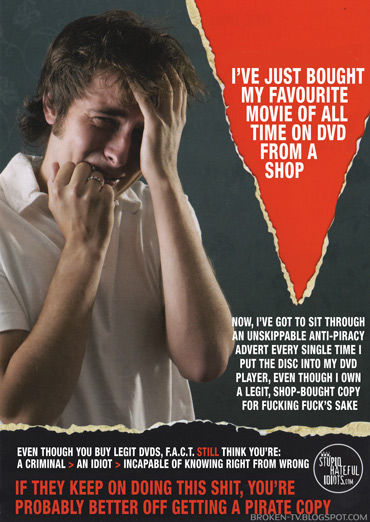
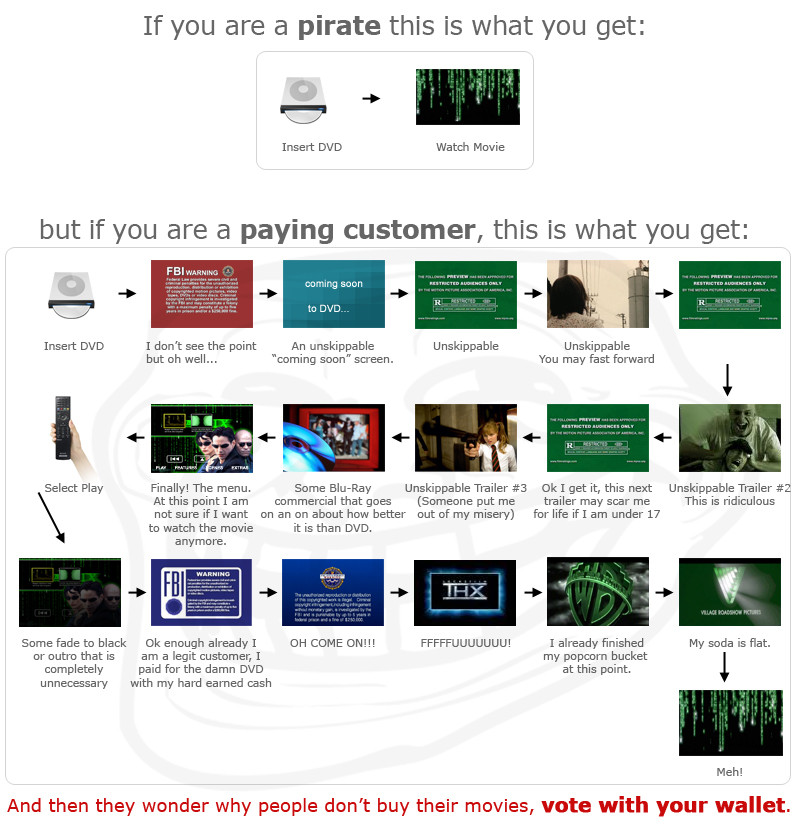
After all, he is the CEO of the organization responsible for inserting those unskippable FBI warnings (which are highly prejudiced and factually incorrect, advising, for example, that DVDs can’t be rented, even though the law says they can) before every commercial DVD. He’s the CEO of the organization that inserts those insulting PSAs in front of every movie chiding those of us who buy our DVDs because someone else decided to download the same movie for free.

And he’s the CEO of the organization responsible for the section of the DMCA that makes it illegal to build a DVD player that can skip these mandatory, partisan, commercially advantageous messages.

So he knows a thing or two about “abuse of power given the freedoms these companies enjoy in the marketplace today.”

You know, the kind of stuff that makes you feel like this guy:

And here’s the reason you pay for a legal copy, rather than being one of those evil pirates:

January 18, 2012

Mother Jones puts on the rose-coloured glasses over SOPA

Filed under: Law, Liberty, Media, Politics, USA — Tags: , , , , — Nicholas @ 10:07

In an otherwise good summary of the SOPA/PIPA issues in Mother Jones, Siddhartha Mahanta and Nick Baumann start the touchdown celebration prematurely:

Late Thursday, Sen. Patrick Leahy (D-Vt.), the lead sponsor of the House bill, announced that he would consider dropping the DNS-blocking provisions from the bill. Late on Friday, Smith, SOPA’s sponsor, did Leahy one better, removing the provision altogether. Not long after, six Republican senators — including two co-sponsors — released a letter they wrote to Majority Leader Harry Reid (D-Nev.), asking him to hold off on a January 24th vote to end debate on PIPA and move to passage.

By this weekend, the writing was on the wall. Rep. Eric Cantor (R-Va.), the House Majority Leader, announced that SOPA would not come for a vote in the House before the controversy over the bill is resolved — essentially killing it for the time being. The White House issued a statement opposing significant portions of the bills. And Issa cancelled the hearing planned for Wednesday, saying he’s “confident” the bill is dead in the House.

Big Hollywood isn’t entirely beaten yet. PIPA, the Senate legislation, could still get a vote and move closer to becoming law, and a modified version of SOPA could conceivably come to the House floor at some point in the future. Wikipedia, Reddit, MoveOn.org, Mozilla (the maker of the Firefox web browser), the blogging platform WordPress, and others are still planning to go dark on Wednesday, just in case. But as of right now, a combination of grassroots activism, blogging, tweeting, boycotts, and the mere threat of having to scroll through 1500 LOLCats without Icanhazcheezburger (another boycott supporter), seems to have beaten an avalanche of money and lobbying. Those 1950s onion farmers would be proud.

Keep your powder dry, boys: the battle is far from won. This is just the latest skirmish in an ongoing campaign, and premature celebration of the victory is just what we don’t need.

January 17, 2012

The media angle on the Costa Concordia wreck

Filed under: Europe, Italy, Media — Tags: , , , — Nicholas @ 09:17

Tim Black points out the most common media memes about the Costa Concordia have much more to do with snobbery and disdain than with human interest or concern about the actual causes of the shipwreck:

The sequence of events that led to the sinking of the luxury cruise liner, the Costa Concordia, is now pretty much established. But facts have not got in the way of a variety of commentators who are using the accident to parade their prejudices about too-big ships and ignorant passengers.

[. . .]

These are the tragic facts so far. What no one knows exactly is why it happened. Explanations have been mooted, of course: a power blackout affecting the ship’s steering; inaccurate navigation charts failing to show the rocks; or human error, in particular by the ship’s captain, Francesco Schettino. Yet while the exact reason for the ship straying off course remains unclear, that has not stopped another object of blame coming to the fore in some of the coverage. That is, the real, underlying reason for the Costa Concordia accident is to be sought not in the actual events of Friday evening but rather in the profit-driven, build-‘em-high cruise industry and, by association, in the sea-faring ignorance of all those who sailed aboard her.

This is why so much of the coverage seems obsessed with the size of the Costa Concordia. Over the past few days, we have been repeatedly told that cruise ships have doubled in size over the past decade. While this is true — and as the twenty-sixth-largest liner in the world, the Costa Concordia is far from the most impressive of this new breed of ships — the Concordia’s size does not actually tell us why it was three miles off course. Nor does it explain why the ship’s crew was unaware of the rock outcrop despite having navigation equipment. Yes, perhaps ship size does affect manoeuvrability, but would a smaller vessel not have suffered a similar fate that befell the Concordia? In fact, the obsession with the ship’s size sheds very little light on what happened to the Concordia on Friday evening.

What the convenient obsession with size draws upon, rather, is an antipathy towards the cruise industry, a sense that it is little more than the ocean-going equivalent of that other right-thinking person’s bête noire, Dubai. In other words, a vulgar testament to profit and sky-high consumption. So although size here is not really relevant as a cause of the Concordia’s capsizing, it appears relevant to certain commentators as a symbol of commercial hubris, of complacent materialism.

January 16, 2012

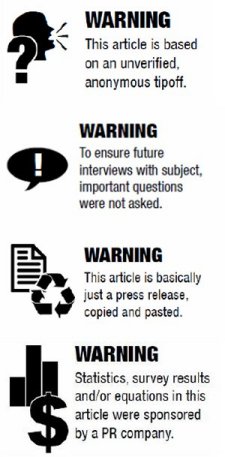
Journalism warning stickers

Filed under: Britain, Humour, Media — Tags: , — Nicholas @ 10:50

A timely addition to your media toolkit from Tom Scott:

It seems a bit strange to me that the media carefully warn about and label any content that involves sex, violence or strong language — but there’s no similar labelling system for, say, sloppy journalism and other questionable content.

I figured it was time to fix that, so I made some stickers. I’ve been putting them on copies of the free papers that I find on the London Underground. You might want to as well.

H/T to Tim Harford for the link.

Cory Doctorow recommends a book on English libel law

Filed under: Books, Britain, Law, Media — Tags: , , , , — Nicholas @ 10:17

There’s a reason that individuals and organizations try to sue for libel under English law, rather than their own national legal system:

The Guardian published a long excerpt from Nick Cohen’s forthcoming You Can’t Read This Book: Censorship in an Age of Freedom, a fantastic-looking book that reveals the dirty truth of English libel law, where “money buys silence” for some of the world’s most notorious dictators, thieves, and bad guys. English libel law is so broad that it allows, for example, Russian oligarchs to sue Russian newspapers for punitive sums (“the cost of libel actions in England and Wales is 140 times higher than the European average”) in an English court, merely by demonstrating that someone, somewhere in England looked at the paper’s website. And yet, the libel law in England and Wales doesn’t actually protect people from the most common forms of libelous publication: false declarations of criminal suspicion by the police, false claims of financial irregularities from credit reporting bureaux and false statements in former employers’ reference letters are protected unless they can be shown to have been malicious and negligent.

That pesky Constitution and the weird candidate who thinks it somehow matters

Filed under: Liberty, Media, Politics, USA — Tags: , , , — Nicholas @ 10:07

Rob Long writes about Ron Paul and his constitutional fixation:

It was always fun to see Paul’s dyspeptic, curdled expression during the 16,000 Republican debates this autumn. (There were 16,000 of them, weren’t there?) It was bracing to see him shrug off appeals to weasel-word his responses — just shutter the Fed! dump NATO! — and it was especially interesting to watch the other candidates, who, philosophically, aren’t supposed to be all that different from Paul, ballet-step around him, like he was one of those loud talkers at the neighborhood bar who make a lot of sense, mostly, but then every now and then say something — Lincoln was a tyrant! — that makes everyone think, “Oh, I get it. You’re just . . . insane.”

Ron Paul isn’t insane, of course. His views on sound money and central banking, and even his narrow interpretation of the national-defense interests, are principled — and not novel — conservative positions. You and I may not agree with them — I do, mostly, up to the part about allowing Iran to bomb Israel — but on the crackpot scale of 1 to Lyndon LaRouche, they’re barely a 3. And if we’re all really honest about it, the sainted Abraham Lincoln did, in fact, violate the Constitution on several occasions. And over a few beers, say, among friends, these are interesting and diverting topics of conversation.

But like all of those kinds of conversations, they always end up the same way. The conversation winds along interesting abstractions and what-ifs, and then someone — usually the old guy at the end of the bar — says something truly out-there — “There’s no constitutional reason, for instance, why the children of illegal immigrants cannot be eaten” — and then the conversation devolves into weird irrational tributaries, and everyone moves on to something else, but you always have the feeling that one guy — usually the old guy at the end of the bar — really meant it.

It may be pseudoscientific gibberish, but it makes a good newspaper headline

Filed under: Health, Media, Randomness — Tags: , , , , — Nicholas @ 09:35

It’s pretty much a certainty that your local newspaper and radio stations have been busy pushing the meme that today is “Blue Monday“. It’s actually a bit of advertising creativity that’s metastasized:

January is a depressing time for many. The weather’s awful, you get less daylight than a stunted dandelion and your body is struggling to cope with the withdrawal of the depression-alleviating calorific foods, such as chocolate, of the hedonistic festive period. January is one long post-Christmas hangover.

So there are many reasons why someone may feel particularly “down” during January. But every year, much of the media become fixated on a specific day — the third Monday in January — as the most depressing of the year. It has become known as Blue Monday.

This silly claim comes from a ludicrous equation that calculates “debt”, “motivation”, “weather”, “need to take action” and other arbitrary variables that are impossible to quantify and largely incompatible.

True clinical depression (as opposed to a post-Christmas slump) is a far more complex condition that is affected by many factors, chronic and temporary, internal and external. What is extremely unlikely (i.e. impossible) is that there is a reliable set of external factors that cause depression in an entire population at the same time every year.

But that doesn’t stop the equation from popping up every year. Its creator, Dr Cliff Arnall, devised it for a travel firm. He has since admitted that it is meaningless (without actually saying it’s wrong).

January 15, 2012

Tim Tebow and David Bowie, as one: Tebowie

Filed under: Football, Humour, Media — Tags: , , — Nicholas @ 11:59

What’s next, allowing only “registered journalists” to report the news?

Filed under: Government, Media, Technology, USA — Tags: , , , , , — Nicholas @ 09:14

A brief item that should send a frisson down the spine of anyone who collects and disseminates information from the web and social media outlets:

Under the National Operations Center (NOC)’s Media Monitoring Initiative that emerged from the Department of Homeland Security in November, Washington has written permission to collect and retain personal information from journalists, news anchors, reporters or anyone who uses “traditional and/or social media in real time to keep their audience situationally aware and informed.”

According to DHS, the definition of personal identifiable information can consist of any intellect “that permits the identity of an individual to be directly or indirectly inferred, including any information which is linked or linkable to that individual.”

H/T to Chris Myrick for the link.

January 14, 2012

Rex Murphy: “Big Environment” finally gets a bit of critical attention

Filed under: Cancon, Environment, Media, Politics — Tags: , , , , — Nicholas @ 12:27

The western world’s largest secular religion may finally be given a bit of balanced coverage — a big change from the automatic deference it has received from the media up to now:

The greatest advantage the greens have had is the relative absence of scrutiny from the press. Generally speaking, it’s thought to be bad manners to question self-appointed environmentalists. Their good cause, at least in the early days, was enough of a warrant in itself. And when it was your aunt protesting the incinerator just outside town, well that was enough. But when it’s some vast congregation of 20,000 at an international conference, or thousands lining up to present briefs protesting a pipeline, well, let’s just say this is not your aunt’s protest movement anymore.

There is no such thing as investigative environmental reporting — or rather very precious little of it in the established media. Environmental reporters rarely question the big environmental outfits with anything like the fury they will bring to questioning politicians or businesspeople. Advocacy and reportage are sometimes close as twins.

And so the great thing I see about Resource Minister Joe Oliver’s little rant against Northern Gateway pipeline opponents a few days ago — asking whether some groups are receiving “outside money” or if they are proxies for other interests — is not so much the rant itself, but rather the fact that at last some scrutiny, some questions are being asked of these major players. Big environment, however feebly, is being asked to present its bona fides. And that’s a good thing: The same rigor we bring to industry and government, in looking to their motives, their swift dealing, must also apply to crusading greens.

Where does their money come from? What are their interests in such and such a hearing? What other associations do they have? Are they a cat’s paw for other interests? Do they have political affiliations that would impugn their testimony? In hearings as important as the ones over the Northern Gateway pipeline, with the jobs and industry that are potentially at stake, the call to monitor who is participating in those hearings is a sound and rational one.

In a media environment where anyone who questions the green orthodoxy is accused of being in the pay of “Big Oil”, it’s refreshing to have at least a bit of the same medicine being forced on the other side of the debate.

January 13, 2012

Continuators: heroes or villains?

Filed under: Books, Media — Tags: , , , — Nicholas @ 09:58

“What’s a continuator?” I pretend to hear you ask. Those are the folks who pick up the fallen pen of other (almost always greater) authors to write endings for unfinished works:

There’s a long list of great authors who have left work unfinished, often because of illness or death. Jane Austen, the Bronte sisters, Albert Camus, Franz Kafka, to name but a few. An industry has grown up around them, of so-called “continuators” — writers eager to finish the stories that they began.

There have been a number of continuations of Austen’s Sanditon, including efforts by Juliette Shapiro and Reginald Hill, author of the Dalziel and Pascoe series. Austen had only got 11 chapters in when she stopped, enough to establish the characters, but leaving the continuators plenty of room for manoeuvre.

But why would a writer choose to finish the work of another author, rather than create original work? Surely that leads to pastiche?

It’s dangerous territory, suggests Prof John Mullan, who is currently writing a book on Austen. “What we expect when we read the work of Austen, or Dickens, or Laurence Sterne, is a particular voice, and that’s terribly difficult to bring off.”

It’s a risky strategy for an author, but perhaps it speaks to a profound need in all of us. The literary critic Frank Kermode wrote in his book Sense of an Ending about our deep-rooted need to be rewarded with conclusions.

John Sutherland, emeritus professor at University College London, agrees. “Kermode famously observed that when we hear a clock go tick tick tick, what we hear is tick tock tick tock, because we like beginnings and endings. We’re hardwired, like lemmings going over a cliff.”

My experiences with continuators has been quite mixed. I’ve never been able to read anything by Spider Robinson since he “finished” a novel from Robert A. Heinlein’s very early period. I hated it so much that it actually diminished my admiration for Heinlein’s entire body of work (I eventually recovered). On the other hand, I quite enjoyed Great King’s War which was a sequel to H. Beam Piper’s Kalvan of Otherwhen. John F. Carr and Roland J. Green did an excellent job of writing in the same voice as Piper and took his characters in believable directions.

Movie and music piracy: what’s the real economic cost?

Filed under: Economics, Law, Media — Tags: , , , , — Nicholas @ 09:00

On the Freakonomics blog, Kal Raustiala and Chris Sprigman look at the actual costs of piracy compared to the ludicrous claimed costs:

Supporters of stronger intellectual property enforcement — such as those behind the proposed new Stop Online Piracy Act (SOPA) and Protect IP Act (PIPA) bills in Congress — argue that online piracy is a huge problem, one which costs the U.S. economy between $200 and $250 billion per year, and is responsible for the loss of 750,000 American jobs.

These numbers seem truly dire: a $250 billion per year loss would be almost $800 for every man, woman, and child in America. And 750,000 jobs — that’s twice the number of those employed in the entire motion picture industry in 2010.

The good news is that the numbers are wrong — as this post by the Cato Institute’s Julian Sanchez explains. In 2010, the Government Accountability Office released a report noting that these figures “cannot be substantiated or traced back to an underlying data source or methodology,” which is polite government-speak for “these figures were made up out of thin air.”

More recently, a smaller estimate — $58 billion — was produced by the Institute for Policy Innovation (IPI). But that IPI estimate, as both Sanchez and tech journalist Tim Lee have pointed out, is replete with methodological problems, including double- and triple-counting, that swell the estimate of piracy losses considerably.

Do you write fan fiction? You might want to check for plagiarists re-using your work

Filed under: Books, Law, Media — Tags: , , , , , — Nicholas @ 08:49

Plagiarism is a problem, but how do you react when someone takes your (erotic) fan fiction work without permission and packages and re-sells it?

After checking the author page for Maria Cruz, who that day had the top-selling erotica book in Amazon’s U.K. Kindle store, she counted 40 erotica ebook titles, including Sister Pretty Little Mouth, My Step Mom and Me, Wicked Desires Steamy Stories and Domenating [sic] Her, plus one called Dracula’s Amazing Adventure. Most erotica authors stay within the genre, so Sharazade was surprised Cruz had ventured into horror. Amazon lets customers click inside a book for a sample of text and Sharazade was impressed with how literate it was. She extracted a sentence fragment, googled it, and found that Cruz had copy and pasted the text from Bram Stoker’s Dracula. Curious, Sharazade keyed in phrases from other Cruz ebooks and discovered that every book she checked was stolen.

[. . .]

It turns out Cruz isn’t the only self-published plagiarist. Amazon is rife with fake authors selling erotica ripped word-for-word from stories posted on Literotica, a popular and free erotic fiction site that according to Quantcast attracts more than 4.5 million users a month, as well as from other free online story troves. As recently as early January, Robin Scott had 31 books in the Kindle store, and a down-and-dirty textual analysis revealed that each one was plagiarized. Rachel M. Haven, a purveyor of incest, group sex, and cheating bride stories, was selling 11 pilfered tales from a variety of story sites. Eve Welliver had eight titles in the Kindle store copied from Literotica and elsewhere, and she had even thought to plagiarize some five-star reviews. Luke Ethan’s author page listed four works with titles like My Step Mom Loves Me and OMG My Step-Brother in Bisexual, and it doesn’t appear he wrote any of them. Maria Cruz had 19 ebooks and two paperbacks, all of which were created by other authors and republished without their consent, while her typo-addled alter ego Mariz Cruz was hawking Wicked Desire: Steamy bondage picture volume 1. 


« Newer PostsOlder Posts »

Powered by WordPress