
Feral Historian
Published 4 Jul 2025Harlan Ellison’s screenplay adaptation of Isaac Asimov’s I, Robot is arguably the best sci-fi movie never made. Let’s take a look at the script itself, why the film was never made, and how it might have altered science fiction cinema in the wake of Star Wars.
00:00 Intro
01:59 Robbie
04:32 A Little Detour
06:18 A Lifetime and a Galaxy
12:12 Liar
14:06 A New Theory
16:29 The Rapid Rise of the Federation
21:01 Obstacles and Ellison
(more…)
November 13, 2025
I, Robot: The Ellison Script
Comments Off on I, Robot: The Ellison Script
November 12, 2025
Bike lanes are only the start
Spaceman Spiff explains how aspirational schemes proposed by our technocratic governments at all levels seem to quickly and effortlessly shift from a nice non-intrusive improvement in life to an overbearing imposition of ever tighter controls on our lives:

Bike lanes on Yonge Street north of Bloor Street in downtown Toronto.
Image from Google Street View
The adoption of cultural novelties follows a predictable path. Some bright idea is proposed and there is nominal support or at least not widespread opposition.
Soon after implementation begins its opposite is condemned. This is the first warning the lunatics have taken over the asylum. We move from a positive, optimistic drive to condemning a perceived negative. By then the intolerant are amassing, attracted to a secular pulpit with which to lecture the rest of us.
More time passes and condemnation of the opposite is not enough. We are commanded to behave in ways more pleasing to our public servants. We learn a key aspect of our future has been decided by a shadowy committee we have never heard of. A well-meaning experiment has become an imperative used to control us.
This absurd sequence is more common than it should be.
A common example in Britain is the creation of bike lanes.
The idea sounds benign. Let’s build cycle lanes to encourage exercise. It is broadly popular, a kind of inoffensive fad to encourage better health despite the weather being an impediment for most.
Few people actively object which is taken to mean they endorse these projects.
It is not long before support for helping cyclists degenerates into discouraging cars since people should be cycling more anyway. The initiative lends moral weight to an otherwise fringe view. The construction of the bike lanes accelerates these ideas as roads are narrowed and traffic slows, frustrating many. There are too many vehicles on the road we are told, all the more reason to get on your bike.
Soon suggestions are made to ban cars completely. The new idea proposed is to shut down the congested roads and replace them with even more bike lanes and pedestrian zones.
Some even openly discuss intentionally making driving awkward and expensive as an explicit goal. The technocratic mind often forgets its charges are people not slaves.
Before long everything shifts, then we wonder how we got to the point our own paid employees can openly gloat we will soon be banned from travelling in ways they dislike as if they are our controllers.
An idea appealing to a minority is imposed on all. Acquiescence to novelties becomes weaponized and subsumed into the ambitions of others. No one ever votes for these things. They seem to just appear.
The end result is often the destruction of goodwill as popular initiatives are rammed down our throats and used to berate us for failing to live up to the standards our public servants impose upon us.
We then tire of the lectures. We wonder where these lunatics come from.
A moment of complacency means unwanted bike lanes but before long it is banned cars, government-controlled IDs and digital currencies. Those who pay attention to the activist world often sense they’d build concentration camps if they could get away with it and all thanks to some benign-sounding scheme we didn’t object to.
Comments Off on Bike lanes are only the start
The legacy media are still fanatically pushing the “Tories in disarray” line
It’s good to see that sometimes you get good value for your money. In this case, it’s the massive financial subsidies the federal government pay out to most of the Canadian legacy media outlets, so that the media ignores stories that the Liberals look bad but push the living bejesus out of anything that makes the Conservatives look bad … even if they have to distort the story almost out of recognition. Brian Lilley has the details:

I told you this would happen, the legacy media is trying to make this whole floor crossing thing into a PC versus Reform Party thing. As I broke down all of the background information that I could muster and tried to present it in a straightforward way, I said this would be a narrative of the MSM.
The reality is, the frustrations exist for a number of reasons but Pierre being too conservative is not the main issue here, it’s that they didn’t win in April. It all goes back to that and how different people interpret that loss and the leader’s response to the loss.
If you haven’t read that piece, it’s worth your time just to understand some of the nuance that you won’t find from other media.
There is no party divide …
The idea that there is still a schism on the modern Conservative Party between old PC voters or members and those that came from the Canadian Alliance or Reform side is not only false, those pushing it are showing their ignorance. The parties merged more than 20 years ago, they governed as the Conservatives for 10 years, anyone that left over this supposed divide left years ago, but the media can’t give this up and so they play into it with Chris d’Entremont on the weekend.
That was followed by Adam Chambers, the Conservative MP for Simcoe North in Ontario who pushed back against the idea that middle of the road Conservatives like him aren’t welcome in Pierre Poilievre’s party.
A hat tip to CBC Watcher on X who grabs so many of these clips and posts them.
Well done by Adam, not that it will help. This is a narrative some in the media are deciding to run with.
They will ignore that d’Entremont first ran under Andrew Scheer, hardly a Red Tory and in fact a so-con and d’Entremont was comfortable with that. Maybe because as a local French CBC outfit pointed out, d’Entremont is also on the pro-life side, the one the Liberals normally hate.
Oh … and another point on CBC’s reporting here. Remember the claim that a staffer was shoved out of the way … this is at the bottom of the CBC article that made the claim.
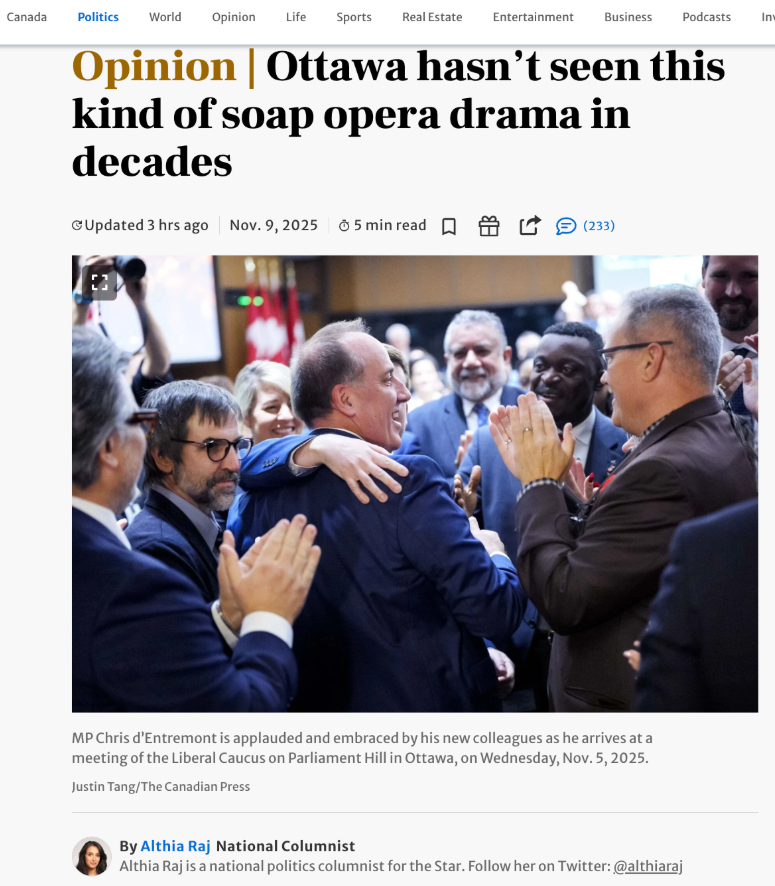
The Toronto Star will not be outdone …
This is a headline that I can’t believe the Toronto Star actually ran.
I’m pretty sure that columnist Althia Raj is old enough to remember all the way back to the morning of December 16, 2024. I know that was a REALLLLLLY long time ago, like, literally decades (please read that with a Valley girl upspeak).
If you don’t know that date, you will know what happened, because that is the day that Chrystia Freeland stabbed Justin Trudeau in the front, not the back. On the day that she was supposed to deliver the federal government’s fall economic statement, she issued a scathing resignation letter instead.
This of course also came after months of Liberal MPs pushing Trudeau to resign. A letter had even circulated among caucus members demanding he stepped down.
Liberal MPs couldn’t make Trudeau leave, Freeland’s resignation couldn’t make Trudeau leave, the 20 point lead the Conservatives then enjoyed couldn’t make Trudeau leave – it was Trump that did it.
All of that was wilder, had more drama than last week, but sure, tell people we haven’t seen this in decades. The column penned by Raj doesn’t mention Trudeau, it doesn’t mention Freeland, but it does want you to believe we haven’t seen this in like, FOREVER!

Comments Off on The legacy media are still fanatically pushing the “Tories in disarray” line
November 10, 2025
Enshittification, the book
Cory Doctorow originally coined the all-too-useful name for the steady deterioration of pretty much everything in the online world and now it’s the title of his latest book:

Author and activist Cory Doctorow wants you to understand why online digital platforms are failing users, and he’s fighting for a better internet. “Enshittification” — a word he coined to describe the degradation of online platforms and services — is the slightly profane albeit funny title of his latest book.
[…]
First question from me: “What does enshittification look like in Canada?” (Try saying that word without chuckling). The country had several opportunities to lead as a global digital force to be reckoned with, Cory agrees, and in his view, “we dropped the ball on market concentration”.
“The Competition Bureau has, through almost all of its history, until last year when we got a new bill out of Parliament, been, I think, the weakest competition bureau in the world,” Cory declares, emphatically. It’s hard to refute his assessment: The merger of Shaw and Rogers, two very large telecoms in Canada, was made official in 2023, the year before Canada’s competition law was modernized.
“Wouldn’t you think, at the very least, Canada would have a robust domestic network platform available by now?” I ask. Gander Social, a made-in-Canada social media platform, designed as an alternative to large U.S.-based companies, is only now being beta tested.
“There are any number of people who would like very, very much to host a few thousand of their friends on a little Mastodon or Blue Sky server that can talk to all the other ones, and everyone can be in a conversation,” Cory counters.
“We don’t all have to be on the same server,” Cory continues. “If there’s one thing we learned from the Amazon outage, it’s that putting everyone on the same server is an incredibly bad idea, right? So we can all be on different servers in the same way we’re all on different email servers, drive on different roads. We have to live in different cities; we don’t all have to be in the same place to all talk to each other and be part of a single digital network. That’s what networks are, right?
“You know, what we don’t have, the lacuna in this plan, the thing that we need public investment in, is not the bicycles on the road, it’s the bike lanes, it’s the infrastructure, and it’s the kind of thing the private sector can’t do well,” he asserts. The pain points for small businesses, communities, large businesses, cooperatives or any entity wanting to host a social media platform, Cory suggests, include things like security audits and content moderation tools.
He also recommends “some mechanism to ease people’s passage off (existing) social media and onto a new platform”. Right now, Cory explains, “you have people building these new platforms and wondering how the people on the old platforms are going to get there. This is like West Germans building housing for East Germans in West Germany, without thinking about how they’re going to get over the wall. Except that, we built the wall. We are the ones maintaining the wall. The wall is made entirely of law. The wall could be torn down with an act of Parliament at the stroke of a pen.”
And on the related topic of artificial intelligence being crowbarred into everything we use online:
Cory’s also saying very provocative things about AI. His most-memorable quip: “AI is the asbestos we are shovelling into the walls of our society and our descendants will be digging it out for generations”. While he sees the merits of AI to support the work of radiologists or lawyers or software engineers — or nearly anyone — he doesn’t believe AI can do the job. “But,” he warns, “an AI salesman can 100 per cent convince your boss to fire you and replace you with AI”.
Comments Off on Enshittification, the book
November 9, 2025
When “research shows” in a headline indicates “bullshit here”
At Science Is Not The Answer, William M. Briggs says we should never trust stories headlined with “research shows X” (although if you’re a regular reader, you probably already know this):

Research Shows headlines are generated from papers by academics, and these all have explicit or tacit claims of cause, all purporting to explain some set of observations (whether gathered in history, the world, or by experiment). To explain is to state or to tacitly point to a cause.
The problem is that the methods science has developed to affirm or claim cause are often wrong: they are not right; they are in error; they are incorrect; they are fallacious; they sometimes make the right decisions, but only accidentally. By which I mean, cause is arrived at not by the methods, but by other means, yet the methods are credited.
I hope it is clear when I say that these methods are not to be used.
But are.
The worst tool, and one whose use is always and every instance a fallacy, is the so-called hypothesis test. We have done (“wee Ps”) in Class so many times, we’re sick of it (or I am). But I want to prove to you “tests” are fallacious another way, using one familiar example and one common situation. And with no math!
The idea is simple: a researcher makes observations, runs a “test”, and makes a pronouncement the cause he thought of is the one correct explanation for the observations.
He might be right about this, but it will only be accidentally, and not because of the “test”. For that same “test” could be used in support of an infinite number of other possible causes. That is the proof against “tests”: that they can support anything.
This will always be the case. As in every time. As in it is inescapable.
Our familiar example comes from A Global Enlightenment: Western Progress and Chinese Science by Alexander Statman (his surname guaranteeing I would read the book). It is mostly a review of the 18th Century Jesuit mission to China, and those Jesuits’ interactions with major figures of the so-called Enlightenment.
An important observation Statman makes is man’s proclivity to look for wisdom in the past or the future. One believes those in the past had superior knowledge, knew more secrets and could communicate with God (or the gods) with greater ease and facility, yet somehow that knowledge was lost (possibly wiped away in the flood; China, having the oldest extant civilization was thought to hold vast repositories). Or one believes those to come will be better than we, will know more, and will lead easier and happier lives, if only they are not held back by those who look to that past (China was also by others thought to have stagnated and could only copy their betters).
Comments Off on When “research shows” in a headline indicates “bullshit here”
November 8, 2025
All cultures are not equal, especially when it comes to crimes like rape
On the social media site formerly known as Twitter, Dr. Sydney Watson responds to a post on feminists blaming all men for the actions of some men from other cultures:
Jessica Pin @jess_ann_pin
It bothers me so much when some feminists act like men are just as misogynist and violent everywhere.
That’s not true. Men from some cultures are absolutely worse than others.
I’m not saying there is a genetic difference. But there are definitely cultural differences, and we need to be careful about who we let in.
[Full sized images in the linked post]
I don’t know how to explain this succinctly —
But, ages ago I watched this series about prisons around the world. There were a few episodes that focused on prisons in African countries – how the prisons ran, what people were charged with etc.
What stood out to me was that over 50% of the male prisoners were there for some sort of sex crime – rape, sexual assault, child sexual abuse etc.
What was even worse was that, when asked about why they committed these crimes, a lot of the men said things about how they were “teaching the woman a lesson” or raping her was some sort of “punishment.”
And I couldn’t help but think, “well, that checks out. Given how these men from these places come to Western countries and rape women.”
People might not like hearing that, and the less evolved among us chalk it up to “racism” (lol) but if someone comes from a culture that views rape as a form of punishment for unruly women, then why would that viewpoint suddenly change when their feet hit British/Swedish/Canadian soil?
If, culturally, you view women as barely people, why on earth would you suddenly start because you’re in a new place?
Point being – it’s utterly mad to put women and girls at risk because people don’t want to admit that some cultures are horrible. I’m tried of pretending that all cultures are equal when they’re so obviously not.

Update, 10 November: Welcome, Instapundit readers! Please do have a look around at some of my other posts you may find of interest. I send out a daily summary of posts here through my Substack – https://substack.com/@nicholasrusson that you can subscribe to if you’d like to be informed of new posts in the future.
The Boomers didn’t do it, but they could have reversed it
On the social media site formerly known as Twitter, John Carter takes the entire Baby Boom generation out to the woodshed for a well-deserved talking-to:
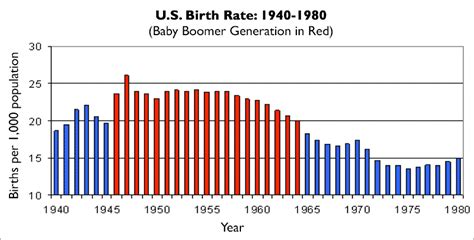
toking-the-abacus @_toking
It’s amazing how catastrophically bad the current job market is in the US. No one wants to train anyone. They want 5-10 years experience in skills that you don’t get unless someone mentors you in a more junior role. Then you have rampant visa abuse.
Boomers mostly got paid to get trained on the job for their jobs.
Then they turned around and demanded college for everything. At a steep markup.
Then they rugpulled all the college grads by hiring foreigners to do the jobs people went into debt learning how to do.
Whole lotta incensed geriatrics in the replies saying “That wasn’t boomers, that was Griggs v Duke Power! Those judges were silent generation!”
Yes. And that was 1970. 55 years ago.
That’s kind of the point.
You were the largest generation in history, boomers. You could have reversed that insane decision. You could have ended the crazy practice of disparate impact. You could have ended the systemic bigotry of affirmative action, which discriminated not only against you, but against your own sons and, now, your grandsons. You could have used your institutional and electoral power to block DEI.
You could have done a lot of things.
But you didn’t.
At most you grumbled some, but not too loudly, because after all dad fought in the big war and you didn’t want to do a Hitler. A lot of you supported all of it wholeheartedly, because John Lennon had an imagination and MLK had a dream and remember Woodstock, man. Some of you profited from it handsomely. As a generation, as a group, whether by action or inaction, you entrenched it in every aspect of law and institutional culture.
You participated, each in your own way, in redesigning our entire society around women’s feelings, black self esteem, and sabotaging the minds, bodies, spirits, and lives of your white sons.
Don’t run from your part in this.
I’m not saying this to be mean.
I’m saying this because we fucking need you.
We need your votes, because as a direct result of the immigration policies of the last half century – which, again, yes, have their origin with Greatest and Silents, but whose most severe consequences unfolded on YOUR watch – we are absolutely, 100% screwed if we don’t deport an absolutely incredible, historically unprecedented number of people in a very short period of time. If that doesn’t happen it’s game over for America and, frankly, Western civilization. For now, for as long as you’re still breathing and capable of casting a ballot, whites are a bare majority. When you’re gone we’re outnumbered, the third world swallows the first, and it’s over.
We need you to confront the consequences of your actions and your complacency, to really feel what its done to your descendants, and to be filled with rage at the way you were misled by evil and selfish men, and an implacable determination to spend what remains to you of your lives doing whatever you can to reverse enough of the damage you allowed to be done to salvage something from this crumbling wreck of a society.
That is why we bully you.
Because we need you to see.
Comments Off on The Boomers didn’t do it, but they could have reversed it
QotD: Singing in church
So, this is oriented toward, primarily, Father Erik and Father Tim, who are certainly free to disagree with me, but anyone who attends mass regularly might find it of use. I also do not know if what I see in my church is normal, but suspect it is.
Note: I used to have a good singing voice, not quite commercial quality, IMHO, no, but quite good nonetheless. I loved to sing. I still do, the songs I can still handle, too.
Almost nobody sings reliably in my church. Oh, they can, but they generally do not. The exceptions are hymns everybody knows the tunes to, some of the responsorials, ditto, and, notably, last 4 July, “America the Beautiful”. And, at Christmas, the traditional Christmas songs.
So why those and not the others. Well, the typical hymn in the typical modern church was penned by a couple of nuns from the Order of the Discalced Sisters of Sappho, or priests from the Gay Jesuit Alliance, and printed in the hymnal largely as an exercise in flattery.
Okay, that’s not really true … or not entirely anyway. No, the real problem is that, and I cannot emphasize this enough, NOBODY KNOWS THE BLOODY TUNES, SO OF FREAKING COURSE THEY DON’T SING, WHILE THEY CHANGE THE HYMNS SO OFTEN — WEEKLY, AS A MATTER OF FACT — THAT NOBODY EVER HAS THE CHANCE TO LEARN THE TUNES.
So I propose the following: Pick five hymns — among my recommendations, “The Battle Hymn of the Republic”, “We Gather Together”, “Amazing Grace”, “How Great Thou Art”, “Abide with Me”; but I’m not a fanatic about it — and use only those five for however long it takes for 75% of the congregation to sing all of them. Then change ONE and keep at that until 75% will sing that. And keep doing that until you have a repertoire of 20-25 songs everybody knows and most everybody will sing.
“Make a joyful sound unto the Lord” and see if your parish doesn’t grow and if your parishioners aren’t a lot happier in mass.
Tom Kratman, The social media site formerly known as Twitter, 2025-07-03.
Comments Off on QotD: Singing in church
November 7, 2025
“BookTok on its own sounds innocent enough”
I’ve seen occasional references to BookTok on other platforms but as it seemed to be as female-coded as an online community can be, I’d never bothered to pay close attention to it. If Zoomertea is to be believed, it’s a weird and disturbing space for the unprepared to visit:

Image from “The Female Gooner Epidemic” at Zoomertea
If you’re smart enough to have never downloaded TikTok, then you’ve probably never heard of BookTok and the resulting epidemic of female gooners (a term borrowed from porn culture to describe obsessive arousal and fixation). BookTok on its own sounds innocent enough, women rediscovering the joys of reading, romanticising cozy nights in, or even joining a book club. In theory, what could be more wholesome? However, the reality is more concerning. It turns out the bookish girls have traded the likes of Pride and Prejudice for highly pornographic dark fantasy erotica, stories that make Fifty Shades of Grey seem tame.
Women have always enjoyed a flair for romance. Once it was the slow burn longing of Romeo & Juliet or Wuthering Heights – the stories weren’t explicit, yet still roused deep, passionate feelings. By the 2000s, romance had evolved into “chick lit” – breezy novels about friendship, love and self-discovery. Books like Bridget Jones and the Devil Wears Prada swapped tragic love for witty realism, capturing the struggles of modern women navigating careers, dating, and independence. It seems like in all aspects of modern culture, people have been pushing for the “reliability factor” – they wanted to see themselves in the characters and storylines. But somewhere along the way, the realism and reliability factor lost its appeal.
During the pandemic, while the virus spread and the world stayed home, TikTok spread too, surpassing 2 billion downloads by mid-2020. With endless free time, people picked up new hobbies: some tried Chloe Ting’s “Get Abs in 2 Weeks” workouts, others turned to BookTok and rediscovered their love for literature. Booktok isn’t just for explicit romantasy novels, however it’s become synonymous with women who obsessively consume dark romance. On BookTok, desire isn’t intimate anymore; it’s performed.
While Fifty Shades of Grey, a book very explicitly about sex, came almost ten years before BookTok, it wasn’t exposed to the algorithmic amplification loop we see today. Although its release did shock readers and spark feminist critiques about patriarchal relationships and sexual themes, it still felt more like a dirty secret. Its eroticism was discussed privately, even sheepishly. It was a book club secret, not a TikTok performance. Now, even the most unassuming women are flocking to BookTok and demanding books with a maximum “spice rating”, without an ounce of shame. But how did this happen?
Somewhere between the isolation and scrolling, the lines between fantasy and reality began to blur. The algorithm on TikTok can be very dangerous for enforcing unhealthy habits on its users. When a woman watches or likes just one “spicy book” video, even just out of curiosity, TikTok interprets it as interest in similar content. Without the user’s knowledge, suddenly their ForYou page is filled with similar videos, “books with a max spice rating”, “extreme taboo book recommendations” or “Top five dark romance recs”. The more they see, the more they engage, the more the algo pushes darker more extreme content. Essentially, the algorithm learns: You like desire, here’s more. Louder. Darker
Comments Off on “BookTok on its own sounds innocent enough”
Crossing the floor in Parliament
It’s not an everyday thing, but I saw someone mention on social media that there had been over 300 floor-crossings since Confederation. The latest Member of Parliament to switch parties … to literally walk across the floor in Parliament to join Carney’s Liberal party is Nova Scotia’s Chris d’Entremont:
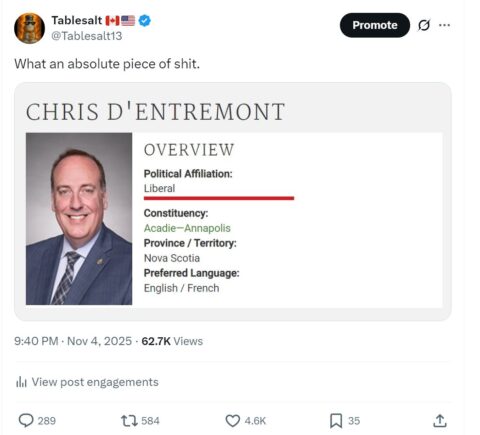
The speculation in Ottawa about floor crossers is getting silly, some of the names being pushed don’t make any sense. Which makes me think that this is really an attempt by the Liberals to try and destabilize the Conservatives.
Sorry, that would be “destablise” in Mark Carney’s new English but more on that shortly.
We have seen Liberals push name after name including Chris d’Entremont who did cross, but others who have said they have no interest in crossing. That was the case for Dominique Vien the Conservative MP from Quebec’s south shore who had to post a video after jerks like me published her name following weeks of speculation.
If you don’t speak French, let me summarize, or sumarise in Carney English. She says that she’s heard the rumours that she would be leaving the Conservative caucus to sit as a Liberal or an independent, but that’s not true. She states clearly that she is and will remain a Conservative and that she doesn’t like Mark Carney’s budget.
Meanwhile, Joël Godin, the MP for Portneuf—Jacques-Cartier a riding northwest of Quebec City, who has been named as a possible floor crosser declined to answer questions entering caucus on Wednesday. Does that mean he’s ready to cross or not just putting up with the BS?
Conservative insiders tell me that he won’t be changing teams anytime soon.
The rumour mill is insane, with Liberals pushing the idea that all kinds of Conservatives are looking to jump ship. I’ve had several Liberals tell me that Michael Chong has been looking to cross the floor, an idea that is so ridiculous that I didn’t even call Chong to ask him because anyone floating that doesn’t know the man or conservative politics.
After I mentioned that on 580 CFRA in Ottawa, Chong called me to assure me that he wasn’t crossing to the Liberals. Michael, I never doubted you.
It’s doubtful that other names Liberals are pushing will come to fruition.
What is clear is that Carney and the Liberals are reaching out to Conservative MPs and making them offers to switch parties. Are they making illegal offers? I’d really like to know what has been put forward.
Is a “comfy landing” being offered for those that will cross? It wouldn’t be the first time that kind of thing has been offered.
As to the particular motivations for d’Entremont decamping to the Liberal benches, discussions on the social media site formerly known as Twitter indicate that he just barely got elected this time around, that he’d been fired by Pierre Poilievre as Deputy Speaker, and he decided he had a better chance of getting back into Parliament as a Liberal in the next election. Quinn Patrick reports that the Liberals had been trying to get d’Entremont to join them for quite some time:
Industry Minister Mélanie Joly said the Liberals had been courting former Conservative MP Chris d’Entremont behind the scenes for five years before he ultimately crossed the aisle.
“We’ve been trying to recruit him for a long time,” Joly told reporters in French on Parliament Hill on Wednesday. “Finally, he saw the light.”
D’Entremont had served as a Conservative MP for six years, after first being elected in the 2019 election.
As several people pointed out, that conveniently meant he’s qualified for the platinum-plated MP pension plan … but I’m sure that’s not why he switched parties.
Liberal MP Kody Blois, who also represents a riding in Nova Scotia, confirmed that he and d’Entremont had been speaking “for a long time about the ways in which we can collaborate.”
“It’s great to see Mr. d’Entremont join. If there’s other members of Parliament feeling the same way, again, I think we’re always welcome to those conversations,” said Blois.
While Blois didn’t explicitly say he had been attempting to enlist d’Entremont, he said the Liberals are a big-tent party with room to accept more “moderate” conservatives.
When asked if the Carney government was actively trying to recruit more MPs, Blois said that “wouldn’t be a conversation I’m going to have right here in front of the media.”
The former Conservative MP met with Prime Minister Mark Carney at a post-budget media conference on Wednesday, saying he didn’t believe his values as a “red Tory” were being “represented.”
“I didn’t find I was represented there … my ideals of an easterner, of a red Tory and quite honestly of trying to find ways to find solutions and help the community rather than trying to oppose everything that’s happening,” said d’Entremont.
He also alluded to the possibility of other Conservative MPs “in the same boat” but stopped short of naming anyone specific, saying he would let them share their stories “if the time comes.”
However, he has been the only one to cross the aisle thus far.
Conservatives and their supporters have accused d’Entremont of betraying his constituents and his values in pursuit of his own ambitions.
Comments Off on Crossing the floor in Parliament
QotD: The Boomer career path
After that they got bored and became Glam rockers, and then switched to Disco because it had a better beat. They used all their free money from Disco record deals to buy cocaine and Malibu real estate at $3 per acre. In 1980 they decided there was even more money in selling cocaine, so they all moved to Miami and drove around shooting machine guns from their Lamborghini Countachs to Giorgio Morodo synth music.
After Reagan’s re-election the Boomers decided greed was good and they all moved to NY where they became serial killer investment bankers and collected up all the Andy Warhol originals. That’s when all of their real estate holdings made them billionaires which they leveraged to get in on the bottom floor of the Internet bubble in the 90s while taking designer drugs.
Today those same Boomers are all driving around to orgies at The Villages in $500k luxury golf carts waving giant Trump flags, laughing it up while lighting doobies with their Social Security cash and executing Howdy Doody’s Final Plan: the secret Boomer Immortality Pill that will allow them to keep their money away from Millennials and Zoomers FOREVER
David Burge, The social media site formerly known as Twitter, 2025-07-30.
Comments Off on QotD: The Boomer career path
November 6, 2025
Mamdanimentum – NYC gets its very own Justin Trudeau clone
It’s been decades since I last visited New York City, so I don’t know if they really deserve what they’ve just voted for, but I guess we’ll all get to find out over the next few years. On the City Journal substack, Reihan Salam weighs in on the newly elected mayor and what to watch for:

New York State Assemblymember Zohran Mamdani photographed in Assembly District 36, 10 February 2024.
Photo by Kara McCurdy via Wikimedia Commons.
A year ago, not even the most perfervid Astoria leftist would have thought that Zohran Mamdani would soon be elected mayor of New York City. Back then, it was easier to imagine Eric Adams coasting to reelection on the strength of declining crime, or state attorney general Tish James, who came close to running for mayor in 2021, swooping in to unite a fractious Democratic coalition. With Adams badly damaged by a federal indictment and James anxious about what a mayoral bid would mean for her ongoing battle with President Donald Trump, however, the path was seemingly clear for Andrew Cuomo to make a dramatic comeback.
Though it was no secret that Cuomo had real weaknesses, thanks to his polarizing tenure as governor, his name recognition and formidable fundraising machine were enough to freeze out other serious contenders. As a result, the Democratic mayoral field was so bereft of talent that Mamdani — an obscure, hard-left state assemblymember with no legislative or professional accomplishments to speak of — was able to cut through, buoyed by surging anti-Israel sentiment and a series of half-baked pseudo-solutions to the city’s very real affordability crisis.
From one vantage point, then, Mamdani is best understood as an accidental mayor. If federal prosecutors had declined to prosecute Adams, if James had jumped in and Cuomo had stayed out, if Hamas had surrendered its hostages a few months sooner, if moderates and conservatives had consolidated behind a single candidate in the general election, or if any of a number of other possibilities had obtained — the outcome of New York City’s 2025 mayoral race would have been quite different.
In another sense, however, Mamdani’s victory represents the culmination of New York’s larger leftward turn. The shift started in 2018 with the dissolution, at Cuomo’s behest, of the state’s Independent Democratic Conference, an eight-member coalition of centrist Democratic senators who caucused with the Republicans. Their subsequent replacement heralded a broader takeover of Albany by progressives who — again, with Cuomo’s assent — passed a series of ideologically inflected bills: bail reform, the “most aggressive climate change legislation in the nation“, and a major overhaul of tenant protection statutes, to name only a few.
The Mamdani revolution was led by downwardly mobile elites — children of the professional class struggling to make ends meet and entranced by the promises of frozen rent and fare-free buses. They were fired by the same ideas that animated those Albany progressives: that some New Yorkers have been handed the short straw, that soak-the-rich policies can correct these imbalances, and that New York’s private sector was resilient enough to sustain a further ratcheting up of punitive taxation and regulation.
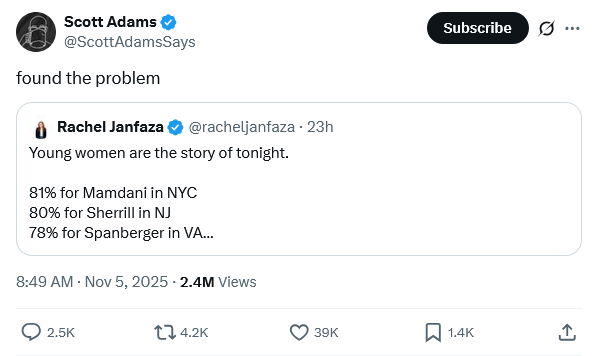
The voters of NYC are not the same demographic distribution as of old … among other things, the Jewish population has shrunk while the Muslim population has grown to nearly the same over the last 25 years, although Jewish women probably voted more similarly to women generally in this election:
Comments Off on Mamdanimentum – NYC gets its very own Justin Trudeau clone
Reactions to Tuesday’s budget announcement
Mark Carney’s government finally got around to releasing their 2025 budget and lots of folks have thoughts and concerns about what is in it and what isn’t in it. After all, it could be the best possible budget, but it would still not satisfy all concerns … and nobody is pretending that this is anything close to “best possible” territory. Sylvain Charlebois says that the budget ignores the food insecurity issues and grocery prices for ordinary Canadians:
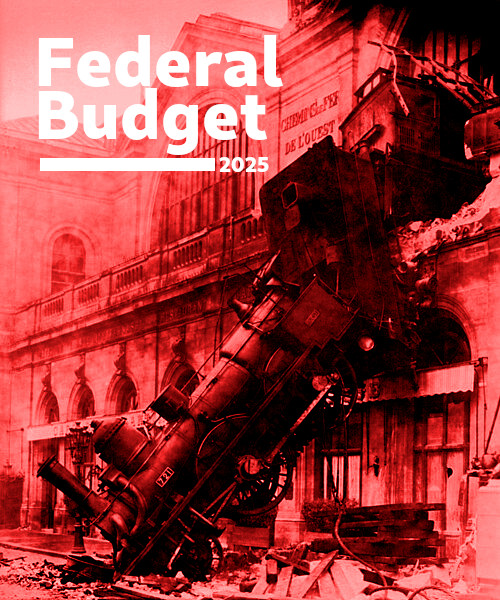
Graphic stolen from Small Dead Animals.
For a government that often talks about food affordability and insecurity, Budget 2025 offers surprisingly little that directly addresses either. There’s no bold food strategy, no affordability roadmap, and no new incentives for domestic food production. Yet, in between the lines, Ottawa has quietly set the stage for some indirect relief — not through grocery subsidies or consumer-facing policies, but through infrastructure, trade, and administrative reforms that could make the food system work a little more efficiently.
The largest signal comes from the government’s $115 billion infrastructure plan, one of its so-called “generational investments”. The new Trade Diversification Corridors Fund aims to modernize ports, railways, and airports — all chronic weak points in Canada’s food supply chain. When bottlenecks ease, goods move faster, and perishable products arrive fresher and cheaper. While no one in Ottawa framed this as a food-price measure, logistics efficiency has long been one of the most effective — and least visible — forms of price control.
[…]
Still, the absence of a broader vision for food affordability stands out. After years of grocery price volatility and public debate about “greedflation”, Canadians might have expected a more direct focus on food resilience — investments in innovation, local processing, or retail transparency. Instead, the government seems to have opted for a quieter, systemic approach: strengthen the arteries of trade and logistics, and trust that efficiency will trickle down to the dinner table.
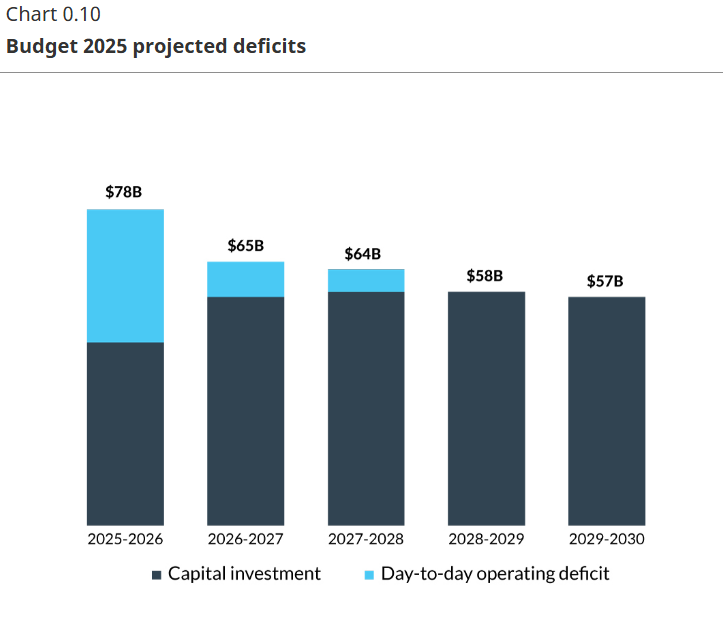
The budget forecasts a $78.3 billion deficit for the 2025-26 fiscal year, which is significantly higher than notorious spendthrift Justin Trudeau’s last budget number. This adds to an already staggering $1.27 trillion debt load, which is nearly double what it was just before the pandemic. In the lead-up to the budget release Mark Carney had hinted at major sacrifices to be made, and while there wasn’t a lot in the document directly corresponding to sacrifice, the need to service that long-term debt will do the job quite adequately.
In the National Post, John Robson says that the budget is “elbows up, IQs down”:
Since I was last propelled years ago into the purgatory known as “the lockup”, where journalists spend budget day, have either process or contents improved? No. Instead they now insert a false stolen-land “acknowledgement” before even getting to the same old same old labeled bold and new. Which is especially troubling at this supposedly critical juncture.
The document is the familiar brick, 406 paper pages and 493 digitally with no explanation for the discrepancy and no excuse for the length. (Or for being called “Canada Strong” with an inexplicable picture of a ship.) Especially as the Finance Minister gabbled “This is a budget that talks to everyday Canadians,” and its purpose is to state plainly how much the government intends to spend, where it hopes to get the money and how far short it already knows it will fall, you shouldn’t have to wade through 248 pages of sludge to find out.
As P.J. O’Rourke said, “beyond a certain point, complexity is fraud”. Though we “privileged” insiders search “Summary Statement of Transactions” and voila, submerged on p. 249 (all references digital) is a $78.3 billion deficit next year if all goes well, and the national debt increasing $80.5 billion so it already didn’t.
Much commentary, and special-interest attention, focuses on trivial fiddles. But what matters is that Leviathan is in hock up to its horns, with interest payments projected at $55.6 billion next year, soaring to $76.1 billion by 2029-30. If the Lord is willing and the creek don’t rise, both forlorn hopes. NDP MP Leah Gazan, who would jail you for “downplaying” residential schools, snarled about not supporting an “austerity budget” but she won’t get the chance.
Some may bleat that times are tough. Indeed the finance minister’s campaign-speech “Foreword, Budget” gasses “The world is changing, profoundly and in real time; we are no longer living in an era of calm, but of significant change”.
The projected deficits are clearly hallucinatory, as the Liberals never seem to get deficit spending to go down, running deficits every year since 2015:
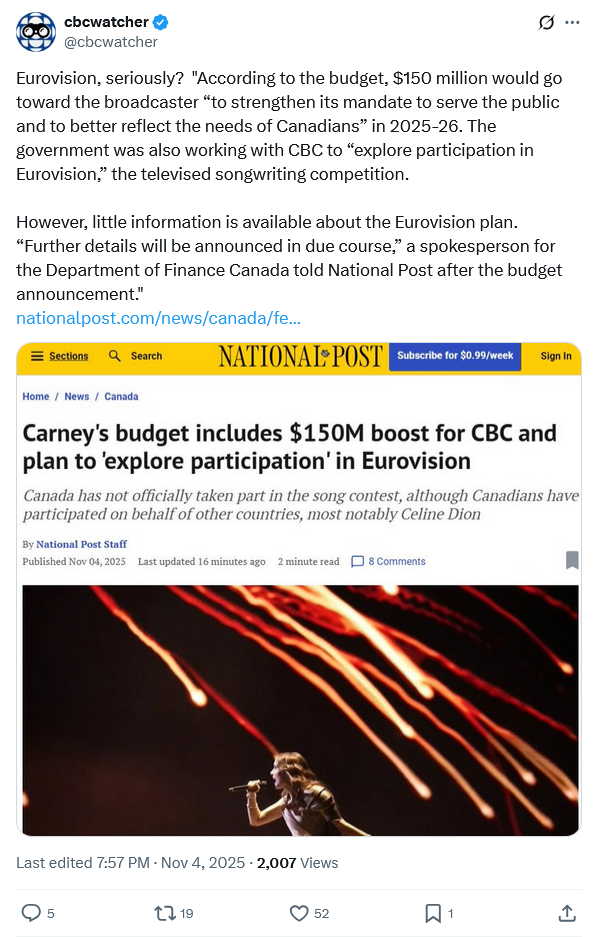
However, on the ludicrous side, the feds want to spend money to “investigate” Canada taking part in the freaking Eurovision contest:
On the slightly less ludicrous side, Noah considers the military aspects of the budget:

Budget 2025 outlines the government’s generational investment to quote, “defend Canada’s people and values, secure its sovereignty, and position the nation as a strong, reliable partner to its allies“. This starts by initiating a process of rebuilding, rearming, and reinvesting in the DND, CCG, and CAF to provide everyone with the necessary tools and equipment to protect sovereignty and bolster security.
Budget 2025 starts by outlining the government’s previous commitment to accelerate investments to meet NATO’s 2 per cent defence-spending target this year, which is five years ahead of schedule.
Budget 2025 goes a step further by setting Canada on a path to meet NATO’s 5 per cent Defence Investment Pledge by 2035. This will be broken down into two categories, 3.5 per cent of GDP by 2035 in core military needs, including supporting the CAF, modernising equipment and technology, and building up defence industries, and 1.5 per cent on security-related infrastructure and investments.
This reinvestment in defence and security is the largest in decades, totaling $30 billion over a five-year horizon on an accrual basis. This funding is allocated across three main pillars: $20 billion for capabilities, $5 billion for infrastructure and equipment, and $5 billion for industrial support.
On a cash basis, Budget 2025 proposes to provide $81.8 billion over five years, starting in 2025-26, to rebuild, rearm, and reinvest in the CAF. This figure includes over $9 billion in 2025-26 that was previously announced in June 2025. This is the funding previously set out for Canada to reach the 2 per cent NATO target.
Key investments from this $81.8 billion fund include $20.4 billion over five years to recruit and retain a strong fighting force, which incorporates the previously announced updates to pay and support for CAF health care.
An additional $19.0 billion over five years is allocated to repair and sustain CAF capabilities and invest in defence infrastructure, including the expansion of ammunition and training infrastructure. Upgrades to digital infrastructure for the Department of National Defence, CAF, and the Communications Security Establishment, particularly for cyber defence, are funded with $10.5 billion over five years.
Finally, $17.9 billion over five years is designated to expand Canada’s military capabilities, with investments in logistics, utility, and armoured vehicles, as well as counter-drone, long-range precision strike capabilities, and domestic ammunition production.
This is a serious chunk of change, although sadly, and as you will see, we don’t get a major breakdown of what this looks like. What we are left with are general piles of money, which isn’t always a bad thing. It’s also expected. The budget is set for a timeline before many critical capabilities will be delivered, so they won’t be included. Almost everything comes after 2030.
Comments Off on Reactions to Tuesday’s budget announcement
November 5, 2025
QotD: Progressive anger
As they did so in this case, I could not help but think of the analogy with our present situation. We have a huge fund of very angry people buzzing about in mobs looking for somewhere on which their anger can settle. It seems an epoch ago that it landed on #MeToo and turned all men into Harvey Weinstein. Then, under the direction of little Greta, who somehow managed to combine an autistic manner with hysteria, opposing tendencies reconciled no doubt by the ineffable self-pity of the privileged, global warming provided a temporary resting place. However, with the killing of George Floyd, climate change seems as passé as Mussolini’s spats. (“Too many spats, too many spats!” someone once said of him.) But if no new thing is found after all the statues have been pulled down, the books burned, and the films withdrawn from circulation, climate change could return faute de mieux. On the other hand, free-floating anger is highly inventive as to the reasons for its existence: It can attach itself to almost anything, as flies can walk upside down on ceilings. Being no prophet myself, I have no idea what will be the next object of angry righteousness by people brought up to believe in moral relativism.
Theodore Dalrymple, “Bees With Degrees”, Taki’s Magazine, 2020-07-02.
Comments Off on QotD: Progressive anger


