
The Great War
Published 11 Jul 2025In early 1917, the United States was still neutral in the First World War. Meanwhile, German leaders were getting desperate — if they couldn’t find a way to break the war of attrition on the Western Front, the Allies would probably defeat them. The result was multiple gambles that staked everything on a quick victory with the risk of drawing the US into the war.
(more…)
November 22, 2025
Why did the US Enter WW1?
Comments Off on Why did the US Enter WW1?
November 21, 2025
The “spat” between China and Japan is far more important than western media are reporting
Claire Berlinsky explains why we should be paying far more attention to what our media are treating as a minor diplomatic spat as Beijing reacts furiously to the new Japanese PM’s comments:
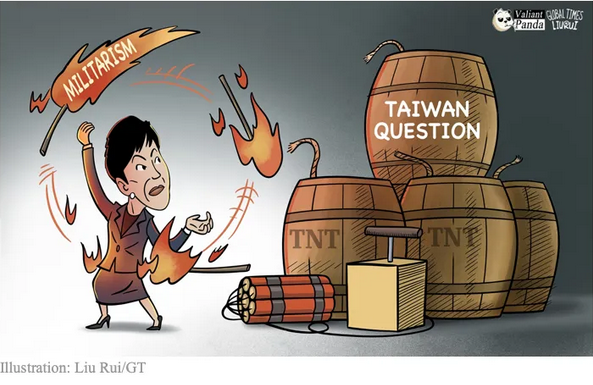
You need to see the Chinese media today to get a feel for this. Front pages of the relevant organs are devoted to frothing in fury at Japan. They’re rectifying bad thoughts like a house on fire.
Here’s why I’m worried by this. Both the Chinese- and Japanese-language press are treating this as a major diplomatic incident. (In English, it’s mostly being described as “a row” or “spat” — then back to Trump and Epstein.) Let me walk you through what it looks from Beijing and Tokyo, with help from ChatGPT on the translations.
The trigger was a comment in by the new Japanese prime minister, Sanae Takaichi. She told a parliamentary committee that a Taiwan contingency involving the use of force might constitute a “sonritsu kiki jitai” (a “survival-threatening situation” — I think we’d use the phrase “existential threat”) for Japan under its 2015 security laws, and justify the exercise of collective self-defense, using Japan’s self-defense forces.
Beijing exploded. China summoned the Japanese ambassador in Beijing for a formal démarche, and it allowed the PRC consul general in Osaka, Xue Jian, to post a (now-deleted) tweet calling for her decapitation—”that dirty head that trespassed should be cut off, are you ready?” The Xue Jian post has, of course, become a media event of its own. Beijing issued a travel advisory urging Chinese citizens to avoid Japan, and told students to “carefully reconsider” study plans. It stepped up coast-guard activity near the Senkakus, and cancelled the Xi–Takaichi bilateral at the G20.
But this arid account doesn’t begin to convey the way the Chinese and Japanese media are talking about this. The Chinese coverage is nothing short of hysterical. To read the Party-line outlets, you’d think Takaichi had just ordered the immediate re-invasion of Manchuria. Her comment, they said, was an evidence of a “dangerous rightward turn” in Japanese politics. They’re calling it a “sky-collapsing opening“, accusing her of “reckless ranting” and tearing up the China-Japan relationship.
The headline in a widely circulated China Daily article:”If China and Japan go to war, Japan will be destroyed“. They found the inevitable panel of “peace-loving international friends” — including Okinawan peace activists and pro-PRC overseas Chinese — to denounce Takaichi as the reincarnation of “Japanese militarism”. The peace activists dutifully warned that the Japanese people would be “dragged into catastrophe” by their government. A CNR column accuses her of “brazen provocation”, and claims that “Taiwan compatriots are also outraged” at the prospect of Taiwan being turned into a battleground between China and a “militaristic” Japan.
The Party line: Taiwan is a “settled” internal issue; any talk of Japanese collective self-defense in the Strait is aggression and a “serious violation” of the post-1945 order. Takaichi represents “unrepentant militarism.” Chinese pieces quote her opponents at length to argue that “sober Japanese elites” are deploring her recklessness. Chinese-language coverage of the travel advisory is not treating it as a minor consular notice. They’re claiming it’s the first coercive step.
In Japan, this is front-page foreign policy news, not a minor gaffe. Mainichi ran an editorial saying, more or less, that Takaichi’s words were legally consistent with the 2015 security laws, but prime ministers should be more discrete about hypothetical military contingencies and show more prudence. Opposition figures are saying she “went too far” and threw the relationship into “a very grave state”. They called it “frivolous” for a commander-in-chief to talk so specifically about use-of-force scenarios.
On the other hand, there’s clearly a domestic constituency that sees this as long overdue. Some in her party see any hint of retraction as “weakness toward China”, and they’re praising her for drawing a firm line on Taiwan. (The coverage about whether to expel Xue Jian is divided: His post was a death threat, obviously, but the Foreign Ministry seems reluctant to escalate this further.)
TV explainers are reminding viewers that the 2015 security legislation already contemplated a Taiwan contingency — what’s new is that the prime minister has now said this out loud. And a prime minister with an openly revisionist profile — that’s definitely new.
So there’s a lot of signaling going on. Beijing is signaling to its own public: “We’ll never again let Japanese militarism threaten China. The Party is the bulwark against a repeat of the 1930s.” To Tokyo: “We’ll punish any step toward military involvement in the Strait, first with economic coercion — then worse. We are not kidding about this.” To the wider region and Washington: “Japan is a destabilizer — this woman isn’t right in the head. If things go wrong in the Taiwan Strait, blame Tokyo. Remember Pearl Harbor.”
Update, 23 November: Welcome, Instapundit readers! Please do have a look around at some of my other posts you may find of interest. I send out a daily summary of posts here through my Substack – https://substack.com/@nicholasrusson that you can subscribe to if you’d like to be informed of new posts in the future.
November 20, 2025
“Oh my God, the Conservatives support children starving at school”
In the National Post, Chris Selley profiles my local MP, Jamil Jivani:
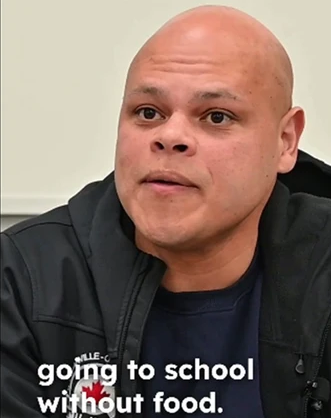
A screengrab from MP Jamil Jivani’s video that is critical of the Liberals’ national school-lunches program. Photo by Jamil Jivani/X
A few eyebrows raised earlier this year when Toronto-area MP Jamil Jivani, long heralded as an essential younger voice in the Canadian conservative movement, wasn’t offered a critic role by party leader Pierre Poilievre. There are 74 official Opposition critics, which is more than half the Conservative caucus. And if Poilievre and Jivani don’t see eye to eye, one might still have thought Jivani’s relationship with U.S. Vice-President JD Vance would be a useful resource.
There’s also the fact that Jivani is rather good at defending conservative policy, especially on the social side — better, one might argue, than Poilievre. On Monday, Jivani posted a video of himself arguing that Canadian children should go hungry at school. Or at least, that’s how certain hysterics chose to interpret his opposition to the Liberals’ national school-lunches program.
“It should frighten us that there are parents who can’t buy their own kids lunch,” he tells a constituent in the video. “(But) the government shouldn’t be your daddy; the government shouldn’t be your mother. We have families, and families should be strong enough to provide for their children, and when they’re not that should break our hearts. … It should not be used as a justification for the government to have even more influence, even more input, even more control over our lives.”
The program is already underway, with $1 billion in funding over five years committed as transfers to the provinces in 2024 — three years after the Liberals first promised it. And the Liberals recently announced plans for more. “Permanent” funding of more than $200 million is set to kick in in 2029.
The response anywhere to Jivani’s intervention, anywhere to his left, in a nutshell: “Oh my God, the Conservatives support children starving at school”. Even among some conservatives we hear the traditional timid refrain: Is this a “winning issue”? Or is the party just making itself look callous? What will the media think? Jivani, unlike many more seasoned Conservatives, seems not to care so much about the potential blowback.
Lunches served at school — paid or subsidized — are hardly a brand-new statist invention. They’ve been around forever, although they’re more common in certain kinds of schools than others. A 2013 Queen’s University study looked at 436 Canadian schools and found only 53 per cent had a cafeteria. (When I was a kid, many of my friends walked home for lunch and back afterwards.) And Jivani concedes in the video that many Canadians will like the sound of a national school-lunch program. Who would argue against it? It’s obviously far more important that kids eat breakfast and lunch (and dinner) than it is who provides it.
But that assumes a national school-lunch program, or even a provincial or local school-lunch program, is the quickest and easiest way to make sure kids are fed. It obviously isn’t, but trust in government, somehow, is a tough nut to crack in this country. Mass pandemic-era supports like CERB weren’t unalloyed successes, but they proved governments at least know how to shovel money out the door when they feel it absolutely necessary.
Especially since so many Canadian schools don’t have cafeterias — 53 per cent of elementary schools in the Queen’s study, and 82 per cent of combined elementary-secondary schools — it would make much more sense just to mail every parent who needs one a subsidy and let them pack the lunch, or the lunch money, that their kids need.
I’ve mentioned many times that I’m not a Conservative, but I don’t mind Mr. Jivani as my Member of Parliament because he doesn’t seem to me to be a typical Canadian Conservative (I thought it was significant that the PPC chose not to run against him once he became the Conservative candidate). In my YouTube recommendations, this video appeared with some sensible views from the Deputy Leader of His Majesty’s Loyal Opposition, Melissa Lantsman:
The trouble, as always with parties in opposition, is that they can sound like they’ve got great ideas and will energetically address the problems they identify while not in government … but once they go into office, sound remarkably like the government they just defeated and little or nothing actually changes.
Comments Off on “Oh my God, the Conservatives support children starving at school”
Our free-speech documentary has been cancelled! | A London cinema has banned Think Before You Post
spiked
Published 19 Nov 2025Our new documentary, Think Before You Post, about the rise of the British speech police, was due to have its premiere in London next week. Last night, the venue got in contact to say it would be cancelling our booking, because the event does not align with its “values”.
Here, spiked‘s Tom Slater tells all.
We are working flat-out to find a new venue for the same night. So if you bought tickets, do bear with us. But if we can’t find somewhere else in time, we’ll refund everyone and postpone it for a later date. If you’d like a refund now anyway, get in touch and we’ll process it.
At least they’re proving our point …
About spiked:
Founded in 2000, spiked was a pioneer of 21st-century journalism – the first online-only political magazine in the UK.
Now edited by Tom Slater, spiked reaches millions around the world with hard-hitting articles, incisive essays and a growing roster of podcasts and videos.
Comments Off on Our free-speech documentary has been cancelled! | A London cinema has banned Think Before You Post
QotD: What happened to the “Lucky Country” when the luck ran out?
I used to think that being born Australian was the greatest blessing in history.
Without thinking too deeply about it, I sensed we had inherited some of the best British qualities: we understood that a batsman should walk when he knew he was out, regardless of the umpire’s decision; and that the best hangover cure began with a cup of tea.
We ridiculed our friends because there was no greater compliment than offensive humour, but didn’t overdo it because brevity was the soul of our wit. (Google it, Abdul.)
Then I discovered that the British colony in Australia was founded 12 years after Americans declared that all men (not just American ones) are created equal, and with certain inalienable rights, and realised that their belief in liberty, too, was part of our precious heritage.
By developing in lockstep with them and marching to every subsequent war alongside them, we had been imbued with Americans’ rugged individualism, but cleverly managed to avoid their gullibility for life’s more superficial panaceas.
For a while, we even gave the Americans a run for their money in the pursuit-of-happiness caper. Our island continent had more room, stranger animals and nicer cities, and we had a bigger middle class, which confirmed to us that egalitarianism, the bedrock of our culture, worked.
Then, in 1983, the crew aboard the Australia II yacht showed the New York elite that their unlimited money was no match for our gritty ingenuity.
What a time to be alive! How brilliant were we! We were six-foot-four and full of muscle, and we thought it would last forever.
That it hasn’t is partly our fault. We constantly called ourselves The Lucky Country, conveniently forgetting that Donald Horne coined the name as a warning, that one day the luck would run out. That’s what luck is: it changes.
We revelled in our prosperity and mocked the idea, fundamental to our founders, that prosperity is a two-way deal.
And we lazily imported “vibrancy” instead of building on the sophisticated western civilisation, going back to Socrates and Aristotle, we were unbelievably fortunate to inherit.
But for all our complacency, at least we never deliberately sought our own demise, which, it is now clear, is what our own government is doing with grim determination and sinister skill.
As a free and prosperous nation with unlimited resources, Australia should have the pick of the richest, cleverest, most urbane migrants in the entire world. Instead, it has opened the door to millions of low-skilled peasants from Third World countries who aren’t even slightly interested in assimilating, if they don’t outright hate our culture and want to subjugate us.
There is more to this than Labor merely symbiotically importing freeloaders whose votes can be bought with unaffordable largesse. […]
As the brilliant Adam Creighton said on X last week, referring to our demographic transformation: “The Australia of your youth won’t remotely exist in 20 years. It will still have nice weather, at least”.
Our cultural suicide aside, this record intake of migrants reduces our already inadequate amount of available housing.
By how much? The Australian Bureau of Statistics isn’t saying. Its biennial Survey of Income and Housing was due out about now, but will not be released at all because of “data collection issues”.
In other words, ABS staff were unable to survey the people most affected by unprecedented levels of immigration because those people kept shifting between city laneways and homeless shelters.
Fred Pawle, “All They Can Manage is Decline”, Fred Pawle, 2025-07-21.
Comments Off on QotD: What happened to the “Lucky Country” when the luck ran out?
November 19, 2025
Julia: A Feminist Retelling of 1984?
Feral Historian
Published 11 Jul 2025Julia, a 2023 novel by Sandra Newman, does more than just retell Orwell’s 1984 through Julia’s eyes. That perspective switch presents an Oceania that is both more mundane and more familiar. It’s certainly a companion piece more than a stand-alone work, but it does have something to offer both in how it examines Orwell and a few times, how it contradicts him.
00:00 Intro
02:18 a Different Perspective
09:30 Caught in a Trap
12:45 Backstory
15:40 Departures
20:18 Endings and Beginnings
(more…)
Comments Off on Julia: A Feminist Retelling of 1984?
QotD: Rum Sodomy & the Lash
The album was even launched on the river, upstream, on board HMS Belfast with the band wearing Nelson-era naval regalia. They’d been ferried to the moored cruiser from Traitor’s Gate, arriving to find the assembled journalists (one of whom ended up, temporarily, in the Thames) already tearing into the drink. After the gig, MacGowan’s admiral’s hat vanished; in one story settling onto the river bed with all that other historical debris. At the time, the album felt like a raucous act of vandalism. Now, it’s viewed almost universally as a stone-cold classic.
The cover, a remade version of Géricault’s The Raft of the Medusa, where the band themselves are among the wretched shipwrecked crew, acts as a framing device. What Rum Sodomy & the Lash does is allow erased, abandoned or sidelined histories to erupt — the piratical and press-ganged, the adventurous and the damned — in a way that gracefully, modestly hides the band’s self-taught virtuosity and the lyricist’s songwriting genius. It was an album that, at that time, socially and politically, shouldn’t have existed, but through courage and sheer force of nature had to.
The Thames may not forget, but society is all too willing to. There are, alas, few signs of gratitude or even recognition of the colossal impact the Irish have had on London. A statue of Oliver Cromwell, the Butcher of Drogheda, stands pride of place outside the House of Commons, but there’s scarce trace of his Hibernian victims. It took the London Irish Centre to erect a plaque in Camden Square, in 2017, to the “Forgotten Irish”, “who left their homes, counties and country … to work and rebuild this city and country, ravaged and destroyed by war … Many would never return to Ireland”.
[…]
Even at the time of the album, in fact, the Pogues ran into opposition, and not just among musical snobs and gatekeepers in England. In Ireland, their adversaries were two-fold — traditionalist embalmers of folk music, and cringe-beset “cosmopolitans” who were mortified with anything too Irish, too plebian, too diasporan. Ironically, it turned out that the Pogues were far more effective custodians of Irish traditional music, and more authentic examples of cosmopolitan hybrid-culture, than their adversaries, exemplifying the maxim that, “Tradition is not the worship of ashes, but the preservation of fire”.
At the heart of Rum Sodomy & the Lash‘s success and legacy is embrace of apparent opposites: high and low culture, Ireland and England, city and rural, home and exile, intellect and soul, sacred and profane, debauchery and dignity, stars and gutter. So you get “Navigator”, a tribute to the Irish workers who built the railways, and MacGowan’s rowdy “Sally MacLennane”, a tribute to his uncle’s Irish pub in Dagenham, the Irish car-making workforce it served and the real-life characters he encountered, some less than salubrious. There’s also a fierce and atmospheric instrumental, “The Wild Cats of Kilkenny”, inspired by Spaghetti Westerns, or else the industrial hangover of Ewan MacColl’s “Dirty Old Town”, especially poignant at a time of deindustrialisation.
The true legacy of the Pogues exists not in print, of course, but in music. Their inheritors include the drone and conscience of the modern band Lankum, the otherworldly transformations of the past in the music of Lisa O’Neill and John Francis Flynn, and the pulse of the new in Fontaines DC. But the album also impels its listeners to articulate discontent, defy the rot, preserve the fire, to genuinely transgress, to face reality in surreal or raw terms, to lament and howl not in the transience of placards or social media, but in an art form that hits far deeper, than rusting plaques, and lasts much longer. It’s all out there, more than ever, out of sight, below decks or at the bottom of the river, waiting to escape.
Darran Anderson, “The Pogues soundtracked Irish London”, The Critic, 2025-08-05.
Comments Off on QotD: Rum Sodomy & the Lash
November 18, 2025
Canada’s divide isn’t left versus right, it’s old versus young
Older Canadians seem to be taking joy in sticking up their elbows and robbing younger Canadians of opportunities, jobs, and hope. It’s quite literally un-Canadian, but the Boomers have always been a generation apart and this is merely the latest manifestation of their self-centred worldview. Alexander Brown wonders if this divide can be fixed before the country itself is ruined:

“eLbOwS uP!”
“Talk to your parents,” the host of an event for Pierre Poilievre joked on Saturday in Vancouver — an event I happened to attend. “But be patient. Be kind.” And he’s right.
The cross-talk, the rock’em sock’em robots, the continued slap-fight between warring consultant tribes, it isn’t getting us anywhere, clearly. When the present iteration of the party of the status quo wedges a nation against itself, and denies a reform election after a decade of haphazard redistribution, non-growth, and abject decline, you get a traditional voter-demographic breakdown flipped entirely on its head.
The party of seemingly endless opposition dominated with youth, held strong with the 35-54s, but found itself walloped 52% to 34% among those aged 55+. Since then, those 55+ numbers have only widened, as the “safe” choice, that more stately actor (when he’s not radicalizing those who don’t know any better with claims of false invasion) can do little wrong, even coming out of “middling” budget heading to a vote Monday, and with a nation remaining pessimistic about its future prospects.
If the Liberals are voted down Monday, they would likely relish that opportunity to seize on a majority. The spin is already built in.
The Conservatives don’t want to stand up against Trump!
At a time like this, when we should be coming together, it’s un-Canadian …
We’re supposed to be one Team Canada right now (offer void in British Columbia, Ontario, and Quebec), we can’t afford Pierre Poilievre’s divisive Trumpiness.
On and on. Yada and yada.
Nowhere in that comms exercise, drummed up by those who spend more time in America or the Arab Emirates, or meeting with Chinese proxies than they’d publicly care to admit, would there be a defence of younger Canadians, of those still on the launch pad, worried about, say, supposed ‘fixes’ to immigration riddled with creative accounting and more of the same.
Nowhere would they address housing, set to get much, much worse, under both the federal Liberals and targets they’re admitting they won’t come close to hitting, and Ontario’s ‘Conservative’ premier who leads the galaxy in not getting off his ass to get out of the way on starts and lowering punitive development costs.
Nowhere would one find a stout defence against “deconstruction“, or the daily humiliation ritual of flags flying that aren’t our own, or imagined and inflated woke excess meant to sully the memory of our war dead and marginalize normal people.
Following recent debates sparked by Without Diminishment, where we’ve argued a version of “it’s not just the economy, stupid,” when it comes to what’s animating young people and young conservatives — actually talk to them, and half of them are trending towards fascism with how alienated they feel by a lack of upward social mobility, or a society without rules or those willing to enforce them — it’s been easier for some serving in established camps to mischaracterize these conversations as focusing too much on culture, or, ridiculously, “blood and soil nationalism”. But we’re not. If one is dealing in good faith, it’s plain to see we’re trying to talk about both.
Of course, the Liberals survived Monday’s budget vote … for now:
When I saw Elizabeth May stand up and ask Mark Carney what looks like a completely planted question, I assumed the budget would pass and I was correct. Planted questions normally come from government MPs and are a soft way for the government to push their agenda.
This time, it wasn’t a Liberal MP, well at least not a Liberal MP in name and fact. Instead it was Green leader, or deputy leader, or let’s be honest the lonely lady in the corner who is the only Green MP asking the question.
That statement put the Liberals one vote closer to passing their budget and of course May later confirmed ahead of the vote that she would back the budget. This was after saying couldn’t back the budget, might back the budget, would probably back the budget, definitely wouldn’t back the budget and finally would back the budget.
How anyone can take Elizabeth May seriously is beyond me.
How the other votes went…
Ahead of the vote there were lots of questions about how things would go. Would all MPs show up or be able to vote online? Would people abstain? Would MPs vote for the budget without crossing the floor?
In the end, the budget passed 170 to 168 with two NDPers abstaining. That leaves five votes not accounted for and we will figure out.
Here is how the vote went.
Now, some members who were not in their seats did vote electronically. I didn’t see Matt Jeneroux vote electronically and I’m told that he is in British Columbia with is family. Also not voting, Conservative MP Shannon Stubbs.
Conservatives Andrew Scheer and Scott Reid both voted no but only in the time that is allowed for MPs voted electronically to claim tech problems. They were both in the House, so why were didn’t they vote in person?
Regardless, the NDP rushed out to say they voted against the budget but also made sure that it passed with their two abstensions.
As for all this talk of a Christmas election, had the government lost this vote and the PM gone to see the Governor General tomorrow, the earliest election date would have been December 25.
A Christmas election.
Comments Off on Canada’s divide isn’t left versus right, it’s old versus young
Canada’s major projects announcements are an economic “hostage release” program
On the social media site formerly known as Twitter, David Knight Legg vents about Dear Leader Carney’s penchant for even-more-Trudeauesque-than-Justin performative governing. Far more emphasis is put on the PR value of an announcement than on the common sense practicality of the thing being announced. And Carney is also starting to re-announce already announced “projects” as if speaking it aloud will magically manifest it into reality:

Canada’s major projects announcements are a national embarrassment — an economic “hostage release” program — that tells the world just how uninvestible Canada has become under the Liberal party.
1970s central planning Liberal govt arrogance is at an all time GDP destroying high.
Try naming another OECD nation (we’re at the bottom now) where the press waits with bated breath for a “dear leader” politician who has never built anything in his life to fly in to grant a bureaucratic benediction on a few projects his bureaucrats will allow past the gate of the caps, taxes, green rules and red tape his govt imposes on everything.
Idea: set up the Major Dumb Redtape office in Calgary instead and get rid of the 10 anti-business rules written into law by the Montreal green alarmist fringe that’s holding Canadian energy, ag, forestry, and manufacturing back while other nations grow …
But PM Carney seems to like his bureaucratic power over what used to be a leading free market economy. Even while our GDP grinds down to the worst in the OECD.
The arrogance is breathtaking.
So is the ineptitude. This same central planning genius just punched a record new $78billiom hole through our public finances because he can’t manage basic public service delivery without more crushing debt.
The budget is a train wreck solidifying the final year of a Liberal decade steeply eroding purchasing power, national wealth, personal security and living standards and public services.
The irony is that this has driven Canada to ever-greater 51st state economic dependency. Donald Trump didn’t do that. They did.
But he’s been a too-convenient way to con the elderly with “elbows up” PR.
But should the next generation really be forced to lend this govt another $78bn in addition to the 1 trillion they’ve already taken to fund their failed decade of central planning, green slush funds and EV mandates while real infrastructure projects wait years for the Liberal party to bless them?
It’s not going to last.
Fitch just questioned the sustainability of all this. Unlike our lacklustre press they aren’t buying “net debt” or “operating/investment” Liberal financial illiteracy.
I had high hopes PM Carney would return fiscal sanity to Canada after openly borrowing Conservative policies to get elected by cutting the carbon and cap gains taxes.
But this budget, this major projects farce and his inability to kill a dozen economy killing rules of his own govt is showing the work how uninvestible Canada has become — and it’s accelerating national economic decline.
2026 is the end of the Liberal lost decade. First recession. Then debt downgrade. Then an election. And Carney can go back offshore to his assets and all the other global investors who like him don’t invest in Canada under Liberal mismanagement.
@SteveSaretsky thx for the brilliant line chart as usual.
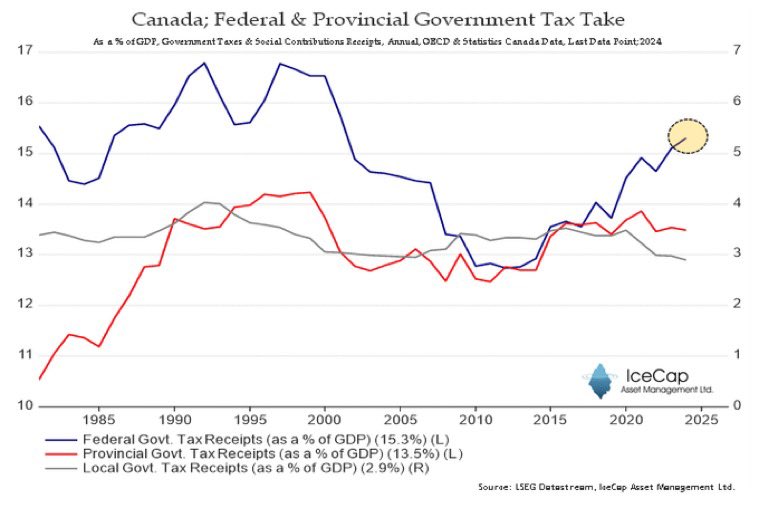

A day later, after his post got significant attention on the social media site formerly known as Twitter, he posted this follow-up:
This angry post I wrote a day ago got 300,000 views.
Canadians are tired of the fake “major projects” PR by the same people who prevented those projects for a decade with their green taxes and prohibitions.
Announcing the release of 7 hostage projects is a joke. Some of these projects aren’t major and most aren’t new. None needed the govt to do anything but get out of the way from the beginning.
All the several hundred major projects still in purgatory need is for this govt to reverse their anti-job and anti-infrastructure tanker ban, industrial carbon tax, emissions cap, and electricity regs.
Oh — and also clarify by law that in Canada property rights are not overridden by leftist judges and UN wishful thinking.
Then get out of the way so a couple trillion dollars can flow in, major projects can get built and the govt revenue will flow to better public services — and to pay down that debt they just added $78bn to.
Comments Off on Canada’s major projects announcements are an economic “hostage release” program
November 17, 2025
The US Supreme Court considers whether Trump’s tariffs are legal
Thanks to the staggering incompetence (and/or deliberate provocation for domestic political advantage) of the Carney government’s dealings with President Donald Trump, the current case before the Supreme Court is of significant interest to those of us on the north side of the US-Canadian border. On his Substack, David Friedman discusses the issues before the court:
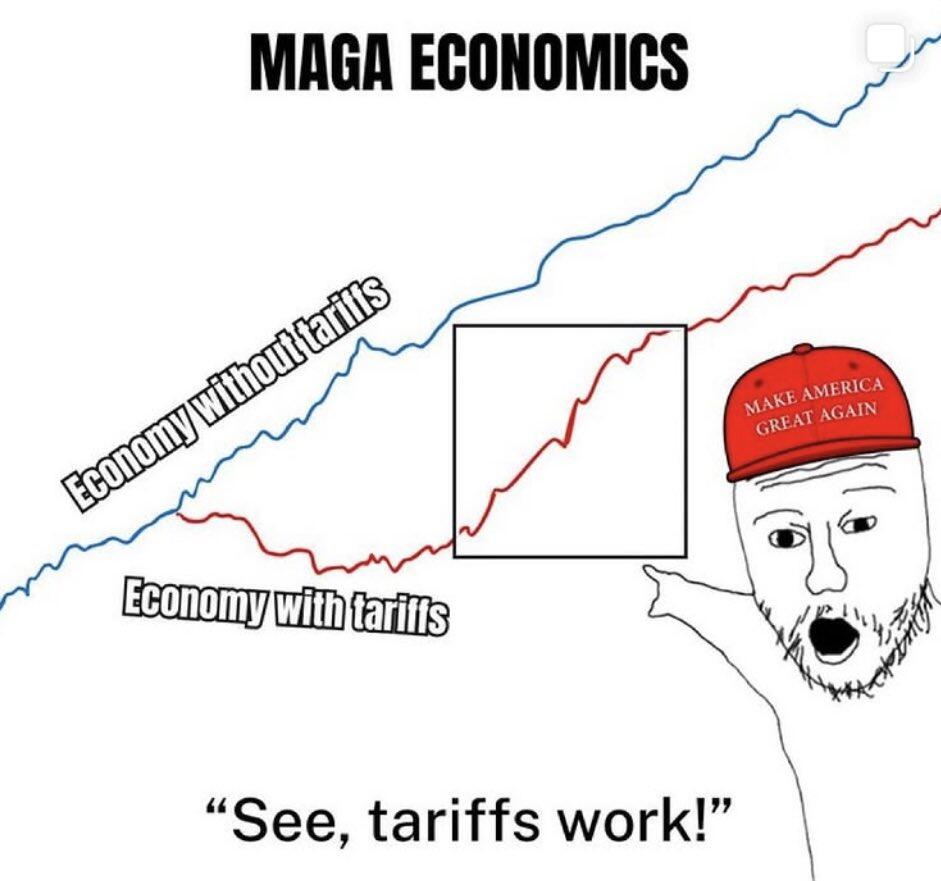
There are three things wrong with Trump’s tariffs. The first is that they cannot be expected to provide the benefits claimed, can be expected to make both the US and its trading partners poorer; the arguments offered for them depend on not understanding the economics of trade. For an explanation of why that is true, see an earlier post.
The fact that the tariffs make us poorer may be the most important thing wrong with them but it is irrelevant to the Supreme Court; nothing in the Constitution requires the president to do his job well. The questions relevant to the Court are whether what Trump is doing was authorized by past Congressional legislation and whether it was constitutional for Congress to authorize it.
What Counts As An Emergency?
Tariffs are under the authority of Congress, not the president.1 Trump’s justification for setting them himself is congressional legislation, the International Emergency Economic Powers Act.
(a) Any authority granted to the President by section 1702 of this title may be exercised to deal with any unusual and extraordinary threat, which has its source in whole or substantial part outside the United States, to the national security, foreign policy, or economy of the United States, if the President declares a national emergency with respect to such threat.
(b) The authorities granted to the President by section 1702 of this title may only be exercised to deal with an unusual and extraordinary threat with respect to which a national emergency has been declared for purposes of this chapter and may not be exercised for any other purpose. (IEEPA, 50 U.S. Code § 1701, emphasis mine)
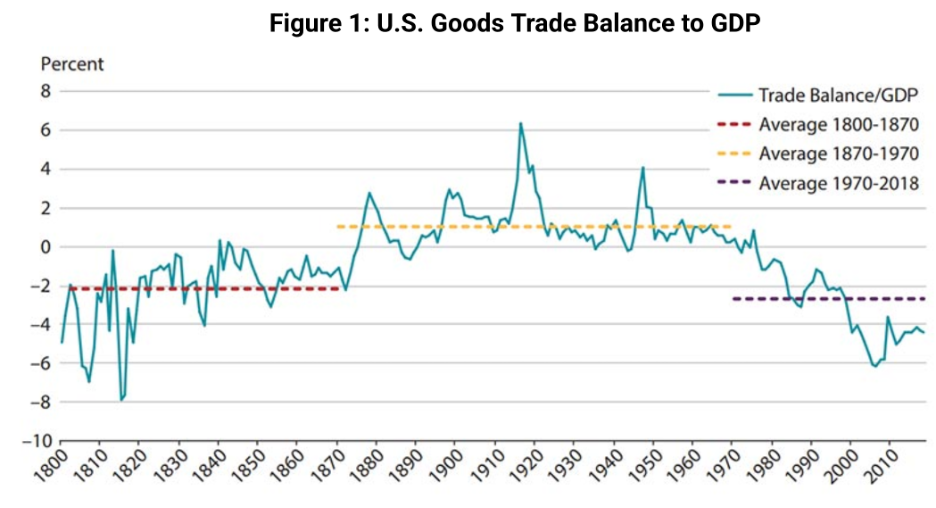
Trump declared that his Worldwide Reciprocal Tariffs were intended to deal with the US trade deficit.2 Whether the deficit is a threat and whether tariffs are a good way to deal with it are questions for economists3 but whether it is unusual is relevant to judges, since if it is not the IEEPA does not apply.
[…]
The Court on Trial
Delegating to the president the power to impose tariffs, a power explicitly given to Congress in the Constitution, is a major question. Under doctrine proclaimed by this court that means that the legislation claimed to delegate that power must be read narrowly. On a narrow reading, on anything but a very broad reading, the legislation fails to apply to President Trump’s tariffs for two independent reasons:
It only grants power in an emergency, which under the language of the Act neither the trade deficit nor the illegal drug problem is; the deficit has existed since 1970, the War on Drugs was proclaimed in 1971.
The powers granted to the president in the Act do not include the power to impose tariffs.
If the six conservative justices believe in the principles they claim, the administration will lose the case 9-0.
- The Congress shall have Power To lay and collect Taxes, Duties, Imposts and Excises … To regulate Commerce with foreign Nations … (U.S Constitution, Article I, Section 8).
- “I found that conditions reflected in large and persistent annual U.S. goods trade deficits constitute an unusual and extraordinary threat to the national security and economy of the United States that has its source in whole or substantial part outside the United States. I declared a national emergency with respect to that threat, and to deal with that threat, I imposed additional ad valorem duties that I deemed necessary and appropriate.” (Executive Order July 31, 2025).
- The answers are no and no.
Comments Off on The US Supreme Court considers whether Trump’s tariffs are legal
Yet another example of the Liberal focus on symptoms rather than underlying problems
The Liberals under both Justin Trudeau and Mark Carney have amply demonstrated that they care far more about appearances than achievements. The immigration crisis is merely the latest example of the government reaching for something that will look good on TV and in the newspapers rather than addressing the root cause of the problem:
Perhaps the most intractable policy disaster handed to Prime Minister Carney by the Trudeau government is the immigration file. The ugliest detail in that file is undoubtedly the astronomic increase in temporary residents (largely foreign workers, international students, and asylum seekers) – a population that expanded from 3.3% in 2018 to 7.5% in 2024. The Carney government’s solution is to limit the inflow of new temporary residents significantly, while at the same time giving permanent residency to many of the ones already on Canadian soil.

The base problem is far too many people entering the country, driving up demand for housing, overloading healthcare facilities, absorbing more and more government assistance at a time the government is running record deficits, and undercutting young Canadians for entry level jobs while youth unemployment is skyrocketing. But this “solution” will look like firm action as it will be presented by the tame media, so from the point of view of the government, it’s “mission accomplished”.
The Carney government’s first annual Immigration Levels Plan commits to “reducing Canada’s temporary population to less than 5% of the total population by the end of 2027”. To this end, Canada’s annual intake of new temporary residents will be cut from 673,650 in 2025 to 385,000 in 2026, and 370,000 in 2027 and 2028. This cut will hit international students the hardest, with annual new study permits cut in half from over 300,000 to 155,000 in 2026, and 150,000 in 2027 and 2028.
This major cut will ease the strain on Canada’s housing, healthcare, food banks, roads, and social services – a strain that is no longer denied by politicians, and is freely acknowledged across the political aisle. But, as is the case with many policies, the devil is the details. It turns out that one of the ways which the federal government intends to shrink the size of the temporary resident population is by making a large number of them permanent residents.
In the recently released 2025 Annual Report to Parliament on Immigration, Immigration Minister Lena Diab says the Carney government intends to “give priority for permanent residence to temporary residents already living and settled in Canada, further reducing the number of new arrivals”.
How many temporary residents will get permanent residency under this plan is unclear, but we can extrapolate from the data we have.
The Carney government’s Immigration Levels Plan sets the annual permanent resident rate at 380,000 for the next three years – or, a total of 1,140,000. The very last Immigration Levels Plan of the doomed Trudeau government – which committed to transitioning many temporary residents to permanent residency – predicted that temporary residents would account for “more than 40% of overall permanent resident admissions in 2025”.
If the Carney government is heralding the idea of transitioning more temporary residents as a way to slow down the catastrophic population growth Canada has experienced in recent years, we can safely assume that this proportion will be at least a little bit higher than the Trudeau government’s rate. A rate of 50%, say, would mean that 570,000 temporary residents will receive permanent residency over the next three years.
See, Canadians are telling the government that there are too many temporary immigrants, so by waving a magic wand and transforming the bulk of the temporary immigrants into permanent residents, the government can pretend they’ve solved the problem. And the sycophants, fluffers, and cheerleaders in the media will laud them to the skies for their brilliant solution.
Comments Off on Yet another example of the Liberal focus on symptoms rather than underlying problems
November 15, 2025
There’s not much room for men and boys in the “Female Future”
Janice Fiamengo responds to a recent discussion between former Fox News host Tucker Carlson and happiness coach Chris Williamson which was intended to be about men’s lives but “quickly becomes a conversation about what women want”:
Chris Williamson: “It’s very hard to try and put forward something that doesn’t sound like putting the brakes on women. And I don’t think that’s what either of us …”
Here is the problem in a nutshell. We must never say No to a woman, no matter the social atrophy and misery she and her sisters are causing. Carlson, in turn, gives the only permissible response: “Are women happier than they were?”
A conversation about men’s lives quickly becomes a conversation about what women want.
**
Men’s issues have long been the purview of a tiny group of outliers who gained traction in the early days of the internet and were popularized in Cassie Jaye’s The Red Pill.
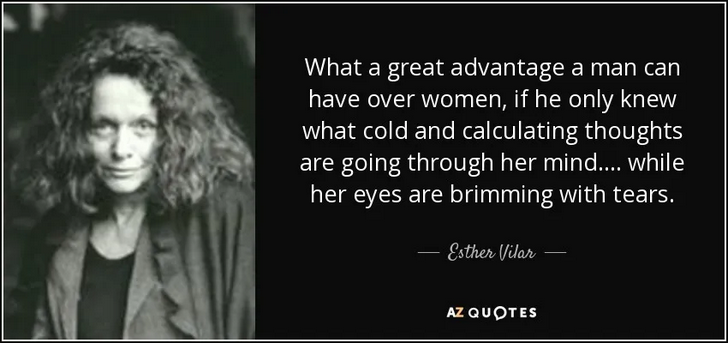
Following in the footsteps of iconoclasts like Ernest Belfort Bax (The Legal Subjection of Men, 1896), Esther Vilar (The Manipulated Man, 1971), and Warren Farrell (The Myth of Male Power, 1993), they questioned standard feminist wisdom, focusing on male disposability (see also here) and the empathy gap. For years, they were voices crying in the wilderness.
Now, decades into our Female Future, it’s becoming harder to ignore the suffering and plummeting fortunes of men and boys — and their knock-on social effects. But what happens when the red pill begins to go mainstream?
As the recent discussion between former Fox News host Tucker Carlson and happiness coach Chris Williamson makes clear, most hard truths get leached away, and we’re left with half-hearted calls for a compassion that the influencers themselves seem unable to maintain.
Spoiler Alert: “Chris Williamson’s Guide to Being Happy, and Debunking the Feminist Lies Sabotaging You” doesn’t debunk any feminist lies. Even the MeToo movement, which harmed or destroyed thousands of men’s lives through unproven accusations (some of them almost inconceivably ridiculous and trivial), is accepted as an attempt to “sanitize the toxic elements of male behavior”. Accusers’ falsehoods, ‘Poor-me-I’m-so-desirable’ showboating, manipulations, and blithe indifference to evidence are all passed over in feminist-compliant silence.
Sadly, the discussion is full of feminist lies.
**
Near the beginning of the discussion, Williamson expresses frustration that in order to acknowledge any of the troubles of men and boys in the modern world, it has become obligatory first to rehearse women and girls’ (always at least equal, if not greater) suffering. Unfortunately, Williamson is a prime example of such gynocentric genuflecting, visibly uncomfortable every time the conversation seems to be moving into non-feminist territory.
In order to talk about the drastic decline in men’s higher education attainment, for example, Williamson seems to think it necessary to point out that women were at some point in the past discouraged from getting university degrees. Both Williamson and Carlson refer to men’s diminishing earning power, but pivot immediately to stressing how hard this is on professional women looking for marriageable men.
The sexual revolution is alleged to have mainly benefited men who can now, with impunity, “use and abuse women”; nothing is said about women’s rampant OnlyFans activity or their exploitation of men in divorce.
It goes on and on like this: for every male suicide, divorce-raped father, falsely accused or incarcerated man, there must be at least one woman somewhere who felt at some point that she wasn’t encouraged to do something.
There is a small amount of criticism directed at women, but only when women act badly towards other women, as is the case, according to Carlson, with female bosses. But about female cruelty to men or children (over half of child maltreatment, for example, is female-perpetrated), we do not hear anything.
There is a good deal said about women as a civilizing force, how much women bring to family life, how women are better with social cues, how they are “unbullshittable.” Carlson even gushes about how kind women are to their hubbies: “They wash your underwear. They listen to you snore,” he rhapsodizes. For the considerable number of men who have rarely had a kind word from any woman or who have gone through a hellish marriage and/or divorce with a vindictive shrew, the adulation seems quite unhelpful.

Comments Off on There’s not much room for men and boys in the “Female Future”
November 14, 2025
“Conscription if necessary, but not necessarily conscription” 2 – Electric Boogaloo
 Canada has only had two brushes with military conscription — after voluntary enlistments couldn’t keep up with casualties in both the First and Second World Wars — and both caused severe resentment in Quebec. Canadian politicians have generally avoided any hint of anything that could be framed as “conscription” for fear of triggering yet another existential crisis between Quebec and the rest of the country. Prime Minister Mark Carney isn’t a typical Canadian politician, and does not seem to have any of the built-up scar tissue that most others do. This might make him prone to saying and doing things that seem quite ordinary to him, but trigger civil unrest … like forcing civil servants to become soldiers against their will.
I floated the notion that this might be Carney’s five-dimensional chess strategy to reduce the civil service without having to fire everyone, but it’s far more likely that he genuinely doesn’t understand Canadians and our shared history.
John Carter is … skeptical about the Laurentian Elite being capable of rebuilding the depleted Canadian Armed Forces, as it’s hard to conceal sixty years of open contempt long enough to fake some sincerity:
The Canadian Armed Forces – which refer to themselves as the CAF, pronounced exactly as it’s spelled – recently leaked its intention expand its reserves from the current, anemic 22,000 to 400,000 soldiers. At first I wondered if an extra 0 was added to that number as a typo, but the plan is to grow the Army reserve to 100,000 and the supplementary reserve (which I hadn’t even known existed, and is currently composed of retirees) from a few thousand to 300,000. Further leaked details are that the 300,000-strong supplementary reserve will be created by essentially drafting civilian Federal employees, training them in driving trucks, marksmanship, and drone flying, which really just sounds like the makings of an absolute clown show.
At the same time, Canada’s prime minister Mark Carney has committed to a considerable increase in the CAF’s budget – over $80 billion spread over the next five years, with 2025-26 spending rising to around $62B from the previous average of around $35B – with the goal of reaching the 2% of GDP level that NATO members are expected to (but in practice usually don’t) maintain. As part of this build-up, the CAF is hoping to reach its authorized strength of 71,500 uniformed personnel.
[…]
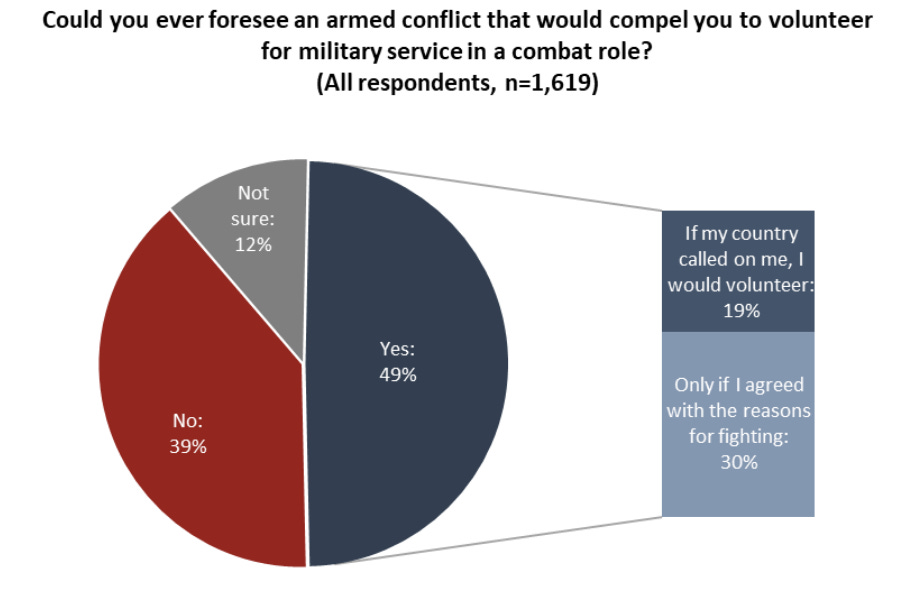
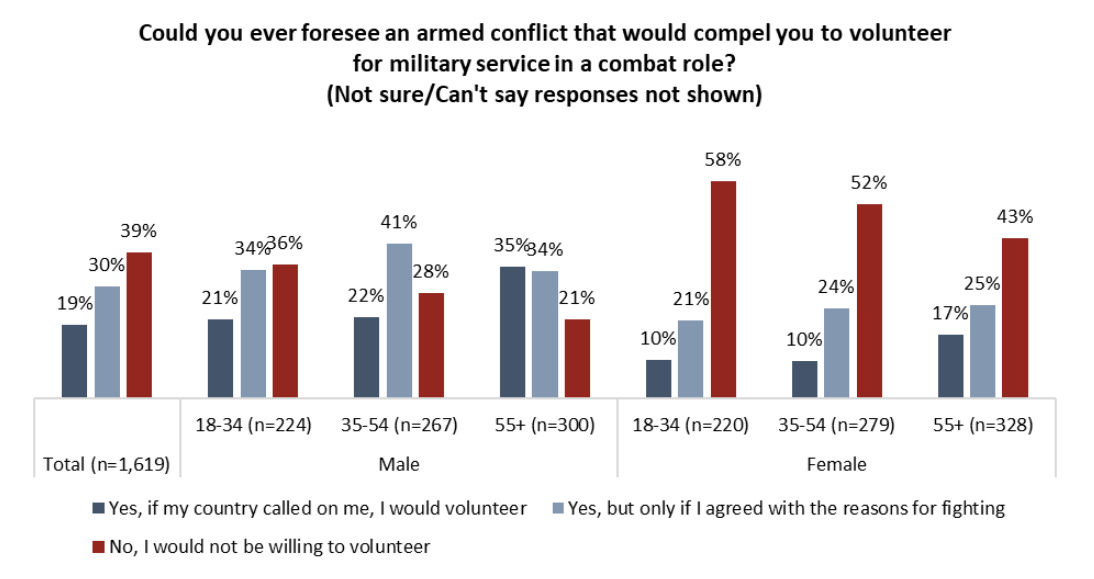
A recent Angus Reid poll indicates that there is very little enthusiasm for military service amongst Canada’s population. Only one in five Canadians would volunteer no matter the reason if their country called them, while 40% would refuse service under any circumstances.
Young men are even less likely to be potentially willing to unconditionally volunteer than old men, while being far more likely to refuse to volunteer under any circumstances (of course, women are almost universally aghast at the idea of serving). Contrast this to World War 2, when about 1/3 of fighting-aged men volunteered.
Governments that find it impossible to motivate their young men to volunteer for military service, but need their warm bodies in uniform anyhow, have historically resorted to conscription. Since they are manifestly not interested at the moment, the political class has begun floating trial balloons about mandatory military service in its media.
[…]
Just because conscription would be unpopular doesn’t mean that the government won’t reach for it, of course. More or less by definition, conscription has never been popular. It is, however, very far from ideal. Conscripts don’t tend to make the most enthusiastic troops. Their morale tends to be low, their enthusiasm non-existent, and their propensities to shirk their duties, avoid danger, surrender, and mutiny are all much higher than those of the committed volunteer.
[…]
The Canadian government has worked hard to systemically alienated the native population. Official state ideology is that Canada is a post-national multicultural state with no core identity built on stolen native land by genocidal settler-colonialists. As such, there’s nothing to defend. There’s no there, there: no identity to identify with, no boundaries of culture to justify the borders of political geography, no in-group to defend against an outgroup. No nationalism without a nation; no patriotism without patria.
Reinvigorating Canadians’ willingness to serve their country and rebuilding Canada’s military into a force that can win wars would both require the Canadian political class to repudiate the ideological territory of globalism, feminism, multiculturalism, mass immigration, and gender-bothering that they have made themselves synonymous with. However, they can’t reverse course without discrediting themselves, and so, they won’t. Fixing the recruitment crisis is therefore a coup-complete problem: it cannot be accomplished absent wholesale replacement of Ottawa’s political class. We only need to look south of the border for demonstration of this. Until 2025, the American military was suffering from precisely the same recruiting woes as afflict Canada and Great Britain, due entirely to a collapse in interest amongst America’s traditional warrior class: white rural Southern men.
The ascendant Trump replaced the shapeless blob Lloyd Austin as the Secretary of Defense with the young, energetic, crusader-tattooed Pete Hegseth as the Secretary of War (and that difference in terminology matters). Recruitment rebounded immediately, with the US Army alone exceeding its 2025 goals by 61,000, four months ahead of schedule. Including reserves, the US military as whole recruited about 325,000 new personnel in 2025, with each branch either hitting or exceeding its recruitment targets (which were also 10-20% higher than in 2024). Adjusting for population ratios, this would be the equivalent of the CAF recruiting 32,500 personnel in one year.
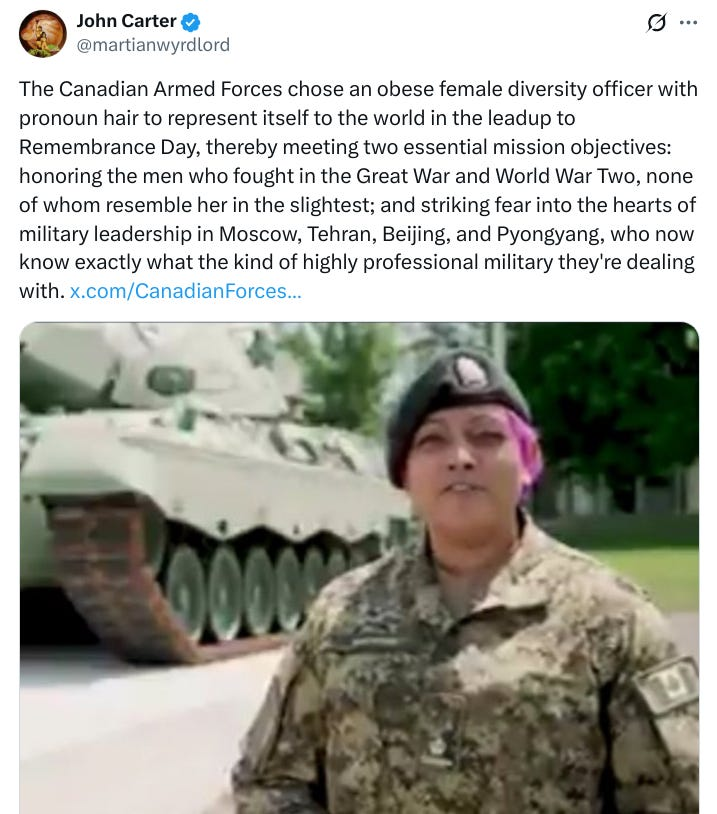
Of course, as we’ve noted here before, the CAF doesn’t have the same kind of recruiting problem that the American services faced (please pardon the self-quote here):
We’ve had surprising numbers of media folks paying attention to the crippling recruiting crisis, as even on current funding, the CAF is short thousand and thousands of soldiers, sailors, and aircrew. Sadly, but predictably, most of that media attention looks at the shortfall of new recruits being trained for those jobs, which is true but incomplete. The biggest problem on the intake side of the CAF is the bureaucratic inability to bring in new recruits in anything remotely like a timely fashion. The last time I saw annual numbers, the CAF had huge numbers of volunteers coming in the door at recruiting centres, but getting the paperwork done and getting those volunteers into uniform and on to job training was an ongoing disaster area. More than seventy thousand would-be recruits applied to join the CAF and the system managed to process less than five thousand of those applicants and get them started on their military careers.
At a time that we’re losing highly trained technicians in all branches to overwork, underpay, and vocational burn-out, we somehow lack the competence to take in more than one in twenty applicants? That is insane.
Comments Off on “Conscription if necessary, but not necessarily conscription” 2 – Electric Boogaloo
November 13, 2025
How the school environment encourages male disconnection and stokes extremism
On the social media site formerly known as Twitter, a parent describes the experience of visiting a local high school and observing just how politicized and progressivized most of the classrooms are (which also strongly implies that the instruction is part education, part indoctrination):

Wokal Distance @wokal_distance
Nov 11I despise the Groyper movement, but if you want to understand where Fuentes gets purchase with young men I will tell you how it happened by telling you about my experience at the orientation night when my son joined elementary school band:
My 11 year old son son joined the elementary school band, and so I went to the parents orientation night which was held at a local high-school. As the night went on it became obvious to me why young men rage against the larger social system.
The classrooms were inundated with DEI messages and trans pride flags. On the walls there were posters, stickers and various decorations that all invoked the various totems if diversity. Black lives matter messaging, decolonization messaging, LGBTQ+ messaging, and basically ever sort of race and gender social justice messaging you can imagine was present. The advertisements for post secondary opportunities featured social justice education prominently, including advertising a course on indigenous ways of knowing” as something grade 12 students should pursue upon graduation. Many of the teachers has “this is a safe space” sticker son their doors, and others had variations of “in this house” messaging on their doors or on the walls of the classroom.
The entire aesthetic which dominated the decoration of classrooms was the progressive leftist coded “in this house” and “be kind” aesthetic. As soon as you walked into a classroom there was no doubt as the the political leanings of whichever teacher occupied that classroom. The only way I can describe it is to say that progressive social justice activists have colonized the school and marked their territory.
A woman in a mask (who was in charge) got up and read a number of land acknowledgements before acknowledging the contribution of indigenous people to ways of knowing. Standard leftist land acknowledgement boilerplate. Additionally, every interaction was done in the style of HR style professionalism mixed with progressive leftist coded gentle parenting.
When it comes to how the teachers behaved I am going to draw on both that night and the other times I have been at my sons school in order to explain it. To begin, the boys are treated almost as though they are defective girls. The feminine modes of interaction and socialization are treated as though they are the only legitimate modes of interaction and serve as the taken for granted way to properly interact and navigate the world. Almost all the authority figures at my sons school are women with almost no exceptions. One day my son found out that the school had hired a single male education Assistant, and my son came home and told me, in wondrous amazement, that he saw a “boy teacher” at school. The level of wonderment and surprise he expressed was on par with what I would expect if he had walked into school and seen a triceratops walking the hallways.
My son often comes home from school and expresses utter frustration at the fact that his preferred way of communicating, as well as the things that are aligned with his temperament are treated as though they were somehow inferior. As he is 11 (and being assessed for autism) he lacks the correct technical language to describe this, so it generally shows up as him getting in trouble for being insufficiently “gentle” and “kind” in response to various passive aggressive power plays and instances of bullying carries out by his more socially developed (often) female peers.
To say that band night was feminine coded would be an understatement. It would be more accurate to say that feminized modes of behavior and communication were embedded in every single interaction. It was a totally alien environment for anyone who isn’t well versed in navigating the social codes of progressive leftist institutional spaces. It was like the slogan “the future is female” was taken to be a command delivered from God Himself turned into an education program.
Now, I want you to imagine what it is like for an 11 year old boy to be saturated in that environment day after day. he is an alien in his own school who is treated essentially like a ticking time bomb who needs to be effectively managed rather than engaged with an taught, and he knows this is happening. It is hard to overstate the level of hostility towards boys that is floating around in the ambient culture of the school system. It isn’t so much that there is an explicit form of anti-male bigotry (although examples of that exist) it is more that there is an overall attitude of distaste for anything masculine and an utter indifference towards the interests, fortunes, and inner lives of young boys. The expectations, norms, rules, and standards of behavior cater to the sensibilities of girls and women.
This is the entire social system that a young boy goes through from when he is 6 years old all the way until he is graduated from university.
It’s an old trope on the right to say “imagine if the roles were reversed,” but that would be to miss the point. I know that many on the left will say that all of this is perfectly acceptable because of historical injustices and the pursuit of Social Justice. What I want to point out to you is how absurd the world must appear through the eyes of the average 11 year-old boy. He is basically told he has a host of social advantages (white privilege, male privilege, straight privilege, etc) that he has never experienced and will never benefit from, and this justifies the system which he is immersed in. And the worst part is, if young men point any of this out, the very people who are doing it will look them in the eye with a straight face and deny that any of this ever happened. Making matters worse these men begin to figure out that the institutions have been used to advance a leftist political agenda that scapegoated their group (young white men), and when they point this out everyone in authority calls them evil bigots.
And all this happens during their formative years.
Now, Imagine you are a young white male.
You graduate from the school system and are released into the world only to find that the feminine modes of socialization pushed on you are entirely unfit for purpose. That the social skills you were taught fail utterly in both the job markets young men tend towards (construction, engineering, building, landscaping, etc) and have no purchase in the dating market where highly agentic, masculine, wealthy men have a huge advantage over the passive, docile “nice boy.” On top of that, imagine that a great deal of the job listings that you peruse make it clear that preference will be given to women and “diverse” candidates, and that the job interview itself is full of shibboleths, coded statements, and trap questions meant to elicit responses that allow the hiring party to exclude anyone who isn’t sufficiently versed in and aligned with the priorities of the DEI/Woke/Social Justice paradigm.
On top of that, that if a you do get a job you will exposed to various sensitivity trainings, DEI trainings, and intersectionality workshops in which your group (straight white men) are repeatedly scapegoated as the source of all the worlds pathologies. Laid at your feet are patriarchy, colonialism, racism, sexism and a great number of other social evils for which you are taken to be complicit in and have a responsibility for fixing in virtue of being a white male.
While all this is going on a series of scandals (COVID, Men in womens’ sports, trans kids, etc) reveal to you the degree to which the institutions that make up the society you live in have adopted an ideology that is actively hostile to you because you are a straight white male, and have been denying you opportunity while scapegoating you for all societies problems and treating you like you are a defective girl.
Once you understand this, the real question is not “why are some young men radicalizing?” the real question is “why are there any young men at all who have not been radicalized?”
None of this is to excuse any of the extremist radicals who are attempting to harness the resentment and anger of young men for their evil purposes. The point is to get you to understand why young men will attach themselves to any voice who is willing to stridently call for the obliteration of the social system and ideology which lied to them during their formative years and is currently doing things which rob them of opportunities for advancement and success.
The institutions have totally blown their credibility with young men, and have completely destroyed young men’s trust in institutions. Young men view the current set of social institutions as ideologically corrupt and totally illegitimate, and they view the narratives that emerge from those institutions as being expressions of as nothing more then a story told to legitimize an ideology which seeks to hold them back. As such, the institutions and their narratives have absolutely no normative pull on young Gen Z men.
I am not saying the situation is hopeless, but unless you acknowledge what I have laid out here, and engage in a good faith attempt to understand what the school system, Universities, non-profits, HR departments, and other civic institutions have done to young men, you will never be able to gain their trust enough to lead them away from guys like Nick Fuentes, Andrew Tate, Andrew Torba, and other pathological influences.
/fin
H/T to Sarah Hoyt at Instapundit for the link.
Comments Off on How the school environment encourages male disconnection and stokes extremism
Blue Hairster Cult: (Do Fear) The Zoomers
In the free-to-cheapskates portion of this post, Ed West explains why the Boomers and even the Millennials should fear the Zoomers:

“To understand the man, you have to know what was happening in the world when he was twenty”. I’ve thought about that quote, sometimes attributed to Napoleon, a fair bit recently. I suppose for my generation, 9/11 was the formative event, which signalled the end of the triumphalist Nineties — although the extent to which it affected us is questionable. Perhaps of far greater importance was the financial crisis which unfolded towards the very end of the Bush-Blair era.
What about those born around the turn of the millennium, the so-called “Zoomers”? I suppose it would be the experience of being locked down for a year in order to protect an older generation whose wealth they can never hope to emulate. An already bitter and disillusioned cohort, denied their patrimony by house price inflation, came to adulthood with a period of deliberate social isolation with only the internet at hand — a lockdown that was punctuated by weeks of millennial hysteria over racism.
The intelligent ones would have seen the hysteria for it was — a wild distortion, and realised that the media regularly distorts all sorts of things, and it’s the intelligent ones I worry about. Indeed, when I read the thoughts and worldview of that generation, I feel a sense of dread about what’s coming; perhaps even more so when it comes from the Right.
I only watched a Nick Fuentes video for the first time this summer, an amusingly edited version of a talk in which he rails against Israeli military success. It had been sent by a Jewish friend with strong Zionist sympathies, and it’s very funny — Fuentes is very funny. If I were 20 years old, I might have watched his show, one of many aspects of life in 2025 which I thank God wasn’t around in my adolescence.
After all, most of the things I watched on television – five channels, kids, in fact more like four and half, as the Channel 5 reception wasn’t very good – liked to poke fun at the prevailing morality of the older generation. My favourite comic, Viz, would laugh at the old people whose fault it was that Eddie Murphy’s swearing had to be dubbed over with “freak you, monkeyfeather”. Today it’s only natural that young men should wish to offend woke scolds.
But then, of course, something darker might also be happening. Rod Dreher recalls a fascinating, and disturbing, account of his conversations with young Republican activists this week, writing that: “Not every DC Zoomercon who identifies with Fuentes agrees with everything he says, or the way he says it. What they like most of all is his rage, and willingness to violate taboos. I asked one astute Zoomer what the Groypers actually wanted (meaning, what were their demands). He said, ‘They don’t have any. They just want to tear everything down’.”
There is certainly polling to suggest that younger voters in the US are moving to extremes, if you believe polls. One found that “explicit antisemitic attitudes are now much more common among young voters”, who are five times more likely to have an “unfavourable view of the Jewish people than 65 year olds”. Since 2018, the percentage of American boys who believe in gender equality has shrunk. Far more worrying is that younger Americans are also much more likely to support political violence. and this is more of a problem on the left.

Comments Off on Blue Hairster Cult: (Do Fear) The Zoomers


