
Another brilliant bit of realpolitik from Yes, Minister, disguised as humour:
January 14, 2017
January 12, 2017
QotD: Scientific feuds
To the outside world the sheer nastiness of scientific feuds often comes as something of a surprise; politics, by contrast, is a relatively polite affair.
Matt Ridley, Genome: The autobiography of a species in 23 chapters, 1999.
Comments Off on QotD: Scientific feuds
December 31, 2016
QotD: Political Correctness and “Big Gay”
Well, I can’t speak for the massed ranks of conservatives, but I’m not the least “apoplectic with rage at the idea of a boy in a dress”. In what passed for a talent show in my last year at high school, me and the lads climbed into the fishnets and mini-skirts to do a truly terrible pop song and, as I generally do even in unpromising circumstances, I gave it my best. Afterwards, the ladies in attendance agreed that my legs were better than any of theirs. And they’re still pretty good, as you can see if you pre-order the Mann vs Steyn 2016 nude calendar.
Nor do I think it fair to take refuge in the old saw that conservatives are “terrified of their own sexuality”. Mine doesn’t scare me in the least, although it’s sent a date or two screaming for the exits. What “terrified” me and others about Caitlyn and her débutante’s balls was the ruthlessly enforced celebratory tone. When the Queen marks her Diamond Jubilee or the Duchess of Cambridge has a baby, you’re allowed to roll your eyes and say “God, aren’t you sick of these bloody royal parasites?” or “Who cares about one more sponger in the palace?” Even “state” media like the BBC and CBC accept that there are a wide range of views on the head of state. But if you watched the coverage of Caitlyn on ABC, CBS, NBC, CNN et al you would have had no idea that there are people out there for whom this was not cause for joyous celebration. There was something not “terrifying” — not yet — but coercive and authoritarian in the uniformity of the mandatory jubilation. Even Fox News seemed to intuit that this was something that they had no choice but to cover in a life-affirming way.
I found that disturbing — because, at a stroke, everyone who matters from the Obamas to Hollywood seemed to have decided that this is one more area of discussion it’s safe to shut down, permanently. And there’s way too much of that. Look at it from your average imam’s point of view: Mike Huckabee is persona non grata because Big Gay didn’t like his dissing of Caitlyn, but when the Prophet Mo (PBUH) gets dissed Muslims are told tough, you gotta suck it up.
Mark Steyn, “The Moronization of the Republic”, SteynOnline, 2015-06-18.
Comments Off on QotD: Political Correctness and “Big Gay”
December 29, 2016
QotD: Not Homeschooled
Tell me that one about how my home schooled kids aren’t going to be socialized again. I love that one. It’s a hardy perennial. Love that shite. Tell me again about how screwed my kids are because they’re not pressing meaningless buttons 24/7 on an iSlab on their Jitter stream or their FriendFace page.Tell me about how they’ll never be popular enough to be bullied if I’m not careful. They won’t even be eligible to get whooping cough.
Tell me the one about how my kids won’t be able to go on field trips to the museum if they’re not enrolled in school. I love that one, too. It’s totes adorb. It’s my favorite, except for my other favorites, which are my favorite favorites. My children never get the opportunity to be chaperoned by someone on the sex offender registry. Of course that’s better than being left at the museum like the other kid in the same story. I think. Pretty sure. Maybe the kid they left behind actually looked at something on the wall in the museum after the batteries in his iBrick ran out. Hey, could happen.
I’m with you, though; I doubt it. We all know if a school-age child’s iBinky battery runs out of electricity, they immediately lie down on the floor and die.
“Not Homeschooled”, Sippican Cottage, 2015-06-15.
Comments Off on QotD: Not Homeschooled
December 24, 2016
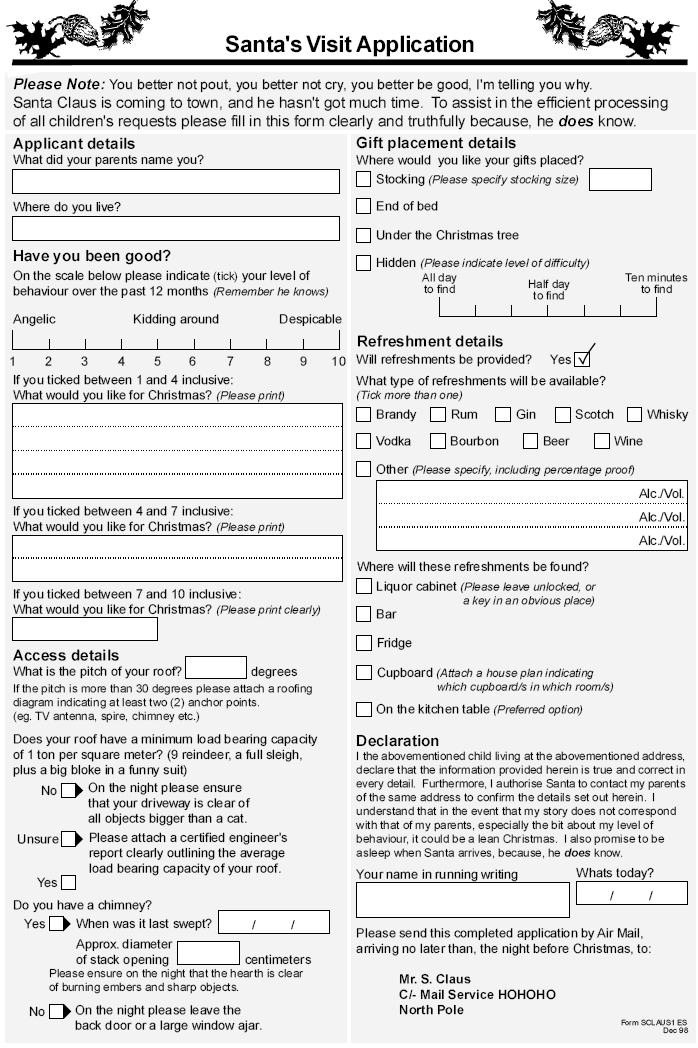
Repost – Hey Kids! Did you get your paperwork in on time?
If you hurry, you can just get your Santa’s Visit Application in before the deadline tonight!
Comments Off on Repost – Hey Kids! Did you get your paperwork in on time?
December 22, 2016
The Libertarian Holiday Gift Guide
Published on Dec 20, 2016
Don’t know what to get the libertarians on your holiday list? We’ve got you covered!
Comments Off on The Libertarian Holiday Gift Guide
A bit of Laundry Files fanfic
If you haven’t read any of the Laundry Files novels by Charles Stross, this fanfic won’t be of much interest. On the other hand, if you have, I think you’ll enjoy it.
The Howard/O’Brien Relate Counseling Session Transcripts – Part 1
cstrossSummary:
Bob and Mo obviously have some issues, and have made a date with a relationship counselor. But there are problems …
Comments Off on A bit of Laundry Files fanfic
Repost – ‘Tis the season to hate the senders of boastful holiday letters
Gregg Easterbrook receives the perfect, perfect holiday letter:
Don’t you hate boastful holidays letters about other people’s fascinating lives and perfect children? Below is one Nan and I received last week.
Dear Friends,
What a lucky break the CEO sent his personal jet to pick me up from Istanbul; there’s plenty of room, since I have the entire aircraft to myself, to take out the laptop and write our annual holiday letter. Just let me ask the attendant for a better vintage of champagne, and I’ll begin.
It’s been another utterly hectic year for Chad and I and our remarkable children, yet nurturing and horizon-expanding. It’s hard to know where the time goes. Well, a lot of it is spent in the car.
Rachel is in her senior year at Pinnacle-Upon-Hilltop Academy, and it seems just yesterday she was being pushed around in the stroller by our British nanny. Rachel placed first this fall in the state operatic arias competition. Chad was skeptical when I proposed hiring a live-in voice tutor on leave from the Lyric Opera, but it sure paid off! Rachel’s girls’ volleyball team lost in the semifinals owing to totally unfair officiating, but as I have told her, she must learn to overcome incredible hardship in life.
Now the Big Decision looms — whether to take the early admission offer from Harvard or spend a year at Julliard. Plus the whole back of her Mercedes is full of dance-company brochures as she tries to decide about the summer.
Nicholas is his same old self, juggling the karate lessons plus basketball, soccer, French horn, debate club, archeology field trips, poetry-writing classes and his volunteer work. He just got the Yondan belt, which usually requires nine years of training after the Shodan belt, but prodigies can do it faster, especially if (not that I really believe this!) they are reincarnated deities.
Modeling for Gap cuts into Nick’s schoolwork, but how could I deprive others of the chance to see him? His summer with Outward Bound in the Andes was a big thrill, especially when all the expert guides became disoriented and he had to lead the party out. But you probably read about that in the newspapers.
What can I say regarding our Emily? She’s just been reclassified as EVVSUG&T — “Extremely Very Very Super Ultra Gifted and Talented.” The preschool retained a full-time teacher solely for her, to keep her challenged. Educational institutions are not allowed to discriminate against the gifted anymore, not like when I was young.
Yesterday Rachel sold her first still-life. It was shown at one of the leading galleries without the age of the artist disclosed. The buyers were thrilled when they learned!
Then there was the arrival of our purebred owczarek nizinny puppy. He’s the little furry guy in the enclosed family holiday portrait by Annie Leibovitz. Because our family mission statement lists cultural diversity as a core value, we named him Mandela.
Chad continues to prosper and blossom. He works a few hours a day and spends the rest of the time supervising restoration of the house — National Trust for Historic Preservation rules are quite strict. Corporate denial consulting is a perfect career niche for Chad. Fortune 500 companies call him all the time. There’s a lot to deny, and Chad is good at it.
Me? Oh, I do this and that. I feel myself growing and flowering as a change agent. I yearn to empower the stakeholders. This year I was promoted to COO and invited to the White House twice, but honestly, beading in the evening means just as much to me. I was sorry I had to let Carmen go on the same day I brought home my $14.6 million bonus, but she had broken a Flora Danica platter and I caught her making a personal call.
Chad and I got away for a week for a celebration of my promotion. We rented this quaint five-star villa on the Corsican coast. Just to ourselves — we bought out all 40 rooms so it would be quiet and contemplative and we could ponder rising above materialism.
Our family looks to the New Year for rejuvenation and enrichment. Chad and I will be taking the children to Steamboat Springs over spring break, then in June I take the girls to Paris, Rome and Seville while Chad and Nicholas accompany Richard Gere to Tibet.
Then the kids are off to camps in Maine, and before we know it, we will be packing two cars to drive Rachel’s things to college. And of course I don’t count Davos or Sundance or all the routine excursions.
I hope your year has been as interesting as ours.
Love,
Jennifer, Chad, Rachel, Nicholas & Emily(The above is inspired by a satirical Christmas letter I did for The New Republic a decade ago. I figure it’s OK to recycle a joke once every 10 years.)
December 18, 2016
QotD: The new Whitney Museum in New York City
On a recent visit to New York City, I had the opportunity to walk around the exterior of the new Whitney Museum, built at a cost of $442 million. It is a monument of a kind: to the vanity, egotism, and aesthetic incompetence of celebrity architects such as Renzo Piano, and to the complete loss of judgment and taste of modern patrons.
If it were not a tragic lost opportunity (how often do architects have the chance to build an art gallery at such cost?), it would be comic. I asked the person with whom I was walking what he would think the building was for if he didn’t know. The façade — practically without windows — looked as if it could be the central torture chambers of the secret police, from which one half expects the screams of the tortured to emerge. Certainly, it was a façade for those with something to hide: perhaps appropriately so, given the state of so much modern art.
The building was a perfect place from which to commit suicide, with what looked like large diving boards emerging from the top of the building, leading straight to the ground far below. Looking up at them, one could almost hear in one’s mind’s ear the terrible sound of the bodies as they landed on the ground below. There were also some (for now) silvery industrial chimneys, leading presumably from the incinerators so necessary for the disposal of rubbishy art. The whole building lacked harmony, as if struck already by an earthquake and in a half-collapsed state; it’s a tribute to the imagination of the architect that something so expensive should be made to look so cheap. It is certain to be shabby within a decade.
Theodore Dalrymple, “A Monument to Tastelessness: The new Whitney Museum looks like a torture chamber”, City Journal, 2015-04-22.
Comments Off on QotD: The new Whitney Museum in New York City
December 14, 2016
QotD: Fill-in-the-blank OECD fun
When writing about the Organization for Economic Cooperation and Development, an international bureaucracy based in Paris, my life would be simpler if I created some sort of automatic fill-in-the-blanks system.
Something like this.
The OECD, subsidized by $____ million from American taxpayers, has just produced a new _________ that advocates more power for governments over the _________ sector of the economy.
But this may not be sufficiently descriptive.
So maybe I should create a multiple choice exercise. Sort of like when students take tests and get asked to circle the most appropriate answer.
The bureaucrats at the Paris-based OECD, working in cooperation with union bosses/class-warfare advocates/other tax-free international bureaucrats/politicians, have released a new report/study/paper urging more power/control/authority for governments in order to increase regulation/taxes/spending/redistribution/intervention.
You may think I’m trying to be funny, but this is totally serious.
How else would you describe a bureaucracy that consorts and cooperates with leftist groups like Occupy Wall Street and the AFL-CIO and routinely published propaganda in favor of Obama’s agenda on issues such as global warming, government-run healthcare, so-called stimulus, and class-warfare taxation.
And never forget that American taxpayers finance the biggest chunk of this bureaucracy’s budget.
Adding insult to injury, the bureaucrats at the OECD get tax-free salaries, which makes their relentless support for higher taxes on the rest of us even more obnoxious.
Dan Mitchell, “More Statist Propaganda from the Taxpayer-Funded OECD”, International Liberty, 2015-04-12.
Comments Off on QotD: Fill-in-the-blank OECD fun
December 11, 2016
QotD: Muzzling the comment section, for its own good
For some time now the trend du jour among many media outlets has been to ban news comments — then insult reader intelligence by proclaiming this is being done out of a deep-rooted love of “conversation” and “relationships.” You see, these websites aren’t banning comments because they’re too lazy or cheap to weed out spam and trolls, but because they love you. These sites aren’t outsourcing all human interactivity to Facebook because bean counters can’t monetize quality on-site discourse in a pie chart, they’re doing it because they care so very deeply about their community.
Why, oh, why can’t you people understand that giving the middle finger and a shiny new muzzle to your entire readership is an act of love?
Karl Bode, “The Globe And Mail Tries Something Revolutionary: Actually Giving A Damn About User Comments & Conversation”, Techdirt, 2016-11-30.
Comments Off on QotD: Muzzling the comment section, for its own good
December 7, 2016
NFL time is weird
Dave Rappoccio on the least likely event that just apparently happened in the NFL:
What I think is funny is an irony that I don’t think anyone else has picked up on yet. Andy Reid, a coach with quite possibly the worst reputation for time management on final drives, now effectively, in a way, holds the record for fastest game winning comeback drive in an NFL game.
It is. It’s the fastest. The only way a comeback can be faster is if the exact same thing happens but the guy runs to the endzone slightly faster. There is no way to score a faster comeback. Extra Points or conversion attempts do not take time off the clock. Effectively, the Falcons, despite scoring the go-ahead touchdown…were never actually ahead. When the clock started again, the Chiefs had the lead. The Falcons lead was maybe a minute of real time, but in game time sits in a weird vacuum between dimensions, never to be found. This is the fastest game winning drive in NFL history, and the man who owns it couldn’t call a timeout properly if his lunch date depended on it. Andy Reid, a man who is so baffled by clocks he’s still trying to understand how daylight savings works, owns this record. This might low-key be the most amazing thing that happens all year. Sometimes football can deliver in ways you’d never expect.
Comments Off on NFL time is weird
December 1, 2016
Rick Goes Medieval
Published on 30 Nov 2016
Rick joins the Society for Creative Anachronism in recreating life in the middle ages at the Feast of the Hare in Ottawa in the Kingdom of Ealdormere (Ontario).
Comments Off on Rick Goes Medieval
November 27, 2016
Jeremy Clarkson’s Life Revealed – Exclusive Documentary
Published on 25 Nov 2016
Subscribe for more great content, about the upcoming Grand Tour
Comments Off on Jeremy Clarkson’s Life Revealed – Exclusive Documentary


