
World War Two
Published 24 May 2025Indy and Sparty handle your questions on the German intervention in North Africa. Why did Rommel make such an impact so quickly? What was the war like for the local populations? How deeply involved was Rommel in the persecution of North African Jews?
(more…)
May 25, 2025
Rommel’s Dark Secrets in North Africa – WW2 Fireside Chat
Comments Off on Rommel’s Dark Secrets in North Africa – WW2 Fireside Chat
When NATO “stopped being an effective military alliance” and instead “became a kind of social club”
In UnHerd, Edward Luttwak says that Europe (however you might prefer to define it) needs a new Great Power:

All through European history, the intervals of peace, during which reconstruction and progress overcame the ravages of war, were secured by a temporary equilibrium between the Great Powers of the day.
It is obvious that there was no such equilibrium on 23 February 2022, when Russian columns started rolling towards Kyiv, and Russian President Vladimir Putin had just described Ukraine not merely as Russian, but as the homeland of the very first Russian state: Kievan Rus’.
[…]
But when the moment came, and Russian tanks rolled into Ukraine, there was no cohesive and determined power ready to respond quickly and effectively. Nato had done just that several times during the Cold War, by promptly reinforcing threatened allies with thousands of air-lifted troops from the so-called “Allied Command Europe Mobile Force”.
That, however, was the old, pre-enlargement Nato, which was still a veritable military alliance of countries capable of defending themselves, and help weaker allies in trouble, and whose chronically weak Mediterranean member states, with the most resplendent uniforms and least combat strength, had no Russian troops on their borders.
But once very deserving yet utterly indefensible countries such as Estonia were included in Nato — along with Poland, which mustered just 42,000 combat soldiers out of its population of 33 million a mere three months before Putin’s full-scale invasion began — it stopped being an effective military alliance.
Instead, it became a kind of social club. The Nato calendar is full of meetings at the “Supreme Allied Headquarters” in Mons in Belgium, where all manner of military and related issues are addressed often very professionally and quite freely — except that nobody is allowed to mention, however politely, even the most glaring military shortcomings of fellow allies, which undermine important war plans.
The highpoint of the Nato calendar is the splendid summits with all flags flying, in which the arrival of new countries is greatly celebrated, regardless of their ability to actually defend themselves. Both heads of state and heads of government are invited to those gatherings on the premise that there is strength in numbers, with no concerns about the inherent difficulty of reaching any agreements in such a vast crowd.
In the last summit, held in Washington DC in July 2024, Biden’s confusion of President Zelensky with Putin added a touch of humour to otherwise gloomy proceedings: nobody in attendance offered any suggestions on how to end the war in Ukraine.
What proves that Nato is no longer a genuine military alliance was that nothing was done in the last pre-war days before Putin’s invasion finally began. The satellite intelligence that revealed Russian forces on the move also showed that they were already in assault formations. But even then, five days remained to fly fighter-bomber squadrons to forward bases.
Yet even inaction would have been better than what actually happened. Instead of ordering the rapid deployment of tactical airpower to bases in Germany, Italy and the United Kingdom, the Biden administration instead evacuated US diplomats from Kyiv, starting a panic that induced the evacuation of some 20 other diplomatic missions.
Comments Off on When NATO “stopped being an effective military alliance” and instead “became a kind of social club”
BD-44: The New Semiauto Sturmgewehr from D-K Productions
Forgotten Weapons
Published 13 Jan 2025D-K Productions is a collaboration between the German company Sport System Dittrich (SSD) and an American partner. SSD has been making reproductions of German World War Two small arms for something like 20 years — including Sturmgewehrs. Their guns are really good recreations of the 1940s originals, but there have long been issues importing them into the US. This was solved at last by forming a US company and doing the receiver manufacturing here in the States. While the company has plans to offer a whole bunch of different models, the one currently available is the BD-44, a copy of the standard production model of MP-44/StG-44.
I was really impressed by the use of not-finish-machined forgings for parts like the stacking rod and gas block, correctly duplicating the original German production. The stampings look good, and the handling matches the original guns (don’t expect it to be AR-level ergonomic!). The gut “feel” of the gun is an excellent match for an original MP-44. The 8×33 chambering and use of original magazines (alongside new-production magazines made by D-K) is the correct choice, of course.
I did not like the mismatch between the magazine well and magazine stops, and I did have a couple malfunctions in the two magazines I ran through it so far. Note that the gun I have at the range is my second one; the first one (which is what you see on the table) had consistent feed problems and D-K replaced it when I sent it back to them.
Whether the gun is worth the steep asking price is a personal decision, naturally. Hopefully this video gives you the information necessary to make your decision if you were considering getting one!
(more…)
Comments Off on BD-44: The New Semiauto Sturmgewehr from D-K Productions
QotD: Cancellation of the Avro Arrow and destruction of the prototypes
On Friday, February 20, 1959, 14,000 employees were immediately fired and sent home, after a project they had been working on since 1953, was abruptly cancelled. That project was the military, supersonic, advanced interceptor, the Avro Arrow. The company they worked for, A.V. Roe Canada Limited, had come into being just after the war, with the express purpose of designing and building both commercial and military aircraft in Canada. Its subsidiaries included Avro, responsible for developing and building the platform and Orenda, for developing the engines.
The first project of this new company was the C-102 Jetliner, the first commercial inter-city jet to fly in North America in 1949, and the second [civilian] jet to fly in the world, behind the trans-oceanic British Comet. After being test flown successfully for three years and with potential orders pending, the Jetliner project was cancelled, allegedly in favour of committing all company resources to the development of the military sub-sonic CF-100. The Arrow was to be the successor to the latter, designed to intercept and destroy if need be, incoming supersonic bombers coming across the North Pole, from the then Soviet Union.
The Arrow was a sleek, twin engine, delta winged aircraft embodying many advanced features such as fly-by-wire controls, titanium and magnesium alloys for light weight and resistance to frictional heat, transistorized electronics and an advanced engine, the Iroquois. While some other aircraft may have included some of these advanced features, what made the Arrow unique was that all of them were built into this one singular aircraft.
Adding insult to injury, the five flying preproduction aircraft, including all technical documentation, tooling and jigs and fixtures and others in various stages of assembly, were ordered destroyed. Why was a project being hailed by aviation experts around the world, suddenly cancelled? In the absence of clear facts and in the presence of rumour and innuendo, debates have raged back and forth as to the reasons, sparking a series of myths and misconceptions about the entire affair.
In 1988, the late Canadian historian, Professor Desmond Morton, lamented the fact that he could not obtain any government archival documents on the Arrow, assuming they even existed. Out of interest, I decided to try my own hand in this endeavour. Since then I have uncovered and have had declassified thousands upon thousands of records including many Secret and Top Secret, ranging from memos, reports both scientific and financial, to minutes of meetings and letters. The list includes some from the United States and Great Britain as well.
Those documents which I deemed more critical, I have either quoted from or have reproduced in my books, with full references. Following is a discussion of some of the myths and misconceptions that the documents have helped clarify.
Arrow Destruction
Perhaps one of the most enduring myths is that the destruction of the completed Arrows and all else, was ordered by Prime Minister John Diefenbaker, due to his hatred of the President of A.V. Roe, Crawford Gordon. Alternatively, it has been argued that it was Gordon who had everything destroyed as a spite against the Prime Minister. Neither account is true.
The government records from the Department of National Defence clearly show the order to destroy came from the Minister of National Defence, George R. Pearkes, after receiving that recommendation from Hugh Campbell, Chief of the Air Staff, and after conferring with numerous others including the Deputy Minister of National Defence and the Minister of the Department of Defence Production. The documents contain the signatures of those involved, all of whom would later deny publicly having any knowledge of the destruction, leaving the Prime Minister to be subsequently vilified for it. In fact, the paper trail ends with Minister Pearkes. The matter was not discussed with the Prime Minister at all.
Even today, when the Department decides to dispose of something – it does not matter if it is an aircraft, a tank, a ship or some other equipment – there is no need to seek approval or even advise the Prime Minister as to the manner of its disposal. In fact, all departments dispose of their equipment through an arm of the government. At the time it was called Crown Assets Disposal, but today it is renamed GC Surplus. The name may change yet again.
Palmiro Campagna, “The Avro Arrow: Exploding the Myths and Misconceptions”, Dominion Review, 2025-02-20.
Comments Off on QotD: Cancellation of the Avro Arrow and destruction of the prototypes
May 24, 2025
History of Britain, II: Stonehenge; The Druids, Vates, and Celtic Religion
Thersites the Historian
Published 15 Jan 2025In this episode, I briefly examine the presence of prehistorical megaliths on the British Isles and talk about the religion of the Celts, which was ascendant at the time that Britain entered entered the historical record.
Comments Off on History of Britain, II: Stonehenge; The Druids, Vates, and Celtic Religion
QotD: Comparing living standards and technology between the Roman period and medieval western Europe
While I am convinced that the evidence suggests there was a drop in living standards and some loss of technology in the immediate aftermath of the collapse of the Roman Empire in the West, most of that drop was fairly short-lived. But exactly when development in medieval Europe meets and then exceeds the same for antiquity (typically we’re comparing the second century height of the Roman Empire) also depends on exactly what kind of measure is being used.
If the question, for instance, is agricultural productivity on a per capita basis (the most important component of per capita economic production), medieval Europe probably moves ahead of the Roman Empire fairly quickly with the introduction of better types of plow and widespread use of watermills for grinding grain. My understanding is that by c. 1000 AD, watermills show up fairly frequently in things like monastic charters, suggesting they were reasonably widespread (the Romans used watermills too, though their spread was uneven) and by that point, plow technology had also moved forward, mostly through the development of plow types better suited to Europe’s climate. So as best we can tell, the farmer of c. 1000 AD had better tools than his Roman predecessors and probably had such for some time.
If the question is technology and engineering, once again what you see depends on where you look. Some technologies don’t appear to have regressed much, if at all, ironworking being one example where it seems like little to nothing was lost. On the other hand, in western Europe, the retreat in architecture is really marked and it is hard to say when you would judge the new innovations (like flying buttresses) to have equaled some of the lost ones (like concrete); certainly the great 12th/13th century Cathedrals (e.g. Notre Dame, the Duomo di Sienna and I suppose the lesser Duomo di Firenze, if we must include it) seem to me to have matched or exceeded all but perhaps the biggest Roman architectural projects. Though we have to pause here because in many cases the issue was less architectural know-how (though that was a factor) as state capacity: the smaller and more fragmented states of the European Middle Ages didn’t have the resources the Roman Empire did.
If one instead looks for urbanization and population as the measure of development, the Middle Ages looks rather worse. First and Second century Rome is probably unmatched in Europe until the very late 1700s, early 1800s, when first London (c. 1800) and Paris (c. 1835) reach a million. So one looking for matches for the large cities and magnificent municipal infrastructure of the Romans will have rather a long wait. Overall population is much more favorable as a measurement to the Middle Ages. France probably exceeds its highest Roman population (c. 9m) by or shortly after 1000AD, Italy (c. 7.5m) by probably 1200; Spain is the odd one out, with Roman Hispania (est. 7.5m) probably only matched in the early modern period. So for most of the Middle Ages you are looking at a larger population, but also a more rural one. That’s not necessarily bad though; pre-modern cities were hazardous places due to sanitation and disease; such cities had a markedly higher mortality, for instance. On the flip-side, fewer, smaller cities means less economic specialization.
So one’s answer often depends very much on what one values most. For my own part, I’d say by 1000 or 1100 we can very safely say the “recovery” phase of the Middle Ages is clearly over (and I think you could make an argument for setting this point substantially earlier but not meaningfully later), though even this is somewhat deceptive because it implies that no new technological ground was being broken before then, which is not true. But the popular conception that the whole of the Middle Ages reflects a retreat from the standards of antiquity is to be discarded.
Bret Devereaux, “Referenda ad Senatum: August 6, 2021: Feelings at the Fall of the Republic, Ancient and Medieval Living Standards, and Zombies!”, A Collection of Unmitigated Pedantry, 2021-08-06.
Comments Off on QotD: Comparing living standards and technology between the Roman period and medieval western Europe
May 23, 2025
Yasukuni-jinja, Japan’s most controversial historical site
Nigel Biggar on the Yasukuni-jinja in the Imperial Gardens in Toyko, where the Japanese shrine to their war dead also celebrates fourteen convicted WW2 war criminals:
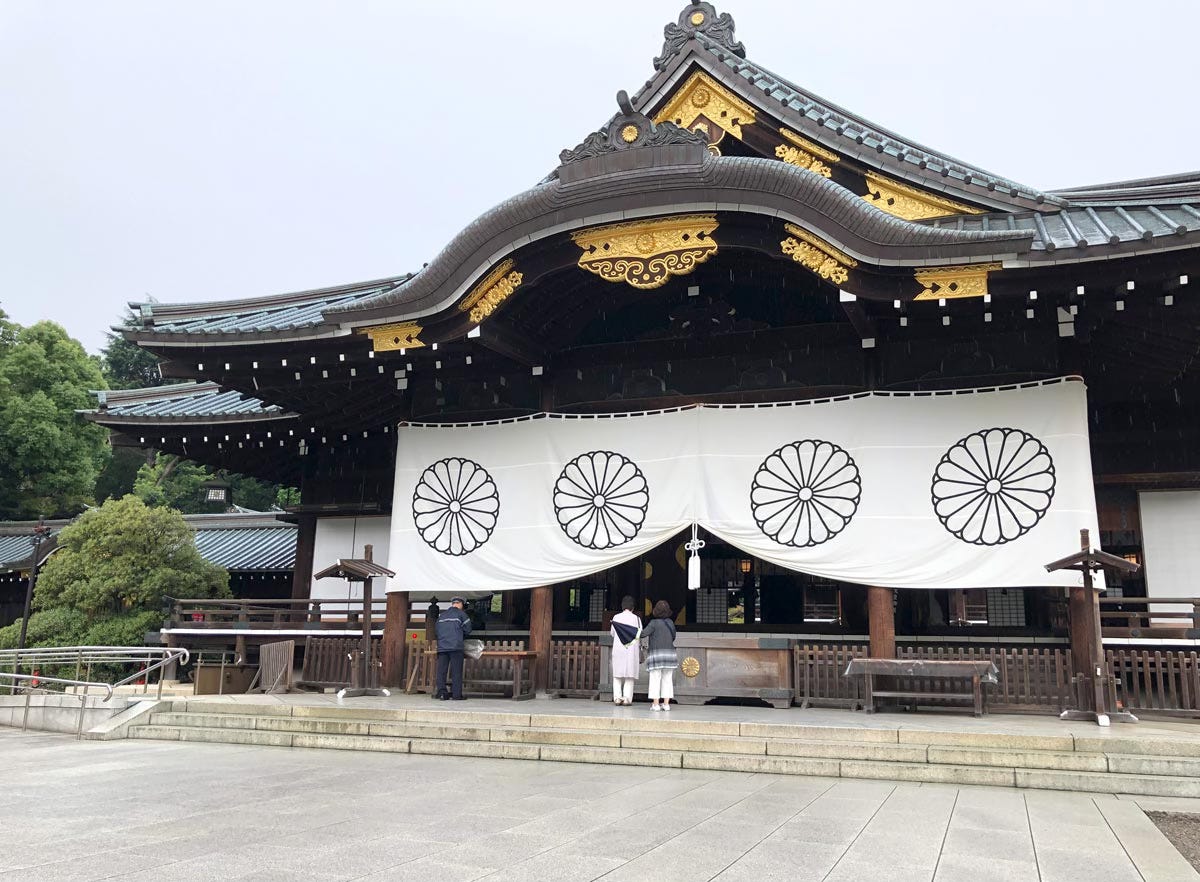
The Yasukuni Shrine in the Imperial Gardens, Tokyo.
Photo by Pierre Hazan
If ever you find yourself in the centre of Tokyo, make your way to the north-west corner of the Imperial Gardens, and turn left. A few minutes will bring you to the Yasukuni-jinja, Japan’s most controversial site. This is the national shrine to the war-dead, whose two and half million resident “glorious souls” include fourteen Class A war criminals.
A hundred yards to the right of the main shrine stands a museum, the Yushukan. Upon entering it, a visitor finds himself immediately face to face with a locomotive.
Now, when an Anglo-Saxon puts together Japan, Second World War, and locomotive, he arrives at one thing only: the “Burma Railway”. This is the railway that was hacked through the Burmese jungle partly by Allied prisoners-of-war, who were treated as slave labour and perished in their thousands. Over 12,000 Westerners died — about one in five — alongside perhaps 90,000 Asians.
So our Anglo-Saxon visitor beholds the locomotive with a mixture of disbelief, rising horror, and curiosity. He approaches the machine, looking for an explanatory text. Finding it, he learns that this locomotive is one of ninety that ran along the Burma Railway. He also learns the name of the military unit responsible for the railway’s construction. But of the Allied prisoners, the slave-labour, and the number of their deaths he learns nothing at all.
The Burma Railway wasn’t Auschwitz, either in genocidal intent or in murderous scale. But it was similar in its cruel contempt for human life. So the experience of confronting this Tokyo locomotive is analogous to stepping into a museum in Berlin and being confronted by one of the trains that shipped Jews to Auschwitz, and then reading an explanation that omits any mention of its cargo or the nature of its destination. If there were such a museum in Berlin, I’d have found it.
When our Anglo-Saxon ventures deeper into the Yushukan, he eventually discovers the exhibition on the 1930s and World War Two in the Far East. And here he learns that Japan’s imperial expansion was in fact a war of liberation, waged on behalf of subjugated Asian peoples, against Western colonial domination. And he learns that, even though Japan lost the war militarily, she won it politically, since the example of her early victories over the French in Vietnam, the Americans at Pearl Harbor, and the British at Singapore helped to inspire anti-colonial movements worldwide and so succeeded in ridding the world of European empires.
He also learns that what is known outside Japan as “the Rape of Nanking” (1937-8) is referred to demurely in the museum as “the Chinese incident”. And that whereas the “Rape of Nanking” is reckoned to have involved the indiscriminate massacre by Japanese troops of about 300,000 Chinese civilians, “the Chinese incident” only involved the severe treatment of Chinese troops who had violated the laws of war by disguising themselves in civilian clothes.
Comments Off on Yasukuni-jinja, Japan’s most controversial historical site
Did Germany Just Choose a King? – Rise of Hitler 17, May 1931
World War Two
Published 22 May 2025May 1931: 150,000 Stahlhelm men parade through Breslau before Crown Prince Wilhelm and other imperial relics, reviving monarchist hopes. Hitler hails his SA and calls for eastern expansion. But it’s economic collapse that dominates — Austria’s top bank nears default, threatening Germany’s own system. As Berlin pushes for a reparations pause and clings to its customs union with Vienna, France stands firm. And in Oldenburg, the Nazis take their first Landtag.
(more…)
Comments Off on Did Germany Just Choose a King? – Rise of Hitler 17, May 1931
May 22, 2025
Landstad 1900: A True Semiautomatic Revolver
Forgotten Weapons
Published 3 Jul 2024The Landstad Model 1900 is a magazine-fed, semiautomatic revolver designed by Norwegian Halvard Folkestad Landstad, who lived in Kristiana (now called Oslo). He designed the gun on his own dime, and presented it to military trials in 1901, which it failed miserably. The gun has a six-round detachable box magazine of 7.5mm Nagant cartridges, a two-chamber cylinder, and a simple blowback action. Its firing cycle is to chamber a round from the magazine into the bottom cylinder chamber by manually cycling the action. The trigger is a long double-action type which rotates the cylinder 180 degrees so the cartridge is in line with the barrel and releases the striker to fire the round. Upon firing, the bolt cycles open, extracting and ejecting the empty case, rechecking the striker, and chambering a new round from the magazine into the bottom of the cylinder.
The purpose of this overly complex system was to provide a semiauto action which did not ever leave a live cartridge under the striker, in the name of safety. Only one example was made, and its bolt broke after just 5 or 6 rounds fired. It was repaired almost immediately, but the Norwegian military had was not interested in further development, and nothing more came of the program. A few years later in 1908 Norway would institute a more serious semiauto pistol trials program which led to adoption of the Kongsberg 1914 (a slightly modified Colt 1911).
Thanks to Jan for allowing me to disassemble and film this one-of-a-kind piece for you!
(more…)
Comments Off on Landstad 1900: A True Semiautomatic Revolver
May 21, 2025
The Korean War Week 48 – Cut Off. Outnumbered. Doomed – May 20, 1951
The Korean War by Indy Neidell
Published 20 May 2025The Chinese Spring Offensive reignites, and it does so with a vengeance, kicking straight into high gear, and also totally surprising the UN forces by hitting them heavily much further east than they had ever expected — in the high Taebacks. Units find themselves, cut off, sandwiched, or broken … although a redeployment means that already by the end of the week, a UN counterattack is in the cards.
Chapters
00:00 Intro
00:50 Recap
01:28 The Offensive Begins
07:39 Van Fleet Reorganizes
11:03 ROK 3rd Corps Breaks
12:55 A Counteroffensive
14:13 The Joint Chiefs Speak
16:31 Summary
16:46 Conclusion
(more…)
Comments Off on The Korean War Week 48 – Cut Off. Outnumbered. Doomed – May 20, 1951
The Butt Report – Nadir of the RAF – The Bomber War Episode 3
HardThrasher
Published 15 Dec 2023As the powers that be on YT have decided that this video is Evil and naughty they’ve removed the ads — which, like, is great from your point of view but a bit shite from mine. So if you wanted to it’d be awesome if you’d consider either hitting the Super Thanks button or consider becoming a super cool kid and joining my Pateron.
If you’d like to email me send a message to lordhardthrasher@gmail.com
In this episode, the Butt Report, what happened next and the arrival of Bomber Harris. Despite this being more than 50 minutes, I’ve skipped some detail e.g. The Singleton Report which basically said “eh – bit difficult this bombing thing” nor Tizard’s rubbishing of Cherwell’s Memorandum, nor really the detail of the Cherwell Memorandum. You’ll live. However if you want more on the subject then I recommend the Official History of Bomber Command to get more into the civil service fire fights.
(more…)
Comments Off on The Butt Report – Nadir of the RAF – The Bomber War Episode 3
May 20, 2025
The Death of Marat
Daniel Jupp uses the famous Jacques-Louis David painting of the 1793 assassination of French revolutionary leader Jean-Paul Marat by Charlotte Corday to illuminate the twisted dealings of the various radical factions within the larger revolutionary movement:
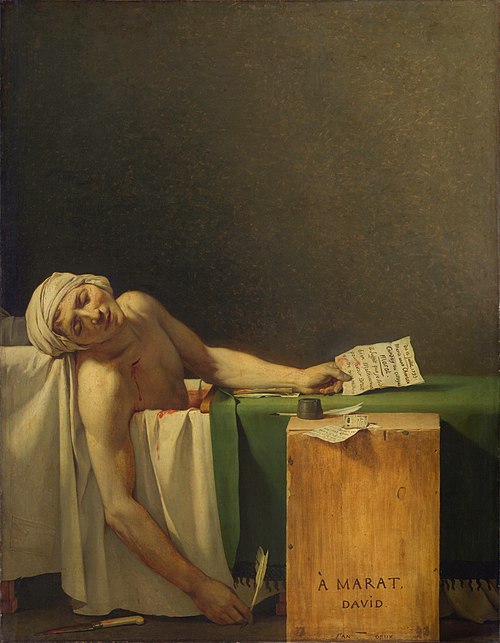
La Mort de Marat (The Death of Marat) by Jacques-Louis David (1748-1825)
From the Royal Museums of Fine Arts of Belgium via Wikimedia Commons.
One of the most famous and celebrated works of art in European history is a painting about a political assassination. That painting is The Death of Marat (La Mort de Marat in French) by Jacques-Louis David. It was painted in 1793. David was already one of the most respected French artists of the 18th century, a leader of French Neoclassical art. He was also himself a political figure, a prominent member of the Montagnard faction (itself a subset of the Jacobins) and a member of the revolutionary Committee of General Security.
It’s an overtly political painting in every way, created by a man who was as much a French Revolutionary politician as he was an established and esteemed artist. It’s about a shocking political event, and it was crafted as an exercise in propaganda. […] The painting shows us Marat in his bath, immediately after being assassinated by Charlotte Corday on the July 13, 1793. It is a beautifully composed image of political martyrdom. Marat’s posture, for anyone with the slightest awareness of Western art traditions, immediately shows where the sympathies of the artist lie (and also, where the sympathies of the artist lie).
Marat’s pose is, of course, a deliberate mirroring of the pose of Christ in hundreds if not thousands of Western art traditional depictions of the Crucifixion. The pale, slim but muscular figure, marked by the assassin’s blade but in a manner that might be compared to the puncture wound inflicted by the Spear of Longinus or to the stigmata nail wounds of crucifixion on Christ himself, has that peculiar serenity in death that other artists place in depictions of Jesus. The blood is present as proof of supreme sacrifice, but artistically minimised, prevented from distracting from the clean, shining, almost marble-like flesh of the deceased, who is already a kind of heroic statue in repose, fixed for the admiration of the ages. The dead man has a gentle, compassionate smile on his lips, as if interrupted in the process of forgiving his murderer. The angle, the gentleness, the delicacy of it all suggests Christ-like self sacrifice, as if Marat has chosen his death knowingly, given his life willingly.
Here is the martyr of the Revolution. A new Christ, as good as the old one … if not better.
[…]
It’s at this point that we should mention the central dishonesties here. Christian self sacrifice and martyrdom is a very different thing to one politically radical extremist being murdered by another. Marat was, in reality, about as far away from this movingly gentle depiction of him as one could imagine. As one of the most radical and zealous figures of the Revolution, Marat was a lesson for the ages in the exact opposite way to the one that David depicts. He wasn’t a gentle figure of self sacrifice. He wasn’t a Lamb bringing Peace in the manner of Christ. He wasn’t an innocent. He was a brutal, grasping, rapacious sadist. He was one of the leaders of the storming of the Bastille, and that too has symbolic and practical importance – the terrible monarchical regime had hardly anyone in its most hated prison, whereas the Revolutionary “liberators” soon stuffed it full of their political enemies.
Even at a point where many murders were already being committed, Marat was noted as an unusually brutal proponent of Revolutionary excess. His assassin was from a rival, supplanted Jacobin faction, the Girondists. The Girondists too had supported the earliest uses of violence, riot and uprising within France, and were a “war party” who wanted to export the Revolution abroad and topple monarchical dynasties across Europe. These two factions did not really differ on whether you should murder your political enemies or not, but the Girondists were at times embarrassed by Montagnard violence when it was at its most indiscriminate. The Girondists tended to be the most intellectualised of the Revolutionaries. They were the writers of pamphlets and doctrines of great length and increasingly mind-numbing tediousness. Marat, although also a street-level gutter pamphleteer, was much more of a bloody handed man of action, more akin to a modern terrorist. But the two were aligned in the creation of the bloodshed, even if the Girondins wanted it to be more focused and controlled and ultimately directed outside France:
Temperament largely accounts for the dividing line between the parties. The Girondins were doctrinaires and theorists rather than men of action. They initially encouraged armed petitions, but then were dismayed when this led to the émeute (riot) of 20 June 1792. Jean-Marie Roland was typical of their spirit, turning the Ministry of the Exterior into a publishing office for tracts on civic virtues while riotous mobs were burning the châteaux unchecked in the provinces.
The split between the two factions came to a head as a fall out from the September Massacres of 1792. Marat, a leader of the peasant sans-culottes mobs, was personally engaged in the orgy of bloodshed. Girondist leaders were alarmed, already sensing that previously aligned Revolutionaries or widespread mob violence could turn on them. Typically, the Girondists took defensive measures that were mainly concentrated on written statements, declarations or on bureaucratic ministries, whereas the Montagnards gradually took control of revolutionary militias and the people who were prepared to actually decide, at the point of a sword or via the barrel of a musket, who got killed and when. Neither side could be described as moderates, but one side were more ruthlessly pragmatic, which is why it was the Girondists who ended up being put on the execution lists of the Terror.
At the time that Corday assassinated Marat, Girondists had already been ousted from positions of power and arrested. Marat, along with Danton and Robespierre, was one of their three most prominent denouncers and enemies. Corday stated that she had “killed one man so that 100,000 could be saved”. It’s clear that she had hoped her action would save her arrested Girondin allies and personal friends, but it had the opposite effect and sealed their subsequent trial and executions.
Comments Off on The Death of Marat
The Battle of Aquino
Canadian Tank Museum
Published 13 Jan 2025You may know about AQUINO Tank Weekend at our Museum, but what was the Battle of Aquino? When did it take place? What happened to the Ontario Regiment RCAC during that action?
Enjoy this short documentary with our Curator Sam Richardson as he gives you a detailed look at the situation in May 1944 during the Italian campaign of the Second World War. Learn more about the soldiers that took part, the battle that took place and why it remains important to our Regiment and our Museum.
(more…)
Comments Off on The Battle of Aquino
May 19, 2025
1949: What are those kids listening to? – W2W 29
TimeGhost History
Published 18 May 2025There seems to be an evolution, that may one day become a revolution, in popular music in the US. Songs with amplified electric guitars, wailing saxophones, and backbeat rhythms are being released more and more often, but it’s not just R&B or jump blues, this is a bit of a different style — a new style. And it’s spreading quickly thanks to a vinyl record revolution that’s also getting in gear. Looks like exciting times ahead for the youth of America, and maybe even the whole world.
(more…)
Comments Off on 1949: What are those kids listening to? – W2W 29
The Roman Empire and climate change
Sebastian Wang considers “what we all know” about the rise and fall of the Roman Empire in the light of more recent research (not all of it politically motivated) into climate change:
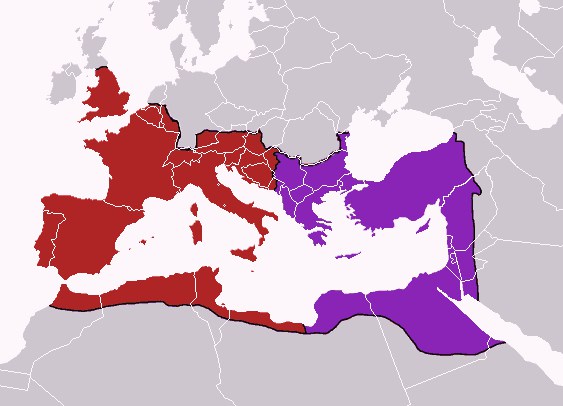
The approximate extent of the Roman empire circa 395AD.
Before we get into climate, and for those who tend to the wholly ignorant spectrum of my readers, we need a quick sketch of Roman history. The Empire officially began in 27 BC, when Octavian — better known as Augustus — became the first emperor. It ended in the west in AD 476, when the last western emperor was kicked out. As said, the eastern half, based in Constantinople, carried on for another thousand years.
Broadly, we can divide Roman history as follows:
- 27 BC – AD 180: The golden age. Augustus and his successors took over and further expanded a huge empire. There was peace (mostly), trade flourished, and cities grew. People call it the “Pax Romana“.
- AD 180 – 284: Everything starts to fall apart. This is called the Crisis of the Third Century. Civil wars, foreign invasions, plagues, and economic collapse all hit at once.
- AD 284 – 395: The empire pulls itself together. Emperors like Diocletian and Constantine bring in reforms. But the empire is now divided for administrative convenience — east and west.
- AD 395 – 476: The west goes under. It’s invaded. It’s conquered and broken up. Very quickly, it disappears. Though, once again, a parochial view of history, we call this the Fall of the Roman Empire.
The standard histories still blame bad rulers or too many wars. That’s fair enough. There were some very bad rulers, and the wars without number. But if you look at the climate data — tree rings, ice cores, sediment levels — you start to see another pattern underneath what may be called the political and economic superstructure of Roman history.
When Rome came to greatness, the climate was unusually good. From around 200 BC to AD 150, there was a long phase of stable, warm, and mostly wet conditions. Scientists call this the Roman Climate Optimum. In Egypt, the Nile flooded regularly and well. That meant lots of grain. In the Alps, glaciers shrank. In northern Europe, people were growing grapes in places too cold for vineyards today. In the Middle East, the Dead Sea stayed high, showing good rainfall.
This kind of weather made everything easier. Crops were reliable. Surpluses could be taxed. Cities could be fed. Roads and aqueducts could be built and maintained. And because the army was well supplied, the Empire was protected, and could even continue a modest expansion. But, as McCormick and his team point out, the high phase of Nile flooding correlates exactly with the high point of Roman prosperity — and once those floods became less predictable, problems followed.
The good times came to an end. By the mid-second century, a wave of volcanic eruptions thew great masses of dust into the atmosphere, blocking sunlight. Solar activity dropped. The climate became less stable. Then came the Antonine Plague in AD 166. It probably started in the east and spread quickly. Some think it was smallpox. Whatever it was in terms of microbiology, it was almost certainly brought on by changes in the climate. It may have killed a third of the Empire’s population.
Worse was coming. By AD 200, climate records show more erratic rainfall and cooling. In Gaul and the Balkans, harvests became less predictable. Glaciers began to advance again. Speleothem data from Austrian caves shows sharp shifts in rainfall patterns.
At the same time, the empire started to shake. Between 235 and 284, Rome had over twenty emperors. Most were generals who seized power, then got killed. Civil wars broke out. Trade declined. Foreign tribes pushed harder at the frontiers. Coin hoards — money buried for safety — increased in number. That’s usually a sign of fear and instability. Cities shrank. The economy shrivelled.
Was this all because of climate? No — not wholly. A good definition of historical crank is someone who tries to explain everything in terms of one cause or set of causes. But as McCormick et al. argue, bad weather made everything worse. It weakened agriculture, strained supplies, and made people more likely to panic or rebel. In a world without modern logistics, you couldn’t afford bad harvests two or three years in a row.
The empire buckled in the third century, but didn’t collapse. And its survival probably was an effect of human agency. A line of competent Emperors rose from the army and stabilised the frontiers. This line culminated in the reigns of Diocletian and Constantine, who restructured the Empire. They fixed taxes. They reorganised the army. Constantine built his new capital in the east. His successors found Constantinople safer and more strategically useful than Rome.
This being said, around AD 290, climate records suggest a small rebound. Warmer temperatures and better rainfall returned — especially in the east. That helped the eastern provinces recover faster. They had stronger governments and better infrastructure. But climate helped. Dead Sea levels remained relatively high, which meant steady rain in the Levant.
The west wasn’t so lucky. Italy and parts of Gaul stayed unstable. In Britain, pollen records show that farmland was being abandoned. The archaeology matches this, with fewer building projects and shrinking urban centres. The killing shock for the west came in the fifth century. In Central Asia, a long drought began around AD 370. Steppe tribes like the Huns were hit hard. They migrated west, pushing other tribes like the Goths ahead of them. In AD 376, the Goths crossed the Danube into Roman territory. Two years later, they crushed a Roman army at Adrianople. This all happened in the eastern half. But greater wealth and better leadership allowed the government in Constantinople to push the barbarians west. Over the next century, the western empire was hit again and again.
Meanwhile, the weather got worse. Europe cooled. Rainfall patterns shifted. Flooding and crop failures increased. Volcanic sulphur levels spike in the ice core record from Greenland.
Rome was sacked in AD 410. Again in 455. Finally, in 476, the last western emperor was deposed. That was it. The western Roman Empire was gone.
The east survived. But was hardly untroubled. In AD 536, a huge volcanic eruption darkened skies around the world. The sun barely shone. Crops failed. Famines spread.
A few years later, the Plague of Justinian broke out. It probably started in Egypt and spread through trade routes. Some say it killed half the population in affected areas.
Climate and disease worked together. Hunger weakened people. Infection finished them off. As McCormick et al. put it, the event of 536 and the plague that followed created one of the worst demographic shocks in recorded history.
Comments Off on The Roman Empire and climate change


