
Quotulatiousness

April 19, 2012

The Limits to Growth scorecard, 40 years on

Filed under: Books, Economics, Environment, Food, History, Media — Tags: , , , — Nicholas @ 08:00

Ronald Bailey tots up the hits and misses from that 1972 dystopia manual, The Limits to Growth:

Industrial development: World GDP stood in real 2010 dollars at about $19 trillion in 1972 and has tripled to $57 trillion today. Average per capita incomes rose in real dollars from $5,000 to $8,100 today. Just to explore how incomes might evolve between 1972 and 2000, the researchers simply extrapolated the current growth, investment, and population growth rates to calculate GDP per capita for 10 large countries. They stressed these were not “predictions” but added that if one disagreed then one was obligated to specify which factors changed, when and why. A comparison of their extrapolations with actual GDP per capita (in 2010 dollars) finds U.S. GDP per capita $56,000 versus actual $44,000; Japan’s per capita GDP was projected to be $120,000 versus actual $46,000; the now defunct USSR would be $33,000 versus Russia’s $2,200; and China’s per capita income was supposed to grow to $500, but was instead $1,200.

Population: The Limits researchers noted, “Unless there is a sharp rise in mortality, which mankind will strive mightily to avoid, we can look forward to a world population of around 7 billion persons in 30 more years.” In addition, they suggested that in 60 years there would be “four people in the world for everyone living today.” In fact, average global life expectancy rose from 60 to nearly 70 years. On the other hand, the global fertility rate (the average number of children a woman has during her lifetime) fell from about 6 per woman in 1970 to 2.8 today and continues to fall.

[. . .]

Food supplies: According to the data from the Food and Agriculture Organization, global food production has more than tripled since 1961, while world population has increased from 3 billion to 7 billion. This means that per capita food has increased by more than a third. The latest figures from the United Nations show that as world population increased by a bit over 10 percent between 2000 and 2009, global food production rose by 21 percent.

[. . .]

Nonrenewable resources: Probably the most notorious projections from the MIT computer model involved the future of nonrenewable resources. The researchers warned: “Given present resource consumption rates and the projected increase in these rates, the great majority of currently nonrenewable resources will be extremely expensive 100 years from now.” To emphasize the point they pointed out that “those resources with the shortest static reserve indices have already begun to increase.” For example, they noted that the price of mercury had increased 500 percent in the last 20 years and the price of lead was up 300 percent over the past 30 years. The advent of the “oil crises” of the 1970s lent some credibility to these projections.

To highlight how dire the situation with nonrenewable resources was, the MIT researchers calculated how quickly exponential consumption could deplete known reserves of various minerals and fossil fuels. Even if global consumption rates didn’t increase at all, the MIT modelers calculated 40 years ago that known world copper reserves would be entirely depleted in 36 years, lead in 26 years, mercury in 13 years, natural gas in 38 years, petroleum in 31 years, silver in 16 years, tin in 17 years, tungsten in 40 years, and zinc in 23 years. In other words, most of these nonrenewable resources would be entirely used up before the end of the 20th century.

[. . .]

Environment: In most of the Limits model runs, the ultimate factor that does humanity in is pollution. In their model pollution directly increases human death rates and also dramatically reduces food production. In fact, as the world economy has grown, global average life expectancy has increased from 52 years in 1960 to 70 years now. It must be acknowledged that globally, pollution from industrial and agricultural production continues to rise. But the model assumed that pollution would increase at exponential rates. However, many pollution trends have not increased exponentially in advanced countries.

Consider that since 1970, the U.S. economy has grown by 200 percent, yet the levels of air pollutants regulated by the federal government have fallen by nearly 60 percent. For example, in both the U.S. and the European Union sulfur dioxide emissions have dropped by nearly 70 percent since 1990. Recent data suggests that sulfur dioxide emissions even from rapidly industrializing China peaked in 2006 and have begun declining. Earlier studies cite evidence for a pollution turning point income threshold (purchasing power parity) of around $10,000 for demands to reduce this form of air pollution.
April 18, 2012

A guerilla war is fought in two primary theatres: in the field and in the media

Filed under: History, Media, Military, Politics, USA — Tags: , , , , , — Nicholas @ 08:57

A survey of US experiences in guerilla fighting over the years at Strategy Page:

After a decade of fighting Islamic terrorists the U.S. Department of Defense finally realized, at the most senior levels, that the nature of, and progress in this war was being poorly presented to the national leadership and the public. Actually, from the very beginning, there was a reluctance to reveal the masses of data collected and how it was analyzed. Partly this was to prevent the enemy from realizing how much information on terrorist operations it possessed. But another reason was the fact that such a large mass of data could be interpreted many different ways, some of them unfavorable to the United States. Thus there was no “body count” or any other type of measure released by the Department of Defense. Internally, there were various metrics (measurements) presented to senior military and political leadership. The big problem was the use of aggregation (combining a lot of data together that should not have been combined). That was a problem that slowly became obvious over the last decade.

It’s now recognized that the wars in Iraq and Afghanistan (and elsewhere, like Yemen, Somalia, North Africa and so on) were all somewhat different and that context for each of them was crucial if you were going to analyze them. For example; al Qaeda is more of an idea than a centralized organization. Thus the al Qaeda found in each country, or part of a country, usually has different means and motivations. The war in Iraq was actually several separate wars going on at the same time, and occasionally interacting with other “wars” nearby. Same thing in Afghanistan and places like Somalia. Measuring progress is more accurate if you show the unique trends in all the different wars. Some of them ended early, some escalated and some are still in progress while others evolve into new kinds of conflicts. In other words, the military should use contextual assessment in reporting what is going on with guerilla conflict (or “irregular warfare” in general.)

[. . .]

When the United States first got involved with Vietnam in the late 1950s, there was good reason to believe American assistance would lead to the defeat of the communist guerilla movement in South Vietnam. That was because the communists had not been doing so well with their guerilla wars. In the previous two decades, there had been twelve communist insurgencies, and 75 percent of them had been defeated. These included Greek Civil War (1944-1949), Spanish Republican Insurgency (1944-1952), Iranian Communist Uprising (1945-1946), Philippine Huk War (1946-1954), Madagascan Nationalist Revolt (1947-1949), Korean Partisan War (1948-1953), Sarawak/Sabah “Confrontation” (1960-1966), Malayan Emergency (1948-1960), Kenyan Mau-Mau Rebellion (1952-1955). The communists won in the Cuban Revolution (1956-1958), the First Indochina War (1945-1954) and the Chinese Civil War (1945-1949). The communists went on to lose the guerilla phase of the Second Indochina War (1959-1970). Guerillas make great copy for journalists. You know, the little guy, fighting against impossible odds. What we tend to forget (and the record is quite clear, and easily available), is that these insurgent movements almost always get stamped out. That does not make good copy, and the dismal details of those defeats rarely make it into the mass media, or the popular consciousness.

Summing up the career of Hunter S. Thompson, graphically

Filed under: Books, History, Media, USA — Tags: , , , , , — Nicholas @ 00:03

At BoingBoing, Mark Frauenfelder reviews Gonzo: A Graphic Biography of Hunter S. Thompson by Will Bingley and Anthony Hope-Smith:

180 pages isn’t much room to examine a life in minute detail. Instead, Bingley tells a story (as if it were written, quite convincingly, by Thompson himself) of Thompson’s frantic search to find meaning in the turbulent era he lived in. Bingley’s story is about a passionate, rebellious genius who sprinted too fast at the beginning of a long-distance race, collapsed early, and spent his remaining decades burnt-out, crawling bewilderedly.

The book’s forward, written by Thompson’s longtime editor, Alan Rinzler, is especially revealing. Rinzler believes that Thompson could have been the “heavyweight champion of American letters,” but his self-destructive behavior, which got worse with each passing year, ruined that opportunity.

[. . .]

After Lono, says Rinzler, “Hunter’s substance abuse, writer’s block and brief attention span were increasing exponentially. He’s slip out to see his dealer and come back so tanked he couldn’t think straight.” Thompson’s work became a series of “repetitious, mediocre, regurgitated articles and books and collections he allowed to be issued and reissued over the last 30 years of his life.”

The Curse of Lono was the last book by Thompson I read, but I don’t doubt Rinzler’s assessment of the quality of Thompson’s books that followed. (Thompson’s awful “Hey Rube!” columns for an ESPN website were enough to keep me uninterested in his newer books). But his earlier work, especially Hell’s Angels, is so good that I will always admire Thompson as a heavyweight contender who showed a very promising start.

I eagerly read much of Thompson’s early work (Fear and Loathing in Las Vegas, Fear and Loathing on the Campaign Trail, The Great Shark Hunt, Hell’s Angels, and The Curse of Lono) in the early-to-mid 80’s, but tapered off soon after that. Several years ago, I picked up a remaindered copy of Hey Rube: Blood Sport, the Bush Doctrine, and the Downward Spiral of Dumbness Modern History from the Sports Desk and it was the literary equivalent of Rome after too many Goth and Vandal sackings: you could still see some great bits and pieces, but everything else had been broken, burned, hacked, and slashed.

April 17, 2012

The US Navy’s next destroyer will be the USS Lyndon B. Johnson

Filed under: History, Military — Tags: , , , — Nicholas @ 10:00

I guess they’re happy they don’t have to use that particular name on an aircraft carrier:

Strike one against the U.S.S. Lyndon Johnson: the Gulf of Tonkin incident. A confusing episode off the Vietnamese coast on August 2, 1964 resulted in a brief maritime skirmish with the North Vietnamese. The destroyer U.S.S. Maddox got shot; one of its aircraft was damaged. It was unclear who fired first. (A claimed follow-on engagement two days later was ultimately determined to have been a fiction.) Johnson’s administration, seeking an excuse to escalate U.S. involvement in Vietnam, portrayed the incident to Congress as a clear-cut act of North Vietnamese aggression. A decade later, the futile Vietnam war had claimed 57,000 American lives.

Strike two: Lyndon Johnson’s Naval war record was similarly dubious. As Johnson’s magisterial biographer, Robert Caro, documented in Means of Ascent, Johnson’s Naval commission in World War II was the result of string-pulling. (Johnson was a sitting congressman at the time; he sought a commission to bolster his political career.) His military career consisted of a single combat flight over the Pacific for which he received a Silver Star. For the next two decades, Johnson repeatedly exaggerated his tall tale of defying a Japanese Zero.

Strike three: the U.S.S. Lyndon Johnson will be a Zumwalt-class destroyer — a class of ship singled out by good-government watchdogs as an unaffordable boondoggle.

April 14, 2012

John Moore thinks that Canada is stupid to consider Vimy Ridge a “defining moment”

Filed under: Cancon, Europe, France, Germany, History, Military, WW1 — Tags: , — Nicholas @ 11:27

Writing in the Pacifist Times National Post, John Moore expresses the opinion that Canada should derive its sense of national pride from “compassion, hard work and character” rather than remembering anything positive from the bravery and sacrifice of Canadian soldiers in the war against Imperial Germany:

The tropes are well known to Vimy devotes. Over four days in April in 1917, Canadian soldiers accomplished through planning, guts and guile what 150,000 dead French and British soldiers had failed to achieve: The capture of seven kilometres of land rising up to a ridge held by the Germans. It was the first time all four divisions of the Canadian Corps had fought together — 3,598 Canadians lay dead; 7,000 were wounded.

But is Vimy really the best of Canada? Does our modern identity and national purpose hinge on the harrowing slaughter of our citizens on a foreign field of mud in a pointless war?

Canada went to war in 1914 at the same moment that Britain did. Britain went to war because they had guaranteed the independence of Belgium, but Germany needed to violate that independence in order to push the massive right wing of their armies past the French frontier forces in an attempt to outflank and destroy the French army. If Canada entering the war was “pointless”, then we should never have taken part in World War 2 (which Moore paints as being “one of the most unambiguously moral wars in history” either.

If anything, modern Canada should reflect on Vimy and our total First World War sacrifice as a national tragedy. Sixty-thousand Canadian men died in a war in which we had no real casus belli and which was largely administered by damnable incompetents. A generation of teachers, milkmen, farm hands, labourers, students and artists died on the field of battle, so hollowing out the population that many of the women they left behind would never marry. One hundred and seventythree thousand returned home suffering from burns, chemical poisoning, amputations and traumatic stress disorder that would leave them depressed and spastic for the remainder of their lives.

So why, 95 years later, do we venerate Vimy? Perhaps because it’s far easier to stir emotions where military matters are concerned. You can’t erect a heroic statue to the civility for which Canada is renowned. Social justice has never been able to muster an inspiring flypast. The national understanding that in Canada we look after each other doesn’t have a solemn bugle call to draw a tear.

So Moore thinks that Canada is defined by social justice and civility? I guess that’s at least a bit better than the even more common notion on the left that Canada is defined only by socialized medicine.

April 13, 2012

Mapping 18th century shipping patterns

Filed under: Africa, Americas, Asia, Economics, Europe, History, Science — Tags: , , , , — Nicholas @ 09:06

An interesting post at the Guardian on tracing historical shipping patterns:


(Larger version at the original URL)

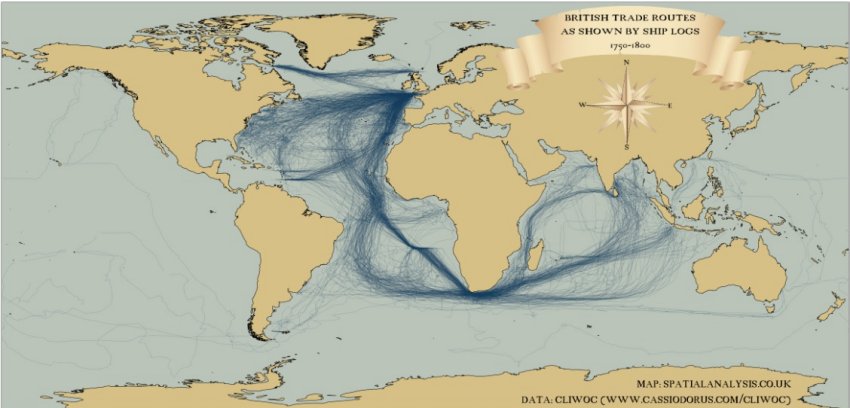
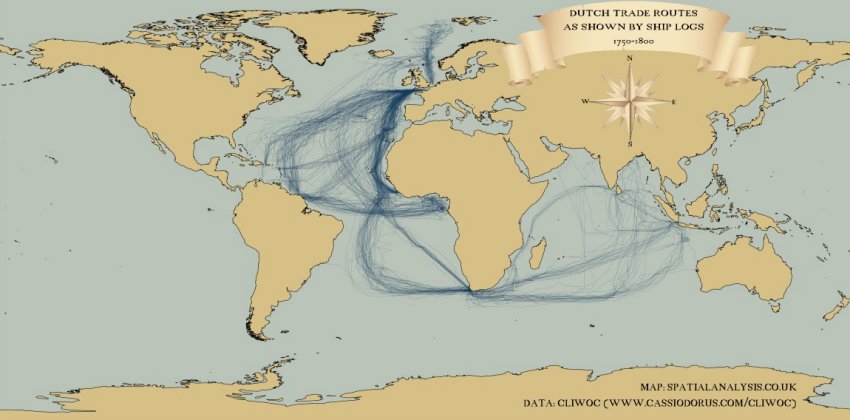
James Cheshire, of Spatial Analysis, has taken historical records of shipping routes between 1750 and 1800 and plotted them using modern mapping tools.

The first map, above, shows journeys made by British ships. Cross-Atlantic shipping lanes were among the busiest, but the number of vessels traveling to what was than called the East Indies — now India and South-East Asia — also stands out when compared to Dutch and Spanish records.

I was surprised to see how many trading voyages there were to and from the Hudson Strait — fur trade traffic, I assume.


(Larger version at the original URL)

This second map shows the same data for Dutch boats. The routes are closely matched to the British ones, although the number of journeys is noticeably smaller.

You can also see the scattering of journeys made by Dutch ships to Svalbard, off the North coast of the Norwegian mainland

“Brzezinski[‘s] … realpolitik approach … is actually refreshing in today’s age of flippant air-bombing humanitarianism”

Filed under: Books, Economics, Government, History, Military, USA — Tags: , , , , , — Nicholas @ 08:24

Sean Collins reviews a pair of books that — rather than signing on to the idea of America as terminal-phase western Roman Empire — perhaps go too far in the other direction. The books are The World America Made by Robert Kagan and Strategic Vision: America and the Crisis of Global Power by Zbigniew Brzezinski:

It is clear that the US faces a number of challenges, especially with regard to its stagnant economy and gridlocked politics. But more and more, the country’s specific problems are overshadowed by creeping fears of national decline. This backdrop of decline extends beyond domestic economics to contemplating whether America’s influence in the world is diminishing, in particular relative to emerging powers like China.

[. . .]

Brzezinski is not only old, he’s old-school, too. His realpolitik approach, which includes Cold War concepts like containment, is actually refreshing in today’s age of flippant air-bombing humanitarianism. For example, he quite baldly comes out and calls for the US to lead an effort to expand the West (via NATO and the EU) to include Russia and Turkey. This, he says, is necessary to prevent Russia from striking out on its own, or allying with China. Brzezinski is also still very mindful that great-power politics have not disappeared, and could re-emerge more forcefully. More than once, he speculates that Asia today resembles Europe before the twentieth-century world wars, and argues for care to ensure that a new conflagration does not break out.

The two authors’ respective approaches to American relations with China illuminate their differences in approach. Kagan is blunt, arguing for an antagonistic stance. He calls on the US to ‘press for greater democratic and liberal reforms’ in China (and in other authoritarian nations), and to promote free trade and markets, and thus ‘push back’ against state capitalism in China. In contrast, Brzezinski urges a diplomatic approach, one that attempts to reach mutual agreement while preventing China from becoming a too-dominant regional power. He is opposed to the Obama administration’s recent ‘Asia pivot’, which calls for more US troops in the region. In an interview with Edward Luce in the Financial Times, Brzezinski warned: ‘We have to focus on Asia, but not in a manner that plays on everyone’s anxieties… It becomes very easy to demonise China and they will demonise us in return. Is that what we want?’

[. . .]

This is illustrated by their treatments of the recent wars in Iraq and Afghanistan. On the surface, the two seem to take very different lines. Kagan was bullish at the outset of both wars and, consistent with his general style in the book, he quickly skates right past such awkward issues. Brzezinski, in contrast, is damning, highlighting how the wars have undermined America’s ability to project its power. But the fact is that neither author really spends much time thinking about them. This is telling: both prefer to speculate about the future rather than face up to the reality of recent foreign-policy moves. Oddly, neither author examines either President George W Bush’s record or President Obama’s record. When Brzezinski does address the Bush administration’s foreign policy, his analytics go out the window and he just sneers. We are left believing that the interventions in Iraq and Afghanistan were nothing more than purely subjective mistakes made by Bush and his vice-president, Dick Cheney.

April 11, 2012

QotD: The silly claims about “capitalism in crisis”

Filed under: Economics, History, Media, Quotations — Tags: , , , — Nicholas @ 00:08

Yes, times are tougher than they otherwise could be; however, to claim that the bumps in the road over the last few years show that “capitalism is in crisis” is absurd.

[. . .]

Even with the a few recessions, Real per-capita Gross Domestic Product is a lot higher than it was in 1960, 1970, 1980, 1990, or 2000. The truly unique fact about the world as it has changed in the last few centuries is that, as a number of economic historians have emphasized, we live in a world where economic growth is taken to be the norm. […]

Indeed, as the economist Joseph Schumpeter pointed out long ago, capitalism has given us the time and energy to criticize capitalism. People content themselves by being outraged at working conditions in Foxconn plants in China. However, it is the economic growth we have achieved in the western world that allows us the comfortable working conditions from which we express horror at working conditions elsewhere in the world. Further, not all the workers are greeting the reformers as saviors (HT: Doug Stuart). If people are willing to trade off longer working hours for higher incomes, I don’t see how it’s my right to stop them.

[. . .] Donald J. Boudreaux points out how we have to be very careful with income data if we are going to get an accurate picture of trends in standards of living.

If we’re going to talk about “stagnation” we also have to be very clear about precisely what we mean. Consider the near-ubiquity of the iconic gizmo of the early 21st century and its technological cousin: the smart phone and social media. My Forbes.com colleague Erik Kain reported in February that “472 million smartphones were sold worldwide in 2011.” In a world of 7 billion people, the top 1% would be 70 million people. If all the gains really went to them, that would be about six and a half smartphones each for the members of the world’s Top 1%. I’m pretty sure that isn’t what’s happening.

Art Carden, “It’s the Final Crisis of Capitalism, Charlie Brown!”, Forbes, 2012-04-10

April 10, 2012

In praise of Britain’s National Trust

Filed under: Architecture, Britain, History — Tags: — Nicholas @ 10:37

When we used to travel more frequently to the UK, we were members of the National Trust. It was a great investment for anyone interested in historic properties, and quite a bargain at the time. We let our membership lapse because we were no longer able to visit on a regular basis. Kelvin Browne discusses the great things the National Trust is doing and wonders why there’s no Canadian equivalent:

The Trust has lofty ambitions, but it’s not elitist: They know that without wide enthusiasm for the organization, it won’t survive.

Founded in 1895 to save Britain’s architectural heritage and open spaces, the organization’s initial purpose hasn’t changed much. In fact, many of its goals relate to today’s pressing issues, including stewardship of the environment and concern for the preservation of small communities.

The Trust protects and opens to the public more than 350 historic houses, gardens and ancient monuments. They also look after forests, woods, fens, beaches, farmland, downs, moorland, islands, archaeological remains, castles, nature reserves and villages “for ever, for everyone.”

Its operating model addresses many of our own concerns related to preserving pieces of Canadian history. However, unlike our system, Britain’s is completely independent of government. the Trust relies on income from membership fees, donations and legacies and revenue raised from its commercial ventures such as cafés, event rentals, the sale of produce from its gardens and farm properties and from leasing a number of its smaller properties to individual tenants.

In other words, no additional taxes are raised to save heritage properties and no meddling bureaucrats inefficiently telling the Brits about their history.

As he points out, the reasons for Canada not having a direct equivalent are two-fold: we are a far younger country and therefore have far fewer truly historical buildings, and we default to expecting the government to take care of preservation of what little we have.

The 7 rules of bureaucracy

Filed under: Bureaucracy, Economics, Government, History — Tags: , , , — Nicholas @ 08:27

A long post by Loyd S. Pettegrew and Carol A. Vance at the LvMI blog explains the seven rules (and many sub-rules) of modern bureaucracy:

In order to understand the foundation of America’s morass, we must examine bureaucracy. At the root of this growing evil is the very nature of bureaucracy, especially political bureaucracy. French economist Frédéric Bastiat offered an early warning in 1850 that laws, institutions, and acts — the stuff of political bureaucracy — produce economic effects that can be seen immediately, but that other, unforeseen effects happen much later. He claimed that bad economists look only at the immediate, seeable effects and ignore effects that come later, while good economists are able to look at the immediate effects and foresee effects, both good and bad, that come later.

Both the seen and the unseen have become a necessary condition of modern bureaucracy. Max Weber, considered the father of modern bureaucracy largely in response to the Industrial Revolution, is credited with formalizing the elements of bureaucracy as a fundamental principle of organization. He was also painfully aware of the arbitrariness of bureaucratic decision processes.

[. . .]

One of the truisms of bureaucracies, be they government or private sector, is that if left to their own devices, they will grow bigger, bolder, and less manageable over time. Teasley has seen this happen over and over again and put his considerable intellect to how its apparatus works. John Baden has offered us one of the most promising, yet ignored, solutions to the bureaucratic leviathan. Baden (1993) puts the problem at the feet of politicians concentrating benefits and dispersing costs and believes “predatory bureaucracies” would allow bureaucracies to feed on themselves with the most effective and efficient bureaucracy taking money and responsibility away from those that are less efficient and effective. While a provocative theory, the problem lies in the very rules that underpin bureaucracies. Despite the concept being nearly 20 years old, it has not been attempted, let alone enacted in any meaningful or widespread way.

[. . .]

Rule #1: Maintain the problem at all costs! The problem is the basis of power, perks, privileges, and security. [. . .]

Rule #2: Use crisis and perceived crisis to increase your power and control. [. . .]

Rule 2a: Force 11th-hour decisions, threaten the loss of options and opportunities, and limit the opposition’s opportunity to review and critique. [. . .]

Rule #3: If there are not enough crises, manufacture them, even from nature, where none exist.

Bureaucracies are always on the lookout for a new crisis. In his “Guiding Principles of Politicians, Bureaucrats, and Bureaucracies,” Harry Teasley points to three examples:

  1. The Gulf of Tonkin incident, where an alleged attack took place on two US naval destroyers by a North Vietnamese torpedo boat, allowing President Johnson to deploy conventional military forces to Vietnam without congressional approval.
  2. The attribution of weapons of mass destruction (WMDs) to Saddam Hussein permitted President George Bush to invade Iraq (again, without the need of congressional approval), after which no WMDs were found.
  3. Man-made global warming. The first two resulted in loss of life and a terrible toll of people maimed and injured. We are still in the throes of discovering the effects of the third crisis.

[. . .]

Rule #4: Control the flow and release of information while feigning openness. [. . .]

Rule 4a: Deny, delay, obfuscate, spin, and lie. [. . .]

Rule #5: Maximize public-relations exposure by creating a cover story that appeals to the universal need to help people. [. . .]

Rule #6: Create vested support groups by distributing concentrated benefits and/or entitlements to these special interests, while distributing the costs broadly to one’s political opponents. [. . .]

Rule #7: Demonize the truth tellers who have the temerity to say, “The emperor has no clothes.” [. . .]

Rule 7a: Accuse the truth teller of one’s own defects, deficiencies, crimes, and misdemeanors. [. . .]

April 9, 2012

The “bloodiest battle” in British history

Filed under: Britain, History — Tags: , , , , , — Nicholas @ 12:28

Although the total number of casualties would be exceeded in other wars the British fought, the Battle of Towton in 1461 was the bloodiest battle to take place in Britain:

The bloodiest battle ever fought on British soil was not Hastings in 1066, when King Harold died, nor Marston Moor in 1644, where the Whitecoats fought to the death against Cromwell’s Ironsides, nor Culloden a hundred years later, where “Butcher” Cumberland broke the Highland clans. It was the now all-but-forgotten Battle of Towton, fought on Palm Sunday 1461, between Lancastrians and Yorkists in one of their many clashes in the Wars of the Roses, to decide who should be king.

Forces totaling 75,000 men marched to Towton, reckoned at 10% of the total military-age manpower of England and Wales, and 28,000 of them died there. The figure is the result of a body count performed on the field by heralds and confirmed by several independent contemporary witnesses.

[. . .]

Even though far more of Henry’s Lancastrians than Yorkists fell at Towton, the battle was not even a decisive one: The Wars of the Roses rolled on for more than 20 years afterward. One reason for the clash’s harrowing violence was that civil war had turned into personal vendetta. The Yorkist leader, later King Edward IV, had lost his father and younger brother, dying in battle or murdered after it. Killing York senior and stirring the wrath of his son was a mistake, for the 18-year-old was 6-foot-4, a giant by medieval standards, and he had charisma that inspired followers.

His Lancastrian enemies were led by the Dukes of Somerset and Northumberland and Baron Clifford, all of whom also had fathers to avenge. After years of regional feuds and fighting, the gentry and even the yeomanry of England had scores to pay off as well. There was no taking for ransom, and no quarter given. That probably accounts for the determination with which both sides fought, confirmed by high losses suffered even by the winners. Twenty thousand Lancastrians died, probably at least half of them as they were remorselessly pursued in retreat, but 8,000 Yorkists fell too.

One of the reasons the battle is so little-remembered — aside from it not being decisive in spite of the carnage — is that it was shoved down the memory hole by the Tudors after that dynasty came to the throne:

Very few records of the battle survive, which is one reason that so little is known about it. Historians believe this could be due to an early propaganda campaign by the Tudors.

Author and historian George Goodwin, who this month publishes a new book: Fatal Colours: Towton, 1461 – England’s Most Brutal Battle, said: “The Tudors did a tremendously good propaganda job in making Bosworth the key battle because that was the battle which ended the Wars of the Roses. They were the winners and they got to write the history books. Because Towton was a Yorkist victory that wasn’t really very useful to them.”

April 4, 2012

The authoritarian High-Modernist recipe for failure

Filed under: Bureaucracy, Government, History, Liberty — Tags: , , , — Nicholas @ 08:37

Charles Stross linked to this older post at Ribbonfarm discussing “how to think like a state”:

James C. Scott’s fascinating and seminal book, Seeing Like a State: How Certain Schemes to Improve the Human Condition Have Failed, examines how, across dozens of domains, ranging from agriculture and forestry, to urban planning and census-taking, a very predictable failure pattern keeps recurring.

[. . .]

Scott calls the thinking style behind the failure mode “authoritarian high modernism,” but as we’ll see, the failure mode is not limited to the brief intellectual reign of high modernism (roughly, the first half of the twentieth century).

Here is the recipe:

  • Look at a complex and confusing reality, such as the social dynamics of an old city
  • Fail to understand all the subtleties of how the complex reality works
  • Attribute that failure to the irrationality of what you are looking at, rather than your own limitations
  • Come up with an idealized blank-slate vision of what that reality ought to look like
  • Argue that the relative simplicity and platonic orderliness of the vision represents rationality
  • Use authoritarian power to impose that vision, by demolishing the old reality if necessary
  • Watch your rational Utopia fail horribly

The big mistake in this pattern of failure is projecting your subjective lack of comprehension onto the object you are looking at, as “irrationality.” We make this mistake because we are tempted by a desire for legibility.

[. . .]

Central to Scott’s thesis is the idea of legibility. He explains how he stumbled across the idea while researching efforts by nation states to settle or “sedentarize” nomads, pastoralists, gypsies and other peoples living non-mainstream lives:

    The more I examined these efforts at sedentarization, the more I came to see them as a state’s attempt to make a society legible, to arrange the population in ways that simplified the classic state functions of taxation, conscription, and prevention of rebellion. Having begun to think in these terms, I began to see legibility as a central problem in statecraft. The pre-modern state was, in many crucial respects, particularly blind; it knew precious little about its subjects, their wealth, their landholdings and yields, their location, their very identity. It lacked anything like a detailed “map” of its terrain and its people.

The book is about the 2-3 century long process by which modern states reorganized the societies they governed, to make them more legible to the apparatus of governance. The state is not actually interested in the rich functional structure and complex behavior of the very organic entities that it governs (and indeed, is part of, rather than “above”). It merely views them as resources that must be organized in order to yield optimal returns according to a centralized, narrow, and strictly utilitarian logic.

It’s a long post, but it is well worth reading. In a couple of throwaway examples, it rather cleverly ties the Indian caste system (as made “legible” by the Raj) and the entire Roman empire to Scott’s failure model.

New study estimates US Civil War deaths were 20% higher than previously believed

Filed under: History, Military, USA — Tags: , — Nicholas @ 00:14

Guy Gugliotta summarizes the research of J. David Hacker on the actual death toll for both side during the American Civil War:

For 110 years, the numbers stood as gospel: 618,222 men died in the Civil War, 360,222 from the North and 258,000 from the South — by far the greatest toll of any war in American history.

But new research shows that the numbers were far too low.

By combing through newly digitized census data from the 19th century, J. David Hacker, a demographic historian from Binghamton University in New York, has recalculated the death toll and increased it by more than 20 percent — to 750,000.

[. . .]

The old figure dates back well over a century, the work of two Union Army veterans who were passionate amateur historians: William F. Fox and Thomas Leonard Livermore.

Fox, who had fought at Antietam, Chancellorsville and Gettysburg, knew well the horrors of the Civil War. He did his research the hard way, reading every muster list, battlefield report and pension record he could find.

April 2, 2012

30 years on, and the tension is rising again

Filed under: Americas, Britain, History, Military — Tags: , , — Nicholas @ 08:40

On this day in 1982, Argentina attempted to take the Falkland Islands in a surprise attack. The ruling Junta had hoped to use the invasion to rally popular support. After the islands were retaken, the Junta fell and democracy eventually returned to Argentina. In recent months, a democratically elected Argentinian government has been pushing for Britain to “negotiate” the future of the islands.

A total of 255 British servicemen and about 650 Argentines died after the UK sent a task force following the Argentine invasion on 2 April 1982.

The anniversary comes amid renewed tension, as Argentina has reasserted its claim to the archipelago.

UK Prime Minister David Cameron said the day should be used to remember both the British and Argentine dead.

In a statement, Mr Cameron also said that he remained committed to upholding British sovereignty over the islands.

[. . .]

Argentina’s President Cristina Fernandez de Kirchner is expected to visit the southern port of Ushuaia on Monday to remember the Argentine servicemen who died.

President Fernandez is due to lead rallies to commemorate the Argentine dead and to light an eternal flame devoted to their memory.

[. . .]

Argentina has complained about what it calls British “militarisation” in the south Atlantic.

BBC World affairs editor John Simpson said while a new armed conflict remained unlikely, Argentina was now using diplomatic weapons to push its claim over the Falklands.

The defeat of the Argentine forces led directly to the collapse of the military dictatorship led by Gen Leopoldo Galtieri, who was later jailed in Buenos Aires for “incompetence” during the war.

The British prime minister at the time was Margaret Thatcher, but she is not expected to play a part in the commemoration of the 30th anniversary because of ill-health.

March 31, 2012

Ross McKitrick: Earth Hour, a dissent

Filed under: Cancon, Economics, Environment, History — Tags: , — Nicholas @ 09:26

I don’t observe Earth Hour, and Ross McKitrick explains some of the reasons far more eloquently than I can:

In 2009 I was asked by a journalist for my thoughts on the importance of Earth Hour.

Here is my response.

I abhor Earth Hour. Abundant, cheap electricity has been the greatest source of human liberation in the 20th century. Every material social advance in the 20th century depended on the proliferation of inexpensive and reliable electricity.

Giving women the freedom to work outside the home depended on the availability of electrical appliances that free up time from domestic chores. Getting children out of menial labour and into schools depended on the same thing, as well as the ability to provide safe indoor lighting for reading.

Development and provision of modern health care without electricity is absolutely impossible. The expansion of our food supply, and the promotion of hygiene and nutrition, depended on being able to irrigate fields, cook and refrigerate foods, and have a steady indoor supply of hot water.

Many of the world’s poor suffer brutal environmental conditions in their own homes because of the necessity of cooking over indoor fires that burn twigs and dung. This causes local deforestation and the proliferation of smoke- and parasite-related lung diseases.

Anyone who wants to see local conditions improve in the third world should realize the importance of access to cheap electricity from fossil-fuel based power generating stations. After all, that’s how the west developed.

The whole mentality around Earth Hour demonizes electricity. I cannot do that, instead I celebrate it and all that it has provided for humanity.

Earth Hour celebrates ignorance, poverty and backwardness. By repudiating the greatest engine of liberation it becomes an hour devoted to anti-humanism. It encourages the sanctimonious gesture of turning off trivial appliances for a trivial amount of time, in deference to some ill-defined abstraction called “the Earth,” all the while hypocritically retaining the real benefits of continuous, reliable electricity.

People who see virtue in doing without electricity should shut off their fridge, stove, microwave, computer, water heater, lights, TV and all other appliances for a month, not an hour. And pop down to the cardiac unit at the hospital and shut the power off there too.

I don’t want to go back to nature. Travel to a zone hit by earthquakes, floods and hurricanes to see what it’s like to go back to nature. For humans, living in “nature” meant a short life span marked by violence, disease and ignorance. People who work for the end of poverty and relief from disease are fighting against nature. I hope they leave their lights on.

Here in Ontario, through the use of pollution control technology and advanced engineering, our air quality has dramatically improved since the 1960s, despite the expansion of industry and the power supply.

If, after all this, we are going to take the view that the remaining air emissions outweigh all the benefits of electricity, and that we ought to be shamed into sitting in darkness for an hour, like naughty children who have been caught doing something bad, then we are setting up unspoiled nature as an absolute, transcendent ideal that obliterates all other ethical and humane obligations.

No thanks.

I like visiting nature but I don’t want to live there, and I refuse to accept the idea that civilization with all its tradeoffs is something to be ashamed of.

Ross McKitrick
Professor of Economics
University of Guelph

« Newer PostsOlder Posts »

Powered by WordPress


